
Life, 1903-12-31 · page 12 of 21
Life — December 31, 1903 — page 12: what you’re looking at
What you’re looking at
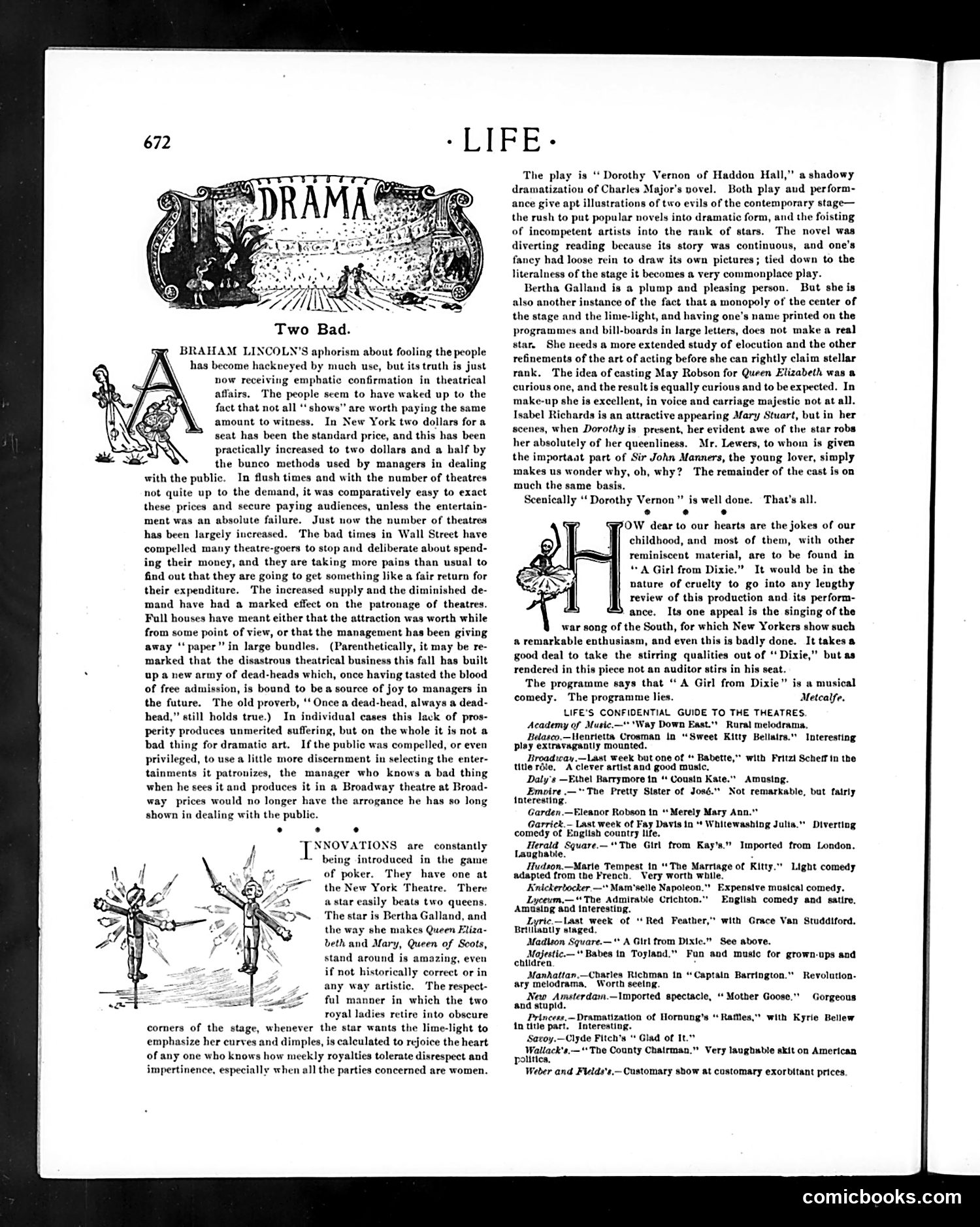
This page critiques theatrical productions and casting decisions of the era. The main text discusses "Dorothy Vernon of Haddon Hall," a dramatization of a Charles Major novel, criticizing how incompetent artists are being cast as stars through popular demand rather than merit. The cartoon labeled "Two Bad" (top left) appears to show two figures in theatrical poses, likely satirizing poorly-trained actors or bad performances. The page includes discussion of Bertha Galland and other actresses, noting casting problems—particularly criticizing May Robson's casting as "Queen Elizabeth" and Isabel Richards' acting abilities. The text argues that theatrical standards have declined due to economic pressures and increased ticket prices, forcing theatres to cast inadequately-trained performers to fill seats and satisfy audiences' demands for celebrity names over talent.
📄 Transcribed text from this page (OCR, searchable)
Machine-transcribed from the original scan — historical spelling and the odd misread are preserved.
» DEBE + BRAHAM LINCOLN’S aphorism about fooling the people has become hackneyed by much use, but its truth is just now receiving emphatic confirmation in theatrical affairs. The people seem to have waked up to the fact that not all “shows” are worth paying the same amount to witness. In New York two dollars for a seat has been the standard price, and this has been practically increased to two dollars and a half by the bunco methods used by managers in dealing with the public. In flush times and with the number of theatres not quite up to the demand, it was comparatively easy to exact these prices and secure paying audiences, unless the entertain- ment was an absolute failure. Just now the number of theatres has been largely increased. The bad times in Wall Street have compelled many theatre-goers to stop and deliberate about spend- ing their money, and they are taking more pains than usual to find out that they are going to get something like a fair return for their expenditure. The increased supply and the diminished de- mand have had a marked effect on the patronage of theatres. Fall houses have meant either that the attraction was worth while from some point of view, or that the management has been giving away ‘paper’ in large bundles. (Parenthetically, it may be re- marked that the disastrous theatrical business this fall has built up a new army of dead-heads which, once having tasted the blood of free admission, is bound to bea source of joy to managers in the future. The old proverb, ‘ Once a dead-head, always a dead- head,” still holds true.) In individual cases this lack of pros- perity produces unmerited suffering, but on the whole it is not a bad thing for dramatic art. If the public was compelled, or even privileged, to use a little more discernment in selecting the enter- tainments it patronizes, the manager who knows a bad thing when he sees it and produces it in a Broadway theatre at Broad- way prices would no longer have the arrogance he has so long shown in dealing with the public. . ‘TNNOVATIONS are constantly being introduced in the game of poker. They have one at the New York Theatre. There astar easily beats two queens. The star is Bertha Galland, and the way she makes Queen Eliza- beth and Mary, Queen of Scots, stand around is amazing, even if not historically correct or in any way artistic. The respect- ful manner in which the two royal ladies retire into obscure corners of the stage, whenever the star wants the lime-light to emphasize her curves and dimples, is calculated to rejoice the heart of any one who knows how meekly royalties tolerate disrespect and impertinence, especially when all the parties concerned are women. tS The play is ‘ Dorothy Vernon of Haddon Hall,” a shadowy dramatization of Charles Major's vovel. Both play aud perform- ance give apt illustrations of two evils of the contemporary stage— the rush to put popular novels into dramatic form, and the foisting of incompetent artists into the rank of stars. The novel was diverting reading because its story was continuous, and one’s fancy had loose rein to draw its own pictures; tied down to the literalness of the stage it becomes a very commonplace play. Bertha Galland is a plump and pleasing person. But she is also another instance of the fact that a monopoly of the center of the stage and the lime-light, and having one’s name printed on the programmes and bill-boards in large letters, does not make a real star. She needs a more extended study of elocution and the other refinements of the art of acting before she can rightly claim stellar rank. The idea of casting May Robson for Queen Elizabeth was @ curious one, and the result is equally curious and to be expected. In make-up she is excellent, in voice and carriage majestic not at all. Isabel Richards is an attractive appearing Mary Stuart, but in her scenes, when Dorothy is present, her evident awe of the star robs her absolutely of her queenliness. Mr. Lewers, to whom is given the importaat part of Sir John Manners, the young lover, simply makes us wonder why, oh, why? The remainder of the cast is on much the same basis. Scenically “Dorothy Vernon” is well done. That's all. e . . OW dear to our hearts are the jokes of our childhood, and most of them, with other reminiscent material, are to be found in “A Girl from Dixie.” It would be in the nature of cruelty to go into any leugthy review of this production and its perform- ance. Its one appeal is the singing of the war song of the South, for which New Yorkers show such a remarkable enthusiasm, and even this is badly done. It takes a good deal to take the ‘ring qualities out of ‘' Dixie,” but as rendered in this piece not an auditor stirs in his seat. ‘The programme says that “A Girl from Dixie” is a musical comedy. The programme lies. Metcalfe. LIFE'S CONFIDENTIAL GUIDE TO THE THEATRES. Academy of Music.—* ‘Way Down East." Rural melodrama, Beasco.—Henrietta Crosman in “Sweet Kitty Bellatra."" Interesting play extravagantly mounted. Broadvcay.—Last week but one of * Babette," with Fritz! Scheff in the title rdte, A clever artist and good music, Daly's Ethel Barrymore tn * Cousin Kate." Amusing. Empire .—* The Pretty Sister of José." Not remarkable, but fairly interesting. Garden—Eleanor Robson in “Merely Mary Ann.” Garrick.— Last week of Fay Davis in “ Whitewashing Julia.” Diverting comedy of English country life. Herald Square.— “The Girl from Kay's.” Imported from London. Laughable. Hudson.—Marte Tempest in “The Marriage of Kitty.” Light comedy adapted from the French. Very worth while. Knickerbocker. —* Mam’selle Napoleon.” Expensive musical comedy. Lyceum.—“The Admirabie Crichton." English comedy and satire, Amusing and Interesting. Lyrte.—Last week of “Red Feather," with Grace Van Studdiford. Brililantly staged, Madtson Square.—** A Girl from Dixie.” See above. Mojestic.—* Babes in Toyland.” Fun and music for grown-ups and children. . Manhattan.—Chaties Richman tn “Captain Barrington." Revolation- ‘ary melodrama, Worth seeing. New Amsterdan.—Imported spectacle, “ Mother Goose.” and stupid. Princess.—Dramatization of Hornung’s in title part. Interesting. Savoy.—Clyde Fitch's “ Glad of It. Wallack's.— “The County Chairman.” Very laughable skit on American politics, Weber and Fietds's— Customary show at costomary exorbitant prices. Gorgeous RamMes,” with Kyrie Bellew comicbooks.com