
Life, 1903-12-31 · page 6 of 21
Life — December 31, 1903 — page 6: what you’re looking at
What you’re looking at
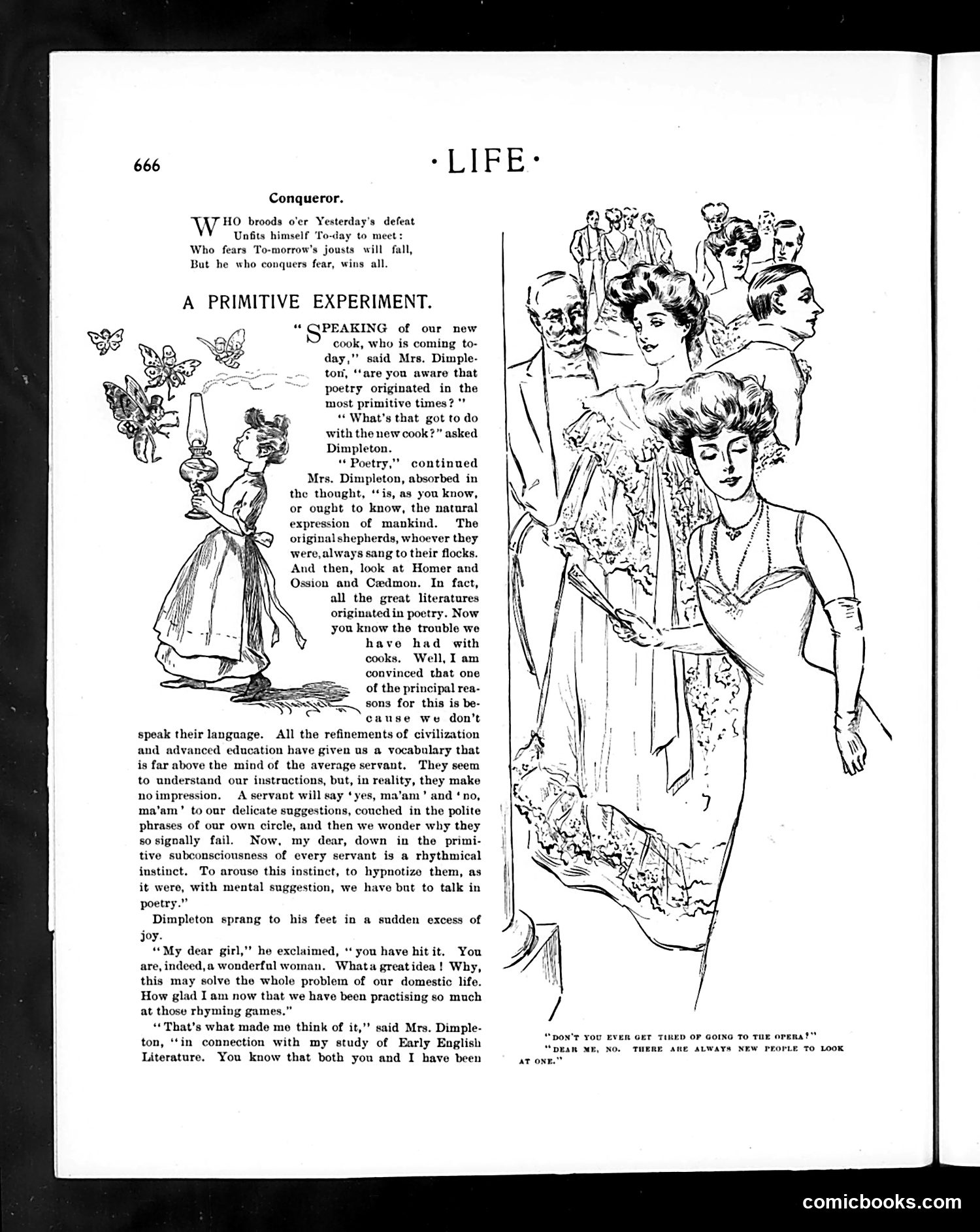
This satirical piece mocks pretentious intellectual arguments about domestic servants. Mr. Dimpleton argues that servants lack refinement because they don't understand "poetry"—claiming poetry originated in primitive times with shepherds, so speaking poetry to servants will somehow awaken their "rhythmical instinct." Mrs. Dimpleton finds this reasoning absurd, countering that both she and her husband have studied Early English Literature, implying his theory is pseudointellectual nonsense. The cartoon ridicules upper-class attempts to "improve" working-class people through condescending cultural lessons. The right illustration shows fashionable society figures, emphasizing the gap between the Dimpletons' pretensions and actual social reality. The satire targets both their pomposity and the era's class-based assumptions about refinement.
📄 Transcribed text from this page (OCR, searchable)
Machine-transcribed from the original scan — historical spelling and the odd misread are preserved.
Conqueror. V HO broods o'er Yesterday's defeat Unfits himself Who fears To-morrow’ diay to meet: jousts will fall, But he who conquers fear, wins all. A PRIMITIVE EXPERIMENT. “ QPEAKING of our new cook, who is coming to- day,” said Mrs. Dimple- ton, ‘are you aware that poetry originated in the most primitive times? "’ “What's that got to do with the new cook?” asked Dimpleton. “ Poetry,” continued Mrs. Dimpleton, absorbed in the thought, ‘is, as you know, or ought to know, the natural expression of mankind. The original shepherds, whoever they were, always sang to their flocks. And then, look at Homer and Ossion and Cwedmon. In fact, all the great literatures originated in poetry. Now you know the trouble we have had with cooks, Well, I am convinced that one of the principal rea- sons for this is be- cause we don't speak their language. All the refinements of civilization and advanced education have given us a vocabulary that is far above the mind of the average servant. They seem to understand our instructions, but, in reality, they make noimpression. A servant will say ‘yes, ma'am’ and ‘no, ma’am’ to our delicate suggestions, couched in the polite phrases of our own circle, and then we wonder why they so signally fail. Now, my dear, down in the primi- tive subconsciousness of every servant is a rhythmical instinct. To arouse this instinct, to hypnotize them, as it were, with mental suggestion, we have but to talk in poetry.” Dimpleton sprang to his feet in a sudden excess of joy. ““My dear girl,”’ he exclaimed, ‘ you have hit it. You are, indeed,a wonderfal woman. Whata greatidea ! Why, this may solve the whole problem of our domestic life. How glad I am now that we have been practising so much at those rhyming games.” “That's what made mo think of it,” said Mrs. Dimple- ton, ‘‘in connection with my study of Early English Literature. You know that both you and I have been “DON'T You EVER GET TIRED OP GOING To TuE oreRa?™ DEAR ME, NO. AT ONE.” THERE ANE ALWAYS NEW PEOPLE TO LOOK comicbooks.com