
Life, 1903-12-31 · page 15 of 21
Life — December 31, 1903 — page 15: what you’re looking at
What you’re looking at
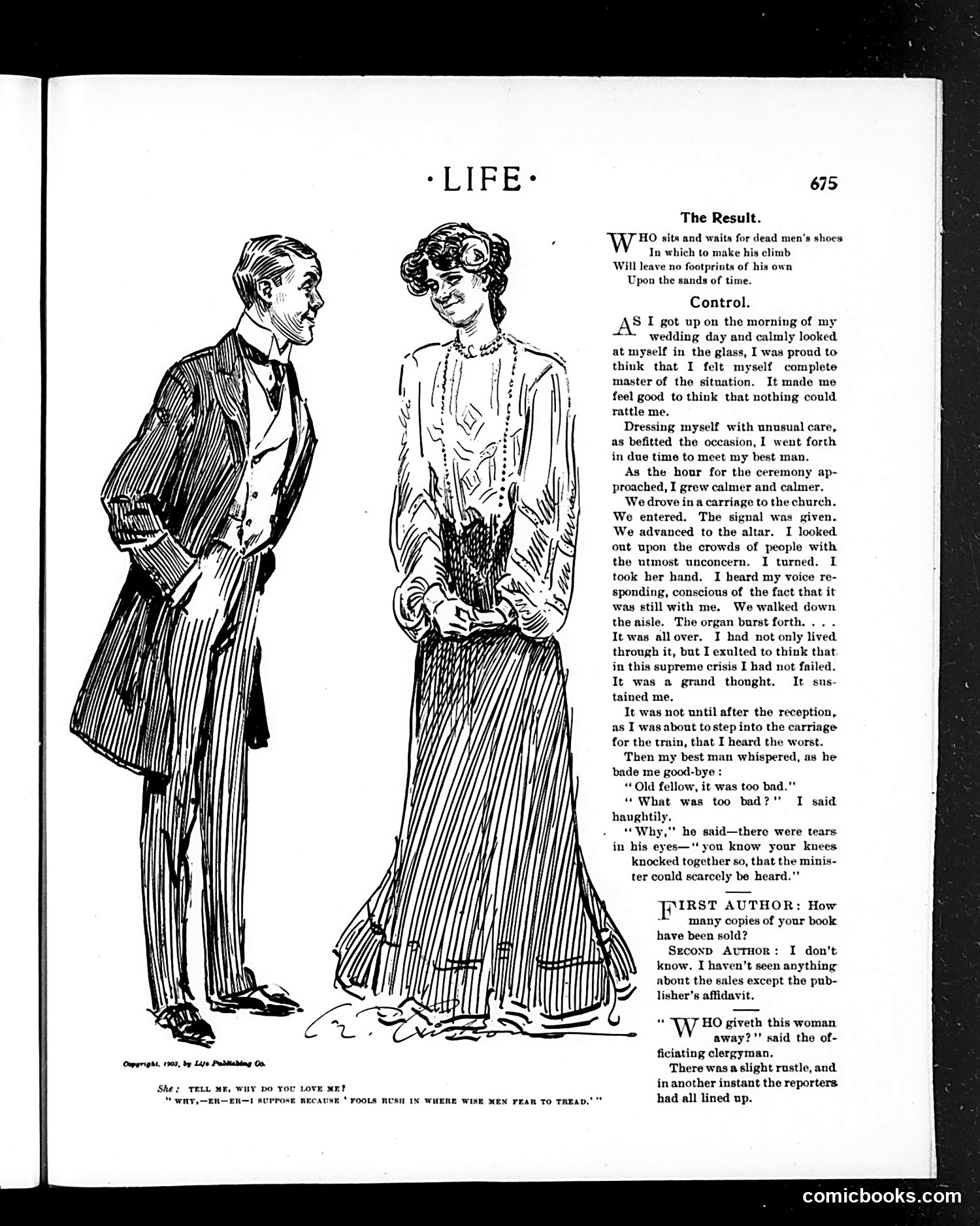
This page from Life (1903) contains three satirical pieces mocking male anxieties and pretense: **Main Illustration & Caption**: A couple at their wedding, with a verse about leaving no legacy. The accompanying story "Control" is ironic satire—a groom boasts about maintaining composure throughout his wedding, only to learn from his best man that his knees were visibly shaking so badly the minister could barely hear the vows. The joke: his imagined mastery was entirely illusory. **Lower Section**: A brief comic exchange between two authors about book sales, where the second admits he knows nothing except what the publisher's legal affidavit states—satirizing either authorial ignorance or publishers' opaque accounting. **Bottom Cartoon**: A clergyman asking "who giveth this woman away?" prompts reporters to rush in—mocking sensationalist journalism's invasion of private moments and the era's obsession with celebrity weddings. The overall theme: exposing the gap between male self-perception and reality, and media intrusion into personal life.
📄 Transcribed text from this page (OCR, searchable)
Machine-transcribed from the original scan — historical spelling and the odd misread are preserved.
675 The Result. HO sits and waits for dead men's shoes In which to make his climb Will leave no footprints of his own Upon the sands of time. Control. AS I got up on the morning of my wedding day and calmly looked at myself in the glass, I was proud to think that I felt myself complete master of the situation. It made me feel good to think that nothing could rattle me. Dressing myself with unusual care, as befitted the occasion, I went forth in due time to meet my best man. As the hour for the ceremony ap- proached, I grew calmer and calmer. We drove ina carriage to the church. We entered, The signal was given. We advanced to the altar. I looked out upon the crowds of people with the utmost unconcern. I turned. L took her hand. I heard my voice re- sponding, conscious of the fact that it was still with me. We walked down the aisle. The organ burst forth. . . . It was allover. I had not only lived through it, but I exulted to think that. in this supreme crisis I had not failed. It was a grand thought. It sus- tained me, It was not until after the reception, as I was about to step into the carriage for the train, that I heard the worst. Then my best man whispered, as he bade me good-bye : “Old fellow, it was too bad.” ‘* What was too bad?"’ I said haughtily. “Why,” he said—there were tears in his eyes—"‘ you know your knees knocked together so, that the minis- ter could scarcely be heard.” PIRST AUTHOR: How many copies of your book have been sold? Sgeconp AutTHoR: I don’t know. I haven’t seen anything about the sales except the pub- lisher’s affidavit. 7 WwW HO giveth this woman away?’ said the of- ficiating clergyman, There was a slight rustle, and in another instant the reporters “ WAY,—-EN—ER—I SUPPOSE BECAUSE * POOLS RUSH IN WHERE WISE MEN FEAR TO TREAD.’ had all lined up. Onperight, 1903, by Lie Pubtiahing Oo. She; TELL ME, WHY bo You LOVE ME? comicbooks.com