
Life, 1903-12-31 · page 4 of 21
Life — December 31, 1903 — page 4: what you’re looking at
What you’re looking at
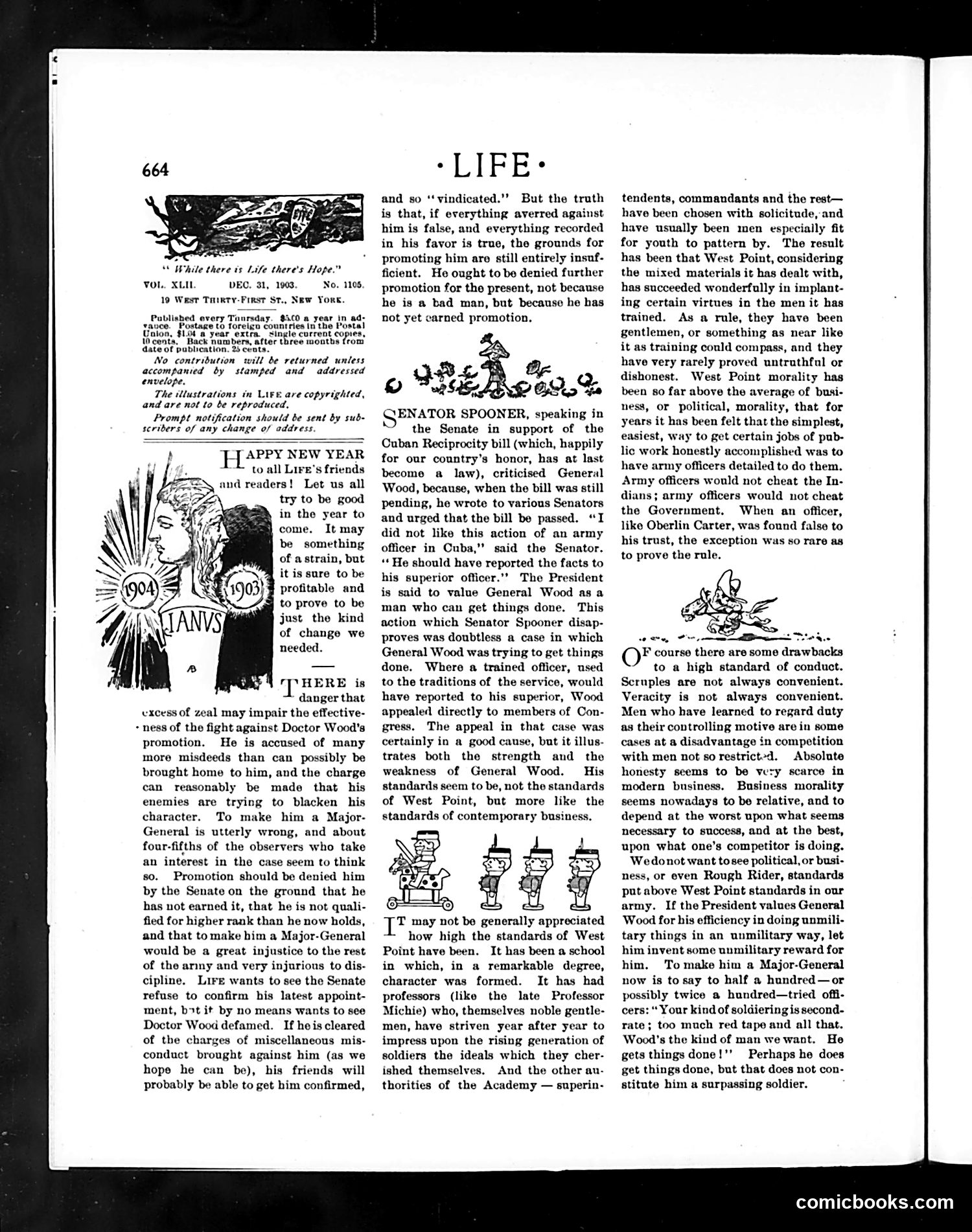
This page addresses General Leonard Wood's promotion controversy. Senator Spooner criticized Wood's handling of the Cuban Reciprocity bill, claiming Wood (as an army officer) should have reported facts to superiors rather than directly lobbying Congress—a breach of military protocol. The editorial defends Wood as exceptionally competent, arguing his promotion shouldn't be denied because he exceeded his rank. However, it acknowledges legitimate concerns: absolute honesty should govern military conduct, and business ethics shouldn't replace military standards. The satirical drawings (small figures at bottom) appear to mock the debate's absurdity—showing how standards differ between military discipline and civilian business pragmatism.
📄 Transcribed text from this page (OCR, searchable)
Machine-transcribed from the original scan — historical spelling and the odd misread are preserved.
‘\ While there ts Life there's Hope.” VoL. XLUL DEC. 31, 1903. No. 1106. 19 West Trinty-First Si w YORE. Published every Tanrsday. $400 a year in ad- vauce. Postage to forelgo countries in the Postal Calon, $1.01 a year extra. single current copies, (cents, Back numbers, after three months from date of publication. 25 cents. No contribution will be returned untess accompanied by stamped and addressed envelope. The illustrations in Live: are copyrighted, and are not to be reproduced. Prompt notification should be sent by sub- scribers of any change of address E APPY NEW YEAR to all Lire’s friends and readers! Let us all try to be good in the year to H come. It may be something of a strain, but it is sure to be profitable and to prove to be just the kind of change we needed. (TT RERE is danger that excess of zeal may impair the effective- + ness of the fight against Doctor Wood's promotion. He is accused of many more misdeeds than can possibly be brought home to him, and the charge can reasonably be made that his enemies are trying to blacken his character. To make him a Major- General is utterly wrong, and about four-fifths of the observers who take an interest in the case seem to think so. Promotion should be denied him by the Senate on the ground that he has not earned it, that he is not quali- fied for higher rank than he now holds, and that to make him a Major-General would be a great injustice to the rest of the army and very injurious to dis- cipline. Lire wants to see the Senate refuse to confirm his latest appoint- ment, b>t it by no means wants to see Doctor Wood defamed. If heis cleared of the charges of miscellaneous mis- conduct brought against him (as we hope he can be), his friends will probably be able to get him confirmed, *LIPE and so ‘vindicated. But the truth is that, if everything averred against him is false, and everything recorded in his favor is true, the grounds for promoting him are still entirely insuf- ficient. He ought to be denied further promotion for the present, not because he is a bad man, but because he has not yet carned promotion, © arch fae GENATOR SPOONER, speaking in ‘the Senate in support of the Cuban Reciprocity bill (which, happily for our country’s honor, has at last become a law), criticised General Wood, because, when the bill was still pending, he wrote to various Senators and urged that the bill be passed. “I did not like this action of an army officer in Cuba,” said the Senator. ‘He should have reported the facts to his superior officer.” The President is said to value General Wood as a man who can get things done. This action which Senator Spooner disap- proves was doubtless a case in which General Wood was trying to get things done. Where a trained officer, used to the traditions of the service, would have reported to his superior, Wood appealed directly to members of Con- gress. The appeal in that case was certainly in a good cause, but it illus- trates both the strength and the weakness of General Wood. His standards seem to be, not the standards of West Point, but more like the standards of contemporary business. I may not be generally appreciated how high the standards of West Point have been. It has been a school in which, in a remarkable degree, character was formed. It has had professors (like the late Professor Michie) who, themselves noble gentle- men, have striven year after year to impress upon the rising generation of soldiers the ideals which they cher- ished themselves. And the other au- thorities of the Academy — superin- tendents, commandants and the rest— have been chosen with solicitude, and have usually been men especially fit for youth to pattern by. The result has been that West Point, considering the mixed materials it has dealt with, has succeeded wonderfully in implant- ing certain virtues in the men it has trained. As a rule, they have been gentlemen, or something as near like it as training could compass, and they have very rarely proved untruthful or dishonest. West Point morality has been so far above the average of busi- ness, or political, morality, that for years it has been felt that the simplest, easiest, way to get certain jobs of pub- lic work honestly accomplished was to have army officers detailed to do them. Army officers would not cheat the In- diat army officers would not cheat the Government. When an officer, like Oberlin Carter, was found false to his trust, the exception was so rare as to prove the rale. & a eee F course there are some drawbacks to a high standard of conduct. Scruples are not always convenient. Veracity is not always convenient. Men who have learned to regard duty as their controlling motive are in some cases at a disadvantage in competition with men not so restricted. Absolute honesty seems to be very scarce in modern business. Business morality seems nowadays to be relative, and to depend at the worst upon what seems necessary to success, and at the best, upon what one’s competitor is doing. Wedonot want tosee political, or busi- ness, or even Rough Rider, standards put above West Point standards in our army. If the President values General Wood for his efficiency in doing unmili- tary things in an unmilitary way, let him invent some unmilitary reward for him. To make him a Major-General now is to say to half a hundred—or possibly twice a hundred—tried offi- cers: “ Your kind of soldiering is second- rate; too much red tape and all that. Wood's the kind of man we want. He gets things done!’ Perhaps he does get things done, but that does not con- stitute him a surpassing soldier. comicbooks.com