
A complete issue · 20 pages · 1903
Life — December 11, 1903
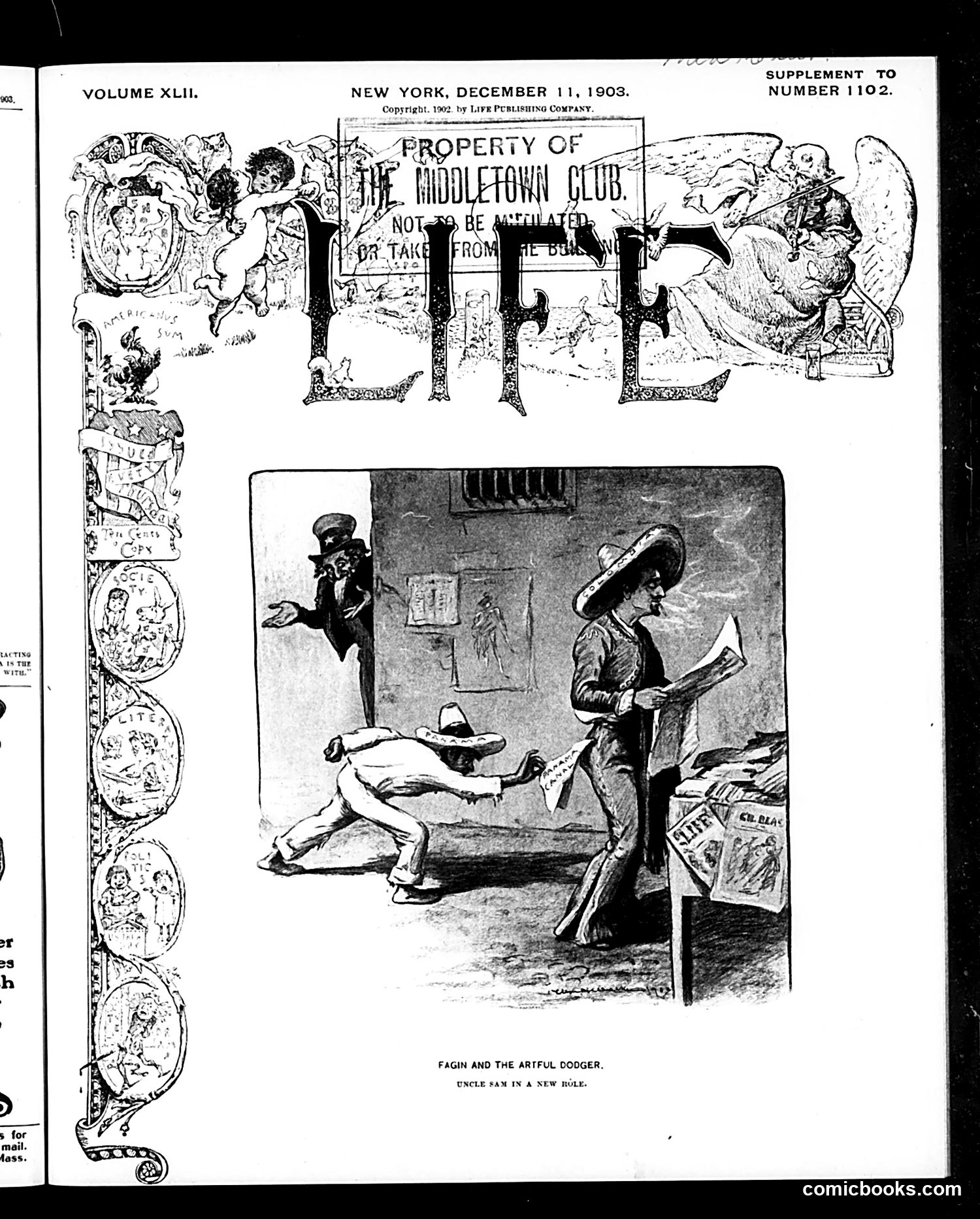
This page features a cartoon titled "Fagin and the Artful Dodger: Uncle Sam in a New Role." The image depicts two figures in what appears to be a jail or confined space. The caption references Charles Dickens' *Oliver Twist* characters—Fagin (the criminal mastermind) and the Artful Dodger (his child pickpocket protégé). The satire likely critiques U.S. imperialism or government exploitation, with "Uncle Sam" cast as Fagin manipulating or corrupting subordinates/territories like the Artful Dodger. The Dickens reference suggests predatory behavior—using others (possibly colonial subjects or exploited groups) for illicit gain. Without additional context about 1903 political events, the specific target remains unclear, though the comparison suggests moral criticism of American policy.
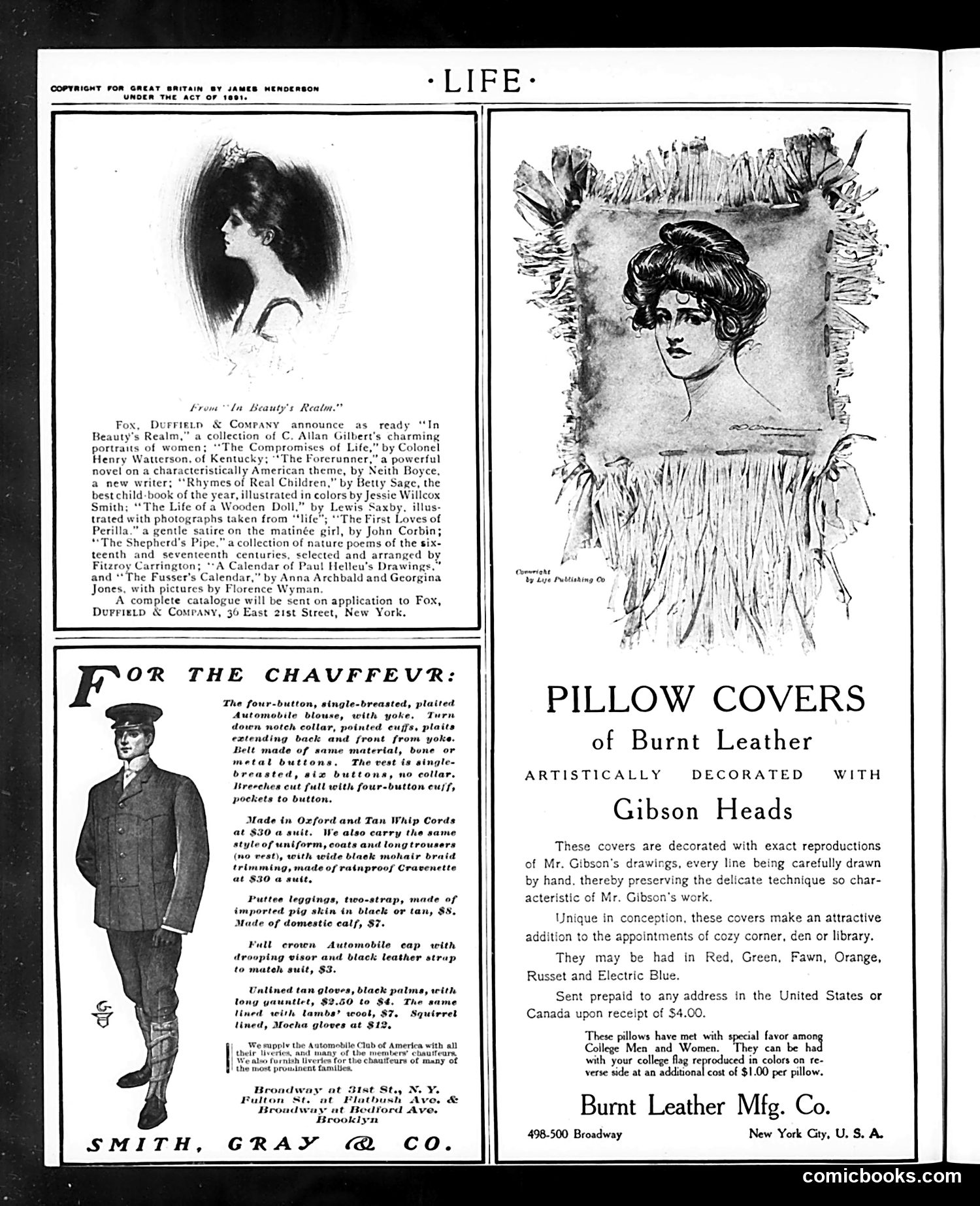
This page is **primarily advertising**, not political satire. The left side advertises "In Beauty's Realm," a collection of stories and books from Fox, Duffield & Company, featuring works by various authors. Below that is an advertisement for Smith, Gray & Co.'s chauffeur uniform. The right side advertises pillow covers decorated with "Gibson Heads" from the Burnt Leather Mfg. Co. These are reproductions of Charles Dana Gibson's famous drawings of idealized women (the "Gibson Girl"). The text notes these covers appeal to college men and women. The page contains no political cartoon or social satire—it's a straightforward compilation of early 20th-century consumer advertisements promoting books, fashion, and home goods.
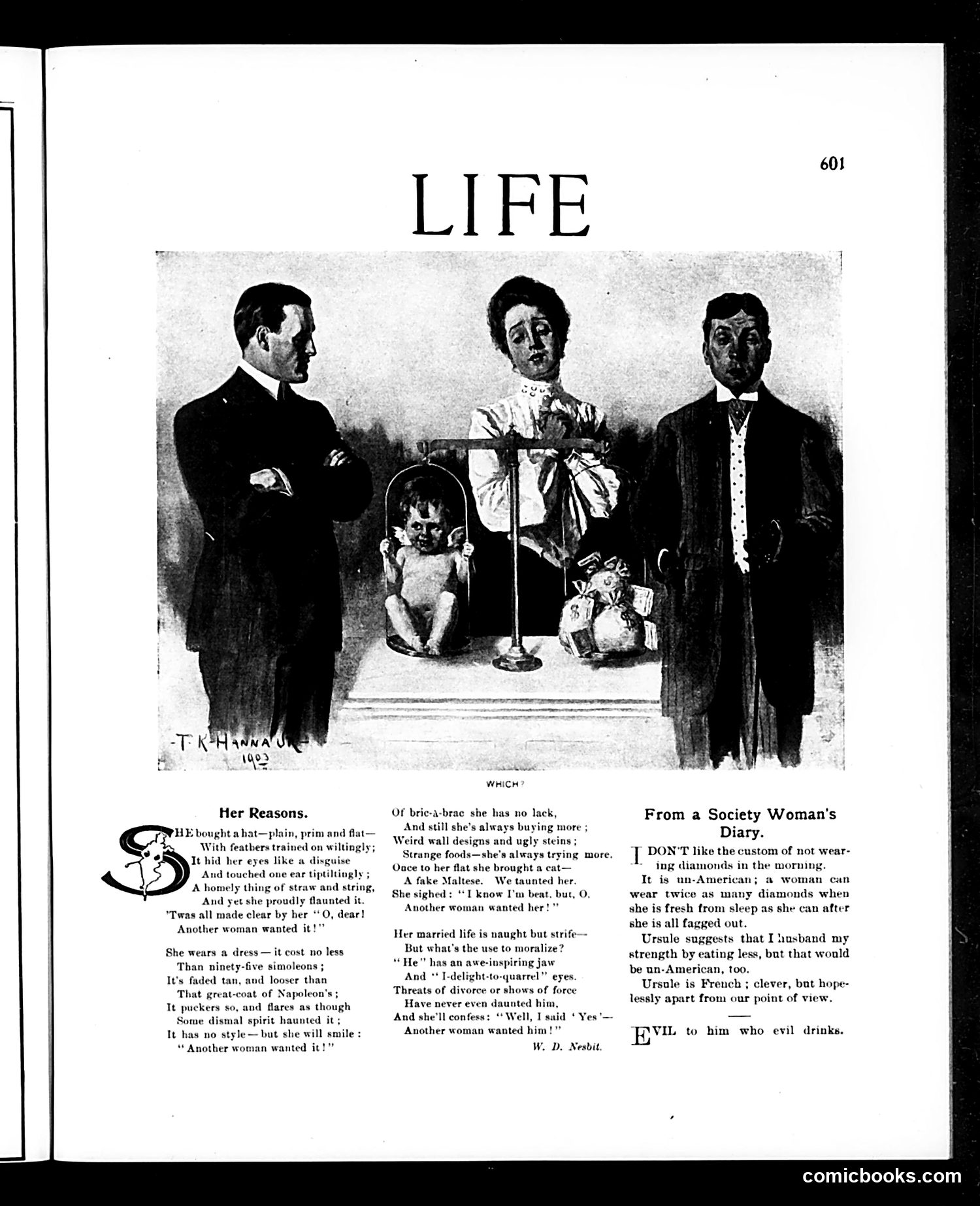
The main cartoon depicts three well-dressed men examining dolls on a table, captioned "Which" and titled "Her Reasons." The satire appears to target women's consumer behavior and marriage choices—specifically satirizing women as objects to be evaluated like commodities. The poem "Her Reasons" mocks a woman who married poorly, describing her as vain and materialistic ("She wears a dress...it cost no less than ninety-five thousands"). The right column, "From a Society Woman's Diary," contains brief, sharp observations about upper-class female behavior—critiquing women who wear excessive diamonds and the French character. The overall message is misogynistic satire typical of early-20th-century Life magazine: women are superficial consumers and poor judges of character in marriage. The humor relies on negative stereotypes about female vanity and judgment.
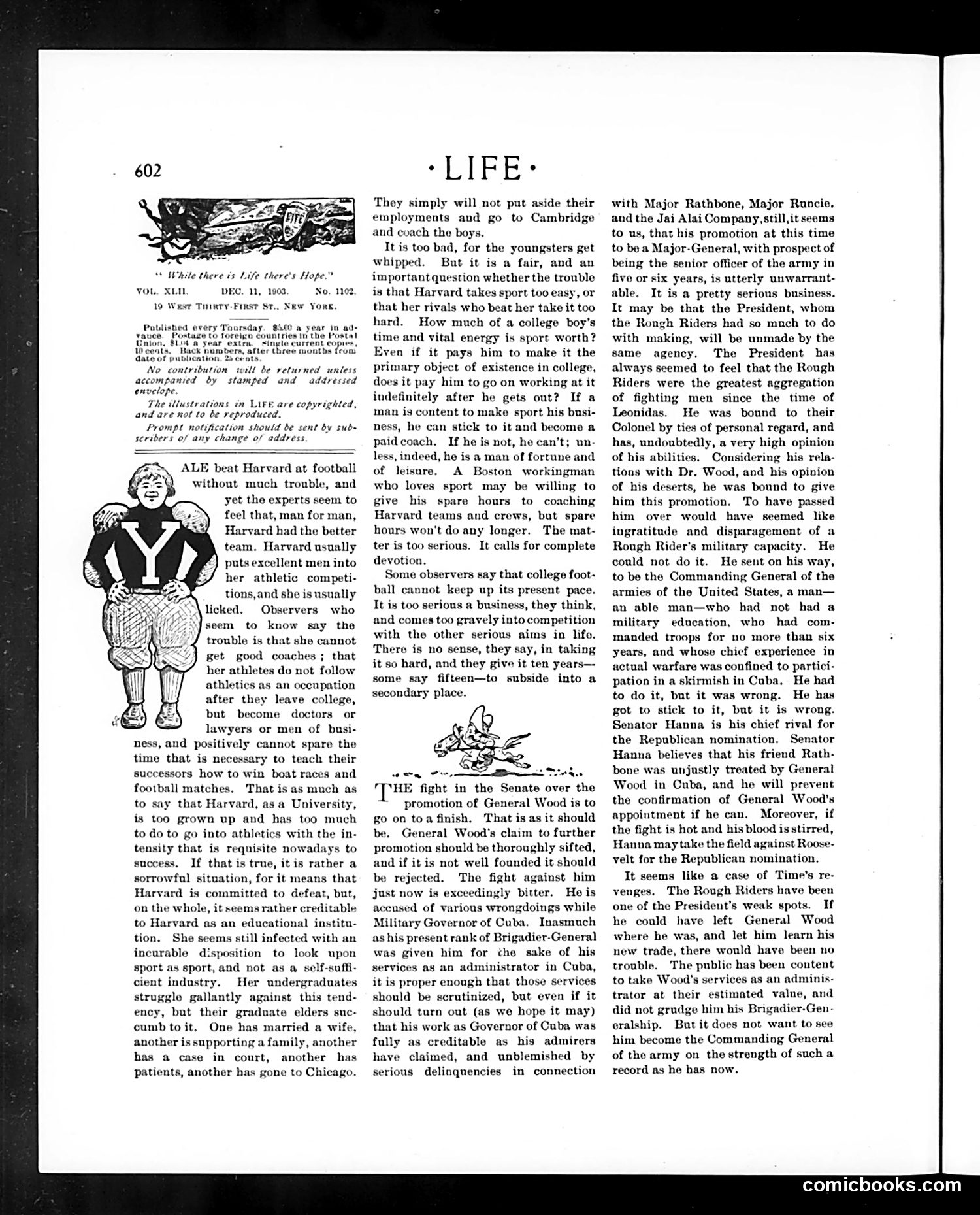
The main cartoon depicts a Yale football player in the distinctive "Y" uniform, captioned "YALE beat Harvard at football without much trouble, and yet the experts seem to feel that, man for man, Harvard had the better team." **The Satire:** This mocks Harvard's excuses-making after losing to Yale. Despite being supposedly superior individually ("man for man"), Harvard lost the actual game. The cartoon ridicules the tendency of Harvard alumni and supporters to explain away athletic defeats through rationalizations rather than accepting Yale's genuine superiority on the field. The accompanying text discusses collegiate athletics broadly—specifically tensions over whether sport should remain a priority at universities like Harvard, and debates about General Wood's military promotion. The magazine satirizes both Harvard's athletic pretensions and broader questions about institutional priorities.
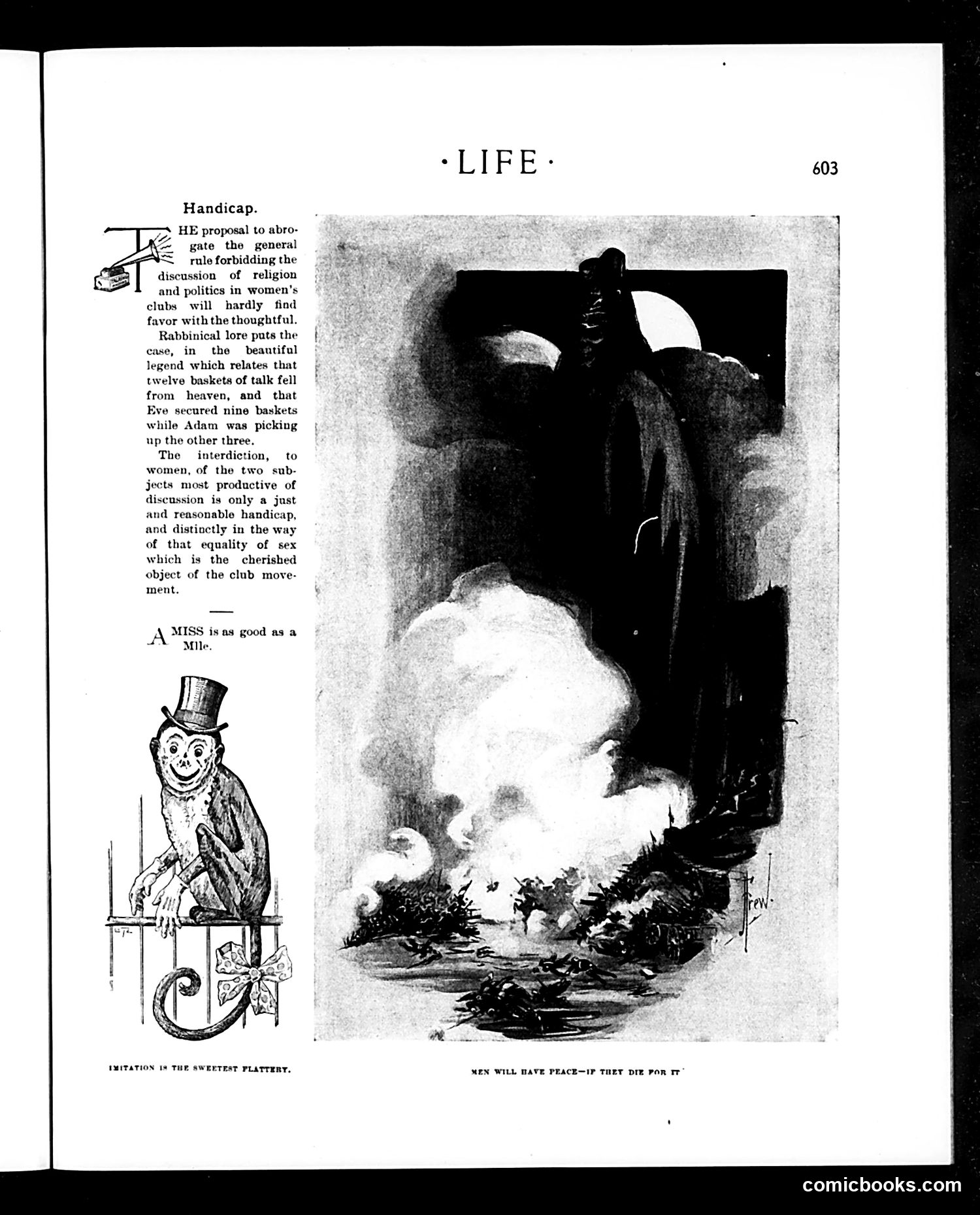
This page from Life magazine contains two distinct satirical cartoons: **Top cartoon ("Men Will Have Peace—If They Die For It"):** A dark allegory showing a large skull-faced figure looming over a battlefield landscape. This appears to reference World War I's devastating human costs, satirizing political promises of peace that require massive military sacrifice. **Bottom cartoon ("Imitation Is the Sweetest Flattery"):** A monkey in formal dress imitates a gentleman, likely satirizing social climbing or the pretension of those adopting upper-class mannerisms without genuine refinement. The article text discusses women's clubs debating religious and political topics, arguing such discussion is appropriate given gender equality principles the club movement champions. The overall page satirizes both war's human toll and class pretension in early 20th-century American society.
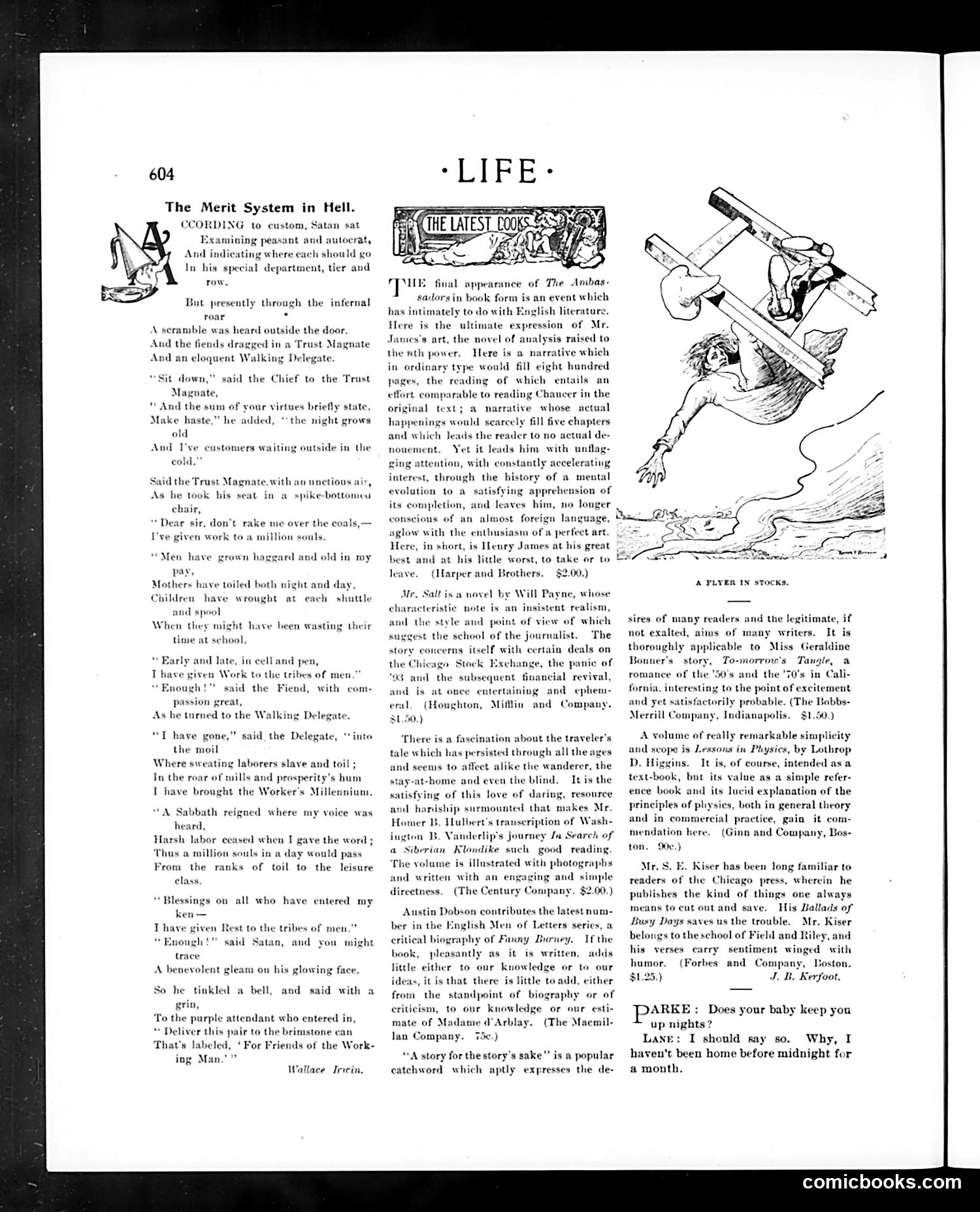
This page contains **"The Merit System in Hell,"** a satirical poem about bureaucratic damning procedures. The cartoon depicts a figure operating what appears to be a large industrial machine or apparatus, suggesting hell's administration has become mechanized and bureaucratic. The satire mocks the "merit system"—likely a contemporary civil service reform debate—by imagining it applied to damnation itself. Rather than immediate punishment, souls now face bureaucratic processing, examination, and categorization. The poem's dialogue between a "Chief" and "Trust Magnate" suggests the satire targets wealthy industrialists and those escaping consequences through technicalities. The accompanying illustration shows the absurdist result: even in hell, modern administrative systems create inefficient, dehumanizing processes that contradict traditional notions of justice.
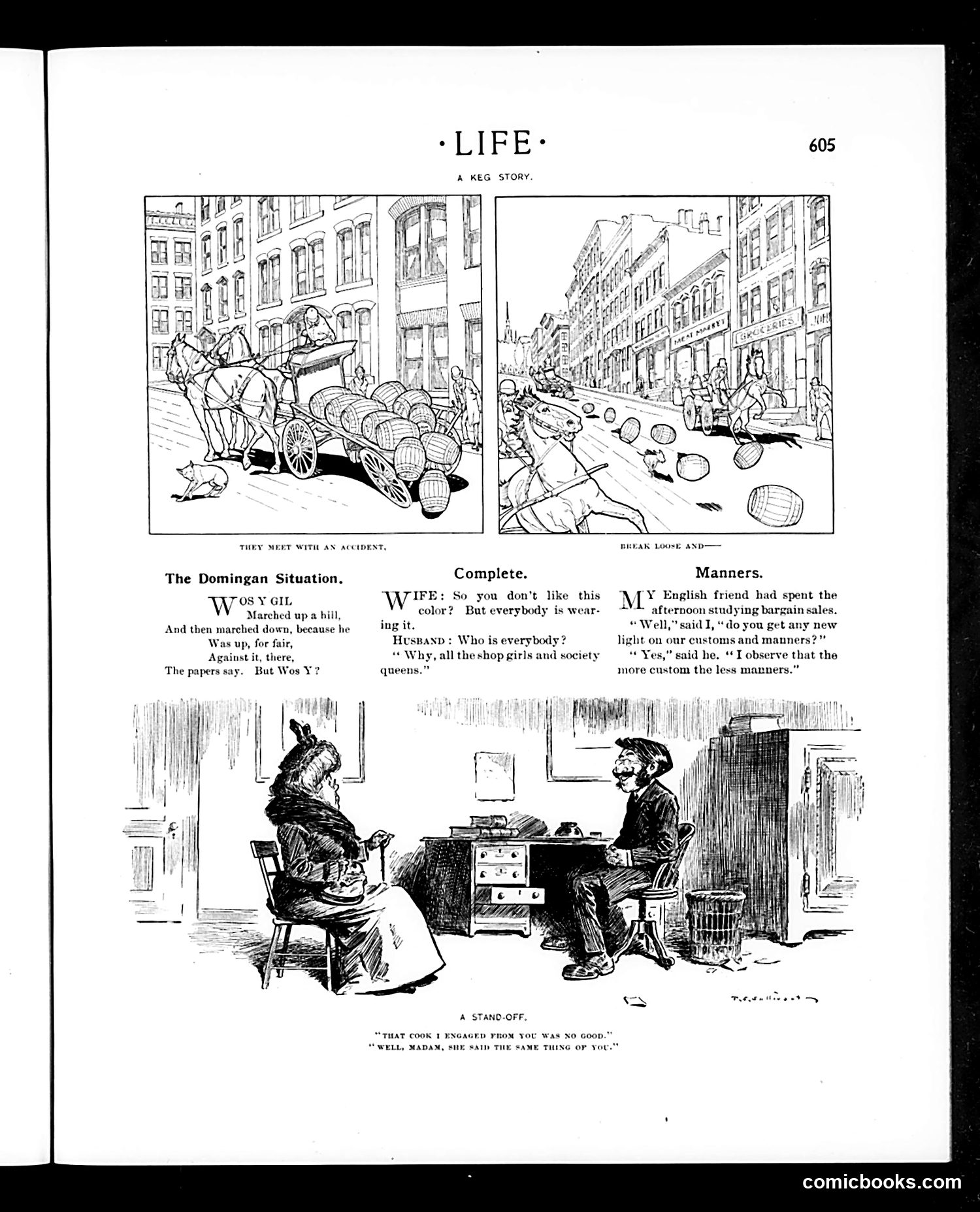
This page contains three separate satirical pieces: 1. **"The Dominican Situation"** (top left): A visual pun showing a horse cart loaded with barrels that spills its cargo. The joke plays on Dominican politics—likely referencing a political controversy, with "Wes Y?" suggesting someone named Wes involved in a scandal that caused public disruption. 2. **"Complete Manners"** (top right): A dialogue mocking social pretension. An English visitor observes that following custom correlates with poor manners—a jab at rigid social conventions. 3. **"A Stand-off"** (bottom): Two figures in a domestic dispute about employment. A woman dismisses a cook, who retorts that the cook "said the same thing of you"—a class-conflict joke about mutual dissatisfaction between employer and servant. The page satirizes politics, social conventions, and labor relations.
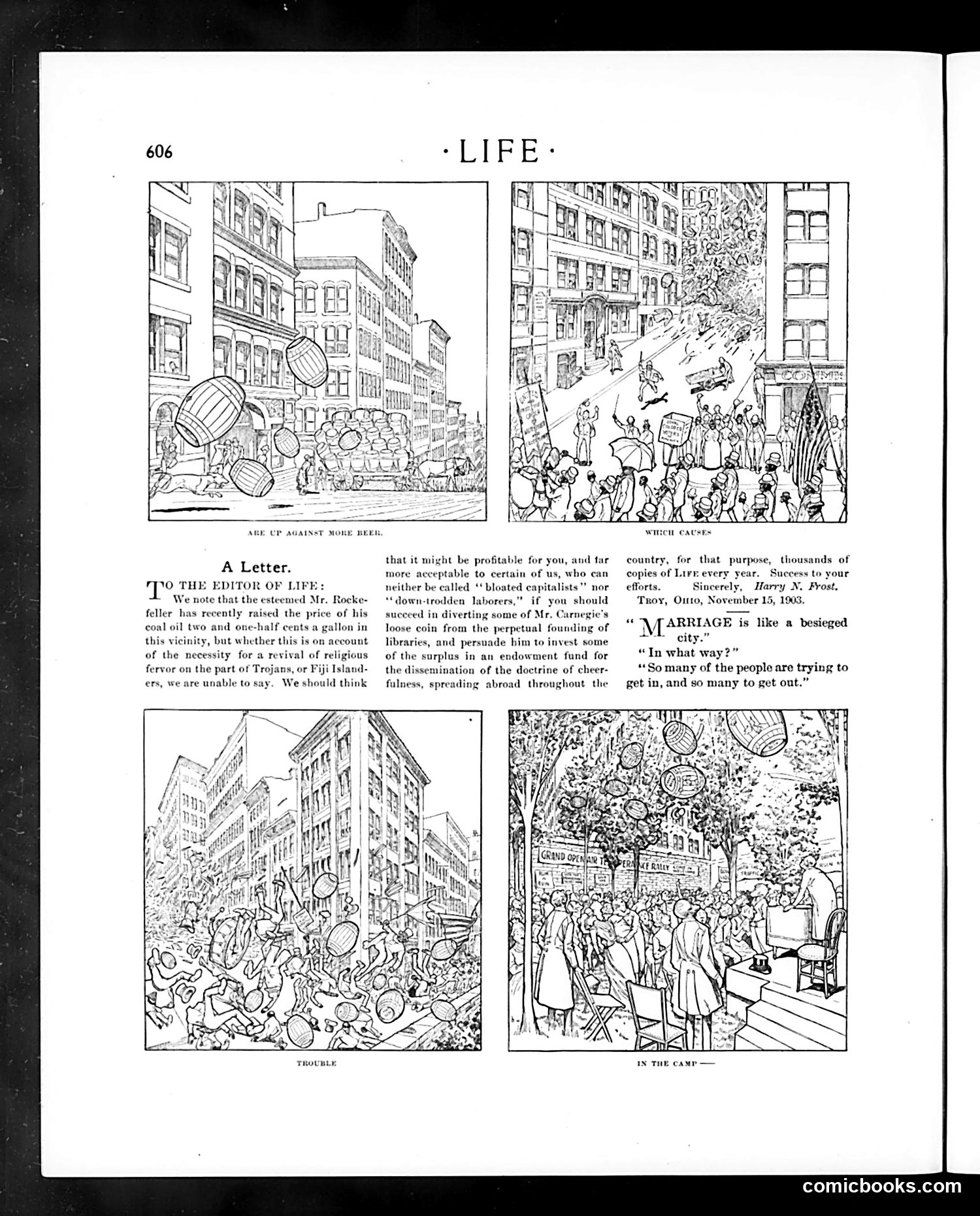
This page contains four editorial cartoons depicting urban chaos and social disorder, each showing crowds of people causing mayhem in city streets. The panels are titled "Age Up Against Nose Beer," "Which Causes," "Trouble," and "In the Camp." The accompanying letter references Prohibition-era concerns: it discusses "bloated capitalists," "downtrodden laborers," and mentions Carnegie's libraries and endowments. The satire appears to critique how wealth distribution and social inequality fuel urban unrest and violence. The final quoted line compares "marriage" to "a besieged city"—likely satirizing domestic conflict through military metaphor. Without a visible date, the Prohibition references suggest early 20th-century publication, though the exact historical moment remains unclear from this page alone.
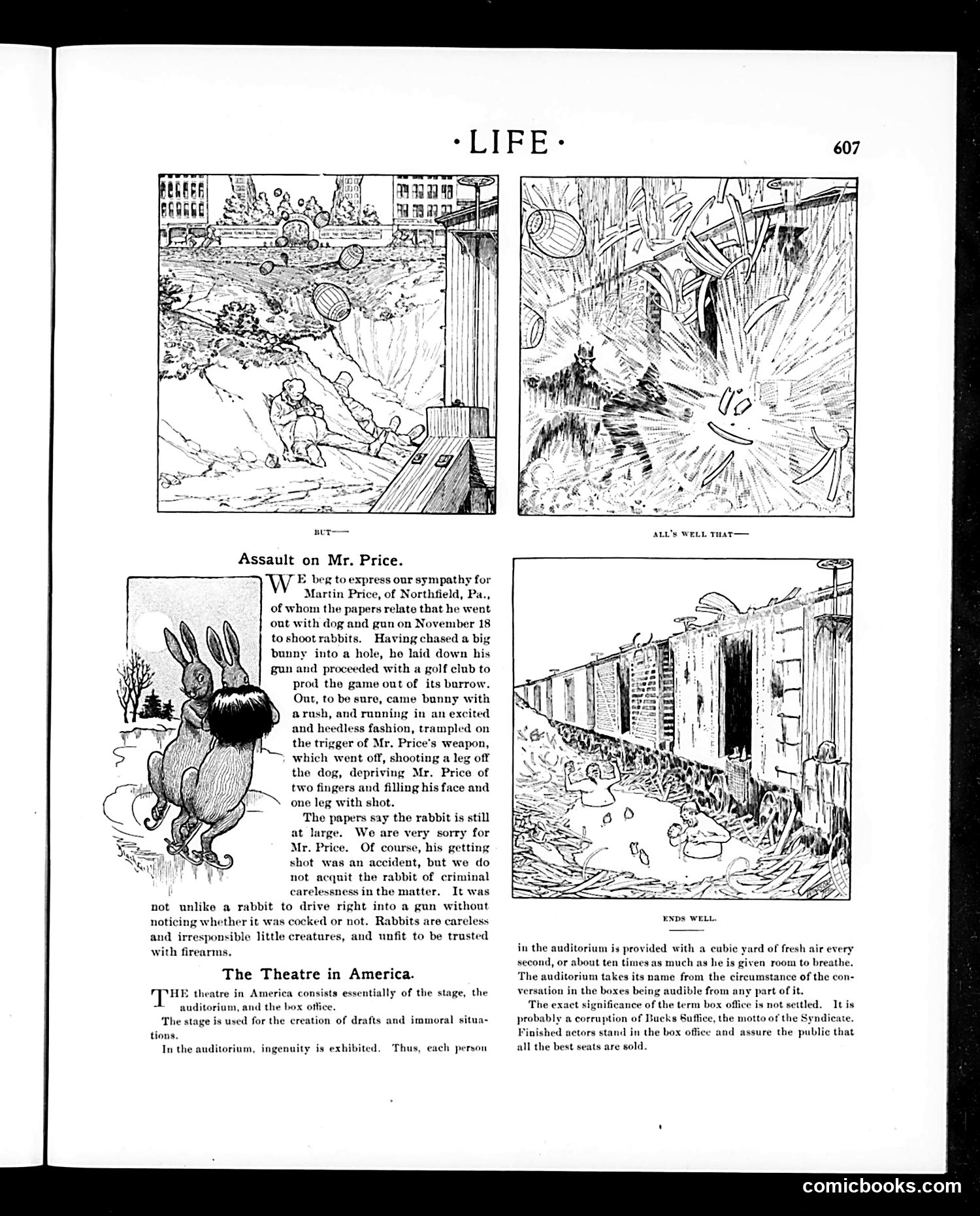
**"Assault on Mr. Price"** is a humorous anecdote about Martin Price of Northfield, Pennsylvania, who went rabbit hunting on November 18. When he chased a rabbit into a hole and reached in with his gun to prod it out, the panicked rabbit ran directly into him, triggering his weapon. The gun shot off, wounding Price in the leg, destroying two fingers, and striking his face. The accompanying cartoon shows rabbits fleeing. The satire mocks the irony of a hunter becoming the hunted—a cautionary tale about overconfidence and carelessness with firearms. The text's tone is darkly humorous, noting that while sympathetic to Price's injuries, rabbits cannot be trusted around guns.
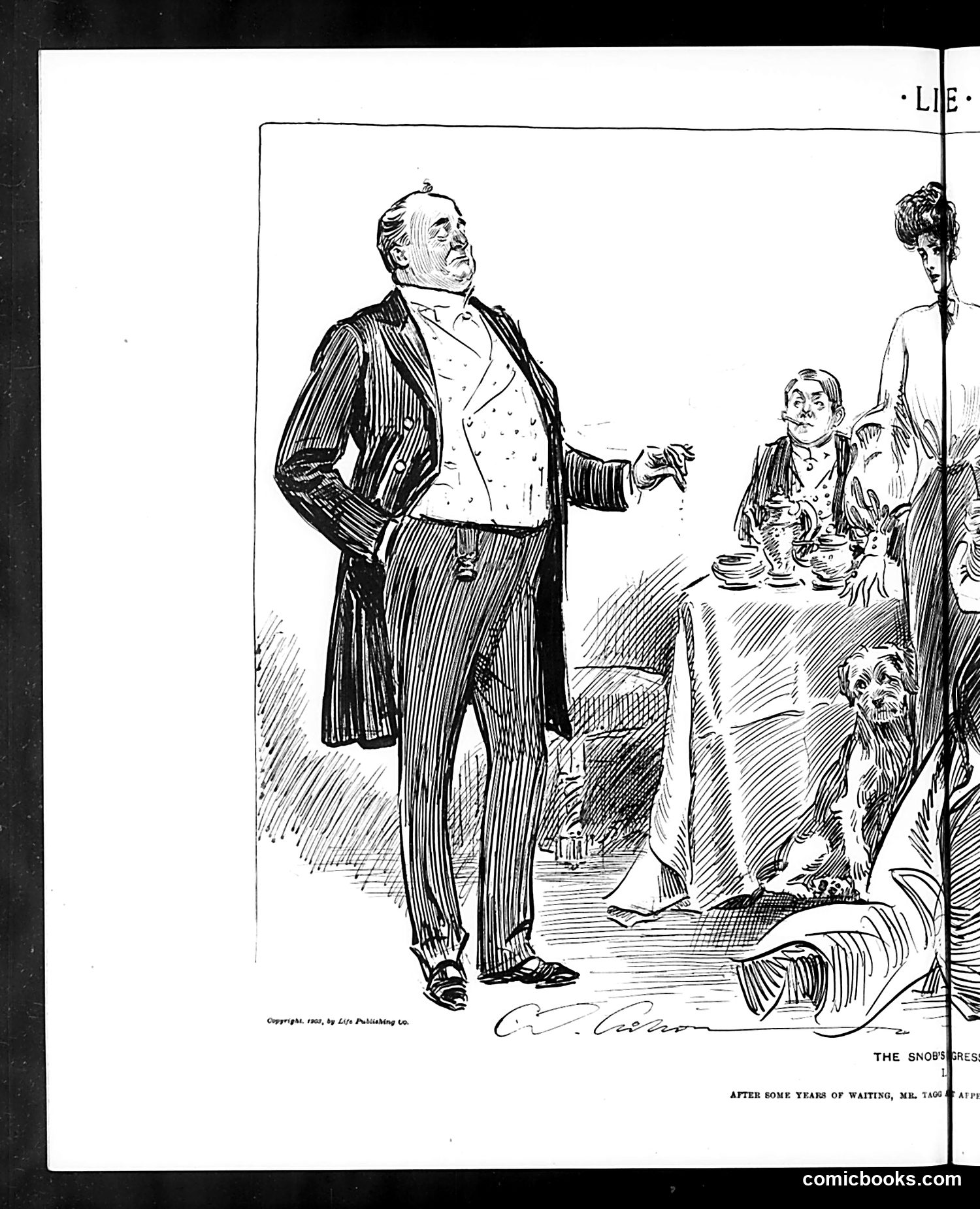
This is a satirical cartoon from Life magazine (copyright 1902, per visible text). The illustration shows a well-dressed man in formal attire standing and gesturing, surrounded by other figures including what appears to be a beggar or poor person at bottom right. The caption reads "THE SNOBS CREST" with partial text "AFTER SOME YEARS OF WAITING, MR. [NAME]" (text cut off). The satire appears to target social pretension and class hierarchy—specifically mocking wealthy individuals who adopt superior attitudes toward those of lower economic status. The contrast between the formally-dressed speaker and the impoverished figure suggests commentary on economic inequality or the hypocrisy of the wealthy. The artist's signature is visible (appears to be C. Cesare or similar), though I cannot definitively identify it.
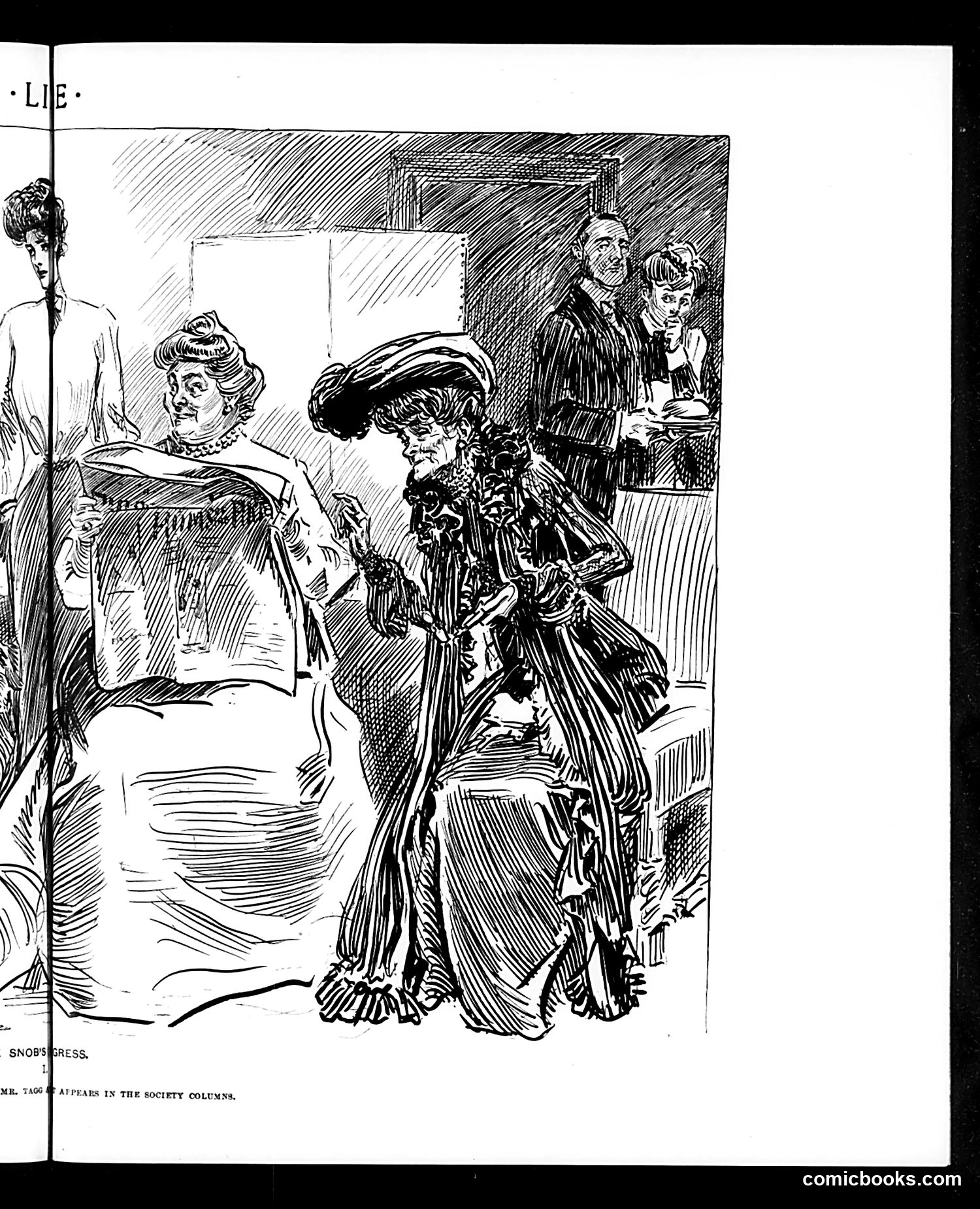
This satirical illustration depicts high society social gatherings, likely mocking the elaborate formality and pretension of wealthy Americans' social events. The figures display exaggerated fashions—elaborate hats, ornate clothing, and theatrical poses—typical of Gilded Age or Progressive Era caricature style. The sketch appears to ridicule how society columns reported on elite gatherings with breathless detail. The standing figures observing or participating in what seems a formal reception embody stereotypes of snobbish wealth and affected manners. The artist exaggerates physical features and dress to emphasize the absurdity of these social rituals. The humor targets the disconnect between the self-importance of high society and what satirists viewed as shallow materialism and pretense. This reflects *Life* magazine's consistent critique of American aristocratic pretensions.
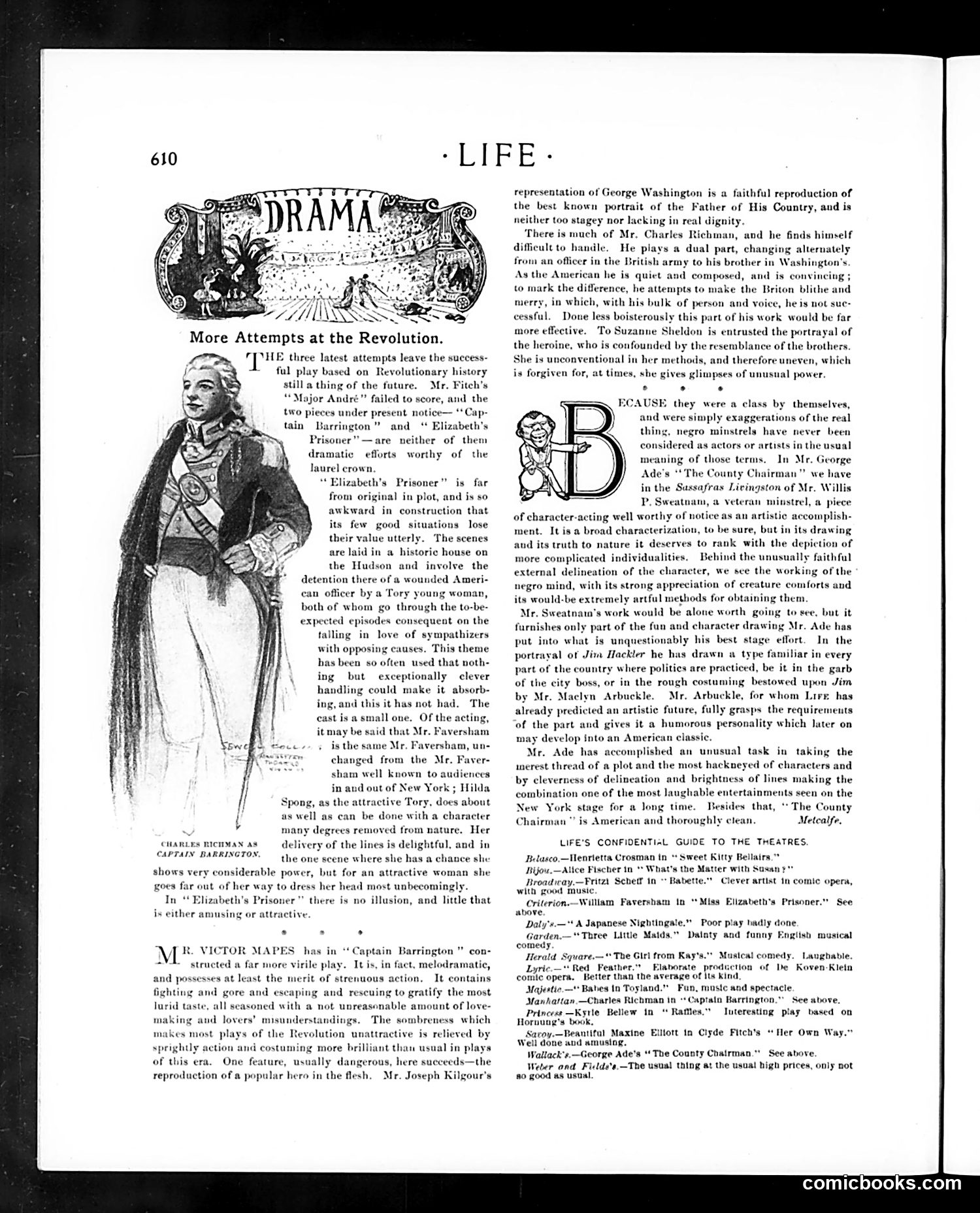
This page reviews contemporary theatrical productions, focusing on Revolutionary War-themed plays. The illustration depicts **Charles Richman as "Captain Harrington,"** a character in one such production. The text critiques three recent plays attempting Revolutionary history: *Major André*, *Captain Harrington*, and *Elizabeth's Prisoner*. The reviewer notes these dramatizations often sacrifice historical accuracy for theatrical effect. The page's satire targets how American theater exploits patriotic subject matter superficially. The commentary suggests playwrights prioritize spectacle and melodrama over authentic historical representation—a familiar critique of populist entertainment treating serious subjects carelessly. The page includes a "Life's Confidential Guide to the Theatres," listing current productions with brief, often dismissive reviews of various shows and performers.
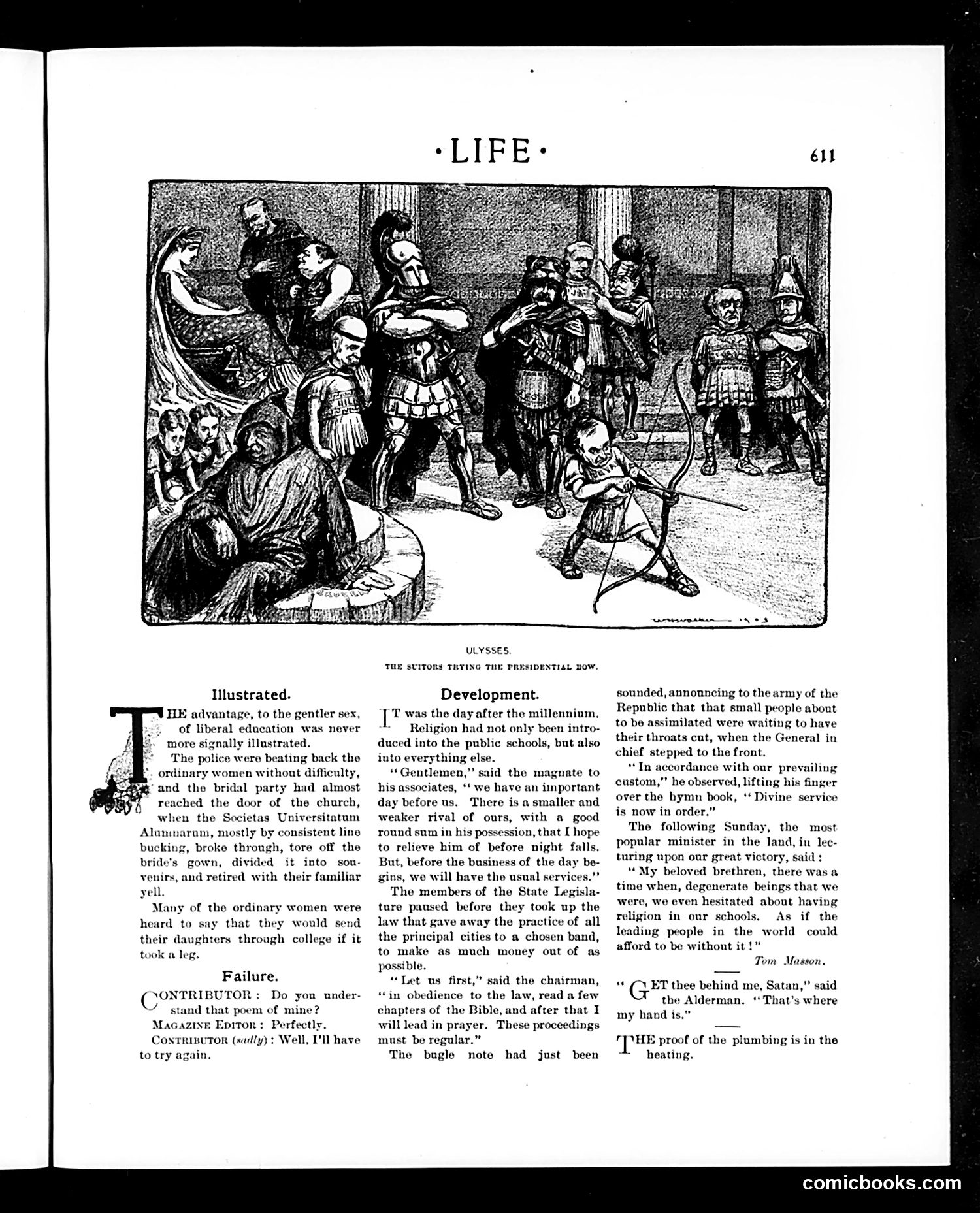
This page contains **three separate satirical pieces** mocking early 1900s American society: 1. **"Ulysses" (top illustration)**: University-educated women violently disrupting a wedding, tearing apart the bride's gown as "souvenirs." The satire targets educated women activists—likely suffragists or social reformers—portraying them as destructive and unladylike. The joke: ordinary women would endure hardship to educate their daughters after witnessing this spectacle. 2. **"Failure" (brief exchange)**: A contributor's poem is so poorly written that even an editor "understands" it perfectly—implying it's meaningless drivel. 3. **"Development" (main text)**: A longer satirical story mocking religious hypocrisy in governance. Corrupt politicians and military leaders pray and cite scripture before pursuing theft and conquest. The satire critiques how religion became performative cover for immoral business and imperial practices, with ministers celebrating violence as righteous. The page attacks educated women activists, literary pretension, and especially the weaponization of religion to justify greed and war.
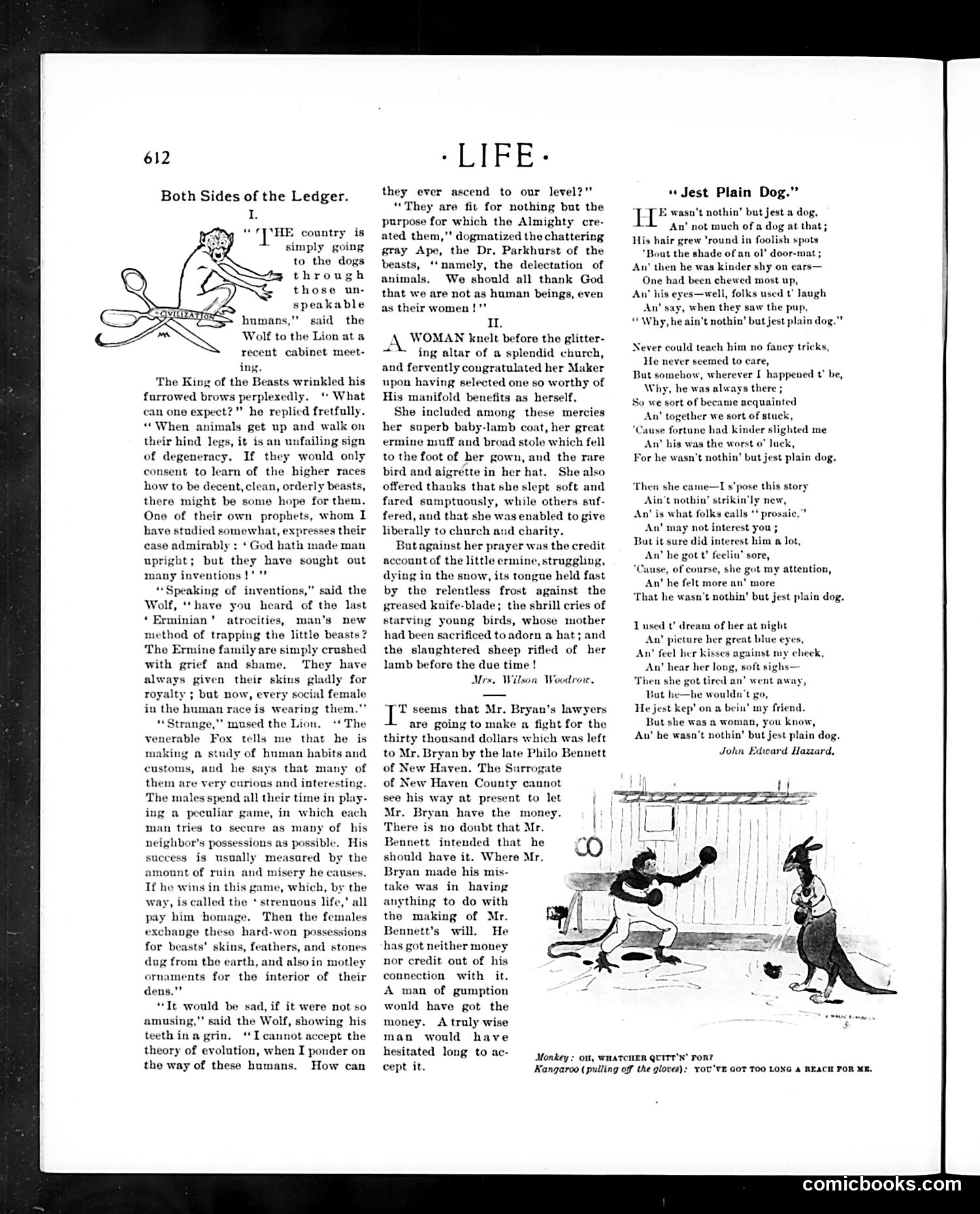
This page contains two interconnected satirical pieces critiquing human hypocrisy, particularly regarding wealth and animal exploitation. **Section I** presents animals (Wolf, Lion, chattering Ape) mocking humans as morally degenerate. The irony is deliberate: the animals condemn human "inventions" and competitive greed—yet this criticism perfectly describes animal behavior. The satire targets human pretensions to superiority. **Section II** directly illustrates this hypocrisy: a wealthy woman kneels in prayer, thanking God for luxuries (ermine coat, aigrette hat) while remaining oblivious to the animal suffering behind them—dying ermines, slaughtered birds, sacrificed sheep. The caption credits "Mrs. Wilson Woodrow," suggesting this targets a real society figure's moral blindness. The cartoon below shows a monkey and kangaroo, reinforcing the animal-perspective commentary. Together, the pieces satirize affluent women's thoughtless consumption of animal products while maintaining pious religiosity—a common Progressive Era target.
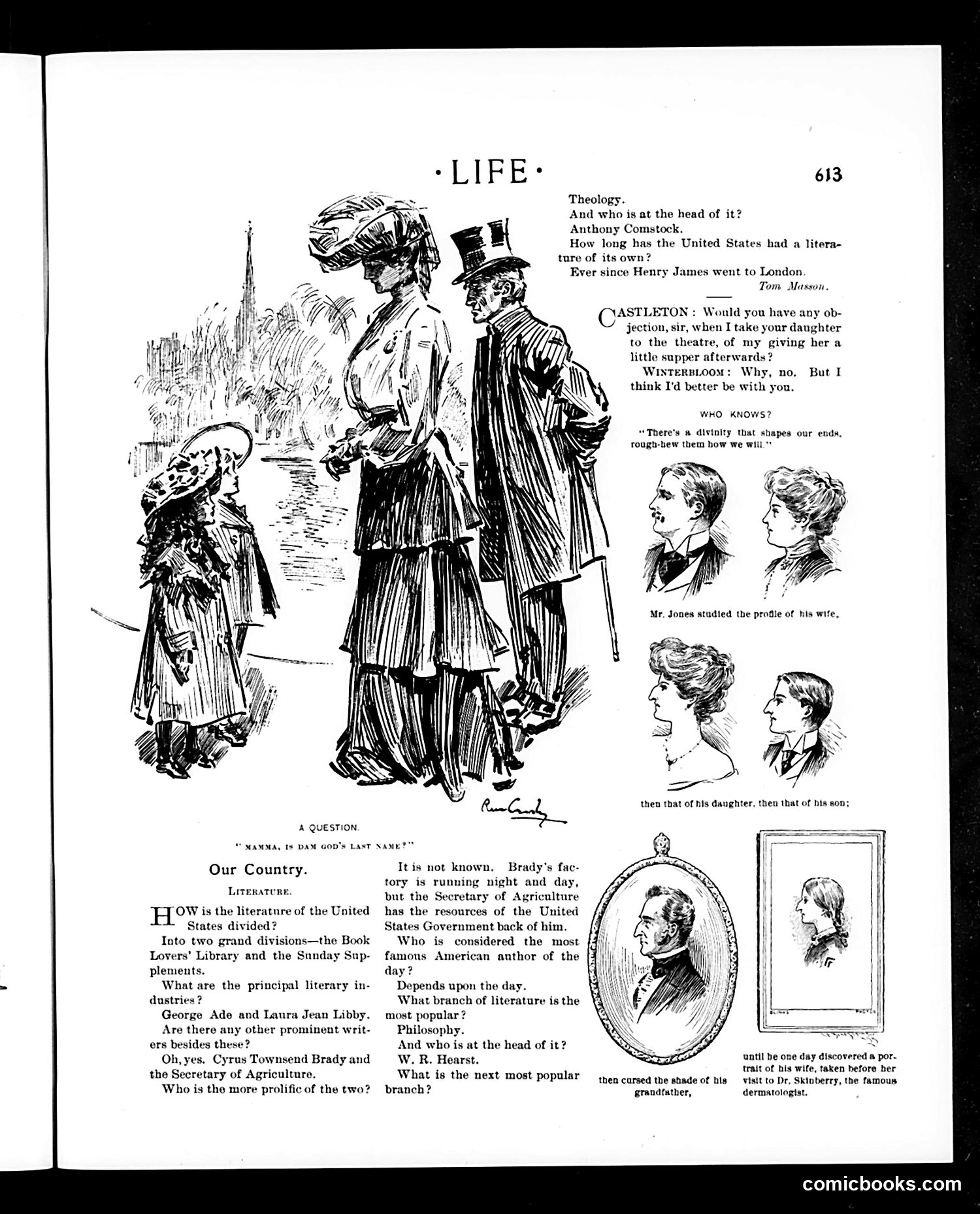
This page from *Life* magazine contains satirical Q&A exchanges mocking American culture around the early 1900s. **"Our Country, Literature"** section ridicules American literary divisions and popular authors. It suggests American literature splits between "Book Lovers' Library" (serious work) and "Sunday Supplements" (cheap serialized fiction). The joke names George Ade, Laura Jean Libby, and Cyrus Townsend Brady as major "literary industries"—implying commercial pulp dominates over serious literature. The quip about Henry James leaving for London suggests American literature only began when serious writers departed. **"A Question"** at top likely references Anthony Comstock, the famous (or infamous) censorship advocate who policed "obscene" materials. **The cartoon "A Question"** depicts a young woman asking her mother about God's last name—humor derived from childish theological confusion. **"Mamma, Is Dan God's Last Name?"** appears to be a separate domestic joke about confused pronunciation. The overall tone satirizes American pretensions about culture while acknowledging its commercial, rather than artistic, foundation.
This page from *Life* magazine contains several humorous short pieces typical of early 20th-century American satire: **"What Father Said"** satirizes parental hypocrisy about football. A father condemns the sport as brutal and violent, then enthusiastically yells encouragement during his son's game, even celebrating when John injures opponents ("broke a nose," "pulled an arm clear out of place"). The joke exposes how principles collapse when personal pride is involved. **Additional humor pieces** mock childhood innocence (a boy's essay describing hens as creatures that "swallow their whittles whole"), male skepticism about statistics, college freshman naiveté, and a child's clever deflection of punishment. The page is primarily **advertising**, featuring whiskey, malted rice cereal, cigarettes, and railroad services—products typical of this era. The ads employ health claims and sophistication appeals common in pre-regulation advertising. Overall, the page reflects early 1900s American middle-class attitudes: mild social commentary, sentimental views of childhood, and uncritical product promotion.
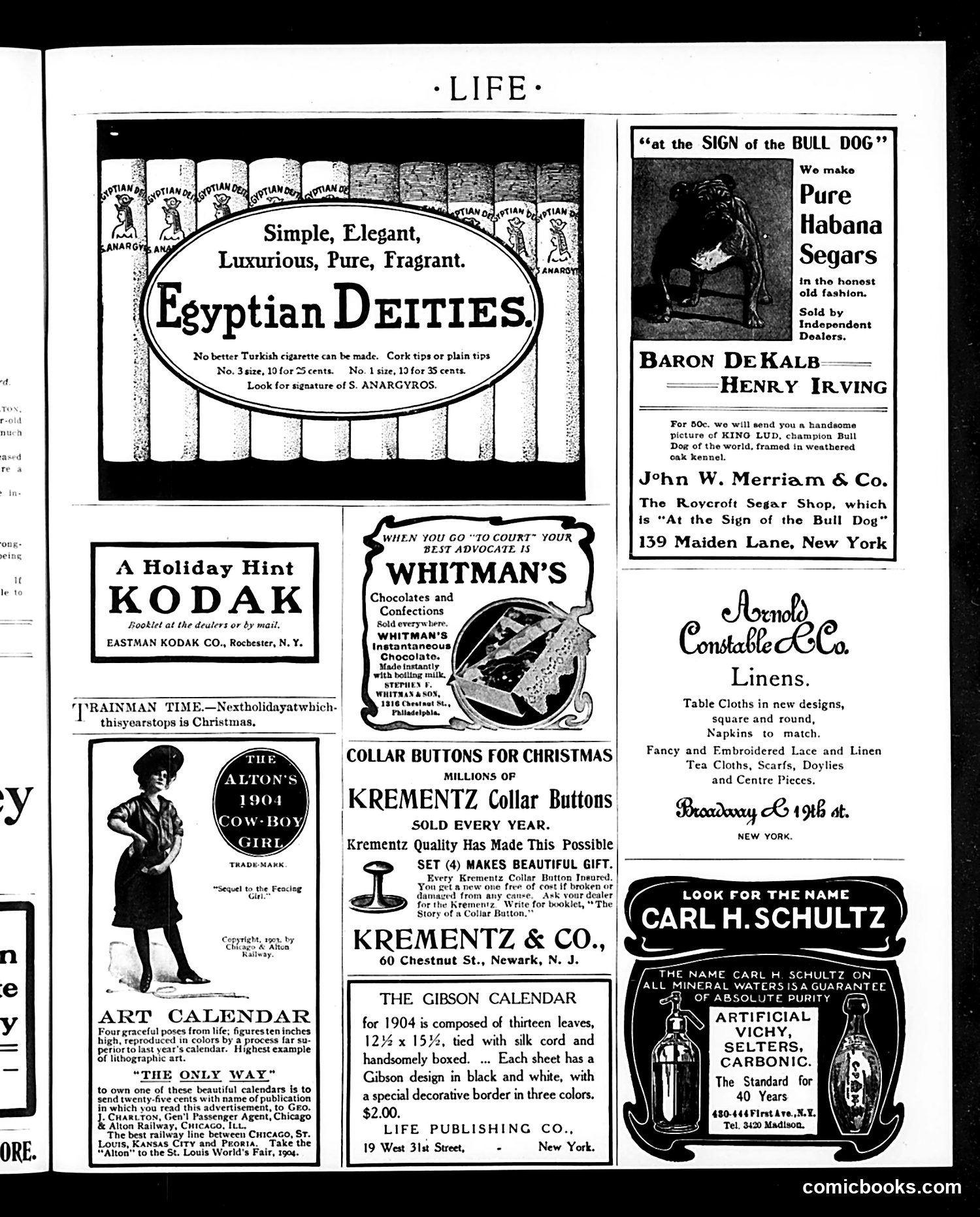
This is primarily an **advertising page** from Life magazine, circa 1904, containing no political cartoons or satire requiring historical context. The page showcases period luxury consumer goods: Egyptian Deities cigarettes, Kodak cameras, Whitman's chocolates, and Krementz collar buttons. Notable is the recurring "Bull Dog" imagery—appearing in both the Baron De Kalb cigar advertisement (featuring "King Lud, champion Bull Dog") and John W. Merriam's cigar shop branded "At the Sign of the Bull Dog." The only potential satirical content is a small reference to the **1904 St. Louis World's Fair** in the Alton Railway ad, and a calendar featuring **Gibson Girl designs** (Charles Dana Gibson's iconic illustrations of idealized American women). The page reflects early 1900s marketing: products positioned as "luxurious" and "pure," holiday gift suggestions, and brand-name emphasis as quality assurance—standard advertising conventions of the era with no deeper satirical meaning.
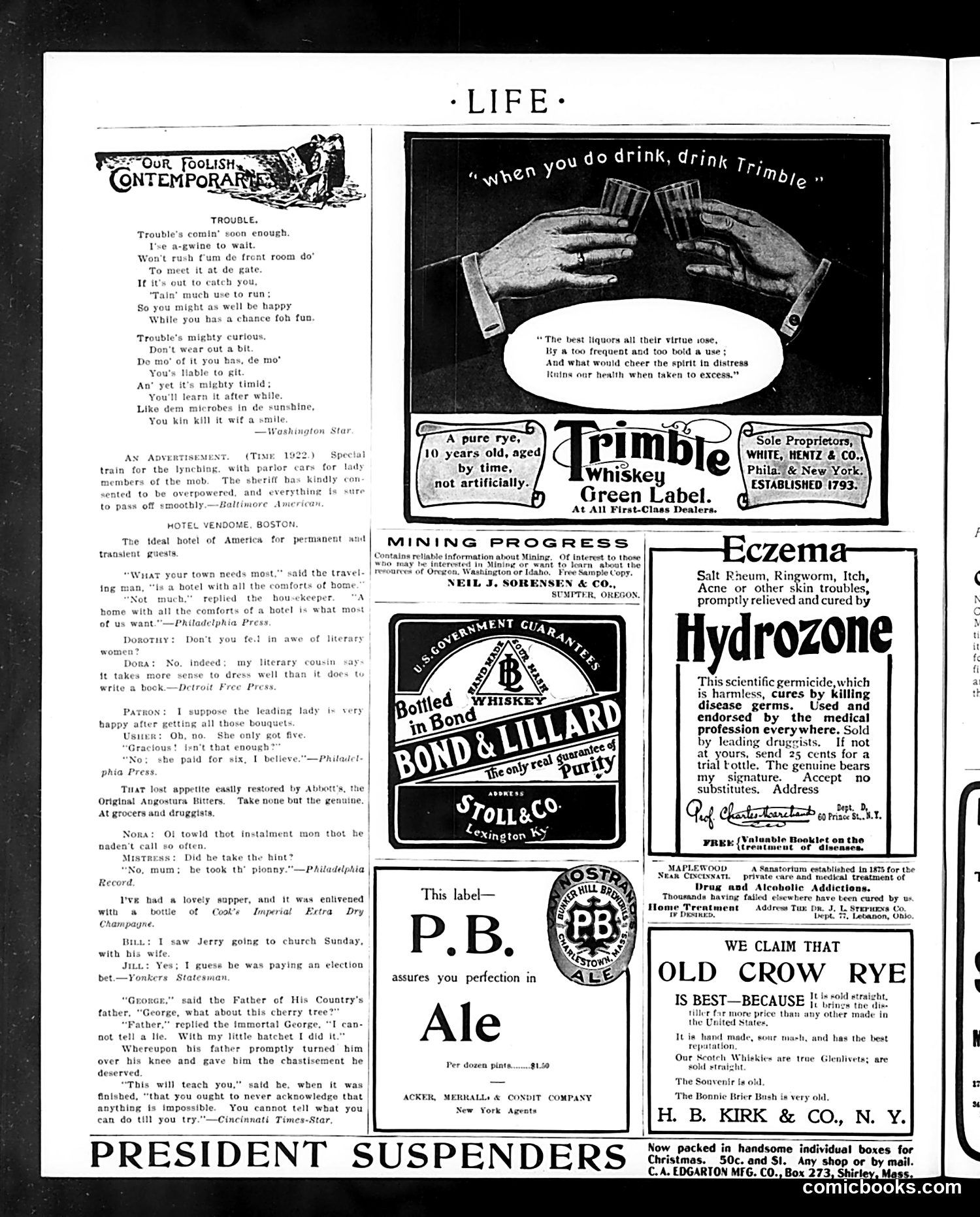
This page features Life's regular humor column mocking everyday foolishness. The main cartoon depicts "Trouble" as a personified character—depicted as someone lazy and cowardly who won't rush to confront you, yet grows emboldened if you flee. The satire suggests people needlessly fear troubles that would dissipate if confronted directly. The poem uses African American vernacular dialect (common in early 20th-century humor, though offensive by modern standards) to present folk wisdom: don't run from problems; face them with a smile. Surrounding the cartoon are brief anecdotes mocking various social types—pompous literary women, hotel patrons, the overly curious—all illustrating contemporary human absurdities. The remainder of the page consists of period advertisements for whiskey, ale, and patent medicines (Hydrozone, Old Crow Rye), typical of 1920s publications.
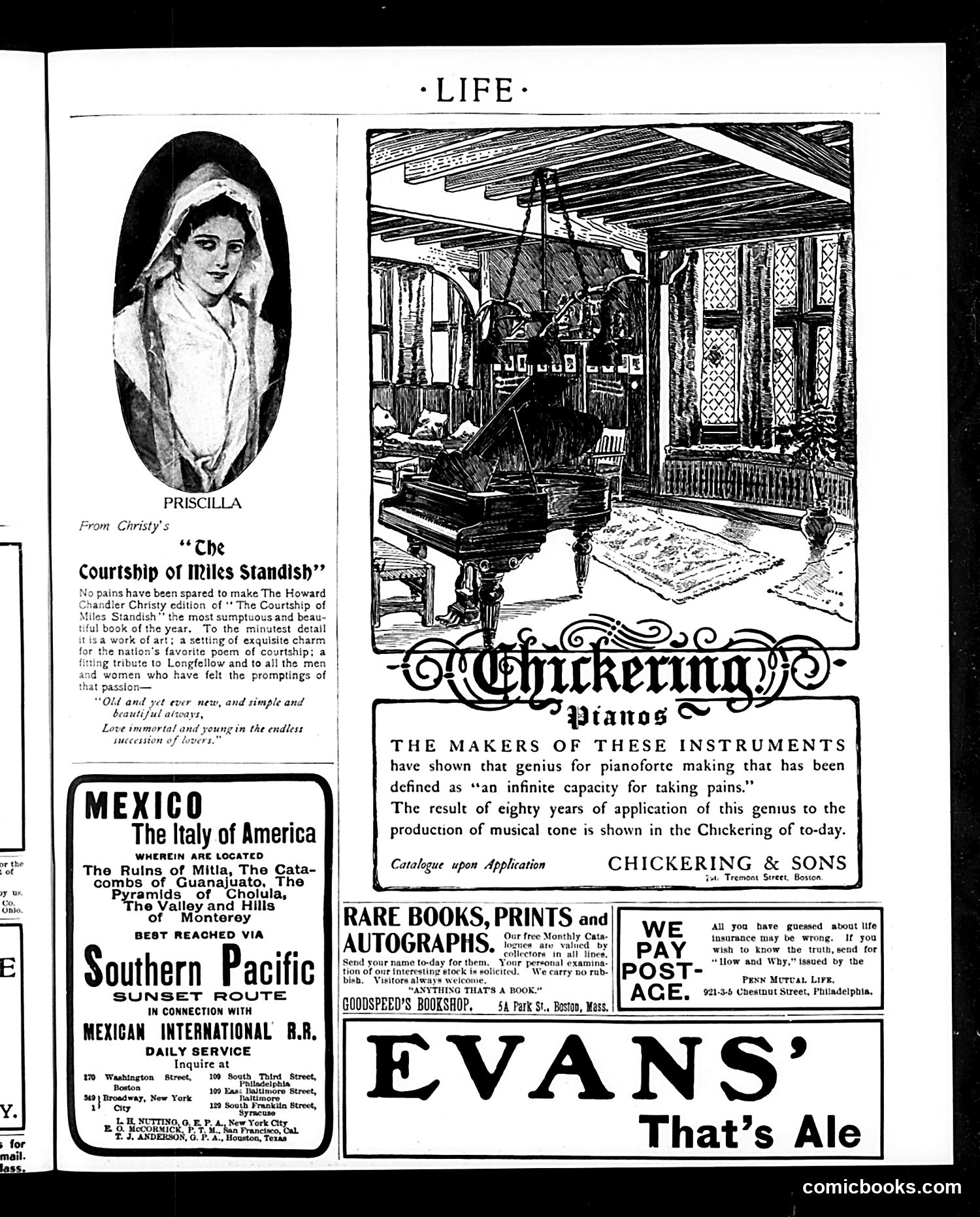
This is primarily a **vintage advertising and promotional page** from *Life* magazine, not a political cartoon. The main content includes: **"Priscilla" illustration**: References a Howard Chandler Christy adaptation of Longfellow's "The Courtship of Miles Standish"—a historical romance poem about early American colonists. The text celebrates the work as a tribute to the famous poem and courtship itself. **Advertisements**: The page features standard early-20th-century ads for: - Mexico tourism (positioning it as "The Italy of America") - Southern Pacific Railroad travel - Chickering pianos (emphasizing their craftsmanship) - Rare books and autographs - Penn Mutual Life insurance - Evans' Ale **Historical context for modern readers**: This reflects pre-WWI American interests in classical literature, domestic leisure (piano ownership), travel to exotic destinations, and early insurance marketing. The aesthetic and typography are characteristic of early 1900s magazine design. There is **no apparent political satire** on this page—it's a straightforward mix of cultural promotion and commercial advertising.
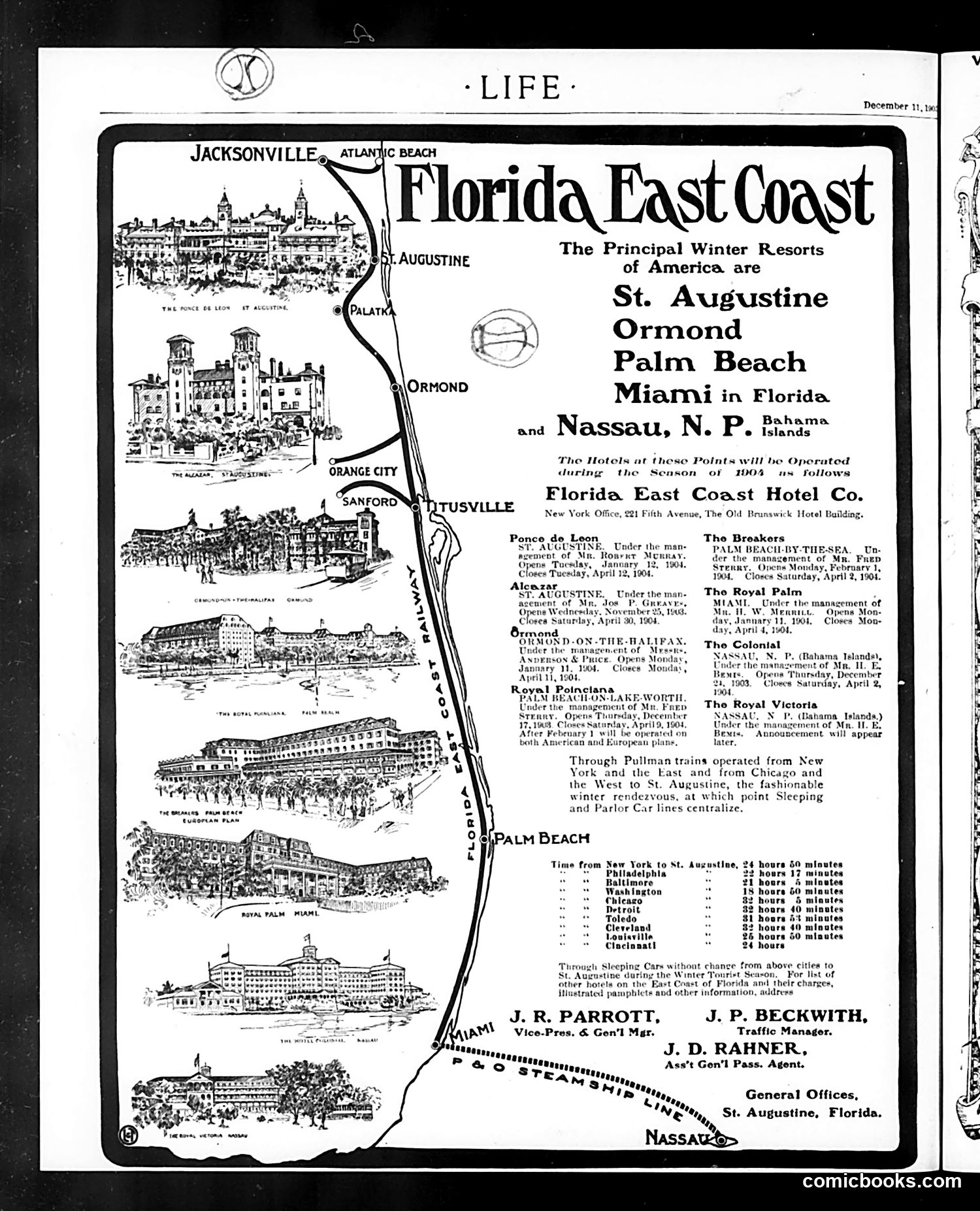
This is not a cartoon page but rather a **full-page advertisement** from Life magazine (dated December 11, 1904) promoting Florida's East Coast as a winter resort destination. The page features: - A **map** showing the Florida coastline with major resort towns marked (Jacksonville, St. Augustine, Ormond, Palm Beach, Miami) - **Architectural illustrations** of grand hotels operated by the Florida East Coast Hotel Company, including the Royal Poinciana, Breakers, Royal Palm, and others - **Operational details**: opening/closing dates for each resort hotel during the 1903-1904 winter season - **Travel information**: train times from major northern cities to St. Augustine (ranging from 24-50+ hours) - **Contact information** for booking through company officers The underlying message targets wealthy northeastern Americans seeking fashionable winter escapes. The elaborate hotel illustrations emphasize luxury accommodations, while the transportation data highlights accessibility via Pullman trains—positioning Florida as the premier destination for affluent leisure travelers during the Gilded Age.