
Life, 1903-12-11 · page 12 of 20
Life — December 11, 1903 — page 12: what you’re looking at
What you’re looking at
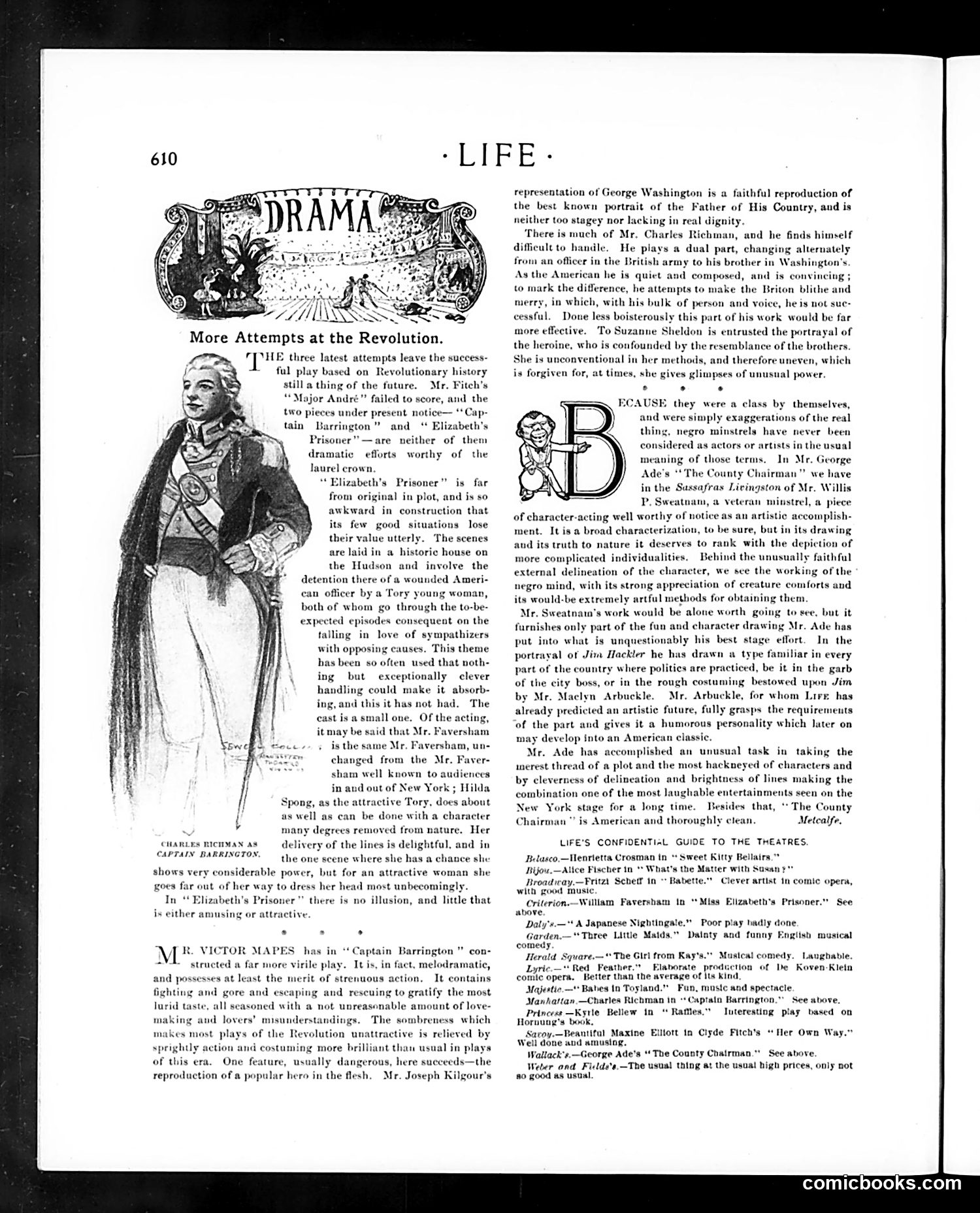
This page reviews contemporary theatrical productions, focusing on Revolutionary War-themed plays. The illustration depicts **Charles Richman as "Captain Harrington,"** a character in one such production. The text critiques three recent plays attempting Revolutionary history: *Major André*, *Captain Harrington*, and *Elizabeth's Prisoner*. The reviewer notes these dramatizations often sacrifice historical accuracy for theatrical effect. The page's satire targets how American theater exploits patriotic subject matter superficially. The commentary suggests playwrights prioritize spectacle and melodrama over authentic historical representation—a familiar critique of populist entertainment treating serious subjects carelessly. The page includes a "Life's Confidential Guide to the Theatres," listing current productions with brief, often dismissive reviews of various shows and performers.
📄 Transcribed text from this page (OCR, searchable)
Machine-transcribed from the original scan — historical spelling and the odd misread are preserved.
2 LUPE = More Attempts at the Revolution. (pee three latest attempts lea\ ful play based on Revolutionary history stilla thing of the future. Mr. Fitch's “Major André” failed to score, and the two pieces under present notice— ‘ Cap- tain Barrington” and “ Elizabeth's Prisoner" —are neither of them dramatic efforts worthy of the laurel crown “Elizabeth's Prisoner" is far from original in plot, and is so awkward in construction that its few good situations lose their value utterly. The scenes are laid in a historic house on the Hudson and involve the detention there of a wounded Ameri- he success- can officer by a Tory young woman, both of whom go through the to-be- ed episodes consequent on the talling in love of sympathizers with opposing causes. This theme has been so often used that noth- but exceptionally clever could make it absorb- and this it has not had. The cast is a small one, Of the acting, it may be said that Mr. F: is the same Mr. Faversham, un changed from the Mr. Fav sham well known to audiences in and out of New York ; Hilda Spong, as the attractive Tory, does about as well as can be done with a character many degrees removed from nature. Her delivery of the lines is delightful, and in the one scene where she has a chance she shows very considerable power, but for an attractive woman sh CHARLES RICHMAN As CAPTAIN BARRINGTON, goes far out ¢ y to dress her head most unbecomingly In “ Elizabeth's Prisoner” there is no illusion, and little that is either amusing or attractive. . . ° M R. VICTOR MAPES has in *‘ Captain Barrington " con- -V1. structed a far more virile play. Itis, in fact, melodramatic, and possesses at least the merit of strenuous action, It contains fighting and gore and escaping and rescuing to gratify the most lurid taste, all seasoned with a not unreasonable amount of love- making and lovers’ misunderstandings. The sombreness which akes most plays of the Revolution unattractive is relieved by sprightly it than usual in plays of this era. One feature, usually dangerous, here succeeds—the reproduction of a popular hero in the flesh, Mr. Joseph Kilgour's ‘tion and costuming more br representation of George Washington is a faithful reproduction of the best known portrait of the Father of His Country, and is neither too stagey nor lacking in real dignity. ‘There is much of Mr. Charles Richman, and he finds himself dificult to handle. He plays a dual part, changing alternately from an officer in the British army to his brother in Washington's nhe is quiet As the Ameri d composed, and is convincing ; to mark the difference, he attempts to make the Briton blithe and merry, in which, with his bulk of person and voice, he is not su cessful. Done less boisterously this part of his work would be far more effective. To Suzanne Sheldon is entrusted the portrayal of the heroine, who is confounded by the resemblance of the brothers. She is unconventional in her methods, and therefore uneven, which is forgiven for, at times, she gives glimpses of unusual power. ° . . ECAUSE they were a class by themselves, and were simply exaggerations of the real thing, negro minstrels have never bee considered as actors or artists in the usual meaning of those terms, In Mr. George Ade’s ‘The County Chairman” we have in the Sassafras Livingston of Mr. Willis P. Sweatnam, a veteran minstrel, a piece of character-acting well worthy of notice as an artistic accomplish- ment. It is a broad characterization, to be sure, but in its drawing and its truth to nature it deserves to rank with the depiction of more complicated individualities, Behind the unusually faithful external delineation of the character, we sce the working of the negro mind, with its strong appreciation of creature comforts and its would-be extremely artful methods for obtaining them. Mr. Sweatnata’s work would be alone worth going to see, but it furnishes only part of the fun and character drawing Mr. Ade has put into what is unquestionably his best stage effort. In the portrayal of Jim Hackler he has drawn a type familiar in every part of the country where politics are practiced, be it in the garb of the city boss, or in the rough costuming bestowed upon Jim by Mr. Maclyn Arbuckle. Mr. Arbuckle, for whom Lire has already predicted an artistic future, fully grasps the requirements of the part and gives it a humorous personality which later on may develop into an American classic, Mr. Ade has accomplished an unusual task in taking the iwnerest thread of a plot and the most hackneyed of characters and by cleverness of delineation and brightness of lines making the combination one of the most laughable entertainments seen on the New York stage for a long time. Besides that, Chairman ” is American and thoroughly clean. The County Metcalfe, LIFE'S CONFIDENTIAL GUIDE TO THE THEATRES. Belasco.—Menrletta Crosman in“ Sweet Kitty Bellairs.* Rijou.—Allce Fischer in * What's the Matter with Susan?" Rroadway.—Fritzi Schell 1n “ Babette." Clever artist in comic opera, with good music. Criterion.—Willlam Faversham tn “Miss Elizabeth above. Daly's.—"* A Japanese Nightingale.” Poor play hadly done. Garden.— “Three Little Maids.” Datoty and fanny Engtish musical comedy. Herald Square. The Girl from Kay's." Musical comedy. Laughable. Lyric.—"* Red Feather." Elaborate production of De Koven-Klein conte opera. Better than the average of Its kind, Majestic. —"* Babes In Toyland.” Fun, muste and spectacte. Manhattan.—Charles Richman in “Captain Barrington.” See above, Princess —Kytle Bellew in“ Ratties.* Iuteresting play based on Hornung’s book. Saroy.—Teantital Maxine Elliott tn Clyde Fitch's “Her Own Way.” Well done and amustog. Wallack'e.—George Ade's “The County Chairman.” See above. Weber ond Ficlde’e,—The usual thing at the usual high prices, only not 80 good as usual. Prisoner." See comicbooks.com