
Life, 1903-12-11 · page 4 of 20
Life — December 11, 1903 — page 4: what you’re looking at
What you’re looking at
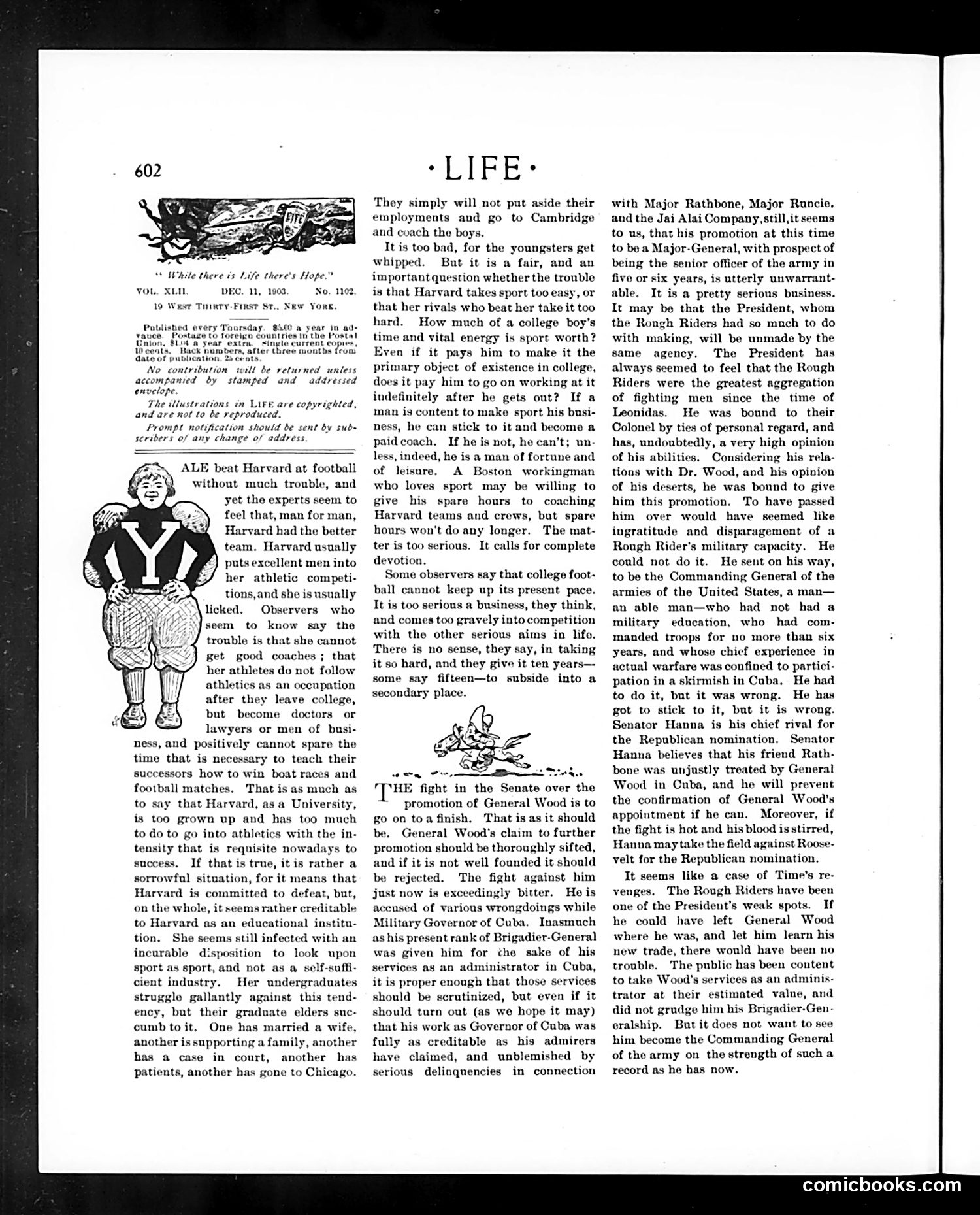
The main cartoon depicts a Yale football player in the distinctive "Y" uniform, captioned "YALE beat Harvard at football without much trouble, and yet the experts seem to feel that, man for man, Harvard had the better team." **The Satire:** This mocks Harvard's excuses-making after losing to Yale. Despite being supposedly superior individually ("man for man"), Harvard lost the actual game. The cartoon ridicules the tendency of Harvard alumni and supporters to explain away athletic defeats through rationalizations rather than accepting Yale's genuine superiority on the field. The accompanying text discusses collegiate athletics broadly—specifically tensions over whether sport should remain a priority at universities like Harvard, and debates about General Wood's military promotion. The magazine satirizes both Harvard's athletic pretensions and broader questions about institutional priorities.
📄 Transcribed text from this page (OCR, searchable)
Machine-transcribed from the original scan — historical spelling and the odd misread are preserved.
“ While there ts Life there's Hope.” 1. XL DEC. 11, 19 West THety-F 1908. No. 1102. RST St.. New YORe. Published every Tanrsda eam r date of publication. 2 cats No contribution will be returned unless accompanied by stamped and addressed envelope. The illustrations in Lue are copyrighted, and are not to be reproduced, Prompt notification should be sent by sub- scribers of any change of address. ALE beat Harvard at football without much trouble, and yet the experts seem to feel that, man for man, Harvard had the better team. Harvard usually puts excellent men into her athletic competi- nd she is usually Observers who seem to know say the trouble is that she cannot get good coaches ; that her athletes do not follow athletics as an occupation after they leave college, but become doctors or lawyers or men of busi- ness, and positively cannot spare the time that is necessary to teach their successors how to win boat races and football matches. That is as much as to say that Harvard, asa University, is too grown up and has too much to do to go into athletics with the in- tensity that is requisite nowadays to suce If that is true, itis rather a sorrowful situation, for it means that Harvard is committed to defeat, but, on the whole, it seems rather creditable to Harvard as an educational institu- tion. She seems still infected with an incurable disposition to look upon sport as sport, and not as a self-suffi- cient industry. Her undergraduates struggle gallantly against this tend- ency, but their graduate elders suc- cumb to it. One has married a wife, another is supporting a family, another has a case in court, another has patients, another has gone to Chicago. ~LIPE* They simply will not put aside their employments aud go to Cambridge and coach the boys. It is too bad, for the youngsters get whipped. But it is a fair, and an important question whether the trouble is that Harvard takes sport too easy, or that her rivals who beat her take it too hard. How much of a college boy's time and vital energy is sport worth? Even if it pays him to make it the primary object of existence in college, does it pay him to go on working at it indefinitely after he gets out? If a man is content to make sport his busi- ness, he can stick to it and become a paidcoach. If he is not, he can’t; un- less, indeed, he is a man of fortune and of leisure. A Boston workingman who loves sport may be willing to give his spare hours to coaching Harvard teams and crews, but spare hours won't do any longer. The mat- ter is too serious. It calls for complete devotion. Some observers say that college foot- ball cannot keep up its present pace. It is too serious a business, they think, and comes too gravely into competition with the other serious aims in life. There is no sense, they say, in taking it so hard, and they give it ten years— some say fifteen—to subside into a secondary place. ee Oe I Ti ke THE fight in the Senate over the promotion of General Wood is to go on toa finish. That is as it should be. General Wood's claim to further promotion should be thoroughly sifted, and if it is not well founded it should be rejected. The fight against him sceedingly bitter. He is used of various wrongdoings while Military Governor of Cuba. Inasmuch as his present rank of Brigadier-General was given him for the sake of his services as an administrator in Cuba, it is proper enongh that those services should be scrutinized, but even if it should turn out (as we hope it may) that his work as Governor of Cuba was fully as creditable as his admirers have claimed, and unblemished by serious delinquencies in connection with Major Rathbone, Major Rancie, and the Jai Alai Company, still,it seems to us, that his promotion at this time to be a Major-General, with prospect of being the senior officer of the army in five or six years, is utterly unwarrant- able. It is a pretty serious business. It may be that the President, whom the Rough Riders had so much to do with making, will be unmade by the same agency. The President has always seemed to feel that the Rough Riders were the greatest aggregation of fighting men since the time of Leonidas. He was bound to their Colonel by ties of personal regard, and has, undoubtedly, a very high opinion of his abilities. Considering his rela- tions with Dr. Wood, and his opinion of his deserts, he was bound to give him this promotion. To have passed him over would have seemed like ingratitude and disparagement of a Rough Rider's military capacity. He could not do it. He sent on his way, to be the Commanding General of the armies of the United States, a man— an able man—who had not had a military education, who had com- manded troops for no more than six years, and whose chief experience in actual warfare was confined to partici- pation in a skirmish in Cuba, He had to do it, but it was wrong. He has got to stick to it, but it is wrong. Senator Hanna is his chief rival for the Republican nomination. Senator Hanna believes that his friend Rath- bone was unjustly treated by General Wood in Cuba, and he will prevent the confirmation of General Wood's appointment if he can. Moreover, if the fight is hot and his blood is stirred, Hanna may take the field against Roose- velt for the Republican nomination. It seems like a case of Time's re- venges. The Rough Riders have been one of the President's weak spots. If he could have left General Wood where he was, and let him learn his new trade, there would have been no trouble. The public has been content to take Wood's services as an adminis- trator at their estimated value, and did not grudge him his Brigadier-Gen- eralship. But it does not want to see him become the Commanding General of the army on the strength of such a record as he has now. comicbooks.com