
Life, 1903-12-11 · page 6 of 20
Life — December 11, 1903 — page 6: what you’re looking at
What you’re looking at
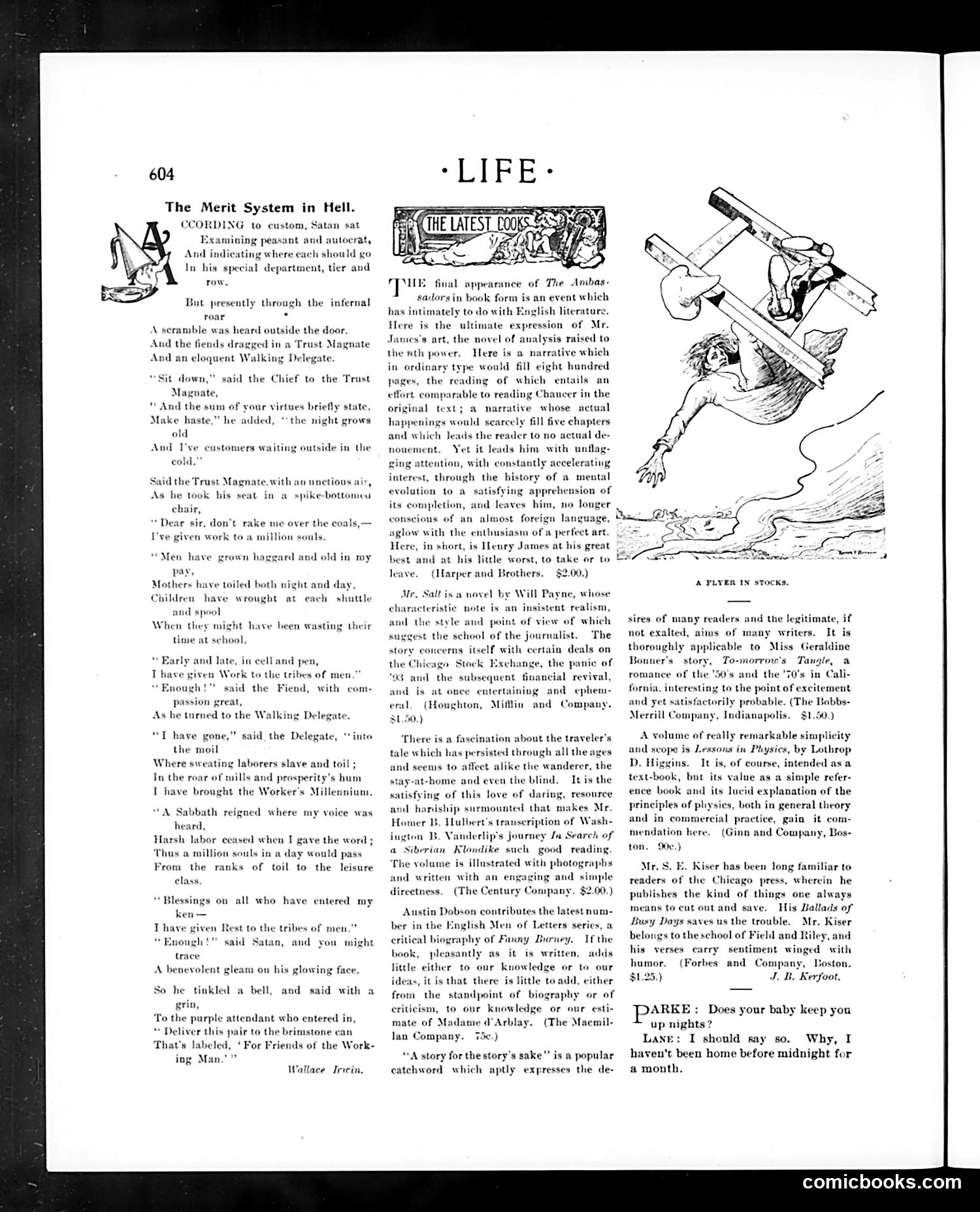
This page contains **"The Merit System in Hell,"** a satirical poem about bureaucratic damning procedures. The cartoon depicts a figure operating what appears to be a large industrial machine or apparatus, suggesting hell's administration has become mechanized and bureaucratic. The satire mocks the "merit system"—likely a contemporary civil service reform debate—by imagining it applied to damnation itself. Rather than immediate punishment, souls now face bureaucratic processing, examination, and categorization. The poem's dialogue between a "Chief" and "Trust Magnate" suggests the satire targets wealthy industrialists and those escaping consequences through technicalities. The accompanying illustration shows the absurdist result: even in hell, modern administrative systems create inefficient, dehumanizing processes that contradict traditional notions of justice.
📄 Transcribed text from this page (OCR, searchable)
Machine-transcribed from the original scan — historical spelling and the odd misread are preserved.
604 The Merit System in Hell. CCORDING to custom, S: Examining peasant and ¢ And indicating where In his special deps row. h should x ‘tment, tier aud But presently through the infernal \ scramble was heard outside the door. fiends dra And an eloquent Walking Delegate said the Chief to the Trust And the sum of your virtues briefly state. he added, ‘the night grows tomers waiting outside in the Said the Trust Magn As he took his seat in a spike-bottomeu tewith an unetions a chair, “Dear sir, don’t rake me over the coals,— I've given work to million souls. “Men ha pay, Moth Children When they mig time at school grown haggard and old in my rs have toiled both night and di have wrought at each shuttle it have been wasting their “Early and late, in cell and pen, Thave given Work to the tribes of men.” “Enough!” said the F with passion great, As he turned to the Walking Delegate. com: “T have gone,” said the Delegate, ‘into the moil Where sweating laborers slave In the roar of mill nd toil ; prosperity’s hum I have brought the Worker's Millennium. “A Sabbath reigned where my voice was heard, Harsh labor ceased when I gave the word ; Thus @ million souls ina From the ald pass ranks of toil to the leisure class “Blessings on all who have entered my ken— T have given Rest to the tribes of me a, and you 1 A benevolent gleam on his glowing face. So he grin ‘To the purple attendant who entered in, tinkled a bell, and d with a * Deliver this pair to the brimstone can at's labeled, ‘For Friends of the Work- ing Man.” Wallace Irvin. r I saitorsin book form is an event which has intimately to do with English literature. Here is the ulti pression of Mr. James's art, the novel of analysis raised to Here is a narrative which in ordinary type would t hundred pages, the reading of which entails an effort compa z Chaucer in the tive whose actual 1 scarcely fill five chapters s the reader to no actual de Yet it leads him with unfl ging attention, with constantly accelerat interest, through the history of a men evolution to a satisfy its completion, and le conscious of an almost. fo aglow with the enthusiasm o Here, in short, is Henry best and at his little worst, to take or to (Harper and Brothers. $2.00.) the nth power. original text and which | nouement apprehension of es him, no longer language, a perfect art. mes at his great leave. wel by Will Payne, whose n insistent realism, ul point of view of which The erns itself with certain deals on change, the panic of neial revival, and suggest the school of the journalist. ad the subsequent fin and is atc eral. (Houghton, Miflin and Company $1.50.) © entertainin phem- ion about the traveler's isted through all the ages the wanderer, the It is the resource and hardship surmounted that makes Mr. Homer 13. Hulbert’s transcription of Wash- ington 1B. Vanderlip's journey In Search of @ Siberian Klondike such good reading. ‘The volume is illustrated with photographs and written with an engagi (The Century Company. $2.00.) pere is a fasein: tale which has pers and seems to affect alib t-home and even the blind. satisfying of this love of darin and simple directness. Austin Dobson contributes the latest num- ber in the English Men of Letters series, critical biography of Fanny Burney. If the book, pl adds little either to our knowledge or to our ideas, it is that there i ysantly as it is writte criticisn mate of M. to our knowledge or our esti- WArblay. (The Macmil- Se.) “A story for the story's sake" is a popular catchword which aptly expresses the de- sires of many readers and the legitimate, if not exalted, aims of many writers. It is thoroughly applicable to Miss Geraldine Bonner’s story o-morrow's ngle, & nce of the ‘50's and the '70's in Cali- interesting to the point of excitement ily probable. (The Bobbs- Merrill Company, Indianapolis. $1.50.) A volume of really remarkable simplicity and scope is Lessons in Physics, by Lothrop D. Higgins. It is, of course, intended as a text-book, but its value as a simple re ence book and its lucid explanation of the principles of physics, both in general theory and in commercial practice, gain it com- menda (Ginn and Company, Bos- ton, 90e.) Mr. S. E. Kiser has been long familiar to readers of the Chicago press, wherein he publishes the kind of things one alwa His Ballads of Busy Days saves us the trouble. Mr. Kiser belongs to the school of Field and Riley, and his verses carry sentiment winged with humor. (Forbes and Company, Boston. $1.25.) J.B. Kerfoot. PAREE : Does your baby keep you up nights? Lane: I should say so. Why, I haven't been home before midnight for a month. ion he means to cut out and save. comicbooks.com