
A complete issue · 20 pages · 1903
Life — November 12, 1903
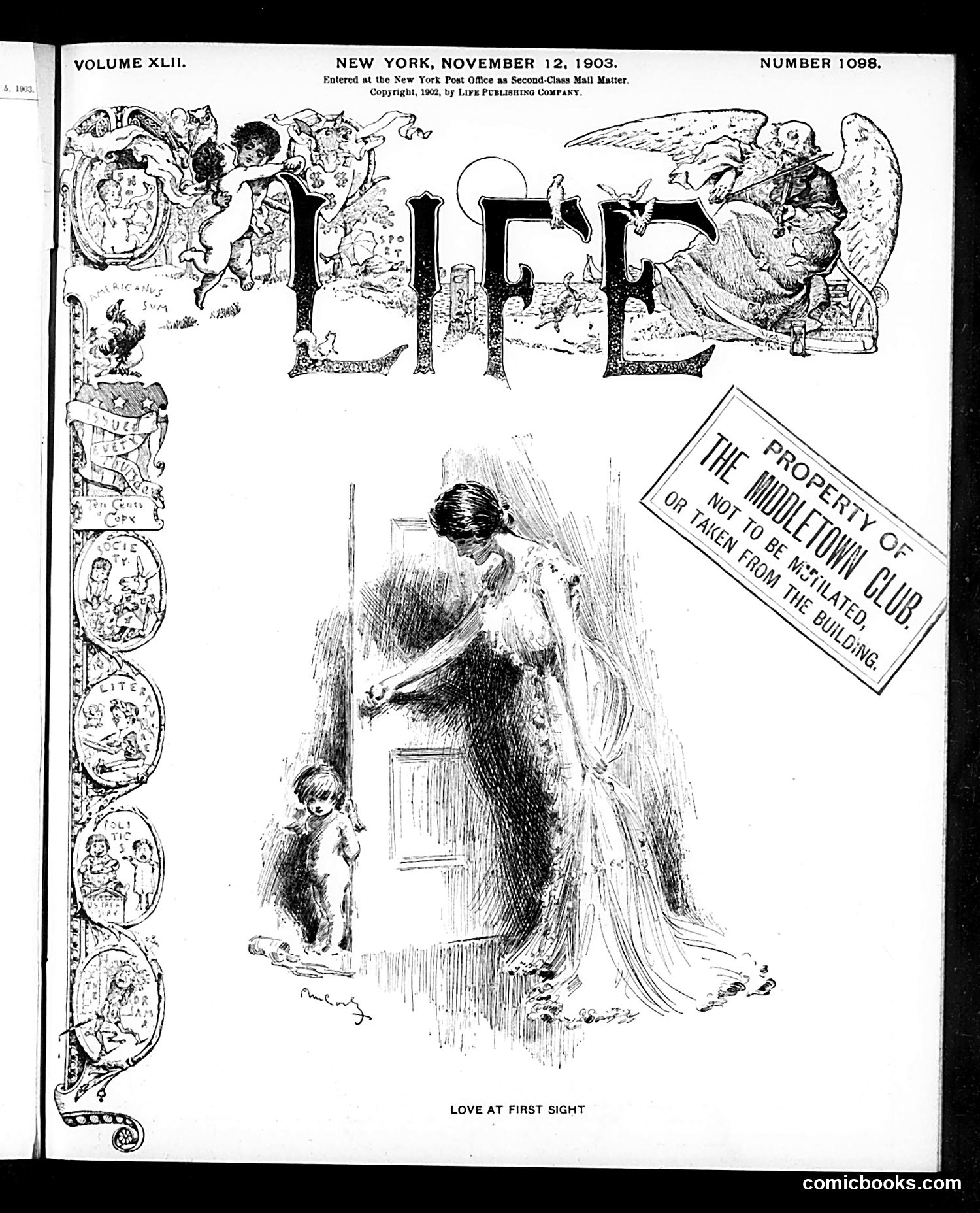
This page features two distinct satirical pieces: **Top:** The "LIFE" masthead is decorated with whimsical cherubs and classical figures—typical Art Nouveau ornamentation for the magazine's cover design. **Bottom:** A sketch titled "LOVE AT FIRST SIGHT" depicts a woman and child at a doorway, with a notice reading "PROPERTY OF FROMONT CLUB / NOT TO BE REMOVED OR TAKEN FROM THE BUILDING." This appears to be social satire about wealthy club culture in early 1900s New York. The joke likely mocks the absurdity of treating human relationships (romantic attraction, motherhood) as "property" owned by elite institutions—contrasting sentimental Victorian ideals about love with the commodification and class-based restrictions of exclusive clubs. The irony underscores period class tensions.
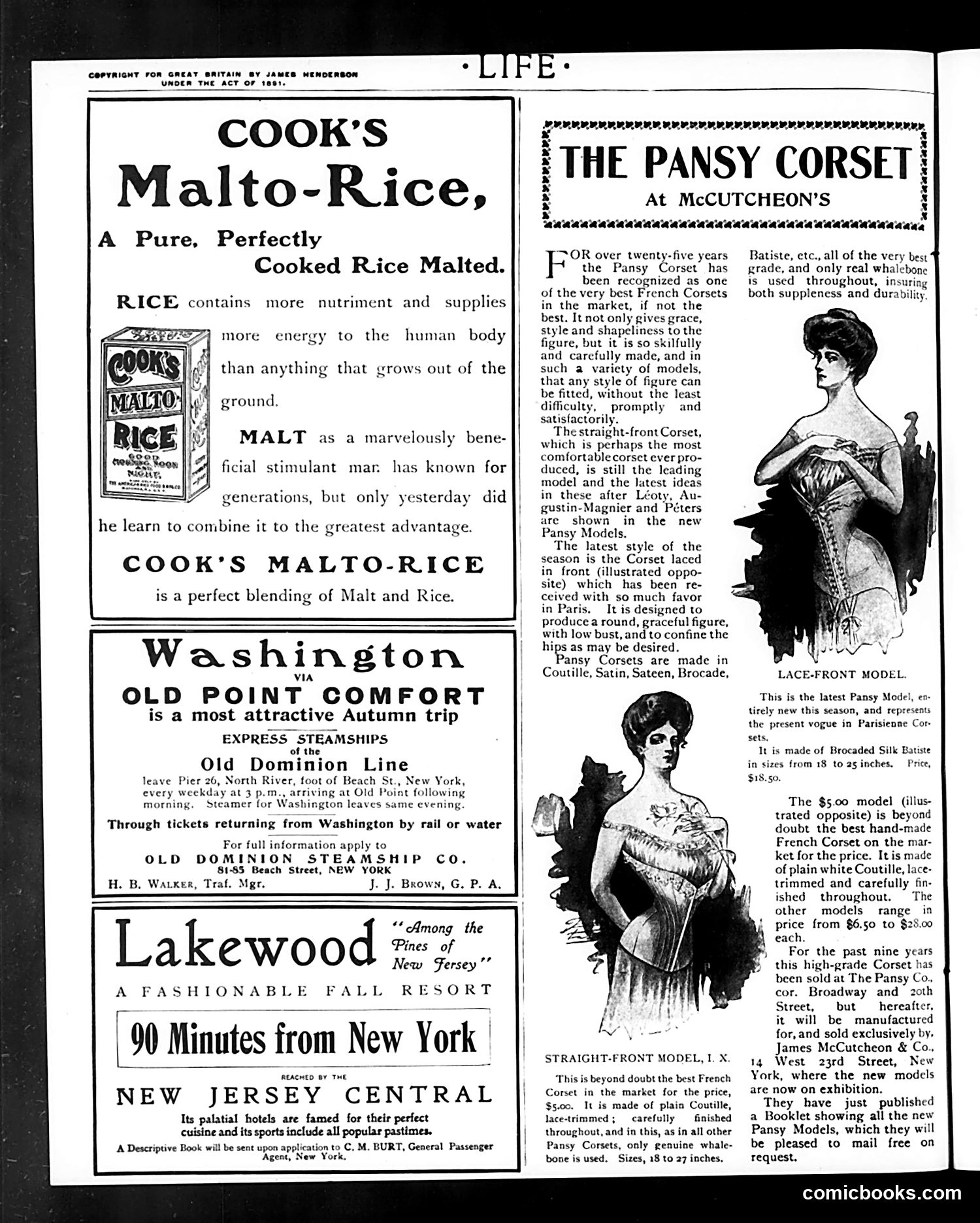
This page is **primarily advertising**, not satirical content. It contains four distinct advertisements: 1. **Cook's Malto-Rice**: A nutritional product combining malt and rice, marketed for its energy and health benefits. 2. **The Pansy Corset** (McCutcheon's): Features illustrations of women in corsets, advertising various models ranging from $5 to $23. The text emphasizes the corsets' comfort and fashionability, naming specific styles like the "Lace-Front Model" and "Straight-Front Model." 3. **Washington via Old Point Comfort**: Promotes steamship travel to Washington, D.C. via the Old Dominion Line. 4. **Lakewood**: Advertises a fashionable fall resort in New Jersey, accessible within 90 minutes from New York. The page reflects early 20th-century consumer culture and advertising conventions, with no evident political satire or cartoon humor.
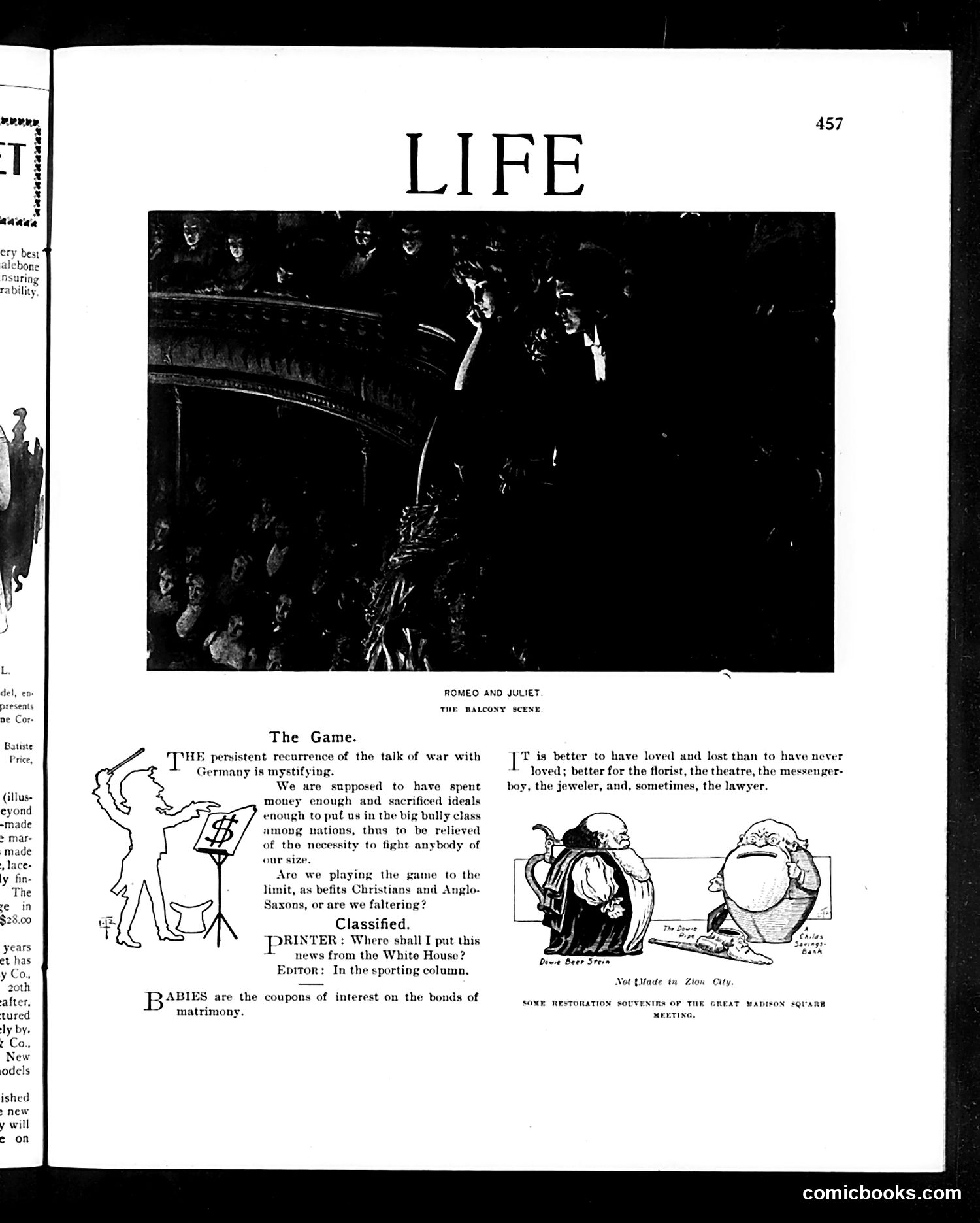
This page contains satirical commentary on World War I-era politics. **"The Game"** section critiques persistent war talk with Germany, questioning whether Americans have genuinely committed to sacrifice or are merely playing at conflict—asking if the nation is truly fighting or "faltering." **"Classified"** is a brief editorial joke about White House news leaks appearing in the sports column. The cartoon illustrations appear to depict social commentary: one figure seems to represent a woman or civilian concerned with material goods (jewelry, theater); another shows what appears to be portly figures, possibly representing profiteers or those unaffected by war hardships. **"Babies"** notes they're matrimonial bonds of interest—likely satirizing how marriage and children factor into wartime social discourse. The page reflects American ambivalence about WWI involvement circa 1917-1918.
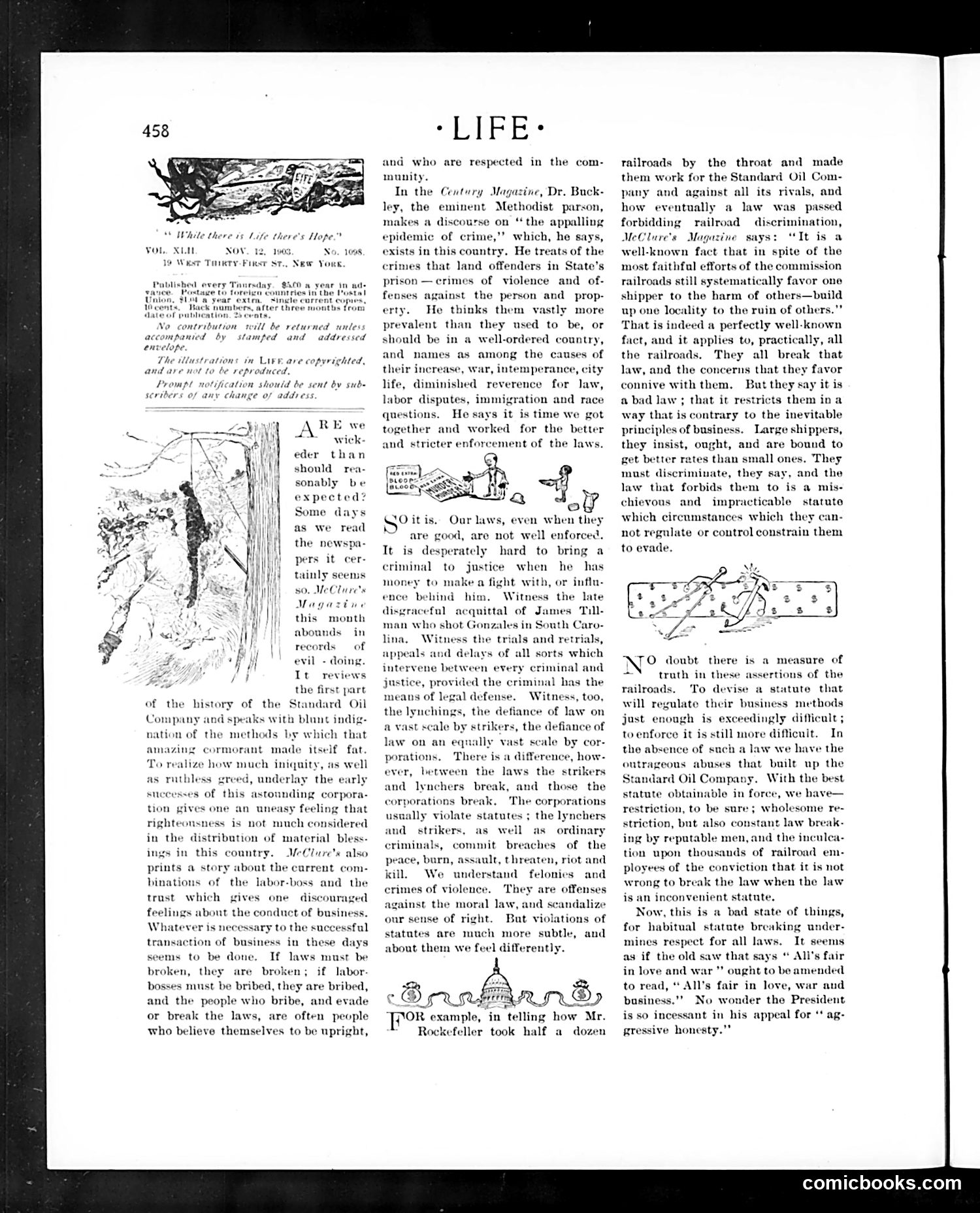
This page contains editorial text criticizing railroad industry practices and corporate law enforcement, without obvious political cartoon figures to identify specifically. The text references Dr. Buckley's *Century Magazine* article on crime, discussing how laws against violence and property crimes are unevenly enforced. It argues that while strikers and lynchers face prosecution, corporations systematically violate statutes with minimal consequence. The piece cites the "disgraceful acquittal of James Tillman" (who shot Gonzales in South Carolina) and Standard Oil Company's methods as examples of how wealth enables legal evasion. Small decorative illustrations accompany the text but lack clear satirical targets. The content advocates for stricter corporate accountability and uniform law enforcement rather than satirizing specific individuals.
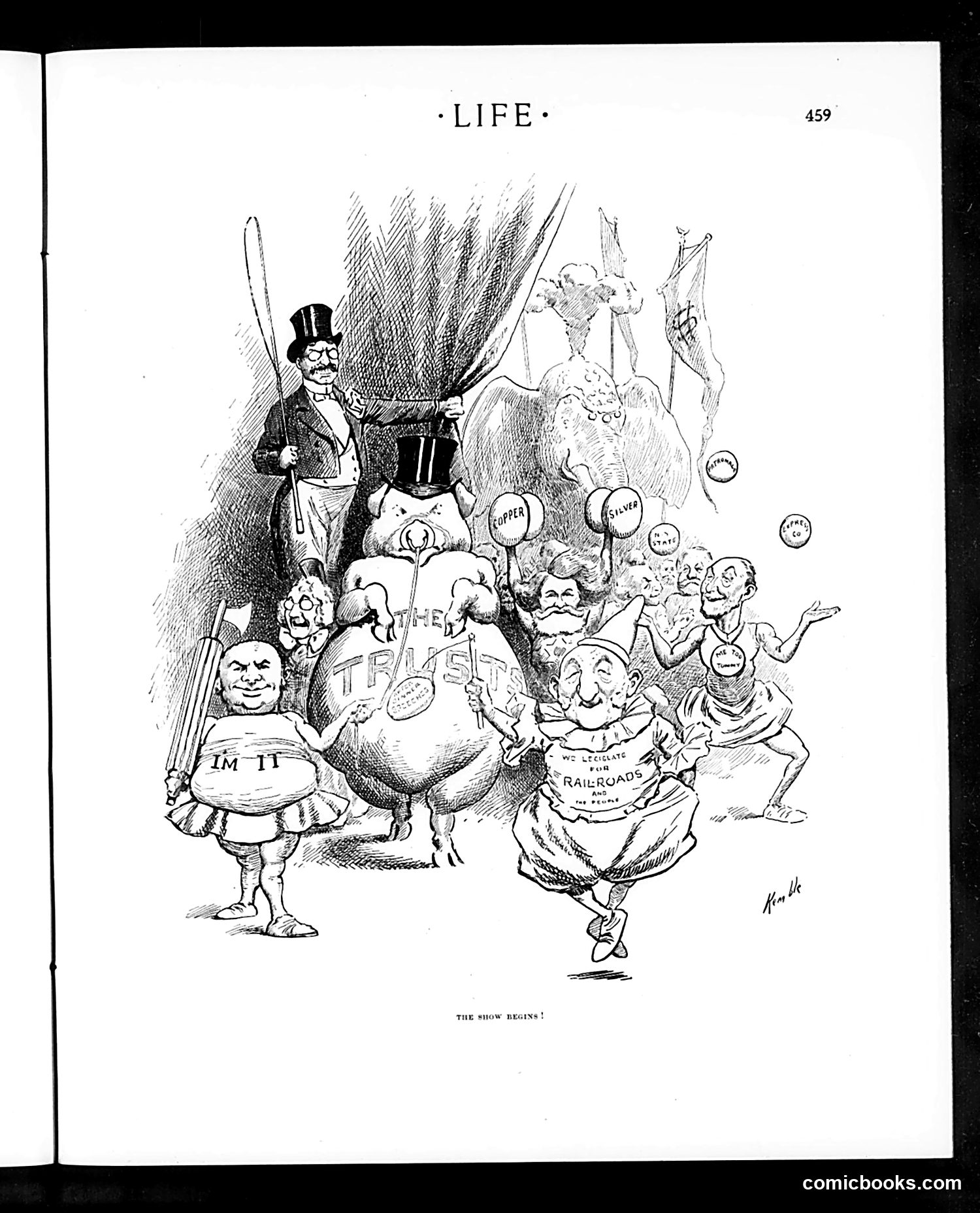
This political cartoon depicts a circus-like scene satirizing American business and politics. A ringmaster in top hat conducts proceedings while various caricatured figures—appearing to represent business interests, railroad magnates, and political players—perform around a large central figure labeled "TRUST." Several figures hold balloons labeled with corporate interests: "COPPER," "SILVER," and notably "WE LEGISLATE FOR RAILROADS" and "IN PEOPLE." The satire critiques how powerful monopolies (trusts) and business interests controlled the political and legislative processes of the era, literally "performing" at the center of American public life while politicians enabled their schemes. The circus framing suggests these were orchestrated spectacles for public consumption rather than genuine governance. This reflects Progressive Era anxieties about corporate power.
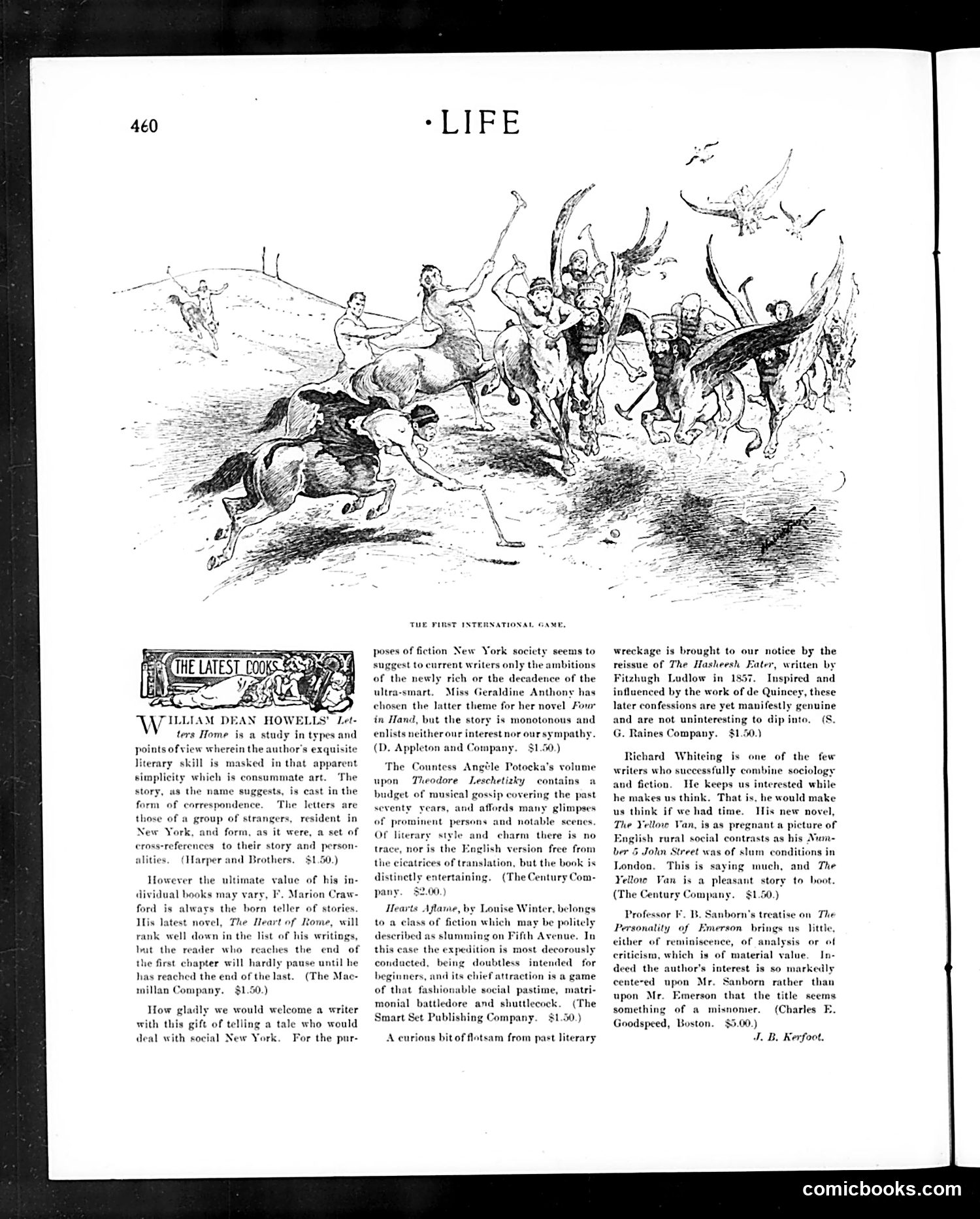
This satirical illustration depicts what appears to be a chaotic sporting event or international competition. The sketch shows figures in disarray—some falling, others in aggressive postures—with spectators visible in the background. The title "THE FIRST INTERNATIONAL GAME" suggests this mocks an early international sporting competition, likely from the late 19th century when such events were novelties. The satire appears to criticize international competition as descending into chaos or ungentlemanly conduct rather than civilized sport. The exaggerated, tumbling figures and general mayhem suggest the cartoonist viewed international athletic contests skeptically—perhaps as vehicles for national aggression rather than friendly competition. The specific event referenced is unclear without additional context.
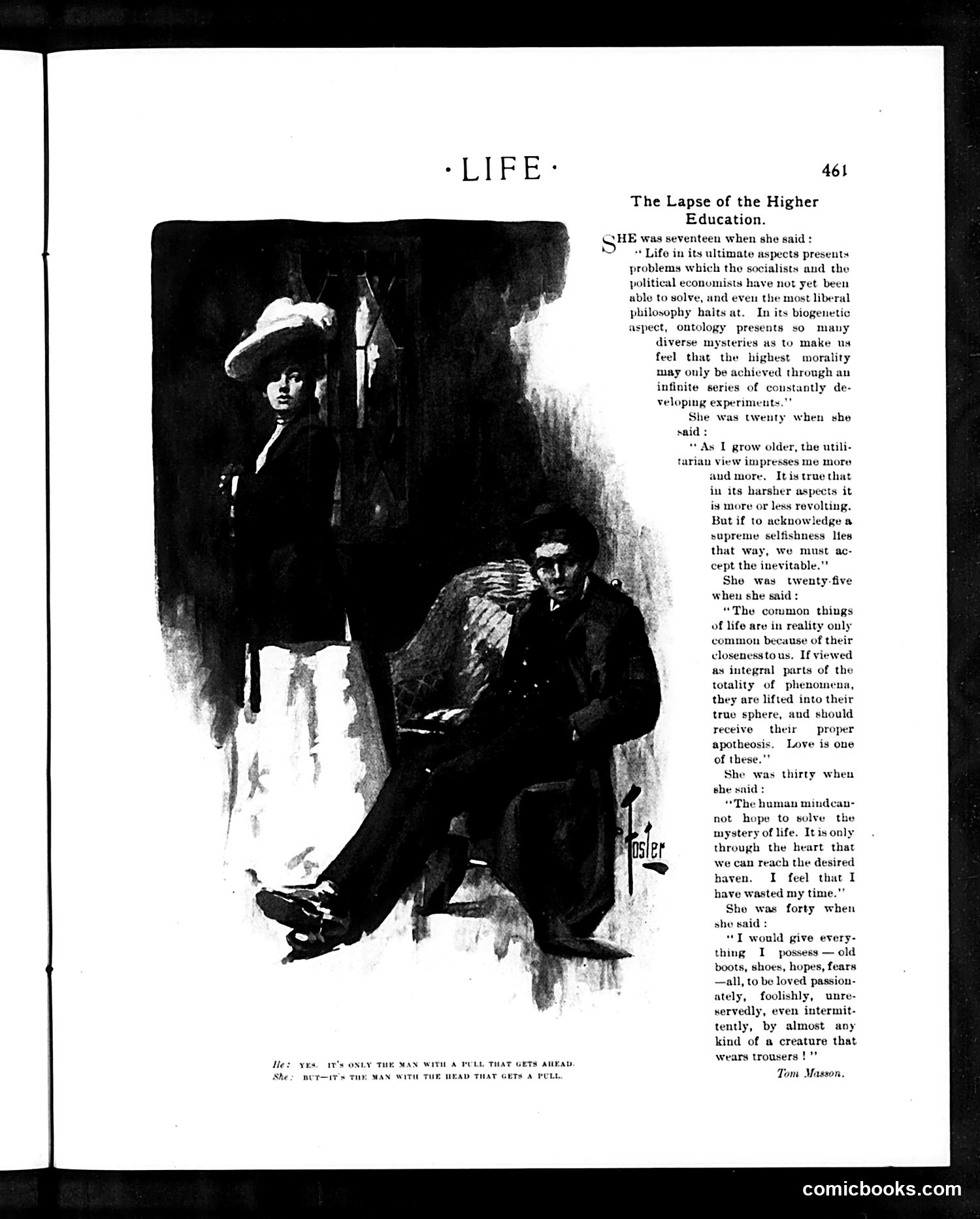
This page features a philosophical essay by Tom Masson accompanying a sketch showing two figures in what appears to be a doorway or corridor. The illustration's caption reads: "HE: yes, it's only the man with a pull that gets ahead / SHE: it's the man with the head that gets a pull." The satire critiques educational idealism versus practical reality. The essay traces a woman's philosophical evolution from age seventeen (believing life's mysteries require infinite intellectual development) through age forty (concluding she'd trade everything for love from "almost any kind of creature that wears trousers"). The cartoon and text together mock how higher education supposedly teaches abstract principles about merit and intellect, yet real advancement depends on "pull" (connections/favoritism), while the woman's arc satirizes how romantic pragmatism eventually defeats intellectual ambition.
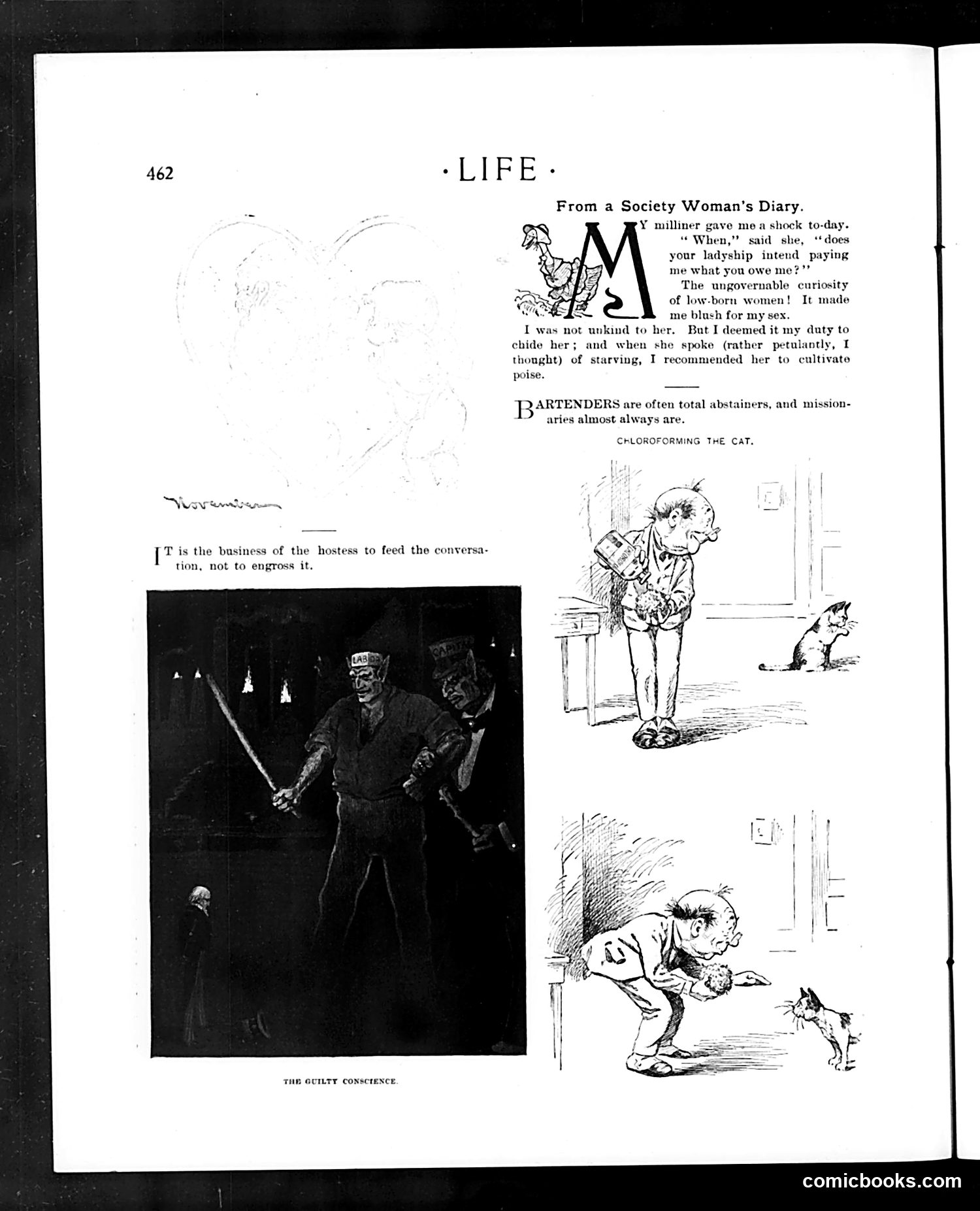
This page from *Life* magazine contains social commentary and humor about upper-class behavior and etiquette. **"From a Society Woman's Diary"** satirizes the pretensions and contradictions of wealthy society women. The excerpt mocks a woman's false indignation when a milliner questions payment, while revealing her own snobbery about cultivating "poise" rather than genuine virtue. **"Bartenders are often total abstainers"** presents a ironic observation about moral contradiction. **"Chloroforming the Cat"** shows a humorous two-panel sequence depicting someone struggling to control a cat, illustrating domestic chaos versus composed pretense—fitting the page's theme of gap between appearance and reality. **"The Guilt Conscience"** (dark photograph) appears to depict a supernatural or psychological scene, likely commenting on moral anxiety. The overall theme critiques hypocrisy and social performance in Gilded Age society.
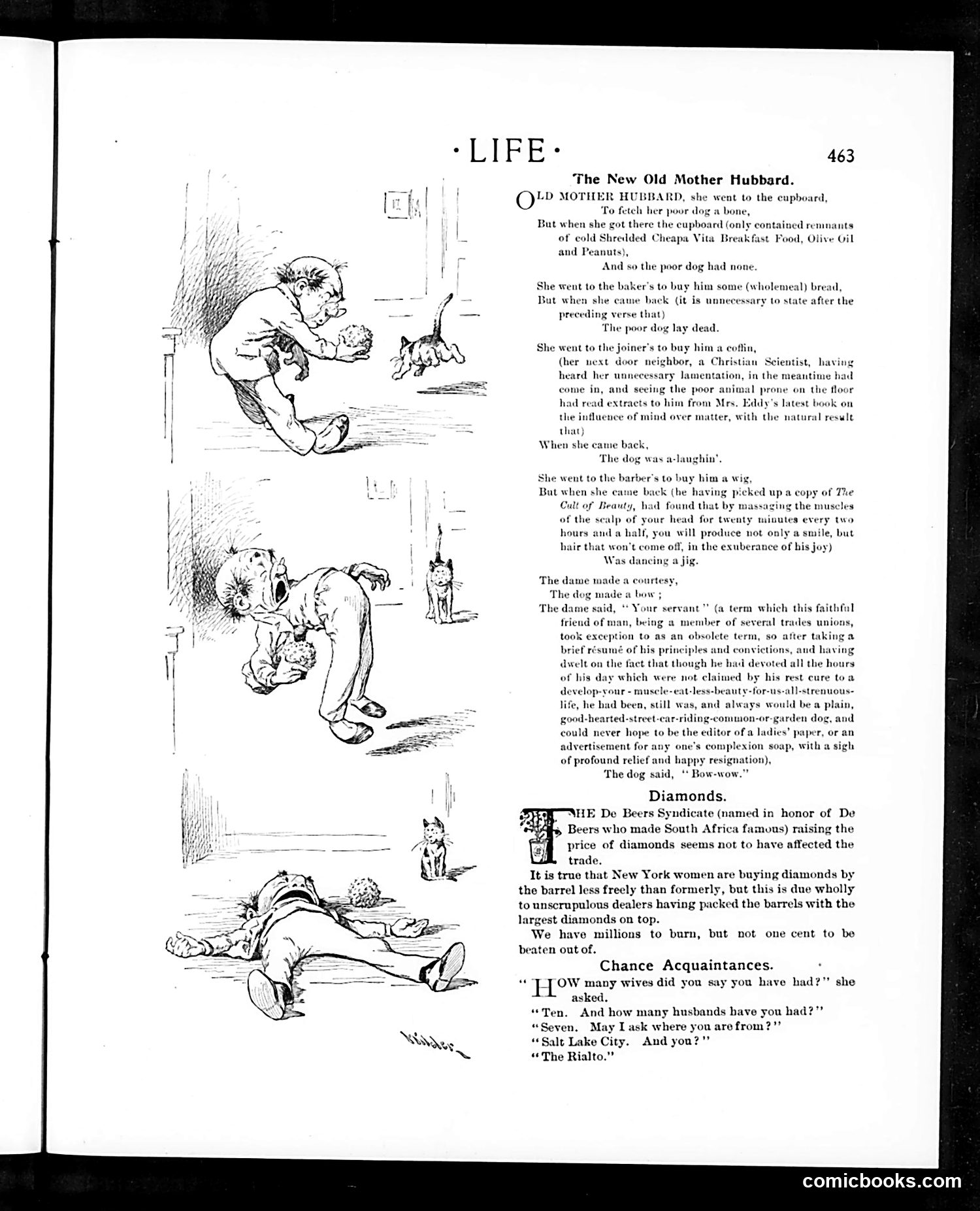
This satirical poem and accompanying illustrations parody the classic nursery rhyme "Old Mother Hubbard," reimagining it as social commentary on 19th-century consumer culture and commercialism. The joke: Mother Hubbard seeks remedies for her starving dog from various tradespeople—a baker, joiner, barber, and scientist—each attempting to sell her their services or products. The punchline suggests these merchants exploit desperation through unnecessary, ineffective, or absurd "solutions" (scalp massages for hair growth, coffins, wigs). The satire targets commercial greed and the rise of advertising/consumer manipulation, implying that modern capitalism offers elaborate answers to simple problems rather than genuine help. The dog remains unfed throughout—the actual need goes unmet while merchants profit.
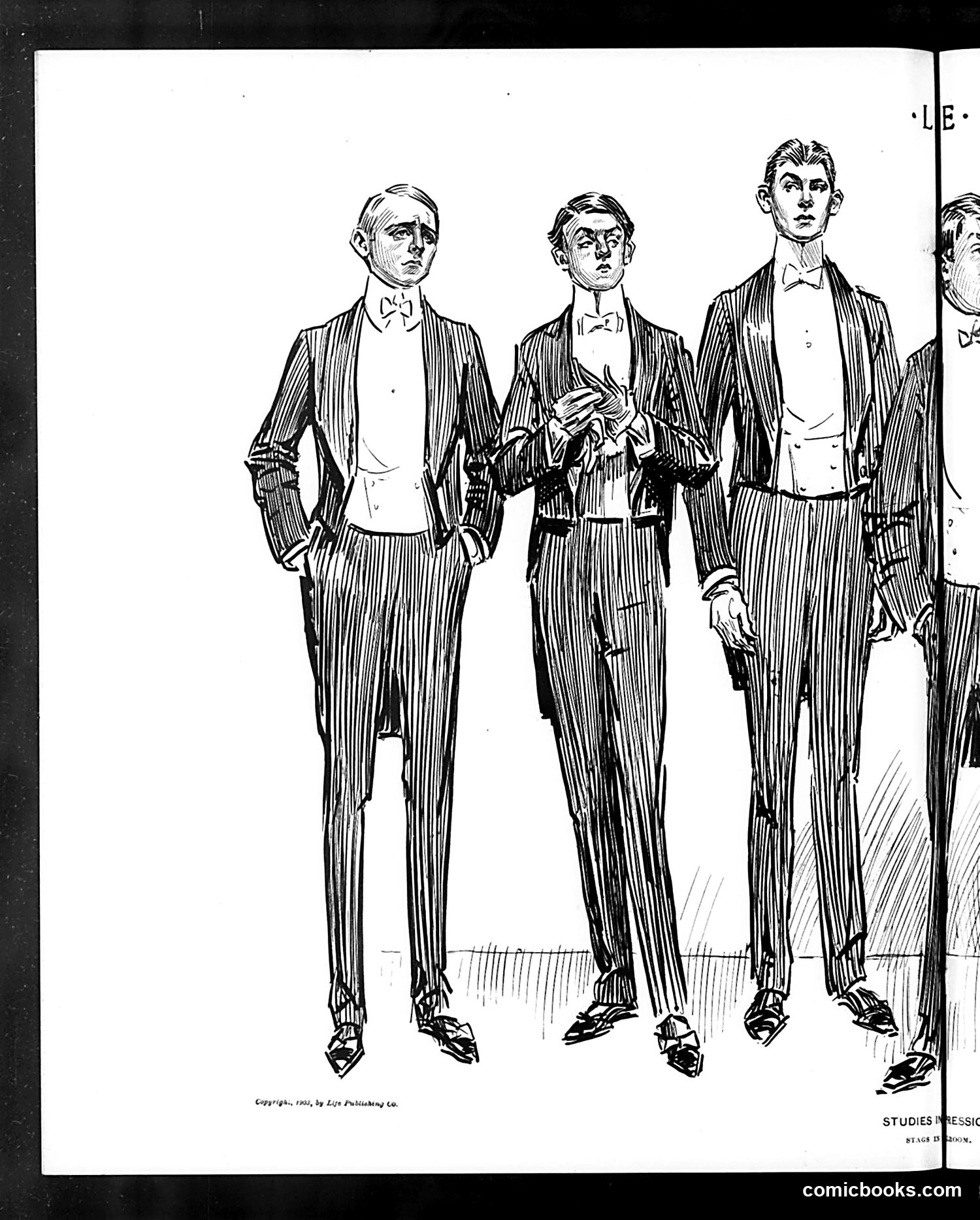
This page shows fashion illustration studies of formal menswear, likely from the early 1900s based on the style and "Life Publishing Co." copyright notation. The drawing depicts four male figures wearing identical formal evening attire—pinstriped suits with bow ties and white shirts—demonstrating variations in how the garments fit different body types and postures. The caption indicates this is titled "STUDIES IN DRESS" by what appears to be a fashion illustrator. Rather than political satire, this appears to be practical fashion guidance showing how formal clothing should be tailored and worn on men of varying builds, a common educational feature in Life magazine during its earlier period when it covered lifestyle and etiquette topics alongside humor.
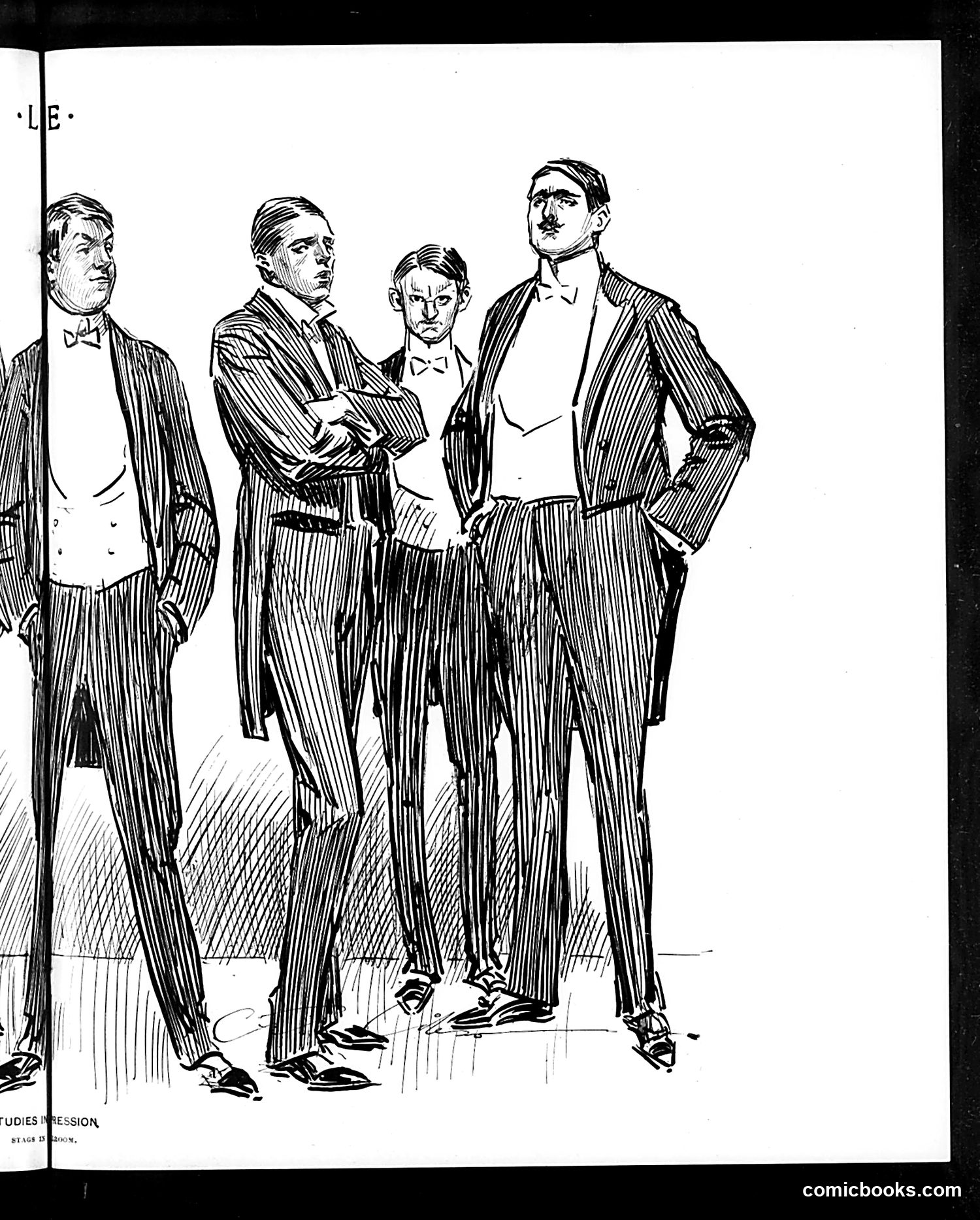
This appears to be a sketch titled "Studies in Session" (visible at bottom), showing four well-dressed men in formal evening wear—tailcoats and bow ties—standing together. The illustration style and formal attire suggest this depicts politicians or public figures in a social or official setting. Without clearer identifying labels or captions visible in the image, I cannot definitively identify which specific figures are caricatured or what particular political event or scandal this references. The formal poses and the nature of *Life* magazine's satirical content suggests this likely mocks prominent politicians or businessmen of the era, possibly commenting on backroom dealing or political posturing, but the specific context and subjects remain unclear from the image alone.
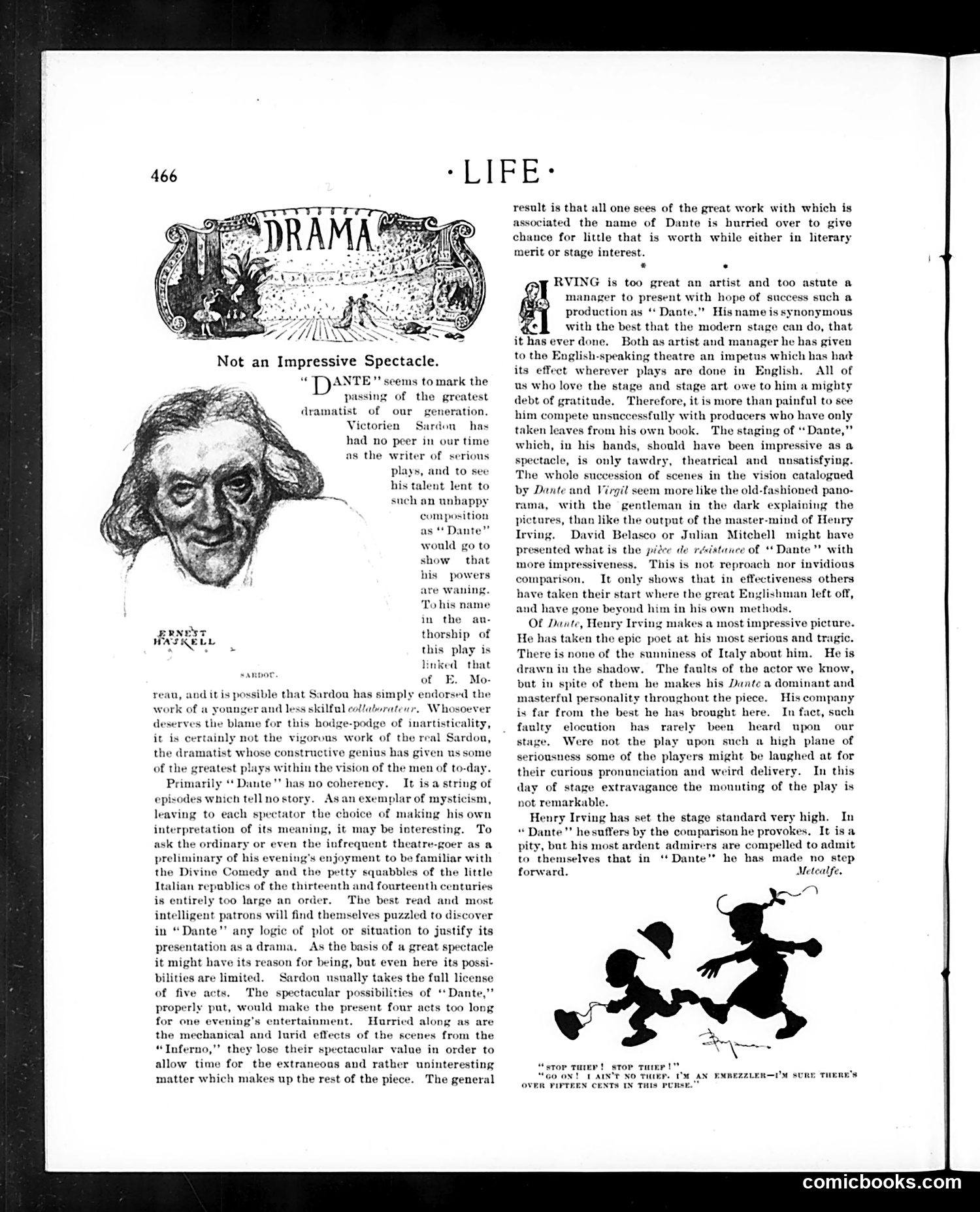
This page reviews Henry Irving's theatrical production of "Dante," critiquing it as an unimpressive spectacle. The article argues that Irving, despite being a great artist and manager, has failed to create a compelling stage adaptation of Dante's work. The text criticizes the production's lack of coherence and logic, suggesting it reads more like a panoramic display than a dramatic work. The reviewer contends that Irving's staging choices prioritize spectacle over meaningful narrative—a common complaint about Victorian theatrical productions. The small cartoon at bottom depicts figures fleeing or running in apparent panic, likely satirizing the chaotic or overwrought nature of the production's theatrical effects.
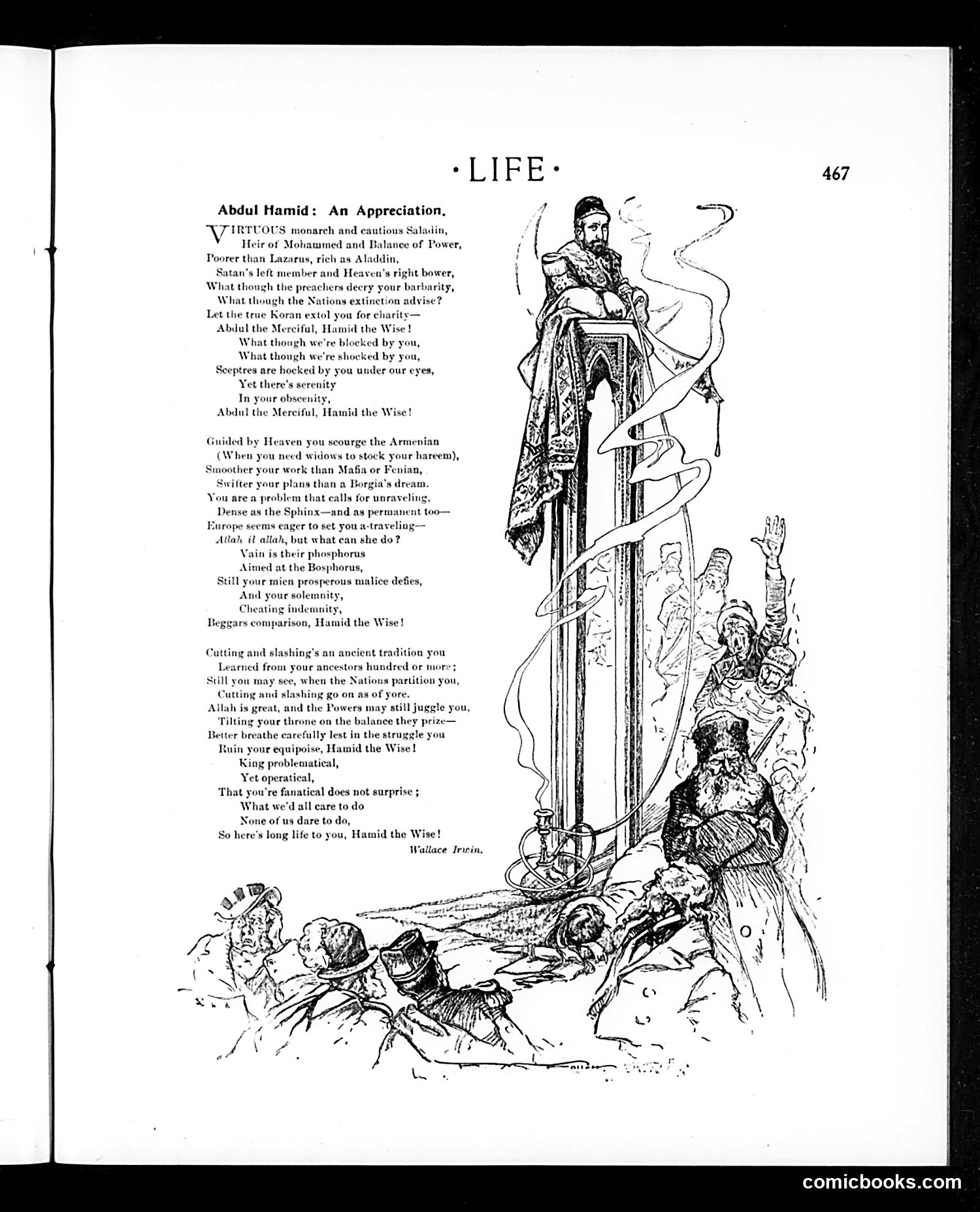
This is a satirical poem by Wallace Irwin mocking **Abdul Hamid II**, Ottoman Sultan (r. 1876-1909). The accompanying illustration depicts him elevated above suffering subjects and world powers. The satire targets Hamid's notorious brutality, particularly the Armenian massacres ("you scourge the Armenian"), and his financial corruption ("Poorer than Lazarus, rich as Aladdin"). References to "widows to stock your hareem" allude to his harem practices. The poem ironically praises his ability to survive political pressure from European powers ("the Nations partition you") while maintaining his throne through ruthlessness and cunning. Phrases like "fanatical," "malice defies," and "cutting and slashing" emphasize his despotism. The backhanded "long life to you" ending is deeply sarcastic—Life magazine presents Hamid as a surviving problem Europe cannot remove, mocking both his brutality and the West's inability to intervene effectively.
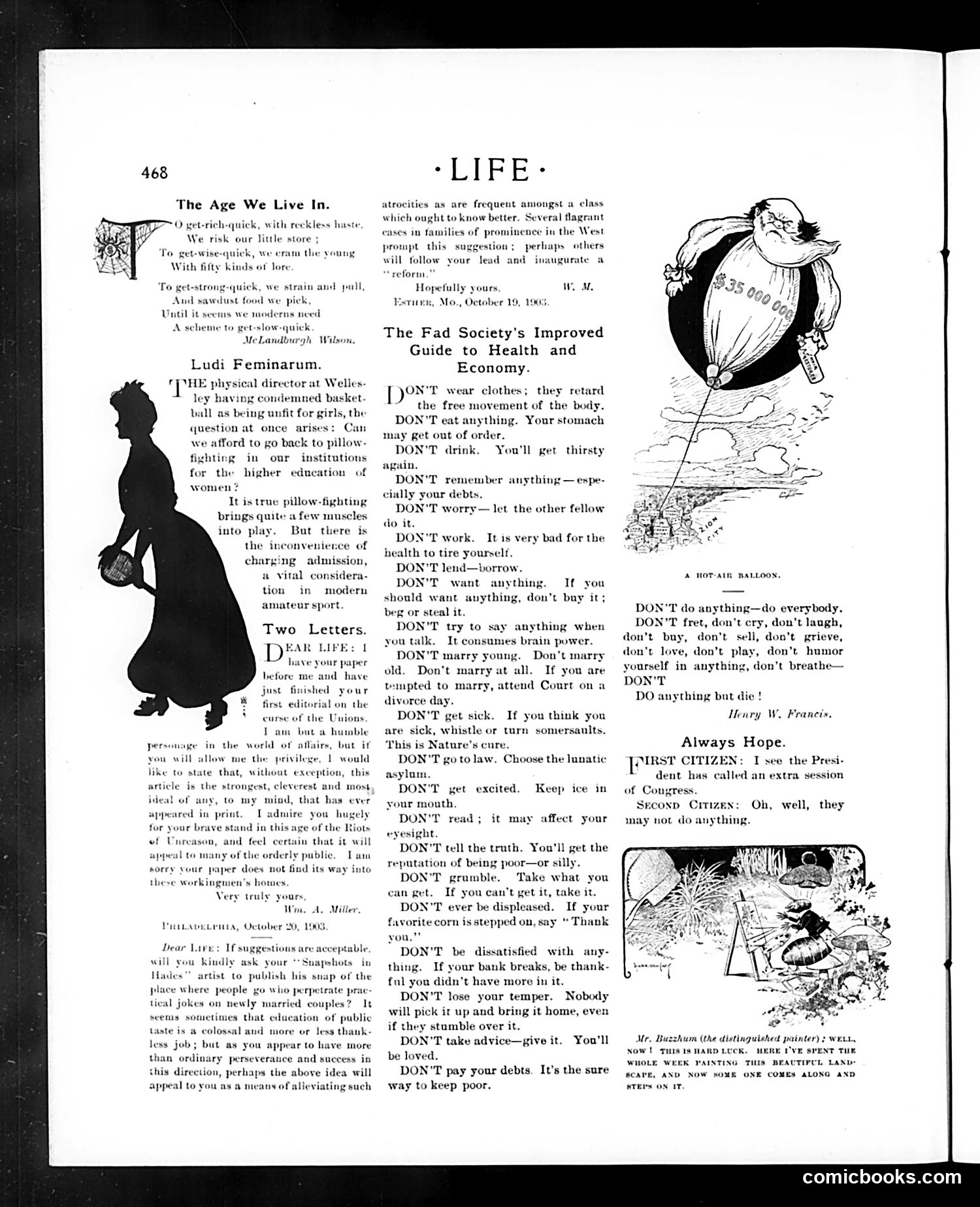
This satirical piece mocks the era's obsession with fad diets and quick-fix health trends. The lengthy list of "DON'Ts" parodies extreme wellness advice circulating among the upper classes—avoid clothes, don't eat, don't work, don't marry—escalating to absurdity. By presenting these fashionable prescriptions literally, the author exposes their ridiculousness: following them would lead to poverty, illness, and death. The accompanying illustration of a hot-air balloon (labeled "A MOT-AIR BALLOON," a pun on "motor") reinforces the theme of floating away from reality. The piece critiques wealthy people blindly adopting contradictory health crazes without rational thought. The final line—"DO anything but die!"—sardonically suggests that under these fad guidelines, mere survival is impossible, highlighting how foolish such trends truly are when taken to their logical extreme.
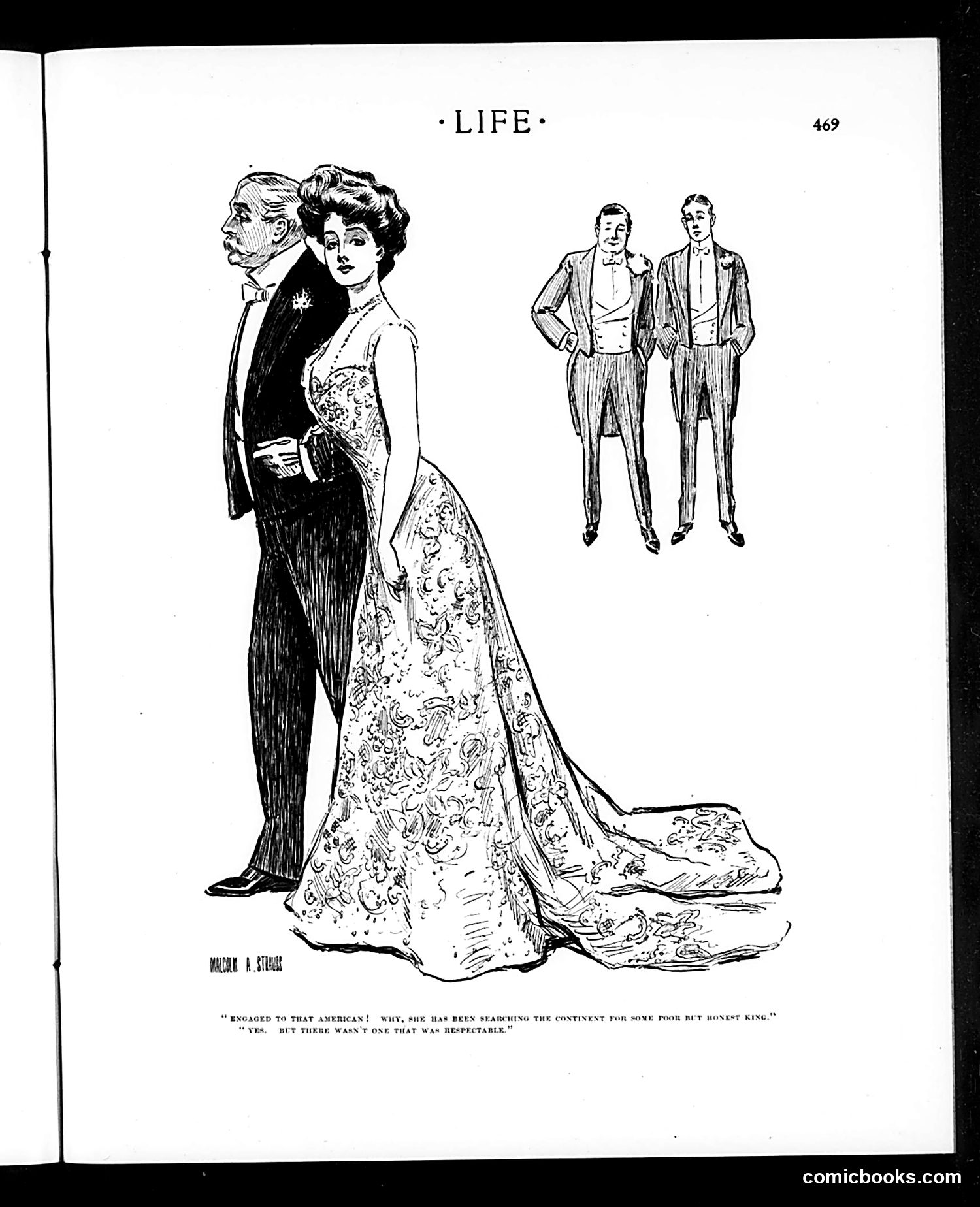
This satirical cartoon depicts a European aristocratic couple discussing an American woman's engagement. The illustration shows an elegantly dressed woman with a train alongside a man in formal evening wear, with two additional male figures in the background. The joke targets American wealth and European aristocratic pretension. The caption suggests the American woman searched Europe for a "poor but honest king"—implying European nobility lacks both money and integrity. The punchline, "there wasn't one that was respectable," mocks European aristocrats as simultaneously impoverished and morally compromised. This reflects early 20th-century American satirical themes: wealthy American heiresses marrying titles-seeking European noblemen, and American skepticism about European "respectability." The cartoon suggests honest poverty is preferable to disreputable aristocracy, inverting traditional class values.
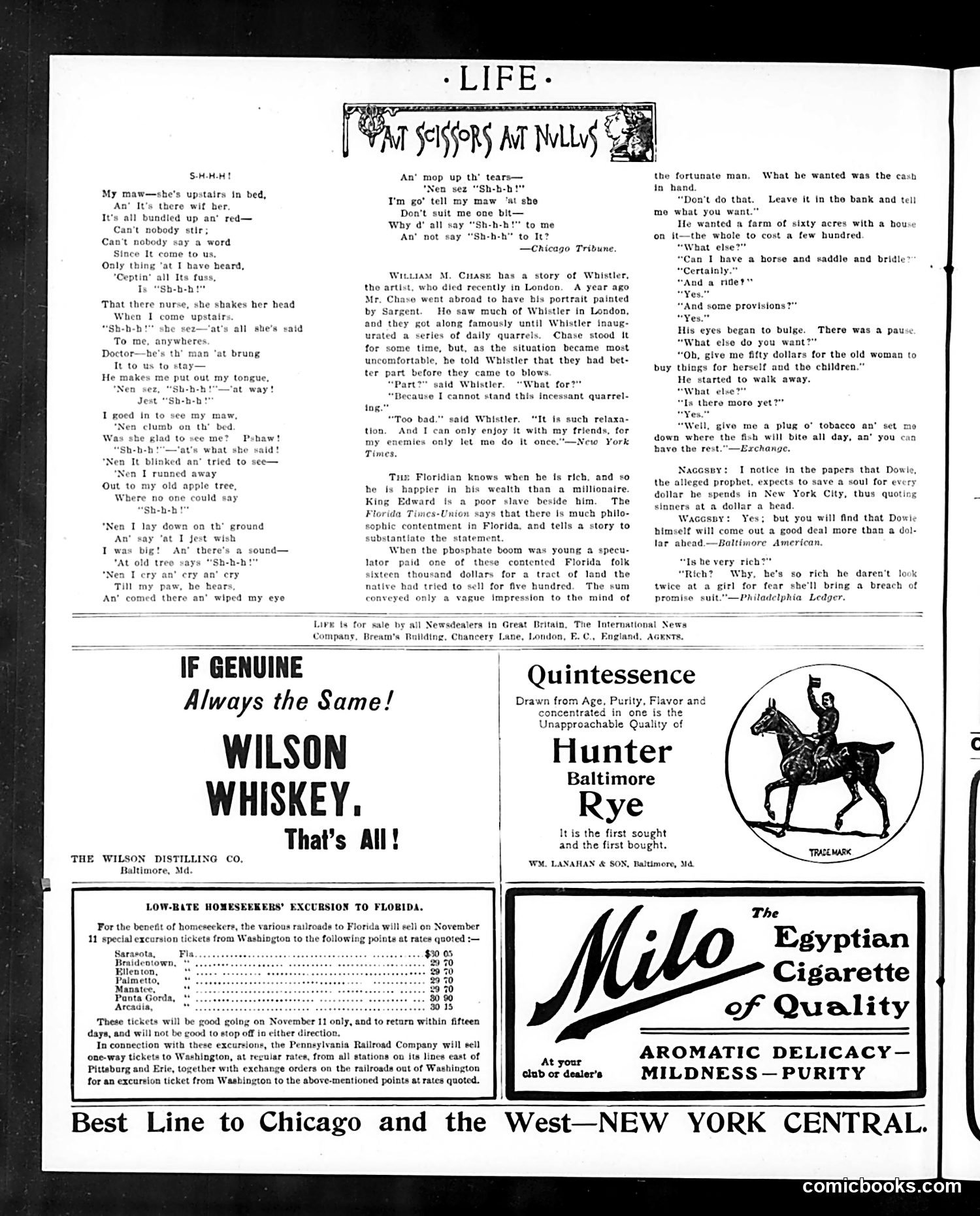
The main content is a comic poem in heavy dialect, likely meant to represent rural or working-class speech patterns (characterized by phonetic spellings like "Sh-b-b!" and "goed"). It depicts a child seeking comfort from a parent—the repeated "Sh-b-b!" appears to be shushing sounds meant to soothe. The poem humorously captures a child's attempt to hide from fear or distress, ultimately finding comfort when the parent discovers and consoles them. The page also contains several anecdotes: one about artist William M. Chase and James McNeill Whistler's infamous quarrels, another about a wealthy but content Florida phosphate mine owner, and a joke about religious prophet John Alexander Dowie's fundraising claims. The remaining content consists primarily of **period advertisements** for Wilson Whiskey, Hunter Rye whiskey, Milo Egyptian Cigarettes, and railroad excursion information—typical of *Life* magazine's revenue model.
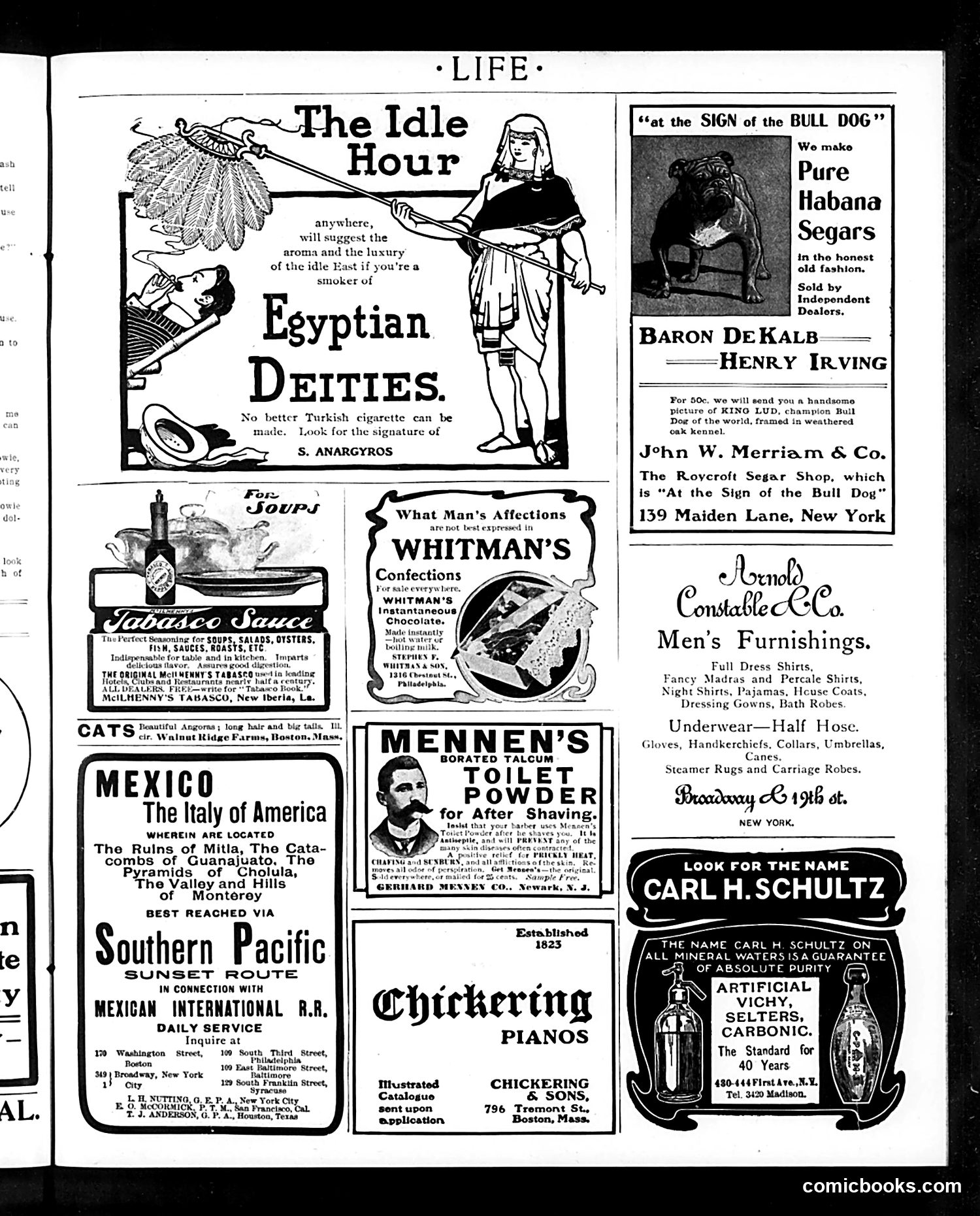
This page is primarily **advertisements** from an early 20th-century Life magazine. The main illustrated item is an ad for Egyptian Deities cigarettes by S. Anargyros. The cartoon depicts a reclining figure in "Oriental" luxury (a common trope of the era) being fanned by an Egyptian-style attendant. The marketing appeal exploits Orientalist fantasy—associating smoking with exotic leisure and sensuality. The phrase "aroma and luxury of the idle East" explicitly sells the product through romanticized stereotypes of Eastern decadence. This reflects period advertising conventions that used ethnic caricature and exoticized imagery to market luxury goods to Western consumers. The "Egyptian" branding implied sophistication and escapism, though it relied entirely on orientalist fantasy rather than authentic cultural references. The rest of the page contains unrelated period advertisements for cigars, pianos, sauces, pharmaceuticals, and men's furnishings.
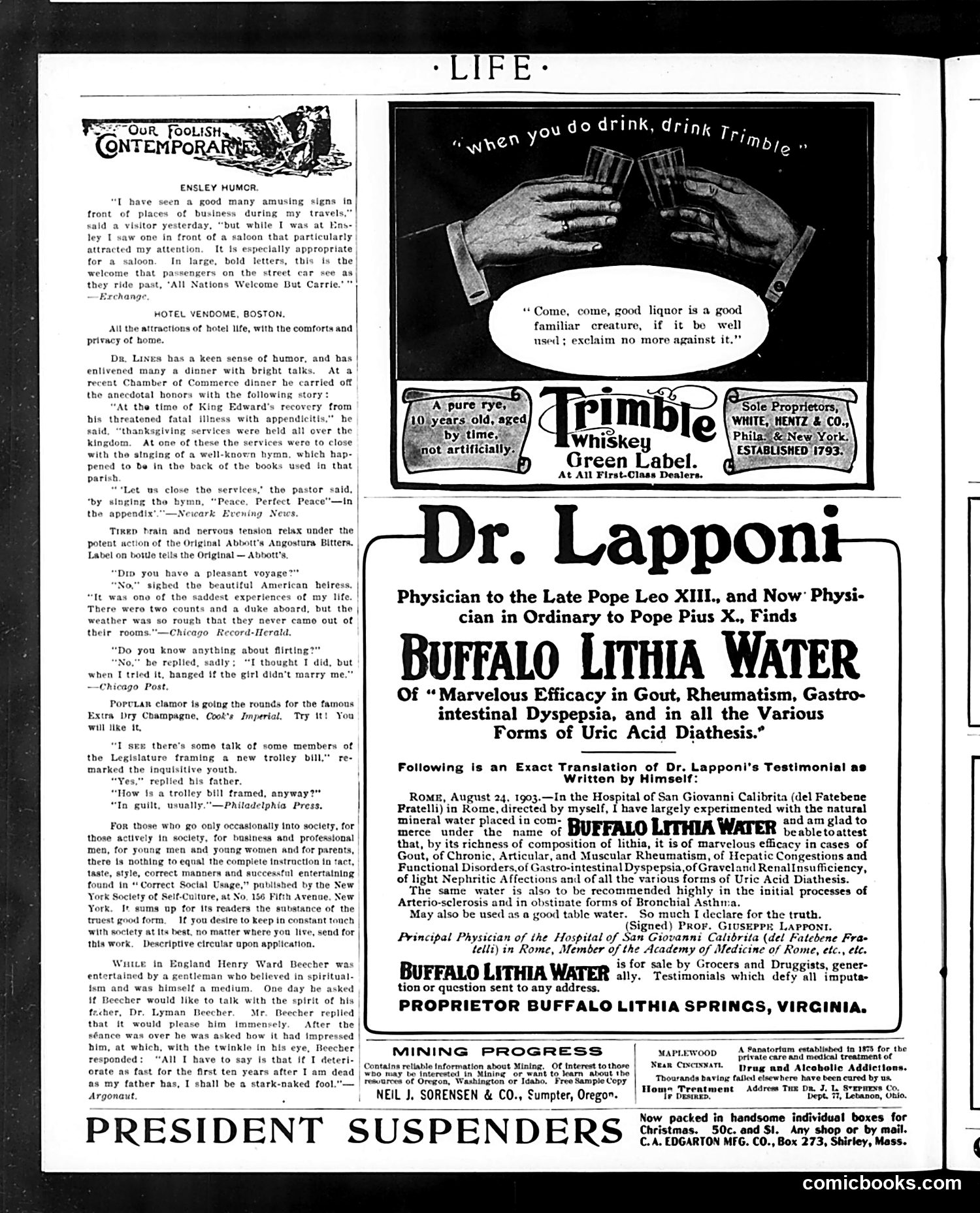
This page combines humor columns with patent medicine advertising, typical of early 1900s Life magazine. **"Our Foolish Contemporaries"** presents satirical anecdotes mocking social pretension and absurdity. Notable: a saloon's sign reading "All Nations Welcome But Carrie"—likely referencing Carrie Nation, the famous temperance activist who violently opposed alcohol and saloons. The joke is that a drinking establishment ironically excludes its most vocal opponent. Other humorous stories ridicule spiritualism (Henry Ward Beecher's séance joke), trolley legislation corruption, and romantic mishaps. **The main advertisement** promotes Trimble Whiskey and—more prominently—Buffalo Lithia Water, endorsed by a papal physician. The water claims to cure gout, rheumatism, and various digestive ailments through its lithia mineral content. This represents the era's widespread faith in "medicinal" mineral waters and patent medicines, before FDA regulation. The page reflects early 20th-century American attitudes: skepticism toward reformers, appreciation for irreverent humor, and credulity regarding health claims.
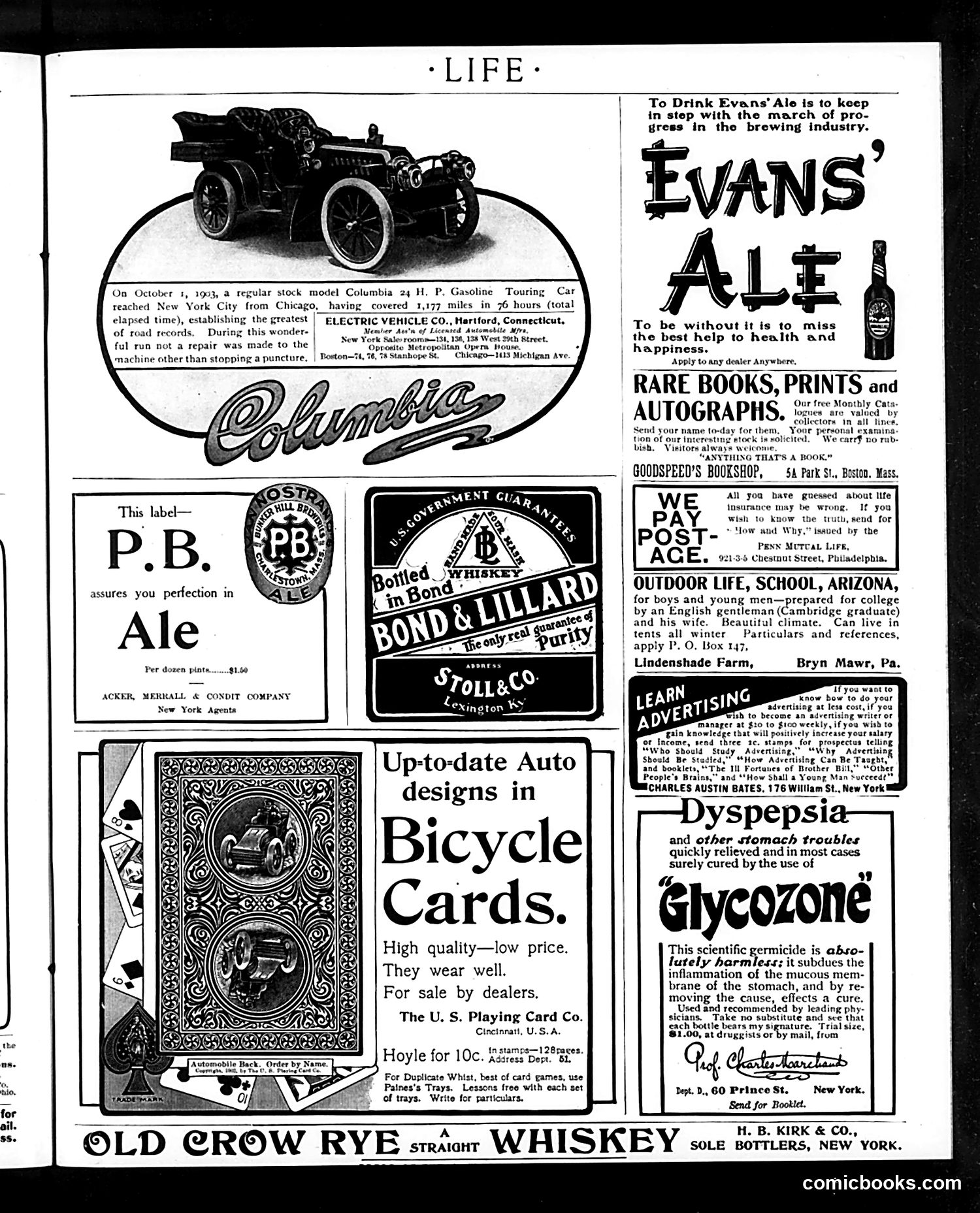
This is primarily a **advertisement page**, not a political cartoon. The dominant feature is a large advertisement for the **Columbia automobile**, celebrating a 1903 cross-country record: a Columbia 24 H.P. touring car traveled from Chicago to New York City (1,177 miles) in 76 hours with minimal mechanical intervention. The surrounding advertisements promote various products typical of the early 1900s: P.B. ale, Evans' ale, bicycle playing cards, bicycle whiskey, Glycozone stomach remedy, and outdoor schools. These ads reflect period consumer culture and contemporary health anxieties (dyspepsia was commonly advertised as treatable). **The implicit satire**: The Columbia ad's emphasis on the car's reliability ("not a repair was made...other than stopping a puncture") humorously undercuts itself—a puncture *is* a repair need. This gentle humor typifies Life's style of satirizing commercial claims through exaggeration or ironic juxtaposition rather than biting political commentary. The page captures early automotive marketing's emphasis on reliability and speed as markers of industrial progress.
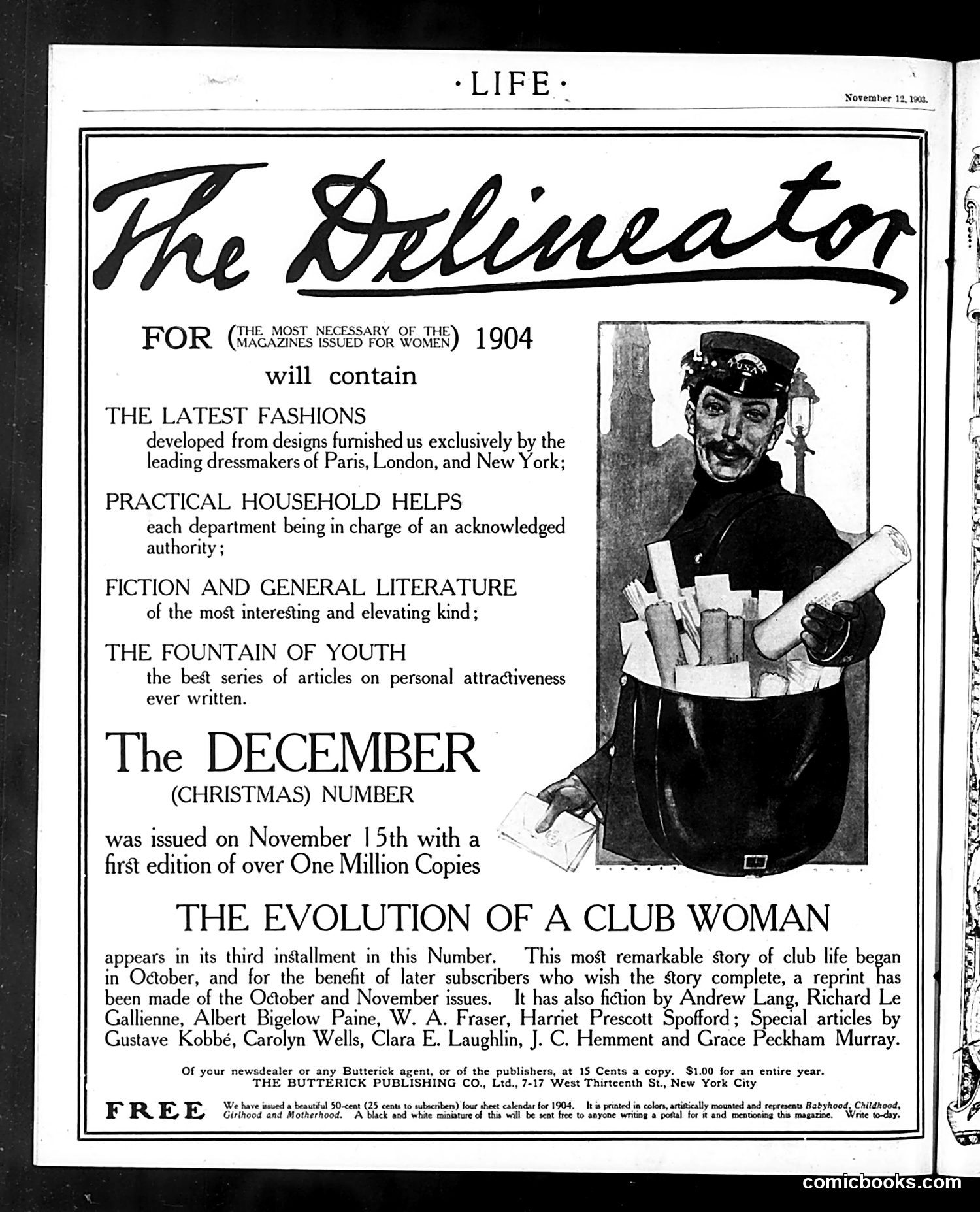
This is primarily an advertisement for *The Delineator*, a women's magazine published by Butterick (a clothing pattern company). The illustration shows a caricatured male figure—likely representing a dressmaker or tailor—holding fashion designs and building materials, symbolizing the magazine's promise of bringing the latest Paris, London, and New York fashions to American women. The ad emphasizes *The Delineator* as "the most necessary" women's magazine, highlighting its content: fashions, household advice, literature, and notably "The Fountain of Youth" articles on personal attractiveness. The December Christmas issue boasted over one million copies, suggesting the magazine's massive popularity. A serialized story called "The Evolution of a Club Woman" appears prominently, reflecting early 1900s interest in women's social organizations and changing gender roles. The free calendar offer ("Babyhood, Childhood, Girlhood and Motherhood") reinforces the magazine's focus on women's life stages.