
Life, 1903-11-12 · page 6 of 20
Life — November 12, 1903 — page 6: what you’re looking at
What you’re looking at
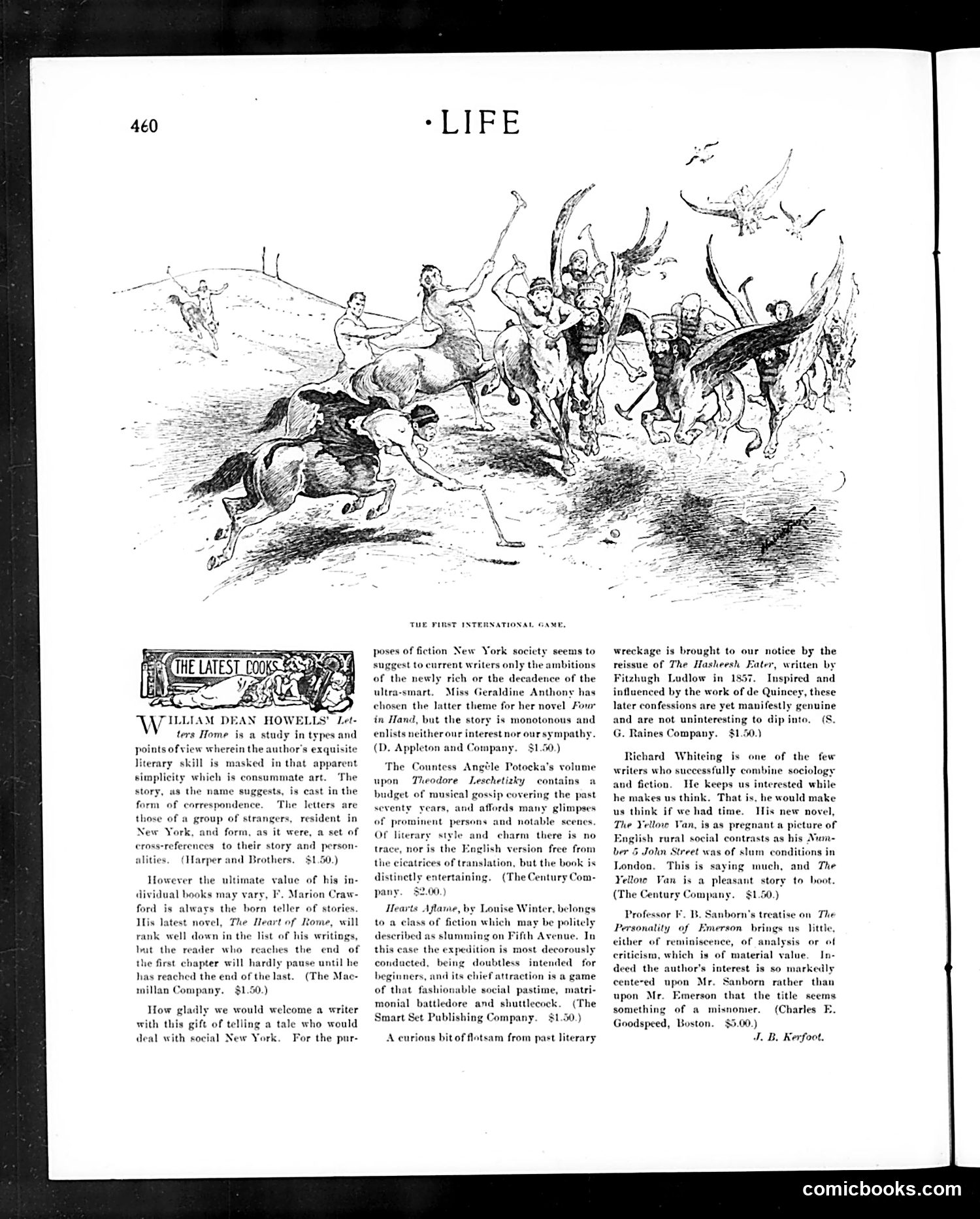
This satirical illustration depicts what appears to be a chaotic sporting event or international competition. The sketch shows figures in disarray—some falling, others in aggressive postures—with spectators visible in the background. The title "THE FIRST INTERNATIONAL GAME" suggests this mocks an early international sporting competition, likely from the late 19th century when such events were novelties. The satire appears to criticize international competition as descending into chaos or ungentlemanly conduct rather than civilized sport. The exaggerated, tumbling figures and general mayhem suggest the cartoonist viewed international athletic contests skeptically—perhaps as vehicles for national aggression rather than friendly competition. The specific event referenced is unclear without additional context.
📄 Transcribed text from this page (OCR, searchable)
Machine-transcribed from the original scan — historical spelling and the odd misread are preserved.
Witias DE ters Home is a study in types and points of view wherein the author's exquisite literary skill is masked in that apparent simplicity which is consummate art. story, us the name suggests, is cast in the form of correspondence. The letters are those of a group of strang: © York form ferences to their story and person- $1.50.) resident in is it were, a set of cross all (Harper and Brothers However the ultimate value of his in- dividual books may vary, F. Marion Craw- ford is alwass the born teller of stories. His latest novel, The Heart of rank well down in th Wut the re end of the first chapter will hardly pause until he 1 the end of the last. (The Mac- millan Company. $1.50.) ome, will list of his writings, jer who reaches th has rea How gladly we would welcome a writer with this gift of telling a tale who would deal with social New York. For the pur- TUE FIRST INTERNATIONAL GAME, poses of fiction New York society seems to suggest to current writers only th of the newly rich or the decadence of the ultra-smart. chosen the latter theme for her novel For in Hand, but the story is monotonous and enlists neither our interest nor our sympathy. (D. Appleton and Company. $1.50.) ambitions Miss Geraldine Anthony hi volume contains The Countess Angéle Potocka’s upon Theodore Leschetizky budget of musical gossip covering the past seventy 3 and affords many glimpses of prominent pe nd notable s OF Li trac nes. rary. styl arm there is no nor is the English version free from nslation, but the book is (The Century Com- Hearts Aflame, by sof fi ped as slumming on Fifth Avenue, In tion is most di doubtless ners, and its chief attraction is a game of that fashionable social pastime, matri- monial battledore and shuttlec (The Smart Set Publishing Company. $1.50.) Louise Winter, belongs on which may be politely Xpe ‘orously intended for A curious bit of flotsam from past literary wreckage is brought to our notice by the reissue of The Hasheesh Eater, written by itzhugh Ludlow in 1857 pired and influenced by the work of de Quincey, these later confessions are yet manifestly genuine and are not uninteresting to dip into. (S. G. Raines Company. $1.50.) hard Whiteing is one of the few writers who successfully combine sociology and fiction. He keeps us interested while he makes us think, That is, he would make us think if we had time. His new novel, The Yellow Van, is as pregnant a picture of English rural social contrasts as his Num- ber 5 John Street was of slum conditions in London. This is saying much, and The Yellow Van is a pleasant story to boot. (The Century Company. $1.50.) Professor F. BB. Personatily of Emerson brings us cither of reminis of analysis criticism, which is of material value. In- deed th centered upon Mr. upon Mr. Emerson that something of a Goodspeed, Boston. born’s treatise on The little, or of the title seems (Charles E. misno: J.B, Kerfoot. comicbooks.com