
Life, 1903-11-12 · page 4 of 20
Life — November 12, 1903 — page 4: what you’re looking at
What you’re looking at
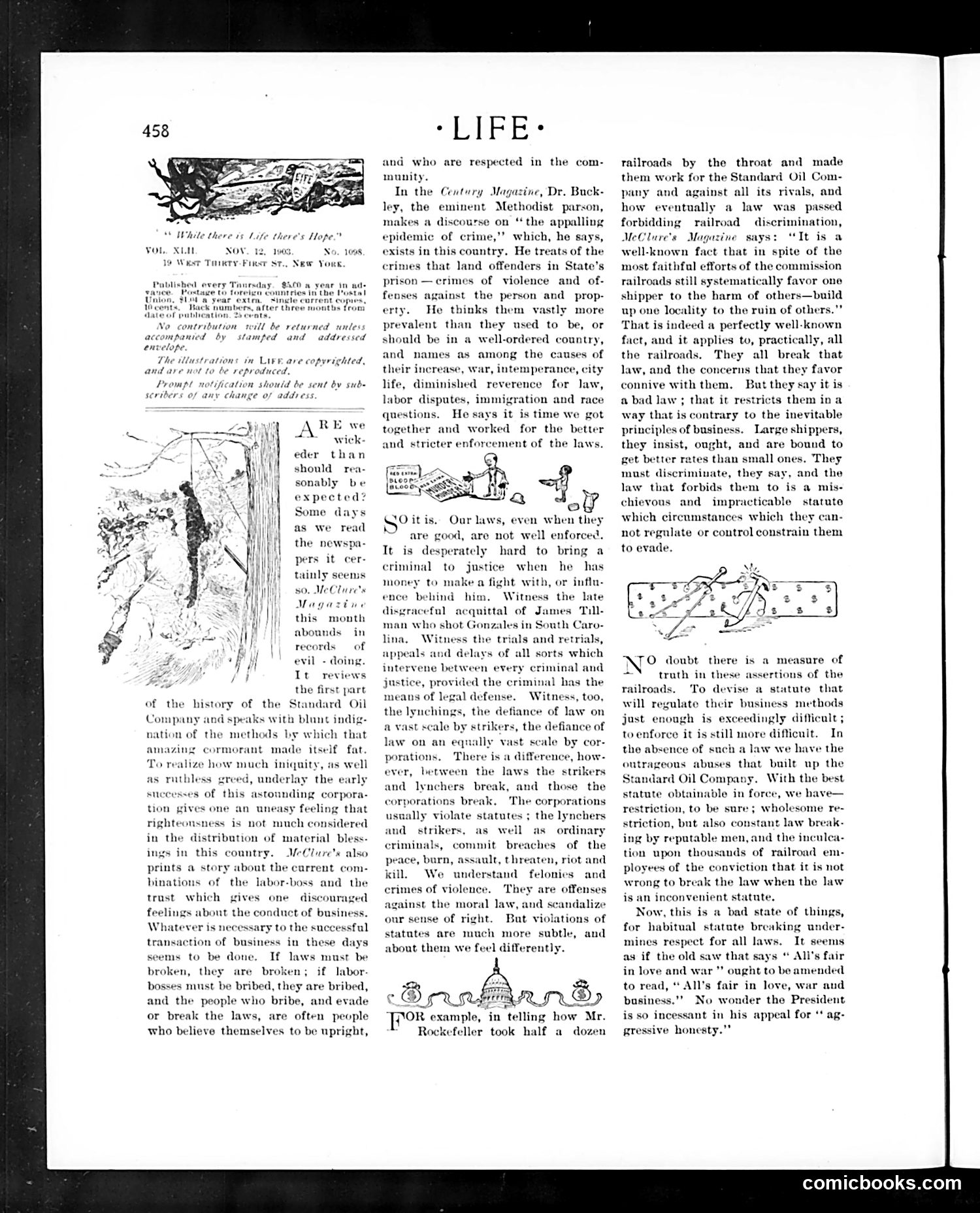
This page contains editorial text criticizing railroad industry practices and corporate law enforcement, without obvious political cartoon figures to identify specifically. The text references Dr. Buckley's *Century Magazine* article on crime, discussing how laws against violence and property crimes are unevenly enforced. It argues that while strikers and lynchers face prosecution, corporations systematically violate statutes with minimal consequence. The piece cites the "disgraceful acquittal of James Tillman" (who shot Gonzales in South Carolina) and Standard Oil Company's methods as examples of how wealth enables legal evasion. Small decorative illustrations accompany the text but lack clear satirical targets. The content advocates for stricter corporate accountability and uniform law enforcement rather than satirizing specific individuals.
📄 Transcribed text from this page (OCR, searchable)
Machine-transcribed from the original scan — historical spelling and the odd misread are preserved.
White the Vou. XU NOV. 12, 1963, No West Tarety-Finsr St., New Yous. 1098, Pavlished every Fin ads in the Postal tc bs fron No contribution accompanied by envelope. The itlustration are not to be Wt be returned untes amped and addressed in Live ave copyrighted, reproduced, id be sent by sube addy ess A RE we wick eder than should sonably be expected? Prompt 1 seribers of an tification sho} ome days as we the news’ pers it tainly seems so. MeClure’ * Magaz this month punds in cords oof - doing. reviews the first part y of the Standard Oil Company and speaks with blunt indig. nation of the methods by which that amazing cormorant made itself fat. To realize how much iniquity, as well i, underlay the early successes of this astonnding corpora- asy feeling tha righteousness is not much considered in the distribution of material bless- ings in this country. MeClire's also prints a story about the current com- binations of the labor-l trust which gives discouraged feelings about the conduct of business. Whatever is necessary to the successful transaction of business in these day seems to be done, If laws must be broken, they are broken; if. labor. bosses must be bribed, they are bribed, and the people who bribe, and evade or break the laws, are often people who believe themselves to be upright, cer- of the hist as ruthless tion gives one a ss and the LIFE and who are respected in the com- munity. In the Century Magazine, Dr. Buck- ley, the eminent Methodist parson, makes a discourse on “the appalling epidemic of crime,’’ which, he say exists in this country. He treats of the crimes that land offenders in State's prison —crimes of violence and of- fenses against the person and prop- erty He thinks them vastly more prevalent than they used to be, or should be in a well-ordered county; and names as among the their increase, war, intemperanc life, diminished reverence for law labor disputes, immigration and ra question: He says it is time we got together and worked for the better and stricter enforcement of the SS xh “ey Se ig Se itis. Our laws, even when the ~ are good, are not well enforced It is desperately hard to bring a criminal to justice when he money to make a fight with, or influ- ence behind him. Witness the late disgraceful quittal of James Till- man who shot Gonzales in South Caro- lina, Witn is and retrial appeals and delays of all sorts which intervene between every criminal and justice, provided the criminal has the means of legal defense. Witness, too, ; s, the defiance of law on a vast scale by strikers, the defiance of law on an equally vast scale by cor- porations. There is a difference, how- ween the laws the strikers and lynchers break, and those the porations break. ‘The corporations usually violate statutes ; the lynchers and strikers, as well as ordina criminals, commit breaches of the ce, burn, assault, threaten, riot and We understand onies and crimes of violence. They offenses ainst the moral law, and scandalize our sense of right. But violations of statutes are much more subtle, and about them we feel differently. laws. has ss the t feller took half a dozen railroads by the throat and made them work for the Standard Oil Com- pany and against all its rivals, and how eventually a law was passed forbidding railroad discrimination, MeClure's Magazine says: ‘It is a well-known fact that in spite of the most faithful efforts of the commission railroads still systematically favor one shipper to the harm of others—build up one locality to the ruin of other: That is indeed a perfectly well-known fact, and it applies to, practi the railroad: law, and the concerns y connive with them, But they say a bad law ; that it restricts them ina way that is contrary to the inevitable principles of business. Large shippers, they insist, ought, and are bound to get better rates than small ones, They must discriminate, they say, and the law that forbids them to a mis- chievous and impracticable statute which circumstances which they can- not regulate or control constrain them to evade. NO doubt there is a measure of = trath in th ussertions of the railroads. To devise a tute that will regulate their business methods just enough is exceedingly difficult; toenforce it is still more difticuit. In the absence of such ww we have the outrageous abuses that built up the ndard Oil Company. With the best statute obtainable in force, we he restriction, to be sure; wholesome re- striction, but also constant law break- ing by reputable men, and the inculca- tion upon thousands of railroad em- ployees of the conviction that it is not wrong to break the law when the law is an inconvenient statute, Now, this is a bad state of things, for habitual statate breaking under- mines respect for all laws. It seems as if the old saw that says * All's fair in love and war " ought to be amended to read, * All’s fair in love, war and business."" wonder the President is so incessant in his appeal for * ag- gressive honesty.’* comicbooks.com