
Life, 1903-11-12 · page 12 of 20
Life — November 12, 1903 — page 12: what you’re looking at
What you’re looking at
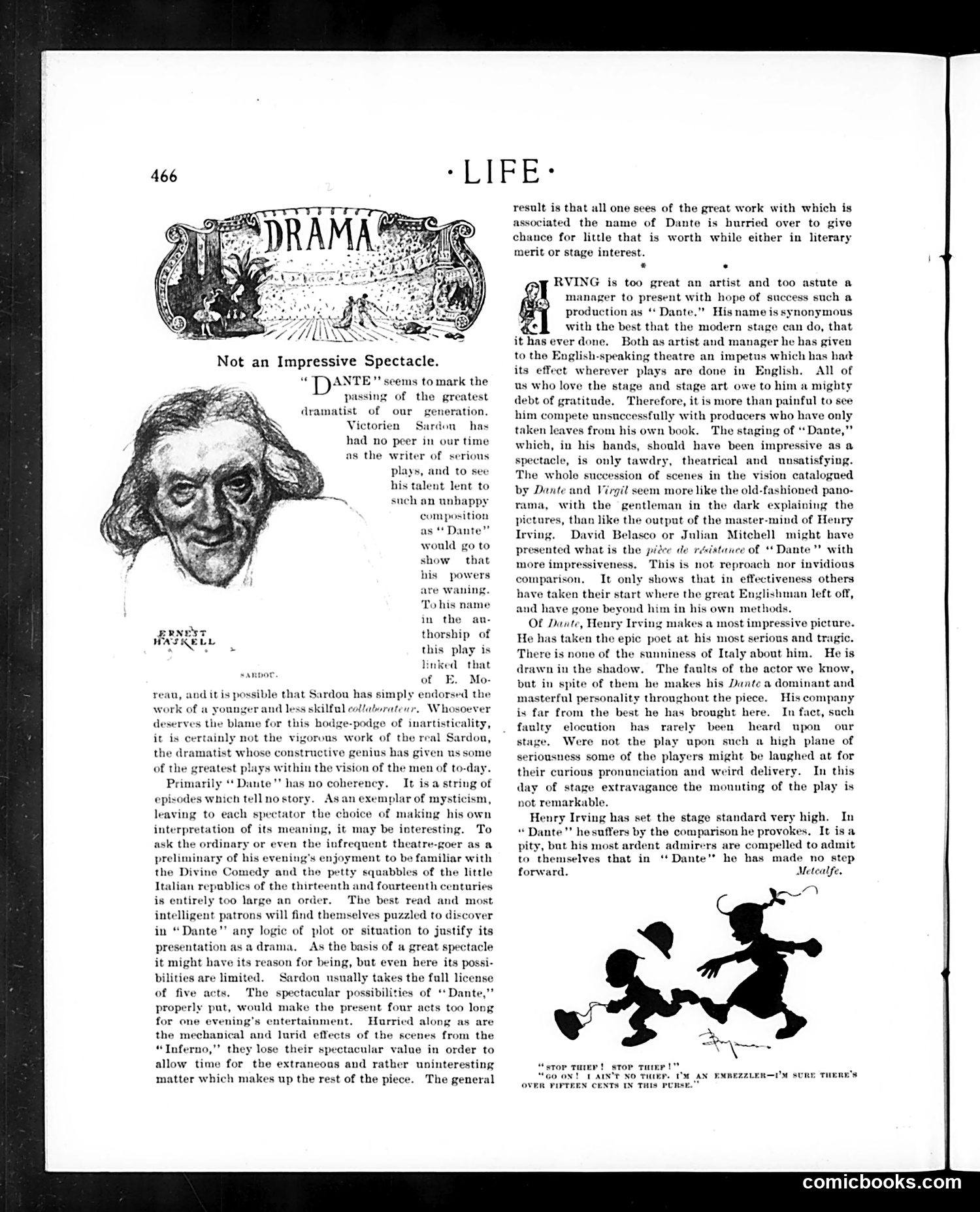
This page reviews Henry Irving's theatrical production of "Dante," critiquing it as an unimpressive spectacle. The article argues that Irving, despite being a great artist and manager, has failed to create a compelling stage adaptation of Dante's work. The text criticizes the production's lack of coherence and logic, suggesting it reads more like a panoramic display than a dramatic work. The reviewer contends that Irving's staging choices prioritize spectacle over meaningful narrative—a common complaint about Victorian theatrical productions. The small cartoon at bottom depicts figures fleeing or running in apparent panic, likely satirizing the chaotic or overwrought nature of the production's theatrical effects.
📄 Transcribed text from this page (OCR, searchable)
Machine-transcribed from the original scan — historical spelling and the odd misread are preserved.
‘LUPE: ae A/S Not an Impressive Spectacle. si D ANTE”’ seems to mark the passing of the greatest dramatist of our generation, Victorien Sardon has had no peer in our time as the writer of serious plays, and to see his talent lent to such an unhappy composition as ** Dante” would go to show that his powers are waning. Tohis name in the an- thorship of this play is linked that of E. Mo- irdou has simply endorsed the s skilful colluboratenr, Whosoever me for this hodge-podge of inartisticality, it is certainly not the vigorous work of the real Sardon, the dramatist whose constructive genius has given us some st plays within the vision of the men of to-day. ‘Dante has no coherency. It isa string of episodes which tellno story. Asan exemplar of mysticism, leaving to each spectator the choice of making his own interpretation of its meaning, it may be interesting. To ask the ordinary or even the infrequent theatre-goer as a preliminary of his evening's enjoyment to be familiar with the Divine Comedy and the petty squabbles of the little Italian republics of the thirteenth and fourteenth is entirely too large an order. enturies The best read and most intelligent patrons will find themselves puzzled to discover in “Dante” any logic of plot or situation to justify its presentation as a drama. it might have its reas bilities are limited. of five acts. As the basis of a great spectacle n for being, but even here its possi- Sardou usually takes the fall license The spectacular possibilities of Dante,” properly put, would make the present four acts too long for one evening's entertainment. Hurried along as are the mechanical and lurid effects of the scenes from the “Inferno,” they lose their spectacular value in order to allow time for the extraneous and rather uninteresting matter which makes up the rest of the piece. The general result is that all one sees of the great work with which is associated the name of Dante is burried over to give chance for little that is worth while either in literary merit or stage interest. * . RVING is too great an artist and too astute a manager to present with hope of success such a production as ‘ Dante.”” His name is synonymous GO with the best that the modern s n do, that it has ever done, Both as artist and manager he has given to the English-speaking theatre an impetus which has hack its effect wherever plays are done in English. All of us who love the stage and stage art owe to him a mighty debt of gratitude. Therefore, it is more than painful to see him compete unsuccessfully with producers who have only taken leaves from his own book. The staging of * Dante,” which, in his hands, should have been impressive as a spectacle, is only tawdry, theatrical and unsatisfying. The whole succession of scenes in the vision catalogued by Dante and Virgil seem more like the old-fashioned pano- rama, with the gentleman in the dark explaining the pictures, than like the output of the master-mind of Henry Irving. David Belasco or Julian Mitchell might have presented what is the pide de résistance of “Dante”? with more impressiveness. This is not reproach nor invidious comparison. It only shows that in effectiveness others have taken their start where the great Englishman left off, and have gone beyond him in his own methods. Of Dante, Henry Irving makes a most impressive picture. He has taken the epic poet at his most serious and tragic. There is none of the sunniness of Italy about him. He is drawn in the shadow. The faults of the actor we know, but in spite of them he makes his Dante a dominant and masterful personality throughout the piece. His company is far from the best he has brought here. In fact, sach faulty elocution has rarely been heard upon our stage. Were not the play upon such a high plane of seriousness some of the players might be laughed at for their curious pronunciation and weird delivery. In this day of stage extravagance the mounting of the play is not remarkable. Henry Irving has set the stage standard very high. In “ Dante" hesuffers by the comparison he provokes. It is a pity, but his most ardent admirers are compelled to admit to themselves that in ‘‘ Dante’? he has made no step forward. Metcalfe. ~—) OVER PIPTEEN CENTS IN THIS PERS: comicbooks.com