
Life, 1903-11-12 · page 7 of 20
Life — November 12, 1903 — page 7: what you’re looking at
What you’re looking at
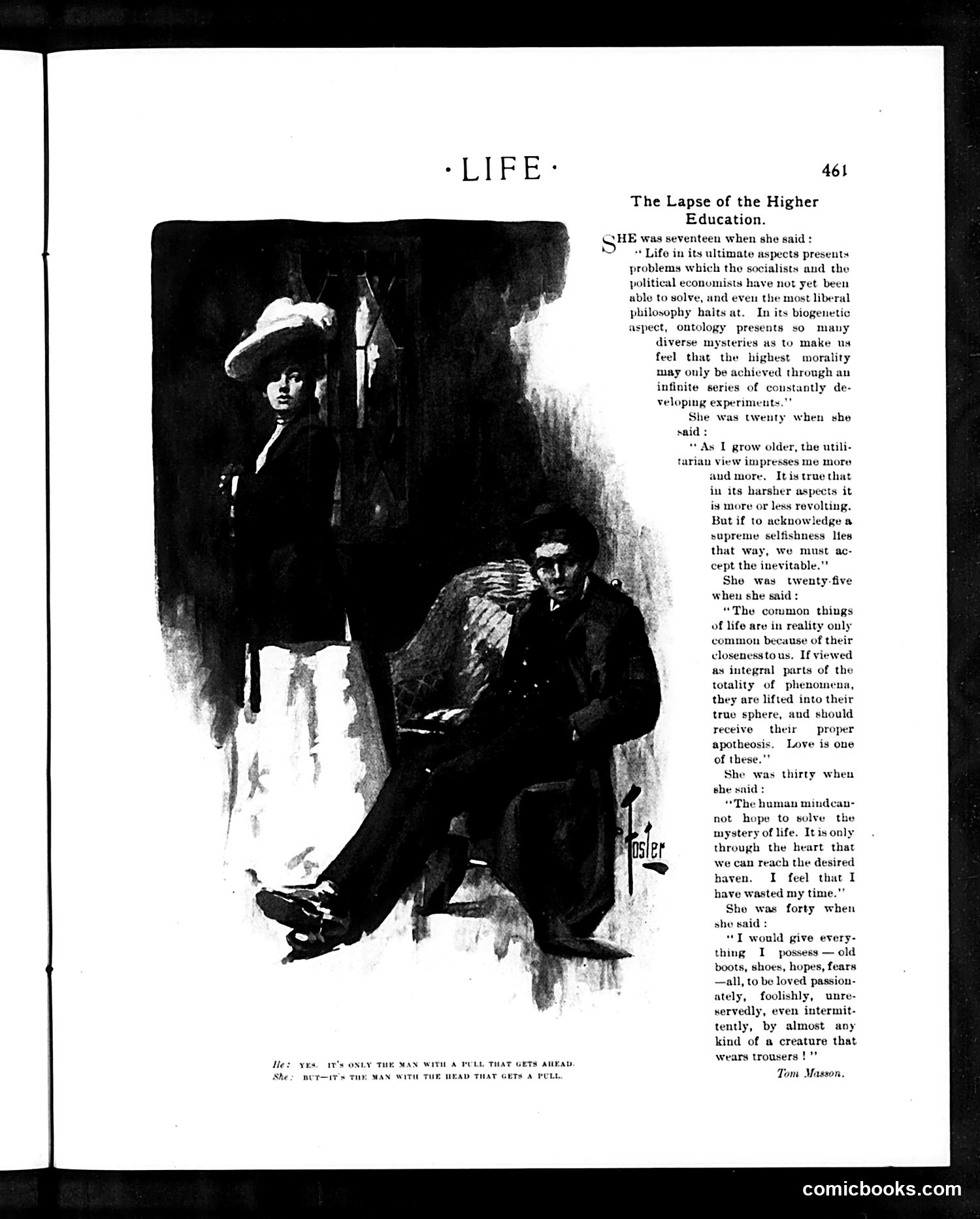
This page features a philosophical essay by Tom Masson accompanying a sketch showing two figures in what appears to be a doorway or corridor. The illustration's caption reads: "HE: yes, it's only the man with a pull that gets ahead / SHE: it's the man with the head that gets a pull." The satire critiques educational idealism versus practical reality. The essay traces a woman's philosophical evolution from age seventeen (believing life's mysteries require infinite intellectual development) through age forty (concluding she'd trade everything for love from "almost any kind of creature that wears trousers"). The cartoon and text together mock how higher education supposedly teaches abstract principles about merit and intellect, yet real advancement depends on "pull" (connections/favoritism), while the woman's arc satirizes how romantic pragmatism eventually defeats intellectual ambition.
📄 Transcribed text from this page (OCR, searchable)
Machine-transcribed from the original scan — historical spelling and the odd misread are preserved.
He: She yes ar ner—it's SLY THE MAN WITH A PULL AT GETS ANEAD We MAN WITH THE HEAD THAT GETS A PULL. ) 461 The Lapse of the Higher Education. HE was seventeen when she said : * Life in its ultimate aspects presents problems which the socialists and the polit economists have not yet been able to solve, and even the most liberal philosophy haits at. In its biogenetic aspect, ontology presents so many diverse mysteries as to make us feel that the highest morality may ouly be achieved through an infinite series of constantly de- veloping experiments. She was twenty when she said As I grow older, the utili- tarian view impresses me more aud more, Itis true that in its harsher aspects it is more or less revolting. But if to acknowledge a supreme selfishness Mes that way, we must ac- cept the inevitable.” She was twenty-five when she said: “The common things of life are in reality only common because of their closeness tous. If viewed as integral parts of the totality of phenomen: they are lifted into their true sphere, and should receive their proper apotheosis. Love is one of these."” She was thirty when she said : “The human mindcan- not hope to solve the mystery of life. It is only through the heart that we can reach the desired haven. I feel that I have wasted my time."’ She was forty when she said: “I would give every- thing I possess — old boots, shoes, hopes, fears —all, to be loved passion- ately, foolishly, unre- servedly, even intermit- tently, by almost any kind of a creature that wears trousers !"" Tom Masson, comicbooks.com