
A complete issue · 32 pages · 1903
Life — September 3, 1903
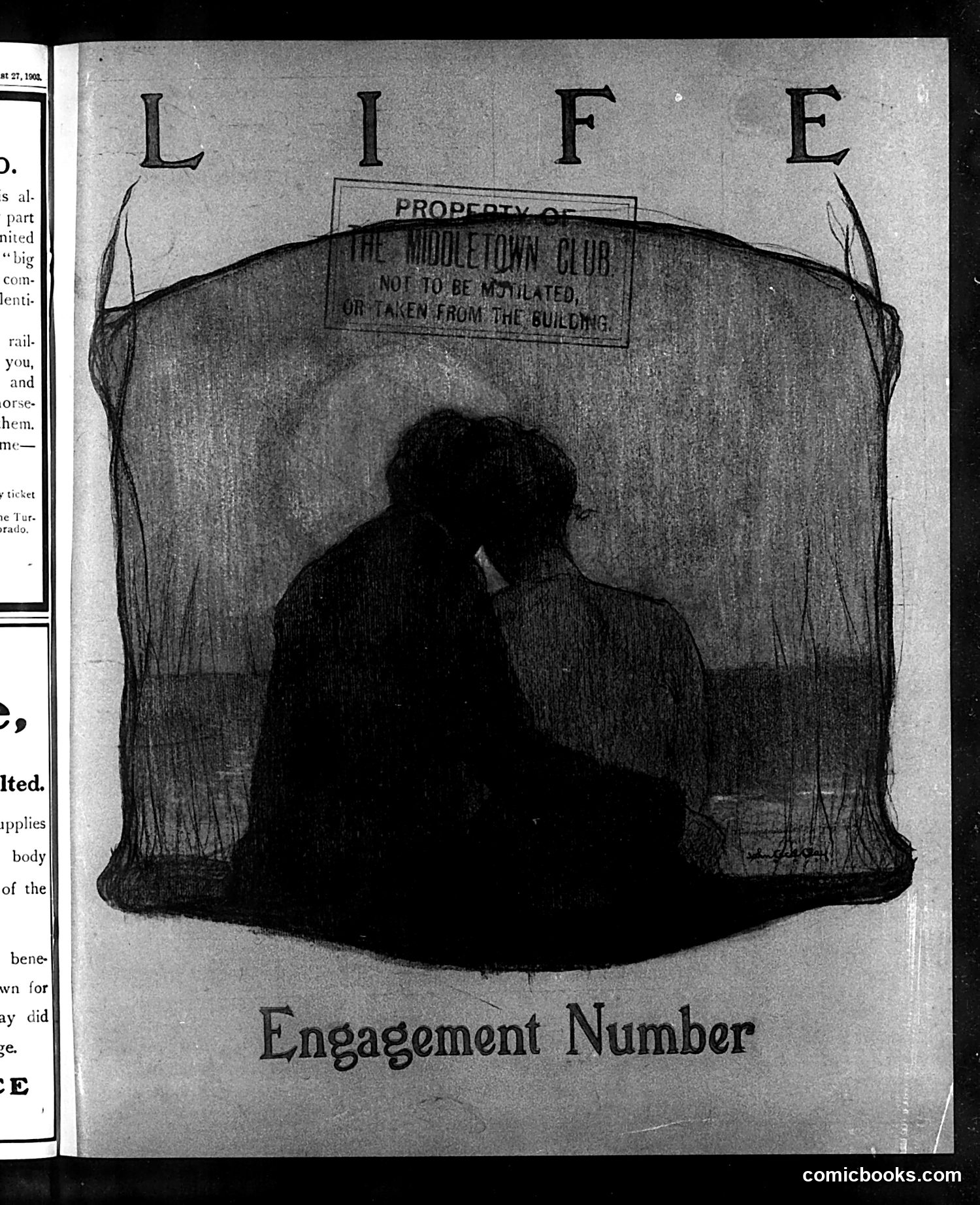
This is a satirical cartoon titled "Engagement Number" from *Life* magazine. The image shows two silhouetted figures in an intimate embrace within what appears to be a framed stage or window setting, with the word "LIFE" at the top. The cartoon satirizes romantic engagements, likely mocking the theatrical or performative nature of courtship announcements in high society. The library stamp reading "Property of The Middletown Club" suggests this was about local social pretensions. The humor targets how engagements were treated as public spectacles or formal "numbers" (performances) rather than genuine private moments. The silhouette technique emphasizes anonymity, suggesting this mocks universal human behaviors rather than specific individuals—a common *Life* magazine approach to social satire.
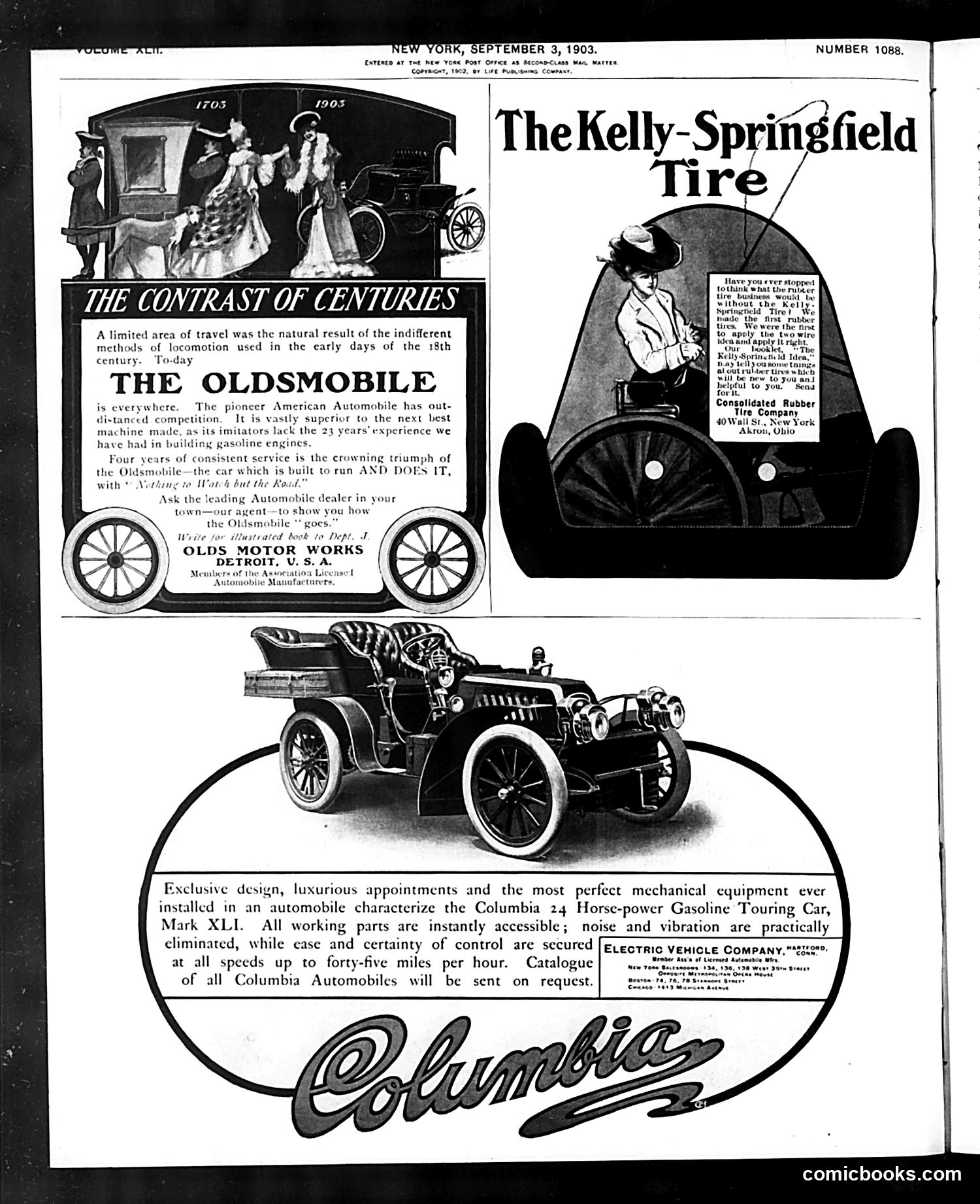
This page is primarily **advertising**, not political satire. It contains three automobile advertisements: 1. **Oldsmobile ("The Contrast of Centuries")**: Contrasts 18th-century travel limitations with the modern automobile's superiority. The ad celebrates the Oldsmobile's 23-year track record and invites readers to test-drive one. 2. **Kelly-Springfield Tire**: A tire manufacturer advertisement featuring a woman examining a tire, emphasizing product quality and durability. 3. **Columbia Automobile**: Promotes the luxury Columbia 24 Horsepower Gasoline Touring Car, Mark XLI, highlighting mechanical features and speed capabilities (up to 45 mph). These ads reflect early 1900s fascination with automobiles as modern technological marvels, positioning cars as symbols of progress and status.
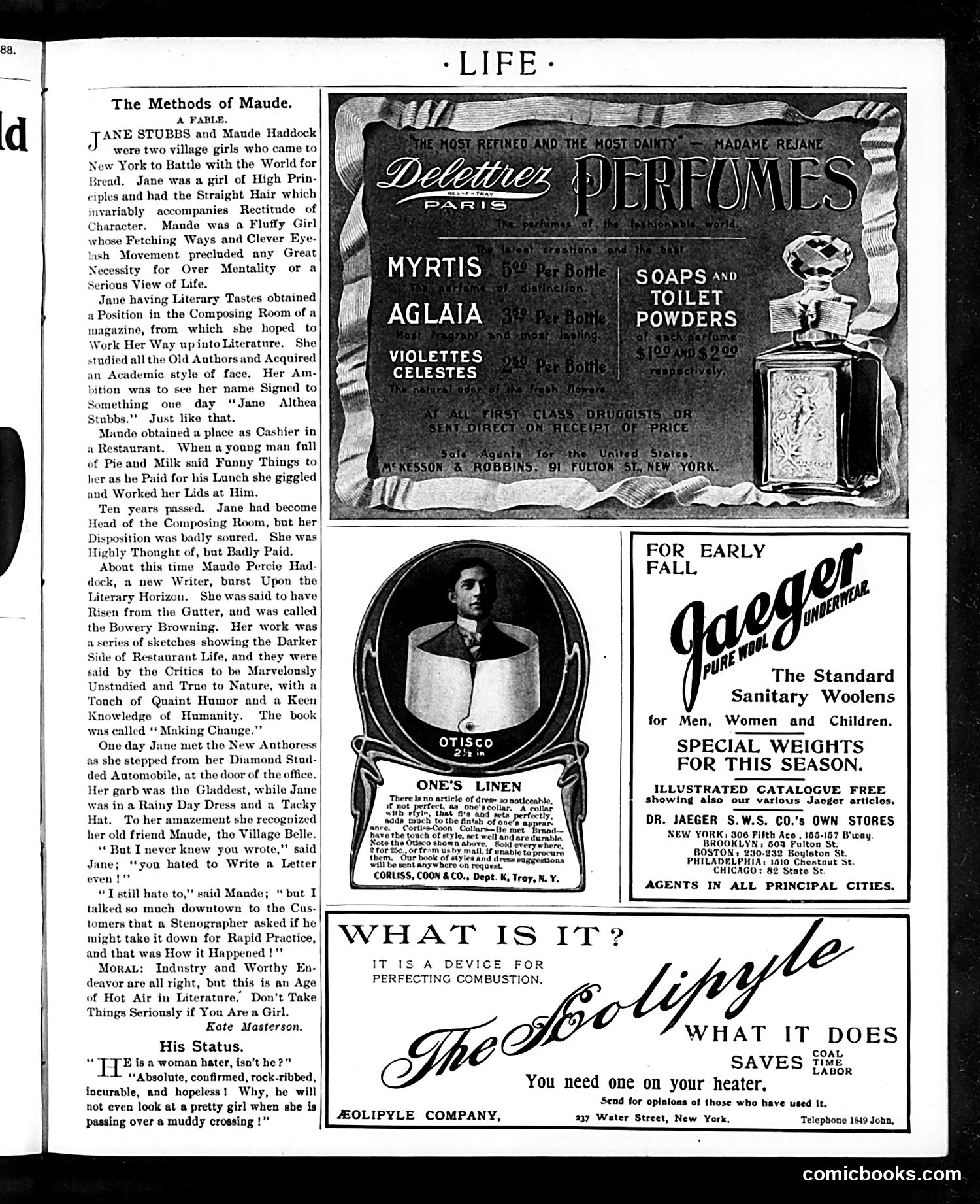
This page is primarily **advertising with a satirical story**. "The Methods of Maude" mocks a young woman's social ambitions through her various jobs: village girl, High School student, magazine composing room worker, restaurant cashier, and ultimately a writer. The satire suggests that Maude opportunistically adopts different personas and social positions to advance herself, each role carefully calculated rather than genuine. The recurring joke is her shallow "Thought" and her ultimate success as a writer despite (or because of) her fraudulent social climbing. This reflects early-1900s anxieties about women's increasing workforce participation and social mobility, portraying ambitious women as inherently insincere social climbers rather than legitimate professionals.
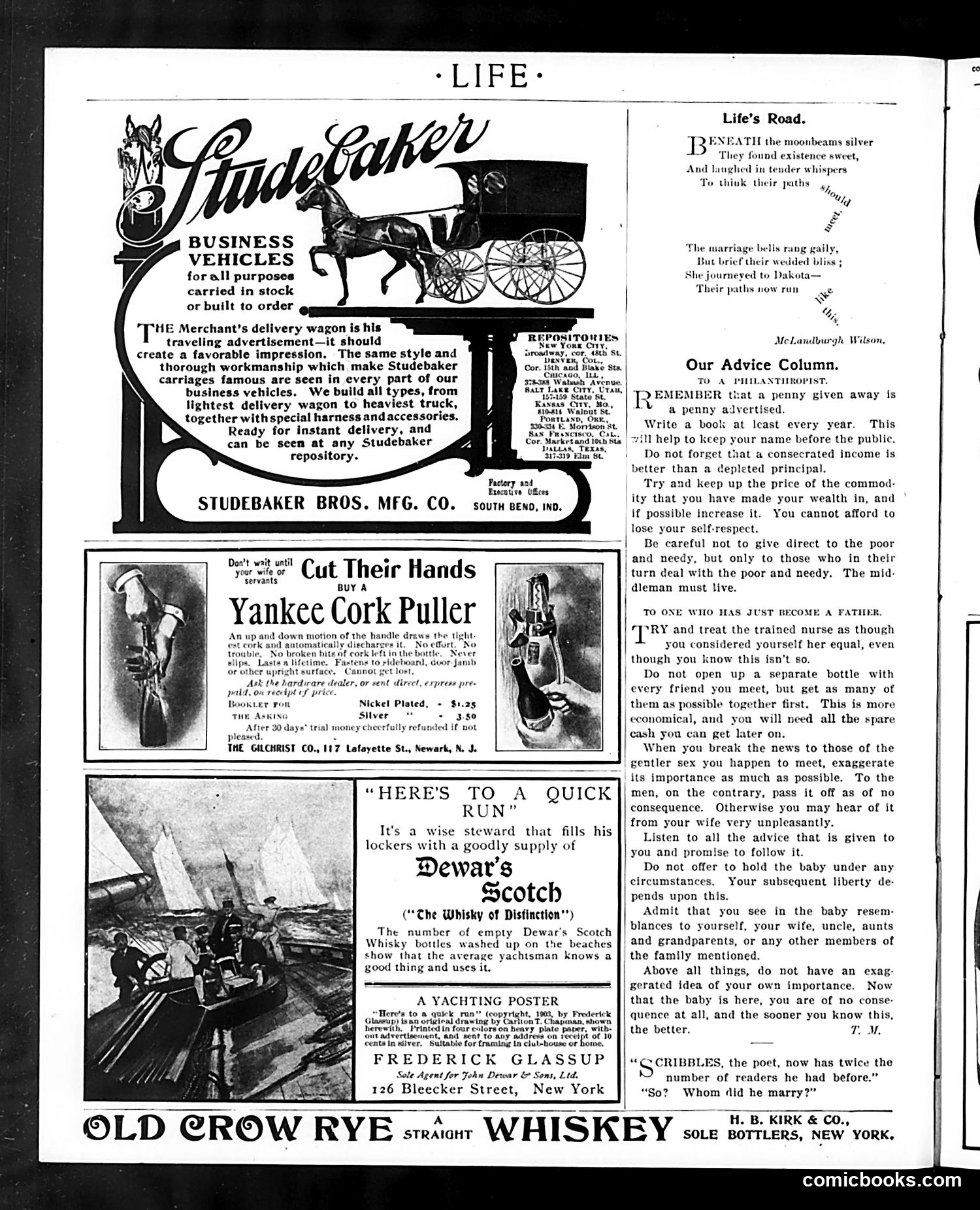
This page is primarily **advertisements interspersed with advice column content**, not political satire. The ads include: - **Studebaker Bros.** (horse-drawn business vehicles) - **Yankee Cork Puller** (a mechanical device to prevent hand injury) - **Dewar's Scotch Whisky** (featuring a yachting scene) - **Old Crow Rye Whiskey** The editorial content is "Our Advice Column" by "T.W.," offering conventional domestic and social guidance: managing household budgets, treating hired help fairly, parenting advice, and discretion when gossiping with women. The poem "Life's Road" appears decorative rather than satirical. **This is a typical early-20th-century Life magazine page: commercial, moralistic, and aimed at middle-class readers.** There is no discernible political cartoon or sharp satire present.
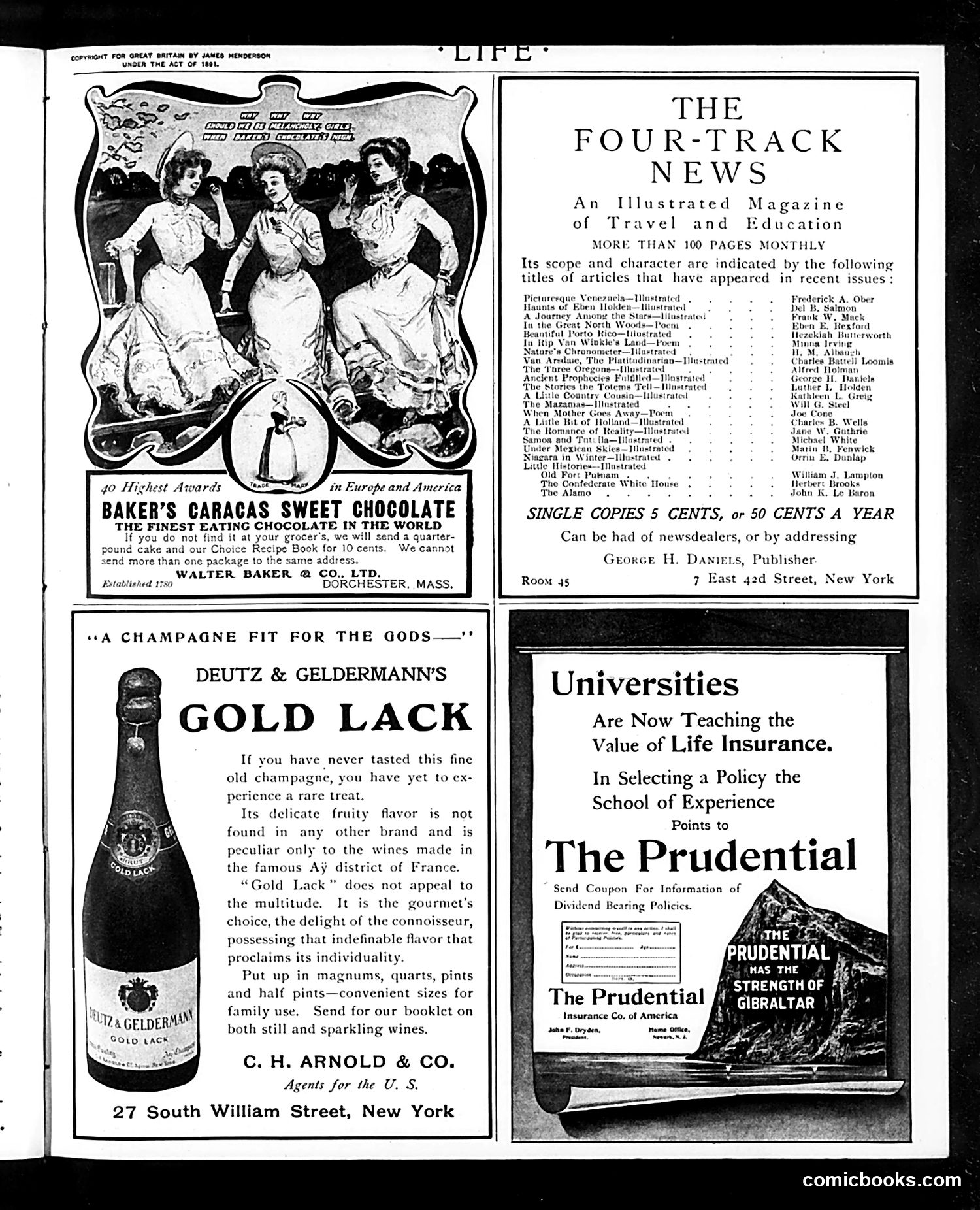
This page is primarily **advertising content** rather than political satire or editorial cartoons. It contains four advertisements: 1. **Baker's Caracas Sweet Chocolate** - promoting chocolate products with an illustrated image of three fashionable women 2. **The Four-Track News** - a travel and education magazine promoting subscription 3. **Deutz & Geldermann's Gold Lack** - champagne advertisement emphasizing its French origin and exclusivity 4. **The Prudential Insurance** - promoting life insurance policies to universities The illustrations are decorative rather than satirical. The women in the chocolate ad reflect early 1900s fashion conventions. The page demonstrates how *Life* magazine generated revenue through high-end product advertising targeting educated, affluent readers. No political commentary or social satire is evident on this particular page.
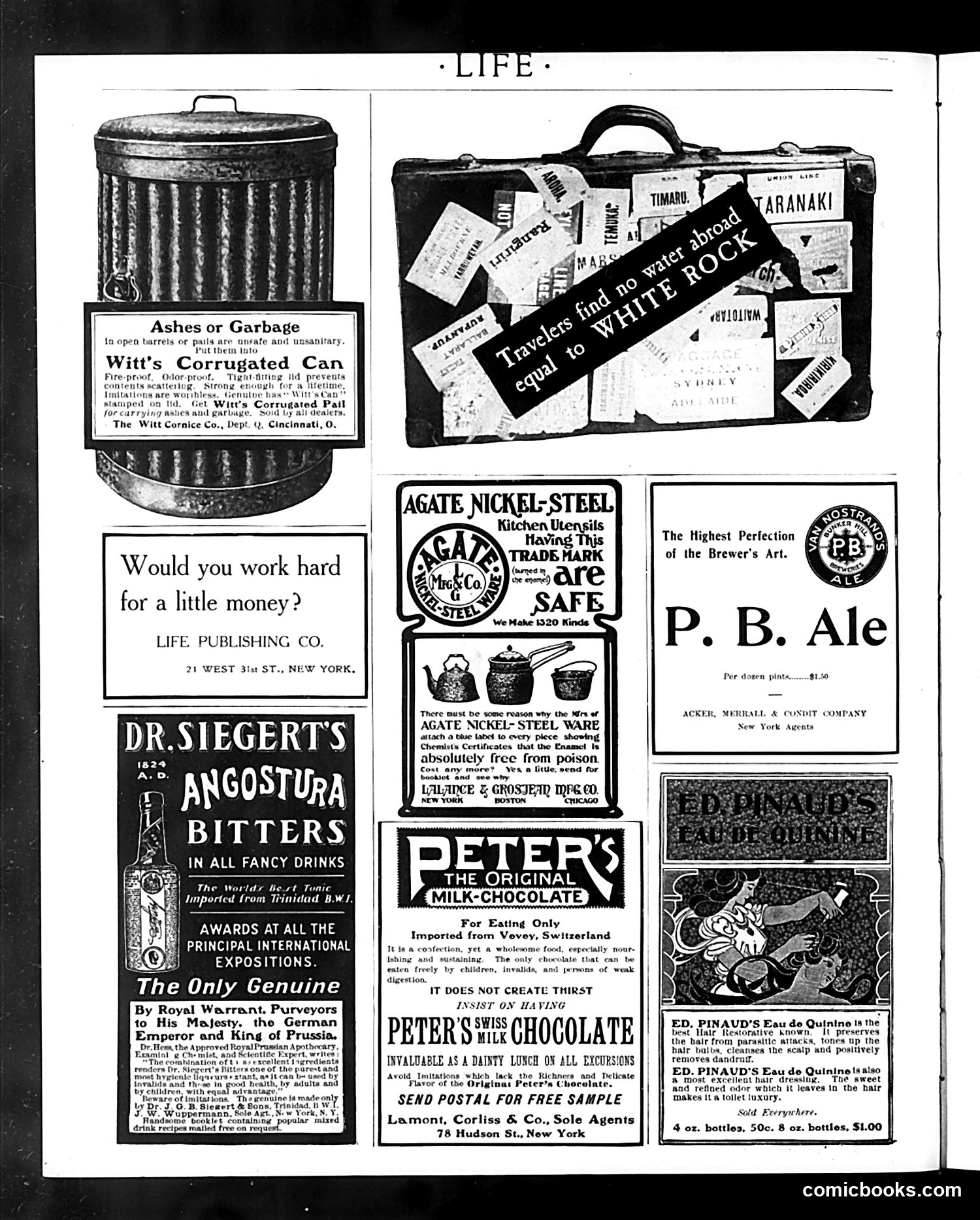
This page is primarily **advertisements** rather than political cartoons or satire. It contains vintage product ads from what appears to be the early 20th century, including: - Witt's Corrugated Can (garbage containers) - Life Publishing Co. (recruitment ad: "Would you work hard for a little money?") - Dr. Siegert's Angostura Bitters - Agate Nickel-Steel kitchen utensils - P.B. Ale beer - Peter's Milk Chocolate - ED. Pinaud's Eau de Quinine (hair treatment) A suitcase labeled "Travelers find no water abrook equal to WHITE ROCK" appears prominently, advertising mineral water. The page serves as a historical document of consumer products and marketing from this era rather than containing satirical commentary. The ads reflect period concerns about product safety, purity, and quality.
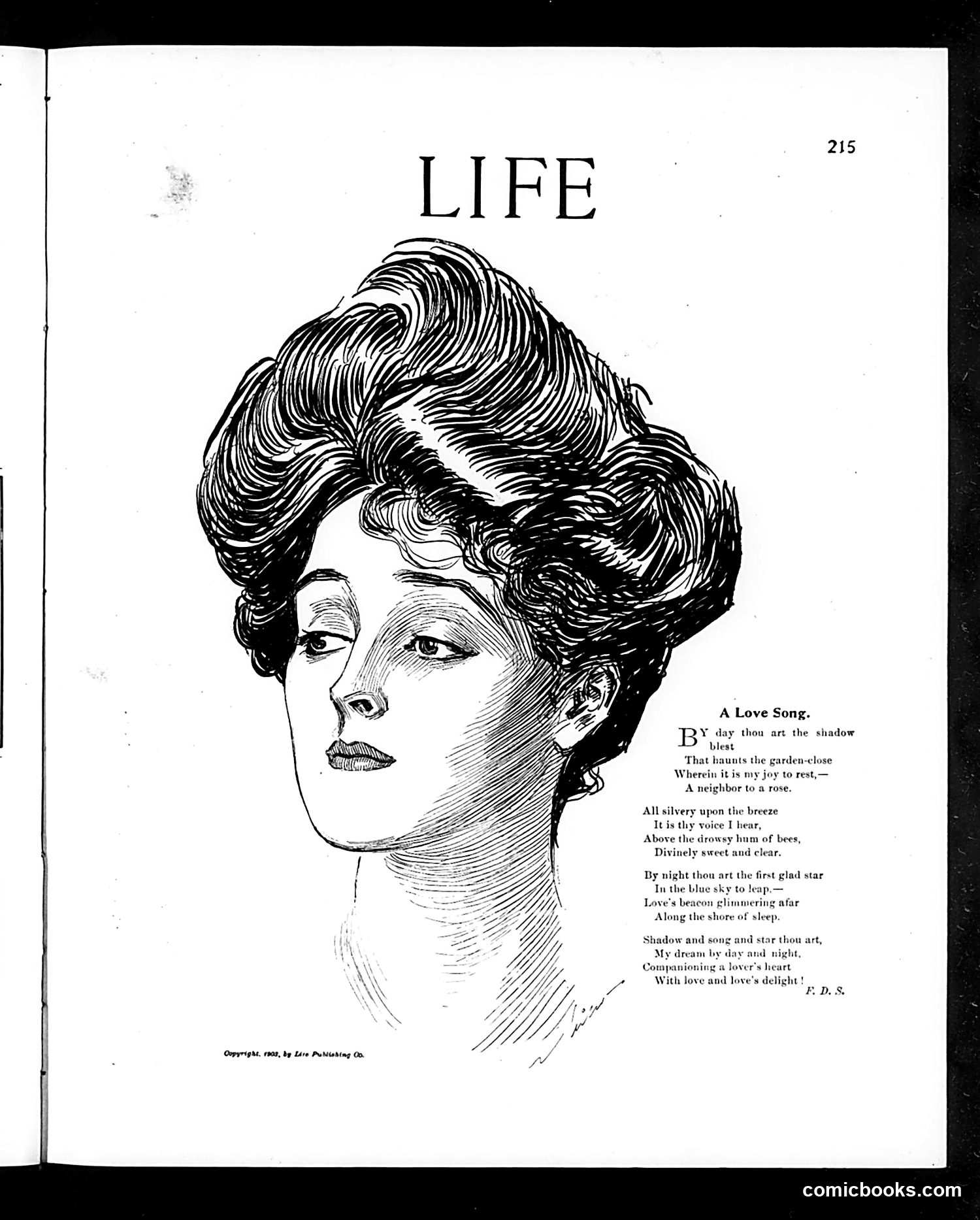
This page from *Life* magazine (page 215) features a portrait illustration titled "A Love Song" alongside romantic poetry signed "E.D.S." The sketch shows a woman's profile in the Gibson Girl style—the idealized feminine aesthetic popular in early 20th-century America, characterized by the elaborate upswept hairstyle and refined features depicted here. This is not political satire but rather a romantic literary and artistic contribution. The poem expresses sentimental love through natural imagery (shadow, star, breeze, rose). The copyright notice indicates publication by Life Publishing Co. in 1903. The page represents *Life*'s dual role as both satirical magazine and venue for contemporary romantic poetry and portraiture that appealed to educated middle-class readers of the era.
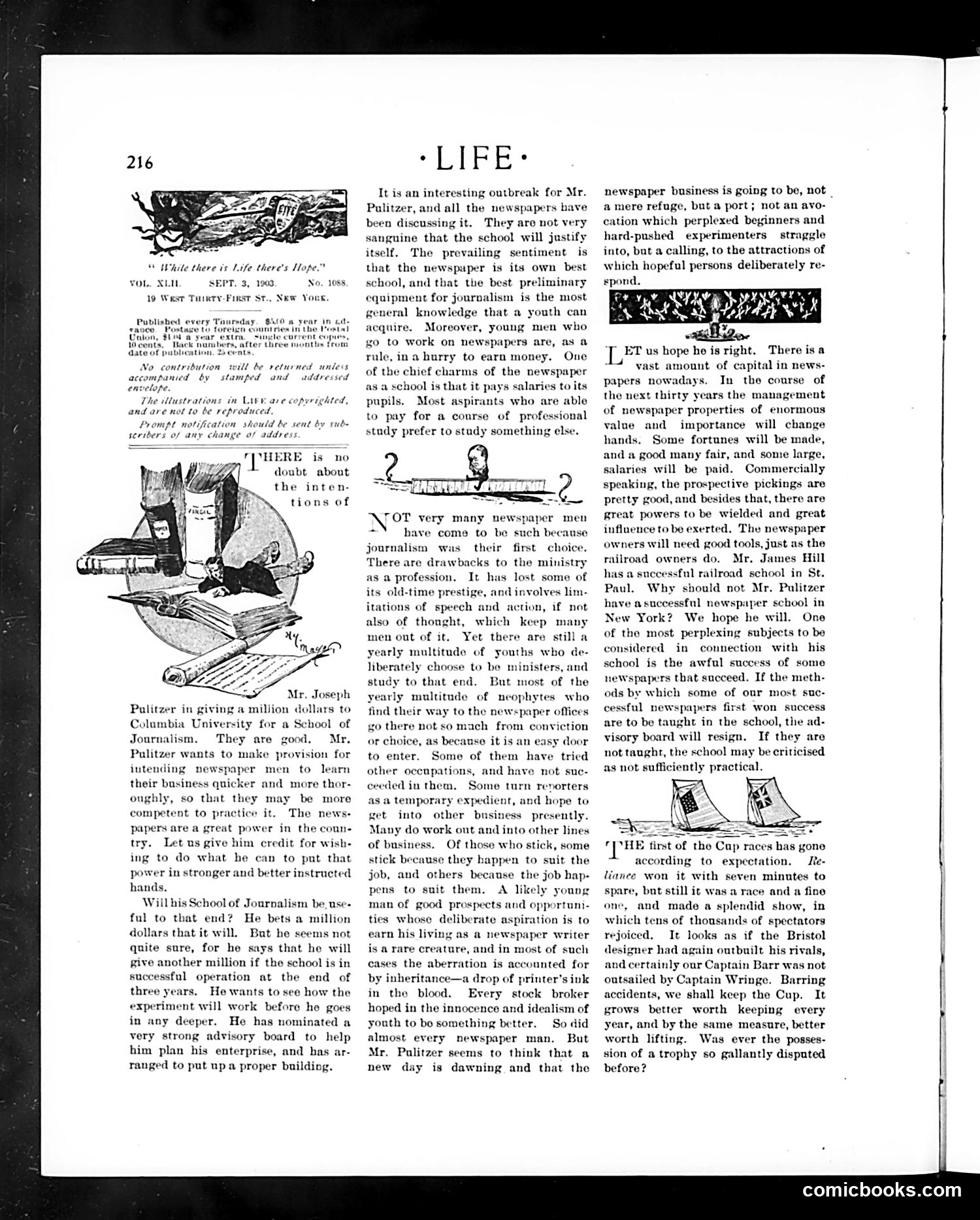
This page discusses Joseph Pulitzer's million-dollar donation to Columbia University for a School of Journalism. The accompanying illustrations satirize the newspaper profession's appeal and challenges. The cartoons show young men attracted to journalism as a career path—depicted entering newspaper offices with enthusiasm. The satire suggests journalism appeals to idealistic youth who romanticize the work, though the text notes many face practical disappointments and career limitations. The piece critiques both the profession's actual drawbacks (low pay, limited advancement) and the naive expectations of aspiring journalists. It questions whether Pulitzer's school will truly improve conditions or merely train more people for a crowded, difficult industry. The satire targets the disconnect between journalism's apparent prestige and its actual working conditions.
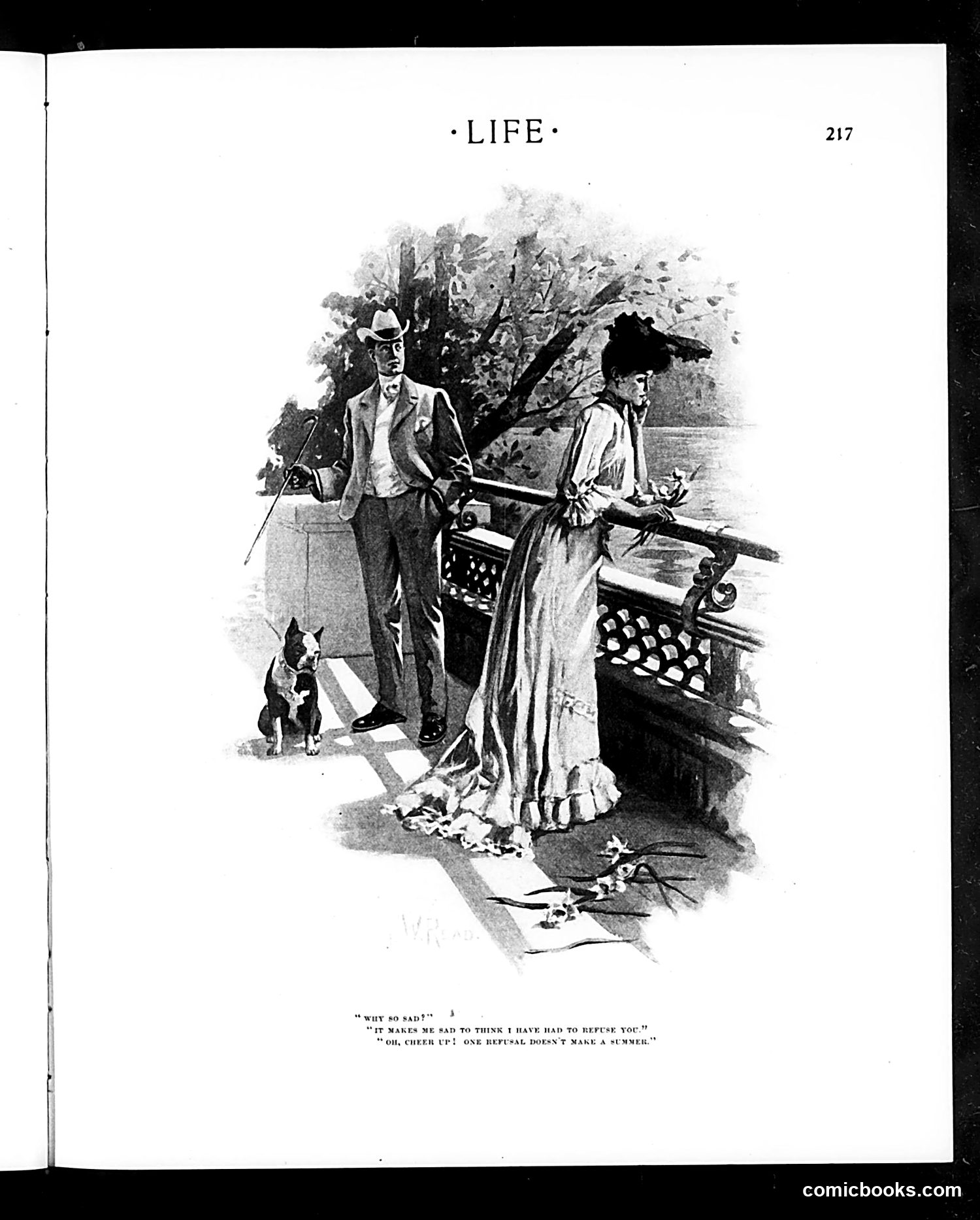
This illustration depicts a romantic scene with satirical dialogue. A man in a cowboy hat and formal attire stands with a woman in an evening gown near a garden gate. A small dog is visible in the scene. The dialogue reads: - "Why so sad?" - "It makes me sad to think I have had to refuse you." - "Oh, cheer up! One refusal doesn't make a summer." The satire plays on the phrase "one swallow doesn't make a summer," subverting it to comment on romantic rejection. The cowboy-dressed suitor appears to be making light of repeated romantic refusals, suggesting the woman has rejected him multiple times. The joke relies on the contrast between his cheerful demeanor and the awkward reality of persistent rejection, typical of Life magazine's romantic humor from this era.
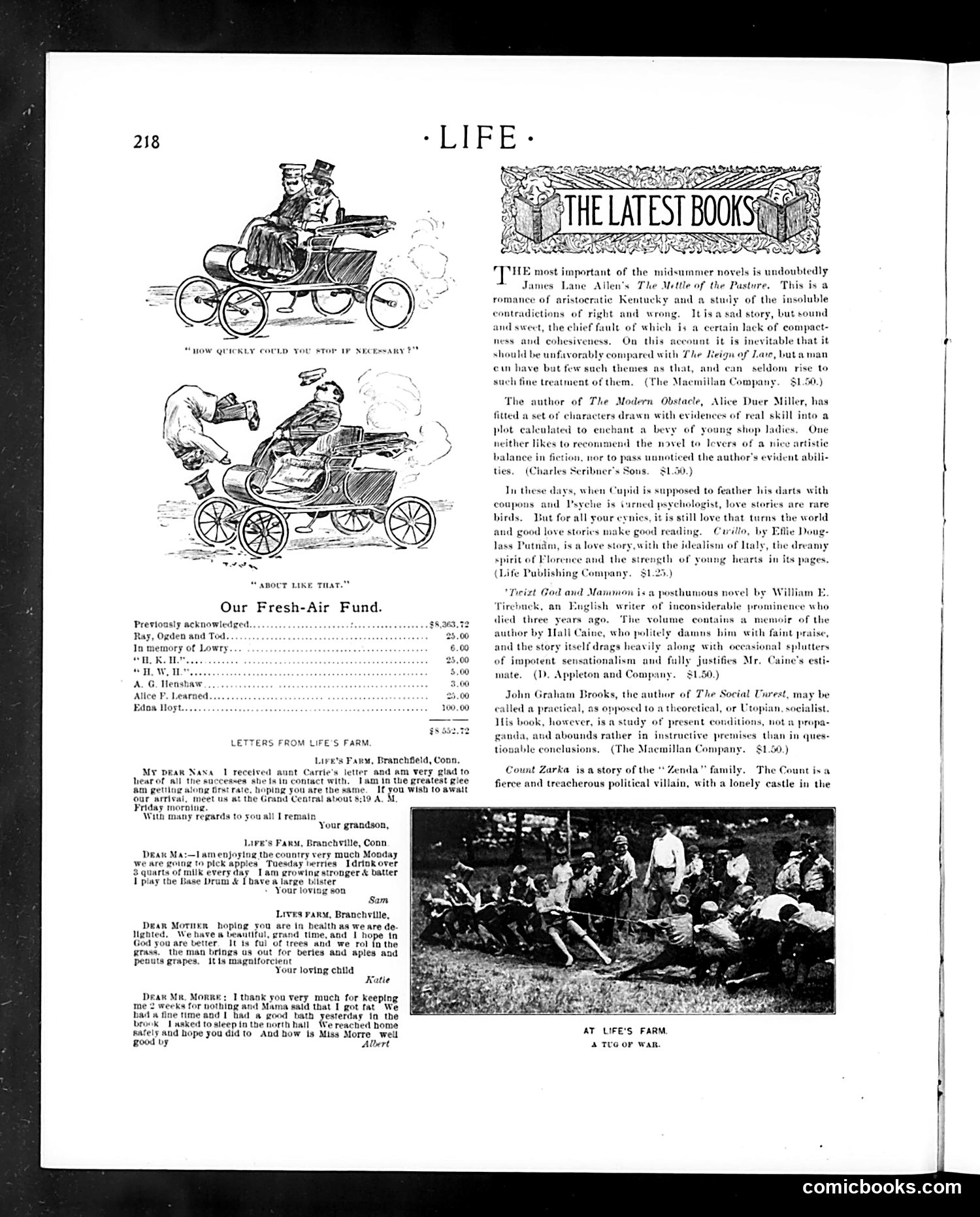
This page contains two editorial cartoons about early automobiles, paired with a "Fresh-Air Fund" section and book reviews. The cartoons depict couples in primitive motor cars with the captions "HOW QUICKLY COULD YOU STOP IF NECESSARY?" and "MORE USE THAT." The humor targets the dangers and unpredictability of early automobiles—vehicles that lacked modern safety features like reliable brakes. The exaggerated depictions of passengers being thrown about or struggling to control their vehicles satirize both the mechanical unreliability and drivers' lack of experience with this new technology. The cartoons appear designed to mock the false confidence of early automobile enthusiasts while highlighting genuine safety concerns that would have been obvious to contemporary readers familiar with these temperamental vehicles.
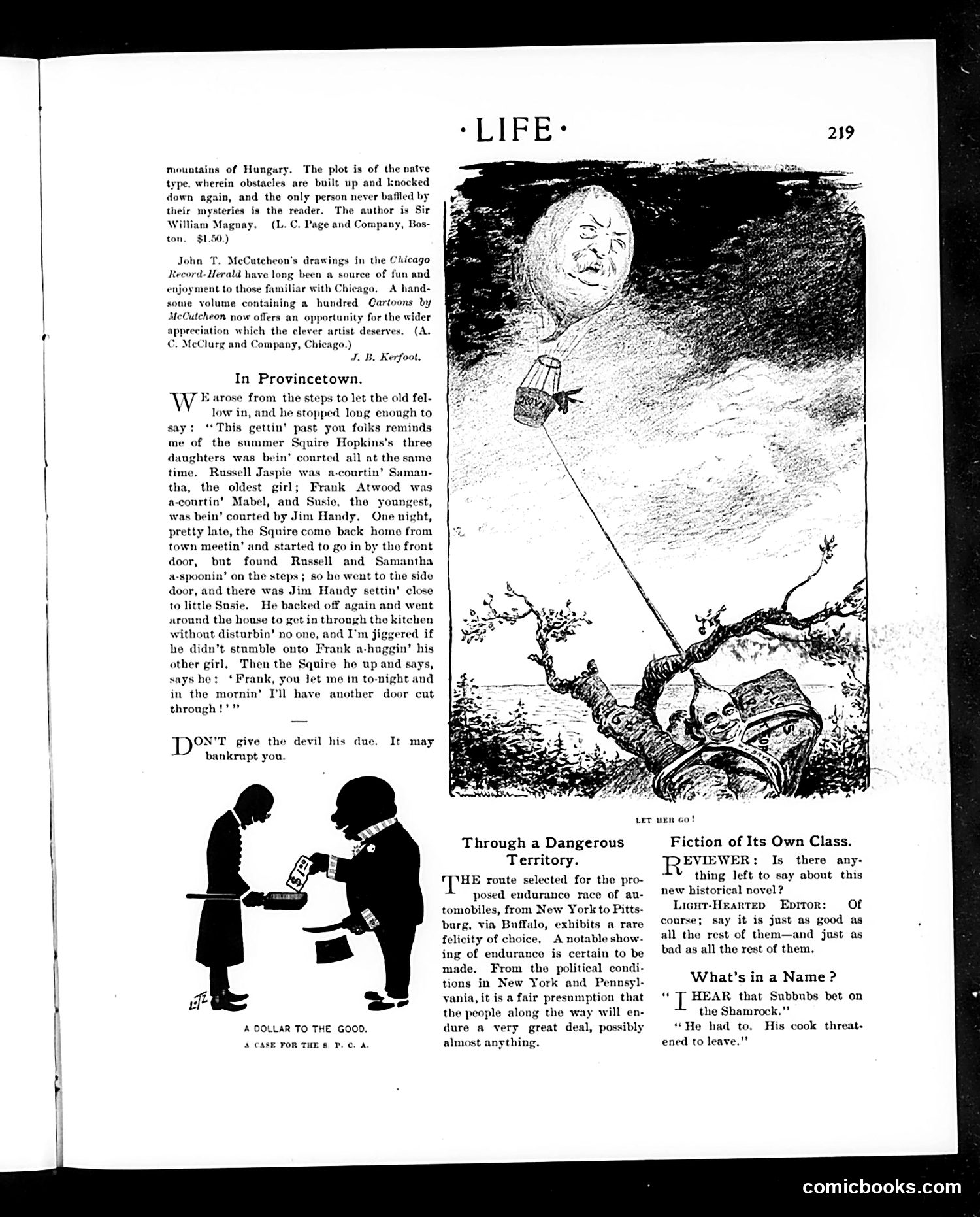
This page contains two distinct cartoons and literary content: **"A Collar to the Good"** (bottom left): A satirical cartoon showing two figures exchanging money, with the caption "A CASE FOR THE S.P.C.A." (Society for the Prevention of Cruelty to Animals). The joke appears to critique financial exploitation or unfair dealings—the "collar" reference likely suggests someone being "collared" (trapped) in a bad transaction, with the S.P.C.A. reference implying the victim is treated like a helpless animal. **Top illustration**: An artistic drawing accompanying the story "In Provincetown," depicting what appears to be a person fishing or struggling with a line in a rural setting. **Literary content**: Sections titled "In Provincetown," "Through a Dangerous Territory," and "What's in a Name?" appear to be story excerpts or serialized fiction typical of Life's mixed editorial format. The page blends visual satire with entertainment content characteristic of early 20th-century American humor magazines.
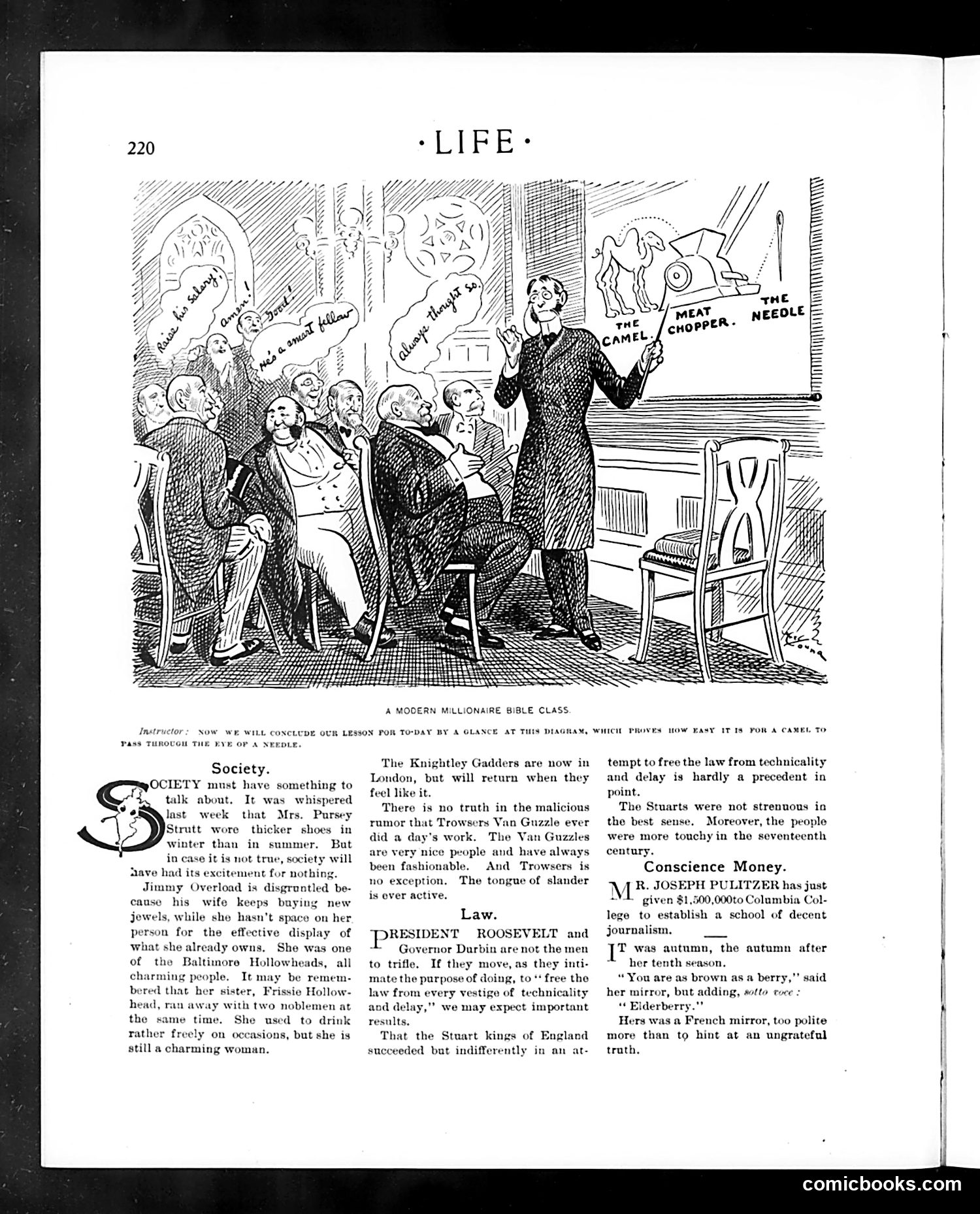
The main cartoon satirizes wealthy industrialists attending a Bible study. The instructor points to a diagram labeled "The Needle," "The Meat Chopper," and "The Camel"—references to Jesus's teaching that it's easier for a camel to pass through a needle's eye than for a rich man to enter heaven (Matthew 19:24). The joke: these millionaires are trying to rationalize their wealth through religion, finding loopholes in scripture. The text sections below discuss society gossip, legal matters regarding President Roosevelt's trust-busting efforts, and journalism education. The satire targets the hypocrisy of wealthy Americans claiming Christian virtue while resisting wealth redistribution and labor protections—core Progressive Era criticisms.
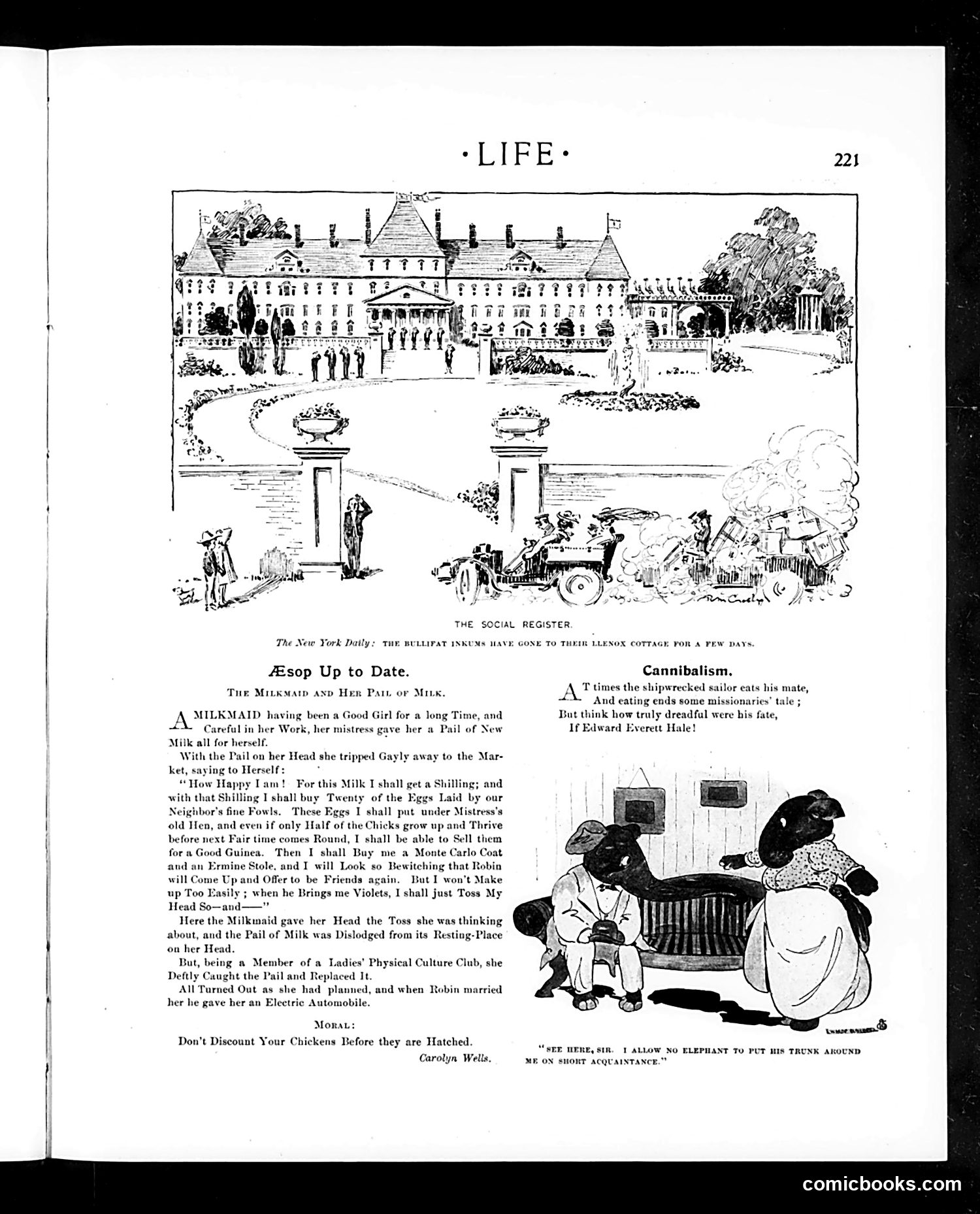
This page satirizes early 20th-century social aspirations and excess. "The Social Register" heading mocks high society's pretensions—the illustration shows an opulent mansion where the wealthy briefly retreat. "Aesop Up to Date" modernizes the classic fable about counting chickens before they hatch. A milkmaid daydreams of escalating luxury (eggs→chickens→Monte Carlo coat and ermine stole) to win back a rejected suitor named Robin. She's literally distracted by vanity, nearly dropping her milk. The moral is updated: even a "Physical Culture Club" member (fashionable fitness movement) can't escape consequences of foolish ambition. "Cannibalism" references Edward Everett Hale (American author/clergyman famous for moral tales), darkly joking that shipwrecked sailors eating each other is less "dreadful" than becoming one of his preachy fictional characters. The bottom cartoon about an elephant mocks pretentious social etiquette—a woman refuses familiarity from an elephant as if enforcing upper-class distance rules. Overall: satire of wealth obsession, romantic folly, and Victorian propriety.
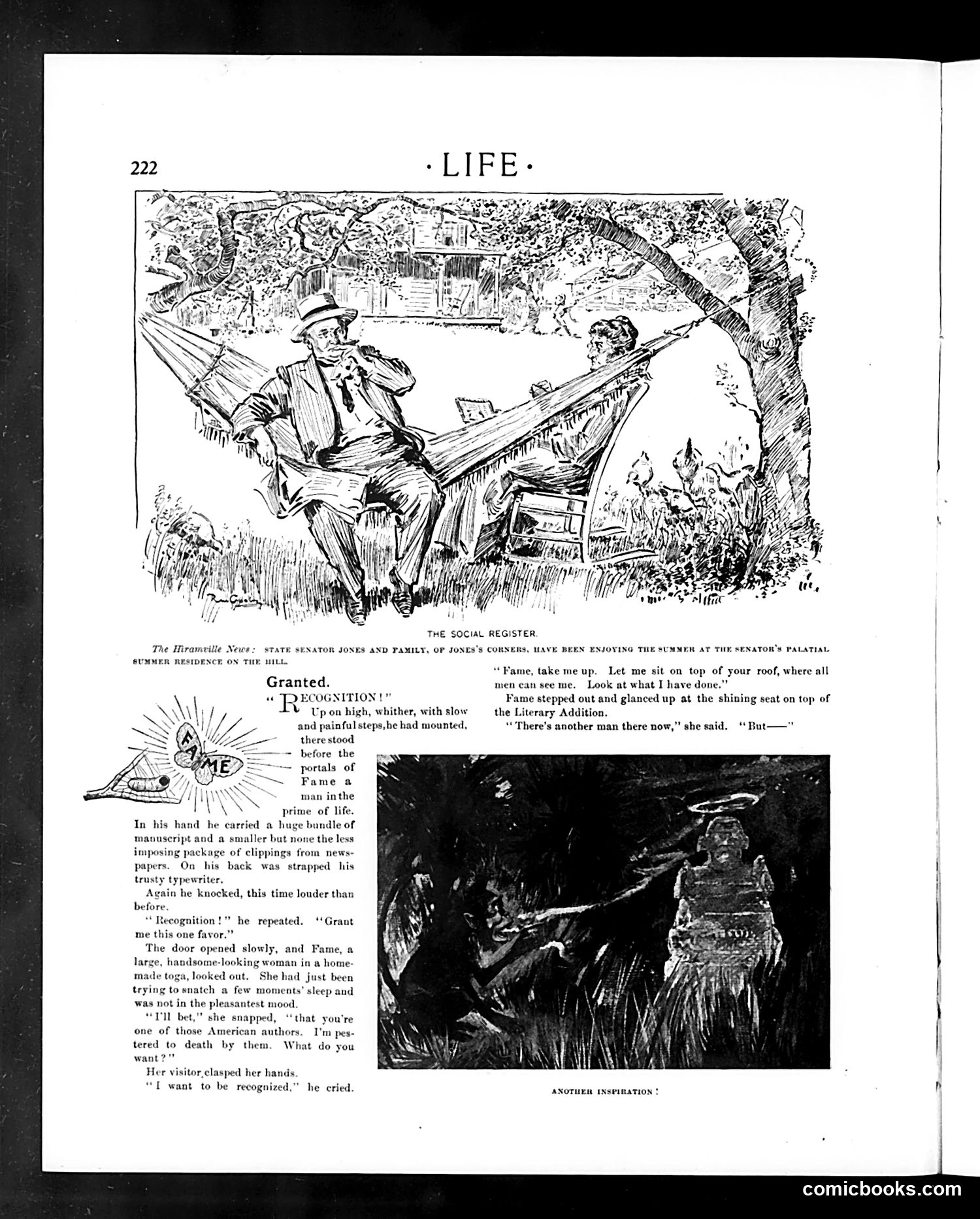
This page contains two satirical pieces about American social ambition and literary recognition. **Top cartoon** ("Granted"): A man approaches "Fame" seeking recognition, carrying manuscripts and newspaper clippings. The satire mocks the American author's desperate pursuit of literary acclaim—Fame is exhausted by constant petitioners and dismisses him as just another pest among "those American authors." The joke targets the proliferation of aspiring writers and their often-futile quests for recognition. **Bottom section** ("The Social Register"): References a real "Hiramsville News" item about State Senator Jones and family vacationing at their palatial summer residence. The accompanying dialogue about Fame's "roof" suggests social climbing—the irony that Fame's "seat" is crowded with people trying to be seen, implying that achieving social prominence is fleeting and replaceable. Together, these pieces satirize American materialism and the obsessive pursuit of status, whether literary or social.
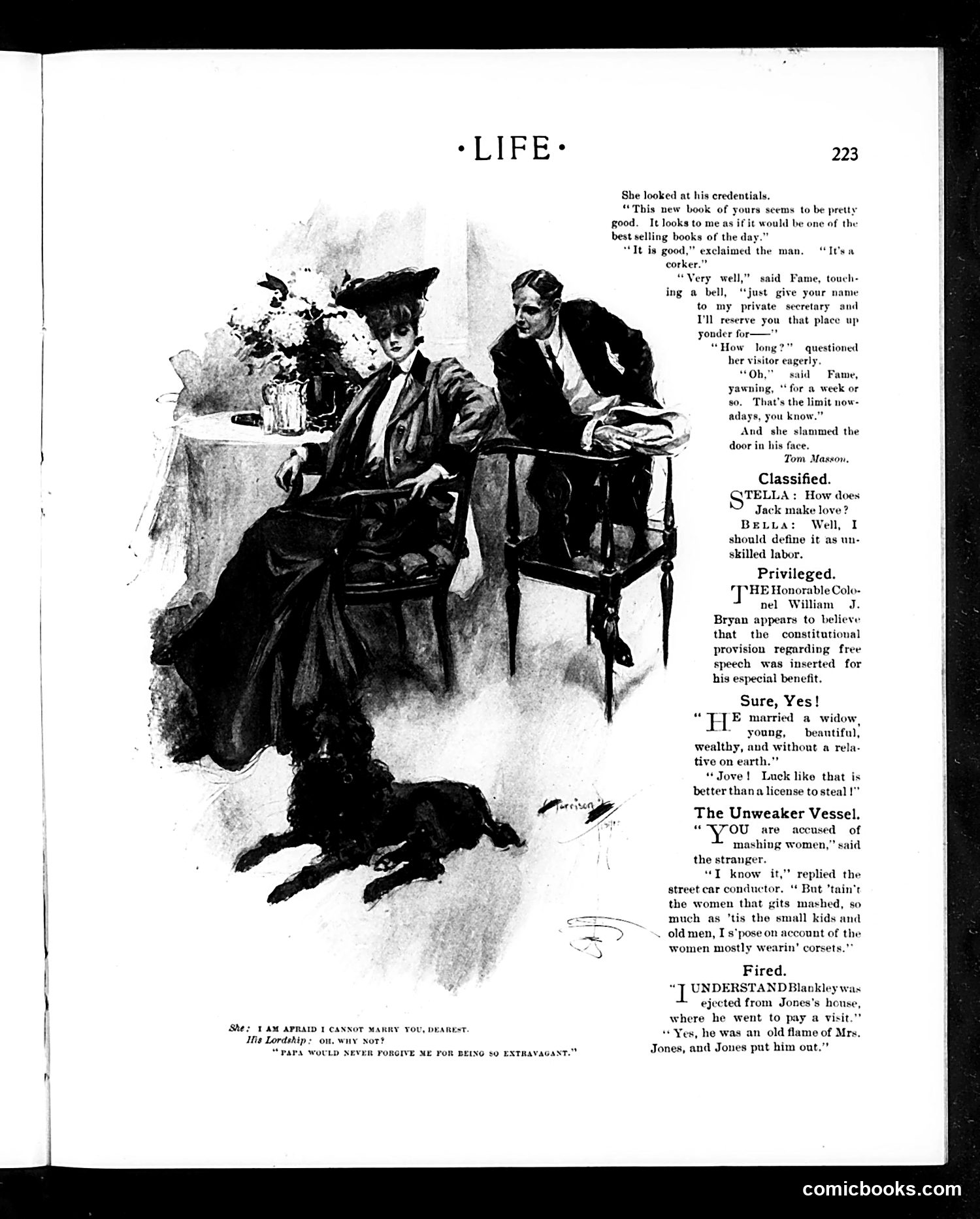
This page contains multiple brief satirical pieces typical of Life magazine's humor format: **Main Cartoon**: A woman representing "Fame" interviews a man with a new book. She offers him a week of prominence—the maximum duration she now grants anyone. The satire mocks the fleeting nature of literary success and celebrity in modern times. **Other Jokes** target contemporary social issues: - A dig at William Jennings Bryan's apparent belief that free speech protections exist solely for his benefit - Jokes about courtship ("unskilled labor"), marriage to wealthy widows, and street-car conductors accidentally injuring passengers wearing corsets - A final bit about a woman rejecting marriage because her father forbids "extravagance" The page reflects turn-of-the-century concerns: celebrity culture's ephemerality, political bombast, class anxieties, and gender dynamics. The corset references suggest ongoing debate about women's fashion and public behavior.
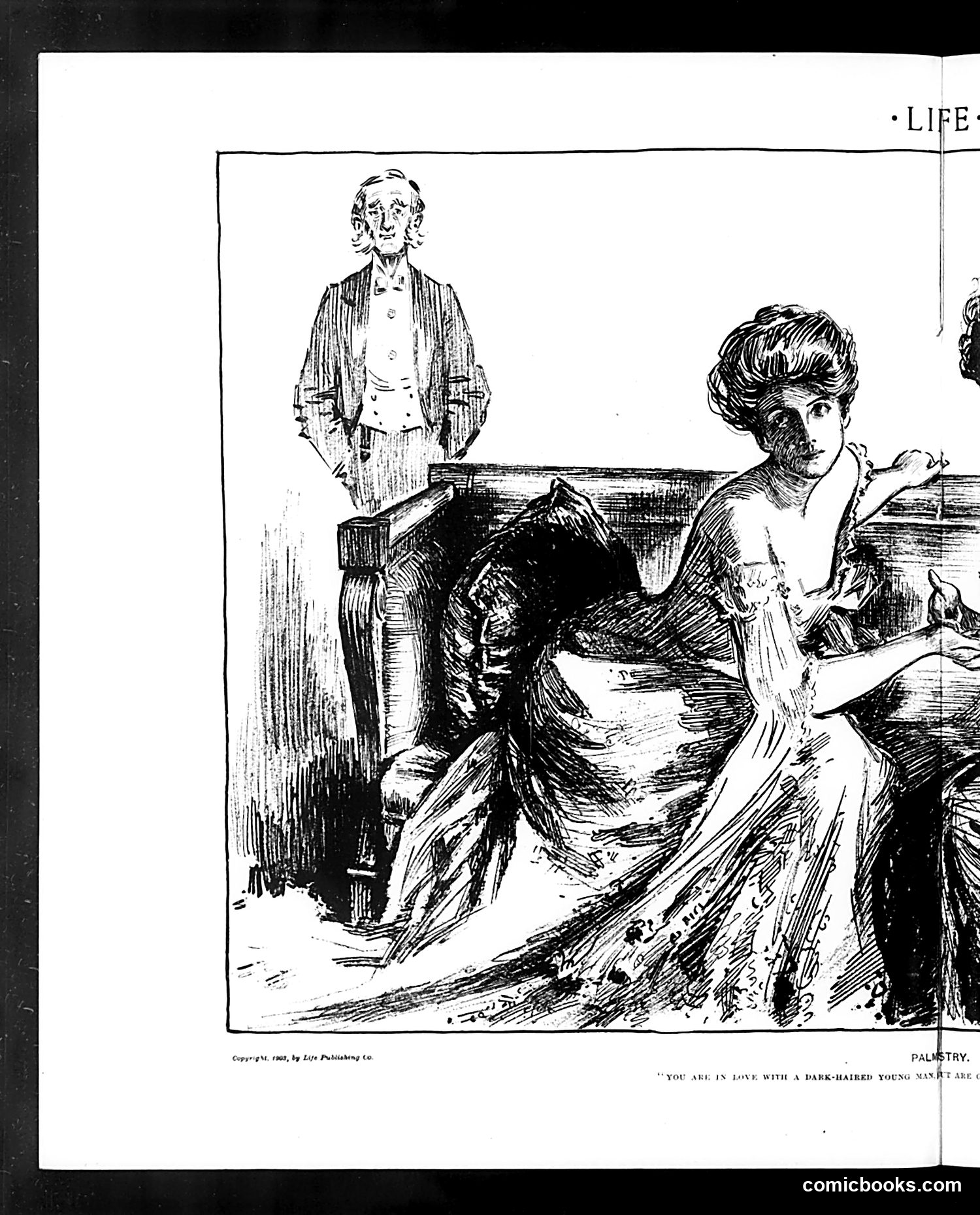
This is a satirical drawing titled "You Are in Love with a Dark-Haired Young Man" (text partially visible). The cartoon depicts an interior scene with a woman seated prominently in an elegant dress, while a man stands in the background. The style suggests early 1900s social satire. The joke appears to target romantic pretension or self-deception. The seated woman's elaborate pose and fashionable attire contrast with the modest gentleman behind her, suggesting a mismatch between her romantic fantasies and reality. This reflects common Life magazine humor mocking upper-class affectations, unrealistic romantic expectations, or the gap between women's idealized suitors and actual available matches. The specific identity of any real figures remains unclear from the visible information.
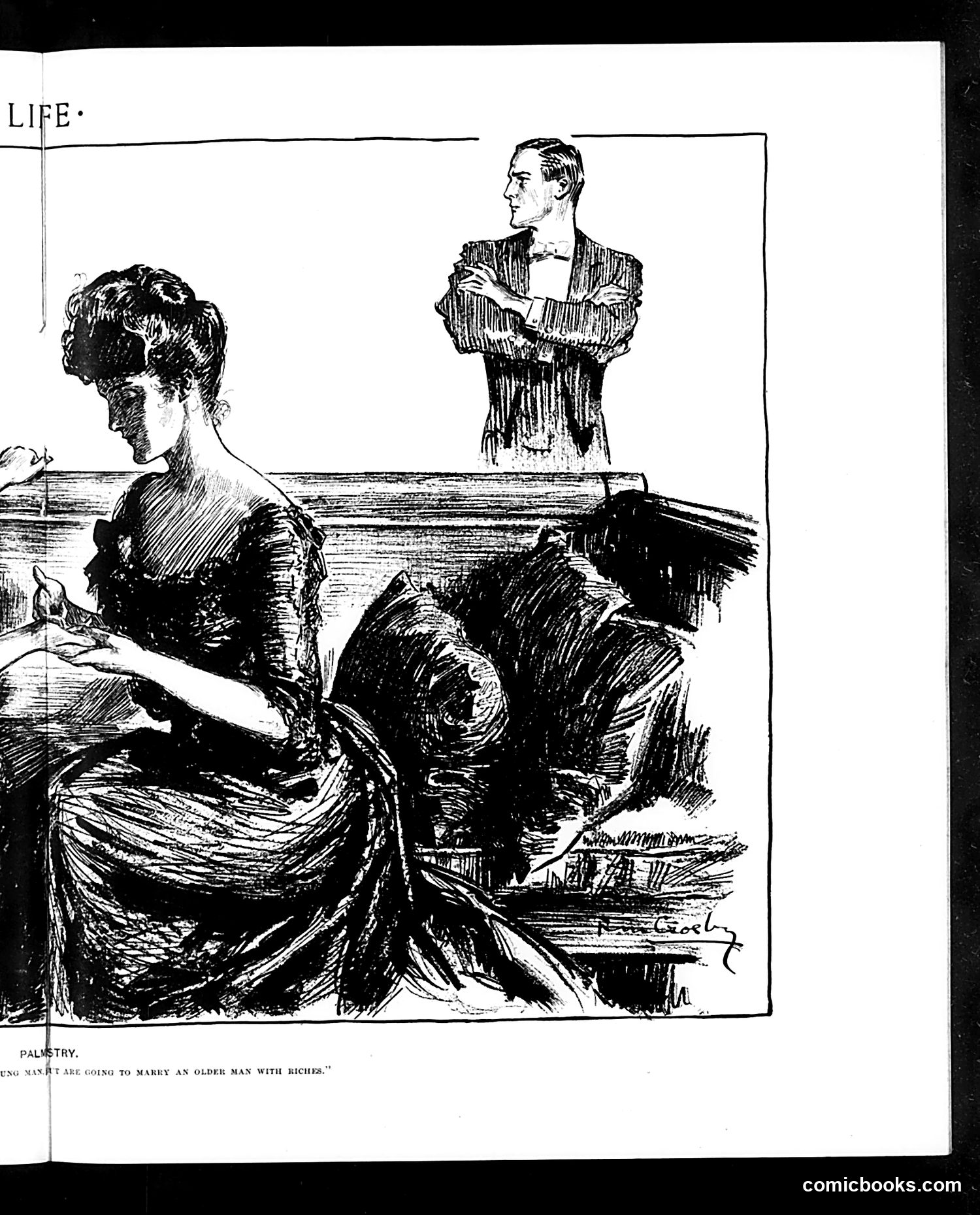
This satirical cartoon illustrates a social commentary on marriage and wealth. A woman has her palm read by what appears to be a fortune teller, who predicts she will "marry an older man with riches." The cartoon mocks the mercenary attitudes of the era regarding matrimony—specifically the expectation that young women would pursue wealthy older suitors for financial security rather than love. The scene suggests this outcome is merely "written in the stars" (via palmistry), implying it's an inevitable, predetermined social reality. The satire critiques both the practice of fortune-telling and the economic pressures forcing women into marriages based on wealth rather than genuine affection. This reflects late 19th/early 20th-century anxieties about class, gender roles, and romantic autonomy.
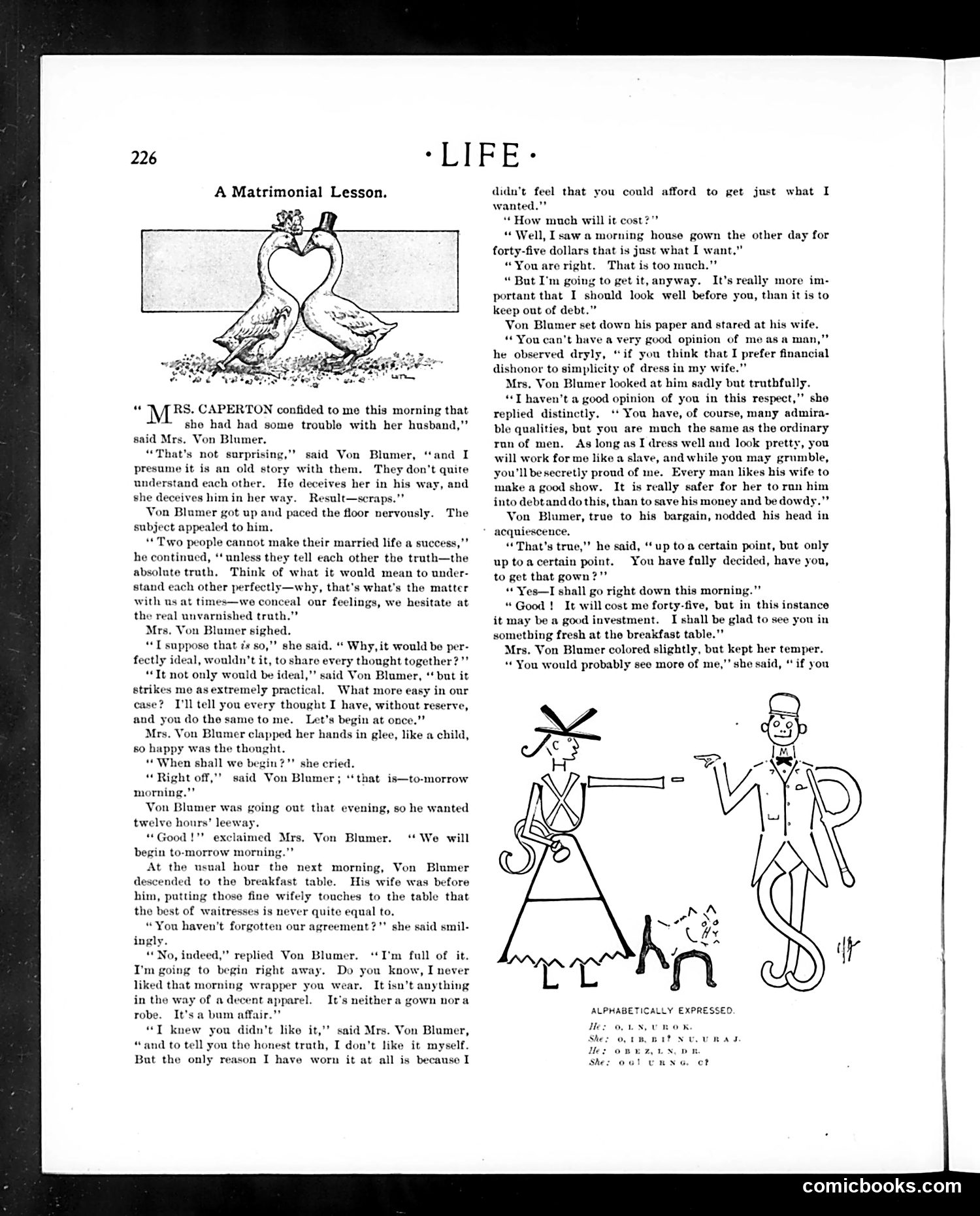
This satirical story critiques naive idealism about marriage. Von Blumer enthusiastically proposes that he and his wife share "absolute truth" with each other—a modern, progressive idea. He eagerly wants to begin "at once." However, when his wife honestly admits she bought an expensive $45 morning gown because she knows men prefer wives who look attractive and will work harder for women who dress well (rather than save money), Von Blumer is confronted with uncomfortable truths about masculine psychology and marital economics. His idealistic philosophy collides with reality: wives strategically use appearance as leverage, and husbands tacitly enable this through vanity. The accompanying cartoons (labeled "Alphabetically Expressed") appear to illustrate marital dynamics humorously. The satire's point: complete honesty in marriage is theoretically admirable but practically uncomfortable—people prefer comfortable illusions to brutal truths about attraction, money, and power dynamics.
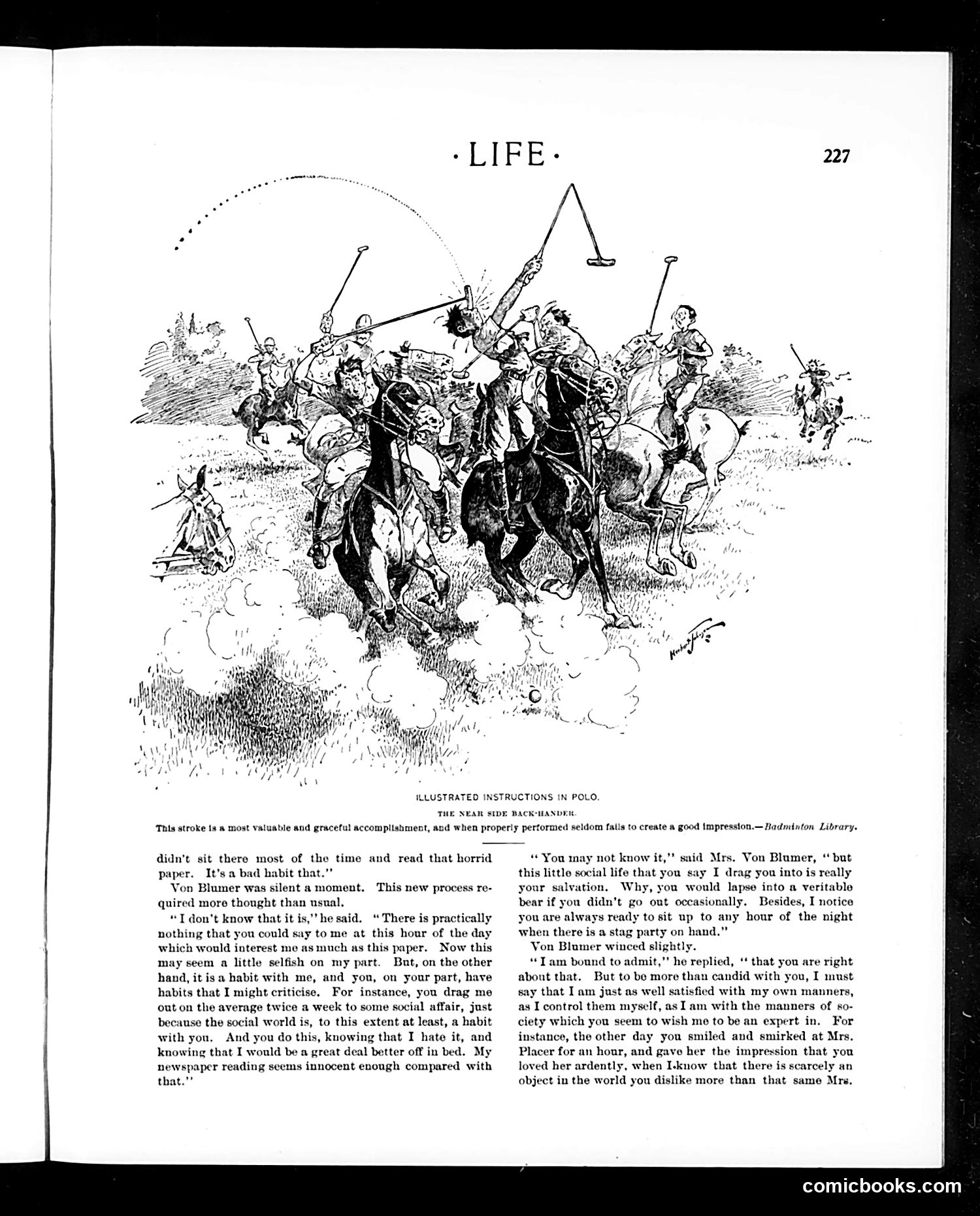
The page features a satirical illustration labeled "Illustrated Instructions in Polo: The Near Side Back-Hander," mocking upper-class sporting pursuits. The drawing shows polo players in chaotic action, with the caption sarcastically calling it "most valuable and graceful." Below is a dialogue between Mr. and Mrs. Von Blumer debating domestic habits. He defends reading newspapers during leisure time; she criticizes this as antisocial and insists he attend social events for his own good. Von Blumer counters that her own social performances—smiling insincerely at people she dislikes—are equally inauthentic. **The satire targets**: Upper-class hypocrisy about "proper" behavior. While society demands conformity to social rituals (polo, parties, polite conversation), individuals perform these roles inauthentically. The couple's argument exposes how both enforce arbitrary social conventions while condemning each other's harmless preferences.
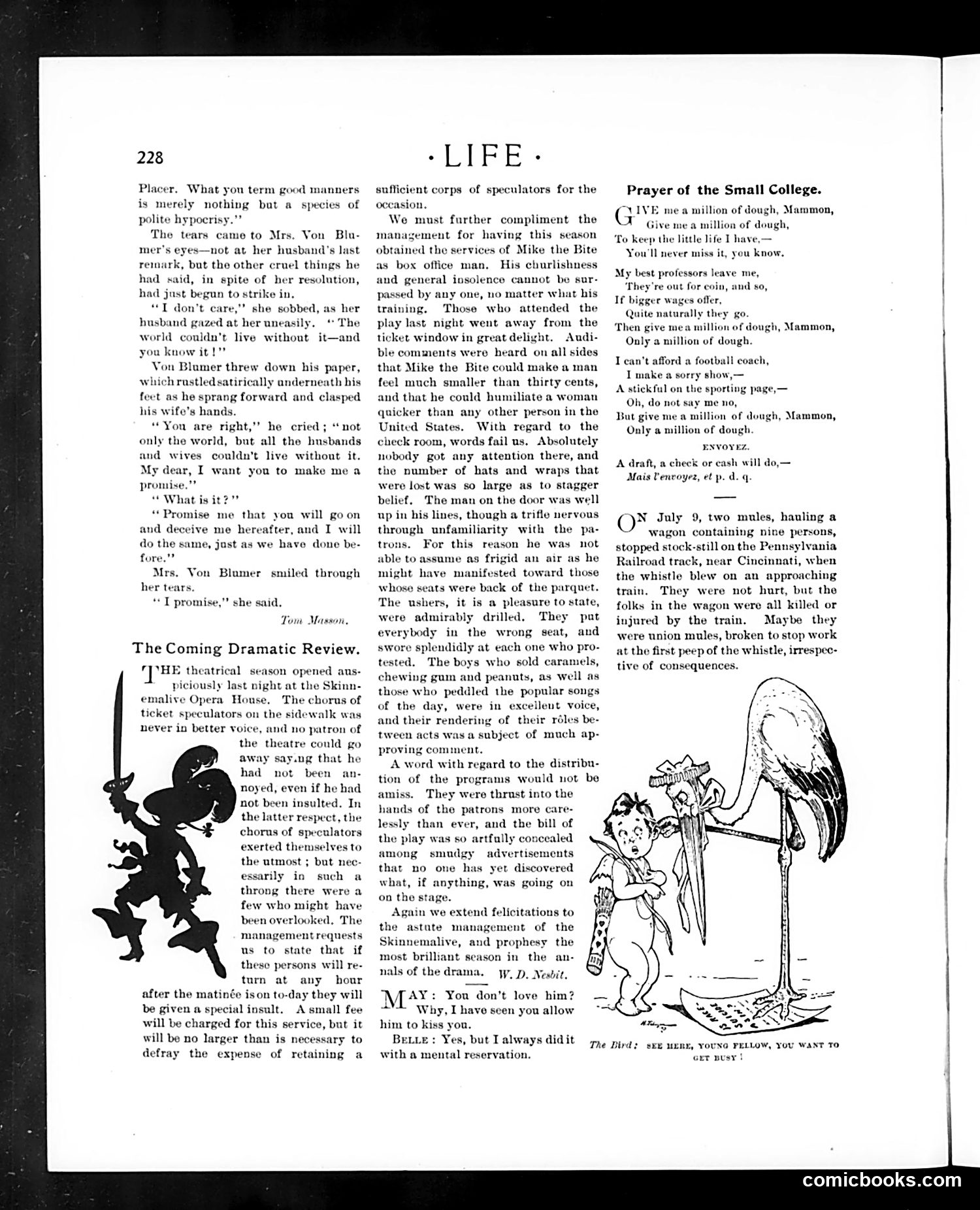
This page contains satirical commentary on New York theater culture, circa early 1900s. **"The Coming Dramatic Review"** mockingly praises the Skinnemalive Opera House's opening night—but the "praise" is entirely sarcastic. The reviewer congratulates management on deploying "speculators" (scalpers) who annoy patrons, hiring "Mike the Bite" as a deliberately rude box office clerk, running a chaotic coat check, seating people incorrectly, and obscuring the program among advertisements. The joke: theaters routinely provided terrible customer service, and Life sarcastically celebrates these failures as intentional features rather than bugs. **The domestic dialogue** (by Tom Masson) depicts a husband and wife agreeing to continue mutual deception "just as we have done before"—satirizing the hypocrisy of polite marriages where infidelity is tacitly accepted. **The illustration** (captioned "The Bird: see here, young fellow, you want to get busy") shows a cherub-like figure being admonished, likely commenting on laziness or procrastination. These pieces ridicule both theatrical incompetence and marital dishonesty masquerading as civility.
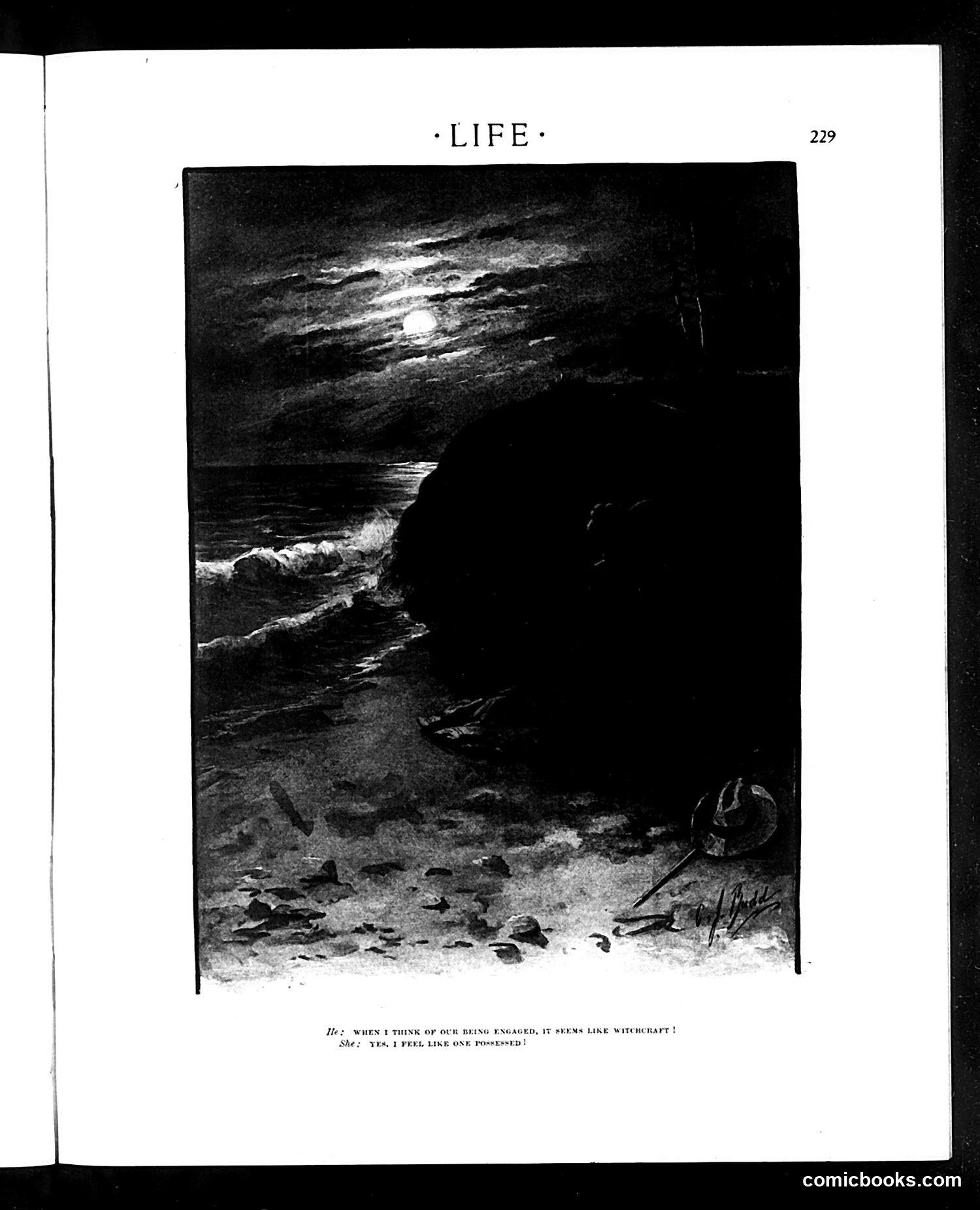
This is a single romantic illustration from *Life* magazine (page 229). The image depicts a moonlit beach scene with two silhouetted figures—a couple sitting together watching the moon over water. The dialogue reveals the cartoon's joke about engagement and romance. The man says thinking of their engagement feels like "witchcraft," and the woman responds she feels "like one possessed"—a humorous double meaning. She's playing on "possessed" as both emotionally overwhelmed by love and literally possessed (as if by witchcraft), continuing his metaphor. The satire is gentle, poking fun at how romantic engagement can feel magical or supernatural to those experiencing it. This reflects early-20th-century attitudes toward courtship, where expressions of love were often coded in dramatic, mystical language.
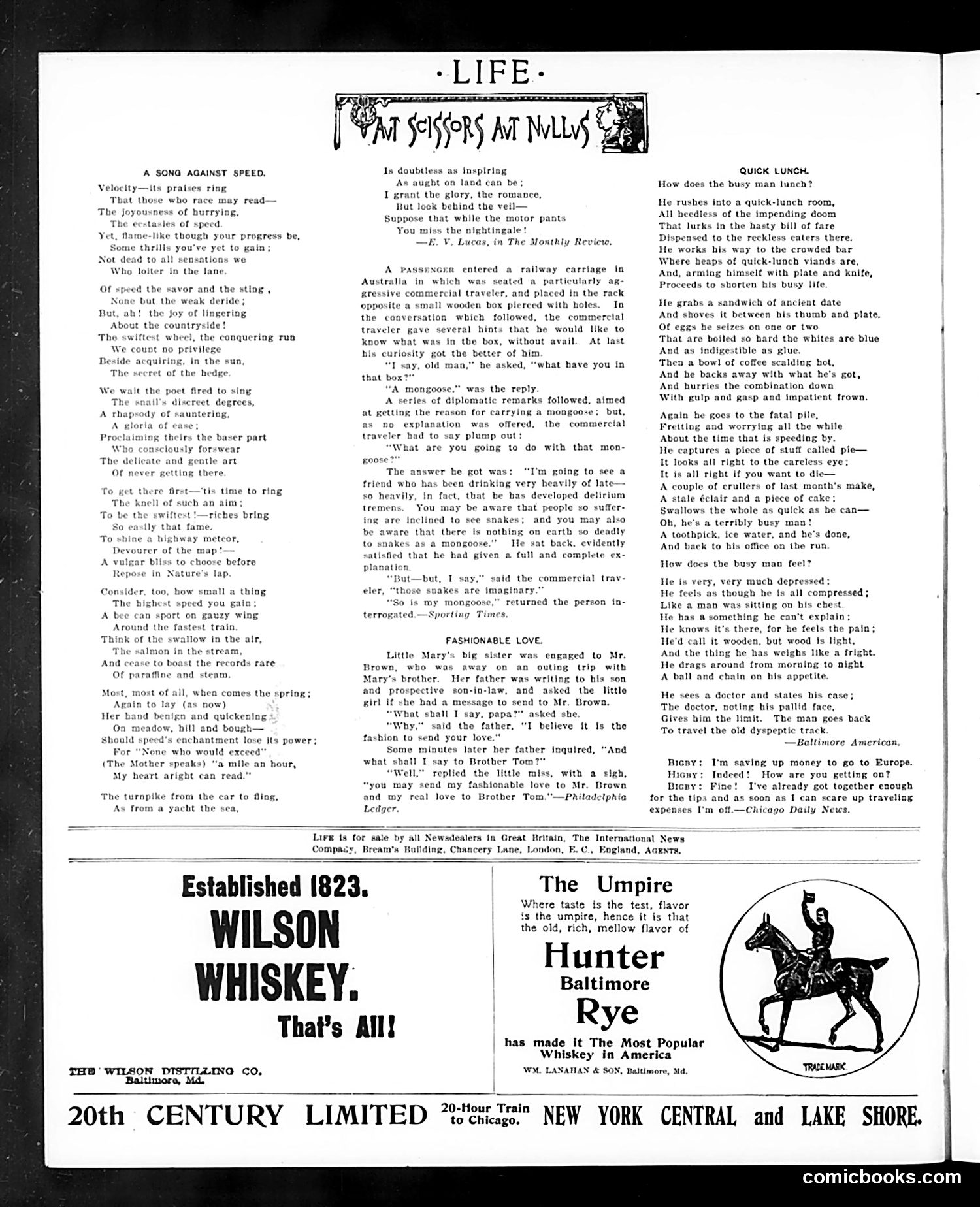
This page from *Life* magazine contains three distinct humorous pieces rather than political cartoons: **"A Song Against Speed"** — A poem satirizing the obsession with rapid travel and modern velocity. It argues that slower, leisurely experiences (meadows, nightingales, countryside strolls) offer superior spiritual rewards to speed's hollow thrills. This reflects early 20th-century anxieties about industrialization and automobiles replacing contemplative living. **"Mongoose Story"** — A joke about a passenger carrying an imaginary mongoose to treat his friend's alcohol-induced hallucinations with an imaginary snake-killer. The humor lies in the circular absurdity: both the snakes and the cure are equally fictitious. **"Fashionable Love"** — A brief domestic humor piece where a young girl distinguishes between sending "fashionable love" to her sister's fiancé (obligatory social courtesy) versus "real love" to her actual brother—mocking insincere social conventions. The advertisements below promote Wilson Whiskey, Hunter Rye, and railroad services. The page is primarily text-based humor rather than visual satire.
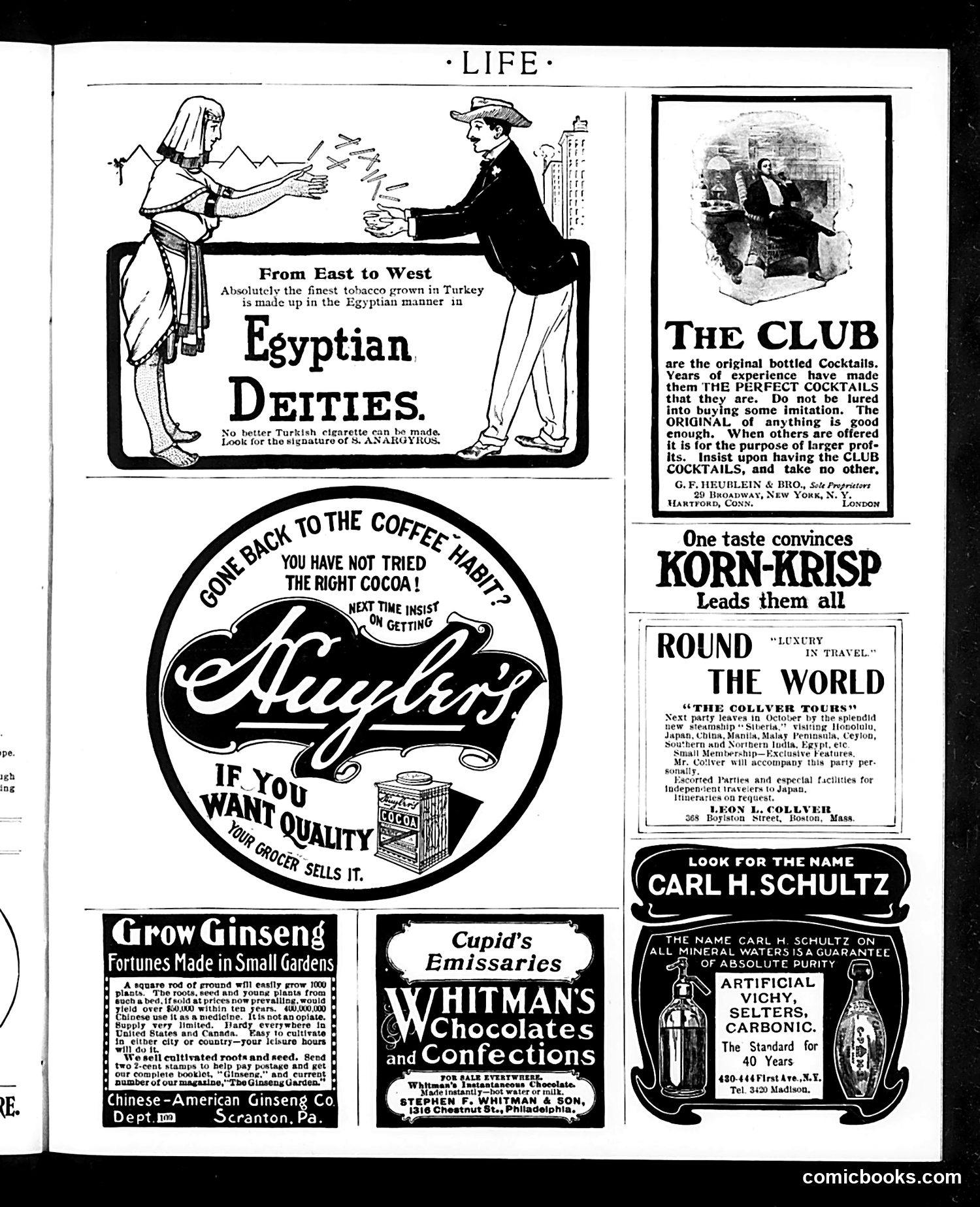
This is primarily an **advertising page** from Life magazine. The top cartoon satirizes cultural attitudes about tobacco and national identity: a Turkish woman in traditional dress hands cigarettes labeled "Egyptian Deities" to a Western man, playing on Orientalist stereotypes and the exotic appeal of imported tobacco products to American consumers. The joke suggests that "Eastern" tobacco, when "made up in the Egyptian manner," represents the finest quality—playing into early 20th-century fascination with non-Western goods. The remaining content consists entirely of product advertisements: Egyptian Deities cigarettes, Allying cocoa, Korn-Krisp cereal, The Club cocktails, world travel tours, ginseng cultivation kits, Whitman's chocolates, and Carl H. Schultz mineral waters. These ads reveal consumer culture priorities and marketing strategies of the era, emphasizing exoticism, quality claims, and leisure activities.
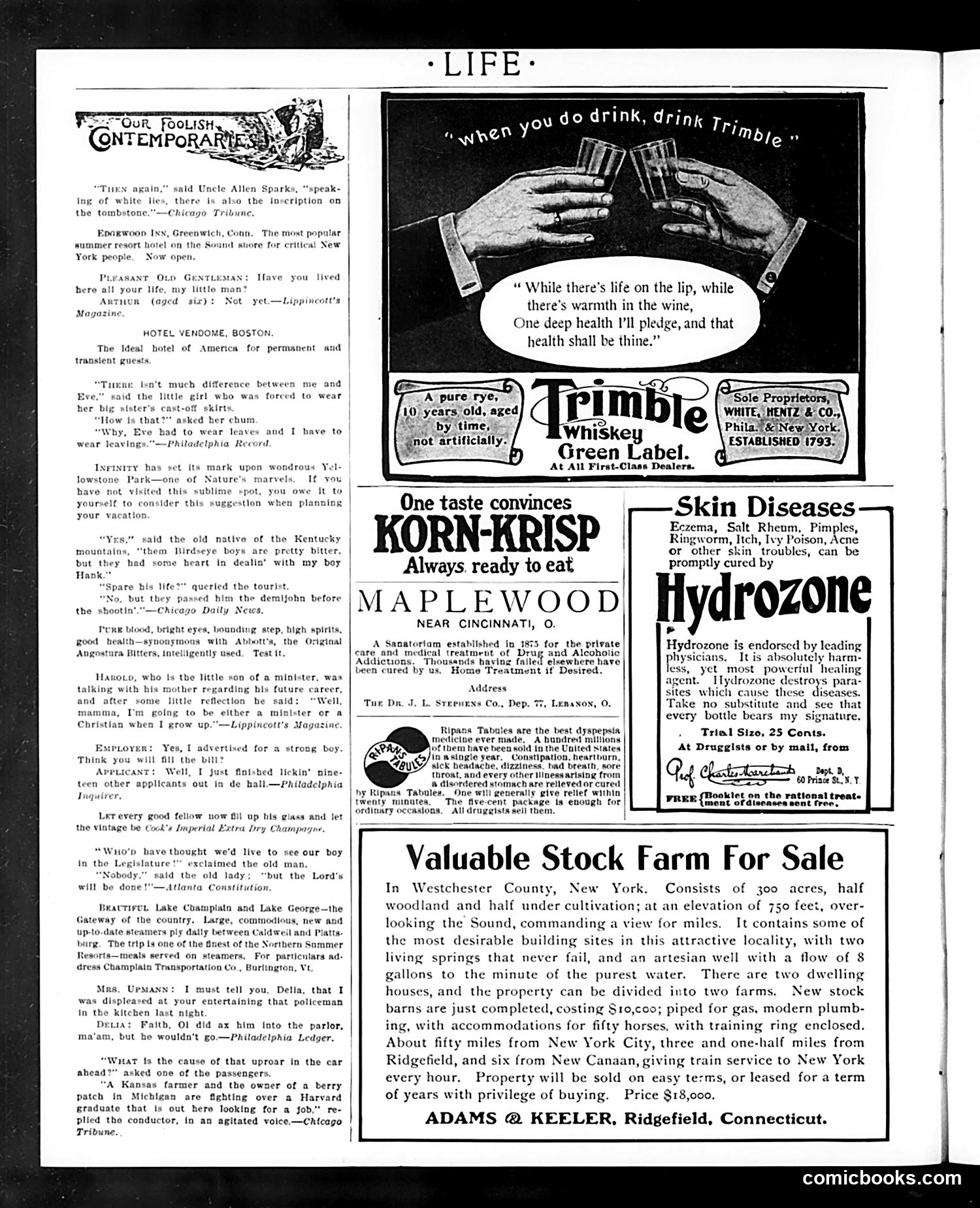
This page from *Life* magazine (undated, but likely early 1900s based on style) contains primarily **humorous anecdotes and advertisements** rather than political cartoons. The jokes satirize **American social pretension and hypocrisy**. One anecdote mocks a girl forced to wear her sister's hand-me-downs ("leavings" vs. Eve's "leaves"). Another jokes about a minister's son torn between priesthood and crime. A third ridicules a policeman who refuses to enter a parlor, accepting only kitchen hospitality—satirizing rigid social class boundaries. The advertisements are notably ironic: **Trimble Whiskey** appears alongside **Hydrozone** (a patent medicine for skin diseases) and **Maplewood Sanatorium** (treating drug and alcohol addiction)—suggesting heavy drinking causes the very ailments other ads claim to cure. This juxtaposition satirizes the era's contradictory consumer culture, where alcohol and "cures" coexist without acknowledgment of their connection. The magazine's humor targets **American smugness, social climbing, and commercial snake-oil marketing**.
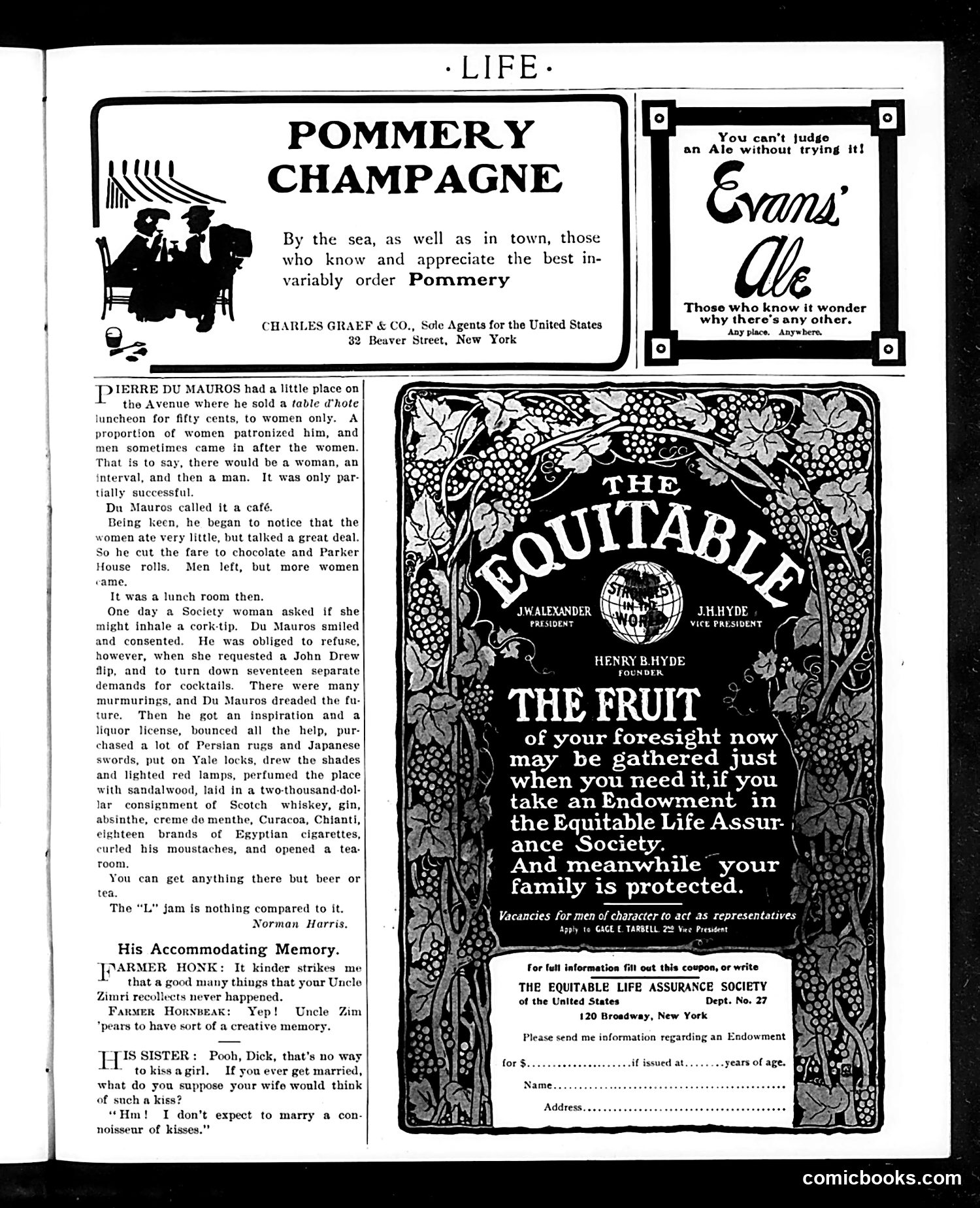
This page is primarily **advertisements and humor anecdotes** rather than political cartoons. The main content includes: 1. **Pommery Champagne ad** (top left): A luxury import advertisement targeting affluent consumers who appreciate quality beverages. 2. **Evans' Ale ad** (top right): A competing beverage advertisement using taste-based marketing. 3. **The Equitable Life Assurance Society ad** (center-right): An insurance company promoting endowment policies, emphasizing family financial security—a major concern for early 20th-century breadwinners. 4. **Humorous anecdotes** (left side): - "Pierre du Mauros" story satirizes a Parisian café owner who adapts his business model by catering to wealthy women's social needs, transforming it into a high-end establishment - "His Accommodating Memory" jokes about exaggerated storytelling - The final exchange mocks overly fastidious courtship etiquette The page reflects **early 1900s concerns**: luxury consumption, entrepreneurial adaptation, family financial planning, and social pretension among the affluent classes that Life magazine typically satirized.
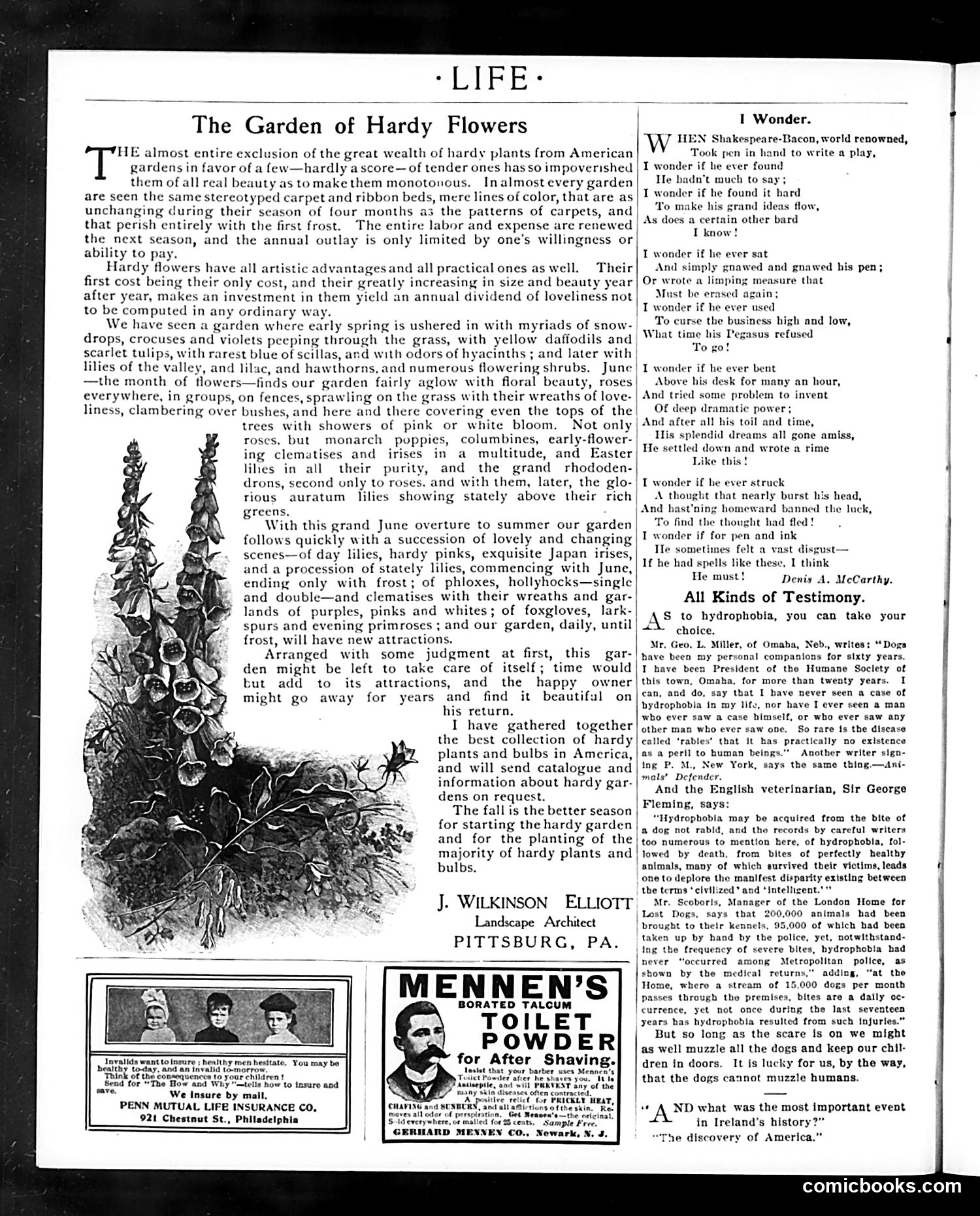
This page is primarily **not satirical content** but rather a legitimate horticultural article and advertisements. **Main Content:** "The Garden of Hardy Flowers" is a straightforward essay by landscape architect J. Wilkinson Elliott (Pittsburgh, PA) promoting hardy perennial plants over tender annuals. He argues hardy plants are more economical and beautiful—they survive winters, multiply yearly, and require less annual replanting than traditional carpet bedding. **Advertisements:** The page includes ads for Penn Mutual Life Insurance and Mennen's Borated Talcum Toilet Powder (for post-shaving use). **"I Wonder"** is a poem by Jones McCarthy playfully questioning whether Shakespeare struggled with writer's block—light verse, not political satire. **Historical Context:** This reflects early 1900s gardening trends favoring perennials, landscape design principles, and the era's advertising conventions. The decorative botanical illustrations support the horticultural theme rather than satirizing it.
This page is primarily **advertising, not satire or political content**. It's a collection of financial institution and consumer product advertisements from Life magazine, typical of early 20th-century business publications. The ads include: - **Allen's Foot-Ease** (foot powder) and **Korn-Krisp** (breakfast cereal)—consumer goods pitched with testimonials - **Financial institutions**: Morton Trust Company, Guaranty Trust Co., United States Mortgage & Trust Company, Wassermann Brothers stockbrokers, and Windsor Crust Company (safe deposit vaults) - **Railroads**: Minneapolis and St. Paul railroad advertisement These reflect the economic interests of Life's readership: affluent investors and consumers. The names listed (Levi P. Morton, August Belmont, Walter G. Oaks) were prominent industrialists and financiers of the era. There is **no cartoon or political satire visible** on this page—it's straightforward commercial advertising.
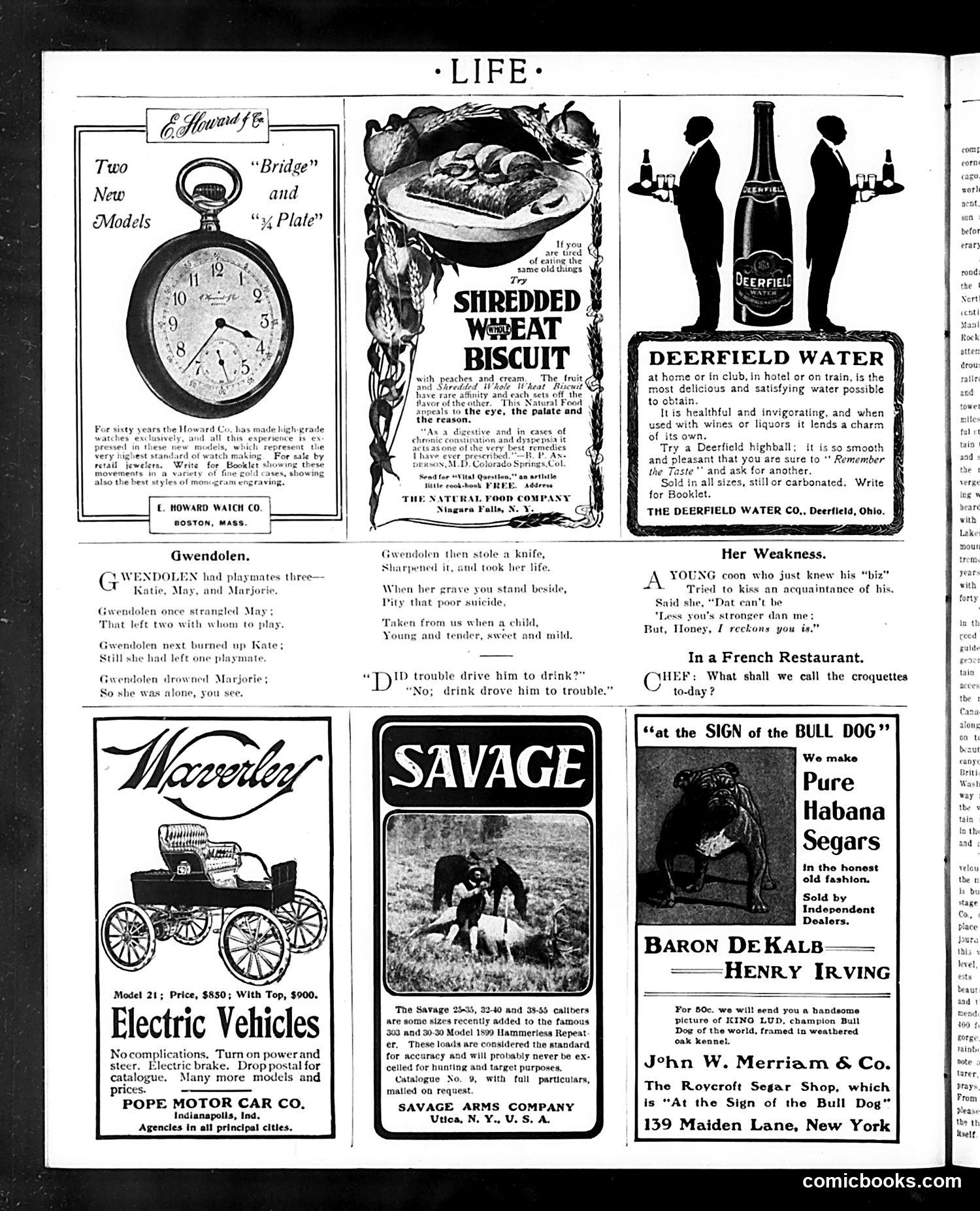
This page contains mostly **advertisements and light humor** rather than political cartoons. The main narrative is "Gwendolen," a darkly satirical poem about a girl who progressively harms her playmates until—in a shocking twist—she drowns one friend and then commits suicide. This is classic *Life* magazine humor: absurdist, morbid, and deliberately unsettling to mock sentimental Victorian sensibilities. The other jokes are brief social observations: "Her Weakness" uses a racial caricature (marked by the period's offensive language) to make a joke about physical strength; the French restaurant gag plays on language barriers. The bulk of the page is **period advertising**: electric vehicles, rifle ammunition, biscuits, bottled water, cigars, and other consumer goods. These ads reflect early-1900s middle-class consumer culture and technological advancement (electric cars were marketed as safe, simple alternatives to gasoline vehicles). The overall effect is typical Life magazine content—mixing dark satire, contemporary social commentary, and commercial advertising to entertain an educated, affluent audience.
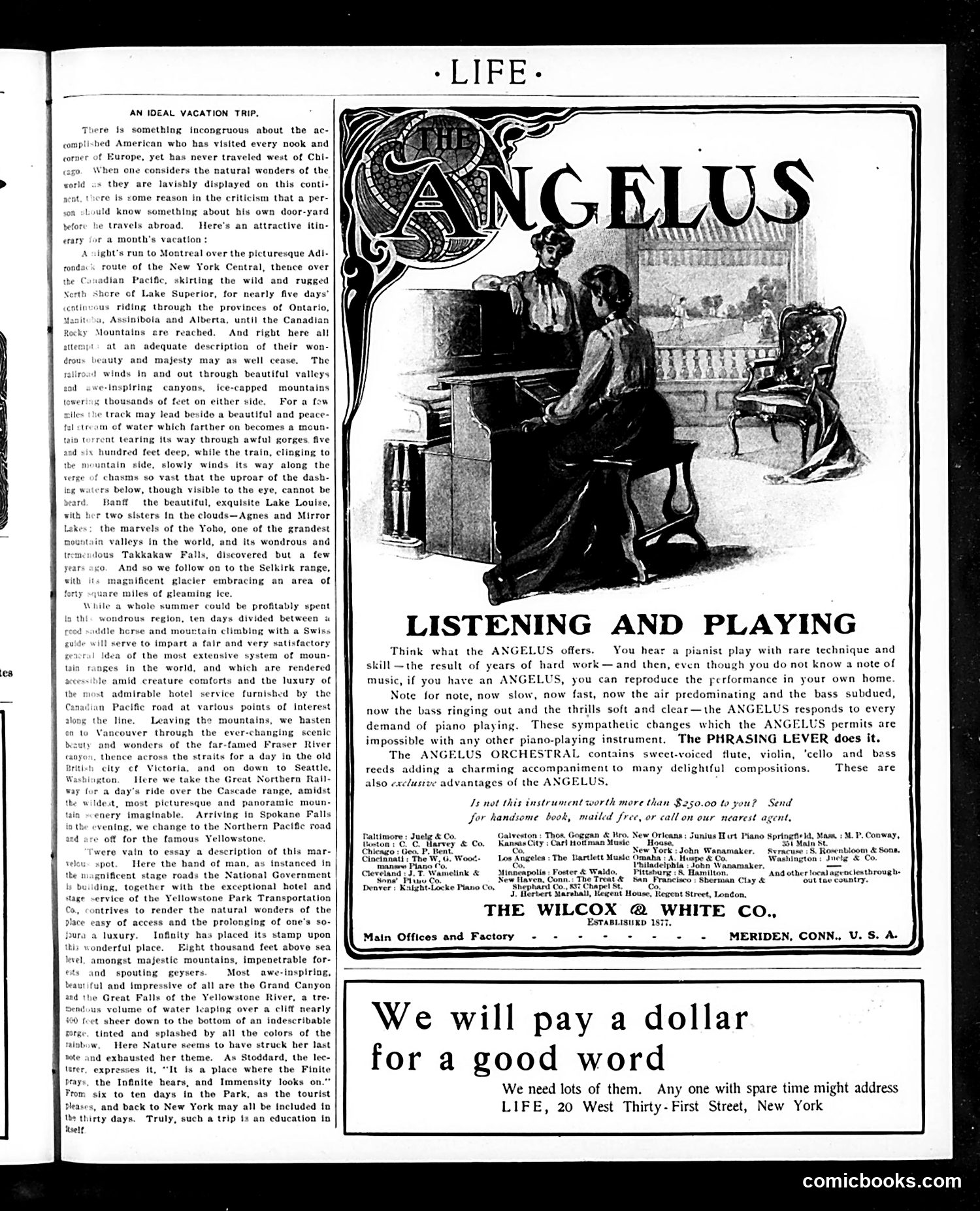
This page is primarily **travel advertising disguised as editorial content**. The left column describes an idealized month-long North American vacation route (Montreal → Canadian Rockies → Vancouver → Yellowstone), emphasizing natural wonders Americans often overlooked in favor of European travel. The right side features an advertisement for the **Angelus piano**, using the travel narrative as a hook. The ad's central image shows a woman at a piano, with text promising that an Angelus player-piano allows one to reproduce concert performances at home—implying that travel and cultural enrichment needn't require leaving one's parlor. **The satire**: Life is gently mocking wealthy Americans' snobbish preference for European tourism while ignoring domestic natural marvels. The Angelus ad extends this: just as you can experience nature without traveling west, you can experience fine music without attending concerts. The page reflects early-20th-century attitudes about American exceptionalism, leisure travel for the affluent, and technological solutions to cultural aspiration.
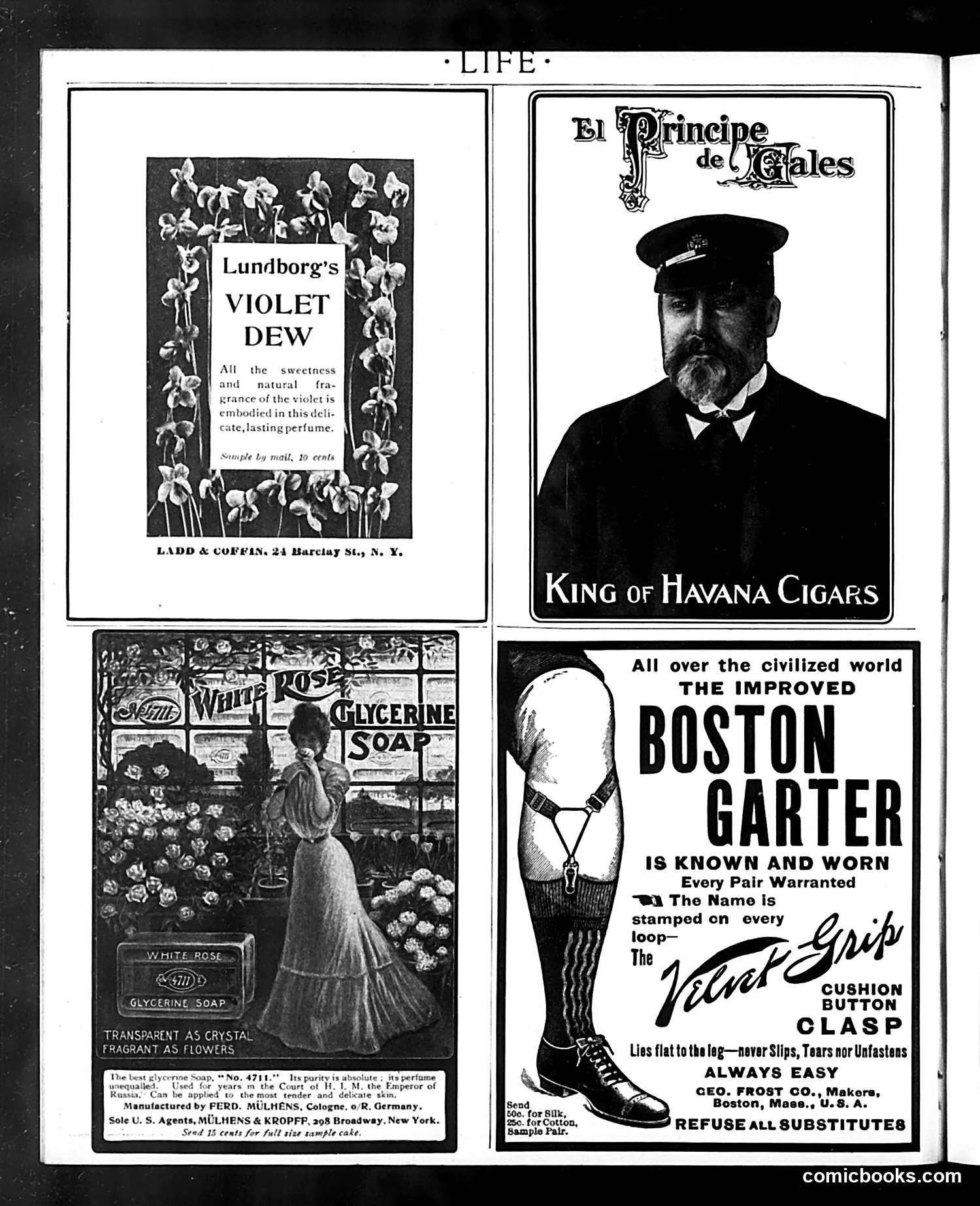
This is **not a political cartoon but an advertising page** from Life magazine. It contains four product advertisements typical of early 20th-century publications: 1. **Lundborg's Violet Dew** perfume (top left) - emphasizes natural fragrance and lasting quality 2. **"El Príncipe de Gales"** cigars (top right) - features a bearded man in captain's uniform, marketing as "King of Havana Cigars" 3. **White Rose Glycerine Soap** (bottom left) - shows a woman admiring flowers, marketed as transparent and fragrant 4. **Boston Garter** (bottom right) - men's garter with cushioned button clasp, promising durability For modern readers: these ads reflect Gilded Age consumer culture emphasizing luxury imported goods (Havana cigars, German cologne), quality guarantees ("every pair warranted"), and gendered marketing (perfume/soap for women, garters for men). The period typography and design are characteristic of early 1900s advertising aesthetics.
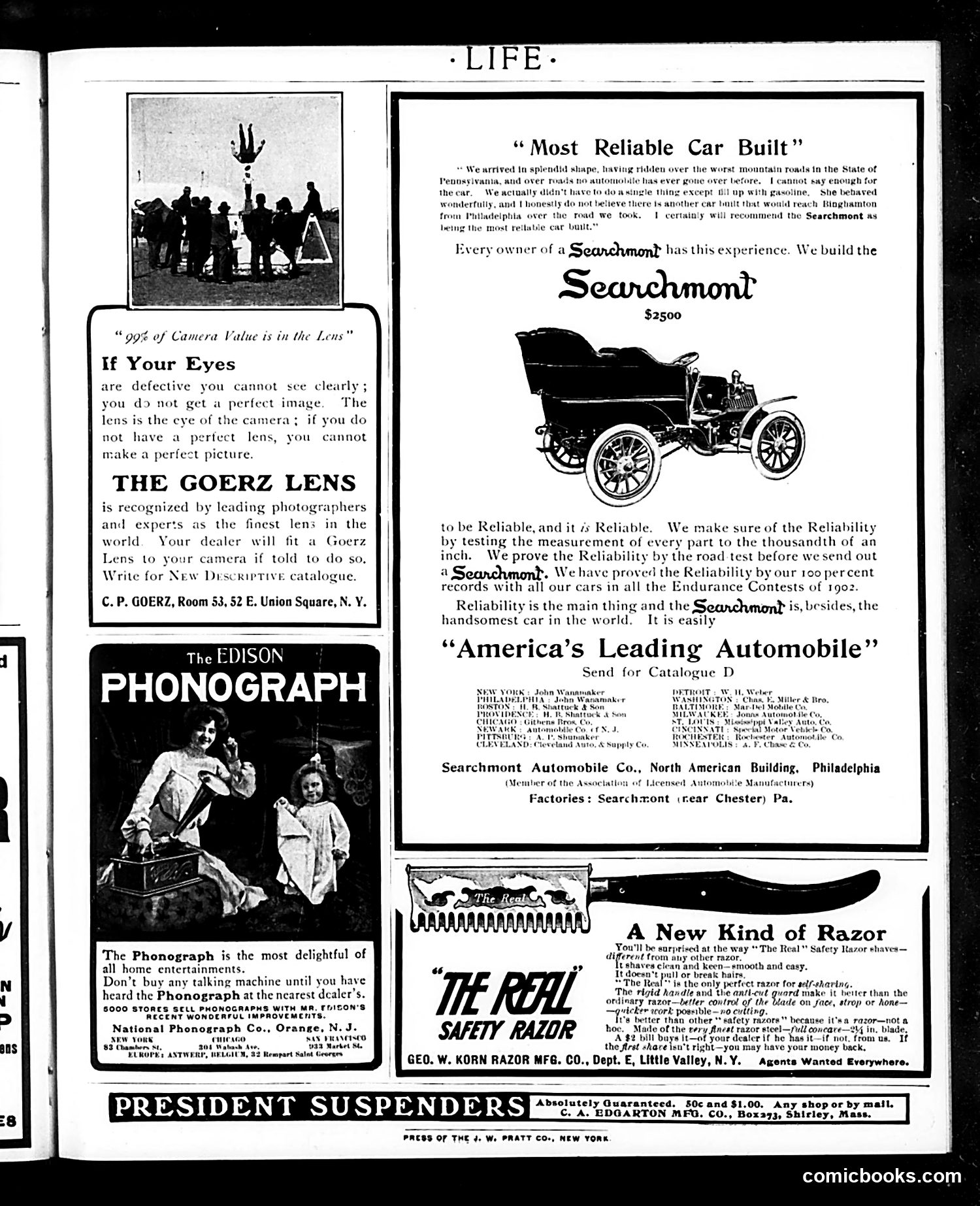
This is primarily an **advertising page** from an early 1900s issue of Life magazine, not a political cartoon. It contains five product advertisements typical of the era: 1. **Goerz Lens** (camera equipment) - uses the metaphor that a camera lens is like the human eye; defective vision produces defective images. 2. **Edison Phonograph** - promotes the gramophone as home entertainment, emphasizing its superiority over competitors. 3. **Searchmont Automobile** ($2,500) - claims reliability through rigorous testing and success in 1902 endurance contests; markets itself as "America's Leading Automobile." 4. **The Real Safety Razor** - distinguishes itself from other "safety razors" by claiming superior design and materials. 5. **President Suspenders** (partially visible) - standard apparel advertisement. The page reflects early 20th-century consumer culture and advertising claims emphasizing technological reliability and superiority. No satire or political content is evident; this represents straightforward commercial messaging of the period.
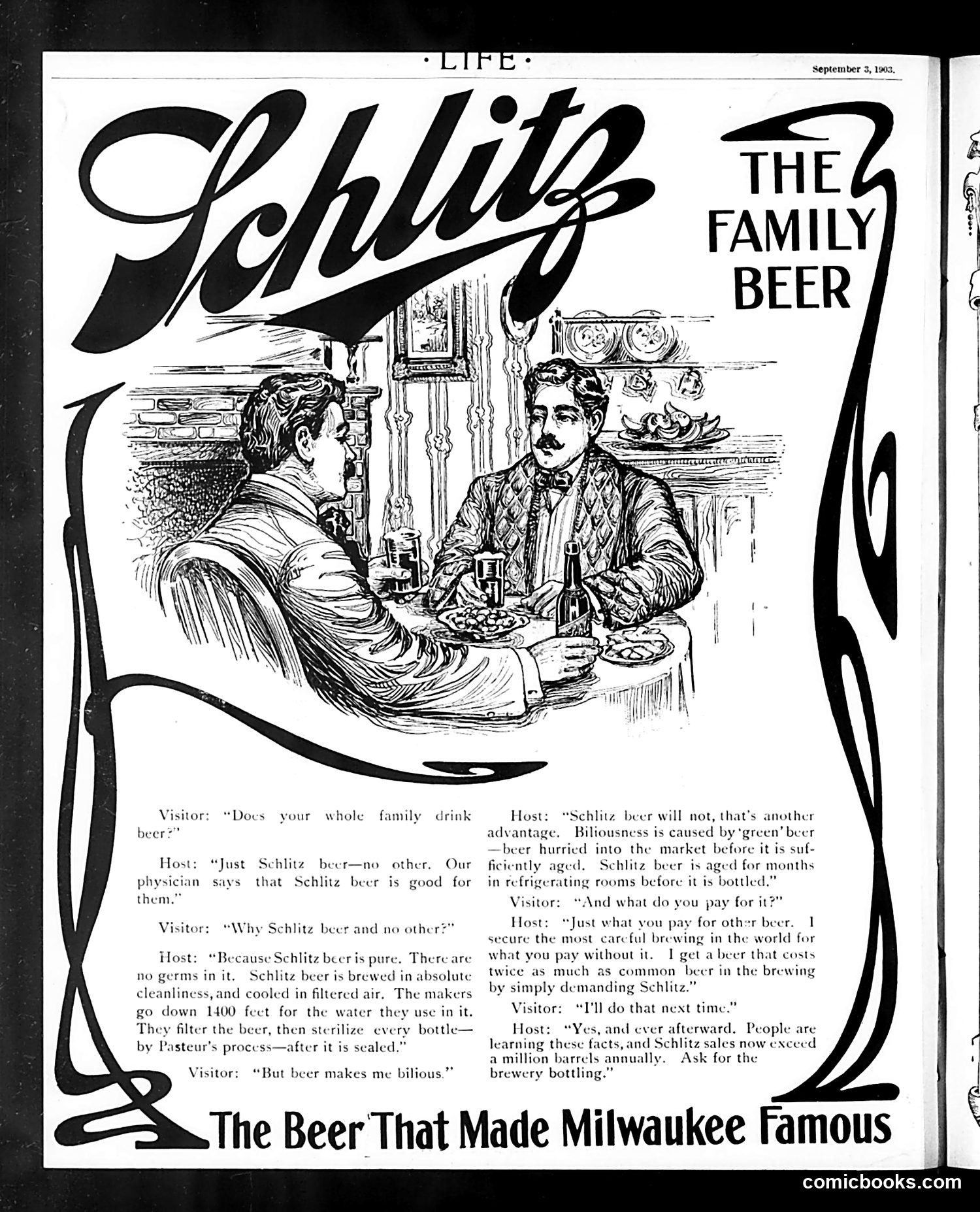
This is primarily a **beer advertisement** disguised as conversational satire, published in *Life* magazine on September 3, 1903. The "joke" presents a smug host lecturing a visiting skeptic about why Schlitz beer is superior—claiming it's medically endorsed, hygienically produced (filtered water from 1,400 feet deep, Pasteur's sterilization process), properly aged to avoid causing illness, and costs no more than inferior competitors. The satire targets **exaggerated health claims** common in early 1900s advertising. The host's pseudo-scientific explanations—invoking physicians and Pasteur's name—parody how manufacturers used emerging germ theory to market products. The visitor's progressively convinced responses mock consumer gullibility. The tagline "The Beer That Made Milwaukee Famous" references Milwaukee's actual dominance in American beer production, particularly Schlitz's genuine market success (the ad notes "over a million barrels annually"). This represents how *Life* magazine sold advertising space through comedic framing—the satirical setup makes the pitch entertaining rather than overtly commercial.