
Life, 1903-09-03 · page 20 of 32
Life — September 3, 1903 — page 20: what you’re looking at
What you’re looking at
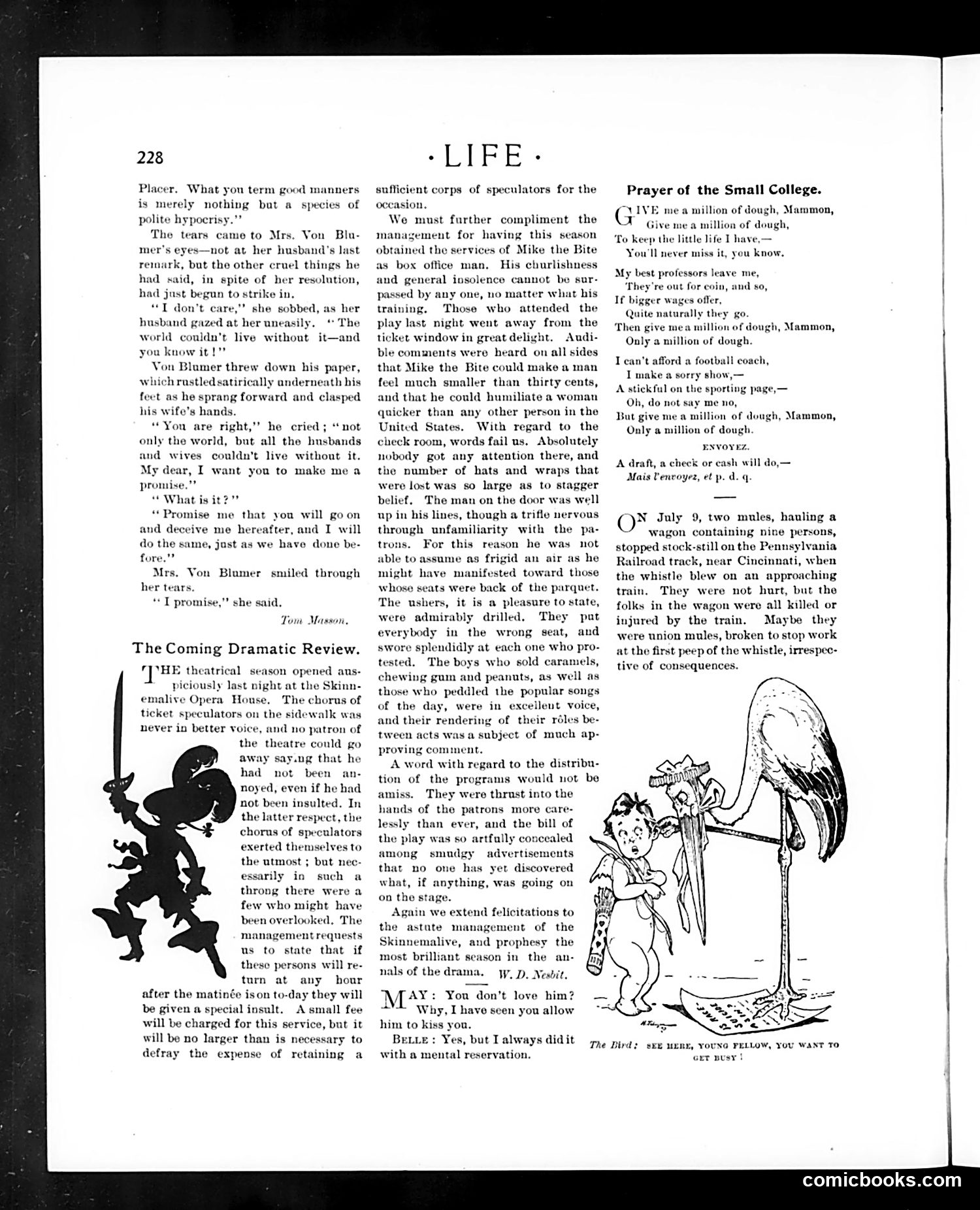
This page contains satirical commentary on New York theater culture, circa early 1900s. **"The Coming Dramatic Review"** mockingly praises the Skinnemalive Opera House's opening night—but the "praise" is entirely sarcastic. The reviewer congratulates management on deploying "speculators" (scalpers) who annoy patrons, hiring "Mike the Bite" as a deliberately rude box office clerk, running a chaotic coat check, seating people incorrectly, and obscuring the program among advertisements. The joke: theaters routinely provided terrible customer service, and Life sarcastically celebrates these failures as intentional features rather than bugs. **The domestic dialogue** (by Tom Masson) depicts a husband and wife agreeing to continue mutual deception "just as we have done before"—satirizing the hypocrisy of polite marriages where infidelity is tacitly accepted. **The illustration** (captioned "The Bird: see here, young fellow, you want to get busy") shows a cherub-like figure being admonished, likely commenting on laziness or procrastination. These pieces ridicule both theatrical incompetence and marital dishonesty masquerading as civility.
📄 Transcribed text from this page (OCR, searchable)
Machine-transcribed from the original scan — historical spelling and the odd misread are preserved.
228 Placer. What you term good manners is merely nothing bat a species of polite hypocrisy."” The tears me to Mrs, Von Blu- —not at her husband's last irk, but the other cruel things he had said, in spite of her resolution, had just begun to strike in, “I don’t care,’ she sobbed, as her husband gazed at her uneasily. “ The id couldn't live without it—and you know it 1” Von Blumer threw down his paper, which rustled satirically anderneath his fect as he sprang forward and clasped his wife's hands. “You are right,’’ he cried; “not only the world, but all the husbands and wives couldn't live without it. My dear, I want you to make me a promise.”” “What is it? “Promise me that you will goon and deceive me hereafter, and I will do the same, jast as we have done be- fore. she said, Tom Masson, The Coming Dramatic Review. [He theatrical season opened ans- piciously last night at the Skinn- emalive Opera House. The chorus of ticket speculators on the sidewalk was never in better voice, and no patron of the theatre could go away say.ng that he had not been an- noyed, even if he had not been insulted. In the latter respect, the chorus of speculators exerted themselves to the utmost ; but nec- essarily in such a throng there were few who might b been overlooked, The management requests us to state that if these persons will re- turn at any hour after the matinée ison to-day they will be given a special insult. A small fee will be charged for this service, but it will be no larger than is necessary to defray the expense of retaining a ve -LIFE- sufficient corps of speculators for the occasion. We must further compliment the management for having this season obtained the services of Mike the Bite as box office man. His churlishness and general insolence cannot be sur- passed by any one, no matter what his training. Those who tended the play last night went away from the ticket window in great delight. Audi- ble comments were heard on all sides that Mike the Bite could make a man feel much smaller than thirty cents, and that he could humiliate a woman quic! than any other person in the United States. With regard to the check room, words fail us. Absolutely nobody got any attention there, and the number of hats and wraps that were lost was so large as to stagger belief, The man on the door was well up in his lines, though a trifle nervous through unfamiliarity with the pa- trons. For this reason he was not as frigid an air as he ifested toward those ats were back of the parquet. hers, it is a pleasure to state, were admirably drilled, They pat everybody in the wrong seat, and swore splendidly at each one who pro- tested. The boys who sold caramels, chewing gum and peanuts, as well as those who peddled the popular songs of the day, were in excellent voice, and their rendering of their réles be- tween acts was a subject of much ap- proving comment. A word with regard to the distribu- tion of the programs would not be amiss. They were thrust into the hands of the patrons more care- lessly than ever, and the bill of the play was so artfully concealed among smudgy advertisements that no one has yet discovered what, if anything, was going on on the stage. Again we extend felicitations to the astute management of the innemalive, and prophesy the most brilliant season in the an- nals of the drama. yy, J), Nesbit, M AY: You don’t love him? AY Why, I have seen you allow him to kiss you. Bete: Yes, but I always didit with a mental reservation. The Bird: Prayer of the Small College. IVE me a million of doug! XG million of dough, ‘To keep the little life T have, — You'll never miss it, you know. {ammon, ven My best professors | re out for If bigger wages offe Quite naturally they go. Then gi willion of dough, Mammon, Only a million of dough. m "t afford a football coach, I make a sorry show, A stickful on the sporting Oh, do not say me no, But give me a million of dough, Mammon, Only a million of dough. age,— ENVOYEZ A draft, a check or cash will do,— Mais Vencoyez, et p. d. q. O* July 9, two mules, hauling a wagon containing nine persons, stopped stock-still on the Pent i Railroad track, near Cincinnati, when the whistle blew on an approaching train. They were not hurt, but the folks in the wagon were all killed or injured by the train. Maybe they were union mules, broken to stop work at the first peep of the whistle, irrespec- tive of consequences. SEE MERE, YOUNG PELLOW, YOU WANT TO. oer Busy! comicbooks.com