
Life, 1903-09-03 · page 8 of 32
Life — September 3, 1903 — page 8: what you’re looking at
What you’re looking at
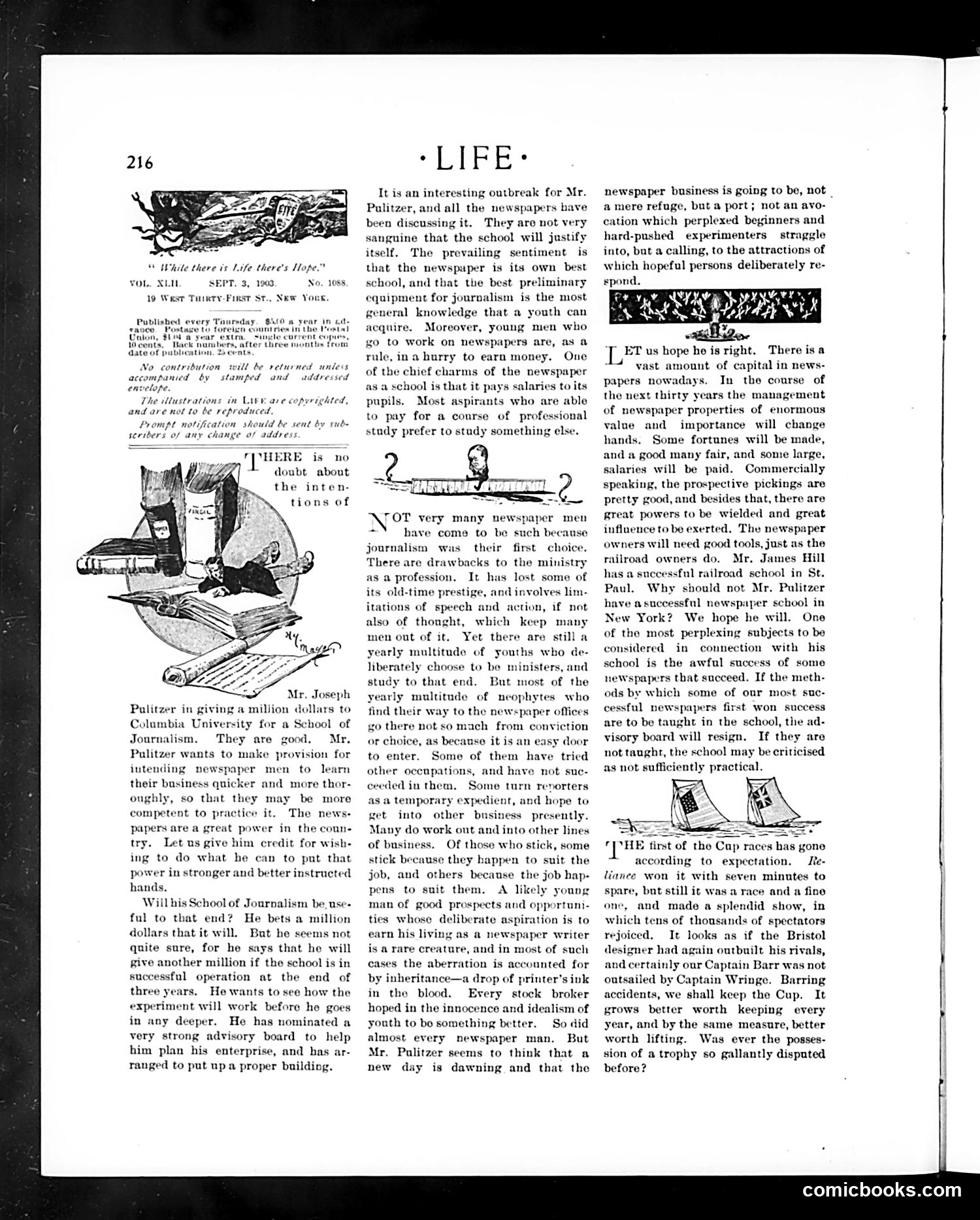
This page discusses Joseph Pulitzer's million-dollar donation to Columbia University for a School of Journalism. The accompanying illustrations satirize the newspaper profession's appeal and challenges. The cartoons show young men attracted to journalism as a career path—depicted entering newspaper offices with enthusiasm. The satire suggests journalism appeals to idealistic youth who romanticize the work, though the text notes many face practical disappointments and career limitations. The piece critiques both the profession's actual drawbacks (low pay, limited advancement) and the naive expectations of aspiring journalists. It questions whether Pulitzer's school will truly improve conditions or merely train more people for a crowded, difficult industry. The satire targets the disconnect between journalism's apparent prestige and its actual working conditions.
📄 Transcribed text from this page (OCR, searchable)
Machine-transcribed from the original scan — historical spelling and the odd misread are preserved.
“ While there is Life there's Hope.” XL SEPT. 3, No. 1088. 19 West Tiiery-First St., New Yous, vou. 1903, 8400 a year in cae vrsday : ries in ni tras afte: ‘ats Tecur three montis fr ult be returned uniess and addressed contribution by stamped envelope The illustrations in Live. are copyrighted, and are not to be reproduced, pt notification should be sent by sub- of any change of address fPHERE is no doubt about the inten- tions of Mr, Joseph Pulitzer in giving a miliion dollars to Columbia University for a School of Journalism. They are good, Mr, Pulitzer wants to make provision for intending newspaper men to learn their business quicker and more thor- oughly, so that they may be more competent to practic The news- papers are a great power in the coun- try. Let us give him credit for wish- ing to do what he can to put that power in stronger and better instructed hands, Wiilhis School of Journalism be.use- ful to that end? He bets a million dollars that it will. But he seems not quite sure, for he says that he will give another million if the school is in successful operation at the end of rs. He wants to see how the iment will work before he goes in any deeper. He has nominated a very strong advisory board to help him plan his enterprise, and has ar- ranged to put up a proper building. exper *LIEFE* It is an interesting outbreak for Mr. Pulitzer, and all the newspapers have been discussing it. They are not very sanguine that the school will justify itself. The prevailing sentiment is that the newspaper is its own best school, and that the preliminary equipment for journalism is the most general knowledge that a youth can acquire. Moreover, young men who go to work on newspapers are, as a rule, ina hurry to earn money. One of the chief charms of the newspaper ays salaries to its pupils. Most aspirants who are able to pay for a course of professional stady prefer to study something else. TOT very many news‘ have come to be such because journalism was their first choice. There are drawbacks to the ministry sa profession. It has lost some of its old-time prestige, and involves lim- itations of speech and action, if not also of thonght, which keep many men out of it, Yet there are still a yearly multitude of youths who de- liberately choose to be ministers, and study to that end. But most of the yearly multitude of neophytes who find their way to the newspaper offices go there not so mach from conviction or cho! as because it is an e door to enter. Some of them have tried other occupations, and have not suc- ‘ded iu them, me turn reporters: asa temporary expedient, and hope to get into other business presently. Many do work ont and into other lines of business. Of those who stick, some stick because they happen to suit the job, and others because the job hap- pens to suit them. A likely young man of good prospects and opportuni- ties whose deliberate aspiration is to earn his living as a newspaper writer is a rare creature, and in most of such cases the aberration is accounted for by inheritance—a drop of printer's ink in the blood. Every stock broker hoped in the innocence and idealism of youth to bo something better. So did almost every newspaper man, But Mr. Palitzer seems to think that a new day is dawning and that the per men newspaper business is going to be, not a mere refuge, but a port; not an avo- cation which perplexed beginners and hard-pushed experimenters straggle into, but a calling, to the attractions of which hopeful persons deliberately re- spond, [ ET us hope he is right. There isa du papers now In the course of the next thirty years the management of newspaper properties of enormous value and importance will change ands. Some fortunes will be made, and a good many fair, and some large, salaries will be paid. Commercially speaking, the prospective pickings are pretty good, and besides that, there are great powers to be wielded and great influence to be exerted. The newspaper owners will need good tools, just as the railroad owners do. Mr. James Hill has a successful railroad school in St. Paul. Why should not Mr. Pulitzer have asuccessful newspaper school in New York? We hope he will. One of the most perplexing subjects to be considered in connection with his school is the awful success of some newspapers that succeed. If the meth- ods by which some of our most suc- cessful newspapers first Won success are to be taught in the school, the ad- visory board will resign. If they are not taught, the school may be criticised as not sufficiently practical. ‘HE first of the Cup races bas gone according to expectation. Te- liance won it with seven minutes to spare, but still it was a race and a fine one, and made a splendid show, in which tens of thousands of spectators rejoiced, It looks as if the Bristol sner had again outbuilt his rivals, and certainly our Captain Barr was not outsailed by Captain Wringe. Barring accidents, we shall keep the Cup. It grows better worth keeping every year, and by the same measure, better worth lifting. Was ever the posses- sion of a trophy so gallantly disputed before? comicbooks.com