
Life, 1903-09-03 · page 26 of 32
Life — September 3, 1903 — page 26: what you’re looking at
What you’re looking at
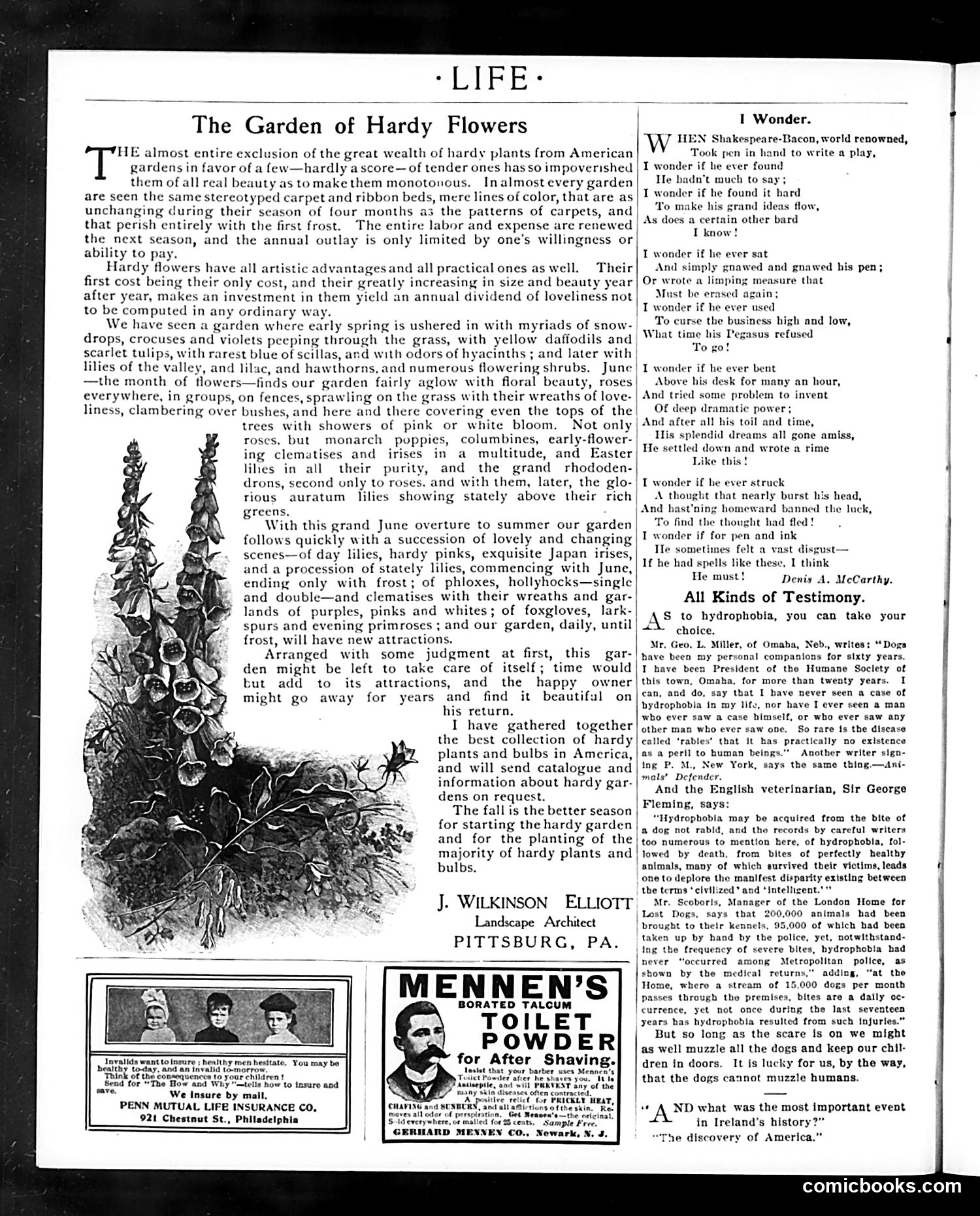
This page is primarily **not satirical content** but rather a legitimate horticultural article and advertisements. **Main Content:** "The Garden of Hardy Flowers" is a straightforward essay by landscape architect J. Wilkinson Elliott (Pittsburgh, PA) promoting hardy perennial plants over tender annuals. He argues hardy plants are more economical and beautiful—they survive winters, multiply yearly, and require less annual replanting than traditional carpet bedding. **Advertisements:** The page includes ads for Penn Mutual Life Insurance and Mennen's Borated Talcum Toilet Powder (for post-shaving use). **"I Wonder"** is a poem by Jones McCarthy playfully questioning whether Shakespeare struggled with writer's block—light verse, not political satire. **Historical Context:** This reflects early 1900s gardening trends favoring perennials, landscape design principles, and the era's advertising conventions. The decorative botanical illustrations support the horticultural theme rather than satirizing it.
📄 Transcribed text from this page (OCR, searchable)
Machine-transcribed from the original scan — historical spelling and the odd misread are preserved.
“LTFE* The Garden of Hardy Flowers HE almost entire exclusion of the great wealth of hardy plants from American gardens in favor of a few—hardly a score—of tender ones has so impoverished them of all real beauty as tomake them monotonous. Inalmostevery garden are seen the same stereotyped carpet and ribbon beds, mere lines of color, that are as unchanging during their season of four months the patterns of carpets, and that perish entirely with the first frost. The entire labor and expense are renewed | the next season, and the annual outlay is only limited by one’s willingness or ability to pay. Hardy flowers have all artistic advantages and all practical ones as well. Their first cost being their only cost, and their greatly increasing in size and beauty year after year, makes an investment in them yield an annual dividend of loveliness not to be computed in any ordinary way. | We have scen a garden where early spring is ushered in with myriads of snow- drops, crocuses and violets peeping through the grass, with yellow daffodils and scarlet tulips, with rarest blue of scillas, and with odors of hyacinths ; and later with lilies of the valley, and lilac, and hawthorns, and numerous flowering shrubs, June | —the month of flowers—finds our garden fairly aglow with floral beauty, roses | everywhere, in groups, on fences, sprawling on the grass with their wreaths of love- | liness, clambering over bushes, and here and there covering even the tops of the! trees with showers of pink or white bloom. Not only roses. but’ monarch poppies, columbines, early-flower- ing clematises and irises in a multitude, and Easter lihes in all their purity, and the grand rhododen- drons, second only to roses, and with them, later, the glo- rious auratum lilies showing stately above their rich| greens. With this grand June overture to summer our garden follows quickly with a succession of lovely and changing scenes—of day lilies, hardy pinks, exquisite Japan irises, and a pro ‘on of stately lilies, commencing with June, ending only with frost; of phloxes, hollyhocks—single and double—and clematises with their wreaths and gar- lands of purples, pinks and whites; of foxgloves, lark- spurs and evening primroses ; and our garden, daily, until frost, will have new attractions. Arranged with some judgment at first, this gar- den might be left to take care of itself; time would but add to its attractions, and the happy owner might go away for years and find it beautiful on his return, I have gathered together the best collection of hardy plants and bulbs in America, and will send catalogue and information about hardy gar- dens on request. | The fall is the better season | for starting the hardy garden | and for the planting of the} majority of hardy plants and | bulbs. J. WILKINSON ELLIOTT Landscape Architect PITTSBURG, PA. MENNEN’S BORATED TALCUM TOILET POWDER After Shaving. that_your barber uses Meni he shaves you. PREVES diseases often contracted. Ive relict for PRICKLY RAT, ve skin. Ret for ‘Tovalids want to Ineure ; healthy men hesitate. You may healthy today. and an Invalid tommorrow: sw’ YOu mAY be Think of the consequences to your children ? Send for "The How and Why "tells how to insure and eave. We Insure by mail, PENN MUTUAL LIFE INSURANCE CO, 921 Chestnut St., Philadelphia I Wonder. (WV HEN Shakespeare-Bacon, world renowned, Took pen in hand to write a play, I wonder if he ever found He hadn’t much to say ; I wonder if he found it hard To make his grand ideas flow, As does a certain other bard I know! I wonder if he ever sat And simply gnawed and gnawed his pen; Or wrote a li ure that Must be erased To curse the business high and low, What time his Pegasus refused To go! I wonder if he ever bent Above his desk for many an hour, And tried some problem to invent Of deep dramatic power; And after all his toil and time, Ilis splendid dreams all gone amiss, He settled down and wrote a rime Like this! T wonder if he ever struck A thought that nearly burst head, And bast’ning homeward banned the luck, To find the thought had fled! I wonder if for pen and ink Tle sometimes felt a vast disgust— If he had spells like these, I think He must! Denis A. McCarthy. All Kinds of Testimony. A® to hydrophobia, you can take <+ choice. Mr. Geo, L. Miller, of Omaba, Neb., writes: have been my personal companions for sixty years. I have been President of the Humane Soclety of this town, Omaha, for more than twenty years. I can, and do, say that I have never seen a case of bydrophobia in my life, nor have I ever seen a man who ever saw a case himself, or who ever saw any other man who ever saw ope. So rare ts the discaso called ‘rabies’ that it bas practically no existence as a peril to human beings.’ Another writer sign- ing P. M., York, says the same thing.—Ani- mals? Defender. And the English veterinarian, Sir George Fleming, says: “Hydrophobia may be acquired from the bite of a dog not rabid, and the records by careful writers too numerous to mention here, of hydrophobla, fol- lowed by death, from bites of perfectly healthy animals, many of which survived their victims, leads one to deplore the manifest disparity existing between the terms ‘civilized’ and ‘intelligent.’ Mr. Scoboris, Manager of the London Home for Lost Dogs, says that 200,000 animals had been brought to their kennels, 95,000 of which had been taken up by hand by the police, yet, notwithstand- | Ing the frequency of severe bites, hydrophobla had never “occurred among Metropolitan police, as shown by the medical returns,” adding, “at the Home, where a stream of 15,000 dogs per month passes through the premises, bites are a daily oc- currence, yet not once during the last seventeen years bas hydrophobia resulted from such Injuries.” But so long as the scare is on we might as well muzzle all the dogs and keep our chil- dren in doors. It is lucky for us, by the way, that the dogs cannot muzzle humans. ‘* A ND what was the most important event in Ireland's history?” ‘ne discovery of America. comicbooks.com