
A complete issue · 36 pages · 1903
Life — June 4, 1903
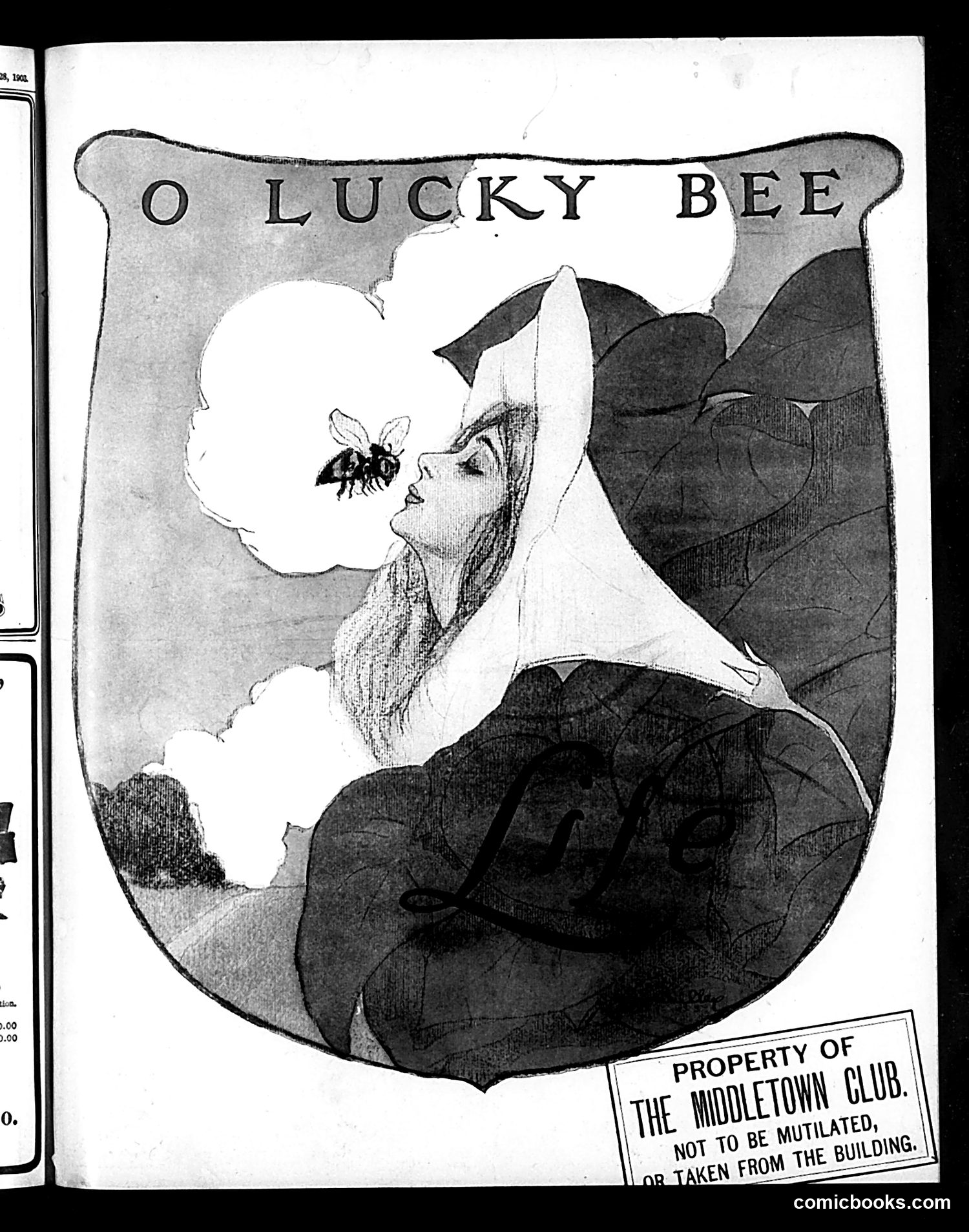
This satirical cartoon depicts a woman in profile wearing a white bonnet, gazing at a bee near a large white flower. The title "O Lucky Bee" suggests ironic admiration for the insect. The joke appears to play on courtship or romantic attention: the woman considers the bee "lucky" for its proximity to the flower—likely a euphemistic reference to female beauty or desirability. The satire mocks either excessive feminine vanity or perhaps contemporary attitudes about women and romantic pursuit. The woman's stylized features and bonnet suggest early 20th-century fashion. Without more specific context about Life magazine's publication date or surrounding articles, the precise political or social target remains somewhat unclear, though the tone is definitely comedic mockery of gendered social dynamics.
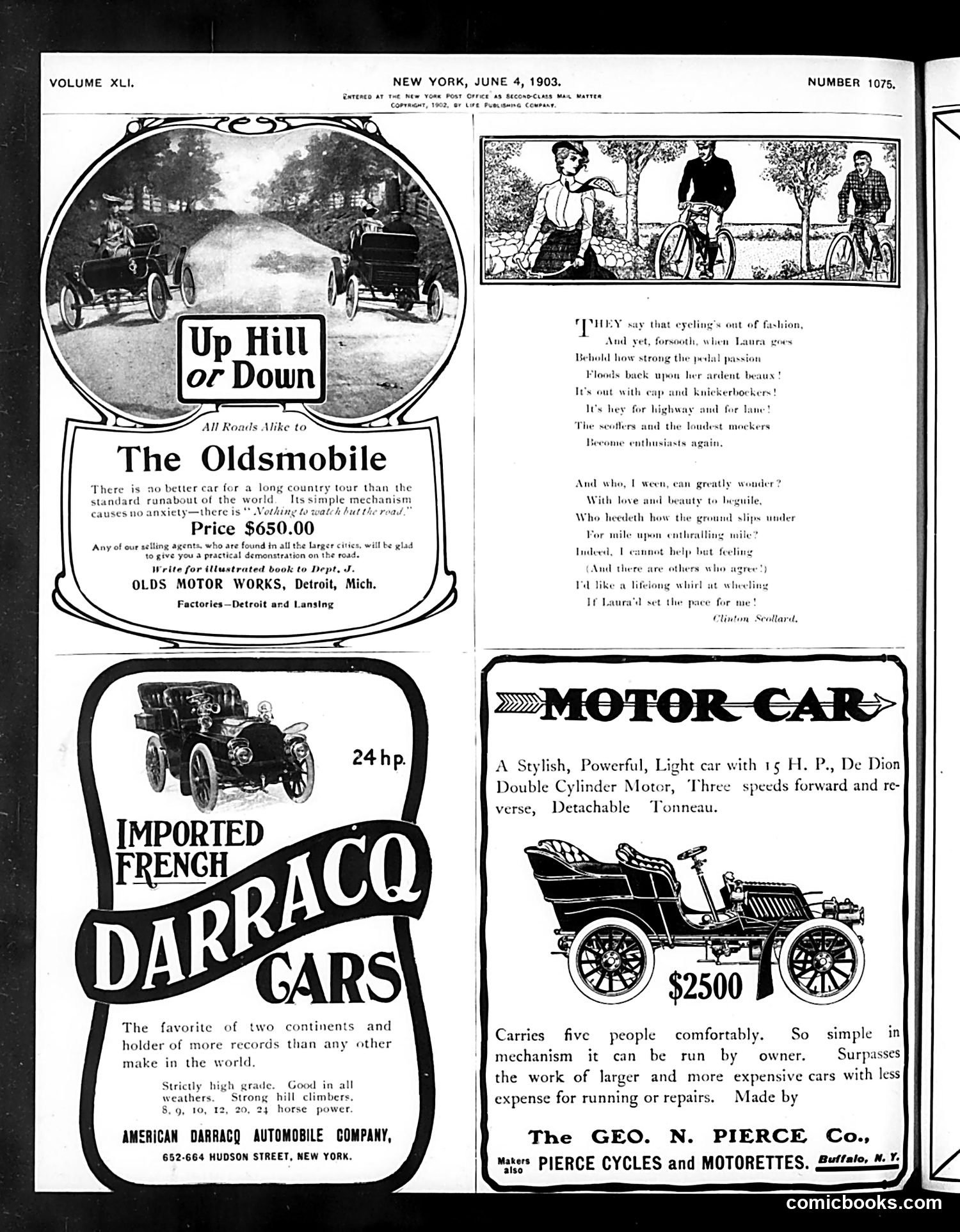
This page is primarily **advertising rather than political satire**. It contains three automobile advertisements from the early 1900s: 1. **Oldsmobile** ("Up Hill or Down") - emphasizing the car's reliability for country touring 2. **Darraco Cars** - imported French vehicles marketed as superior performers 3. **Pierce Motor Car** - a light car priced at $2,500 The only non-advertisement content is a **poem by Clinton Scollard** about cycling. The poem playfully suggests cycling remains fashionable despite claims it's "out of fashion," referencing the bicycle craze that competed with emerging automobiles for recreational enthusiasm. The page reflects the transitional moment when automobiles were becoming viable alternatives to bicycles and horse-drawn carriages in American leisure and transportation culture.
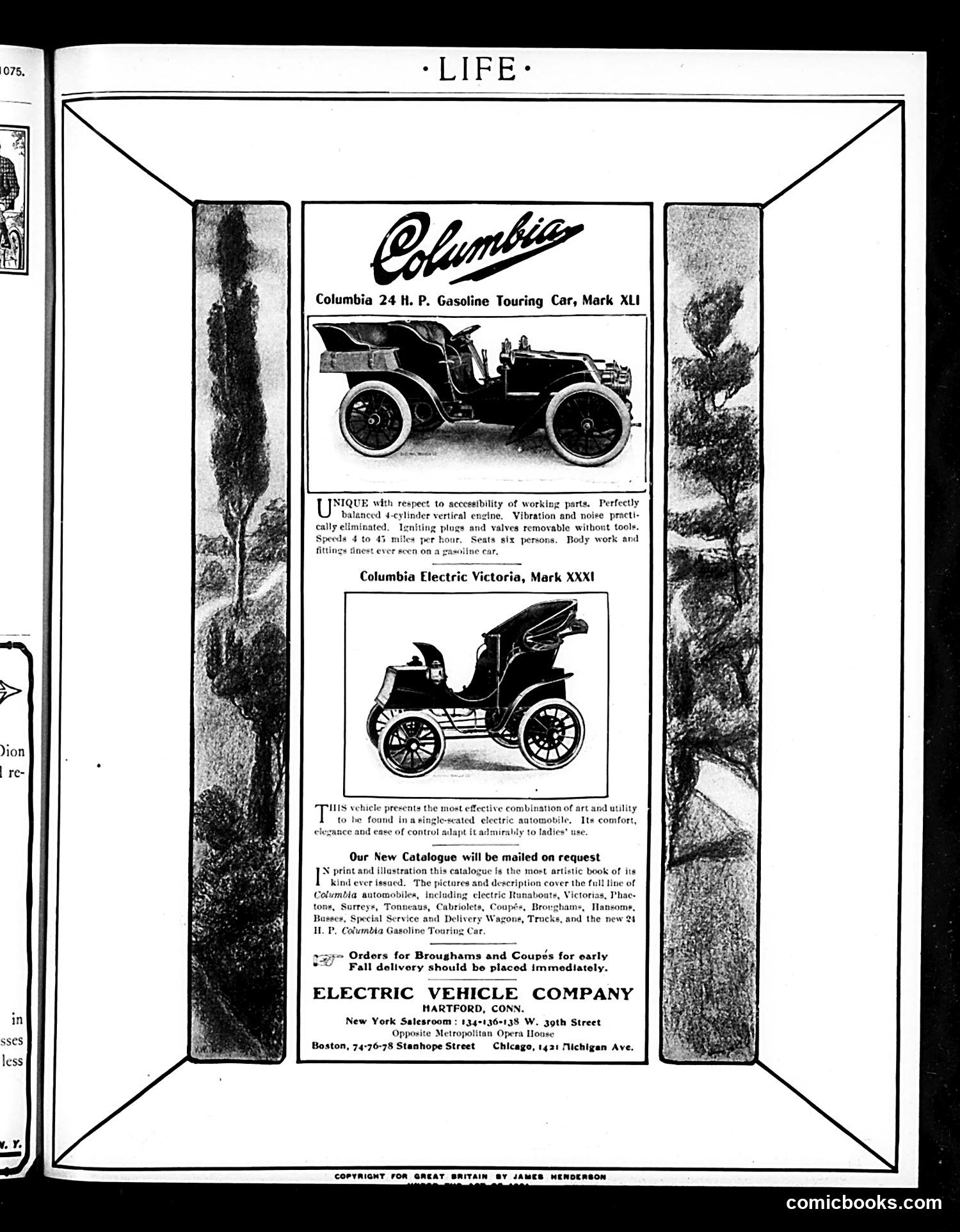
This page is primarily **advertising, not satire or political commentary**. It features two Columbia automobile advertisements framed by decorative cypress trees. The ads promote: 1. **Columbia 24 H.P. Gasoline Touring Car, Mark XLI** — emphasizing reliability, balanced engine performance, and capacity for six passengers 2. **Columbia Electric Victoria, Mark XXXI** — highlighting comfort and ease of control, positioned for women drivers ("ladies' use") The Electric Vehicle Company (Hartford, Connecticut) is marketing these early 1900s automobiles through Life magazine to affluent readers. The juxtaposition of gasoline versus electric vehicles reflects the era's competing automotive technologies before gasoline dominance. There is no political satire present; this is straightforward product promotion using the magazine's advertising space.
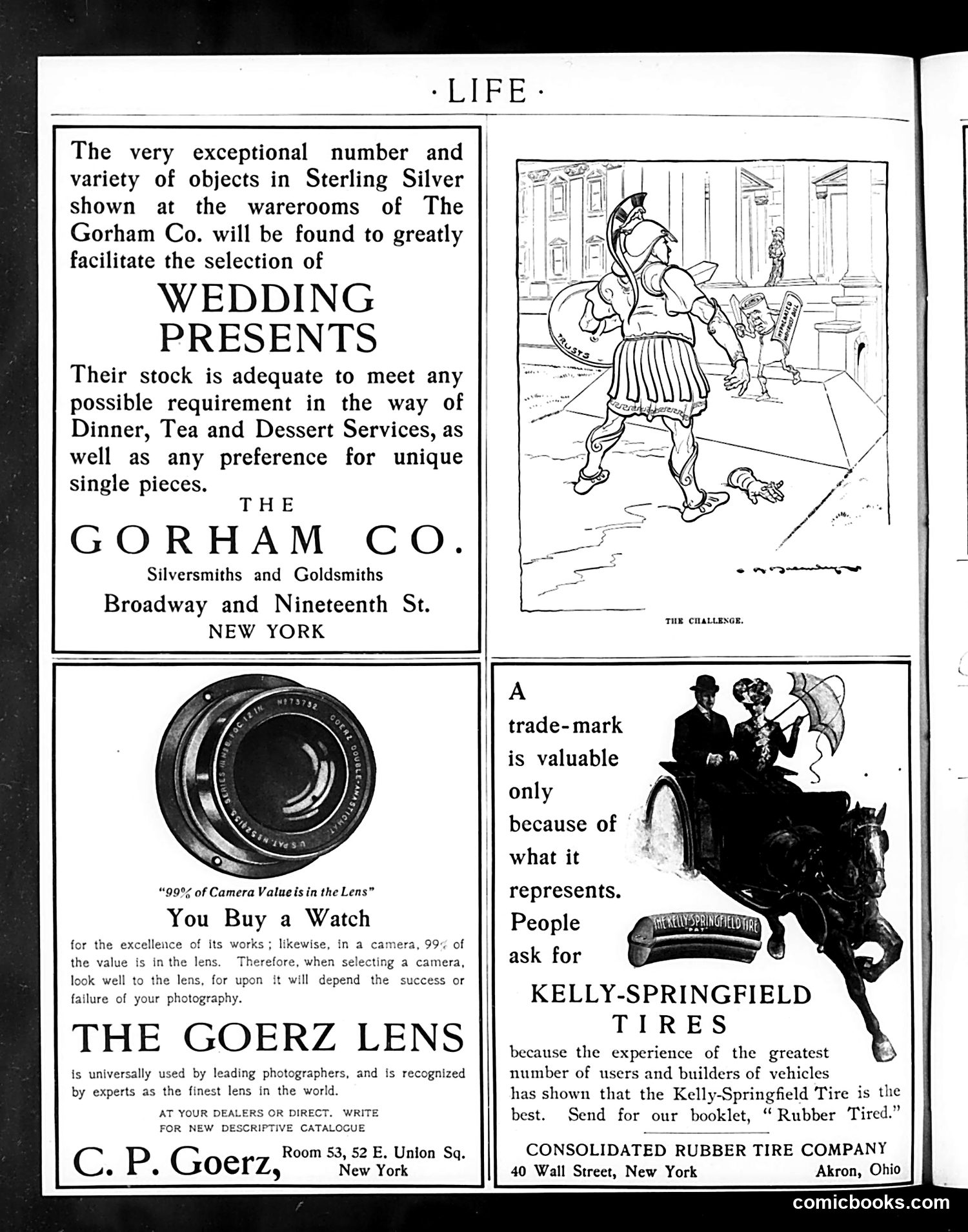
This page is primarily **advertising content** with one cartoon. The main illustration, titled "THE CHALLENGE," depicts a classical Greek or Roman warrior in armor confronting what appears to be a smaller opponent or figure in an interior setting. Without additional context, the cartoon's specific satirical meaning is unclear—it may reference a contemporary political or social conflict, but the historical reference isn't self-evident from the image alone. The page contains four advertisements: The Gorham Company (silver wedding gifts), Goerz Lens (camera equipment), Kelly-Springfield Tires, and a watch advertisement. These ads suggest the magazine's middle-to-upper-class readership and the era's consumer goods marketing.
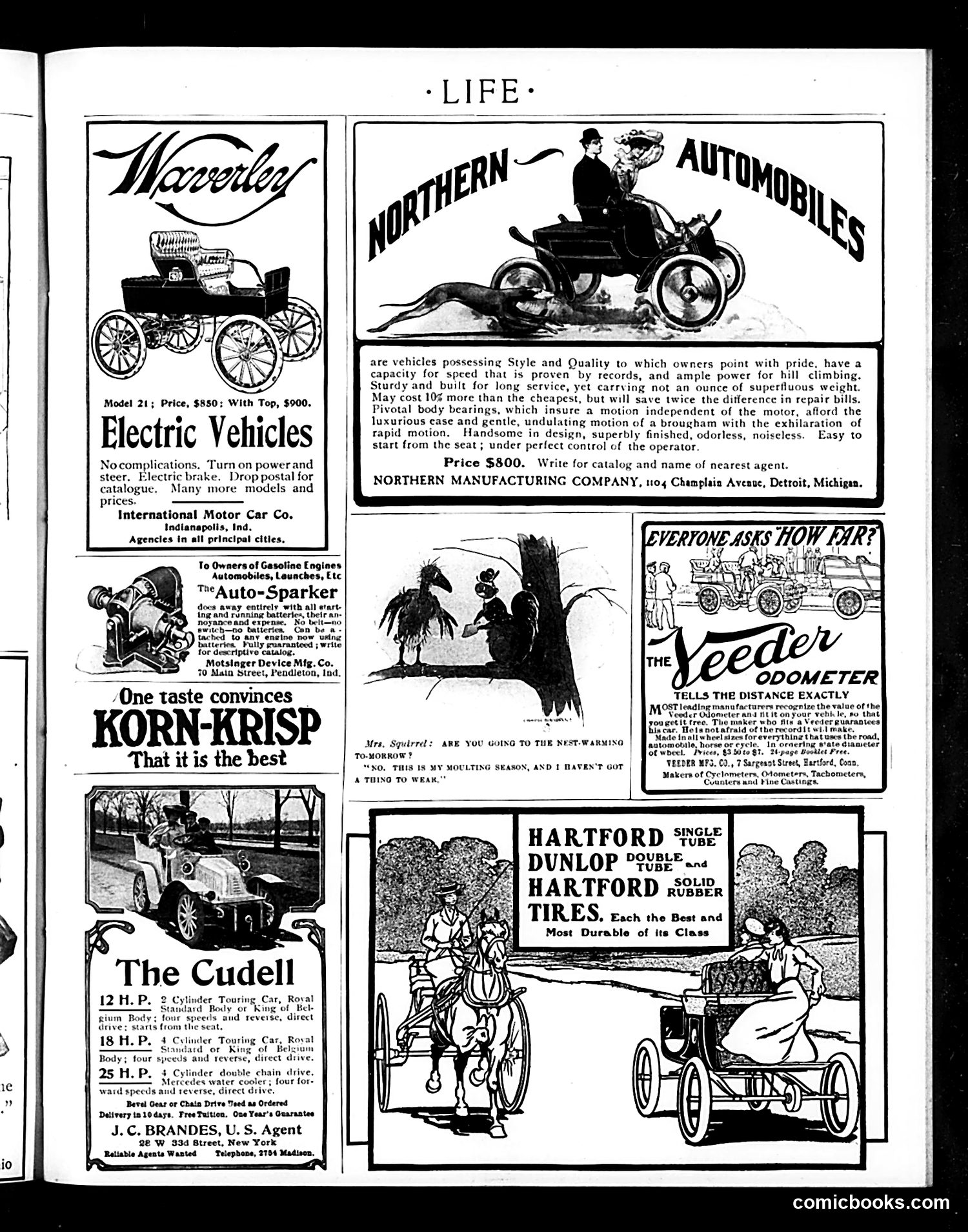
This page consists primarily of **early automobile advertisements** (circa 1900s-1910s), not political satire. The ads showcase competing vehicle technologies of the era: - **Maxim Electric Vehicles** and **Northern Automobiles** promote gas-powered cars - **The Cudell** advertises a touring car with various horsepower options - **Hartford/Dunlop tires** highlight tire quality and durability The only cartoon element is a small sketch showing two women discussing "molting season" in winter clothing—likely social commentary on fashion trends rather than political satire. The page reflects genuine consumer debates of the period: electric versus gasoline vehicles, tire reliability, and automotive specifications. These ads document a transitional moment when automobiles competed for market dominance and consumer trust was still being established.
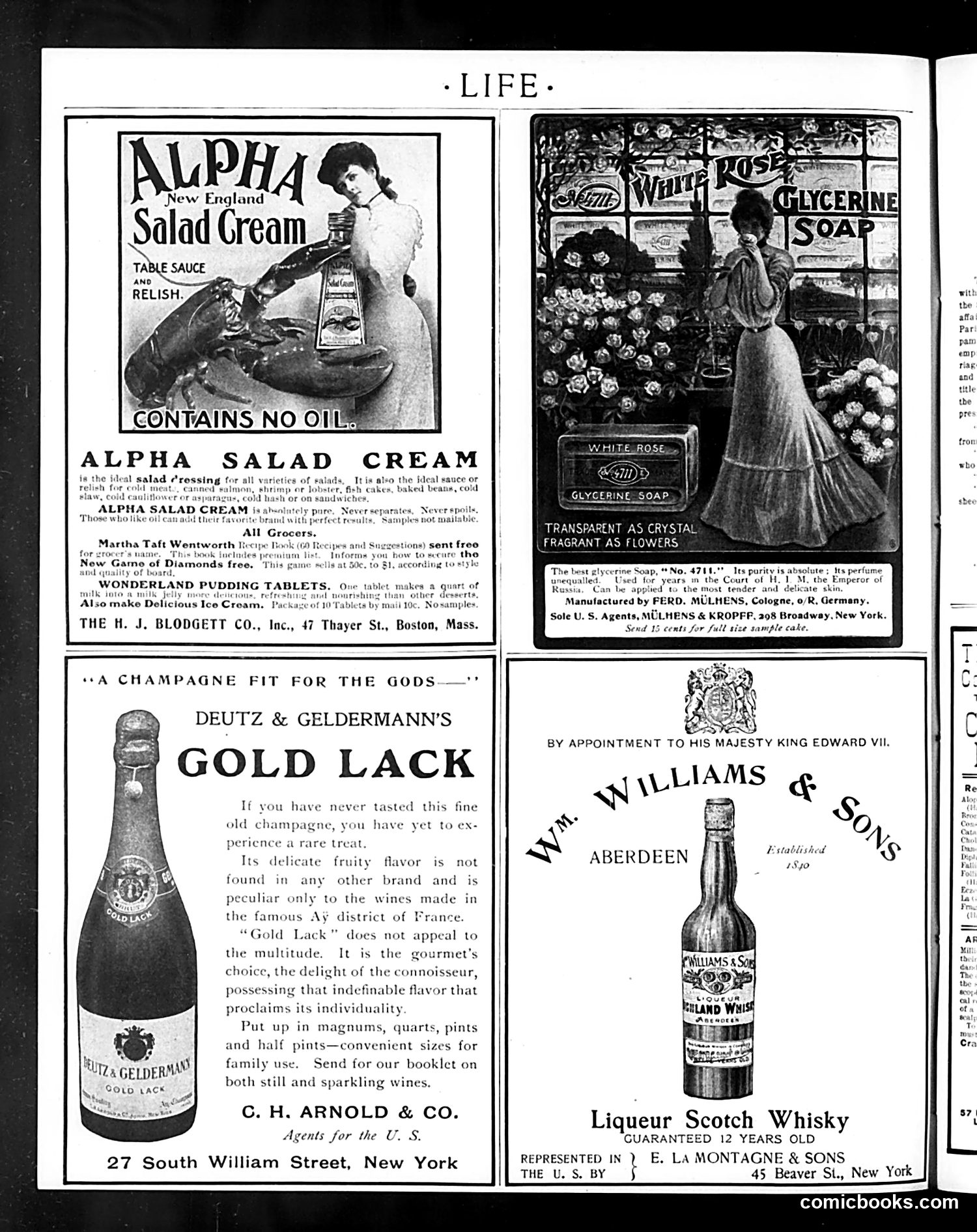
This page is **primarily advertising**, not editorial content or satire. It contains four product advertisements from the early 20th century: 1. **Alpha Salad Cream** - a condiment marketed as ideal for salads and sauces 2. **White Rose Glycerine Soap** - emphasizing purity and fragrance 3. **Deutz & Geldermann's Gold Lack Champagne** - luxury French wine for connoisseurs 4. **Wm. Williams & Sons Liqueur Scotch Whisky** - Scottish spirits with royal appointment The ads feature period-appropriate imagery (women in contemporary dress, product bottles) and marketing claims typical of the era. There are no political cartoons, caricatures, or satirical commentary visible on this page. The content reflects consumer goods marketed to affluent readers of *Life* magazine during this period.
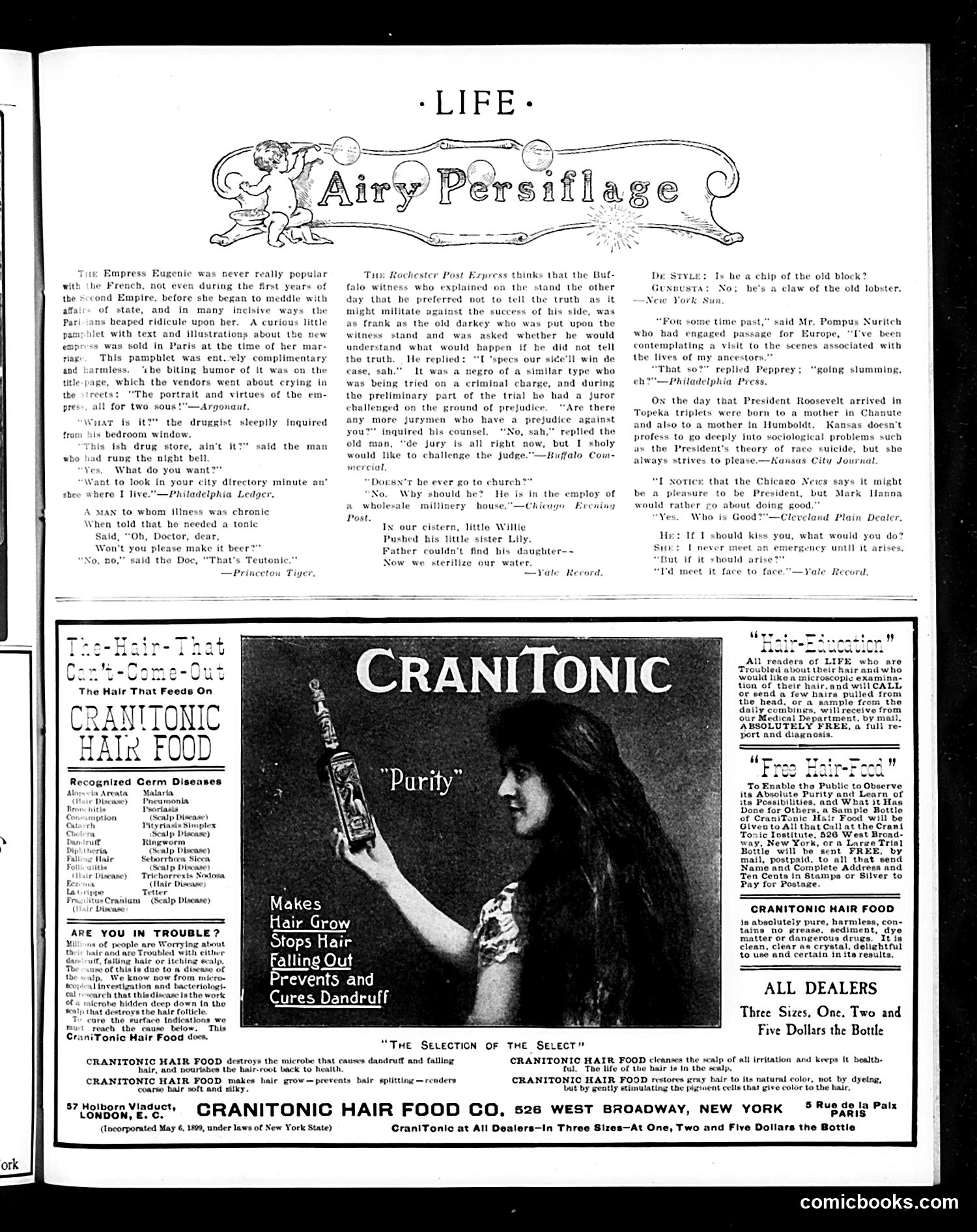
This page is primarily **advertising and humor columns**, not political cartoons. The top section contains several brief satirical jokes and anecdotes under "Airy Persiflage" — typical of Life's light humor format. Topics include an empress's unpopularity, a Buffalo witness in a trial, and President Roosevelt's arrival in Oyster Bay. The dominant content is a **CraniTonic Hair Food advertisement** featuring a woman in profile holding bottles. The ad claims the product "Makes Hair Grow / Stops Hair Falling Out / Prevents and Cures Dandruff." The humor and advertisements reflect early 20th-century concerns (hair loss remedies, social commentary on royalty and politics) but contain no sustained political satire or identifiable caricatures requiring historical context beyond the text itself.
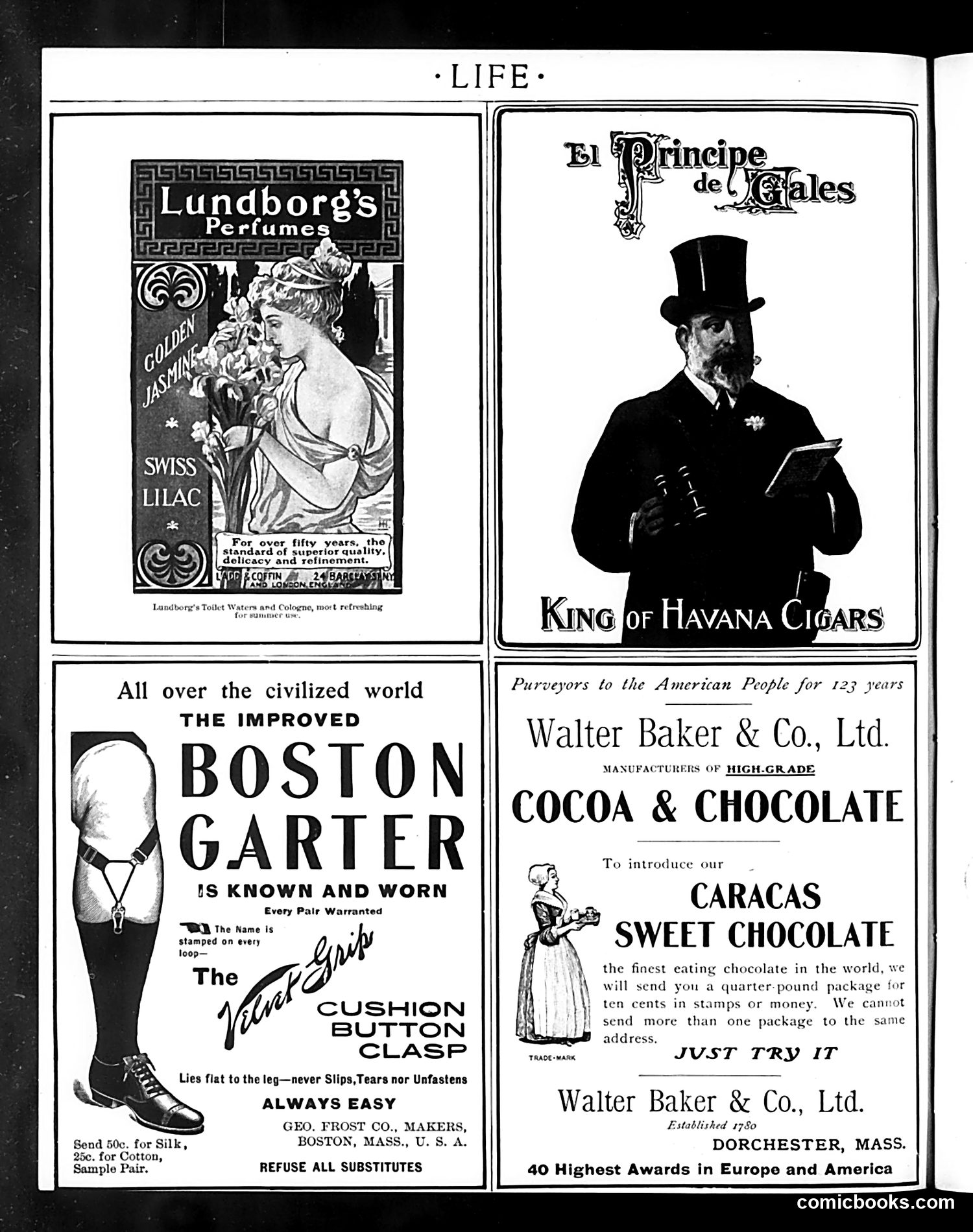
This page consists entirely of **period advertisements**, not satire or political cartoons. There is no editorial content. The four ads promote: 1. **Lundborg's Perfumes** — a luxury fragrance brand featuring classical imagery of a woman with flowers 2. **El Príncipe de Gales Cigars** — "King of Havana Cigars," showing a gentleman in top hat reading 3. **Boston Garter** — a men's sock garter with a "cushion bulge clasp," emphasizing it won't slip or tear 4. **Walter Baker & Co. Chocolate** — promoting their "Caracas Sweet Chocolate," claiming 123 years as purveyors to Americans These represent typical early 20th-century consumer goods targeting middle and upper-class readers. The ads reflect period aesthetics: classical refinement, formal dress, and luxury consumption as markers of respectability and status.
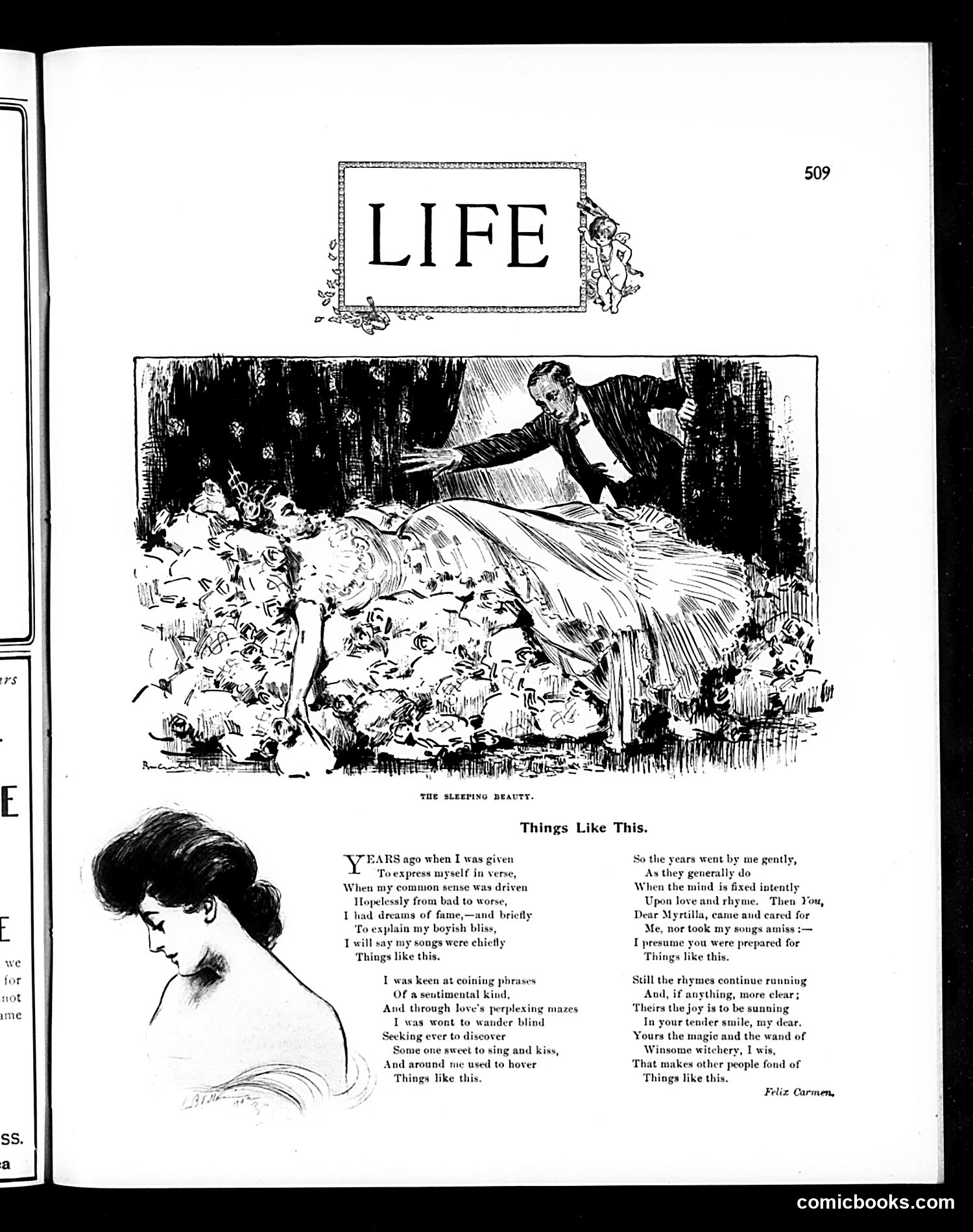
This page features two distinct illustrations: **Top illustration** ("The Sleeping Beauty"): A man in formal dress leans over a woman in a large bed surrounded by scattered items. This appears to be a satirical take on the classic fairy tale, likely commenting on passivity or inertia—though the specific social/political target is unclear from the image alone. **Bottom section**: A portrait sketch of a woman in profile accompanies a poem titled "Things Like This" by Felix Carmen. The poem reflects nostalgically on youthful romantic idealism ("years ago when I was given / To express myself in verse") and how time has changed the speaker's perspective on love and poetry. The overall theme appears to be about lost youth and romance, though without additional context, the precise satirical target remains ambiguous.
This page discusses contemporary social issues rather than featuring political cartoons. The text addresses: **Jewish massacres in Bessarabia**: The article opens by referencing pogroms against Jews in Russia, noting the Czar's government offers no protection—a reference to anti-Semitic violence in the Russian Empire. **Labor strikes**: Extended discussion of nationwide strikes affecting cities including Chicago and New York, with details about hotel workers, bakers, and laundry workers disrupting commerce. **A humorous anecdote**: About a wealthy gentleman (George Vanderbilt) attempting to construct a decorative house on Fifth Avenue in New York, interrupted by construction strikes—satirizing how even the wealthy cannot escape labor disruptions. The page combines serious social commentary on persecution and labor unrest with lighter satirical observations about contemporary inconveniences affecting the privileged classes.
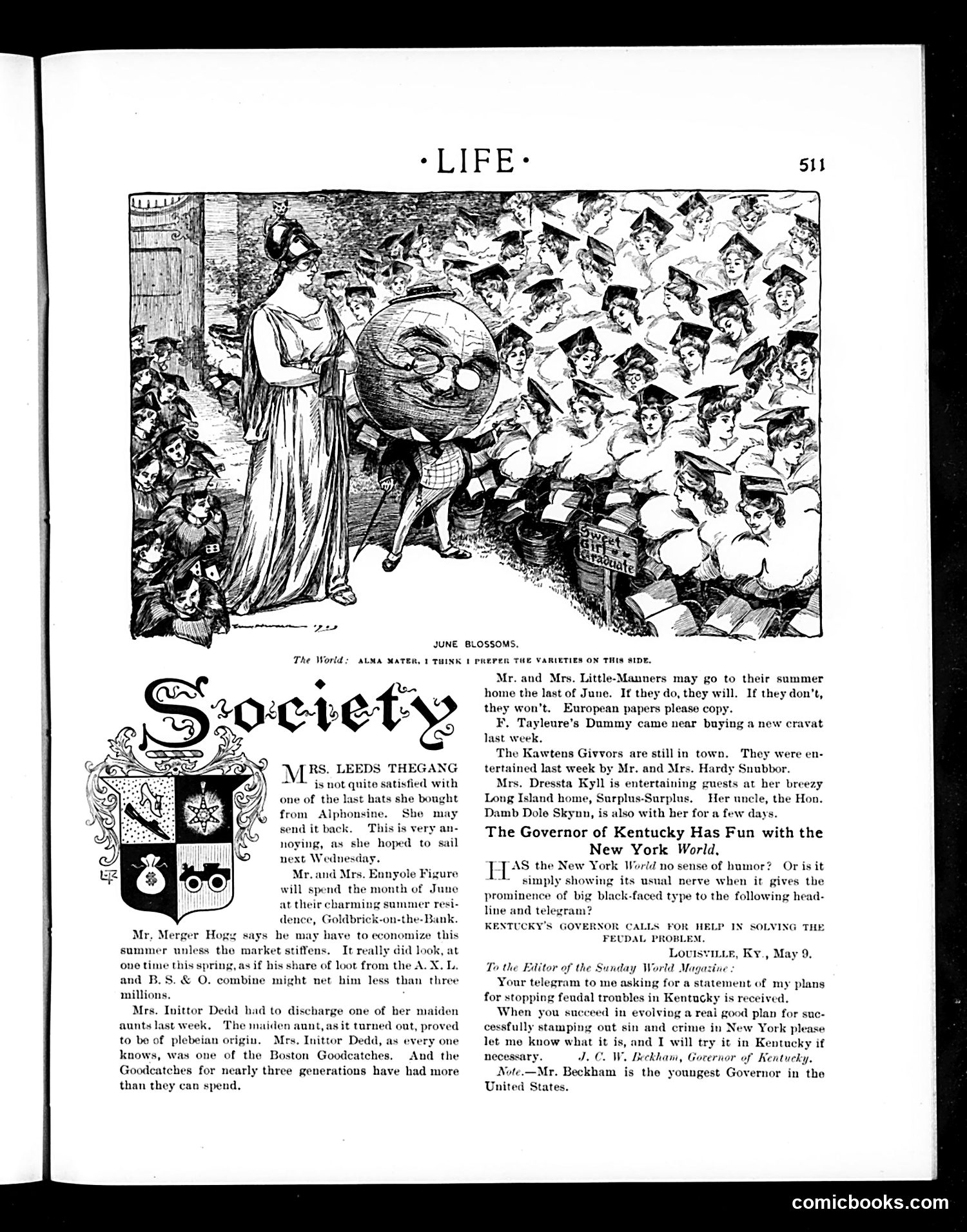
The main cartoon depicts a classical female figure (representing "The World," per the caption) presenting a large globe labeled "June Blossoms" to an eager crowd of well-dressed society figures. The satire targets the social pretensions of the wealthy elite during early summer season. The "Society" column below contains gossipy items about New York's upper class, mocking their summer travel plans and domestic staff matters. A notable section addresses Kentucky Governor J.C.W. Beckham regarding feudal violence in the state, presenting his request for federal intervention as darkly comedic fodder for the publication's satirical treatment of political incompetence and regional lawlessness.
This page from *Life* magazine contains book reviews and literary notices rather than political cartoons. The main content includes: **"The Filipino's Prayer"** - A poem addressing colonial themes, asking God to teach restraint and prevent violence, reflecting early 1900s debates over American imperialism in the Philippines. **Book Reviews** covering: - Works on civilization and exploration - Essays by Charles Warren Stoddard - Various novels examining English and American society **Military section** - Brief commentary on military training's value for boys, suggesting physical development concerns of the era. The page represents *Life*'s role as a literary journal publishing serious cultural criticism alongside light satire, rather than primarily political cartooning.
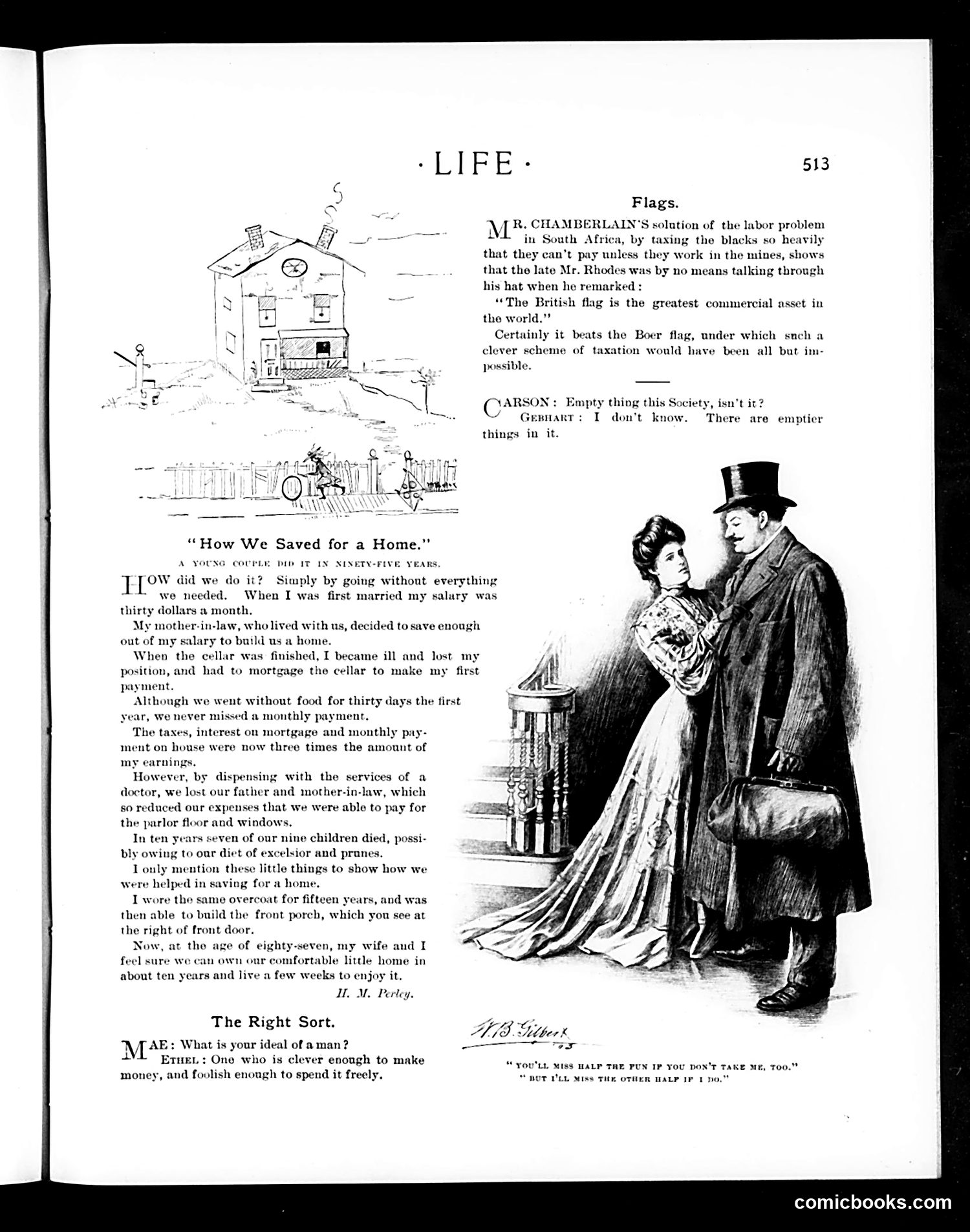
This page contains three satirical pieces: **"Flags"** mocks British imperial exploitation in South Africa. It references Joseph Chamberlain's scheme to tax Black South African miners so heavily they're forced into mine labor. The satire praises this as proof the British flag is superior to the Boer flag—sarcastically celebrating colonial economic coercion as a "commercial asset." **"How We Saved for a Home"** is deadpan social satire about American economic hardship. A family spends 95 years barely affording a house through extreme deprivation: starvation, skipping medical care (killing family members), and wearing the same coat for 15 years. They'll finally own it at age 87, with only weeks left to enjoy it. The joke exposes how capitalism demands impossible sacrifices. **"The Right Sort"** is a brief dialogue joke: Mae asks Ethel's ideal man. Ethel answers: someone clever enough to earn money but foolish enough to spend it freely—meaning he'll support her lavishly. The illustration shows a well-dressed couple, with dialogue implying financial dependency in marriage.
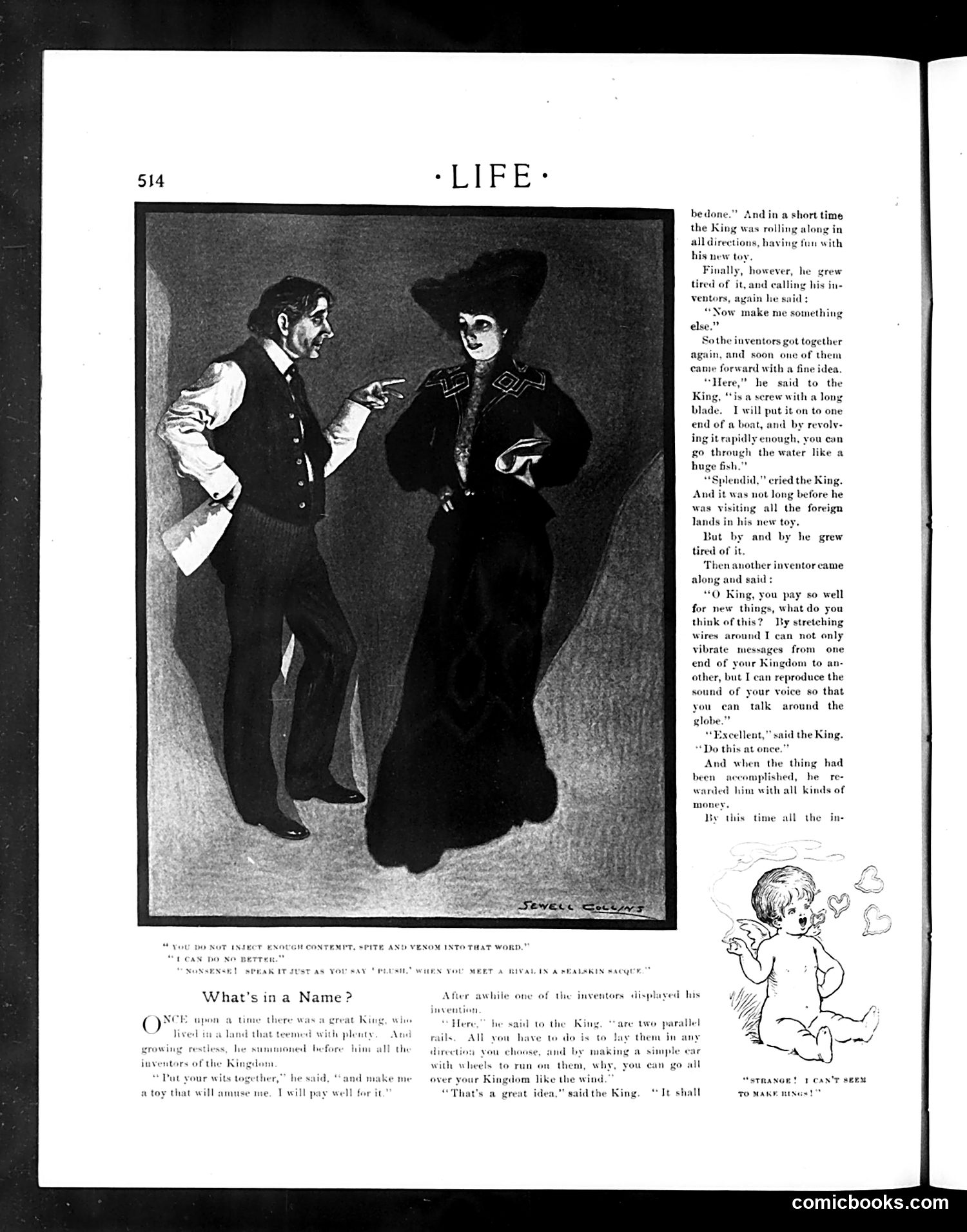
This is a satirical fable titled "What's in a Name?" about a bored King who commands inventors to amuse him. The story showcases three major inventions: a wheeled vehicle, a boat propeller, and a telegraph/telephone system for transmitting messages and voice across distances. The satire likely critiques the era's obsession with rapid technological innovation and industrial progress. The King's endless dissatisfaction—growing bored with each marvel and demanding the next—mocks both wealthy patrons and society's insatiable appetite for novelty. Each invention represents real advances from the Industrial/Telegraph age (the page appears to be from early 20th century Life magazine). The small cartoon inset shows a cherub confused about making "rings"—likely a visual pun related to the telegraph's mechanical workings or a commentary on the abstract nature of wireless communication. The fable's moral appears skeptical: technological progress, no matter how impressive, cannot sustain meaning or contentment. The title's question about "what's in a name" suggests appearances and buzzwords matter more than substance in this rush for innovation.
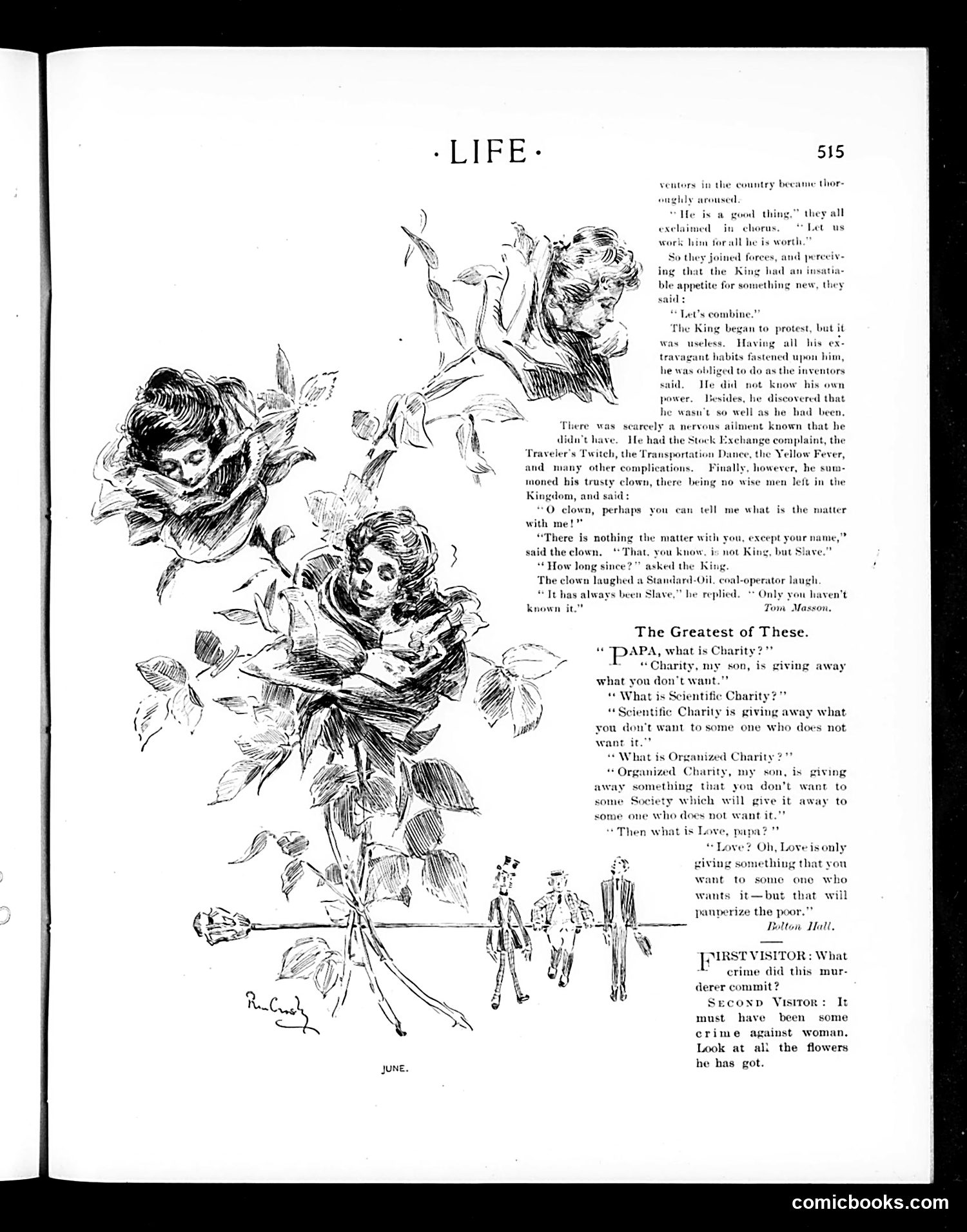
This page contains two distinct satirical pieces: **Left: A political cartoon titled "June"** depicting a flowering plant with human faces growing from it like blossoms. The accompanying text describes a King suffering from various nervous ailments who is forced by inventors to "combine" into some new entity. His clown advisor reveals the King's true name is "Slave"—suggesting commentary on how modern inventions and commercial interests have enslaved people, particularly the wealthy or powerful who believe themselves free. **Right: Two separate pieces:** 1. **"The Greatest of These"** by Bolton Hall presents a satirical catechism mocking charitable organizations. It distinguishes between direct charity, "scientific charity," and "organized charity"—arguing that institutional charity merely shuffles unwanted donations through bureaucratic systems rather than providing genuine help. Love, by contrast, requires *mutual* desire. 2. **A brief joke** about a murderer's excessive flower gifts implying his crime was "against woman"—contemporary social commentary on violence against women and the inadequacy of flowers as recompense. The page reflects Progressive-Era skepticism toward both industrialization and institutional charity.
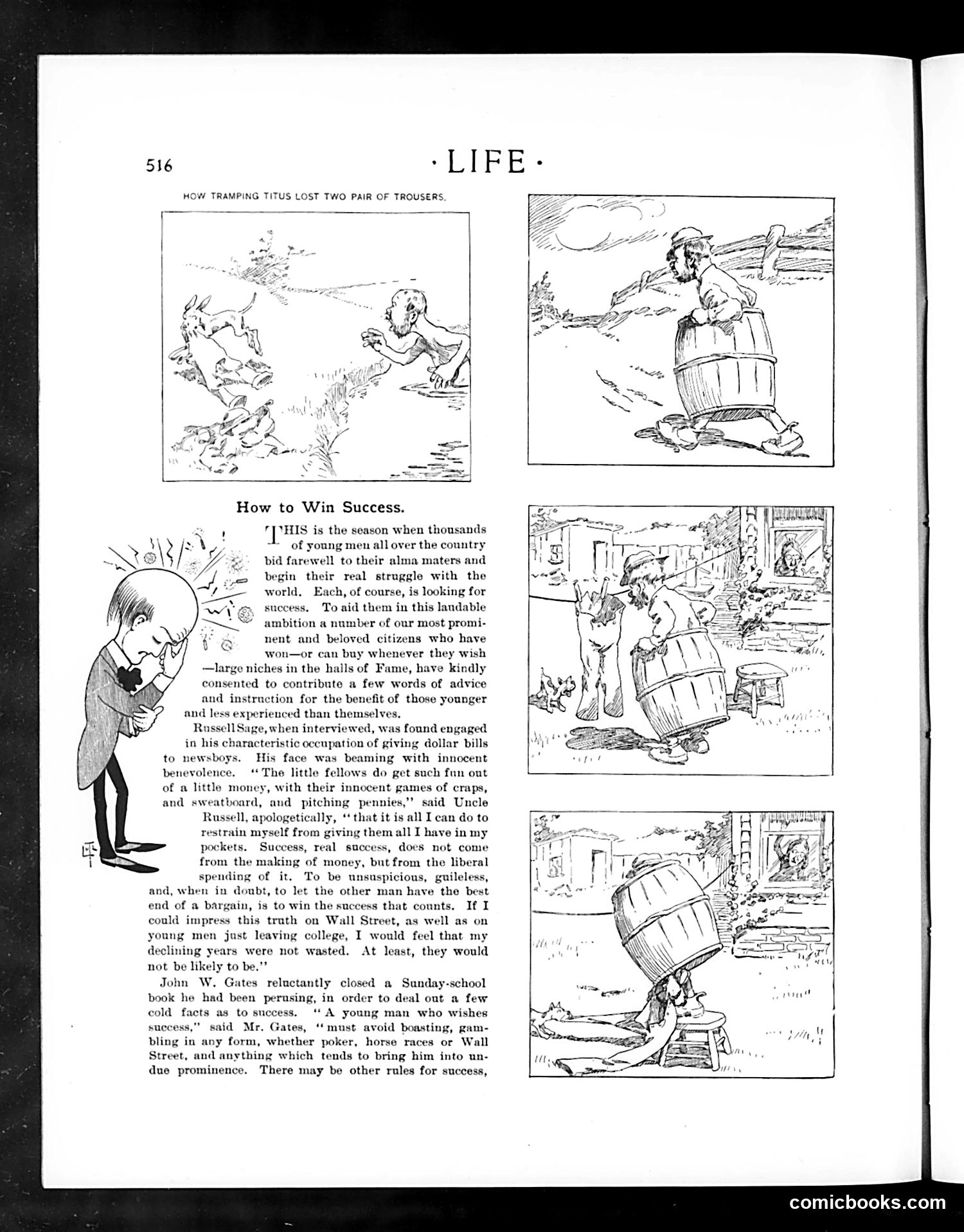
This satirical piece mocks wealthy industrialists' hypocritical advice to young men entering the workforce. The comic strip at top ("How Tramping Titus Lost Two Pair of Trousers") illustrates a vagrant losing his pants—establishing the ironic contrast. The text features **Russell Sage**, a notoriously miserly financier, claiming success comes from "liberal spending" while admitting he can't resist giving money away—a thinly veiled joke about his actual reputation for penny-pinching. **John W. Gates** (a railroad and steel magnate) advises against gambling and "undue prominence"—transparently ironic given his own notorious speculation and public profile. The satire's point: these robber barons offer platitudinous moral advice while their actual behavior and wealth-accumulation methods contradict it entirely. The "success rules" are either obvious platitudes or hypocritical coming from them specifically.
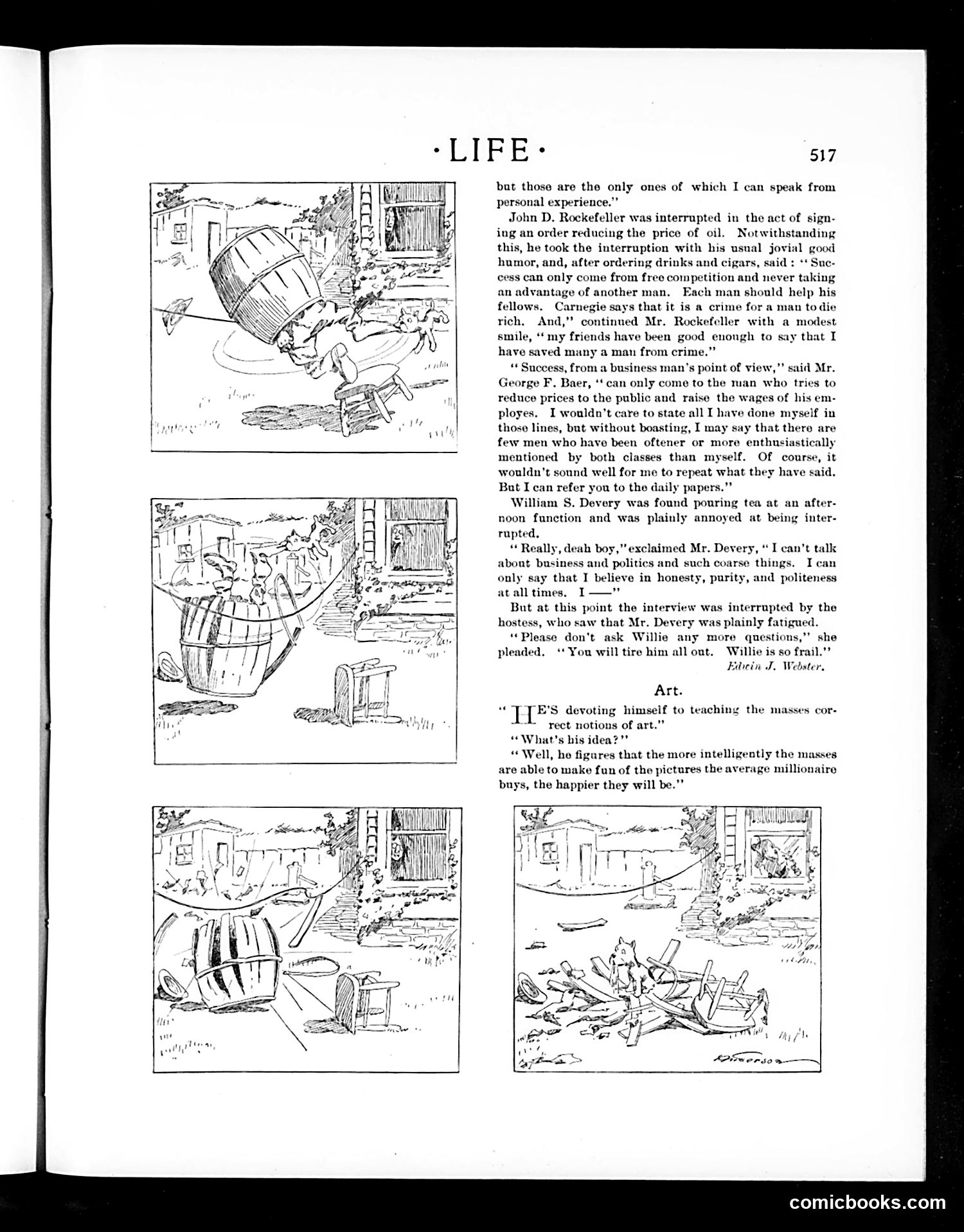
This page satirizes wealthy industrialists and their self-serving rhetoric about business ethics and philanthropy. The text features interviews with **John D. Rockefeller** (oil magnate), **George F. Baer** (coal executive), and **William S. Devery** (appears to be a political figure), each claiming credit for helping workers and the public while reducing prices—yet each reveals transparent self-aggrandizement and hypocrisy. The humor lies in their contradictory statements: they claim altruism while bragging about their prominence in newspapers, and they're portrayed as fragile or easily fatigued when questioned. The final section about "Art" mocks wealthy art collectors, suggesting an intellectual teaches masses to mock millionaires' poor taste in paintings—a dig at both pretentious collecting and class divisions. The four cartoon panels (appearing to show industrial scenes with barrels and machinery) likely illustrate the industrial/business context of these figures' claims.
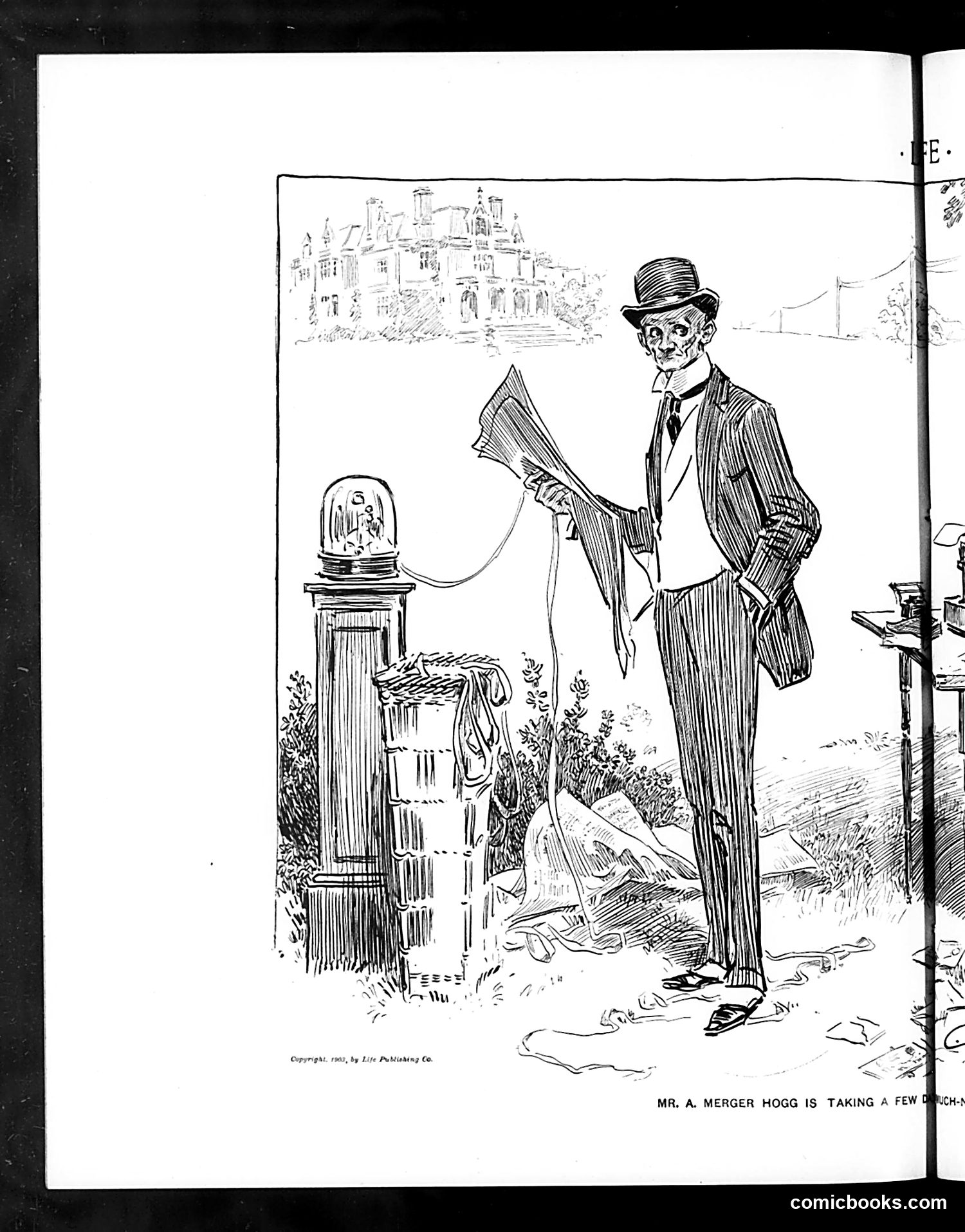
This appears to be a satirical illustration from Life magazine featuring "Mr. A. Merger Hogg." The figure is a well-dressed man in a striped suit and bowler hat, holding papers while standing near a classical stone post or pillar. Behind him is an elaborate castle or mansion sketched in the background. The caption indicates Hogg is "taking a few [words cut off]" — likely referring to some kind of financial or business transaction, given the visual emphasis on his papers and formal attire. The surname "Hogg" combined with the satirical context suggests this is a caricature mocking a wealthy businessman or financier of the era. The castle backdrop and formal costume suggest commentary on wealth accumulation or pretentious social climbing, though without the complete caption, the specific satirical target remains unclear.
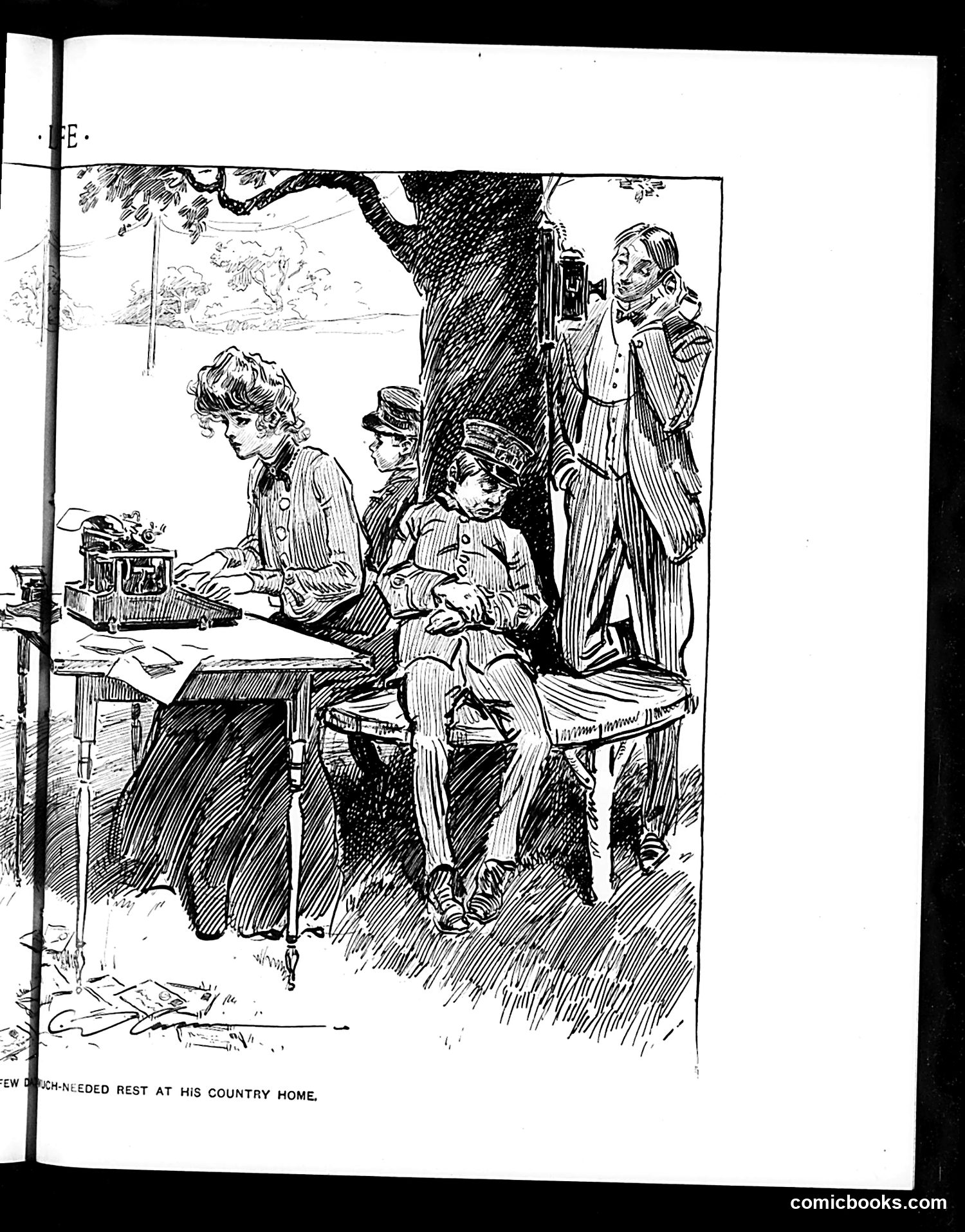
This appears to be a satirical illustration from Life magazine showing a military or political figure receiving rest at a country home. The caption reads "...NEEDED REST AT HIS COUNTRY HOME," suggesting commentary on someone taking leisure time, possibly ironically. The scene depicts four figures: a woman at a desk with papers/work, two uniformed boys, and a standing man in a suit. The composition suggests the central figure is avoiding responsibility or work while others remain occupied—likely satirizing how someone in authority escapes their duties for relaxation. Without visible dates or clearer identifying details, I cannot definitively name the specific person or historical event being referenced. The style and subject matter suggest early 20th-century American political satire targeting a public figure's work-life balance or dereliction of duty.
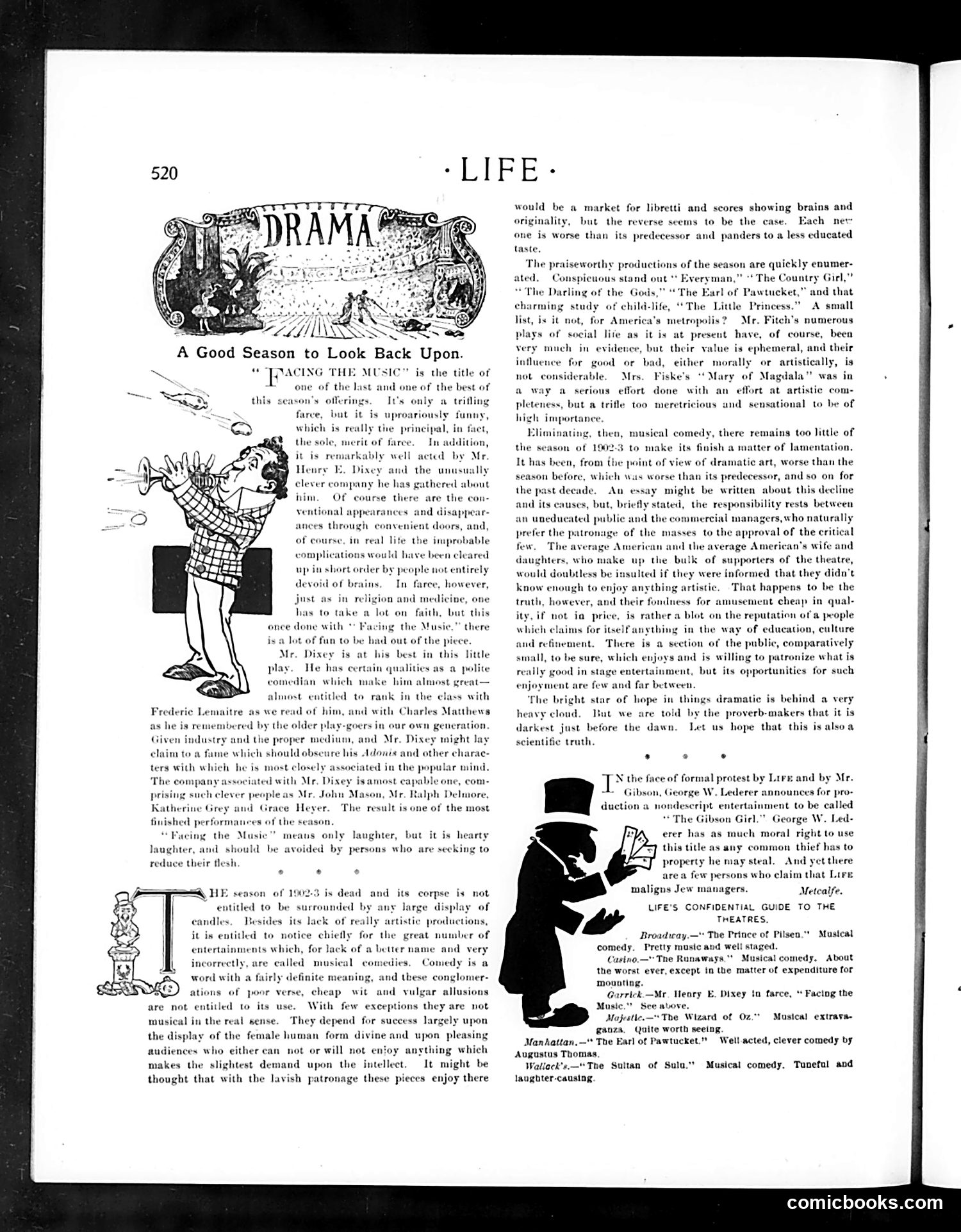
This page reviews the theatrical season, praising shows like "Everyman" and "The Country Girl" while lamenting the overall decline of American drama. The main illustration depicts a comedian (likely Henry E. Dixey, discussed in the text) in a checkered costume, representing the farce "Facing the Music"—described as "uproariously funny" but lacking artistic merit. The satire targets American theater's commercialization: producers cater to "uneducated" mass audiences seeking cheap entertainment rather than artistic excellence. The critic argues this reflects poorly on American culture and education. The small silhouette figure reading a newspaper represents the educated minority struggling to find quality theatrical productions. The page exemplifies Life's role as an arbiter of taste, mocking popular entertainment while championing artistic standards—a characteristic stance of early 20th-century American magazines aimed at educated, affluent readers.
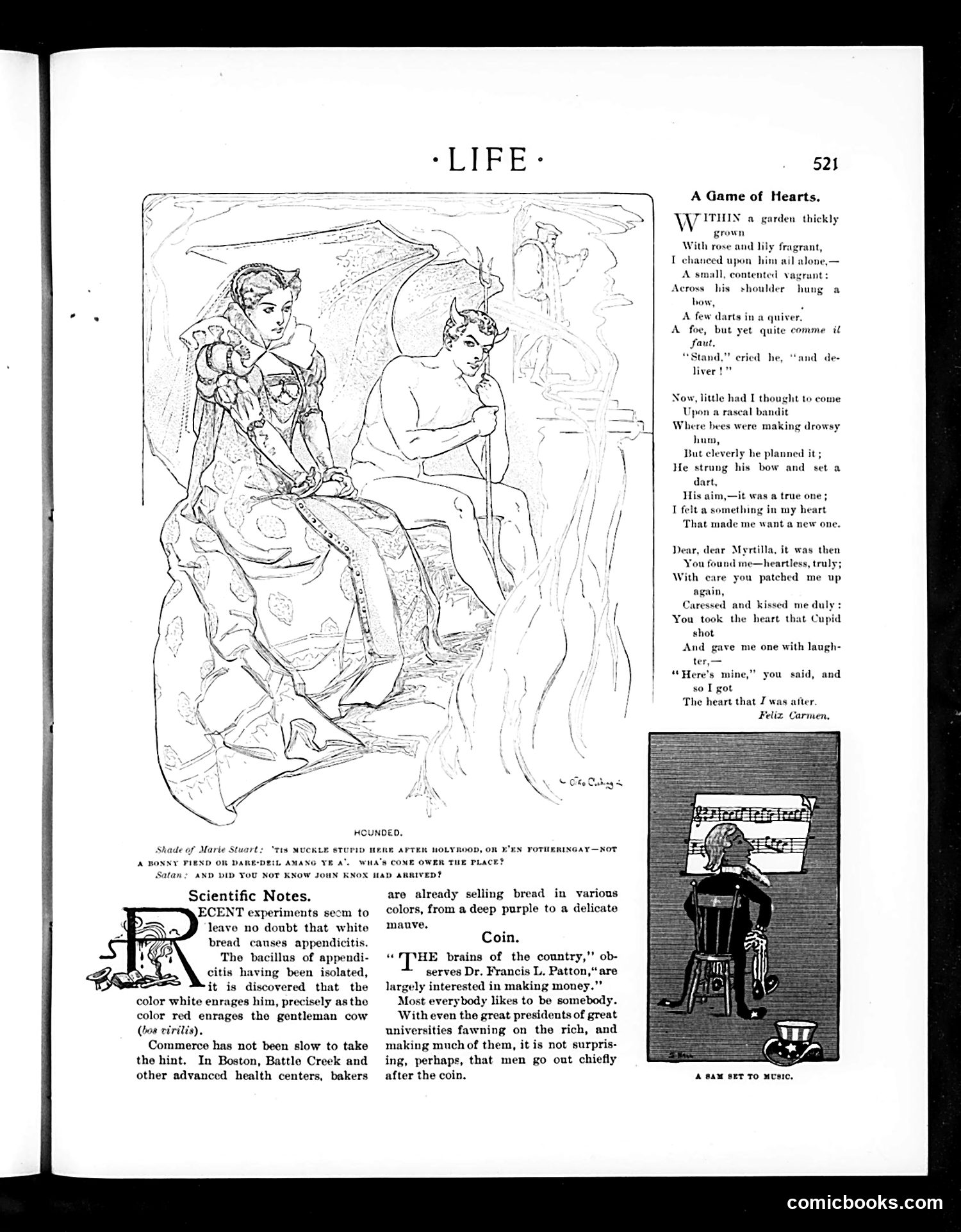
**"Hounded" Cartoon (top):** This depicts Mary, Queen of Scots being pursued by the ghost of John Knox, the Scottish Protestant reformer. The caption mockingly suggests Knox's stern religious influence still "haunts" Scotland even after Mary's execution at Fotheringgay. It's a historical joke about Knox's lasting impact on Scottish Protestantism—he's portrayed as relentlessly pursuing her even in the afterlife, satirizing how his legacy dominated the nation. **"Scientific Notes":** A humorous pseudo-scientific piece claiming white bread causes appendicitis. It mocks both dubious health fads and commercial opportunism—bakers immediately pivot to selling colored bread (purple, mauve) to exploit the supposed health scare. This satirizes how businesses exploit medical concerns for profit. **"Coin":** A brief commentary on greed, quoting Dr. Patton that even university presidents prioritize wealth over education, lamenting how money-seeking has become universal. **"A Game of Hearts":** A romantic poem about Cupid (personified as a bandit archer) shooting the narrator, then the beloved Myrtilla healing him with her own heart—sentimental Victorian verse, unrelated to satire.
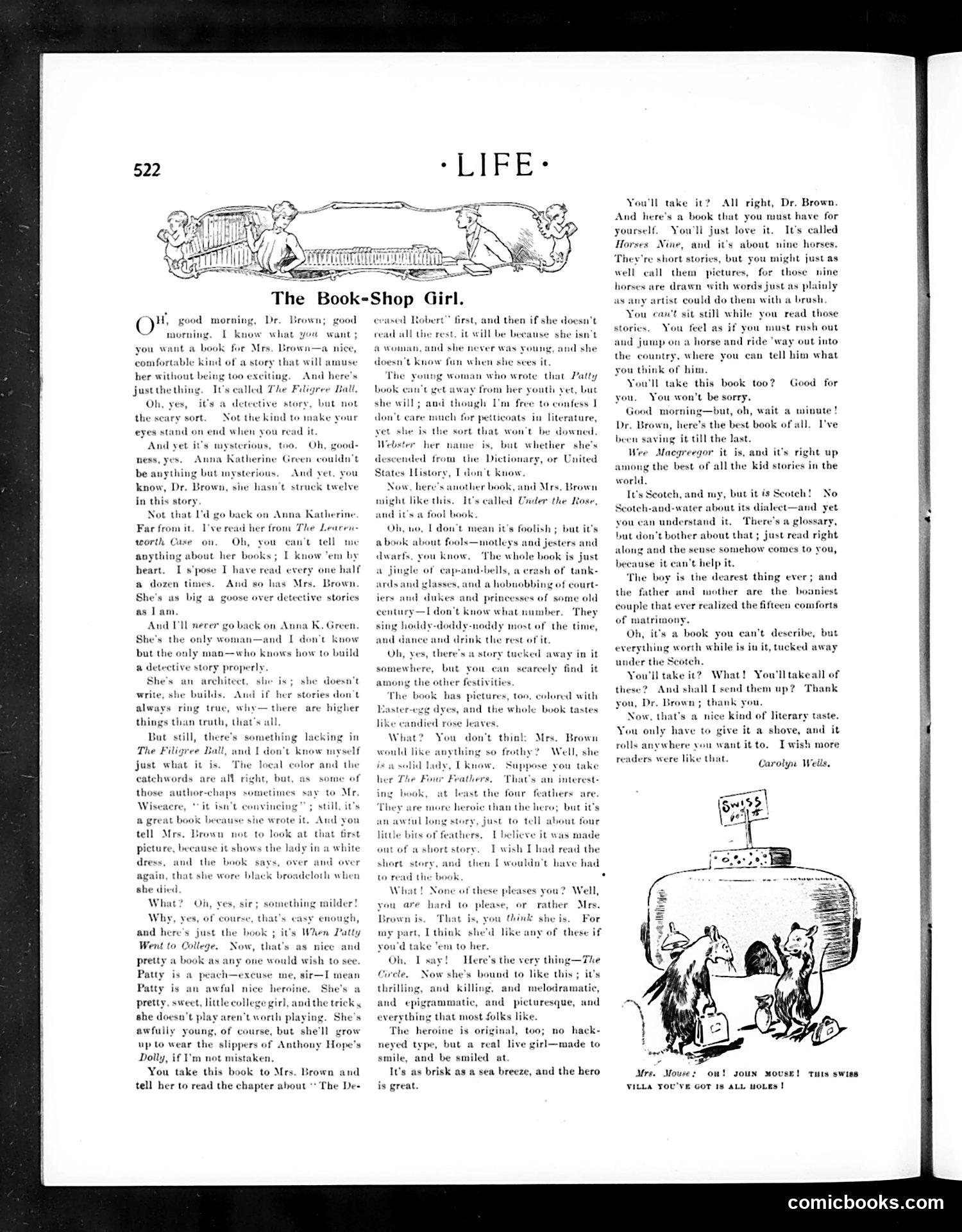
This is a literary advice column disguised as humor, featuring Dr. Brown (a male authority figure) recommending books to an unnamed woman customer. The satire targets early 1900s attitudes about women readers and "appropriate" literature. **The Social Context:** The piece mocks the condescending gatekeeping of women's reading. Dr. Brown dismisses serious literature (Anna Katharine Green's detective novels) as overly intellectual for women, instead recommending sentimental romance and frivolous adventure stories featuring young heroines who will eventually become dutiful wives ("wear the slippers of Anthony Hope's Dolly"). **The Joke:** Women are portrayed as intellectually inferior—incapable of appreciating complex plots or realistic characters. Dr. Brown assumes the customer wants "comfortable" stories that won't tax her mind, not detective fiction requiring sustained attention. **The Illustration:** The cartoon shows mice reading near an inkwell, likely reinforcing the era's view of bookish pursuits as trivial "small-minded" entertainment. This reflects actual early 20th-century debates about women's education and literary merit.
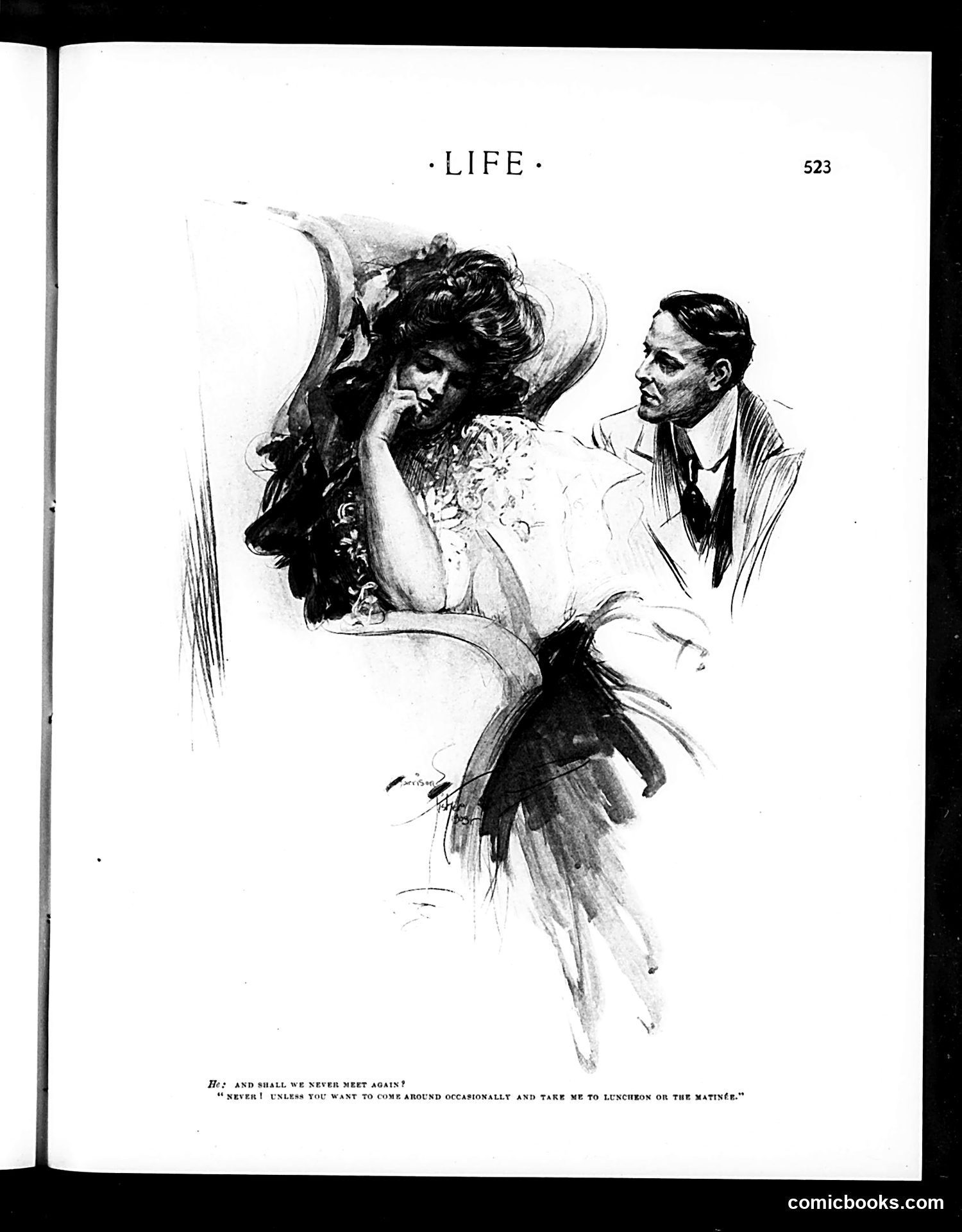
This illustration depicts a romantic scene between a man and woman, likely from the early 20th century based on the art style. The woman wears an elegant hat and dress; the man is dressed formally. The caption presents dialogue about never meeting again, with the woman's conditional response suggesting she'd accept occasional social outings—specifically lunch or matinee theater visits. The satire appears to target romantic relationships of the era, likely mocking either: 1. The performative nature of courtship rituals among the upper classes 2. Women's strategic negotiation within romantic encounters 3. The shallow materialism of such arrangements The humor relies on the woman's frank transactional tone—she'll end the relationship unless compensated with entertainment and meals. This satirizes early 1900s courtship conventions and gender dynamics, where women had limited economic independence.
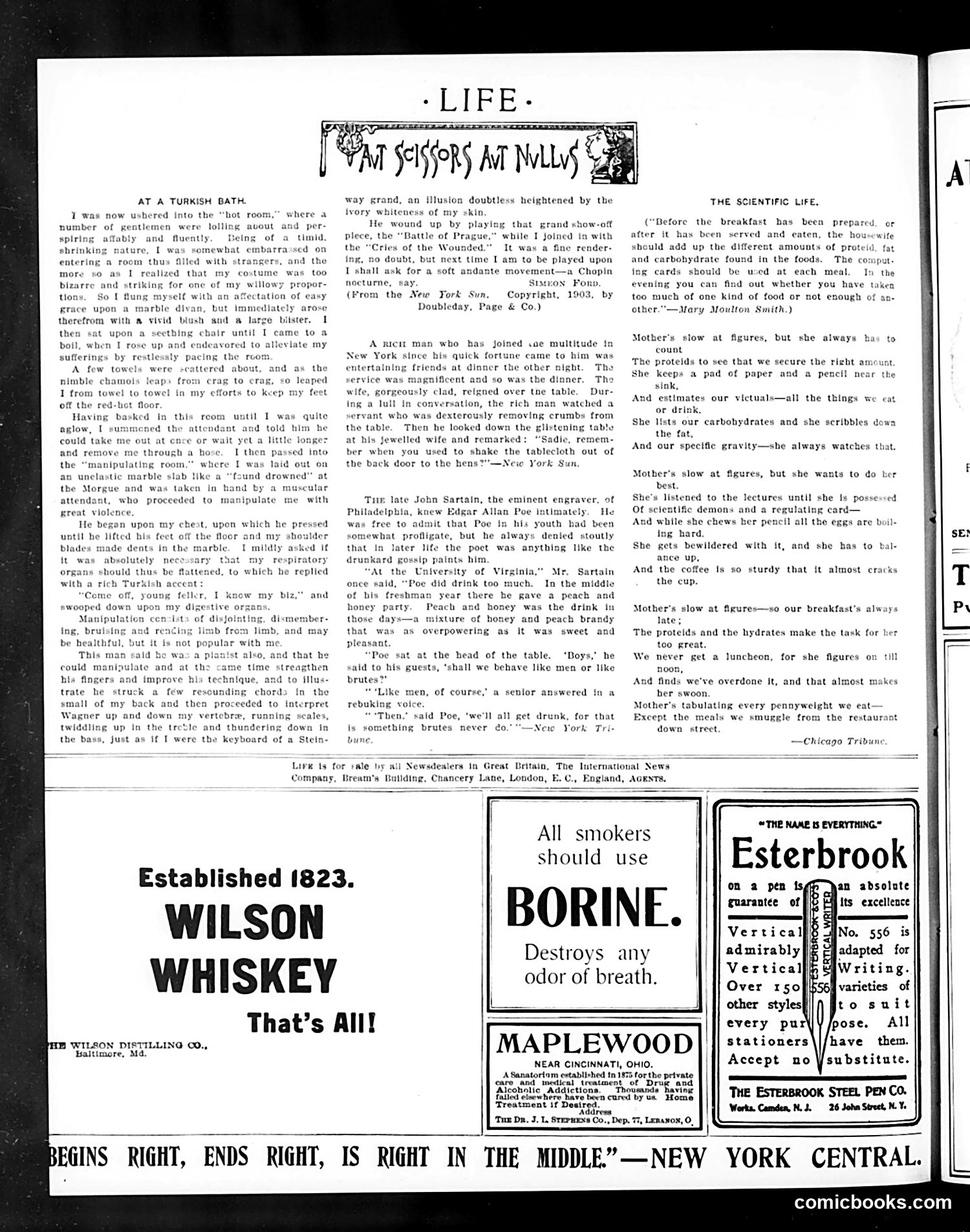
This page from *Life* magazine (circa 1903) contains three humorous anecdotes satirizing American social pretension and domestic science trends of the era. **"At a Turkish Bath"** mocks the fashionable affectation of Turkish baths among gentlemen. The narrator—awkwardly modest and physically delicate—endures an aggressive masseur who treats him like laundry, literally flattening him and playing him like a musical instrument. The satire targets both the trendy health fad and masculine vanity. **"A Rich Man"** ridicules nouveaux riche pretension. A man who's recently acquired wealth boasts of his fine dinner and wife's jewels, only to be reminded by a servant that his wife once shook tablecloths "out of the back door to the hens"—exposing his humble origins. The joke emphasizes how new money can't erase one's past. **"The Scientific Life"** satirizes the emerging obsession with scientific nutrition. It depicts a housewife meticulously calculating protein, fat, and carbohydrates at every meal using "compute cards," portraying domestic science as overly fussy and joyless—reducing eating to mathematical computation. All three pieces target contemporary fads and social anxiety.
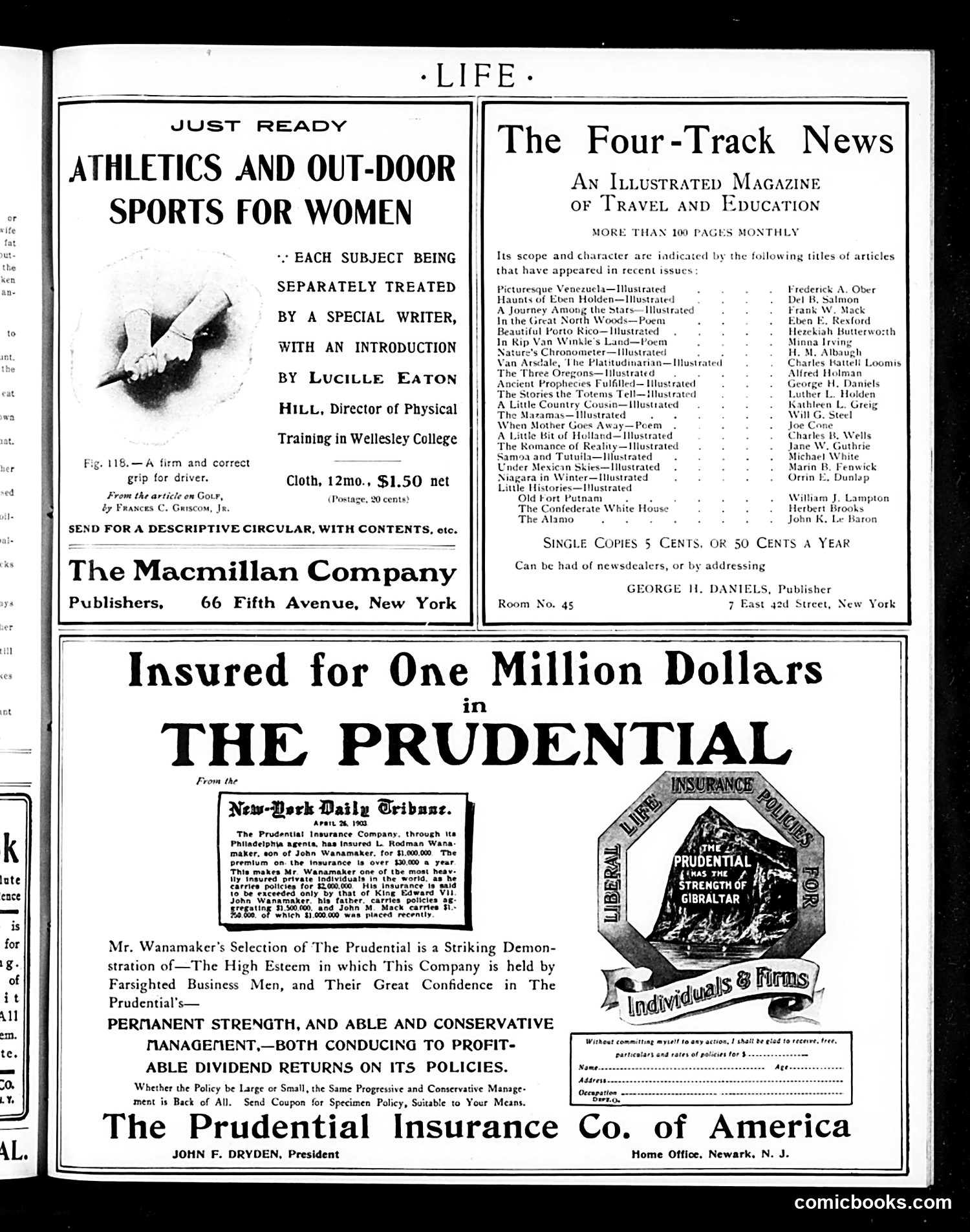
This page is primarily **advertising**, not satire or political commentary. It contains three distinct advertisements: 1. **Top left**: A Macmillan Company book advertisement for *Athletics and Outdoor Sports for Women*, featuring an illustration of a proper golf grip. This reflects early 1900s interest in expanding women's participation in sports, with an introduction by Lucille Eaton Hill, director of physical training at Wellesley College. 2. **Top right**: Promotion for *The Four-Track News*, an illustrated travel and education magazine listing article titles and contributors. 3. **Bottom**: A Prudential Insurance advertisement highlighting that L. Rodman Wanamaker (son of the famous Philadelphia department store magnate John Wanamaker) was insured for one million dollars—positioning this as evidence of the company's prestige among wealthy businessmen. The ad emphasizes the company's "permanent strength" and conservative management. The page demonstrates early 1900s marketing to educated, affluent audiences and reflects contemporary attitudes toward women's athletics and business confidence in insurance.
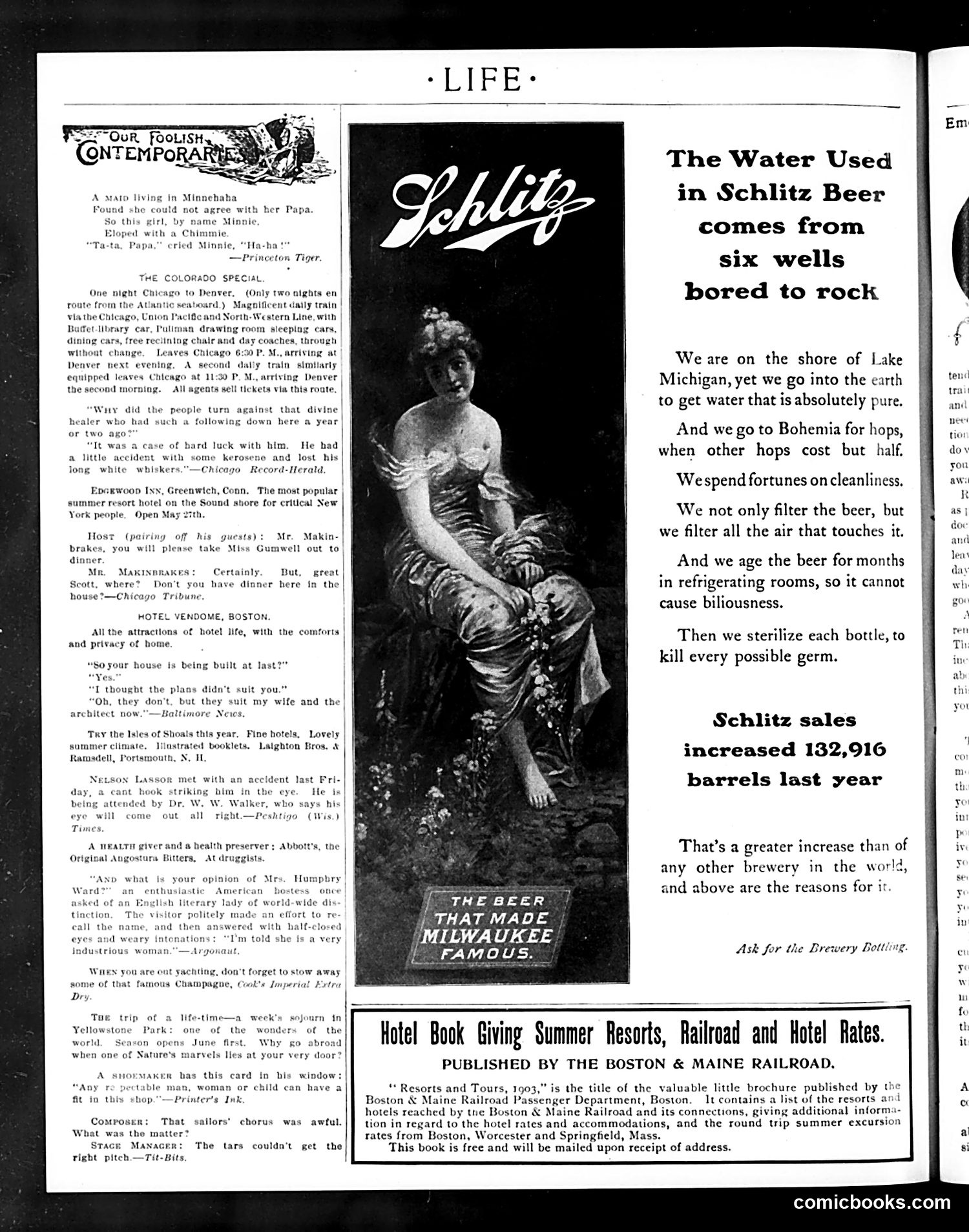
This page is primarily a **Schlitz beer advertisement** disguised as editorial content in *Life* magazine, alongside typical period humor and travel notices. The central image shows a classical female figure (likely representing purity or quality) with the slogan "THE BEER THAT MADE MILWAUKEE FAMOUS." The advertisement's text emphasizes Schlitz's manufacturing process—deep wells, water filtration, air filtration, aging in refrigerated rooms, and bottle sterilization—to counter public health concerns of the early 1900s. During this era, contaminated water and poor sanitation caused widespread illness; breweries competed partly on claims of cleanliness and safety. The satire lies in the **ironic boasting**: Schlitz must literally go underground and spend fortunes on elaborate purification to make beer "absolutely pure"—implicitly mocking the absurdity that beer production requires such extreme measures, while simultaneously reassuring consumers about product safety during an era of genuine public health anxiety. The "132,916 barrels" sales increase claim attempts to validate these quality assertions through market success.
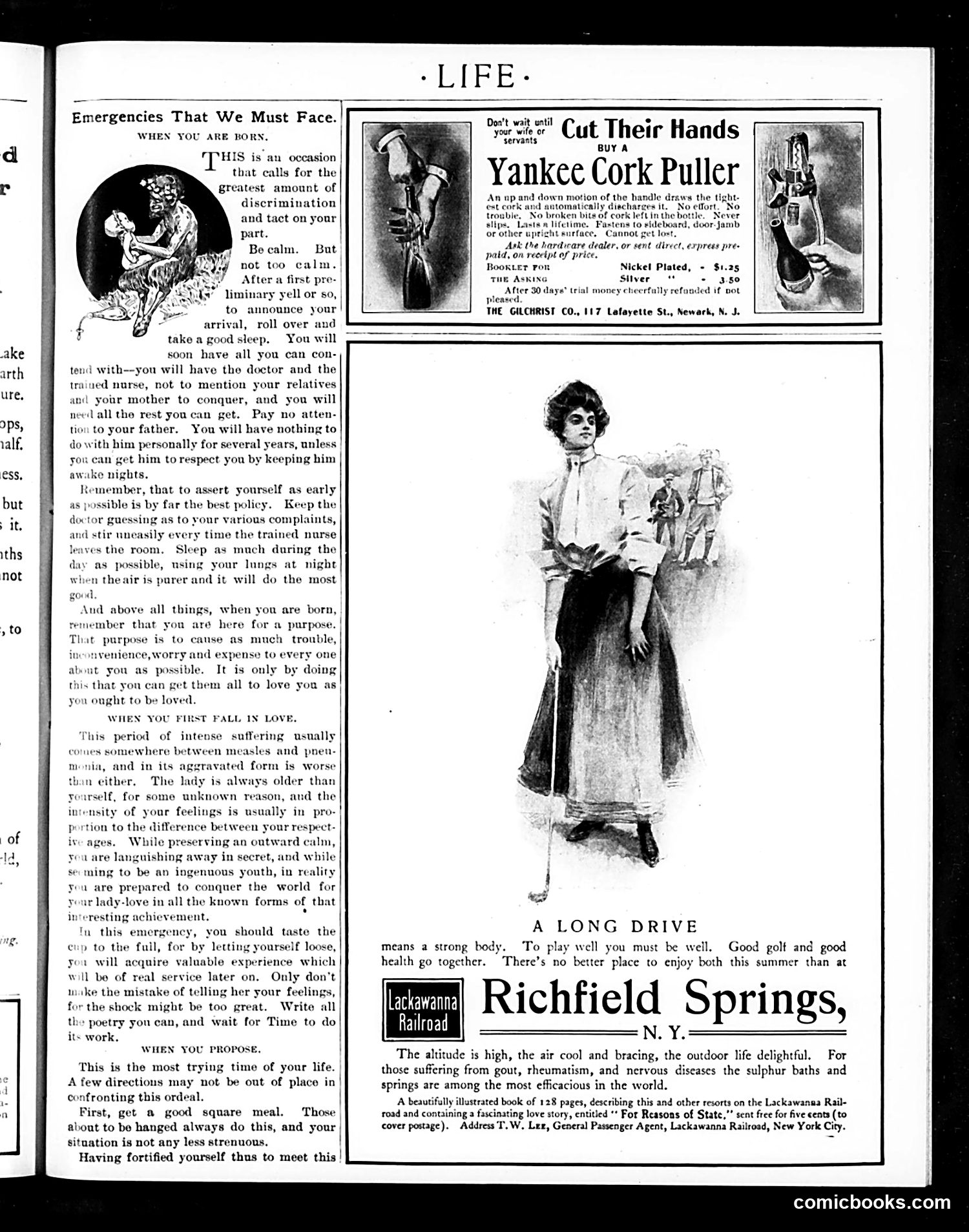
This page contains satirical advice columns and advertisements typical of early 1900s Life magazine. **The Satire:** The left column, "Emergencies That We Must Face," offers mock-serious guidance to young men on three life crises: birth, first love, and marriage proposals. The tone is deliberately absurd—advising newborns to demand attention through sleeplessness and that their purpose is causing "trouble, inconvenience, worry and expense" to everyone around them. For courtship, it counsels extreme emotional performance ("languishing away in secret") while maintaining false composure. The comparison of proposing to "being hanged" reinforces the satirical tone. **The Advertisements:** A Yankee Cork Puller tool ad and a Richfield Springs resort ad flank the text. The Richfield Springs ad explicitly connects leisure travel to romance ("containing a fascinating love story"), which ironically mirrors the satirical advice about love and courtship beside it. The humor relies on exaggeration and inversion of Victorian propriety—mocking both the intensity of young romance and the stuffy social conventions of the era.
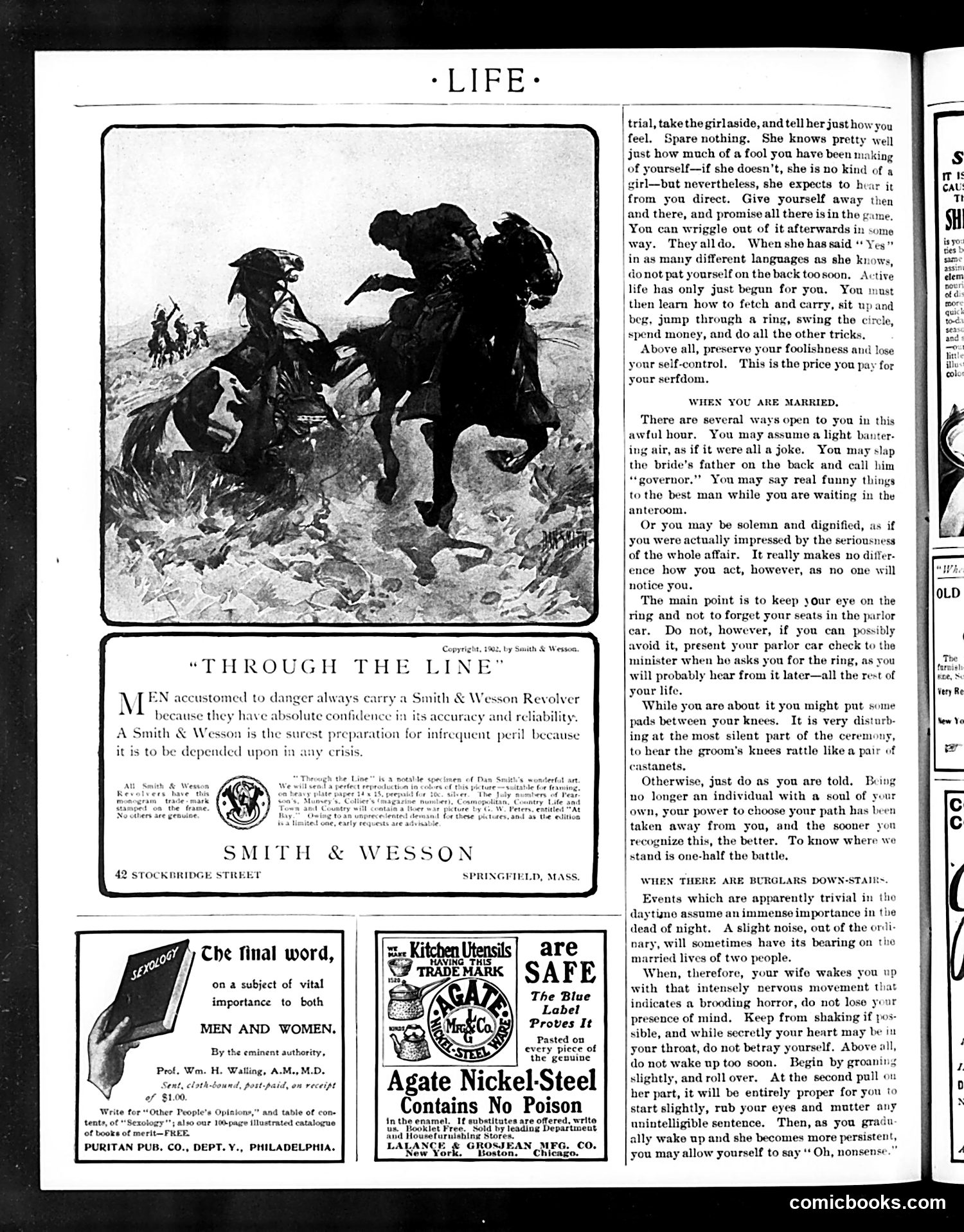
This page contains a Smith & Wesson revolver advertisement ("Through the Line") featuring an illustration of armed men on horseback in what appears to be a Western or frontier conflict scene. The ad emphasizes the gun's reliability for "infrequent peril." The main satirical content is the article on the right, titled "The Final Word," which offers cynical, tongue-in-cheek advice to men about courtship, marriage, and domestic life. The humor lies in its brutally honest mockery of male subservience in relationships—advising men to "give yourself away" to women, treat marriage as servitude ("serfdom"), and accept that they've lost all individual agency. The piece satirizes both romantic idealization and the actual power dynamics of early 20th-century marriage, suggesting men are essentially conquered and must obey. It's dark comedy about masculine disempowerment, paired incongruously with aggressive advertisements promoting weapons and sexual education books—creating satirical contrast between masculine posturing and actual domestic reality.
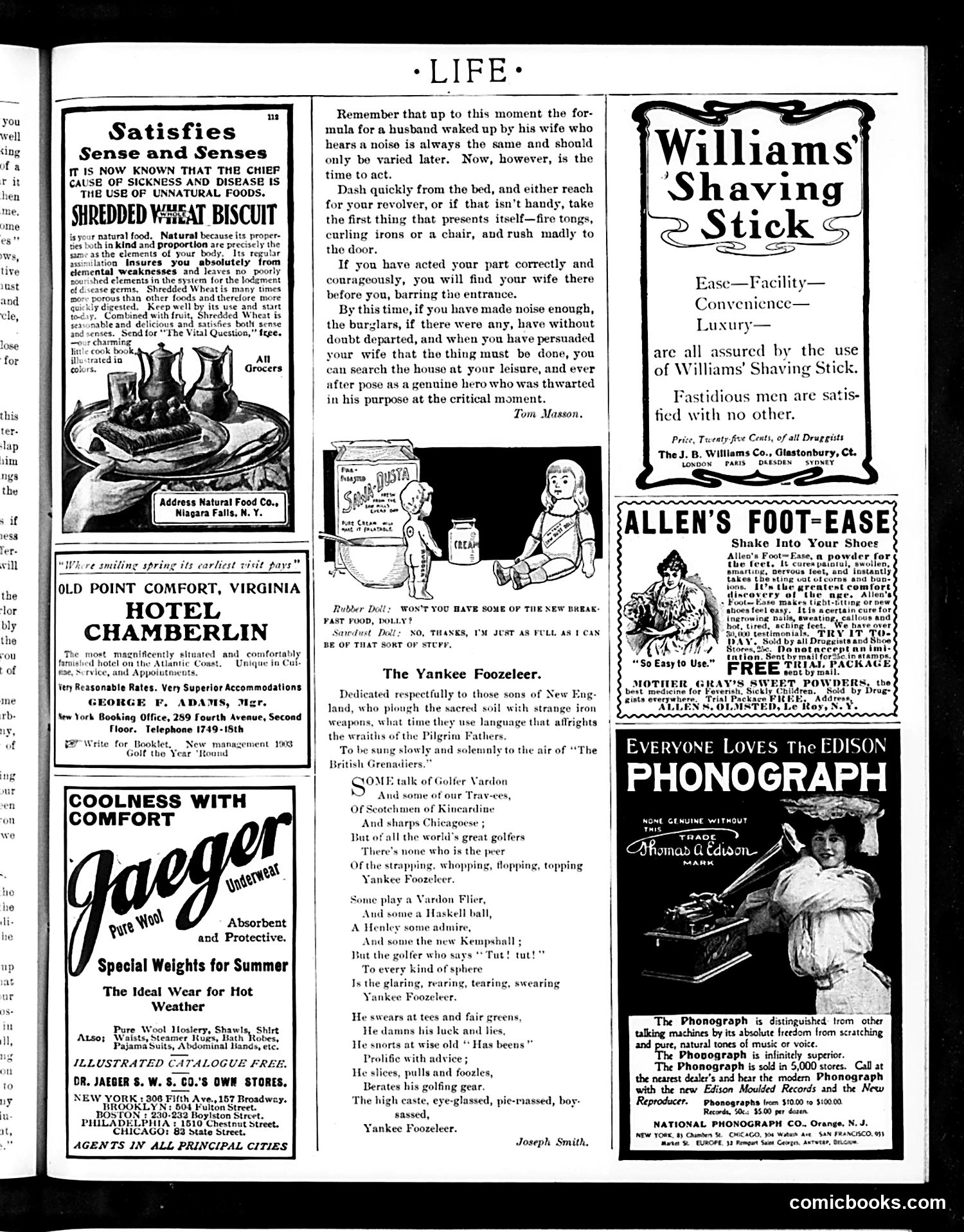
This is primarily an **advertising page** with one satirical element. The main satirical content is a poem titled "The Yankee Foozeleer" by Joseph Smith. It mocks American golfers—specifically those who are loud, profane, and lack skill—contrasting them unfavorably with more dignified British and Scottish golfers (like Vardon). The poem satirizes the "Yankee" as someone who "swears," "damns," "snorts," and "berates" his equipment while producing poor shots ("slices, pulls and foozles"), yet maintains an air of superiority ("high caste, eye-glassed"). The satire reflects early 20th-century tensions between American and British sporting culture, with golf presented as a gentleman's game being "corrupted" by crude American behavior. The remainder of the page consists of period advertisements for foods (Shredded Wheat), hotels, clothing (Jaeger Pure Wool), shaving products (Williams), phonographs (Edison), and foot powder—typical of Life's revenue model at this era.
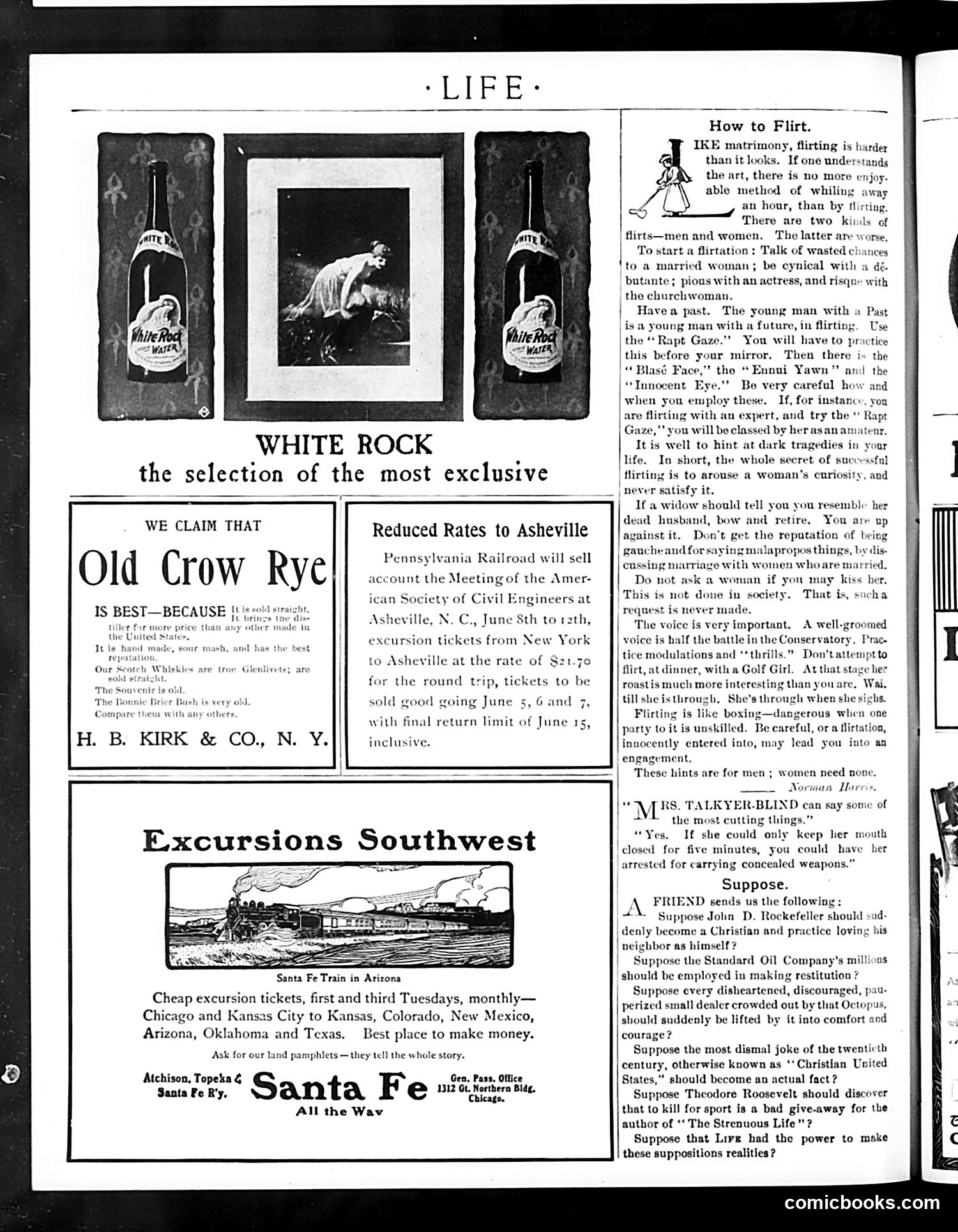
This is primarily an **advertising and humor page** from Life magazine (early 1900s). The main content includes: **Advertisements**: White Rock whiskey, Old Crow Rye, Pennsylvania Railroad excursions to Asheville, and Santa Fe Railway promotions. **"How to Flirt" essay**: Satirical dating advice for men, mocking upper-class courtship rituals. It humorously prescribes theatrical poses ("Rapt Gaze," "Blasé Face") and suggests hinting at dark past tragedies to arouse women's curiosity—clearly tongue-in-cheek commentary on affected romantic behavior. **"Suppose" humor column**: Satirical "what-ifs" ridiculing wealthy industrialists and political figures. It mocks John D. Rockefeller's ruthless monopoly practices, Theodore Roosevelt's big-game hunting, and sarcastically imagines these powerful men becoming genuinely ethical. The joke is the absurdity of such reversals ever occurring—biting social criticism wrapped in hypothetical humor. The page reflects Life's mission as a satirical publication critiquing wealth inequality, corporate excess, and hypocrisy in Gilded Age America.
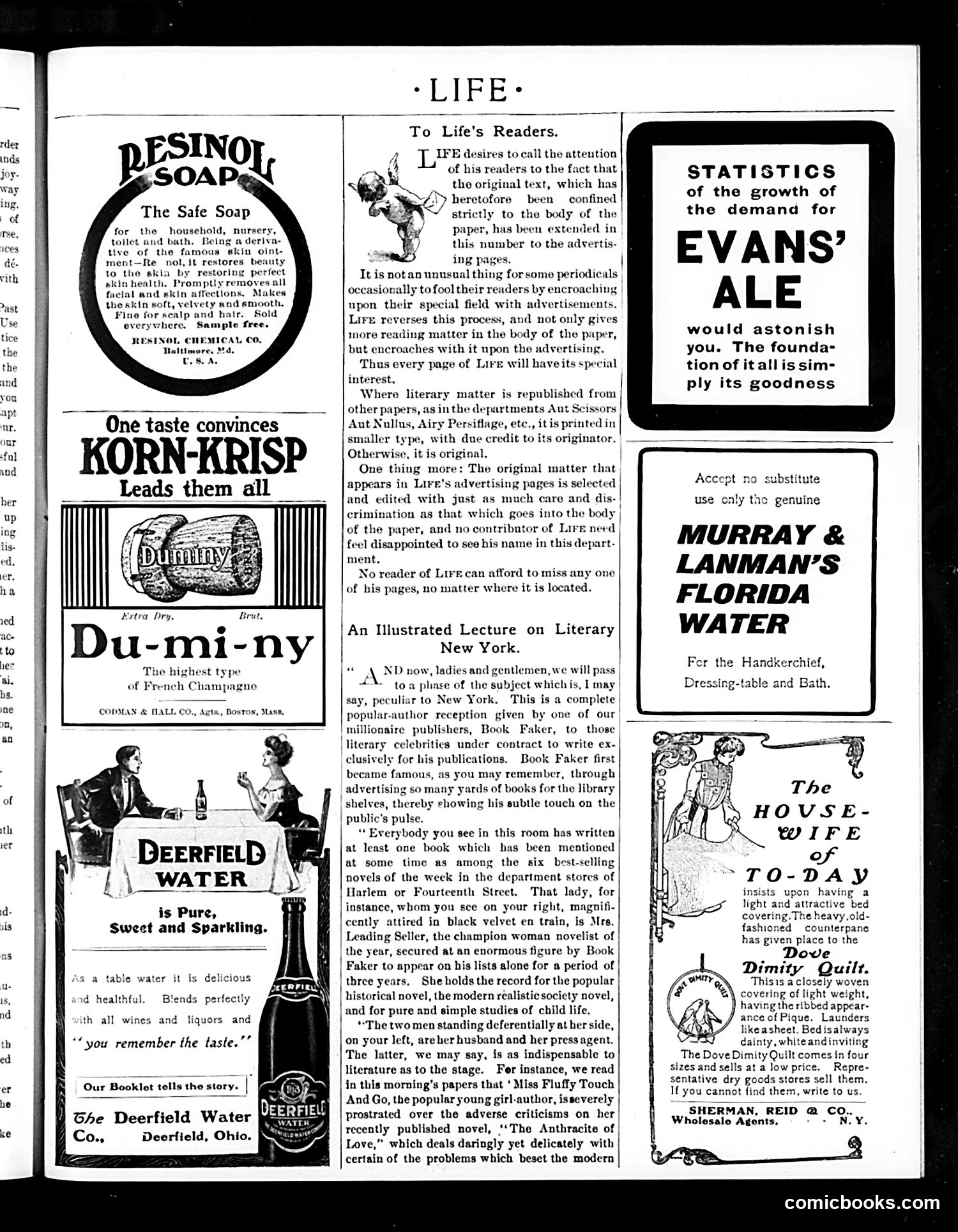
This page is primarily **advertising with an embedded satirical article**. The central feature mocks New York's literary establishment through a fictional "lecture" describing a publisher's reception for contracted authors. The satire targets the commercialization of literature: a character called "Book Faker" (transparent pseudonym) buys bestselling authors exclusively, judging their worth by sales figures and department-store mentions rather than literary merit. The piece ridicules how publishers artificially manufacture literary prestige—an author's value depends on being "among the six best-selling novels of the week," not genuine quality. The named female author "Mrs. Leading Seller" represents interchangeable, market-driven writers producing formulaic historical novels, society novels, and sentimental child-life stories. The satire suggests that 1910s New York publishing was cynical machinery prioritizing commercial appeal over art. This reflects Life magazine's recurring critique of Gilded Age consumer culture masquerading as sophistication.
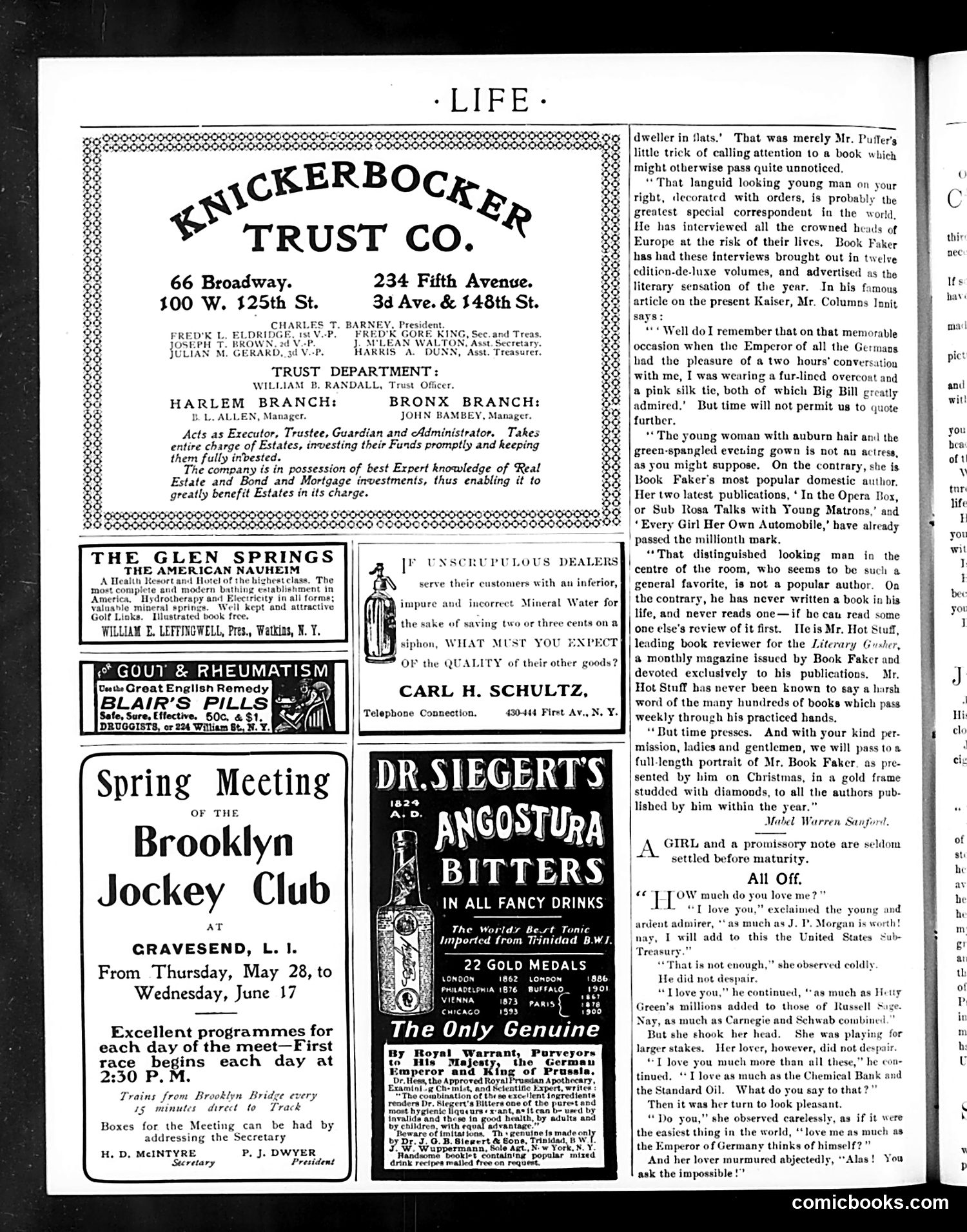
This page is primarily **advertisements and notices**, not a political cartoon. The main content is commercial: a trust company, health resorts, patent medicines (Blair's Pills for gout), mineral water, horse racing announcements, and bitters. The only satirical article visible is a brief piece titled **"All Off"** by Michel Warren Sanford, which mocks literary pretension. It describes "Book Faker," a charlatan author who fabricates interviews with European royalty and publishes them as sensation-seeking "edition-de-luxe" volumes. The satire targets: - **Fake journalism**: invented celebrity interviews presented as fact - **Literary fraud**: padding books with fabricated material for commercial success - **Social climbing**: using false credentials and associations to gain credibility The article mentions the Kaiser (German Emperor) and suggests "Book Faker" invents anecdotes about meeting him. This is straightforward criticism of fraudulent publishing—a concern as relevant then as now.
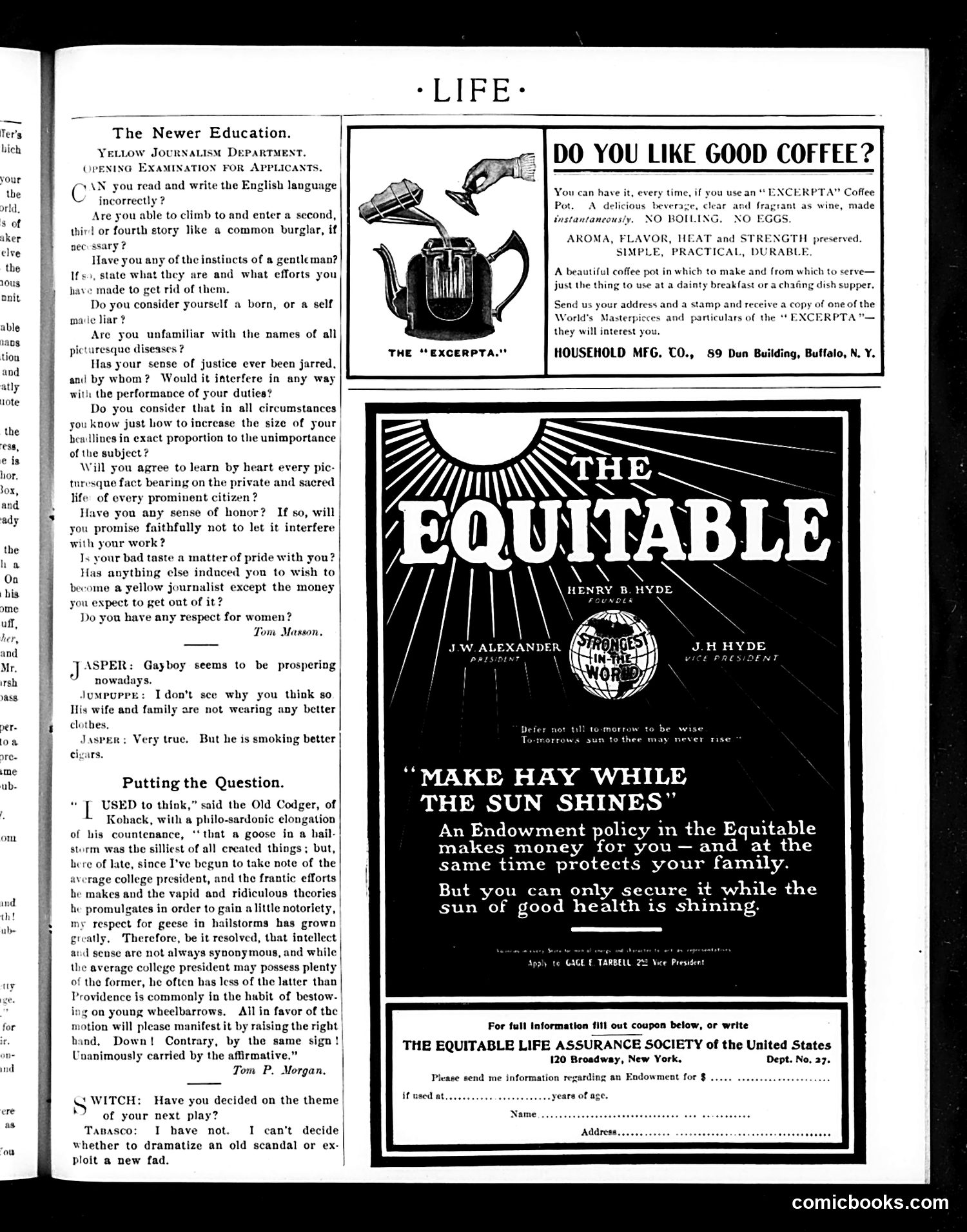
This page from *Life* magazine contains satirical commentary on contemporary issues circa early 1900s. **"The Newer Education"** is a biting mock job application for yellow journalists—sensationalist newspaper writers. Tom Masson's satire questions whether applicants can write incorrectly, commit burglary, lack gentleman's instincts, lie, ignore ethics, manufacture headlines from trivia, and exploit public figures' private lives. The final question asks if they respect women. This attacks yellow journalism's exploitative, unethical practices that were prevalent in American newspapers of the era. **"Putting the Question"** by Tom P. Morgan presents an old man's speech comparing college presidents unfavorably to geese in hailstorms, mocking their pretentious efforts for notoriety despite lacking practical sense. The remaining content consists of period advertisements (Excerpta coffee pot, Equitable Life Assurance endowment policies) unrelated to the satire above.
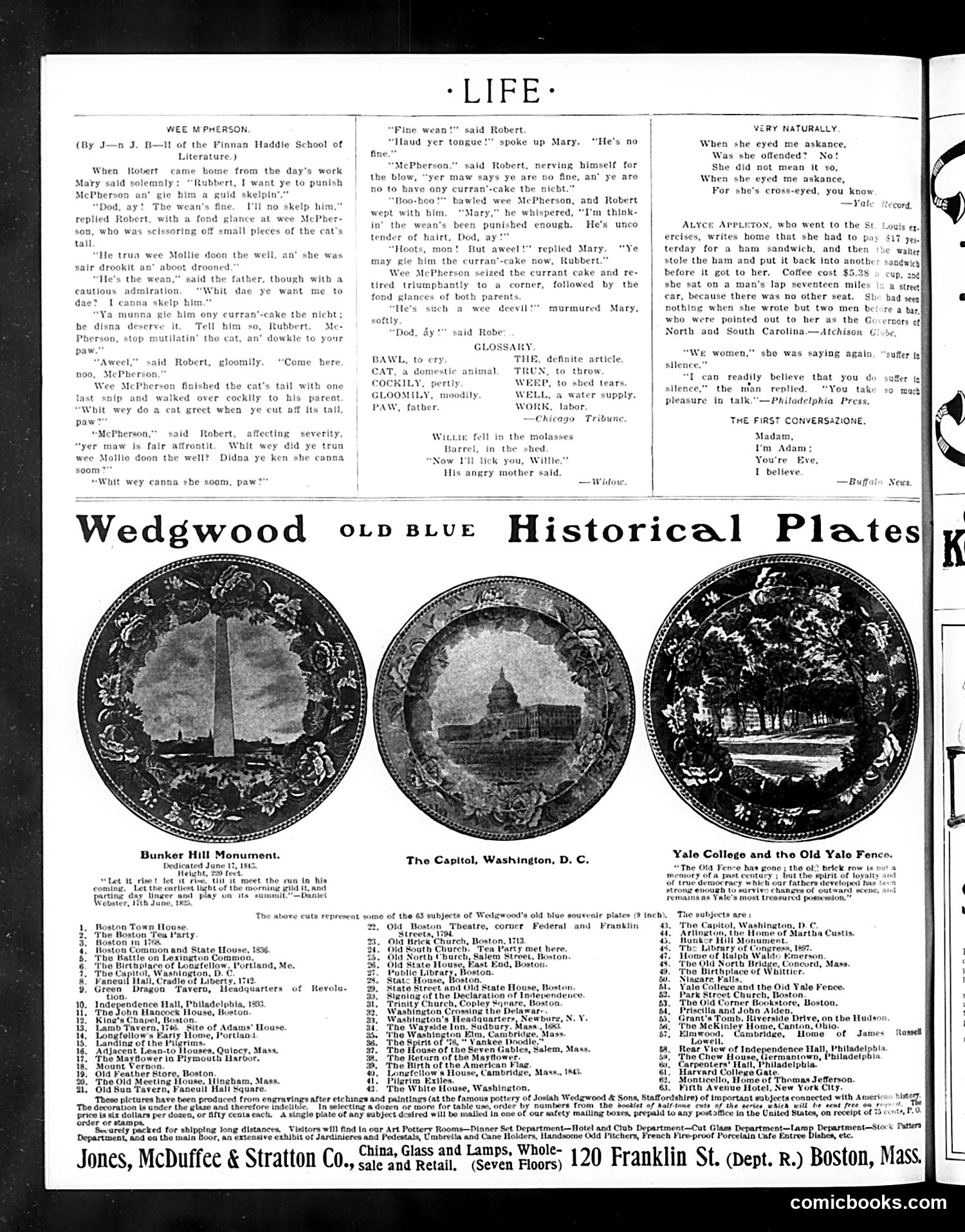
This page contains humorous Scottish dialect fiction and social commentary typical of *Life* magazine's satirical content. **"Wee M'Pherson"** is a short story about a mischievous Scottish child who throws his playmate Mollie down a well. His parents debate punishment—the mother wants to deny him currant cake; the father, though exasperated, ultimately refuses to beat the boy, calling him "the wean" (child). The humor derives from the thick Scottish vernacular and the parents' conflicting approaches to discipline. The page also includes three brief, unrelated satirical pieces: one mocking women who feign offense easily; another about Alice Appleton's travel complaints; and "The First Conversazione," a quip about a woman who enjoys complaining under the guise of conversation. The dominant visual element is an advertisement for **Wedgwood Old Blue Historical Plates**—decorative ceramics featuring American landmarks like Bunker Hill and the Capitol, marketed as souvenirs of national history. The content reflects early 20th-century *Life* as a magazine balancing literary humor, social satire, and commercial advertising.
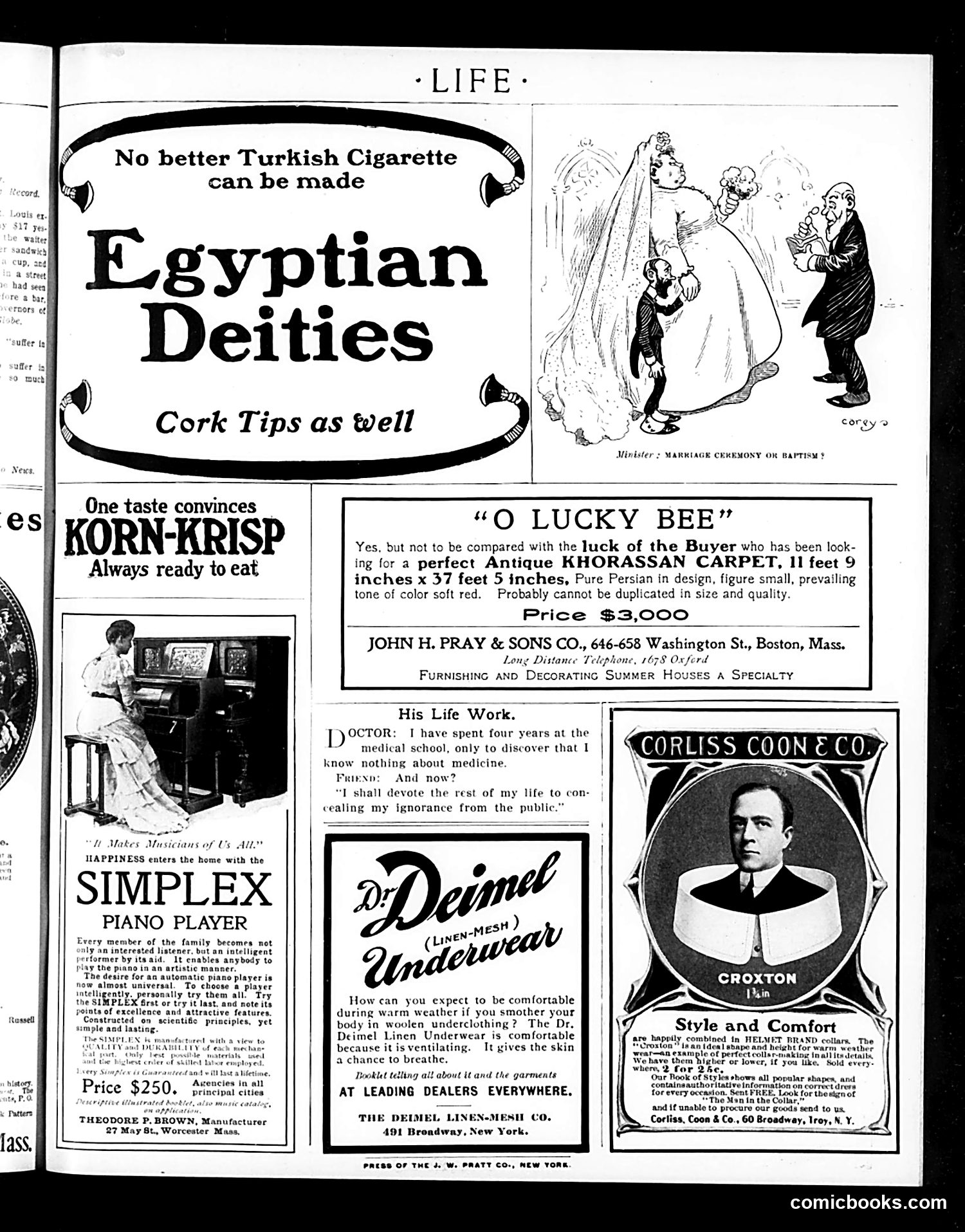
This page is primarily **advertising**, not political satire. The main cartoon—captioned "Minister: Marriage Ceremony or Baptism?"—is a small sketch showing a clergyman unable to distinguish between the two ceremonies, suggesting clergy incompetence or absent-mindedness. It's a mild joke about professional negligence. The bulk of the page consists of period product advertisements (Egyptian Deities cigarettes, Korn-Krisp cereal, Simplex piano player, Dr. Deimel underwear, etc.) interspersed with the "His Life Work" vignette—a cynical joke where a doctor admits spending four years learning he knows nothing about medicine, then devotes his life to hiding his ignorance. There are no identifiable political figures or events referenced. The page reflects early 20th-century consumer culture and reflects period attitudes about gender (women as homemakers), class, and technology as domestic novelties. The humor is domestic and commercial rather than satirical.
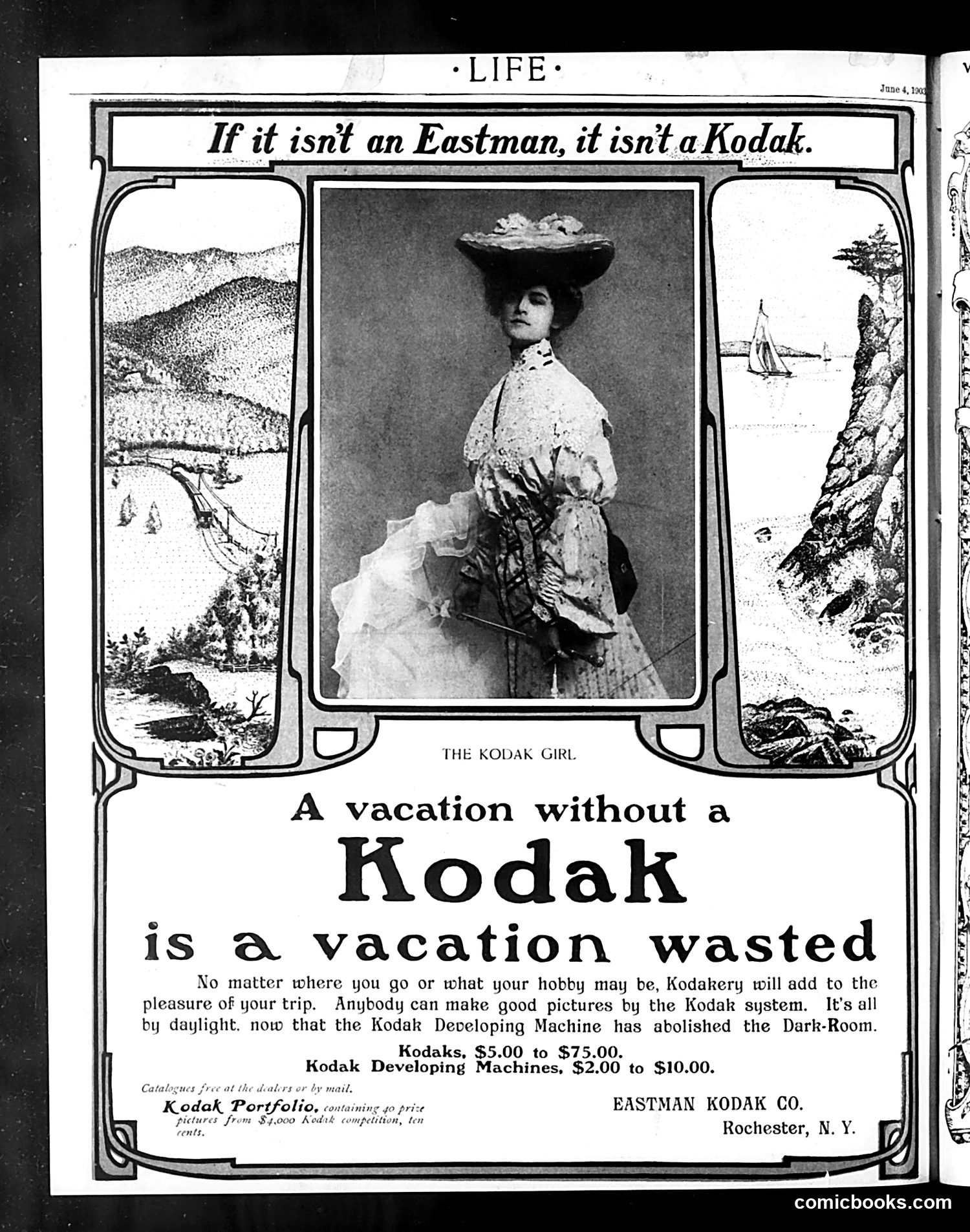
This is a **Kodak camera advertisement**, not political satire. It promotes photography as essential to vacation enjoyment, featuring "The Kodak Girl"—an elegantly dressed woman in early 1900s fashion wearing a large hat. The ad's central claim—"A vacation without a Kodak is a vacation wasted"—uses hyperbole to suggest that documenting trips photographically is now indispensable. The surrounding landscape vignettes (mountains, sailboat, trees) demonstrate Kodak's versatility across different vacation settings. The ad highlights a recent innovation: Kodak's new "Developing Machine" that eliminated the need for darkrooms, making photography more accessible to amateur users. Pricing ranges from $5-$75 for cameras, positioning Kodak across consumer segments. The tagline "If it isn't an Eastman, it isn't a Kodak" emphasizes brand dominance—Eastman Kodak effectively *owned* the camera market at this time.