
Life, 1903-06-04 · page 17 of 36
Life — June 4, 1903 — page 17: what you’re looking at
What you’re looking at
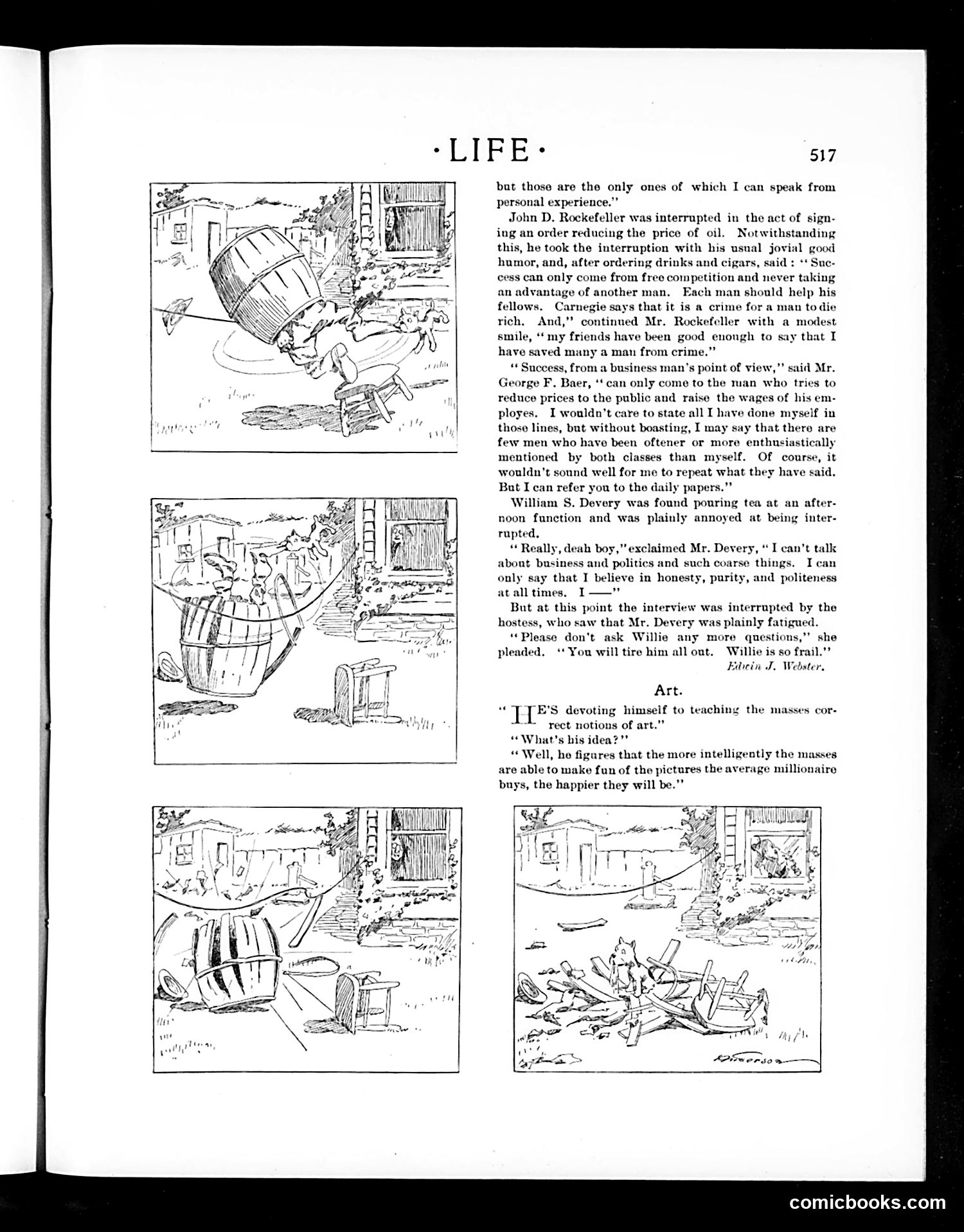
This page satirizes wealthy industrialists and their self-serving rhetoric about business ethics and philanthropy. The text features interviews with **John D. Rockefeller** (oil magnate), **George F. Baer** (coal executive), and **William S. Devery** (appears to be a political figure), each claiming credit for helping workers and the public while reducing prices—yet each reveals transparent self-aggrandizement and hypocrisy. The humor lies in their contradictory statements: they claim altruism while bragging about their prominence in newspapers, and they're portrayed as fragile or easily fatigued when questioned. The final section about "Art" mocks wealthy art collectors, suggesting an intellectual teaches masses to mock millionaires' poor taste in paintings—a dig at both pretentious collecting and class divisions. The four cartoon panels (appearing to show industrial scenes with barrels and machinery) likely illustrate the industrial/business context of these figures' claims.
📄 Transcribed text from this page (OCR, searchable)
Machine-transcribed from the original scan — historical spelling and the odd misread are preserved.
op ok 517 but those are the only ones of which I can speak from personal experience.” John D. Rockefeller was interrupted in the act of sign- ing an order reducing the price of oil. Notwithstanding this, he took the interruption with his usual jovial good humor, and, after ordering drinks and cigars, said : cess can only come from free competition and never tal an advantage of another man. Each man should help his fellows. Carnegie says that it is a crime for a man todie rich, And,” continued Mr. Rockefeller with a modest smile, ‘‘ my friends have been good enongh to say that I have saved many a man from crime.” “« Success, from a business man’s point of view,” said Mr. George F, Baer, ‘can only come to the man who tries to reduce prices to the public and raise the wages of his em- ployes. I wonldn’t care to state all I have done myself in those lines, but without boasting, I may say that there are few men who have been oftener or more enthusiastically mentioned by both classes than myself. Of course, it wouldn’t sound well for me to repeat what they hav id. But I can refer you to the daily papers.” [f WIAs { William S. Devery was found pouring tea at an after- Lisi noon function and was plainly annoyed at being inter- ye Hy rupted, i “ Really, deah boy,” exclaimed Mr. Devery, “I can’t talk ie about bi ess and politics and such coarse things. I can only that I believe in honesty, purity, and politeness atalltimes, I——” But at this point the interview was interrupted by the hostess, who saw that Mr. Devery was plainly fatigued. “Please don't ask Willie any more questions,” she pleaded, ‘* You will tire him all out. Willie is so frail.’” Edicin J. Webster, Art. * a Les devoting himself to teaching the masses cor- ~~ rect notions of art.”” “What's his idea?’” “Well, he figures that the more intelligently the masses are able to make fun of the pictures the average millionaire buys, the happier they will be.”’ ca Ai Hh Person ——| comicbooks.com