
A complete issue · 36 pages · 1903
Life — May 7, 1903
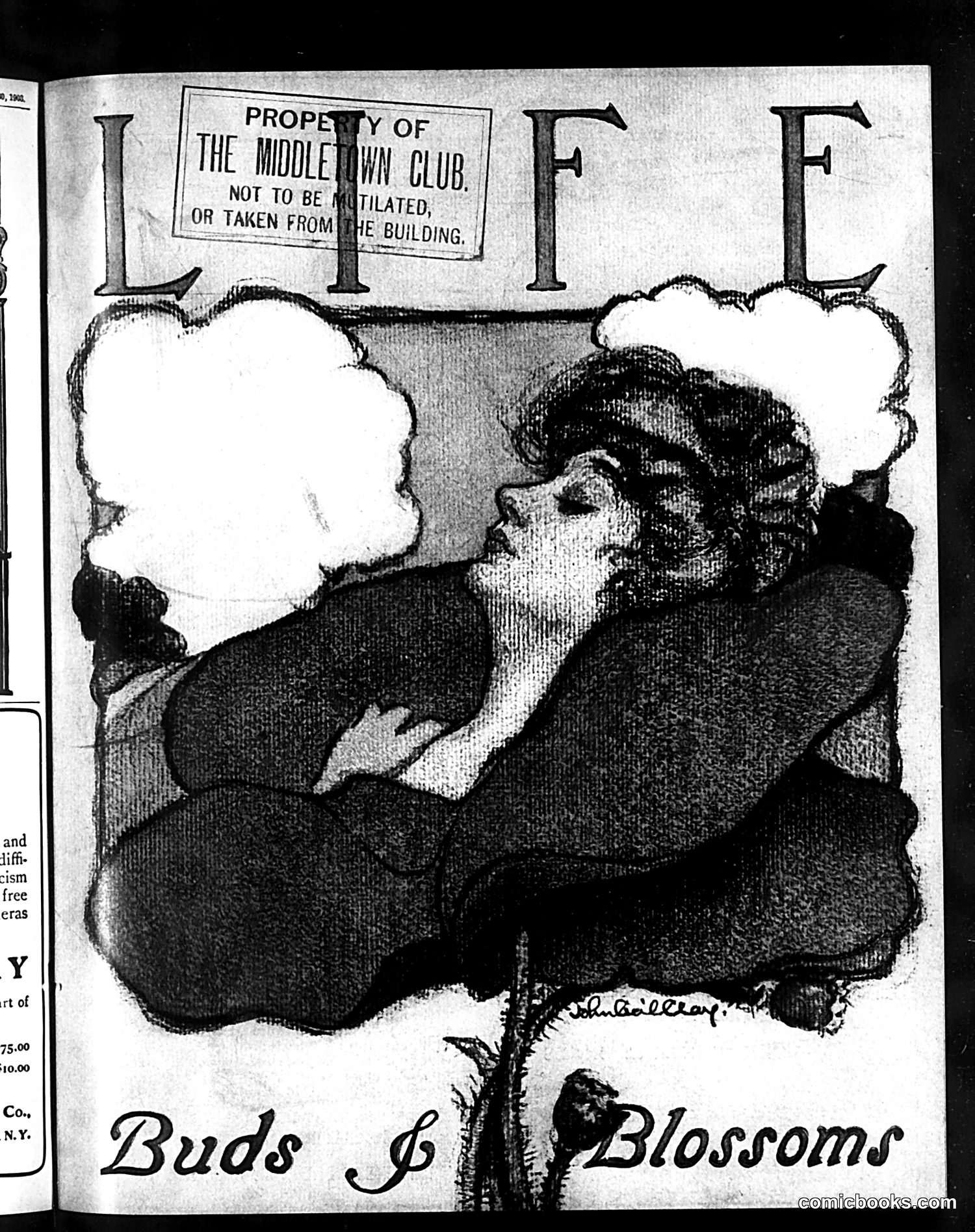
This is a cover for *Life* magazine featuring a satirical illustration titled "Buds & Blossoms." The image shows two figures in profile facing each other, with large cloud-like speech bubbles above their heads—appearing empty or blank. The stamp at top reads "Property of The Middletown Club" with a warning against removal, suggesting this particular copy belonged to a club library. Without additional context (date, byline, or caption text), I cannot definitively identify who these figures represent or what specific political or social situation the cartoon satirizes. The blank speech bubbles suggest commentary on silence, miscommunication, or empty rhetoric, but the exact target of this satire remains unclear from the image alone. The artist's signature appears in the lower right corner.
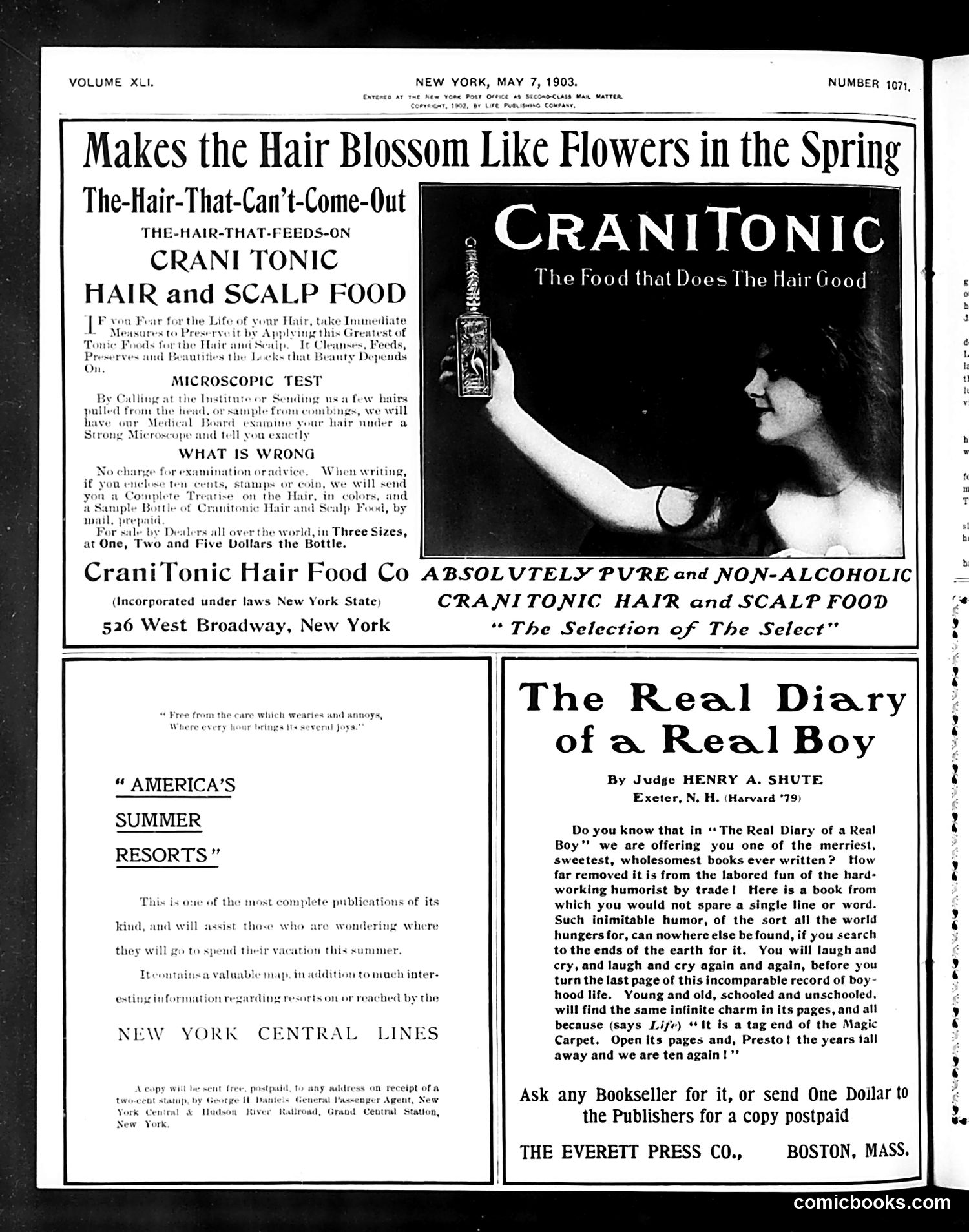
This page is **primarily advertising**, not satirical content. It contains three distinct ads from May 7, 1903: 1. **CraniTonic Hair and Scalp Food** - A patent medicine ad promising to prevent hair loss through a "hair food" product. The copy references a "microscopic test" and includes testimonial language typical of early 1900s medical advertising. Such products were common then, often making exaggerated health claims. 2. **"America's Summer Resorts"** - A travel guide advertisement from New York Central Lines railroad, promoting vacation destinations. 3. **"The Real Diary of a Real Boy"** - A book advertisement from the Everett Press, marketing a humorous children's book by Judge Henry A. Shute. No political satire or caricatures are present on this page.
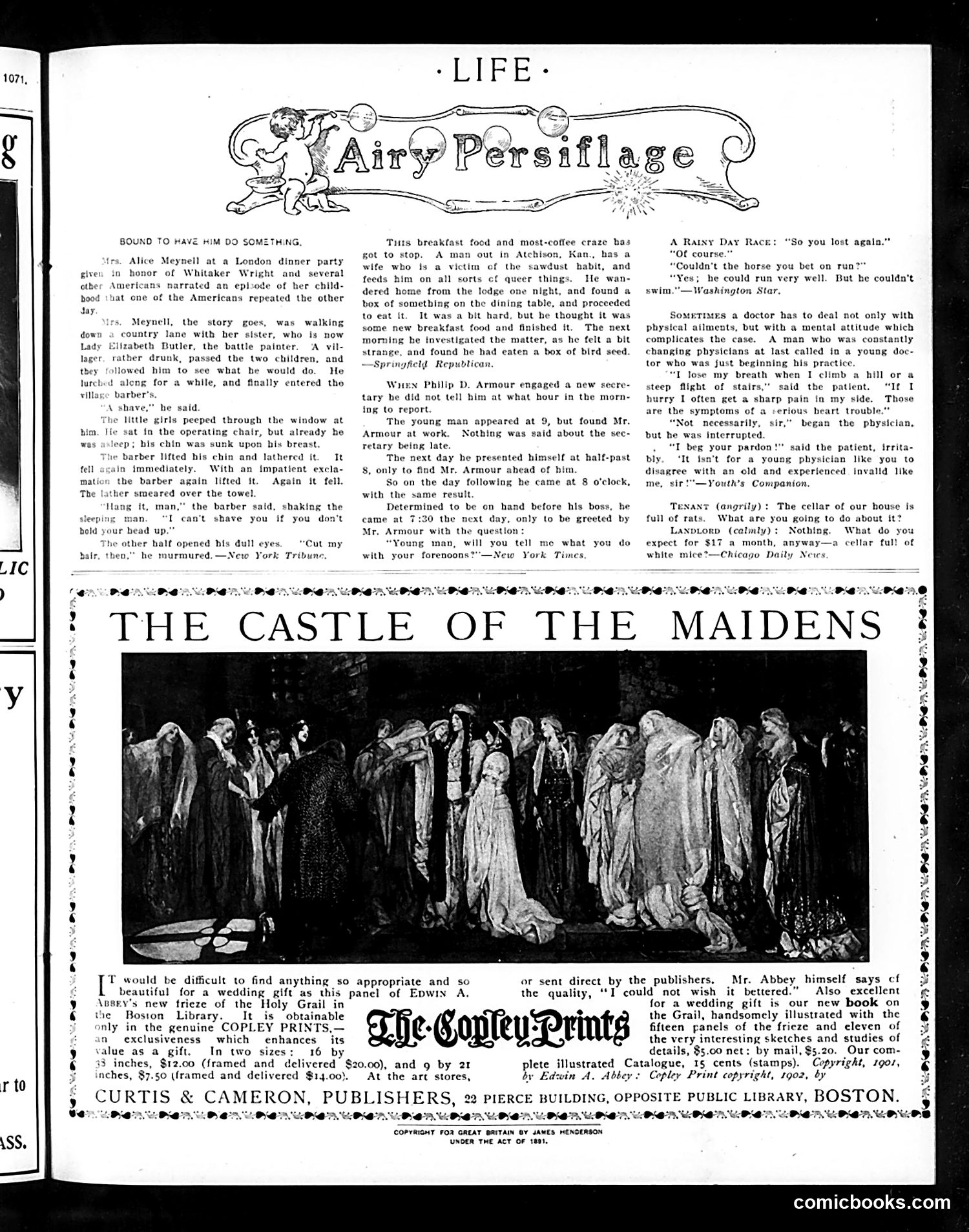
This page contains two distinct sections: **"Airy Persiflage" (top):** A humor column featuring anecdotes about upper-class social situations. One story recounts a London dinner party where an American guest told stories about Native Americans, while another describes a barber's misadventure with a customer who fell asleep mid-haircut. These are light, domestic comedies with no clear political content. **"The Castle of the Maidens" (bottom):** An advertisement for an illustrated book by Edwin A. Abbey, featuring a medieval scene with robed figures. The ad emphasizes the book's quality production and artistic merit, marketed to wealthy collectors willing to pay premium prices ($7.50-$21 depending on binding). Neither section contains political satire or recognizable caricatures—this page is primarily humor and advertising rather than political commentary.
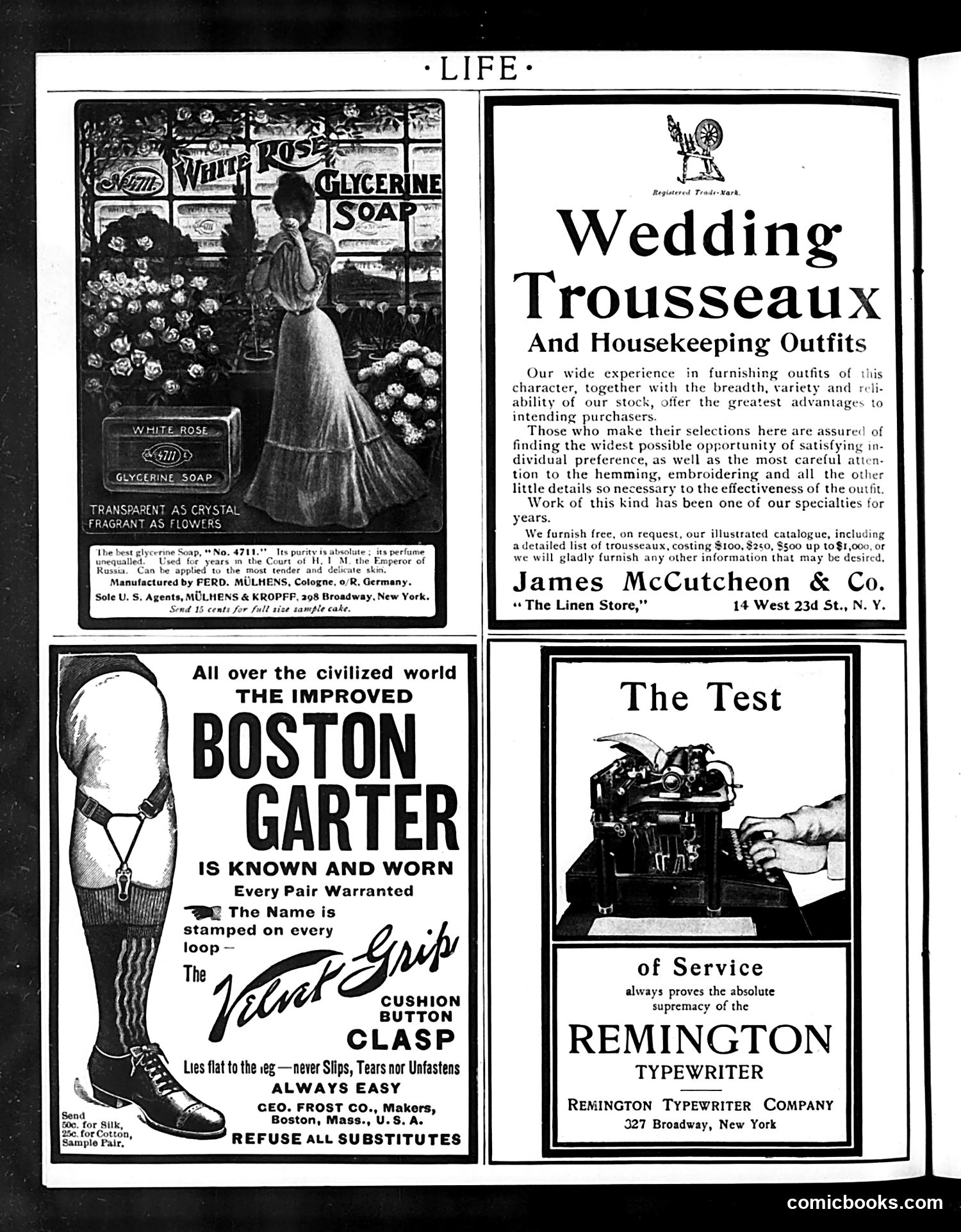
This page is primarily **advertising, not satire or political commentary**. It contains four vintage advertisements from what appears to be an early 20th-century magazine: 1. **White Rose Glycerine Soap** — promotes a product as "transparent as crystal, fragrant as flowers" 2. **James McCutcheon & Co.** — advertises wedding trousseaus and housekeeping outfits from their "Linen Store" 3. **Boston Garter** — markets a garter with a "Velvet Grip Cushion Button Clasp" that "lies flat to the leg" 4. **Remington Typewriter** — showcases reliability with "The Test of Service" There is no political or social satire here. The page simply represents typical commercial advertisements targeting early 1900s consumers, reflecting period concerns about personal hygiene, wedding preparation, proper undergarments, and modern office equipment.
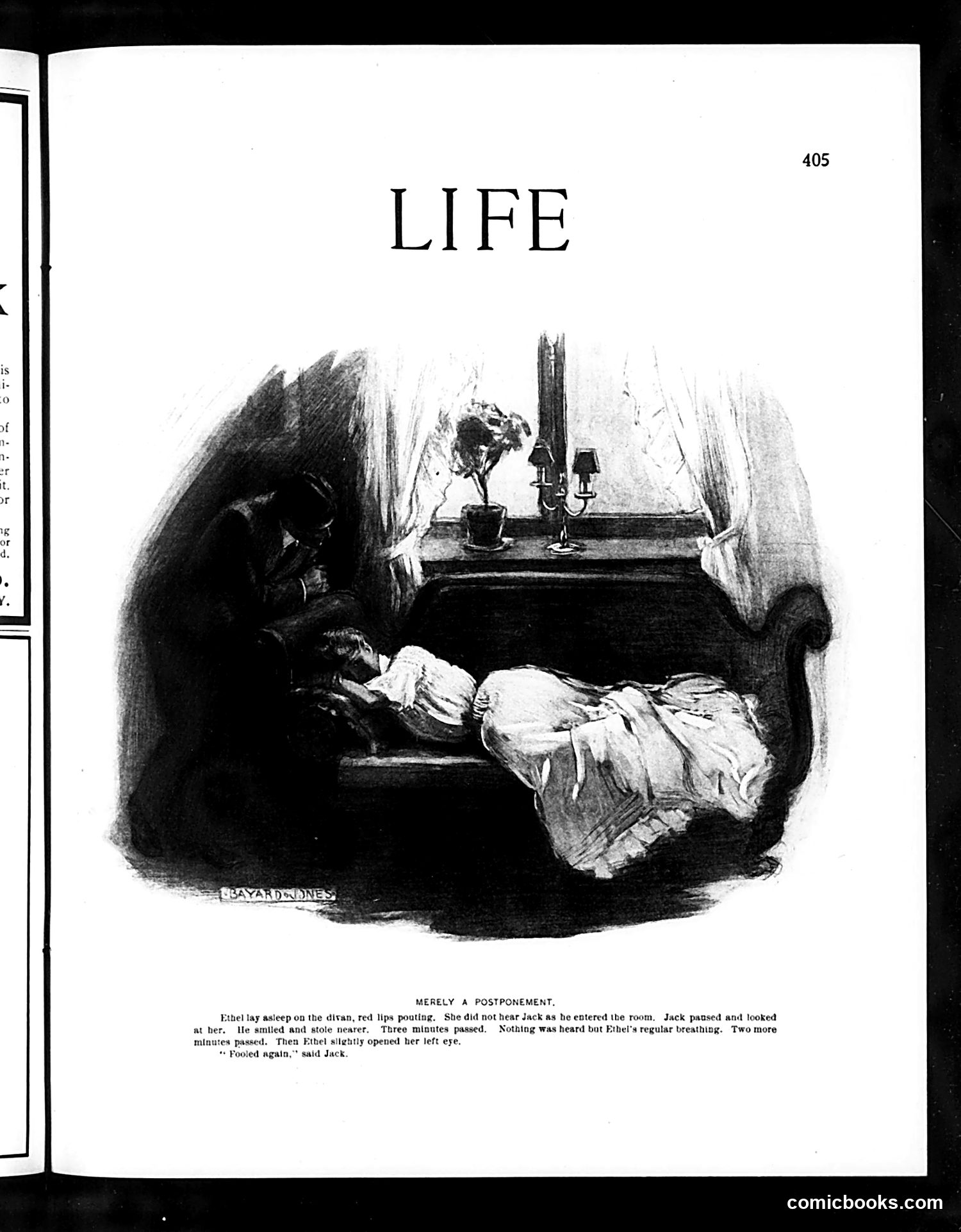
This illustration depicts a domestic scene where a woman (Ethel) lies asleep on a divan while a man (Jack) enters the room. The caption indicates Jack has returned after being away, finding her sleeping. He observes her briefly, then leaves without waking her. The title "Merely a Postponement" suggests a humorous commentary on marital relations—the joke appears to be that Jack's hoped-for intimate encounter is simply delayed rather than denied, since Ethel is merely sleeping. This reflects early 20th-century satirical humor about marriage, portraying the common domestic scenario where spousal intimacy is perpetually deferred by circumstance (in this case, sleep) rather than actual refusal.
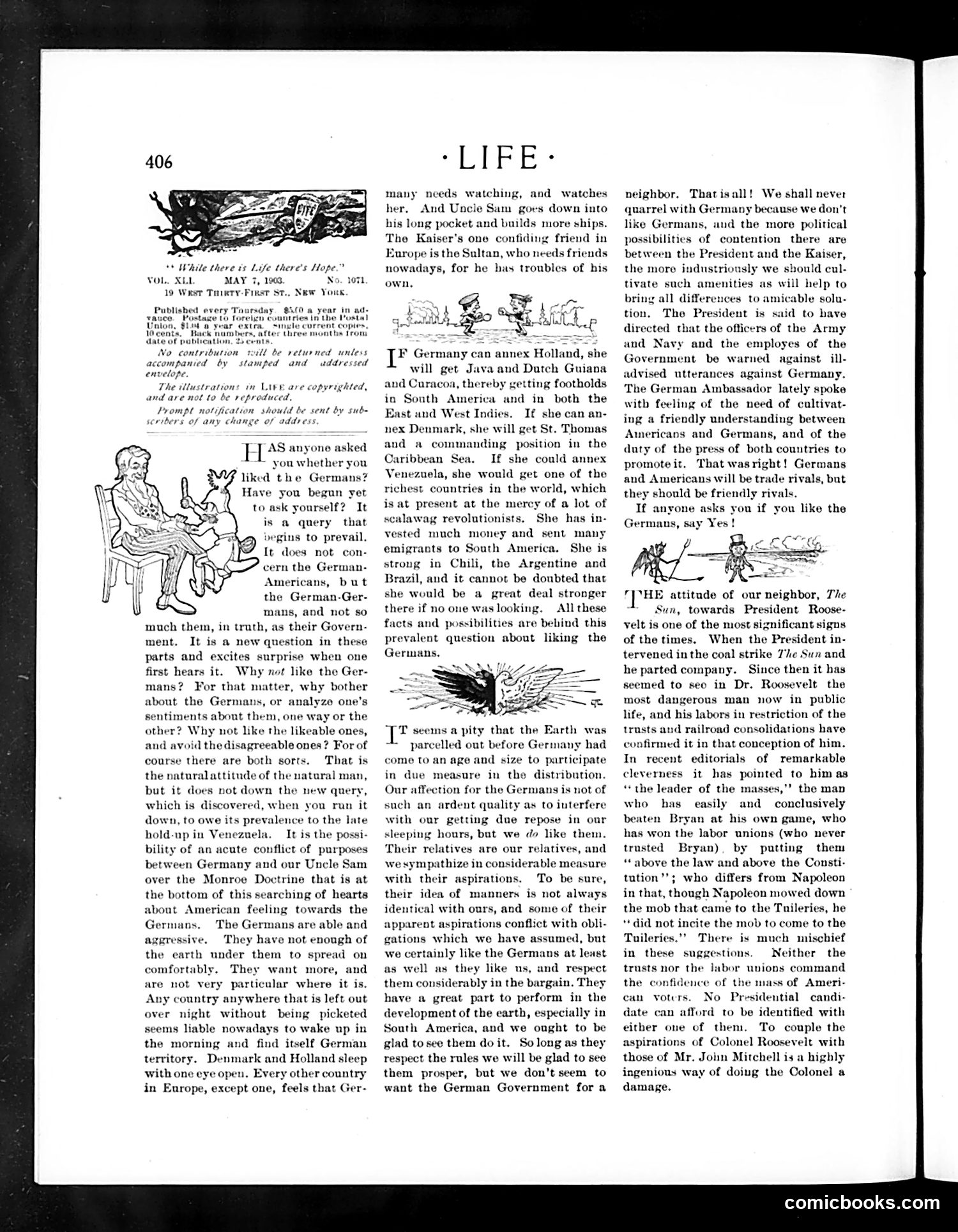
This page presents editorial commentary questioning American sympathy toward Germany. The text challenges the notion that Americans should "like the Germans" by examining Germany's imperial ambitions in South America and the Caribbean—specifically potential annexation of Holland, Denmark, Venezuela, and other territories. The cartoon (upper left) depicts an elderly figure being asked about liking Germans, illustrating the article's central debate. The commentary argues that while Germans and Americans share some values, Germany's expansionist goals threaten American interests. The piece dismisses romantic notions of German-American kinship, emphasizing instead that geopolitical rivalry—not cultural affinity—should determine policy. The final section discusses President Roosevelt's recent intervention in the coal strike and railroad consolidation issues, positioning him as actively managing American industrial concerns.
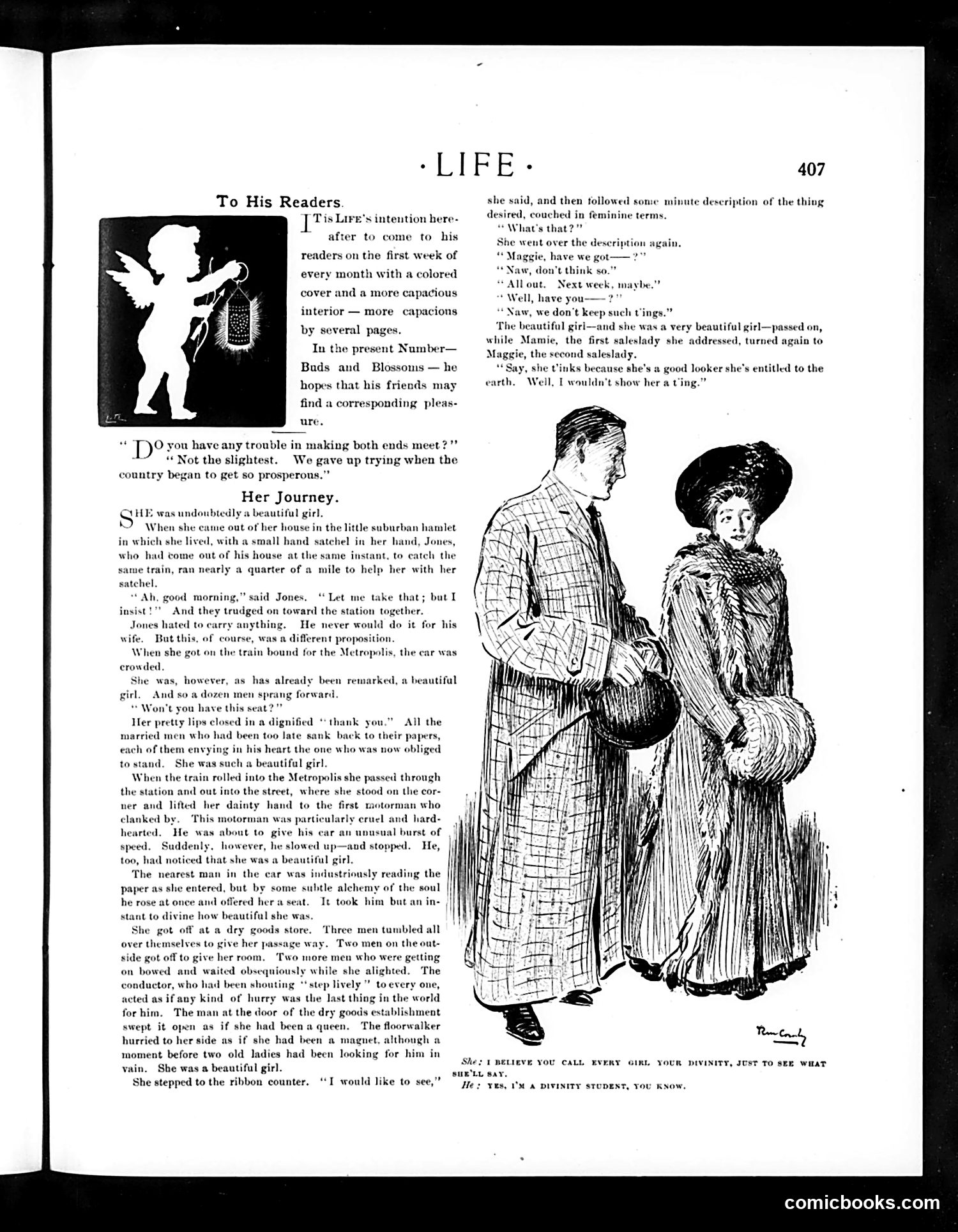
This page contains a short story titled "Her Journey," illustrated with a pen-and-ink drawing of a man and elegantly dressed woman on a city street. The narrative describes a beautiful young woman traveling from a small suburban town to the city, where she experiences various encounters—men offering her seats, a rude motorman, curious onlookers at a dry goods store. The story appears to satirize the *commodification of female beauty* in urban settings: the woman is repeatedly noticed and commented upon solely for her appearance, with strangers assuming she's available or requiring assistance. The accompanying illustration and caption suggest this is social commentary on how women, particularly those new to cities, were objectified and treated as curiosities in early 20th-century urban environments. The narrative's tone is gently ironic about this dynamic.
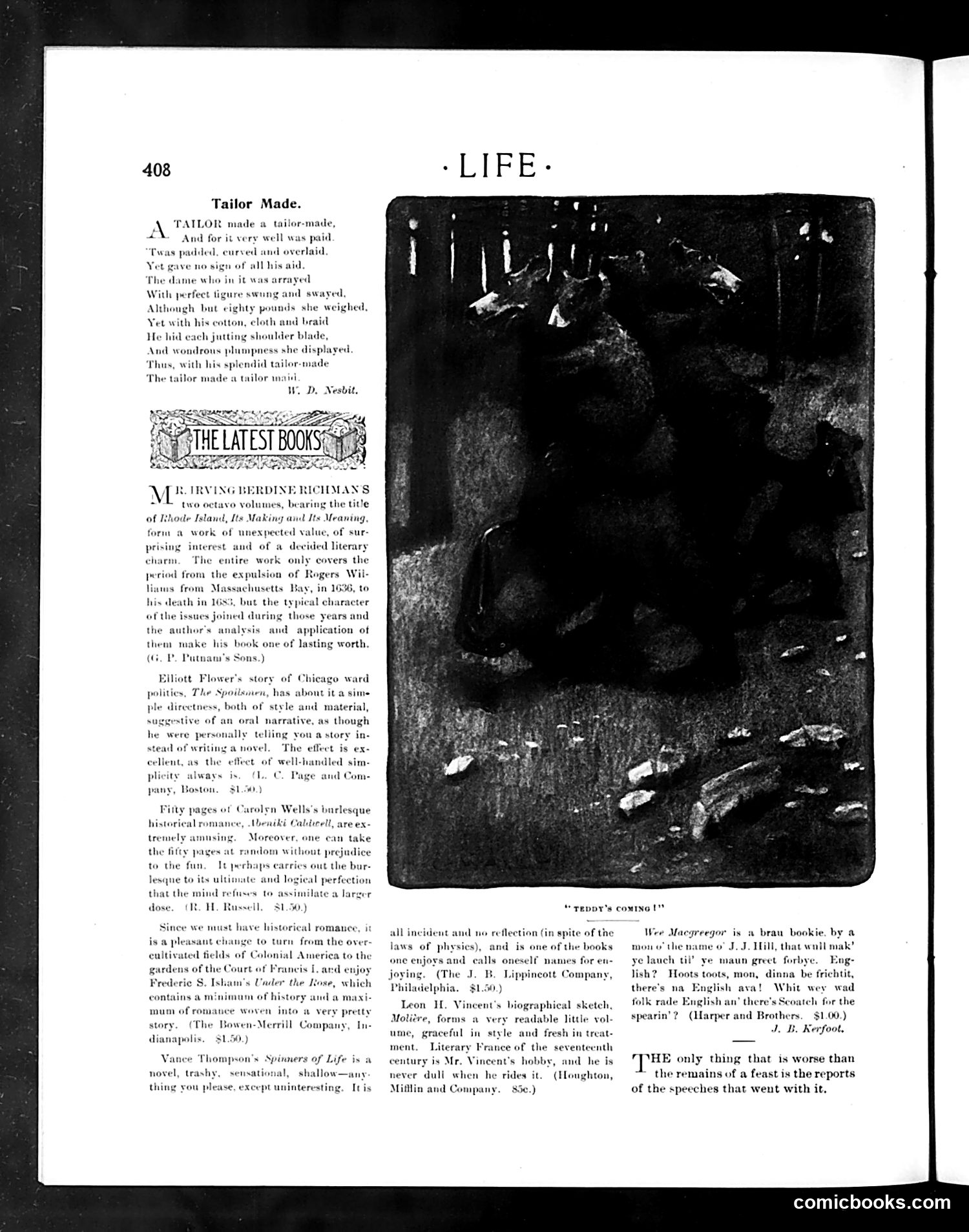
This page from *Life* magazine contains a poem titled "Tailor Made" by W. D. Nesbit, book reviews, and one political illustration captioned "Teddy's Coming!" The cartoon appears to show a group of people in what looks like a dark interior space, reacting with apparent alarm or concern. The caption "Teddy's Coming!" likely references Theodore Roosevelt, whose return from Africa or political activities would have generated public reaction. Without clearer visibility of specific figures or dates on this page, the exact historical moment remains unclear, but the dramatic staging suggests anxiety about Roosevelt's imminent arrival or involvement in some political matter—possibly related to his presidency or post-presidential influence during the early 20th century.
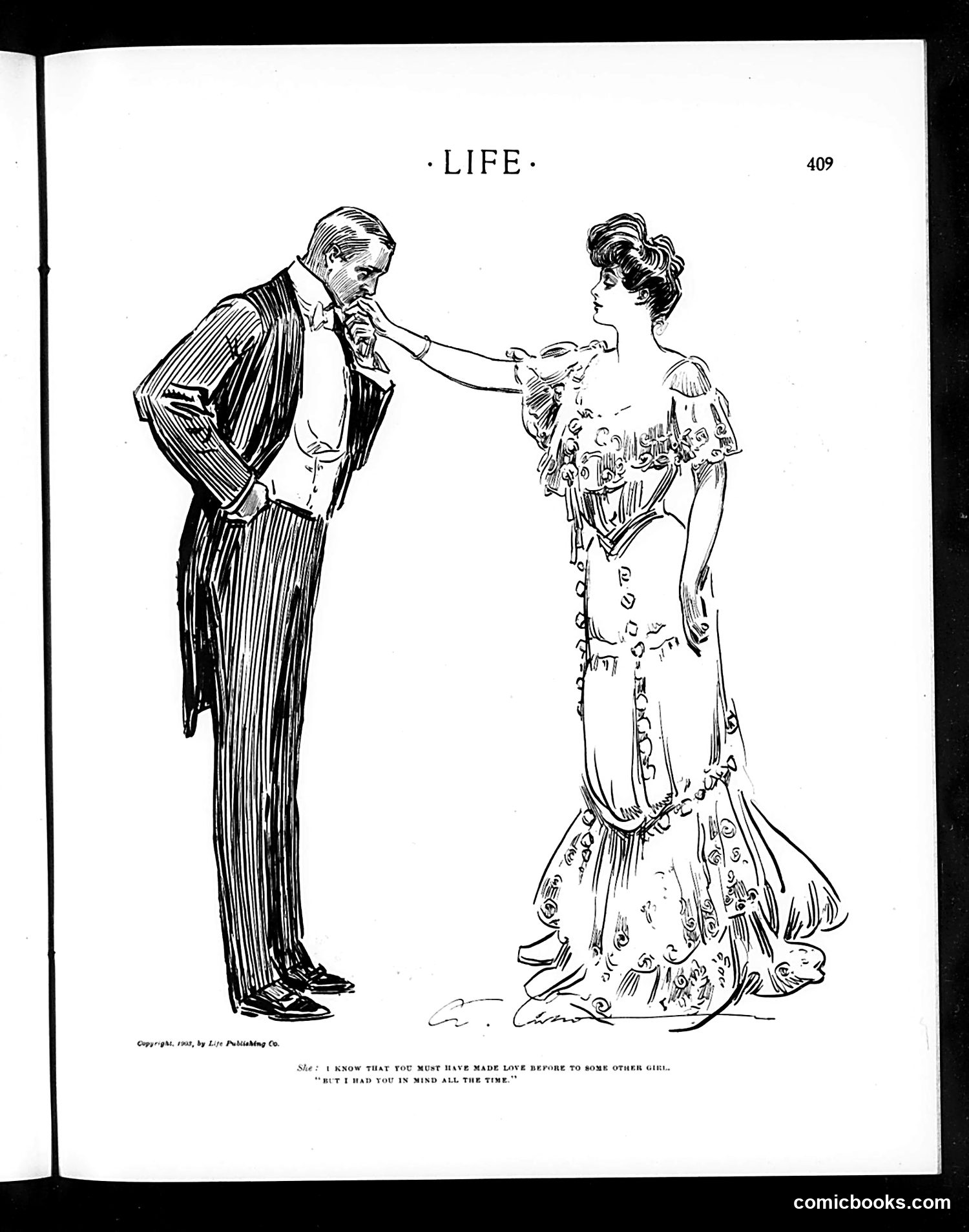
This is a single-panel cartoon from *Life* magazine (page 409) depicting an elegant couple in formal Edwardian dress. The man, in evening wear, appears uncomfortable or contemplative while the woman in an ornate gown addresses him. The caption reads: "I KNOW THAT YOU MUST HAVE MADE LOVE BEFORE TO SOME OTHER GIRL. BUT I HAD YOU IN MIND ALL THE TIME." This is a satirical commentary on courtship and romantic relationships of the era. The joke centers on female possessiveness and the double standard regarding a man's romantic history—she acknowledges his past liaisons but claims emotional precedence regardless. The cartoon gently mocks both masculine anxiety about a woman's expectations and feminine claims of special significance. It reflects early 20th-century social attitudes about romance, jealousy, and gender dynamics in upper-class courtship.
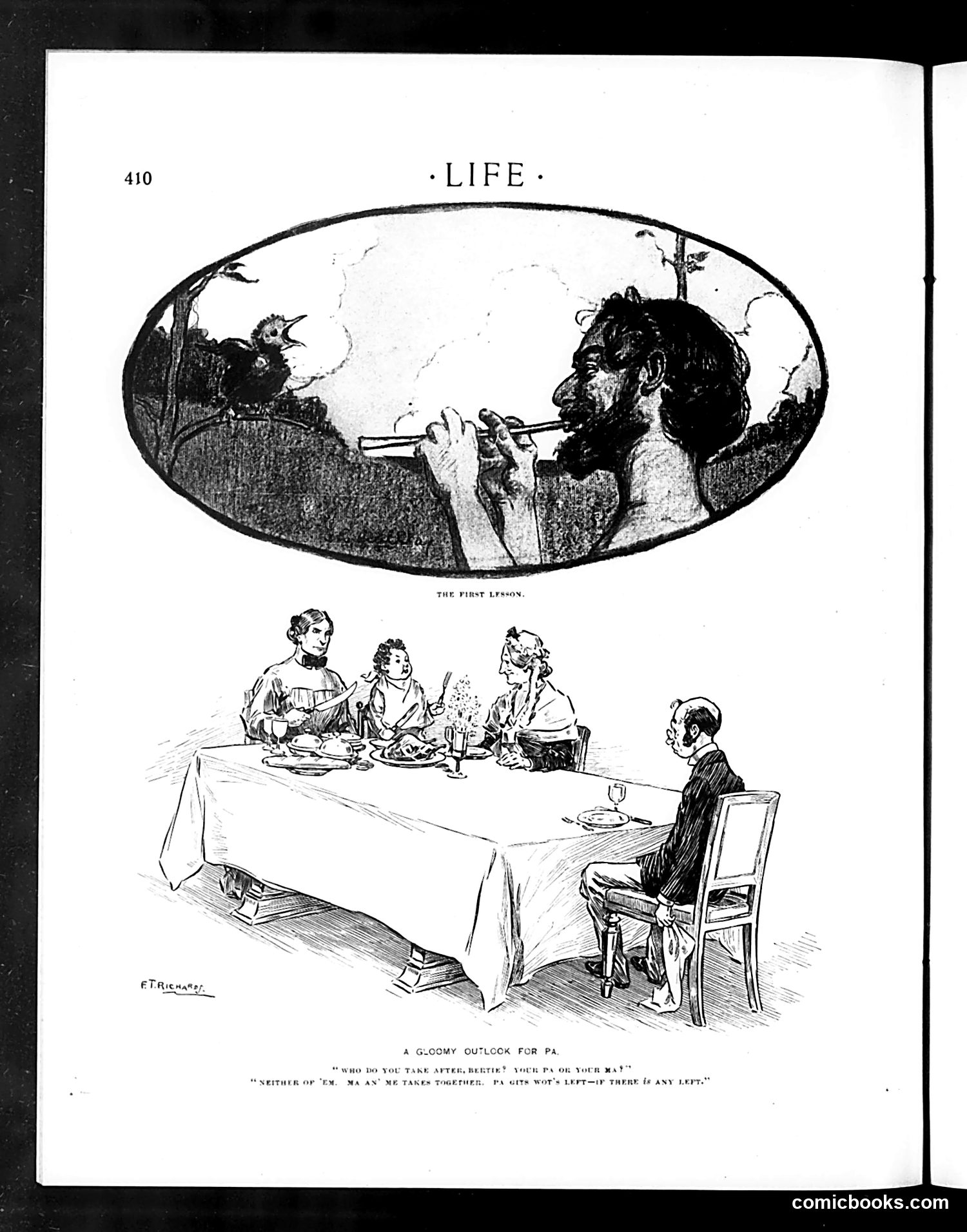
This page from *Life* magazine contains two satirical drawings about Pennsylvania politics. **Top illustration** ("The First Lesson"): A caricatured figure with exaggerated features plays a flute or pipe while children listen. This appears to be a metaphorical "lesson" in manipulation or leadership. **Bottom illustration** ("A Gloomy Outlook for Pa"): Four figures dine together while a fifth sits alone at the table's end. The caption reads: "Who do you take after, Bertie? Your Pa or your Ma?" with the response "Neither of 'em. Ma an' we takes together. Pa cuts what's left—if there is any left." This satirizes Pennsylvania's political or economic situation, suggesting resources are being consumed by multiple parties, leaving little for others. The "gloomy outlook" references financial hardship or mismanagement affecting the state.
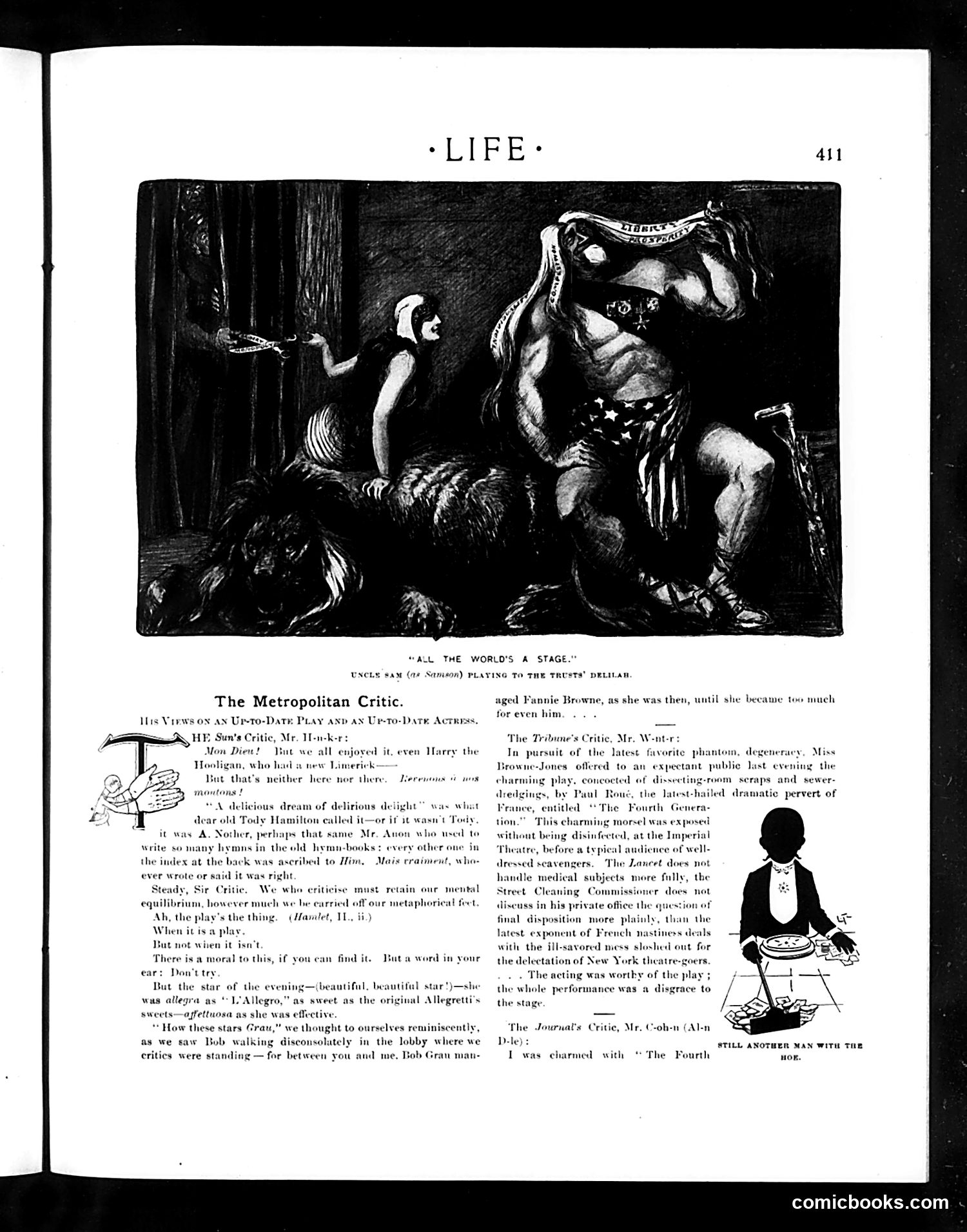
This page contains theatrical criticism from multiple reviewers (The Metropolitan Critic, The Tribune's Critic, and The Journal's Critic) discussing recent Broadway productions, including a play called "The Fourth Generation" and performances by actress Fannie Browne-Jones. The main illustration depicts a scene from Shakespeare's "As You Like It," captioned "All the world's a stage," showing Uncle Sam (identifiable by his characteristic appearance) performing to an audience. This visual metaphor connects the theatrical reviews to broader American political/social commentary, suggesting that public life itself is performative. The small cartoon on the right shows a figure dining alone, captioned "Still another man with the hoe"—likely referencing rural labor or economic hardship. The page blends entertainment criticism with social satire typical of Life's satirical approach.
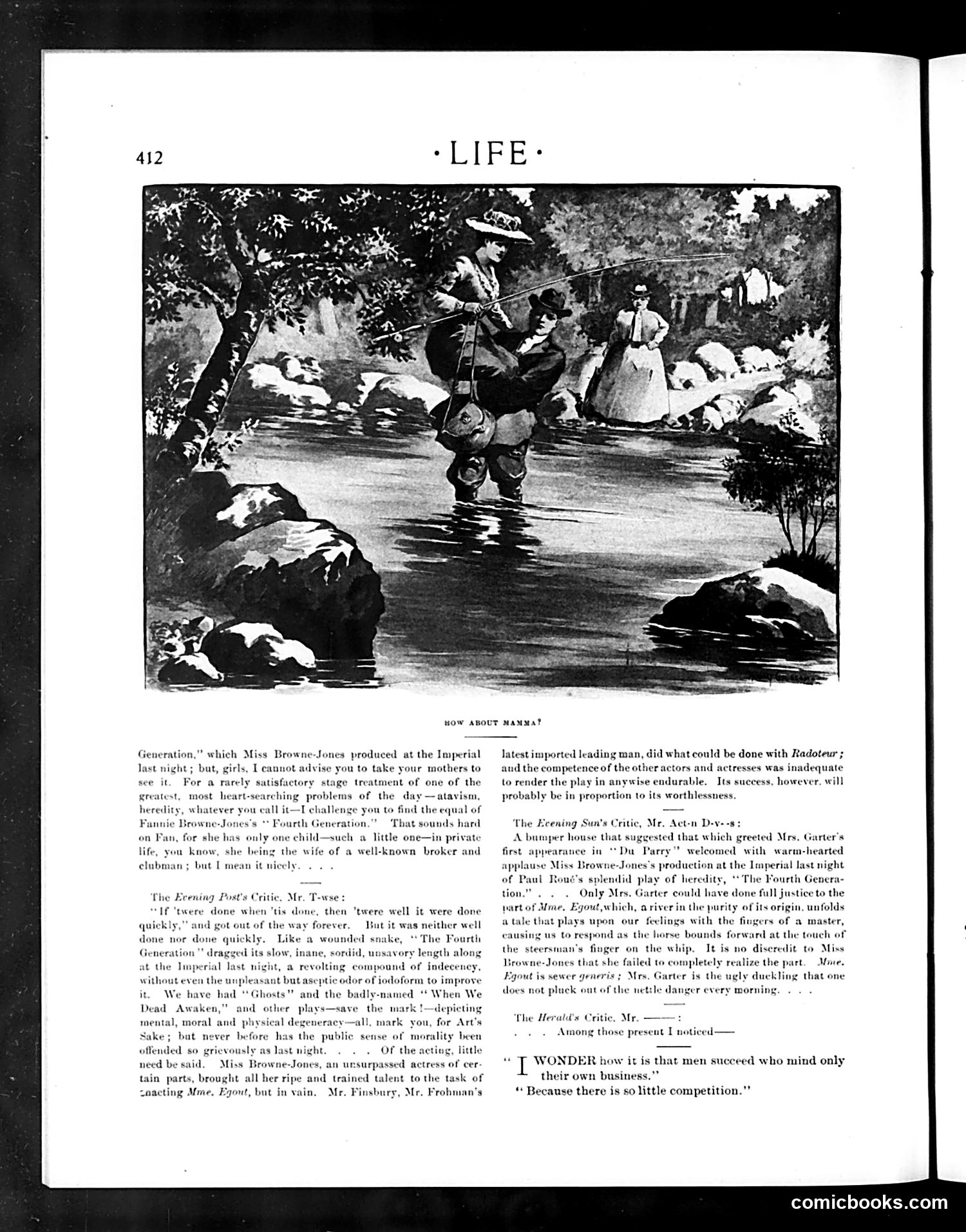
This page features theatrical reviews of Miss Browne-Jones's performance in "The Fourth Generation." The illustration depicts a fishing scene—likely a metaphor for the play's content or theme. The critics discuss the actress's performance across multiple productions. One reviewer praises her handling of difficult material, while another criticizes the play itself as "dragged its slow, inane, sordid, unworthy length" with "revolting compound of indecency." The reviews suggest tension between respecting the actress's talent and condemning the play's moral content. One critic notes Miss Browne-Jones brought "ripe and trained talent" to an "unpleasing" work. The final joke about men succeeding in business due to "little competition" appears unrelated to the theatrical reviews—likely a separate, standalone gag reflecting broader social satire typical of Life magazine's format.
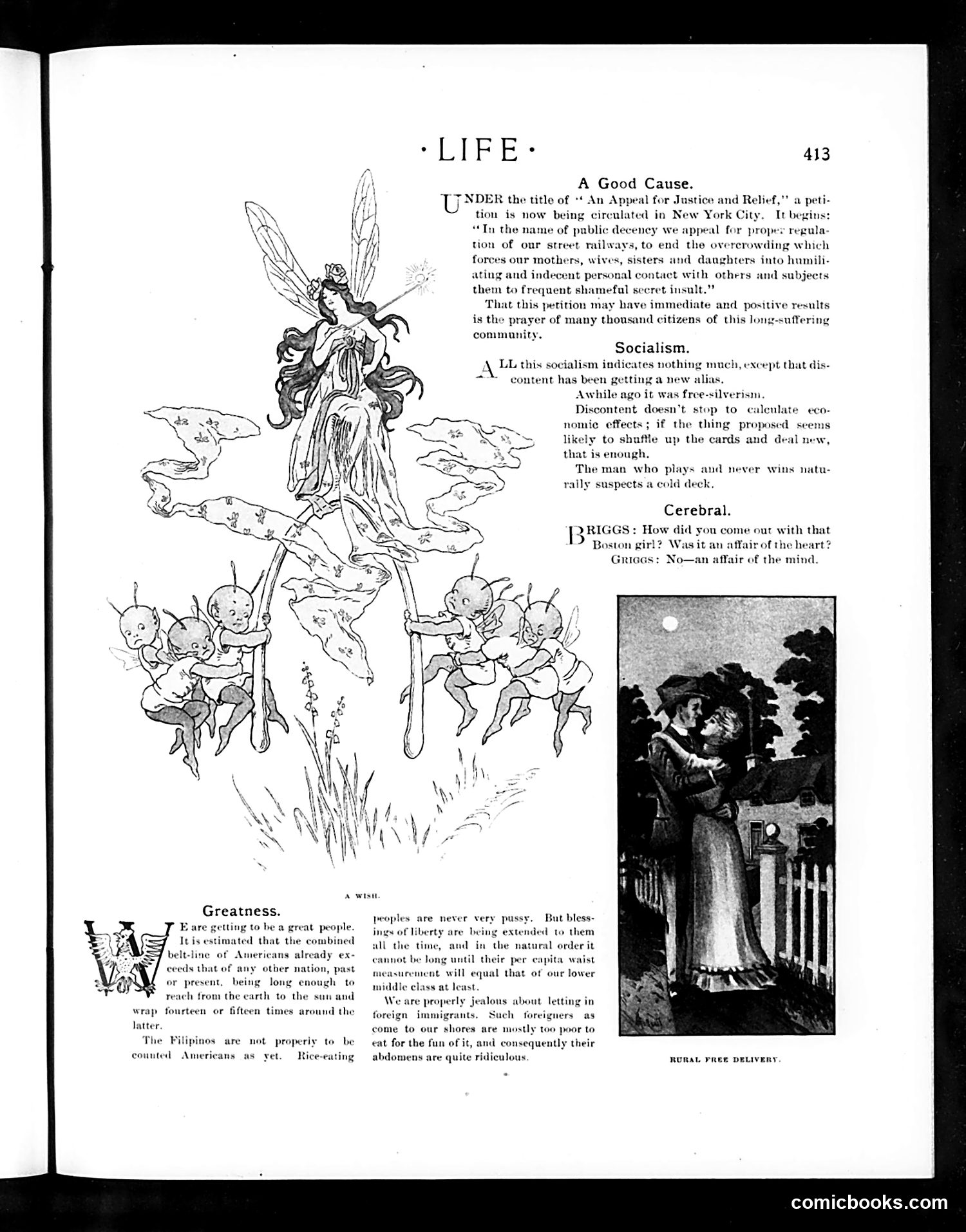
This page contains three distinct satirical pieces: **"A Good Cause"** mocks a petition against overcrowding on New York streetcars, which complained that crowded conditions forced women into "indecent personal contact." The satire suggests the petition is overwrought moral panic about minor discomfort. **"Socialism"** argues that socialism merely channels general discontent without addressing root causes. It compares current socialist agitation to previous populist movements (like free-silverism), suggesting malcontents simply shift causes without reason—like a gambler blaming a "cold deck" rather than examining his own losses. **"Cerebral"** is a brief joke where "Briggs" asks about a Boston romantic interest, and the reply deflects from "heart" to "mind," suggesting Boston intellectuals approach romance cerebral rather than emotionally. **"Greatness"** satirizes American expansionism and waist measurements, mocking attitudes toward Filipino colonization and xenophobia toward poor immigrants. The whimsical fairy illustration at left accompanies the light satirical tone.
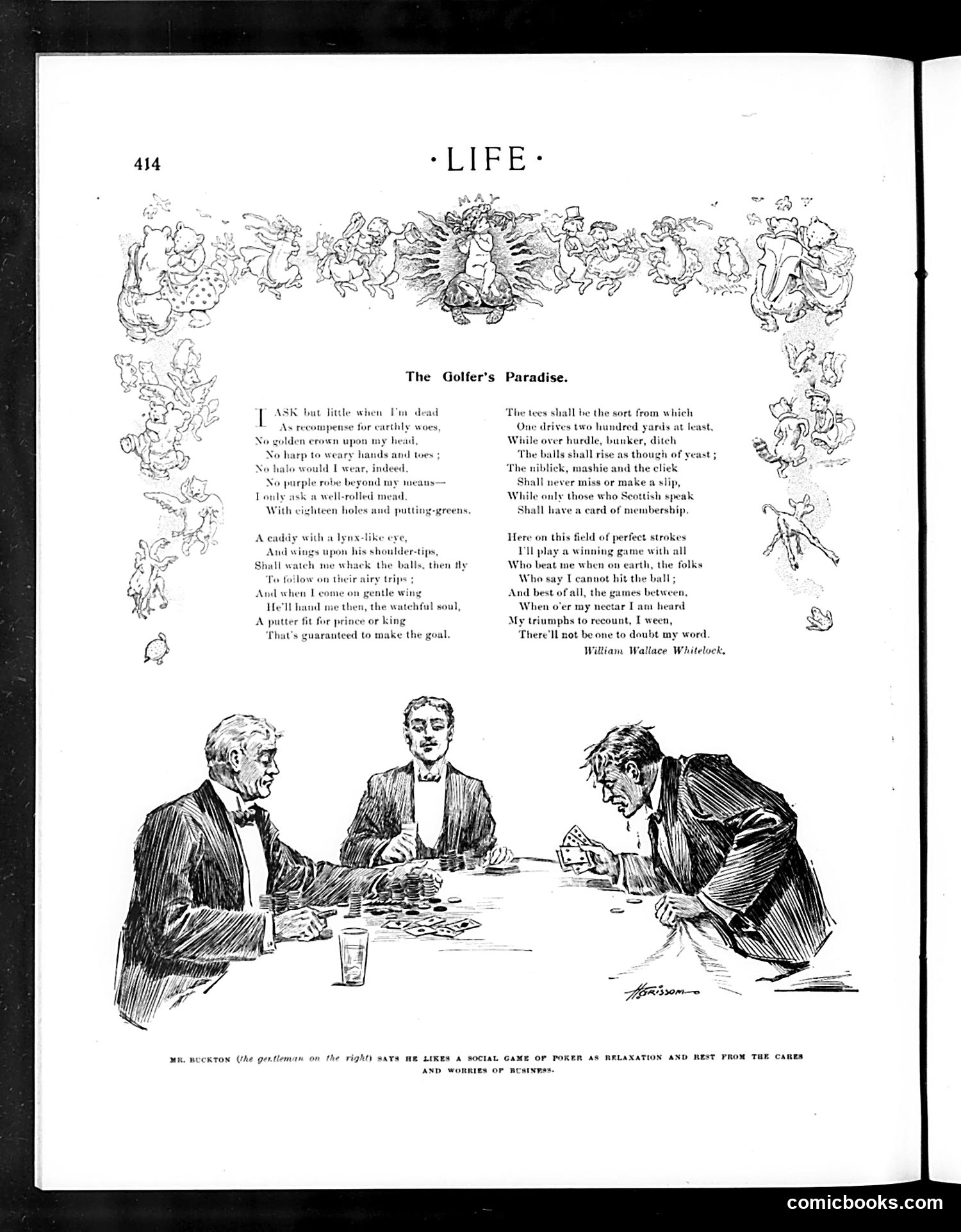
This page presents a humorous poem about golf as a form of leisure, attributed to William Wallace Whitelock. The verse depicts an idealized afterlife where the speaker enjoys perfect golfing conditions—balls that rise "as though of yeast," tees that drive 200 yards, and never-missing putts. The accompanying illustration shows **Mr. Buckton**, identified as "the gentleman on the right," playing poker with two other men. The caption notes he enjoys poker as "relaxation and rest from the cares and worries of business." The satire contrasts two forms of escape for the wealthy businessman: the poem's fantastical golf paradise versus the more grounded reality of a card game. The joke likely satirizes how businessmen justify leisure activities—either through romantic idealization (golf) or pragmatic indulgence (poker)—as necessary respite from work. The elaborate decorative border of cherubs reinforces the humorous, whimsical tone.
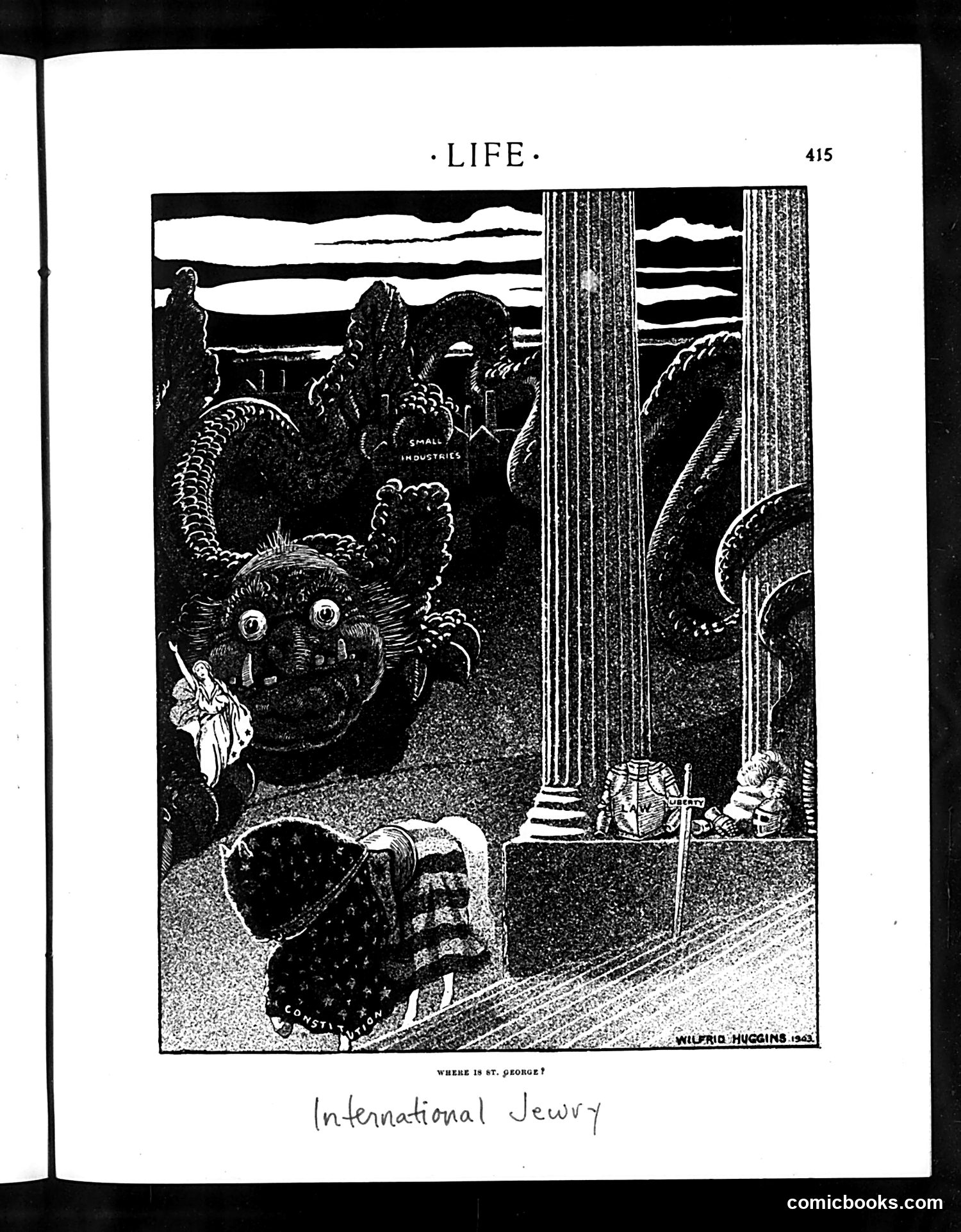
This is a darkly satirical cartoon titled "WHERE IS ST. GEORGE?" by Wilfrid Huggins (1943). It depicts monstrous, demonic industrial machinery and figures looming over a small, vulnerable figure in religious garb (labeled "CONSTITUTION"). The cartoon appears to be wartime propaganda critique, suggesting that unchecked industrial power and militarization ("small industries" visible in the background) have become monstrous forces threatening democratic principles. The reference to St. George—the legendary dragon-slayer—implies the need for a heroic defender against these threats. The handwritten note "International Jewry" at the bottom suggests this was later annotated, possibly to misrepresent the cartoon's actual meaning. The satire critiques industrial overreach and wartime expansion of corporate power during WWII.
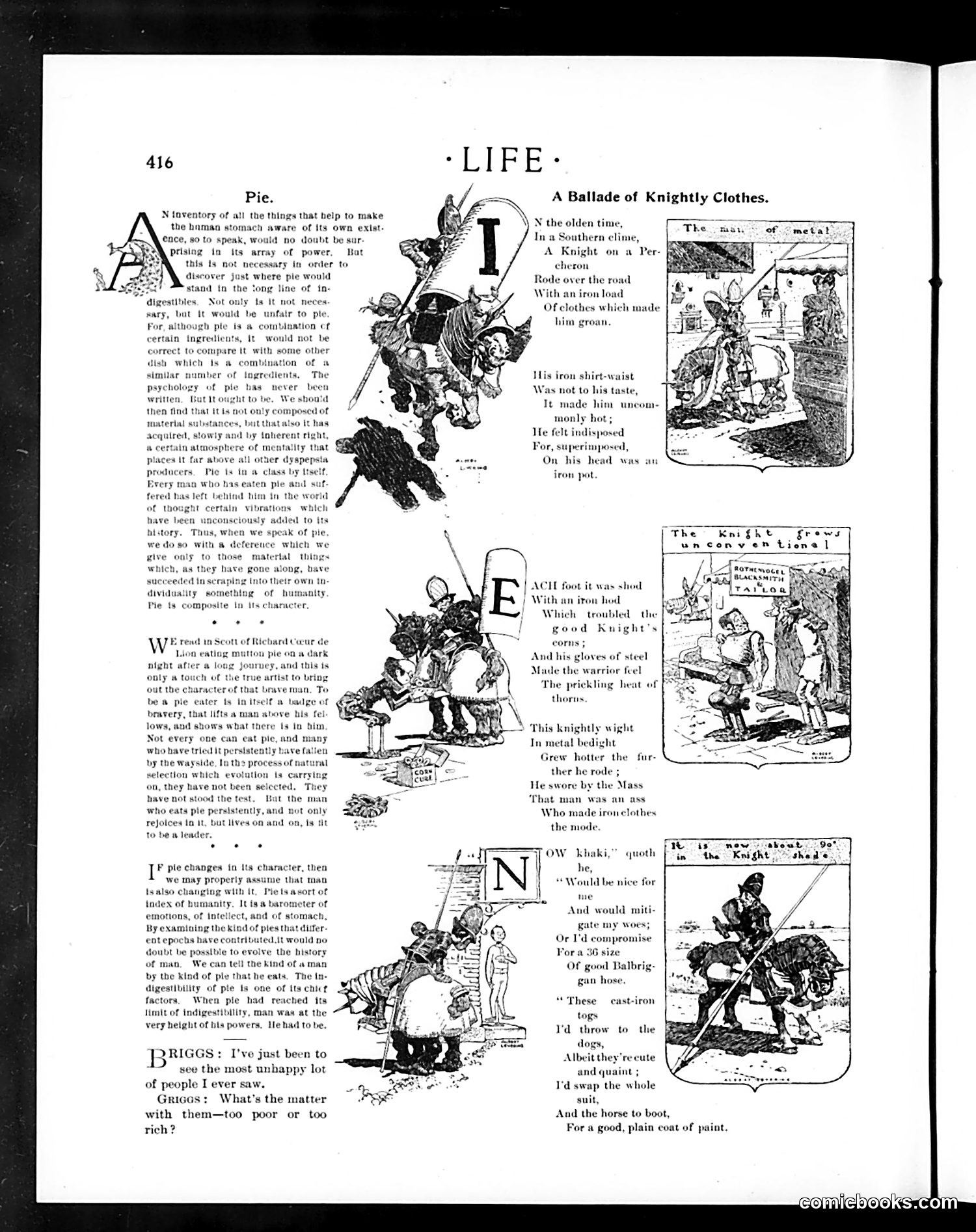
This page contains two distinct pieces of satire: **"Pie"** (left column): A philosophical essay-parody celebrating pie as a marker of human civilization. It humorously argues that pie reveals cultural progress—specifically, that mankind's digestive capacity for indigestible foods indicates his peak power. The joke mocks both pretentious food writing and the notion that hardship (here, eating difficult foods) demonstrates strength. **"A Ballade of Knightly Clothes"** (right): A humorous medieval poem mocking impractical armor. A knight complains that his metal clothing—iron shirt-waist, iron pot helmet, steel gloves—makes him unbearably hot and uncomfortable. He fantasizes about modern "khaki" fabrics and "Balbrigan hose" instead, even willing to trade his armor and horse for "a good, plain coat of paint." The satire appears to contrast medieval discomfort with modern practicality and comfort, likely poking fun at romanticized notions of the past or—less clearly—possibly referencing contemporary military uniform debates.
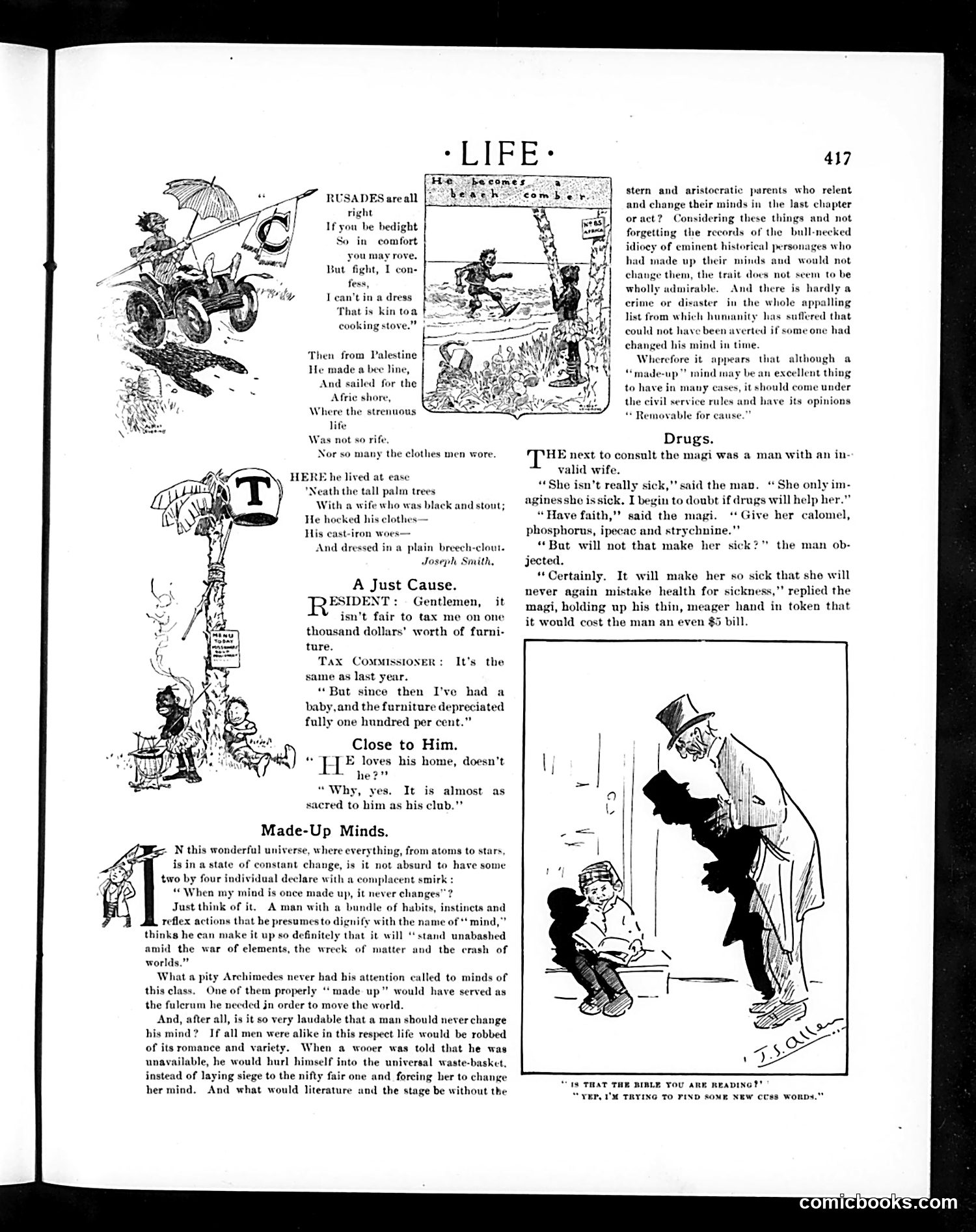
This page contains several satirical pieces typical of Life's social commentary: **"Made-Up Minds"** (main essay) mocks inflexible people who claim their minds "never change." The author argues this rigidity is foolish in a universe of constant change, and that flexibility—even stubbornness in romance—drives literature and human progress. **"A Just Cause"** (dialogue cartoon) satirizes a man complaining about unfair taxation. When the tax commissioner notes the rate hasn't changed, the resident claims depreciation from his baby and furniture. The joke targets petty tax complaints and circular logic. **"Close to Him"** (dialogue) plays on ambiguity: a man loves his home "almost as sacred as his club"—the punch line suggests his actual attachment is questionable. **"Drugs"** (dialogue with illustration) depicts a charlatan "magi" prescribing expensive, contradictory medicines (calomel, phosphorus, ipecac, strychnine) that would worsen the patient's wife's condition while extracting $5. It mocks medical quackery and fake remedies. The lower cartoon shows a child asking about Bible verses; the man seeks "new cuss words"—crude humor about religious hypocrisy.
I can see this is a black and white photograph or illustration from Life magazine, with the word "LIFE:" visible on the left margin. However, the image quality is quite poor—it's very dark and high-contrast, making it difficult to discern specific details, figures, or clear satirical content. The composition appears to show figures in what might be a dramatic or theatrical scene, but I cannot reliably identify who the subjects are, what event is being referenced, or what the intended satirical point might be. Without clearer visibility of the image details or additional text context, I cannot accurately explain the cartoon's meaning to a modern reader. The OCR text only provides the comicbooks.com attribution, offering no further context.

I can see this appears to be a page from Life magazine with "STOLEN SWEETS" printed vertically on the right side. However, the main image area is almost entirely black/dark, making it impossible to discern any cartoon figures, caricatures, or satirical content with confidence. The page appears to be either a printing error, a heavily redacted or damaged scan, or possibly a blank/title page. Without being able to see the actual cartoon or illustration clearly, I cannot identify who is depicted, what political or social references are present, or explain the satirical point. To properly analyze this content, a clearer image would be needed.
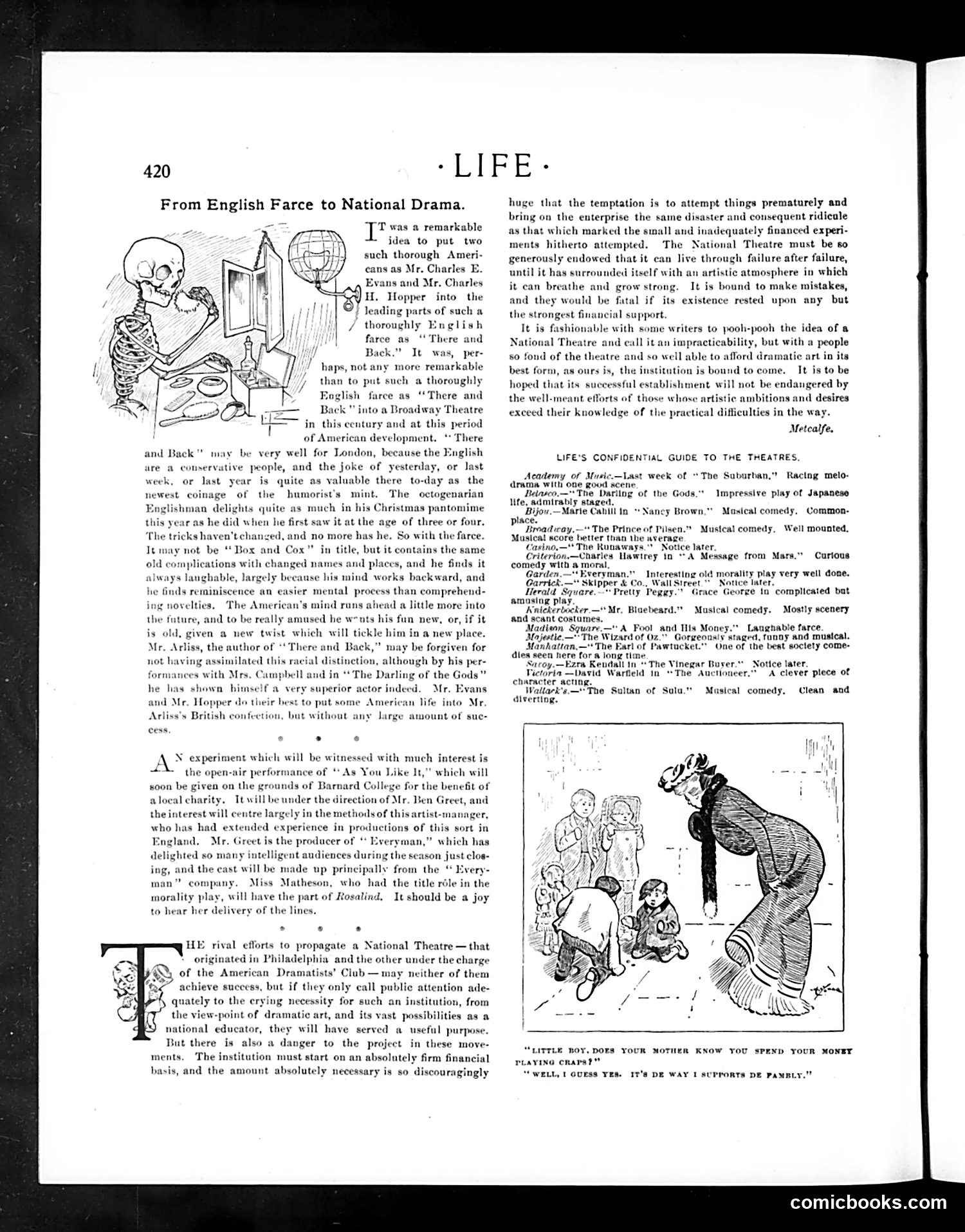
This page discusses American theatre and cultural attitudes circa early 1900s. The main article critiques the casting of American actors (Charles E. Evans and Charles H. Hopper) in the English farce "There and Back," arguing the play suits English audiences who appreciate old jokes, but American audiences demand novelty and "new twists." The cartoon at bottom depicts a boy telling his mother he spent money "playing craps," with her responding she guesses it's acceptable—a joke about mothers' euphemistic acceptance of their sons' gambling. The page also discusses upcoming theatrical experiments: an open-air production of "As You Like It" at Barnard College and efforts to establish a National Theatre in America. The author warns such institutions need secure financial foundations to survive inevitable early failures and develop artistic credibility. The overall theme contrasts American and English theatrical tastes and advocates for serious, well-funded American drama institutions.
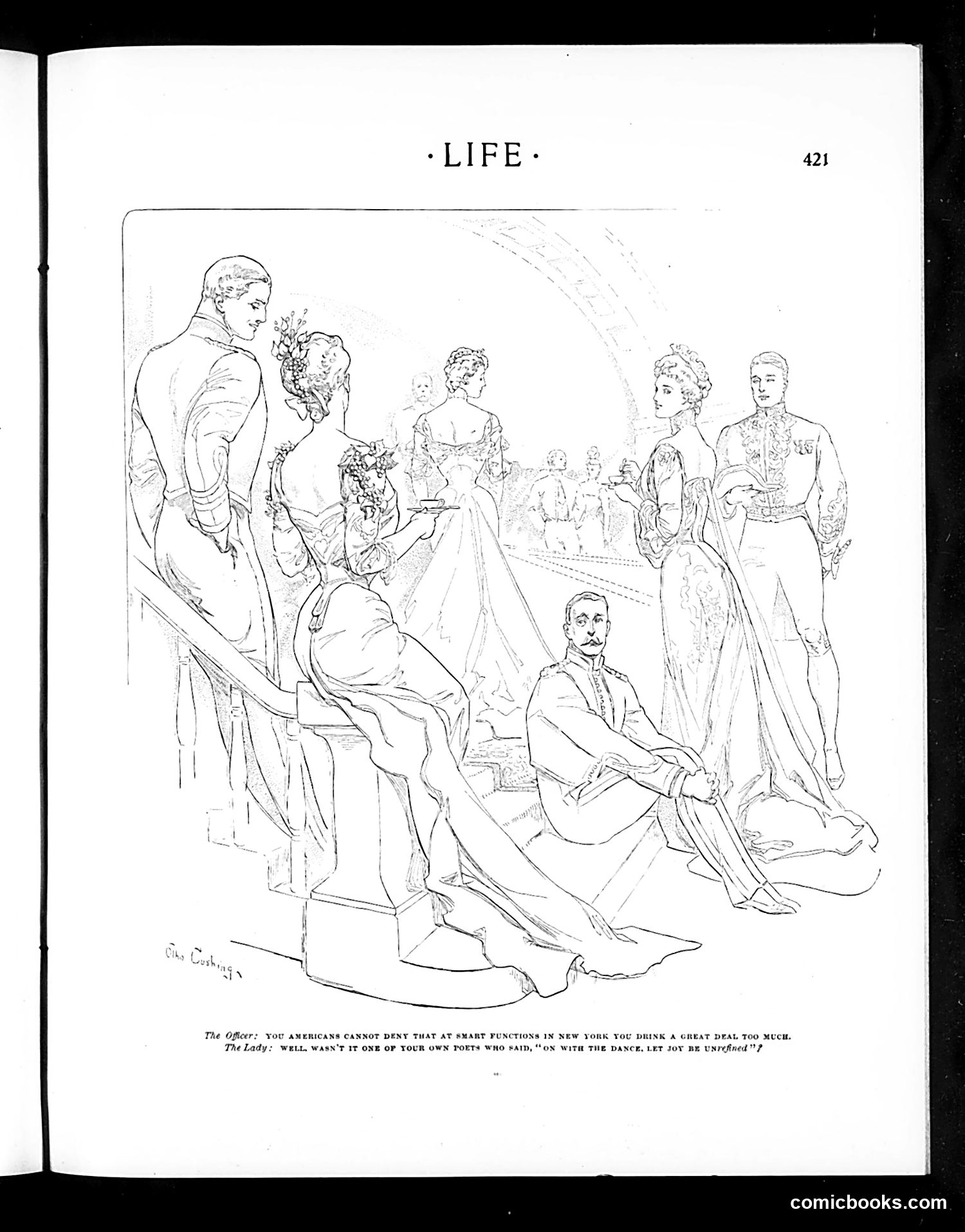
This is a single-panel cartoon satirizing American social customs versus European propriety. An officer (appearing to be foreign, likely British based on his uniform) criticizes Americans for excessive drinking at New York social events. An American lady responds with a witty retort, misquoting or paraphrasing a line about dancing and unrefined joy—implying that Americans intentionally embrace less formal, more boisterous behavior than Europeans consider proper. The satire targets the tension between Old World restraint and New World exuberance. The lady's clever comeback suggests Americans reject European standards of decorum, preferring their own more uninhibited culture. The joke relies on this era's common stereotype of Americans as uncouth compared to refined foreign sensibilities.
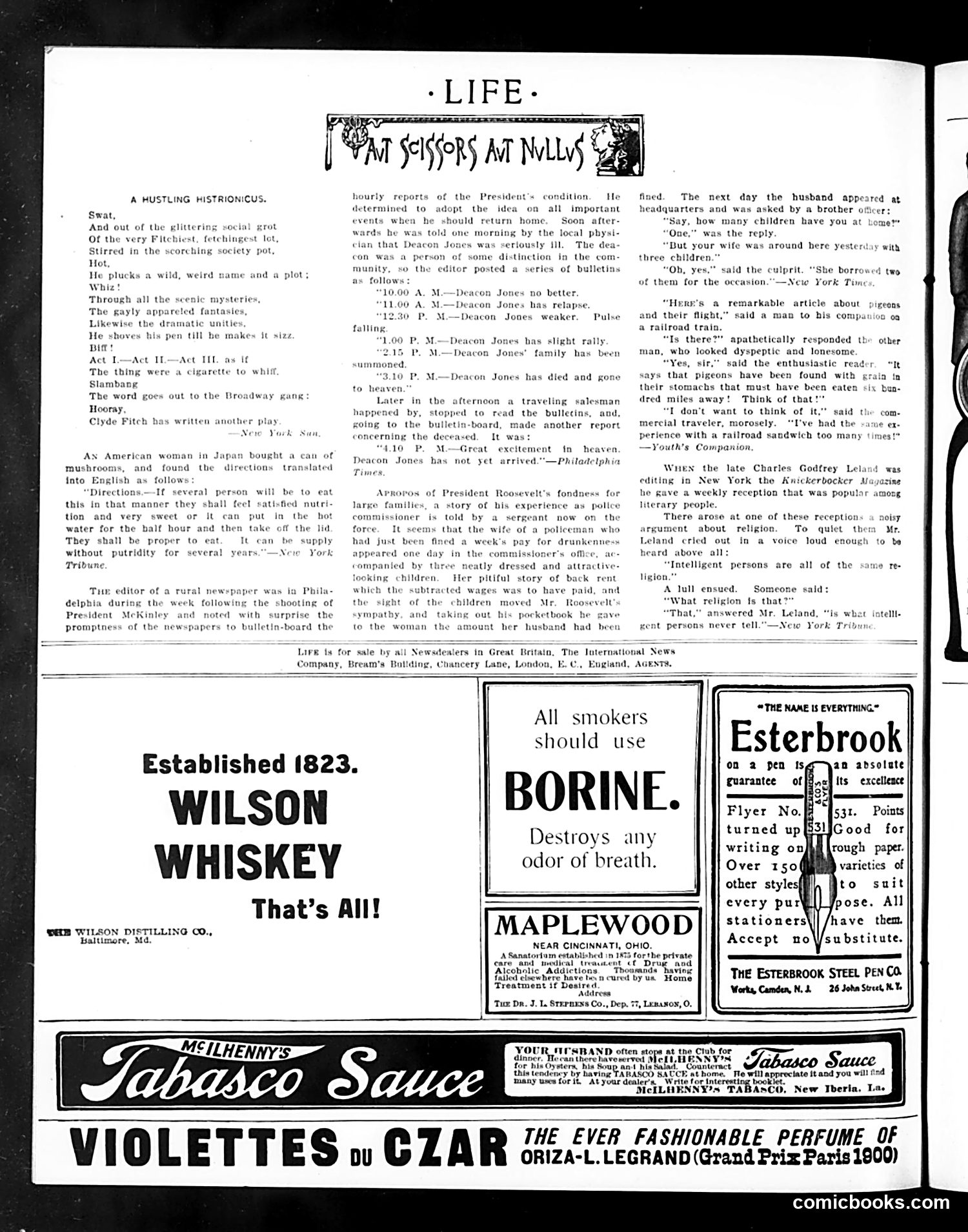
This appears to be a **miscellaneous humor and advertising page** from Life magazine rather than a cohesive political cartoon. The main feature, "A Hustling Histrionicus," satirizes **theatrical melodrama**—specifically mocking the overwrought, rapid-fire plotting and absurd dramatic conventions of Broadway plays. References to "cigarette to whiff," "Slambang," and the breathless pacing parody how playwrights manufactured sensational plot twists. The page also includes humorous anecdotes about **President Roosevelt**, including a joke about his charitable concern for families and a satire on bureaucratic bulletin-board updates tracking a deacon's illness with comedic solemnity. The remainder consists of **period advertisements** for Wilson Whiskey, Borine breath mints, Esterbrook pens, Tabasco sauce, and perfume—typical of Life's advertising-heavy layout in this era.
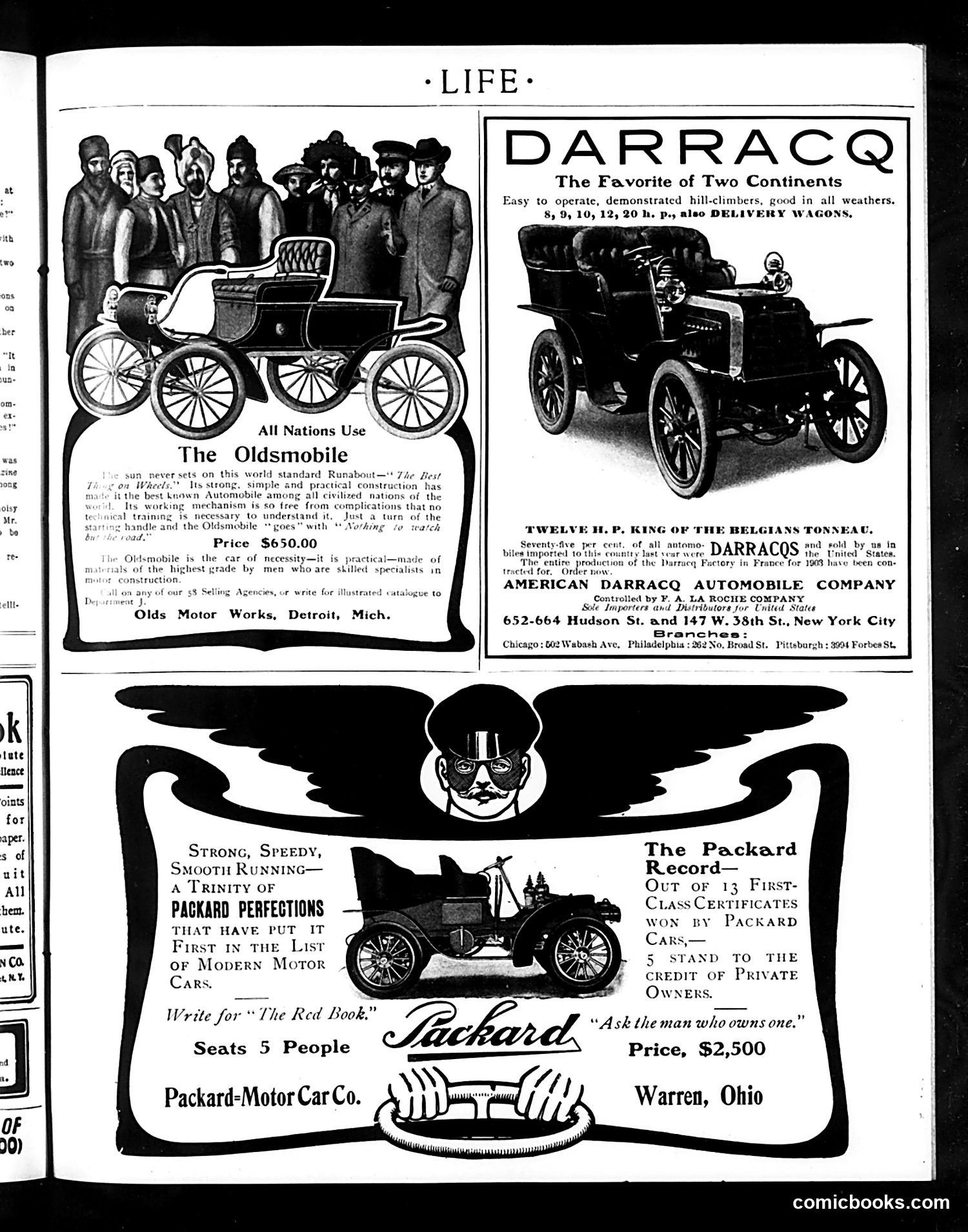
This page is **primarily advertising** rather than political satire. It features three competing automobile manufacturers from the early 1900s: Oldsmobile ($650), Darracq ($2,500), and Packard ($2,500). The humor is commercial rather than political. Each ad uses nationalist appeals: Oldsmobile claims "All Nations Use" it, Darracq advertises as "The Favorite of Two Continents" (Europe and America), and Packard boasts of First-Class certificates won by private owners—suggesting reliability and luxury. The winged cherub figure at the center appears purely decorative, typical Art Nouveau styling of the era. These ads reflect the early automobile industry's competitive positioning: Oldsmobile marketed affordability and simplicity, while Darracq and Packard competed in the luxury market, emphasizing performance and prestige. The page reveals how automobiles were still novelties being justified to skeptical consumers through claims of international success and technical superiority.
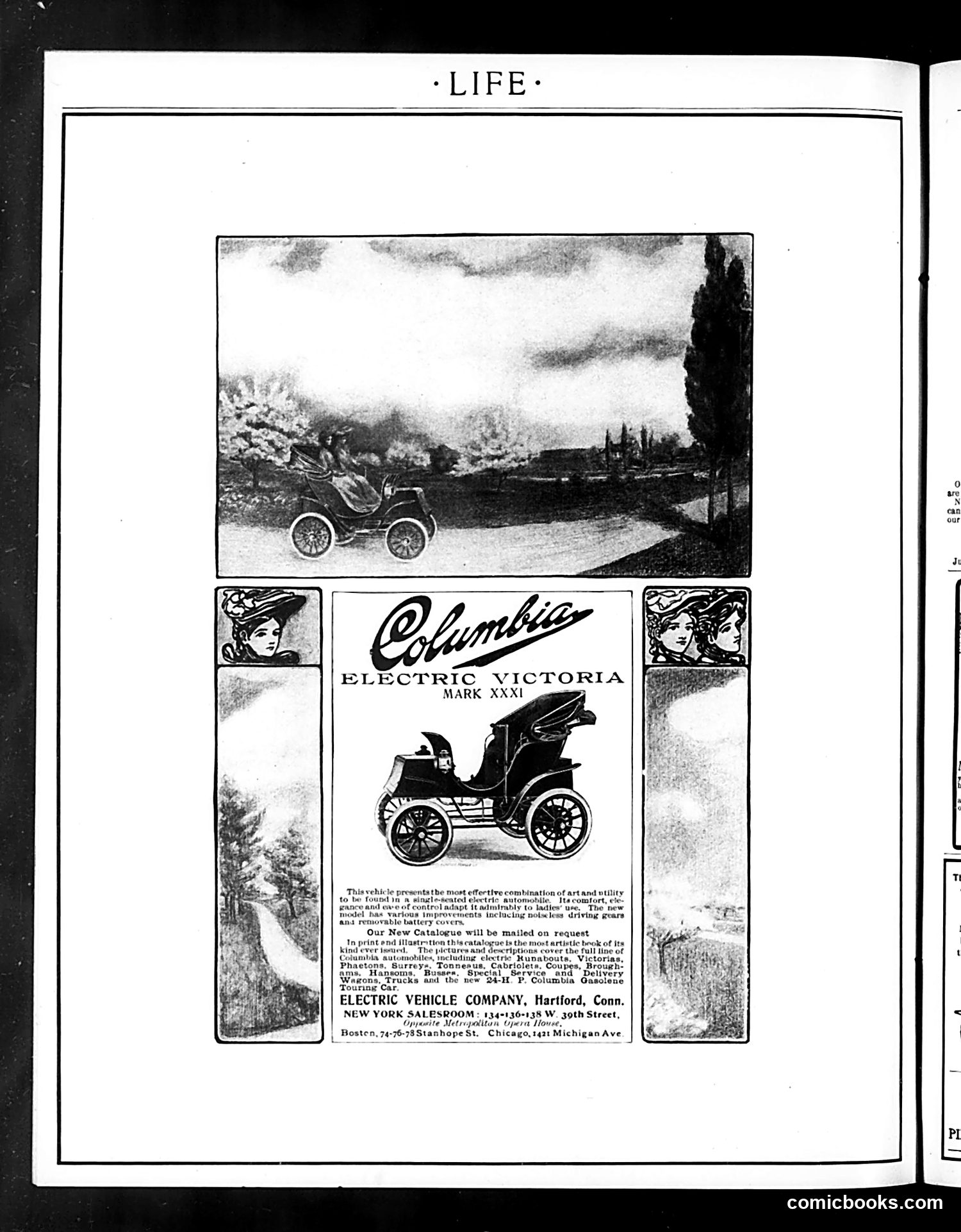
This is **not a political cartoon**, but rather a **full-page advertisement** for the Columbia Electric Victoria automobile, a Mark XXXI model produced by the Electric Vehicle Company of Hartford, Connecticut. The page showcases early 1900s electric vehicles as luxury goods. The top photograph depicts an early electric automobile on a rural road, while the central advertisement features an ornate illustration of the "Electric Victoria" carriage with decorative Art Nouveau-style borders showing women's faces—common advertising imagery of the era meant to appeal to affluent buyers. The ad emphasizes the vehicle's combination of "art and utility," highlighting comfort and aesthetic refinement. Multiple salesroom locations are listed (New York, Boston, Chicago), indicating the company's national reach and the vehicle's status as a premium product. This reflects the pre-1910 period when electric vehicles competed seriously with gasoline cars among wealthy consumers, particularly women drivers, before internal combustion engines ultimately dominated the market.
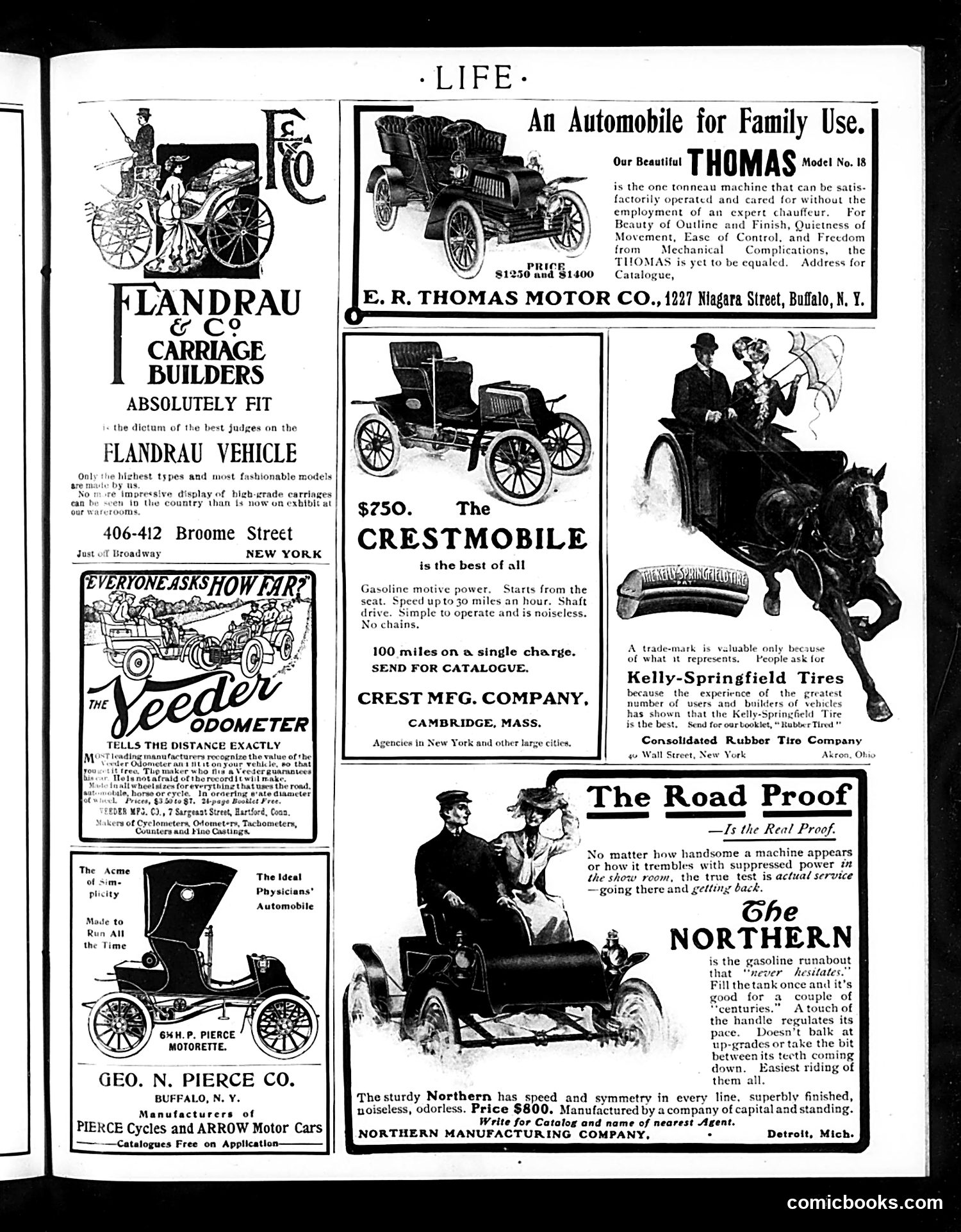
This page is **entirely advertising**, not satire or political commentary. It showcases early gasoline automobiles (circa 1900s-1910s) competing for middle and upper-class buyers. The ads emphasize practical concerns of the era: reliability without requiring a professional chauffeur, ease of operation, speed (20-30 mph), range on a single fuel charge, and simple mechanics. Notably, they market to families and highlight that women can operate these vehicles—a selling point in the transition from horse carriages to automobiles. The testimonial format ("The Road Proof—Is the Real Proof") reflects consumer skepticism about new automotive technology. Brands like Thomas, Northern, Crestmobile, and Pierce compete by claiming simplicity, quietness, and freedom from mechanical complications—suggesting contemporary anxieties about automobile complexity and reliability. This represents the early automotive industry's transition from novelty to practical family transportation.
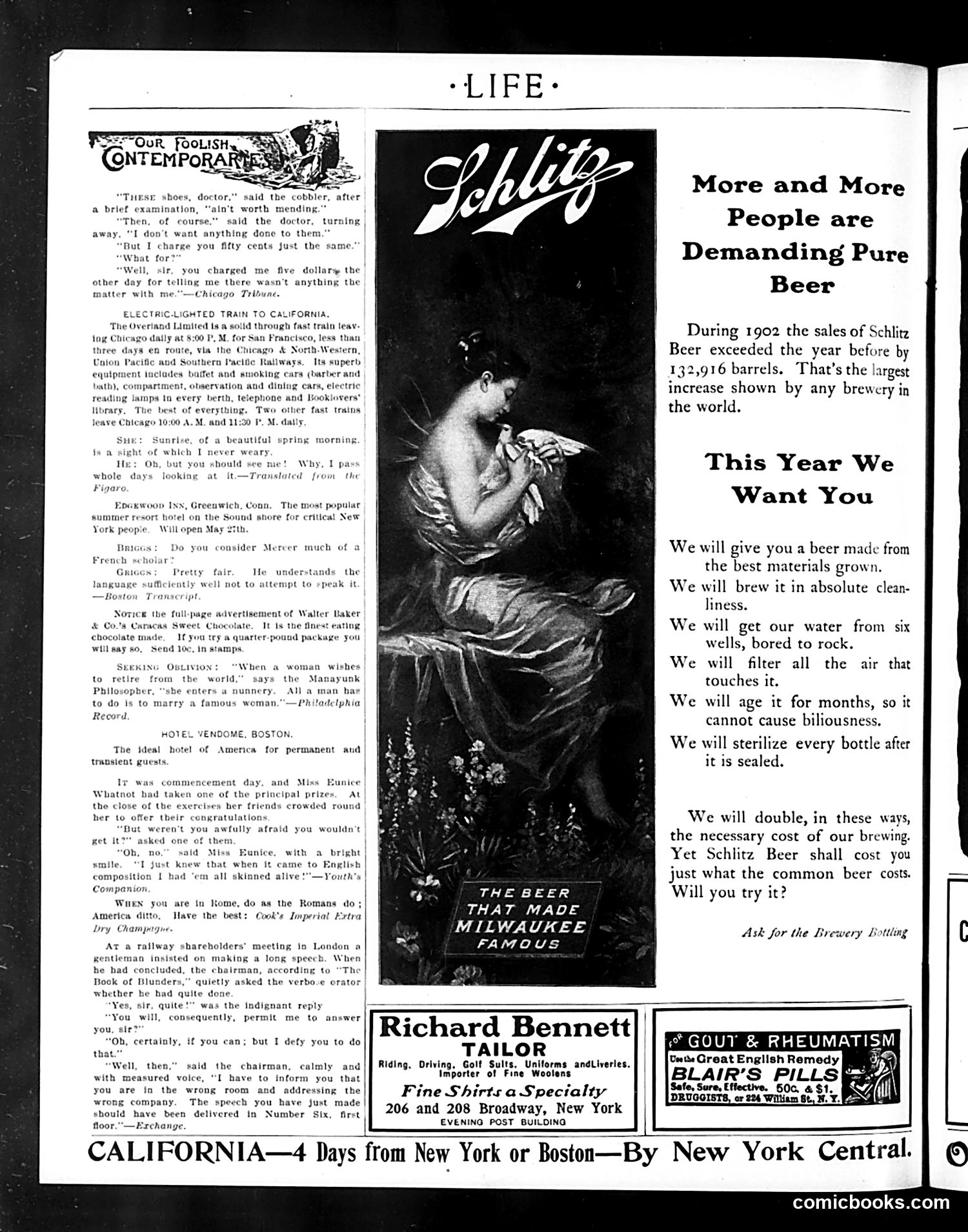
This LIFE magazine page (circa 1902-1903) combines satirical humor with period advertising. **The Cartoons/Jokes:** The left column presents brief comedic vignettes titled "Our Foolish Contemporaries"—short anecdotes mocking human folly. Examples include a cobbler's absurd billing logic and a woman's vanity about her appearance. These are light social satire rather than political commentary. **The Main Advertisement:** The right side features a **Schlitz Beer advertisement** with an artistic illustration of a classical female figure. The copy emphasizes purity—six rock-bored wells, sterilized bottles, filtered air, aged brewing—positioning Schlitz as superior to competitors. The 1902 sales claim (132,916 barrels increase) was marketing copy touting brewery superiority. This reflects early 1900s advertising's pivot toward scientific/sanitary claims, appealing to Progressive Era concerns about product safety and quality. **Context:** The page reflects Edwardian consumer culture and brand competition in the beer industry, where breweries competed on claims of cleanliness and modern methods.
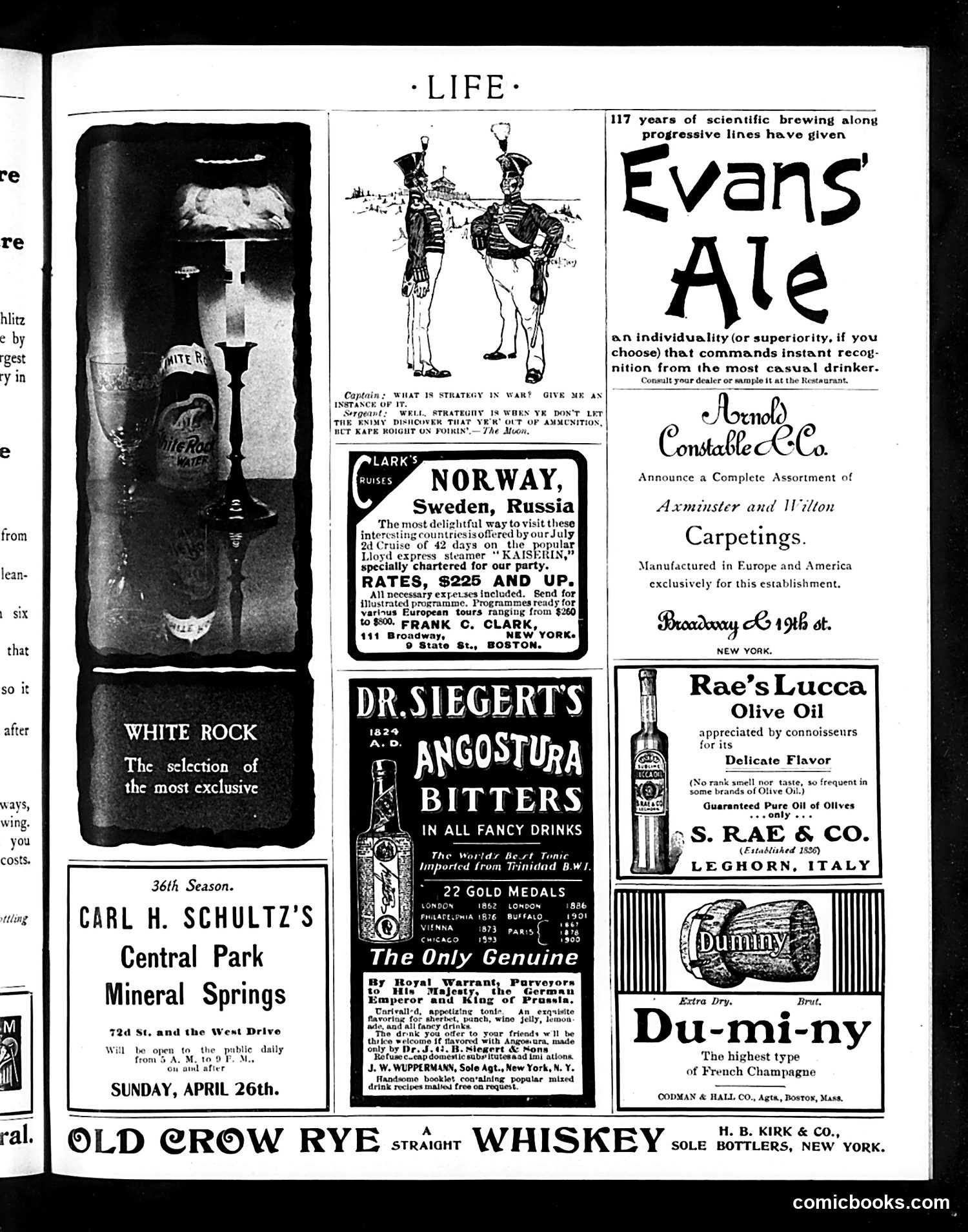
This page is primarily **advertising**, not editorial content or political cartoons. It features luxury goods and services targeting affluent early-1900s readers. The one cartoon element appears in the center-left: two military officers in formal uniforms discussing **war strategy**. One says strategy means giving the enemy "an awful lot of ammunition" while "you don't let 'em out of ammunition." This is satirical commentary on military thinking—likely mocking the apparent contradiction or absurdity of conventional war doctrine. The page itself reflects the era's commercial culture: advertisements for mineral springs, European cruises (to Norway/Sweden/Russia), imported spirits (Dr. Siegert's bitters, Evans Ale, Old Crow whiskey), fine carpeting, olive oil, and champagne. These ads underscore that *Life* magazine, despite its satirical pretensions, depended heavily on advertising revenue from luxury brands targeting wealthy consumers during the pre-WWI era.
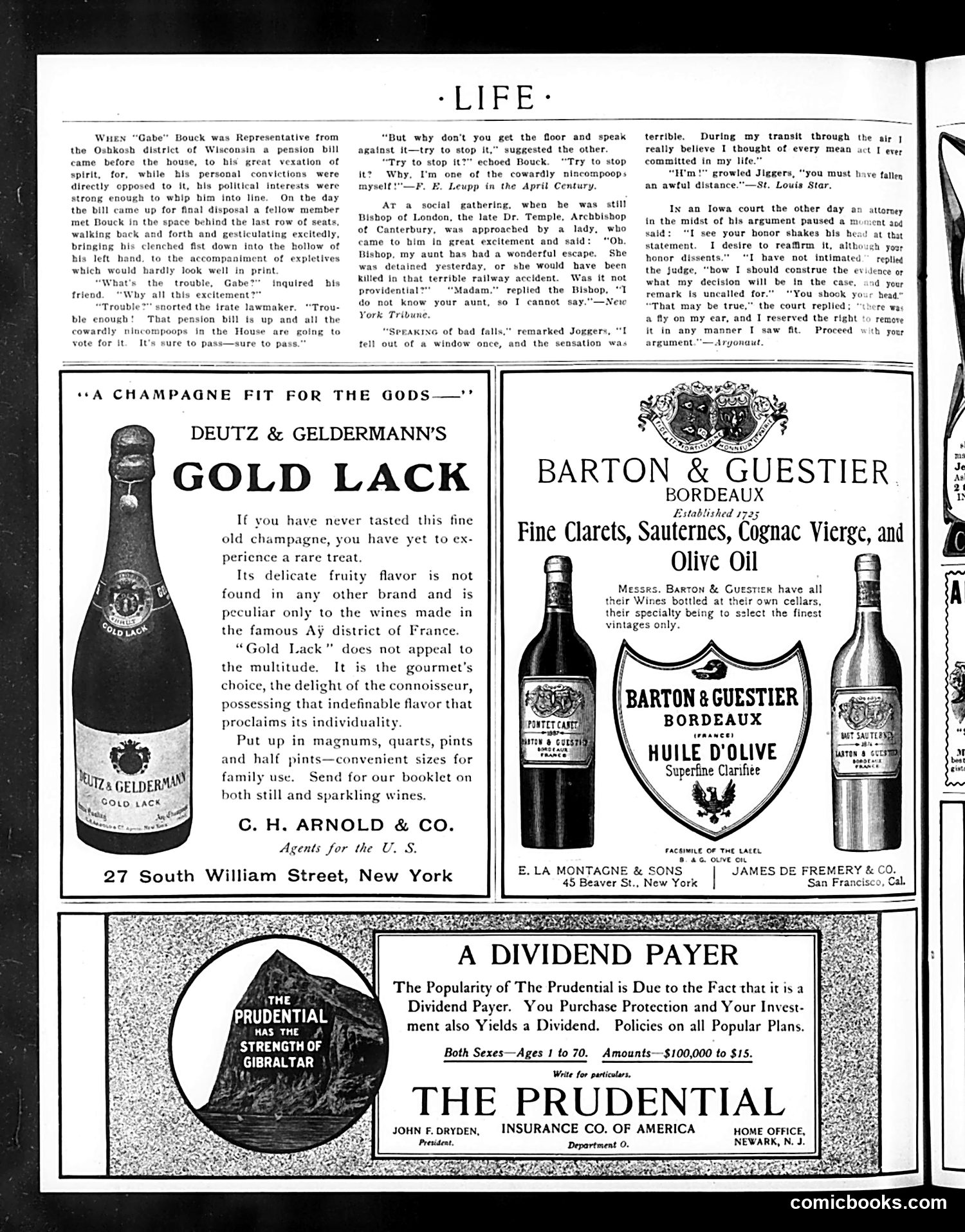
This is primarily an **advertising page** from Life magazine, not a political cartoon page. The OCR'd text at the top contains several **humorous anecdotes** unrelated to the advertisements below: 1. **Representative "Gabe" Bouck** (Oshkosh, Wisconsin): A congressman who personally opposed a pension bill but voted for it anyway due to political pressure—then complained about his own cowardice to a colleague. 2. **Bishop of London anecdote**: A lady tells the Bishop her aunt escaped a railway accident and calls it providential; the Bishop dryly replies he doesn't know her aunt, so can't say. 3. **Iowa courtroom joke**: An attorney misinterprets the judge's head-shake as disagreement, when the judge was merely swatting a fly. The **advertisements** below promote champagne (Deutz & Geldermann's Gold Lack), French wines and olive oil (Barton & Guestier), and Prudential Insurance—typical early 20th-century luxury goods marketing with no political content.
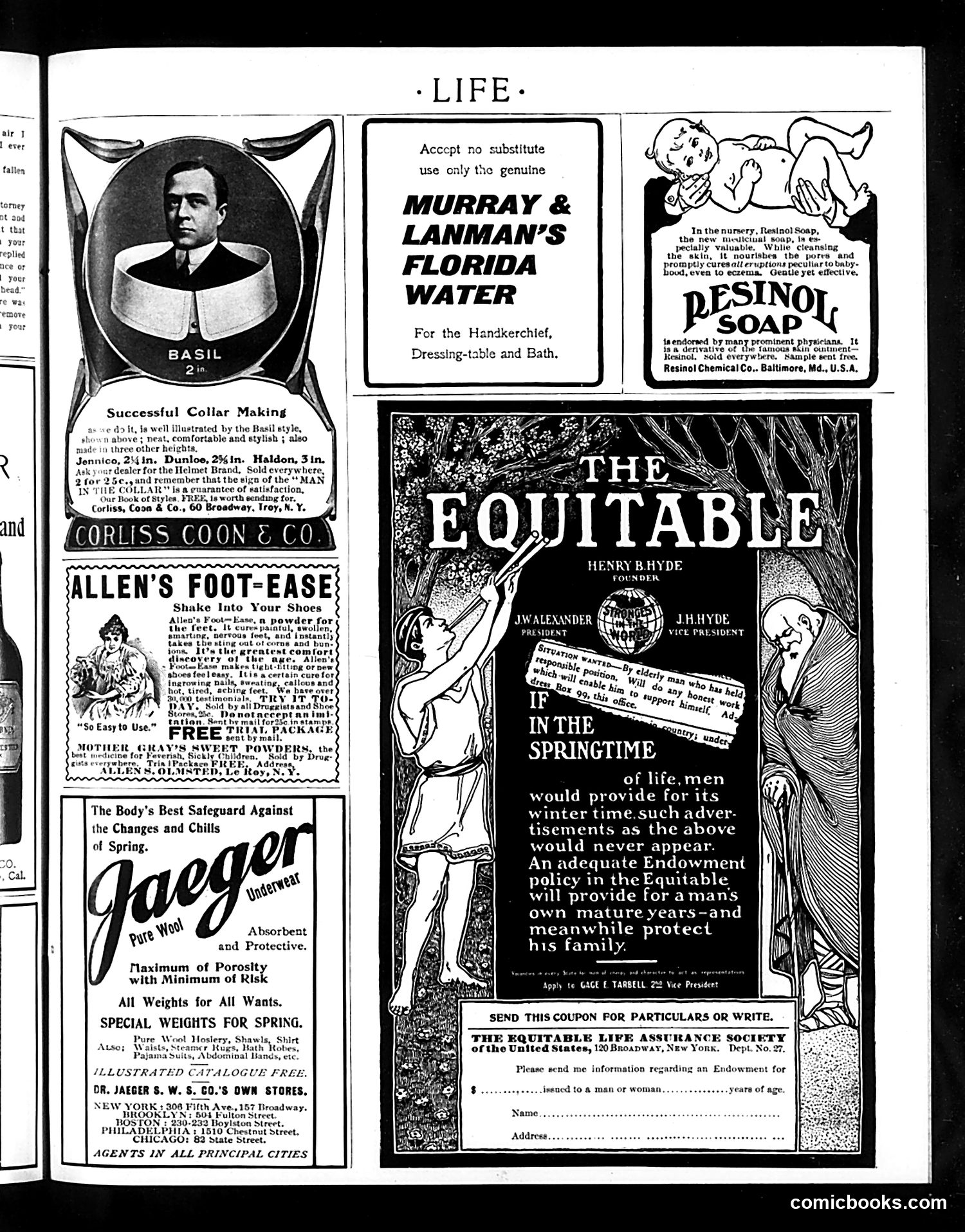
This page is primarily **advertising**, not political satire. It contains vintage product advertisements from the early 20th century: collar-making supplies (Corliss Coon & Co.), foot powder (Allen's Foot-Ease), wool underwear (Jaeger), medicinal soap (Resinol and Desinol), and Florida Water. The only substantial editorial content is **The Equitable Life Insurance Society advertisement**—a large illustrated piece featuring a semi-nude male figure reaching upward. The copy argues that life insurance endowments protect a man's family during his mature years, implying that without such coverage, advertisements promoting frivolous spending would tempt men away from responsible financial planning. This is indirect social commentary: the ad suggests that adequate insurance represents moral prudence and family duty—a common sales pitch of the era. The naked figure may represent vulnerability or aspiration, typical of insurance marketing imagery from this period. Most of the page reflects **early 1900s consumer culture** and the gendered assumption that men needed persuasion toward financial responsibility.
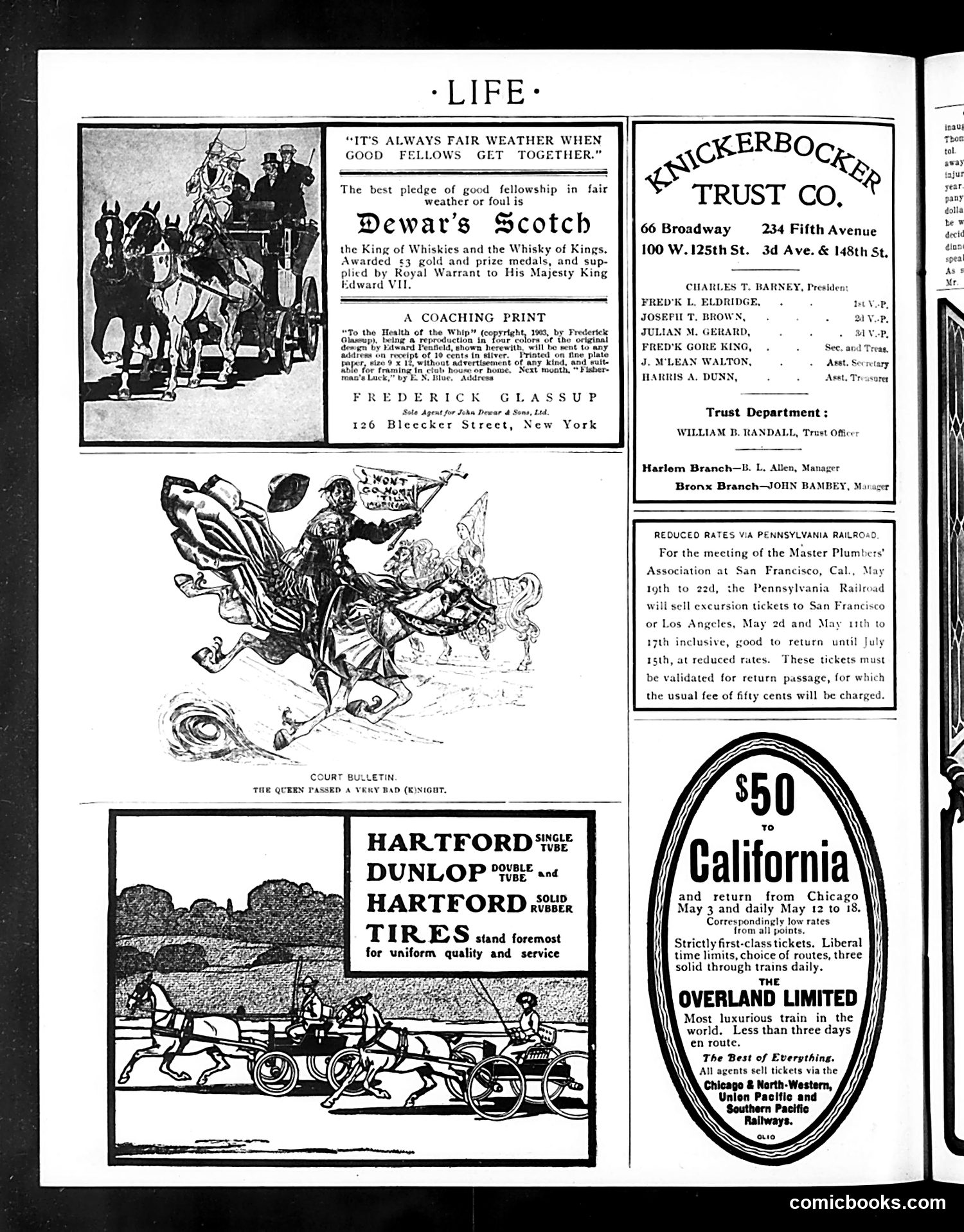
This page is primarily **advertising** with one visual joke. The main content includes ads for Dewar's Scotch whisky, the Knickerbocker Trust Company, Hartford tires, and California train excursions. The single cartoon, titled "Court Bulletin: The Queen Passed a Very Bad (Knight)," is a **visual pun**. It depicts a chaotic scene of a queen in a carriage, likely referencing British royalty. The joke plays on the double meaning of "knight"—a chess piece and a title of nobility. The caption suggests the queen made a poor move or decision involving a knight, rendered as slapstick comedy with horses and figures tumbling. The page reflects early 1900s advertising culture and gentle wordplay humor typical of *Life* magazine's satirical approach. Without clearer context about specific current events, the deeper political meaning—if any—remains unclear.
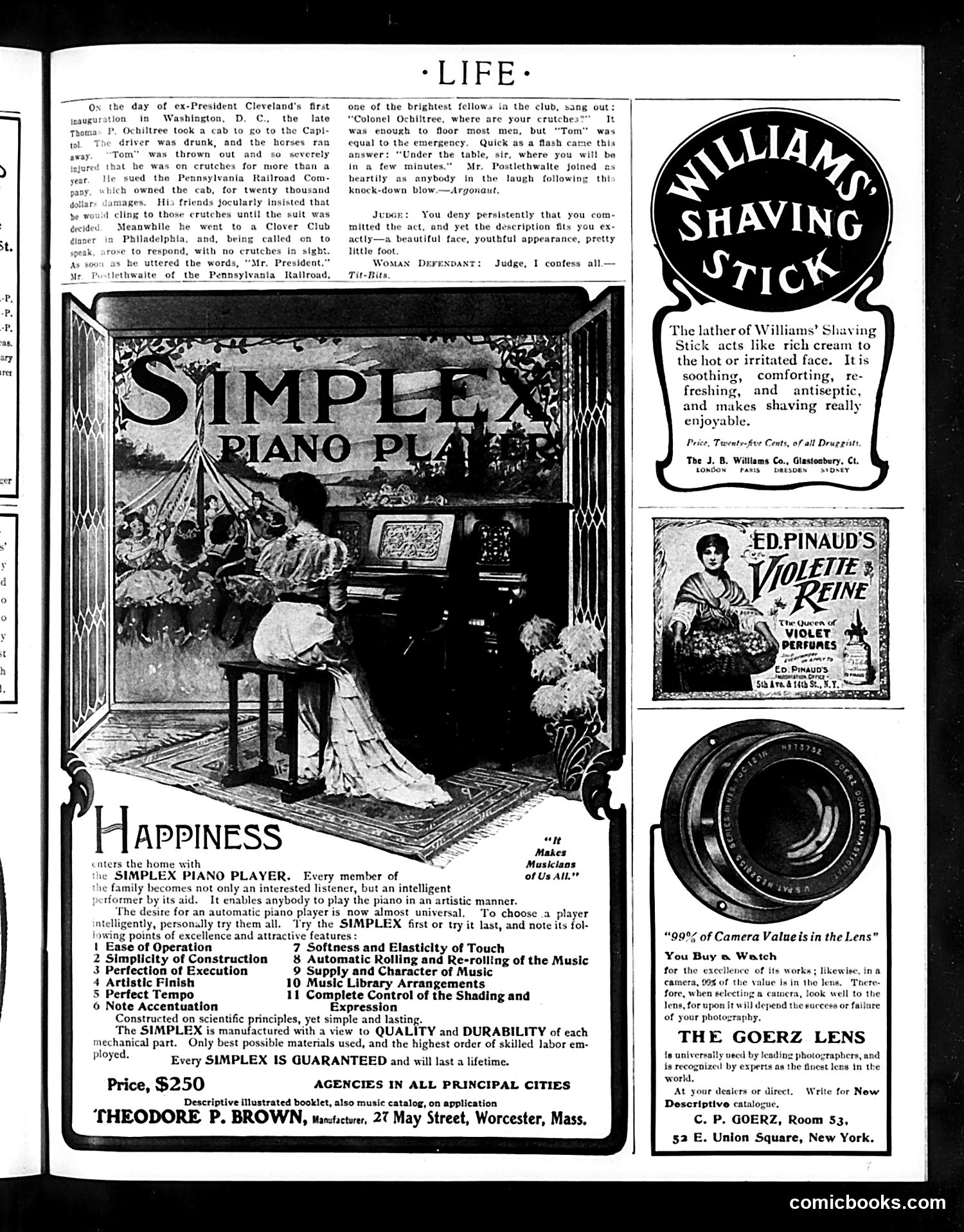
This page is primarily **advertising**, not political satire. However, it opens with a humorous anecdote about **Colonel Tom Ochiltree**, a real 19th-century figure known for wit and drinking. The story describes how Ochiltree, injured in a cab accident (allegedly involving a drunk driver and a Pennsylvania Railroad Company vehicle), attended a Philadelphia dinner while still on crutches. When heckled about his injuries—"where are your crutches?"—he delivered a quick comeback suggesting his heckler would soon join him under the table. The joke satirizes both **personal injury litigation** (Ochiltree's lawsuit against the railroad) and the social performance of recovering gentlemen at formal dinners. The humor relies on readers' familiarity with Ochiltree's reputation for sharp repartee. The remainder of the page features period product advertisements: Simplex Piano Player, Williams' Shaving Stick, Violette Reine perfume, Goerz camera lenses—typical of *Life* magazine's revenue model during this era.
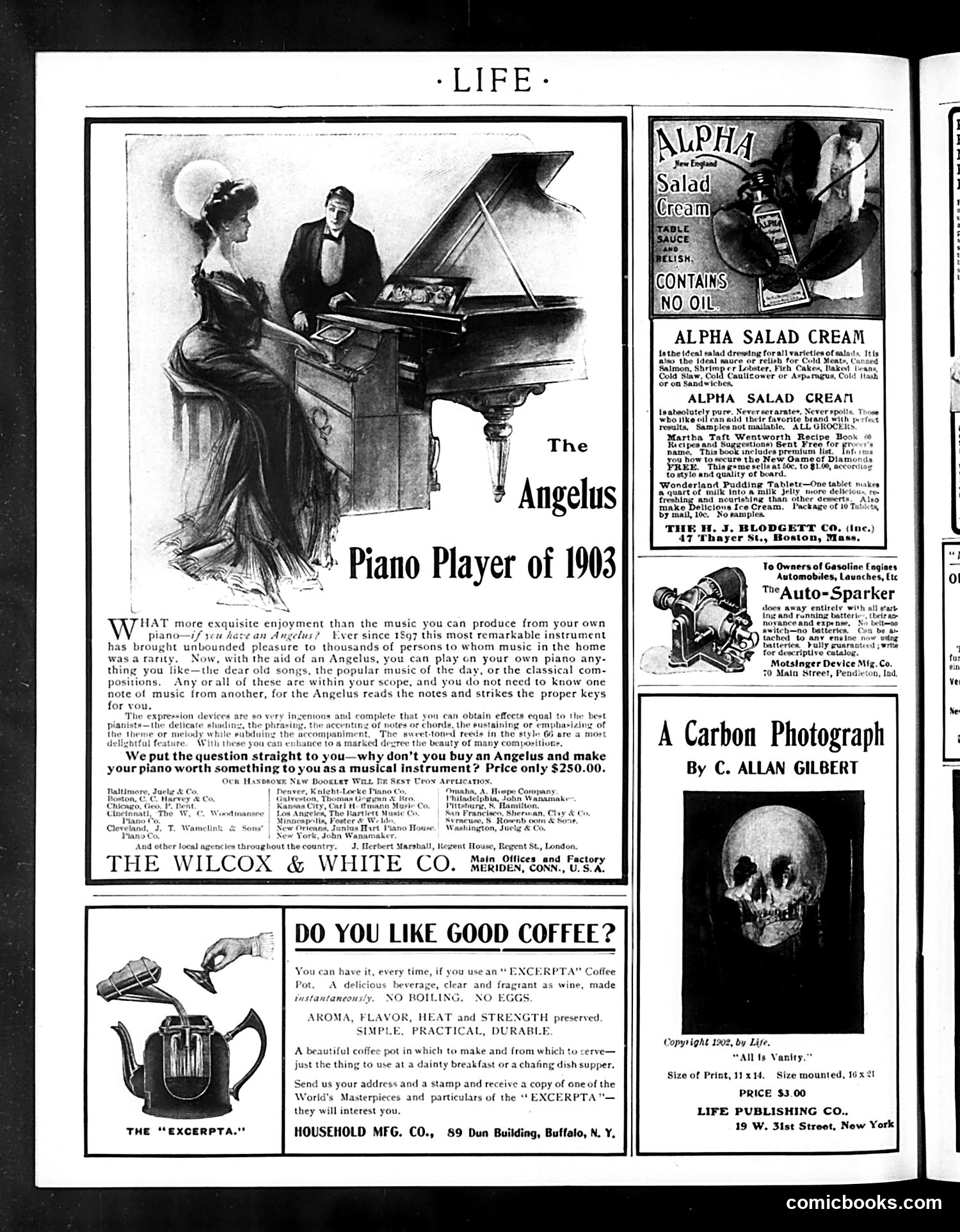
This page is primarily **advertising**, not political satire. The dominant feature is an ad for the **Angelus Piano Player**—a player piano mechanism that automated music performance. The pitch appeals to affluent homeowners: you need no musical training to produce sophisticated music (classical or popular) from your own piano. At $250, it represented a luxury consumer product for the well-to-do. The illustration depicts an elegant couple; the woman watches approvingly as a man operates the device, suggesting the Angelus promised cultured entertainment and social status. The page also carries ads for **Alpha Salad Cream**, an **Auto-Sparker** (automobile ignition device), an **Excerpta Coffee Pot**, and a carbon photograph by C. Allan Gilbert titled "All is Vanity." **Key context for modern readers**: This reflects the early 1900s luxury goods market targeting middle/upper-class consumers with new mechanical conveniences—precursors to modern appliances. Player pianos were genuinely popular before recorded music became standard.
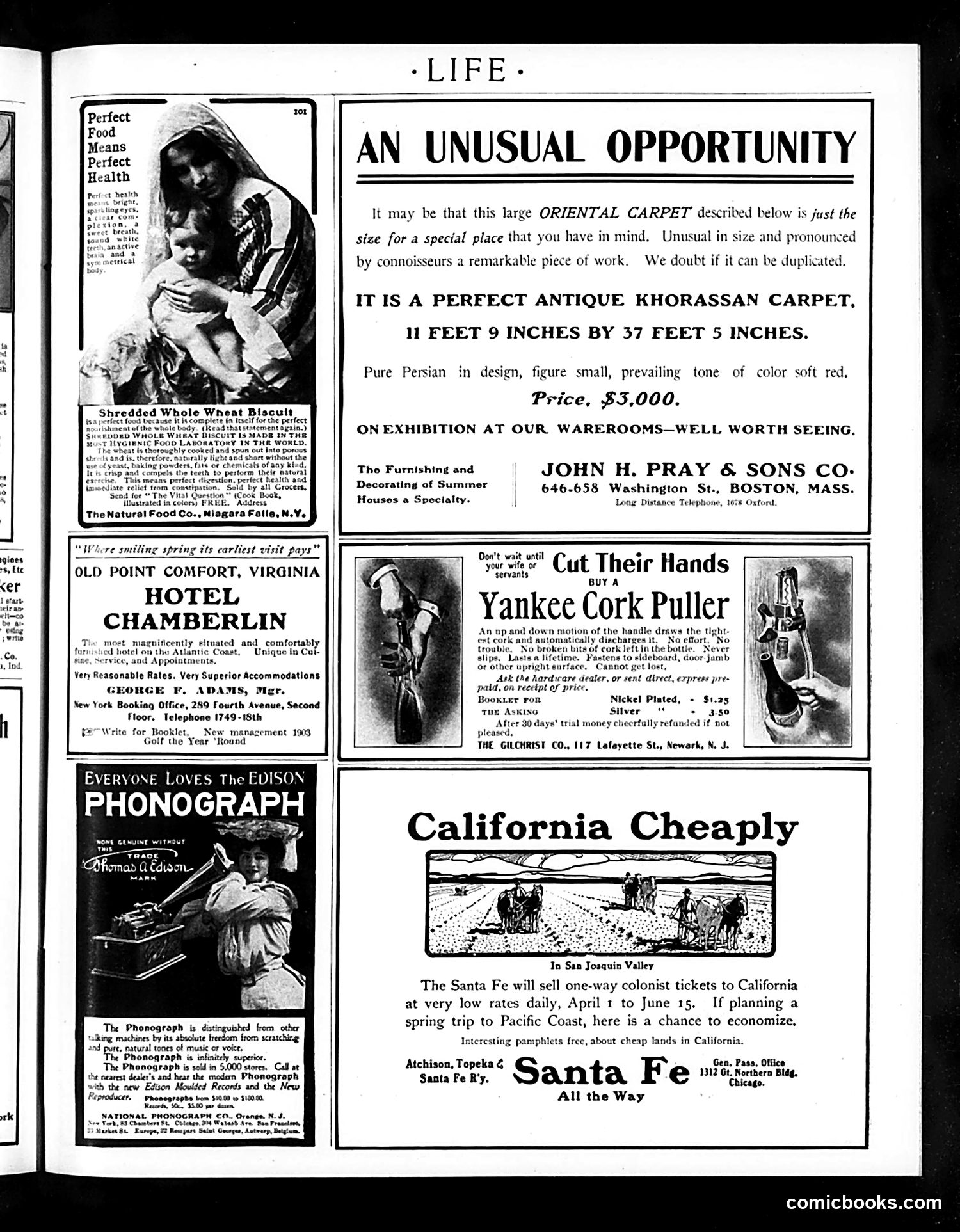
This is primarily an **advertising page** with no political cartoons or satirical content. The page contains vintage advertisements from approximately the early 1900s, including: - A Persian carpet sale ($3,000) from a Boston furnishing company - Hotel Chamberlin in Virginia promoting leisure travel - Edison Phonograph promotion - Yankee Cork Puller (a kitchen device) - Santa Fe Railroad advertising cheap colonist tickets to California The left sidebar includes a food advertisement for "Shredded Whole Wheat Biscuit." **No satire or political commentary is present.** This appears to be a standard commercial advertising section from Life magazine's early era, when the publication mixed editorial content with paid advertisements. The ads reflect consumer goods and services available to middle and upper-class Americans of that period—luxury carpets, resort hotels, new technologies like phonographs, and westward expansion opportunities via railroad.
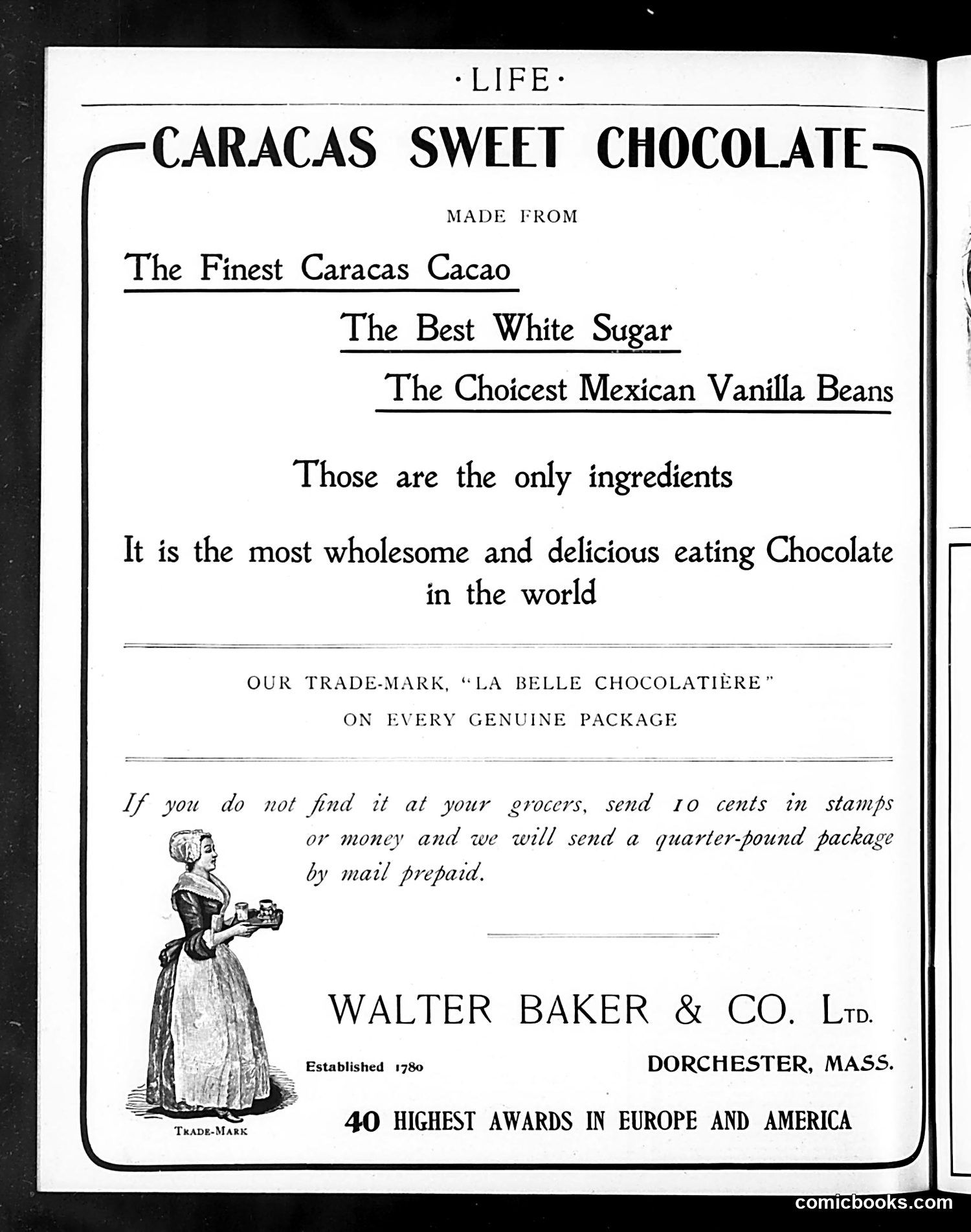
This is primarily a **full-page advertisement**, not political satire. It advertises Caracas Sweet Chocolate by Walter Baker & Co., established in Dorchester, Massachusetts in 1780. The page features a Victorian-era illustration of a woman in period dress holding a chocolate box—the company's trademark "La Belle Chocolatière" (The Beautiful Chocolate Maker). This elegant female figure was a common marketing device to associate the product with refinement and quality. The ad emphasizes purity (only three ingredients listed), prestige (40 highest awards claimed), and accessibility (mail-order option for 10 cents). This reflects late 19th/early 20th-century consumer marketing: establishing product legitimacy through awards, simplicity of ingredients (responding to emerging food-purity concerns), and direct-mail convenience for readers without local grocery access. There is no political satire present on this page.
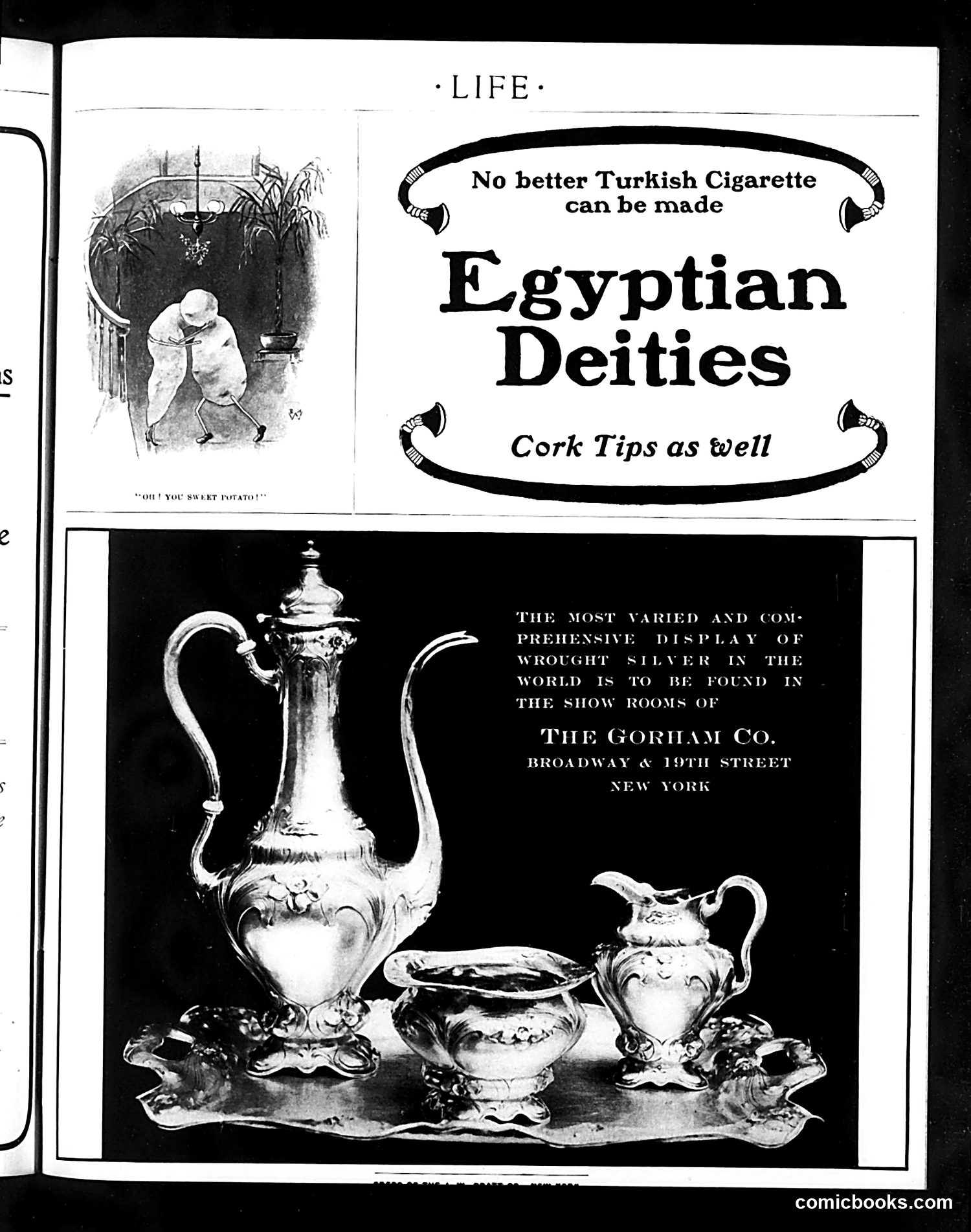
This page contains two distinct elements: a small cartoon sketch (upper left) with caption "Did I not sweet potato?" whose meaning is unclear, and a full-page advertisement for Egyptian Deities Turkish cigarettes with cork tips. The cigarette ad uses "Egyptian Deities" as a brand name, exploiting early 20th-century fascination with ancient Egypt. The ornate silver serving pieces displayed below reference luxury and sophistication, suggesting the cigarettes are premium products. The ad for The Gorham Company (a renowned American silversmith) appears to be unrelated to the cigarettes—likely sharing page space due to magazine layout rather than thematic connection. The satire, if any exists, appears subtle—possibly mocking how exotic product names and luxury imagery were used to market cigarettes to consumers.
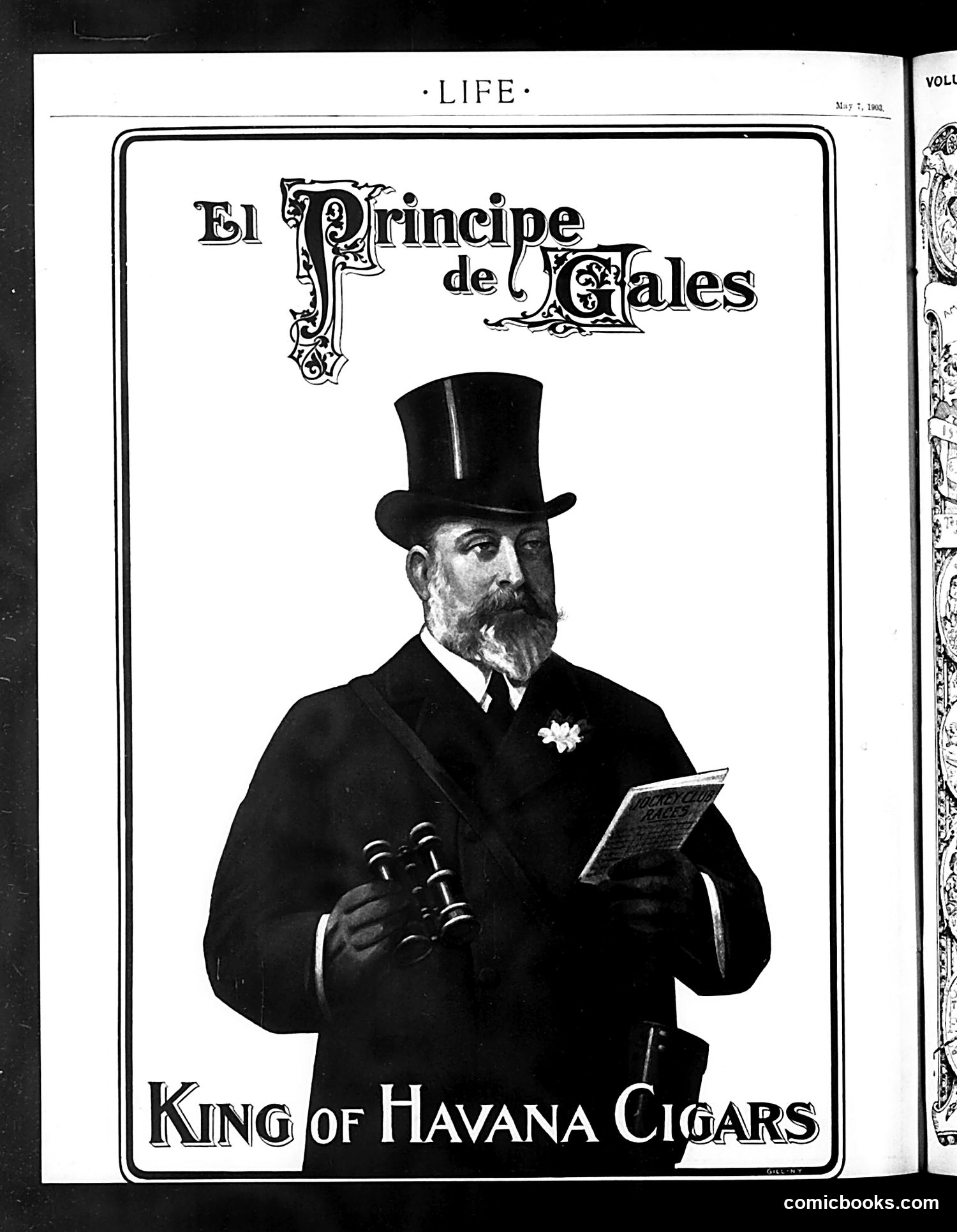
This is an advertisement rather than political satire. It depicts a distinguished gentleman in formal attire—top hat, morning coat, and boutonnière—holding binoculars and what appears to be a pamphlet or catalog. The ad promotes "El Principe de Gales" (The Prince of Wales) brand cigars, marketed as "King of Havana Cigars." The figure represents aspirational sophistication and upper-class leisure. The binoculars suggest a man of means engaged in refined pursuits (perhaps attending sporting events or social functions), while the formal dress code emphasizes respectability and status. By associating their product with such an elegant persona, the advertiser appeals to consumers' desire for prestige and good taste. The Spanish name suggests these are premium imported cigars.