
Life, 1903-05-07 · page 6 of 36
Life — May 7, 1903 — page 6: what you’re looking at
What you’re looking at
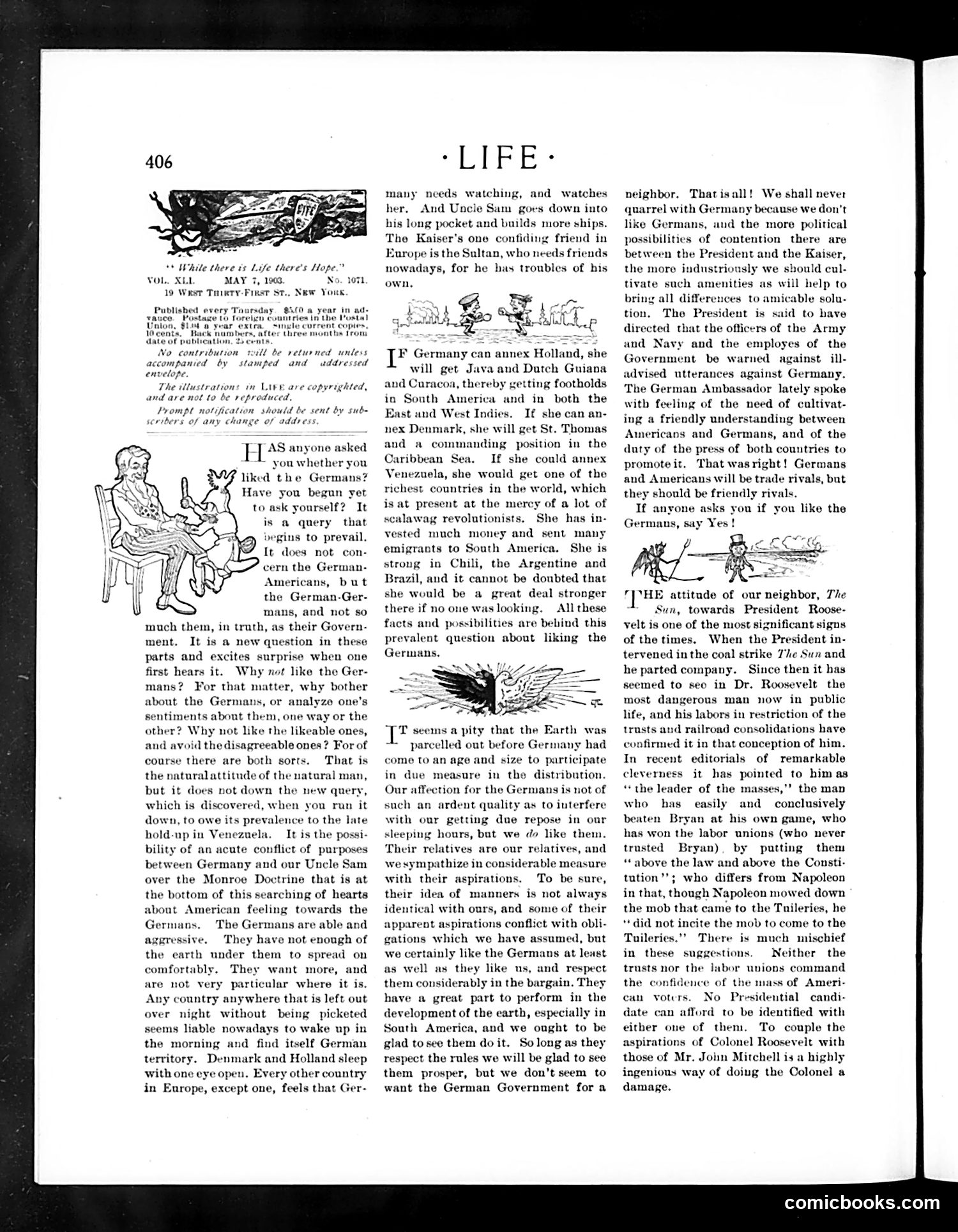
This page presents editorial commentary questioning American sympathy toward Germany. The text challenges the notion that Americans should "like the Germans" by examining Germany's imperial ambitions in South America and the Caribbean—specifically potential annexation of Holland, Denmark, Venezuela, and other territories. The cartoon (upper left) depicts an elderly figure being asked about liking Germans, illustrating the article's central debate. The commentary argues that while Germans and Americans share some values, Germany's expansionist goals threaten American interests. The piece dismisses romantic notions of German-American kinship, emphasizing instead that geopolitical rivalry—not cultural affinity—should determine policy. The final section discusses President Roosevelt's recent intervention in the coal strike and railroad consolidation issues, positioning him as actively managing American industrial concerns.
📄 Transcribed text from this page (OCR, searchable)
Machine-transcribed from the original scan — historical spelling and the odd misread are preserved.
++ White there ts Life there's Hope.” VoL. XL MAY 7, 1903. No. } 19 Wast Taety-Fiesr St.. New Yous. plished a ery Toursday. 8X0 a y eto ries tt LM @ year extra singh ts. Back hambers, after Ue date of pablication No tribution accompanied by envelope. The illustrations in Lure ave copyrighted, and are not to be reproduced, Prompt notification should be seribers of any change of address ill be returned untess stamped and addressed ent by sub= FL] AS anyone asked you whether you liked the Germans? Have you begun yet to ask yourself? It is a query that begins to prevail. It does not con- cern the German- Americans, but the German-Ger- mans, and not so much them, in truth, as their Govern- ment. It is a new question in these parts and excites surprise when one first hears it. Why not like the Ger- mans? For that matter, why bother about the Germans, or analyze one’s sentiments about them, one way or the other? Why not like the likeable ones, and avoid the disagreeable ones? For of course there are both sorts. That is the naturalattitude of the natural man, but it does not down the new query which is discovered, when you run it down, to owe its prevalence to the late hold-up in Venezuela. It is the possi- bility of an acute conflict of purposes between Germany and our Uncle Sam over the Monroe Doctrine that is at the bottom of this searching of hearts about American feeling towards the Gert The Germans are able and ager They have not enough of the earth under them to spread on comfortably. They want more, and are not very particular where it is. Any country anywhere that is left out over night without being picketed seems liable nowadays to wake up in the morning and find itself German territory. Denmark and Holland sleep with one eye open. Every other country in Europe, except one, feels that Ger- + LIFE. « many needs watching, and watches her, And Uncle Sam govs down into his long pocket and builds more ships Tho Kaiser's one confiding friend in Europe is the Sultan, who needs friends nowadays, for he has troubles of his own, |F Germany can annex Holland, she will get Java and Dutch Guiana and Curacoa, thereby getting footholds. in South America and in both the East and West Indies. If she can an- nex Denmark, she will get St. Thomas and a commanding position in the Caribbean Sea. If she could annex Venezuela, she would get one of the richest countries in the world, which is at present at the mercy of a lot of lawag revolutionists. She has in- vested much money and sent: many emigrants to South America. She is strong in Chili, the Argentine and Brazil, and it cannot be doubted that she would be a great deal stronger there if no one was looking. All these facts and possibilities are behind this prevalent question about liking the Germans. T seems a pity that the Earth was parcelled out before Germany had come to an age and size to participate in due measure in the distribution. Our affection for the Germans is not of such an ardent quality as to interfere with our getting due repose in our sleeping hours, but we do like them. Their relatives are our relatives, and we sympathize in considerable measure with their aspirations. To be sure, their idea of manners is not always identical with ours, and some of their apparent aspirations conflict with obli- gations which we have assumed, but we certainly like the Germans at least as well as they like us, and respect them considerably in the bargain. They have a great part to perform in the development of the earth, especially in South America, and we ought to be glad to see them doit. So long as they respect the rules we will be glad to see them prosper, but we don’t seem to want the German Government for a neighbor. Thatisall! We shall never quarrel with Germany because we don't like Germans, und the more political possibilities of contention there are between the President and the Kaiser, the more industriously we should cul- tivate such amenities as will help to brin ferences to amicable solu- tion. dent is said to have directed that the officers of the Army und Navy and the employes of the Government be warned against ill- advised utterances against Germany. The German Ambassador lately spoke with feeling of the need of caltivat- ing a friendly understanding between Americans and Germans, and of the duty of the press of both countries to promoteit. That wasright! Germans and Americans will be trade rivals, but they should be friendly rivals. If anyone asks you if you like the Germans, say Y' ') HE attitude of our neighbor, The Sun, towards President Roose- velt is one of the most significant signs of the times. When the President in- tervened in the coal strike 7ke Sun and he parted company. Since then it has seemed to seo in Dr. Roosevelt the most dangerous man now in public life, and his labors in restriction of the trusts and railroad consolidations have confirmed it in that conception of him. In recent editorials of remarkable cleverness it has pointed to him as ‘the leader of the masses,’’ the man who has easily and conclusively beaten Bryan at his own game, who has won the labor unions (who never trusted Bryan), by putting them ‘*above the law and above the Consti- tution’; who differs from Napoleon in that, though Napoleon mowed down the mob that came to the Tuileries, he ‘did not incite the mob to come to the Tuileries."". There is much mischief in these suggestions. Neither the sts nor the Jabor unions command ence of the mass of Ameri- can voters. No Presidential candi- date can afford to be identified with either one of them. To couple the aspirations of Colonel Roosevelt with those of Mr. Join Mitchell is a highly ingenious way of doing the Colonel a damage. comicbooks.com