
Life, 1903-05-07 · page 12 of 36
Life — May 7, 1903 — page 12: what you’re looking at
What you’re looking at
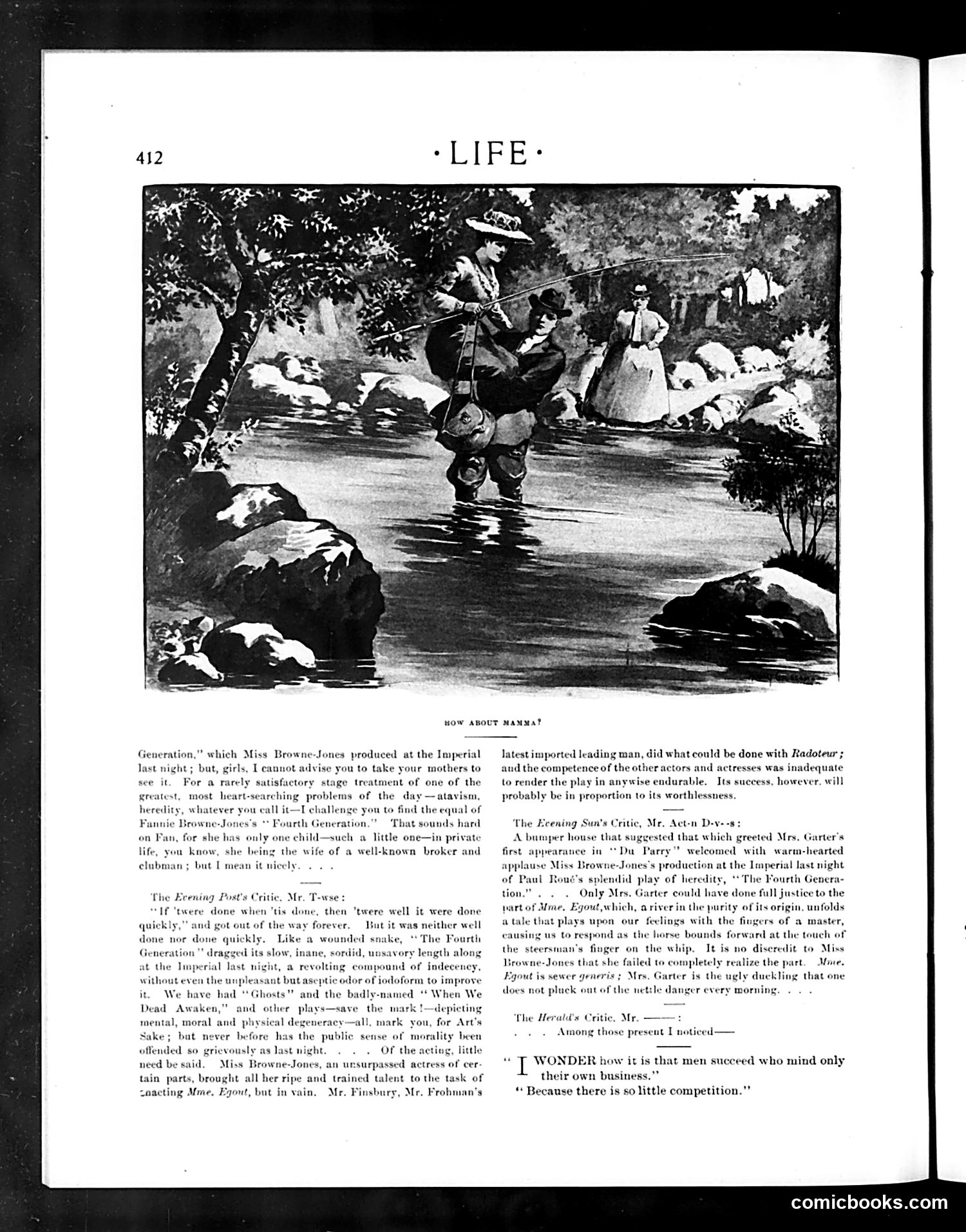
This page features theatrical reviews of Miss Browne-Jones's performance in "The Fourth Generation." The illustration depicts a fishing scene—likely a metaphor for the play's content or theme. The critics discuss the actress's performance across multiple productions. One reviewer praises her handling of difficult material, while another criticizes the play itself as "dragged its slow, inane, sordid, unworthy length" with "revolting compound of indecency." The reviews suggest tension between respecting the actress's talent and condemning the play's moral content. One critic notes Miss Browne-Jones brought "ripe and trained talent" to an "unpleasing" work. The final joke about men succeeding in business due to "little competition" appears unrelated to the theatrical reviews—likely a separate, standalone gag reflecting broader social satire typical of Life magazine's format.
📄 Transcribed text from this page (OCR, searchable)
Machine-transcribed from the original scan — historical spelling and the odd misread are preserved.
HOW ABOUT MaMaat Generation,” which Miss Browne-Jones produced at the Imperial last night; but, girl I canuot advise you to take your mothers to satisfactory stage treatment of one of the greatest, most heart-searching problems of the heredity, whatever you call it—I challe Fann Fourth on Fan, for she has only ot For a rai you to fi That se As hard ha little one—in priv » Browne-J ss child—s life, you know, she clubman ; the wife of a well-known broker « but [ mean it nicely The Evening Post's Critic, Me. quickly,” when ‘tis done, then ‘twere well it were done out of the way forever, hut it was neither well a wounded snake, “The Fourth -Iength alon of indee done nor done quickly, L Generation” dragged its slow, ii at the Imperial last night, a ompout without even the unpleasant but aseptic odor of iodc it. We have had * and the badly-named ‘* When We Dead * and other pls ical degeneracy—all, m: Awaken,” s—save the mark !—depicting k you, for Art's re has the public sense of m ed so grievously as last night need be said. Miss Browne-Jones, an unsurpassed actress of cer tain parts, brought all her ripe and trained talent to the task of zoacting Mme, Egont, but in vain, Mr. y, Mr. Frohman’s lity been insu latest imported leading man, did what could be done with Radoteur ; aud the competence of the other actors and actresses was inadequate to render the play in anywise endurable. probably be in proporti Its success, however. will 1 to its worthlessness, ‘The Evening Sun's Critic, } A bumper house that su rance in Du T applause Miss Brown of Paul Roué’s splendid play tion. Only Mrs. Garter could have done full justice to the partof Mme, Egout,which, ariverin the purity of its origin, unfolds a tale that plays upon our feelings with the fingers of a master, causing us to respond as the horse bounds for at the touch of the steersman’'s fings It is no discredit to Miss nes th failed to completely realize the part Egout is sewer gene y duckling that one does not pluck out of the netsle danger every morning. . ed Mrs. Garter's h warm-hearted ast night Genera- first ap mies’s pro on the w Browne: Mne. The Herald's Critie, Mr. — Among those present I noticed — “-T WONDER how it is that men succeed who mind only their own business.”” “ Because there is so little competition.” comicbooks.com