
A complete issue · 22 pages · 1903
Life — April 23, 1903
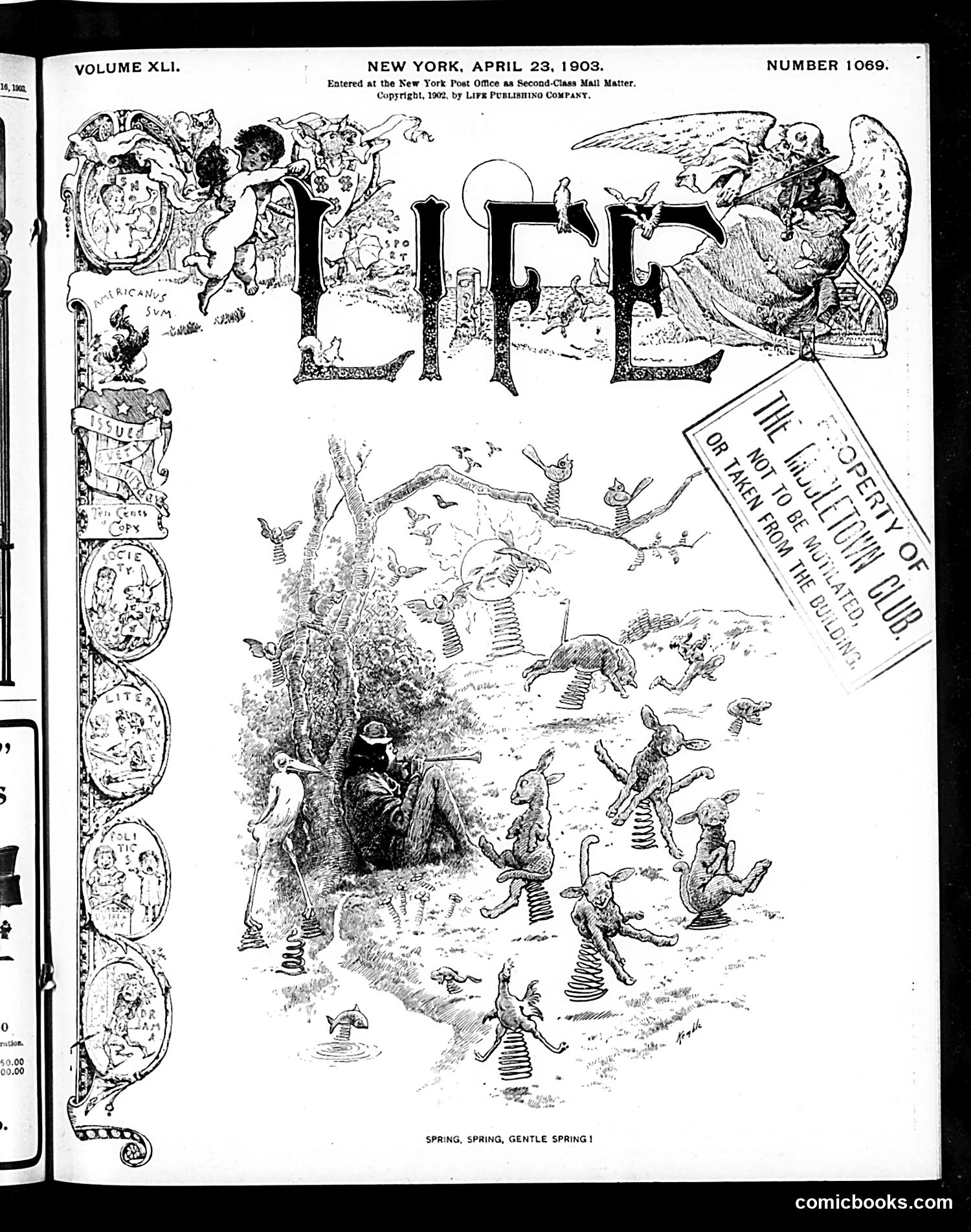
This page features a spring-themed satirical illustration titled "Spring, Spring, Gentle Spring!" The main image depicts creatures emerging from underground burrows with coiled springs attached to their bodies, bouncing upward into the landscape. A central figure (appearing to be human) sits beneath a tree observing this scene. The satire appears to mock the excessive optimism and forced cheerfulness associated with springtime—the creatures' mechanical spring-loaded movements suggest artificial, over-exuberant behavior rather than natural renewal. The decorative borders contain various celestial and mythological imagery typical of Life's ornate style. The joke seems to be poking fun at how people adopt an unnaturally animated, almost mechanical enthusiasm when spring arrives, rather than experiencing genuine natural feeling.
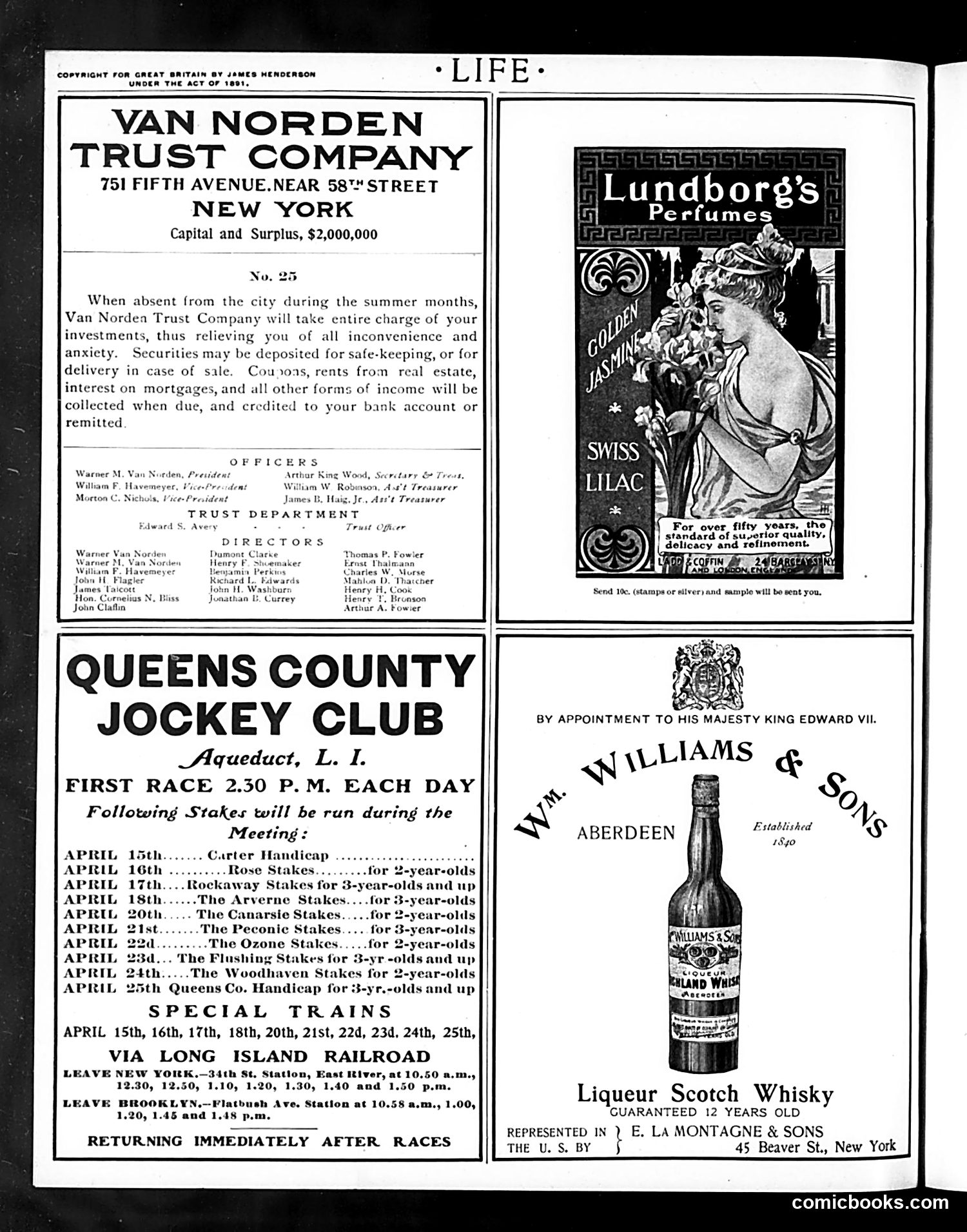
This page contains **no political cartoons or satire**. It consists entirely of four advertisements: 1. **Van Norden Trust Company** (top left)—a financial services firm offering investment management for clients absent during summer months. 2. **Lundborg's Perfumes** (top right)—featuring classical imagery advertising "Golden Jasmine" and "Swiss Lilac" fragrances, with text emphasizing fifty years of quality. 3. **Queens County Jockey Club** (bottom left)—announcing horse races at Aqueduct, Long Island, with specific stake races listed for April dates and special train service from New York and Brooklyn. 4. **Wm. Williams & Sons** (bottom right)—advertising Scottish whisky "by appointment" to King Edward VII. The page is a straightforward advertising section with no satirical content.
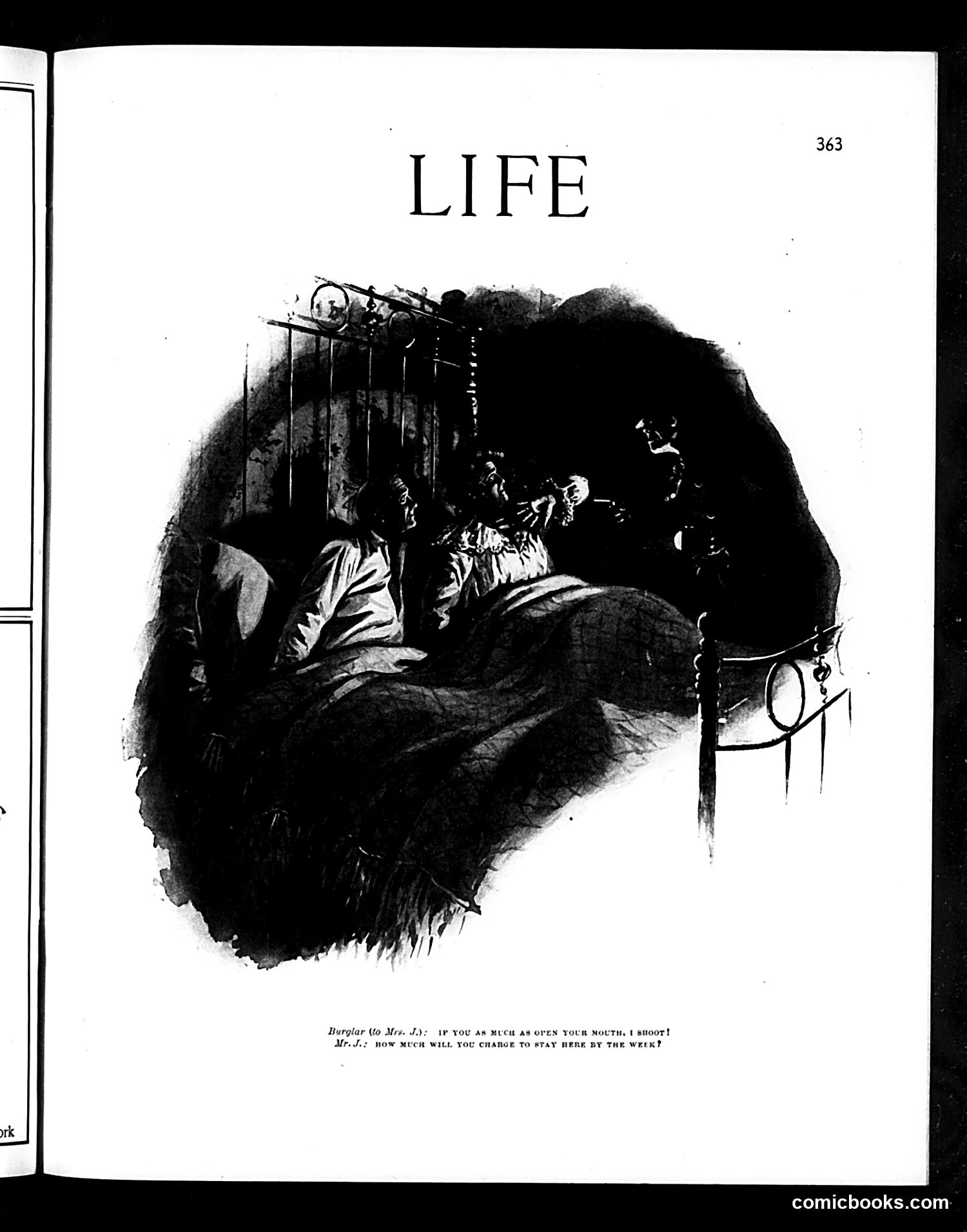
This appears to be a satirical cartoon from Life magazine (page 363) depicting a domestic burglary scene. The image shows a burglar confronting what appears to be a homeowner (identified as "Mrs. J.") in what looks like a bedroom or living space, with a bed visible. The caption's dialogue reveals the satire's point: the burglar threatens the homeowner ("if you so much as open your mouth, I shoot!"), while the homeowner responds by asking about payment rates ("how much will you charge to stay here by the week?"). This suggests social commentary on housing costs or living situations of the era—the joke being that even a criminal's "services" seem preferable to legitimate housing expenses. Without more specific dating context, the exact economic conditions referenced remain unclear, but it appears to mock high living costs relative to income.
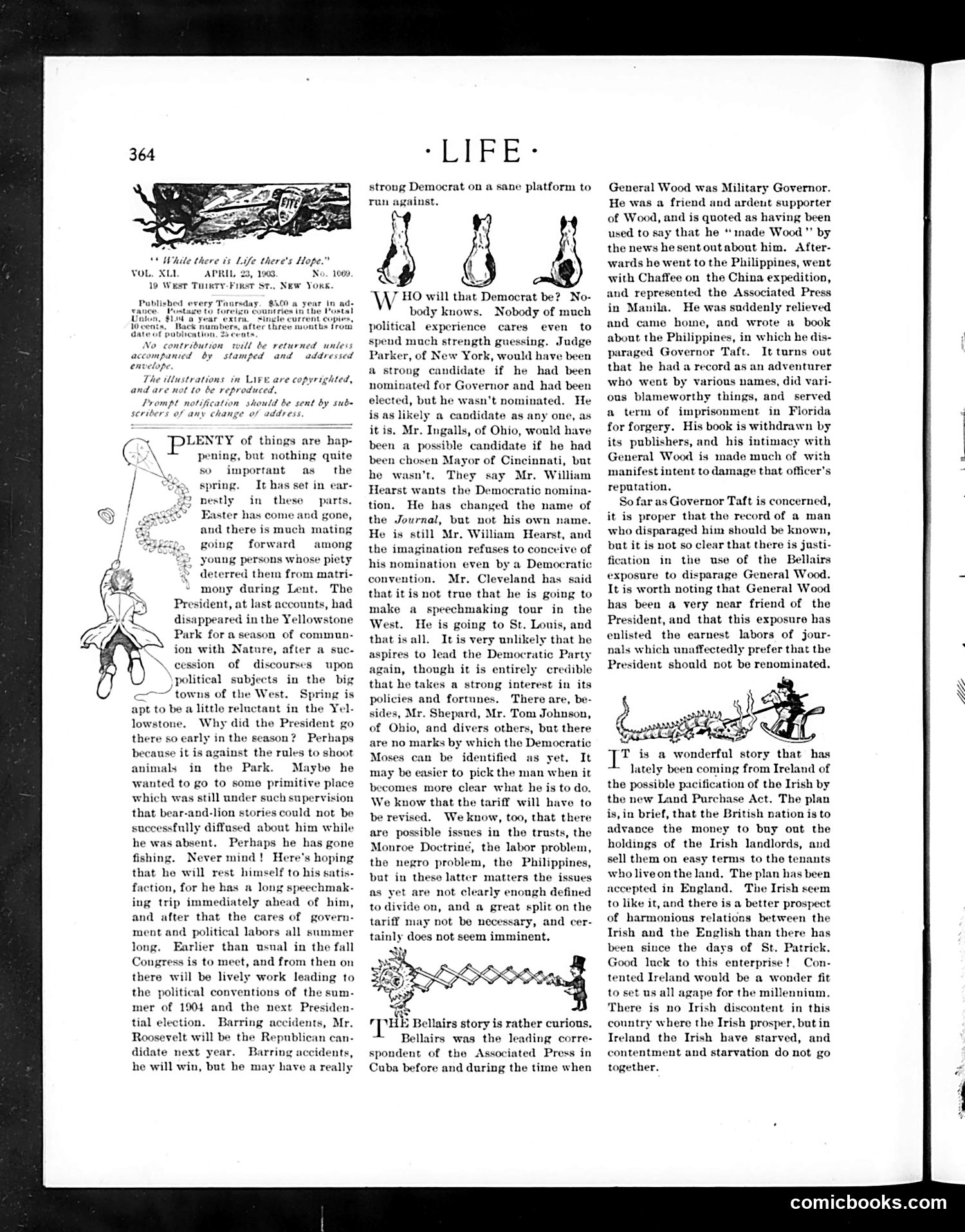
This page contains political commentary about Democratic Party leadership and candidates around 1900. The text discusses potential Democratic nominees, mentioning figures like William Hearst (who changed his newspaper's name from the *Journal*) and Judge Parker of New York as possible gubernatorial candidates. The cartoon on the left depicts a figure emerging from or associated with "the Yellowstone Park" — likely referencing President McKinley's recent disappearance there during a communion visit. The satire suggests Democratic leaders reluctant to take risks, perhaps hoping McKinley would vanish so they could claim power without real opposition. The cartoon's humor relies on readers knowing current political figures and recent news events of that election season.
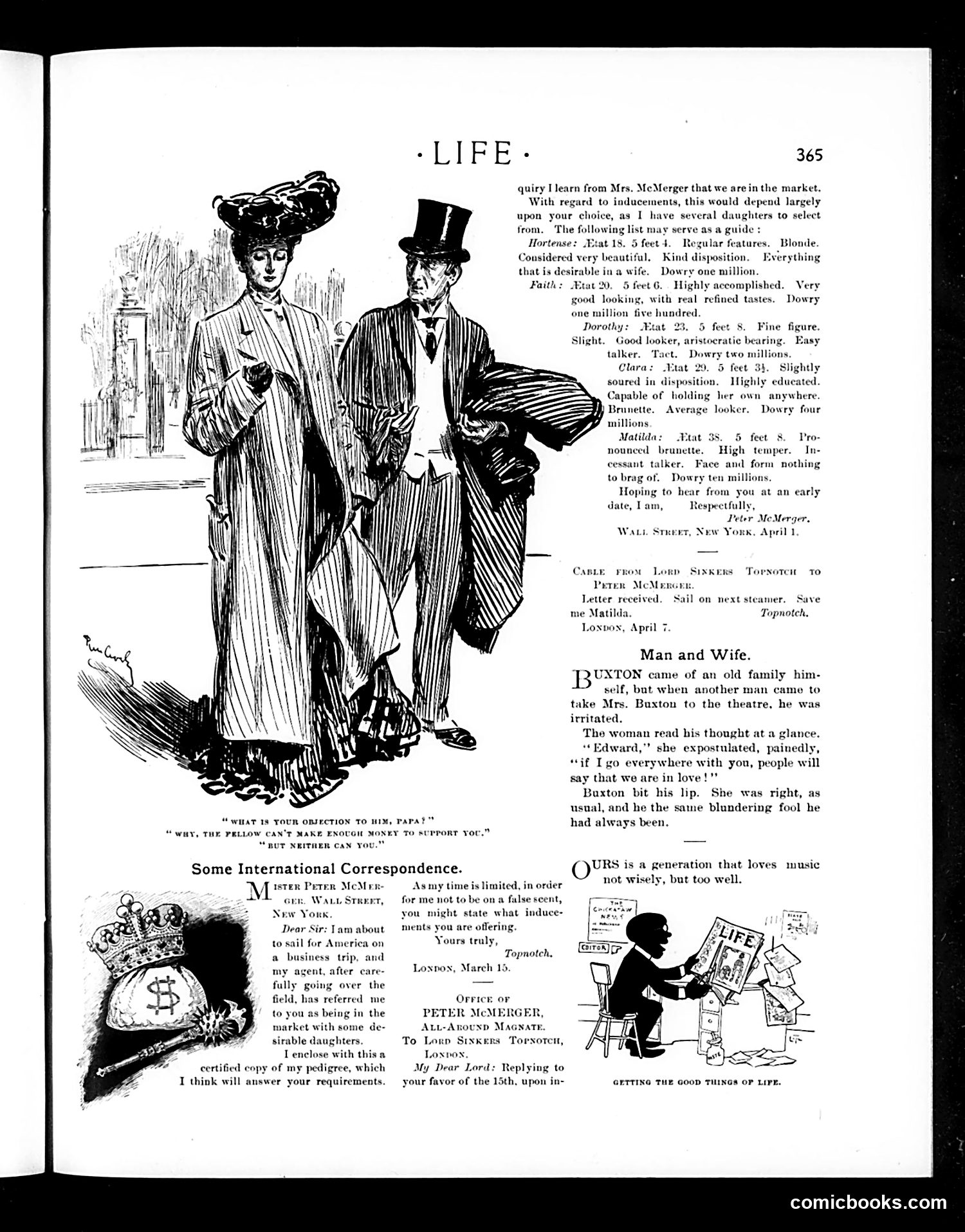
The main illustration depicts a well-dressed couple in early 1900s attire with the caption: "What is your objection to him, papa? 'Way, the fellow can't make enough money to support you. But neither can you.'" This satirizes **marriage and economic dependency**. The father objects to the suitor's financial inadequacy, yet the cartoon's punchline reveals the daughter herself is also financially dependent—highlighting the hypocrisy and economic vulnerability of unmarried women of that era who had limited earning opportunities. The page also contains **"Some International Correspondence,"** business letters regarding matrimonial prospects and market offerings, continuing the marriage-as-transaction theme. The smaller cartoon "Getting the Good Things of Life" shows a woman selecting from various publications, likely satirizing consumer culture and women's magazines.
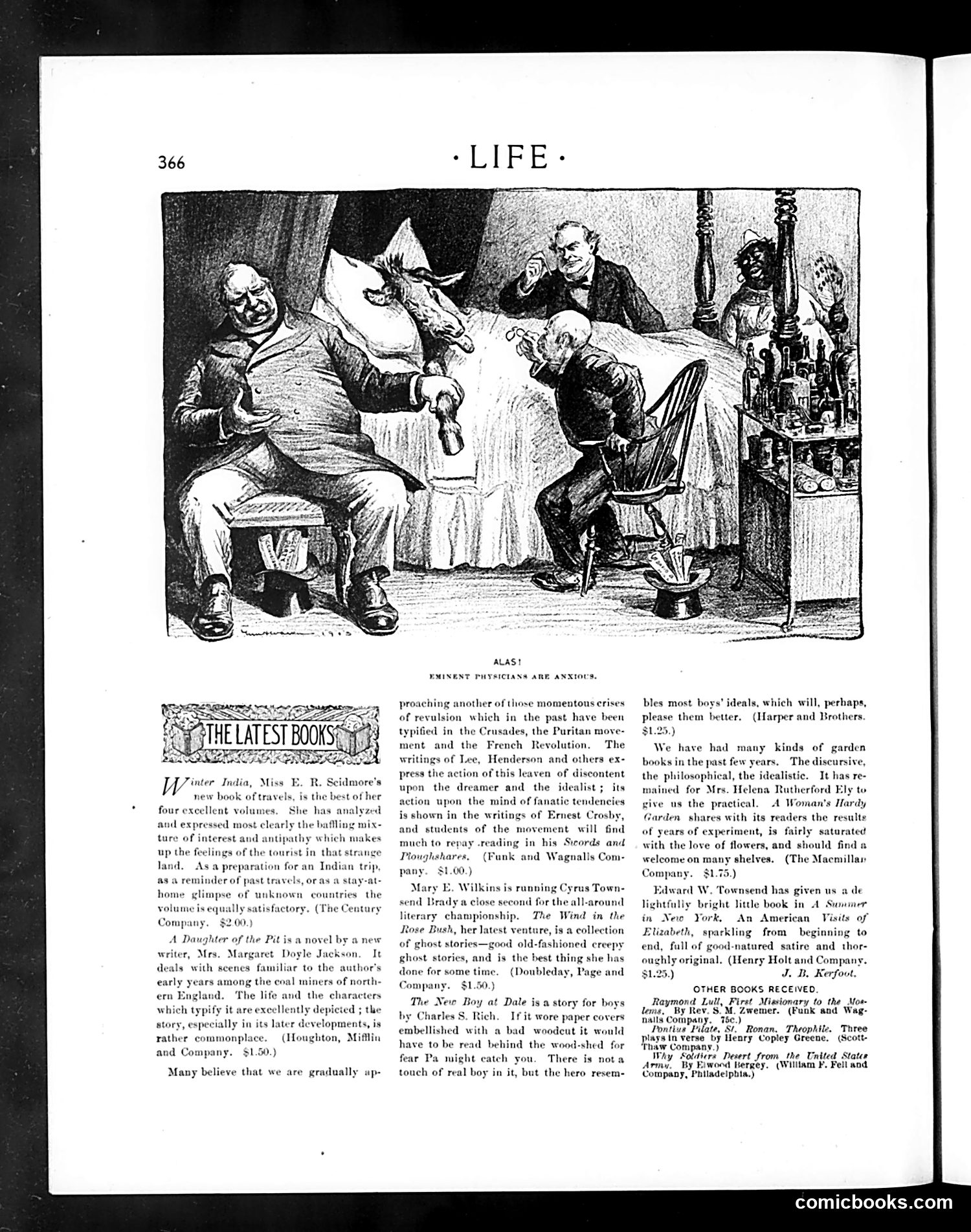
This satirical cartoon depicts a medical consultation, likely from the late 19th century. The caption suggests anxiety among prominent doctors about some unspecified ailment or crisis. The scene shows several distinguished-looking physicians attending to a patient in bed, their expressions grave and concerned. The satire appears to mock the helplessness of medical expertise when confronted with serious illness—the eminent doctors' evident worry undercuts their professional authority. The ornate bedroom setting and formal attire emphasize the gravity of the situation. Without additional context about contemporary medical scandals or prominent cases from this publication's date, the specific target remains unclear, but the cartoon likely satirizes either medical limitations, professional pomposity, or a specific contemporary health crisis that readers would have recognized.
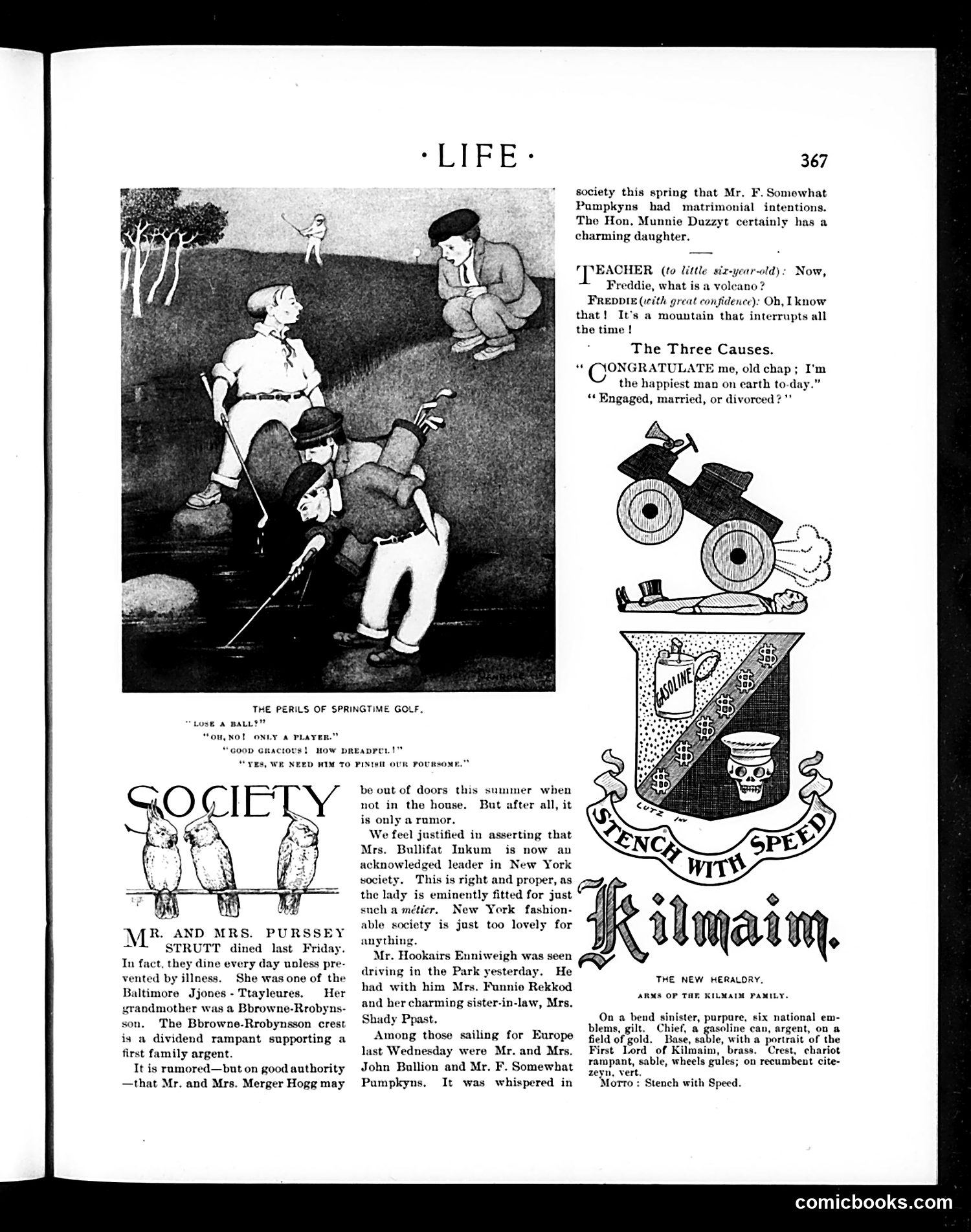
This cartoon satirizes how golf disrupts social life. The illustration shows golfers in various states of mishap on a course—one man has lost a ball, another appears injured. The dialogue reveals the joke: men prioritize golf over domestic responsibilities, with the punchline that they need the fourth player to "finish our foursome." The accompanying text mocks how golfers monopolize their time outdoors rather than attending to family obligations. The society section below continues this theme, noting that New York fashionable society will be empty this summer because men are out golfing instead of being home. This reflects early 20th-century anxieties about golf's grip on leisure time and masculine social behavior.
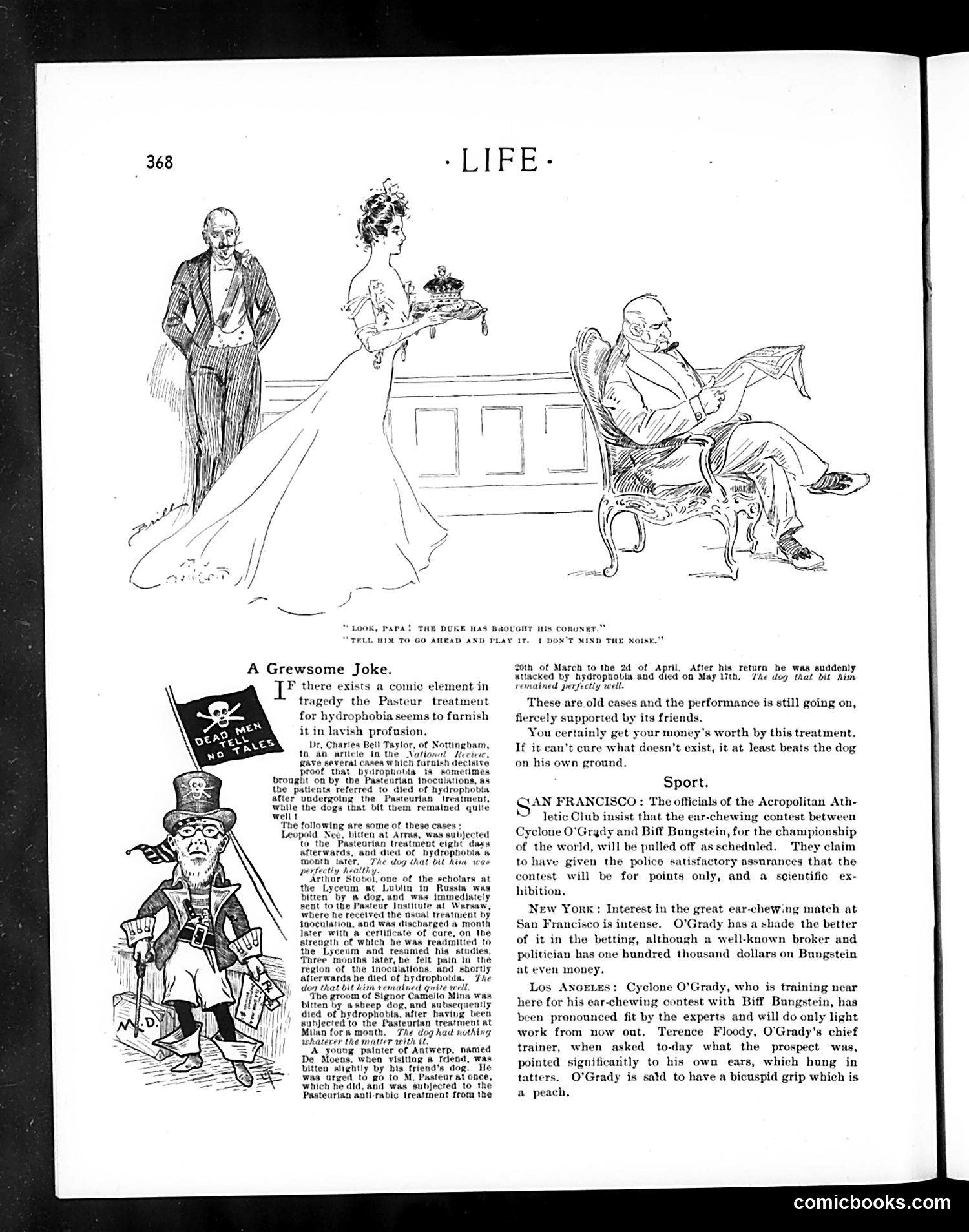
**Main Cartoon ("A Grewsome Joke"):** The top illustration depicts a formal social scene where a woman in an elegant gown presents what appears to be a severed head on a platter to a seated gentleman. The caption quotes: "Look, papa! The Duke has banquot his coronet" and "Tell him to go ahead and play it. I don't mind the noise." This is **satirical commentary on the Pasteur treatment for hydrophobia (rabies)**. The text explains that while the treatment sometimes worked, some patients died afterward anyway. The joke mocks the grim irony: presenting death as if it were a social entertainment or acceptable outcome of medical treatment—darkly suggesting the "cure" was as deadly as the disease itself.
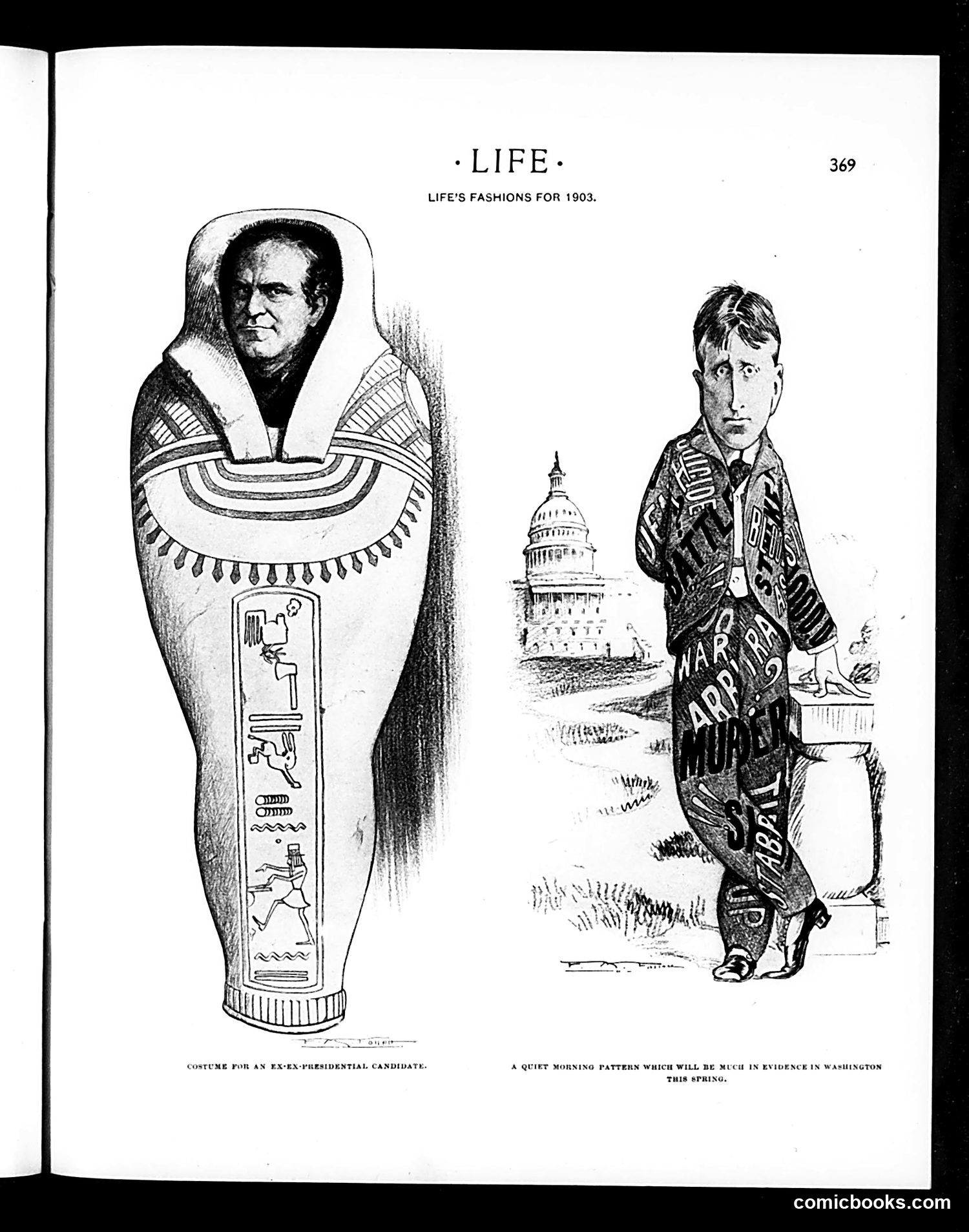
This satirical page presents two political cartoons mocking fashions in Washington politics. **Left cartoon:** Shows a man wrapped in an Egyptian mummy costume labeled "Costume for an Ex-Ex-Presidential Candidate." The Egyptian imagery suggests the figure is politically "dead" or obsolete—preserved like a mummy rather than actively participating in current politics. This appears to mock a former presidential candidate attempting relevance. **Right cartoon:** Depicts a man in ornate, patterned clothing near the Capitol, captioned "A Quiet Morning Pattern Which Will Be Much in Evidence in Washington This Spring." The elaborate, showy garments satirize the ostentatious or deceptive behavior expected in Washington political circles during spring—suggesting politicians will wear metaphorical "fancy dress" to hide their true nature. Both cartoons use costume/fashion as metaphors for political inauthenticity.
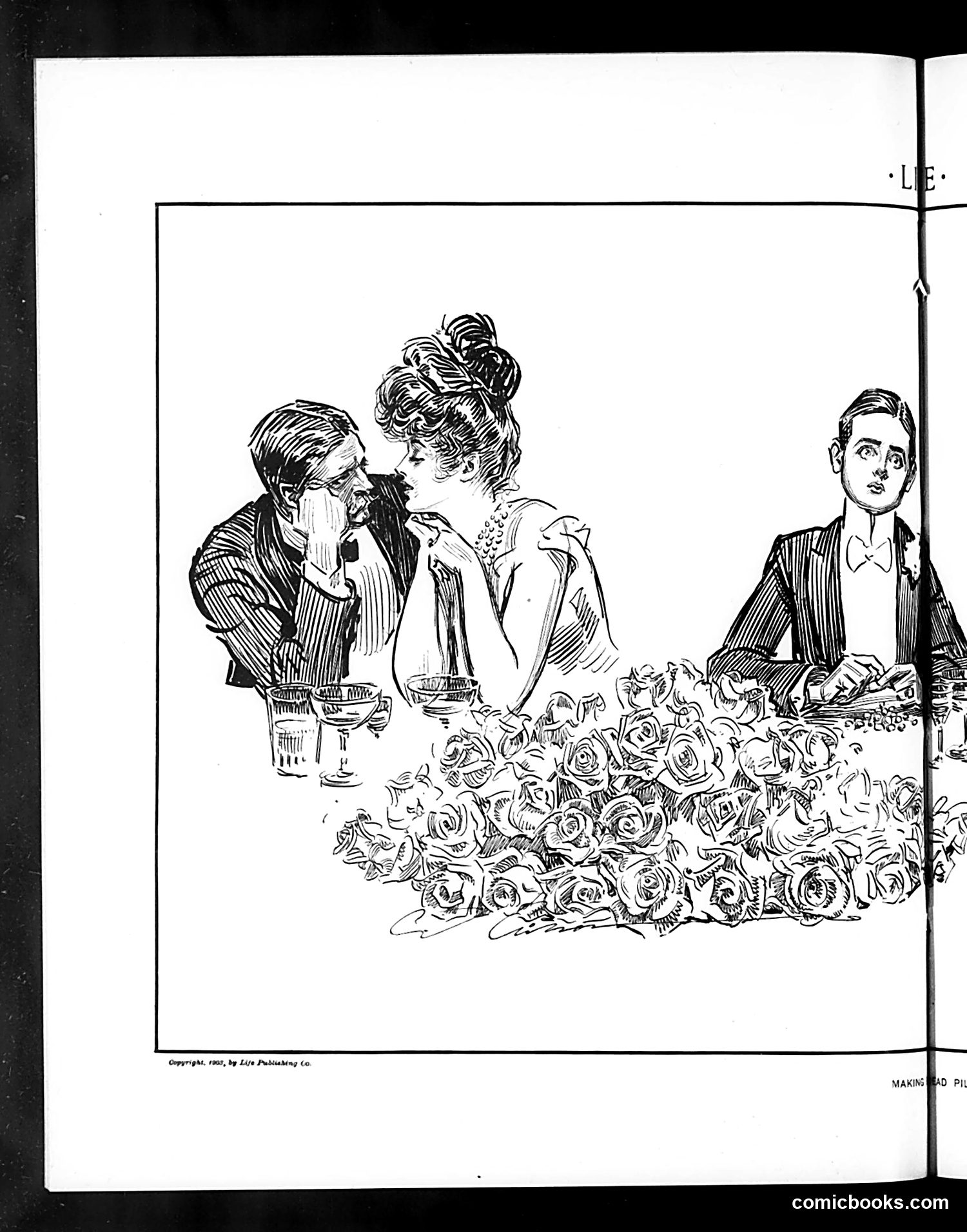
This is a satirical illustration showing three figures at what appears to be an elegant social gathering. Two men in formal attire flank a woman in an elaborate dress, with a large arrangement of roses dominating the lower portion of the image. The cartoon likely satirizes courtship rituals and romantic gestures of the early 20th century—specifically the extravagant use of flowers (particularly roses) as romantic tokens. The woman's elaborate appearance and the men's formal dress suggest upper-class social pretension. The enormous mass of roses appears exaggerated for comic effect, suggesting either excessive romantic devotion or the absurdity of using such lavish floral displays to impress. The title references "Making a Pic[ture]" (text cut off), though the specific satirical target remains unclear without additional context.
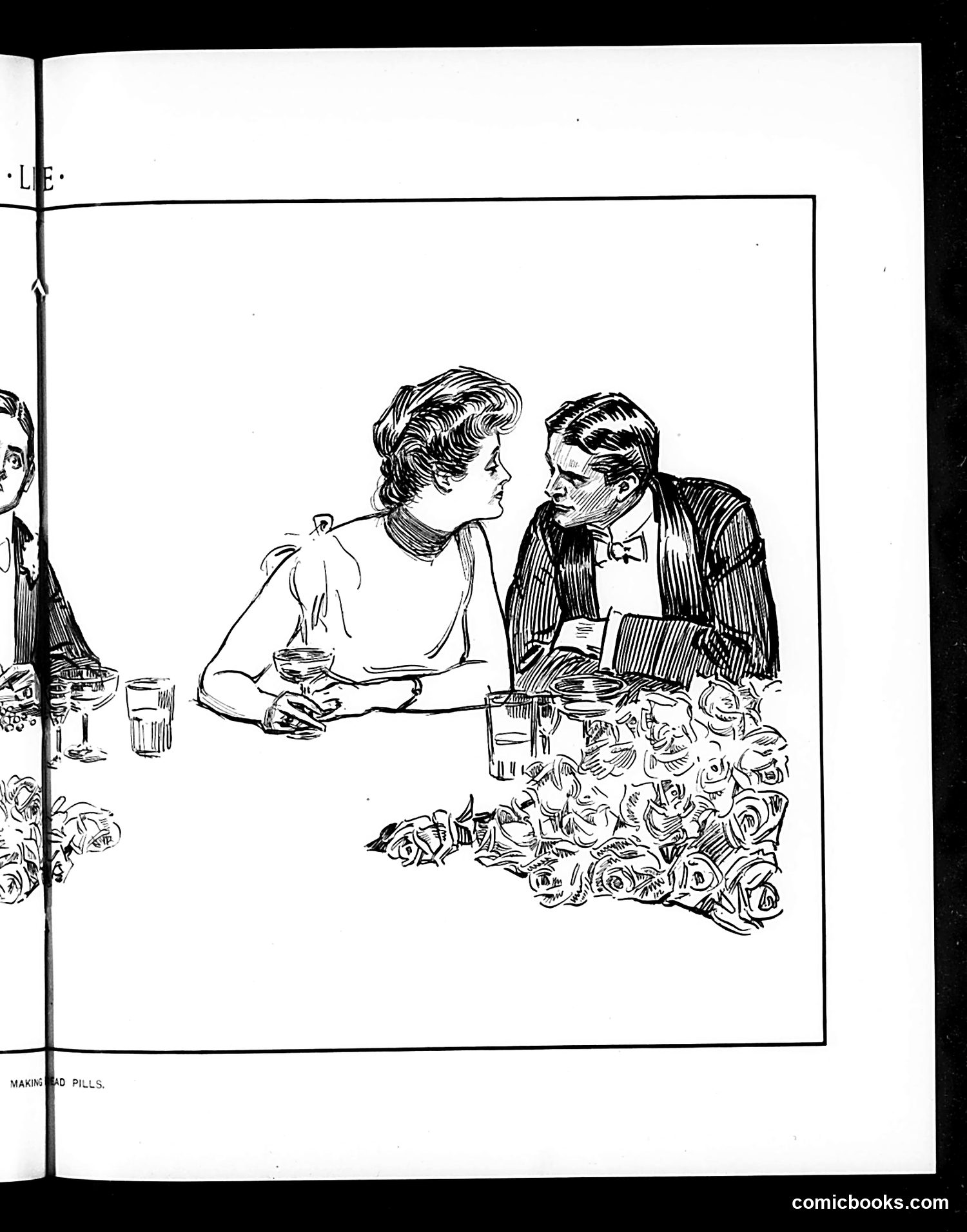
This appears to be a satirical illustration from *Life* magazine showing a romantic dinner scene. The caption at the bottom reads "MAKING BAD PILLS," though the full context is unclear from this page alone. The image depicts a well-dressed couple at a table surrounded by roses, with drinks and food. The man leans toward the woman in what appears to be a romantic gesture. The "bad pills" reference likely contains wordplay or double meaning typical of *Life*'s satirical humor. Without additional context about the specific issue date or surrounding articles, I cannot definitively identify the figures or explain the precise satirical target. The illustration style and subject matter suggest commentary on romance, courtship, or possibly pharmaceutical/medical practices of the era, but the exact joke remains unclear from this single page.
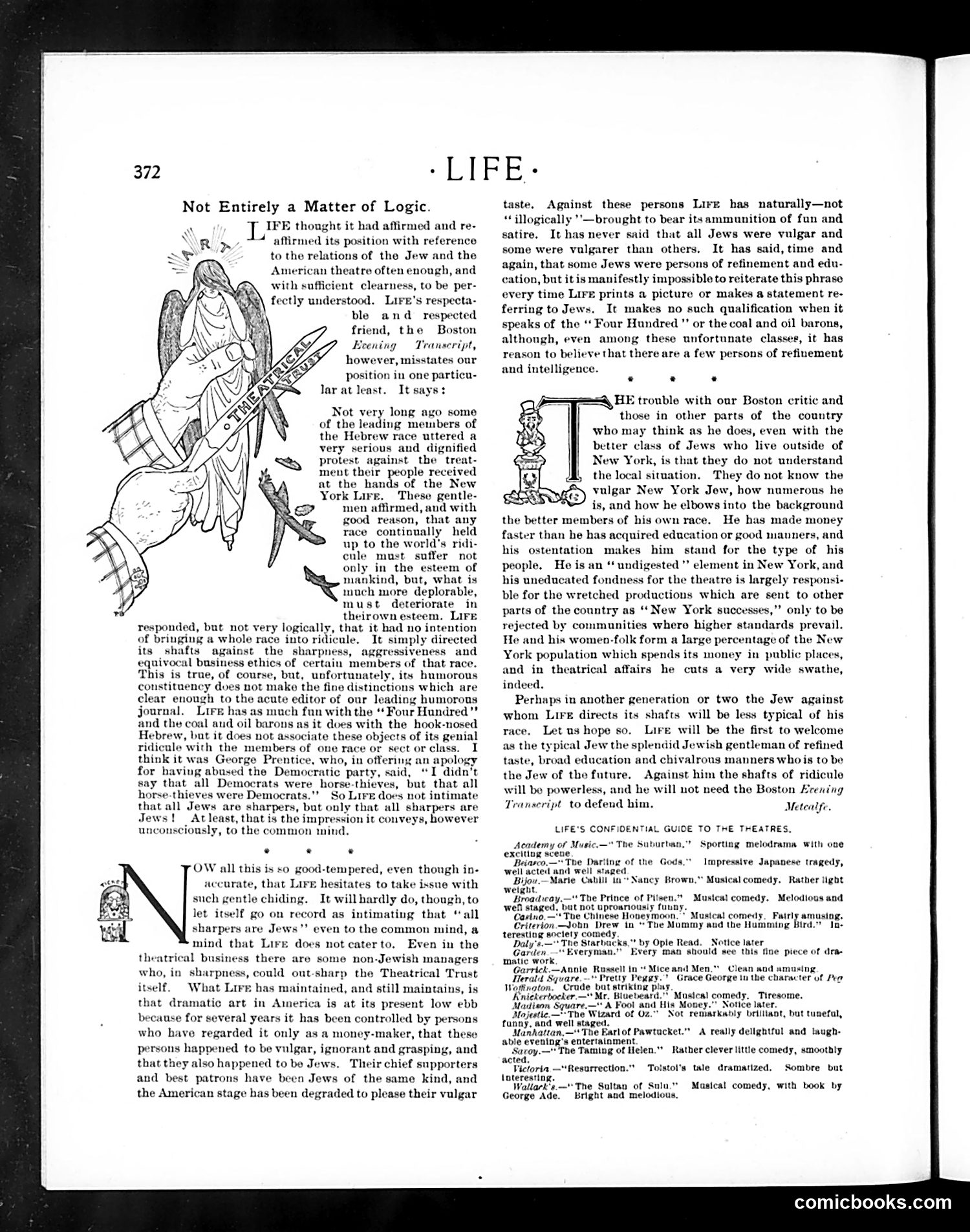
This page contains an essay titled "Not Entirely a Matter of Logic" addressing antisemitic stereotypes about Jewish Americans, particularly regarding their involvement in theater management and production in New York. The cartoon shows a caricatured figure with exaggerated Jewish features. The text defends Jews against claims that they control theater and monopolize entertainment, arguing that such accusations are illogical and unfair. It dismisses comparisons to George Prentice's Democratic apology, asserting that blanket statements about any ethnic group are unreasonable. The piece argues that Jewish theater managers and producers have legitimately succeeded in American business and should not face discriminatory attacks based on their religion or ethnicity. It's a defense against widespread early-20th-century antisemitic conspiracy theories about Jewish cultural influence.
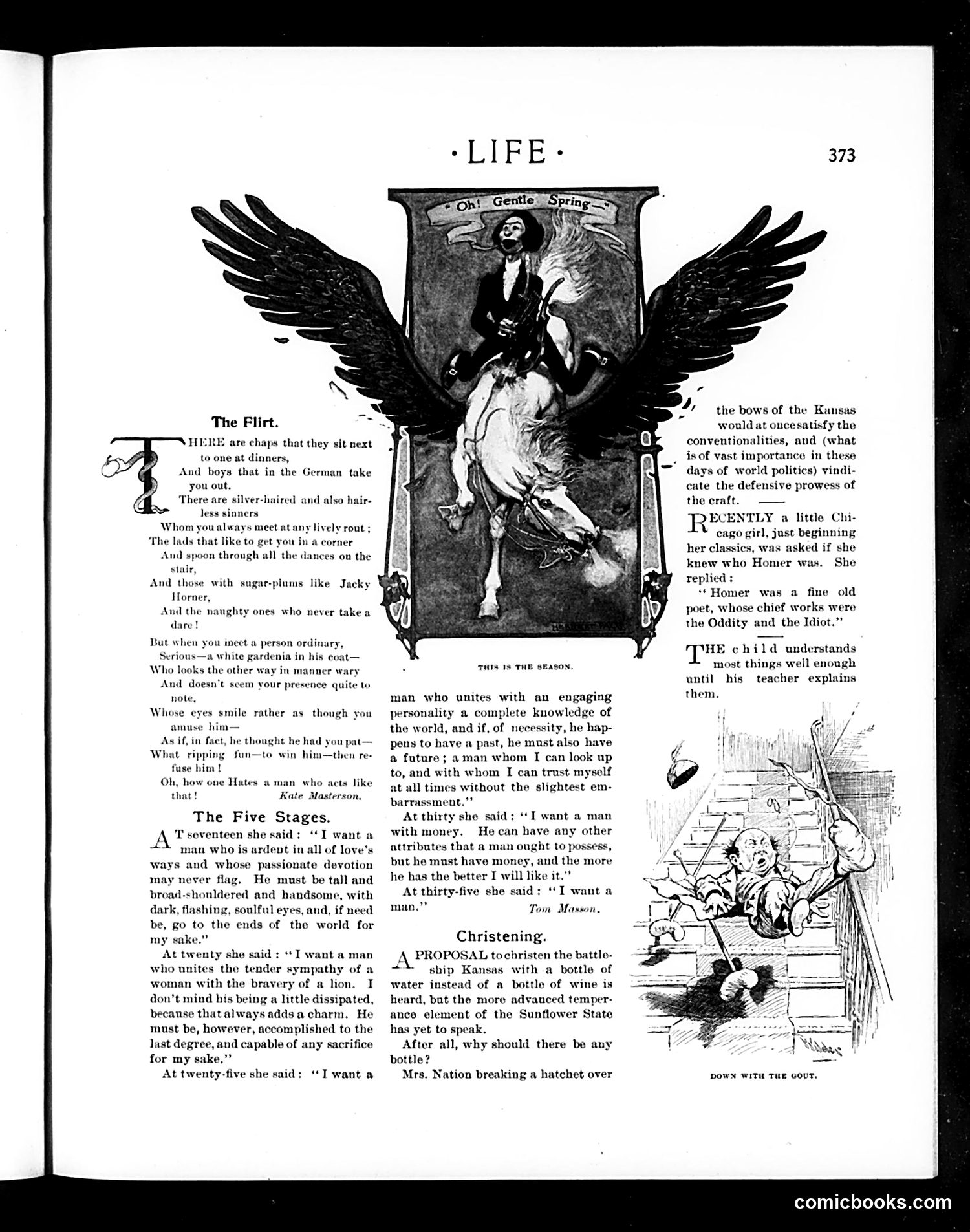
This page contains three satirical pieces mocking courtship and women's expectations: **"The Flirt"** and **"The Five Stages"** skewer women's romantic ideals. "The Five Stages" traces a woman's shrinking standards from age 17 (demanding passionate devotion, handsomeness, world-travel readiness) to 35 (wanting only money). The satire suggests women's romantic fantasies progressively collapse into mercenary pragmatism. **"Christening"** references the USS Kansas battleship and Carrie Nation, the temperance activist famous for destroying saloons with a hatchet. The joke proposes Nation break a bottle over the ship's bow instead of christening it traditionally—both mocking her extremism and making a pun on her violence. The page reflects early 20th-century attitudes toward women as flighty, calculating, or fanatical, presented as humor for Life's male readership. The cartoons and illustrations accompany these texts to reinforce their satirical points about female behavior.
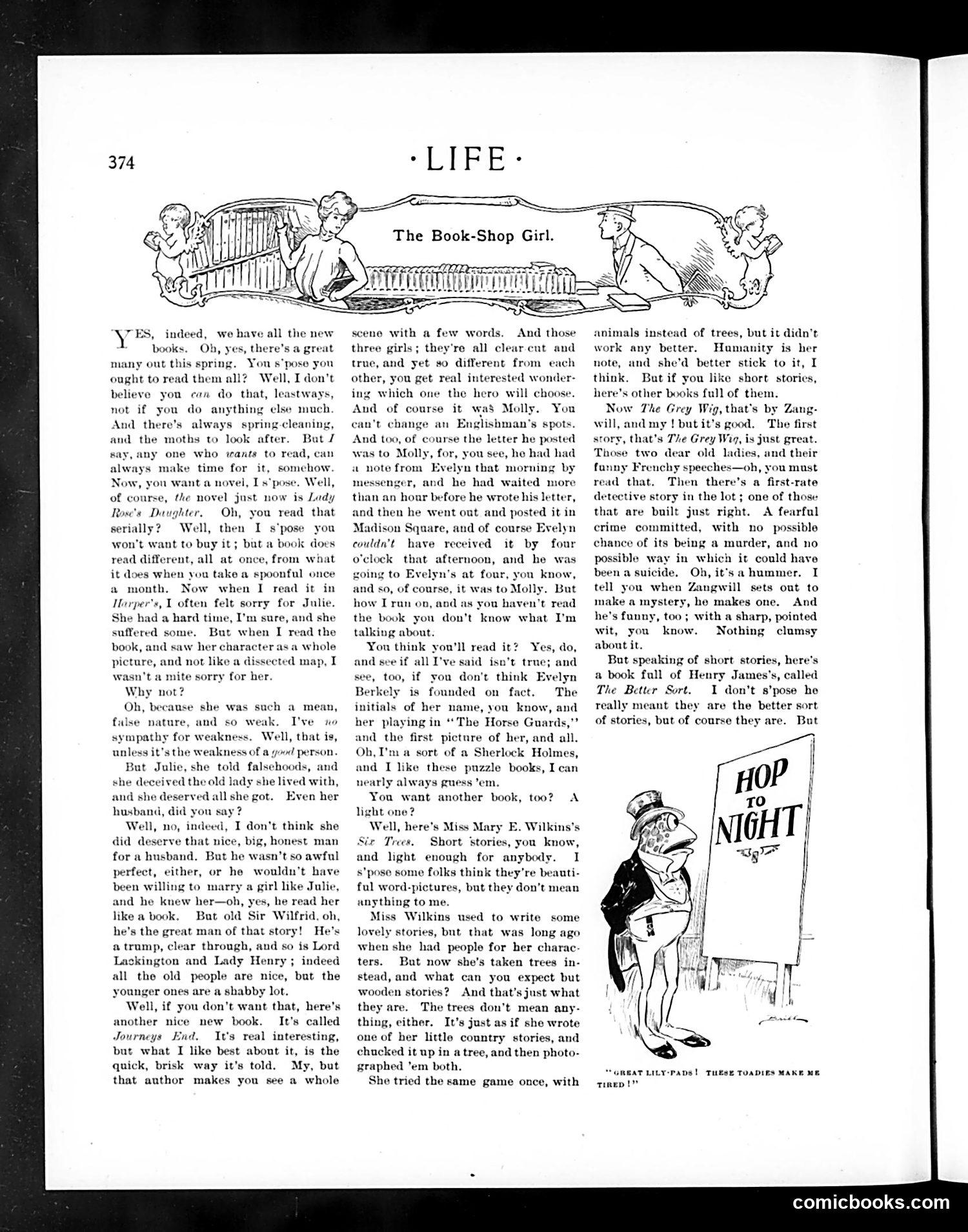
This page presents a monologue by a female bookstore clerk discussing new novels with a customer. The speaker recommends several contemporary books (*Lady Rose's Daughter*, *Journeys End*, Mary E. Wilkins's *Six Trees*) while dispensing shrewd literary criticism. The satire targets both the clerk's pretensions to literary judgment and contemporary fiction itself. She claims to psychoanalyze characters (Julie in *Rose's Daughter* deserves her suffering because she's deceitful), make biographical deductions worthy of "Sherlock Holmes," and dismiss respected authors as washed-up (Wilkins once wrote good stories about people, but now writes "wooden stories" about trees). The small "Hop to Night" advertisement at right features a tired figure—likely depicting the exhausted reader overwhelmed by spring's literary output. The satire suggests ordinary people confidently pontificate about literature while often missing nuance, and that modern fiction, despite acclaim, can be shallow or derivative.
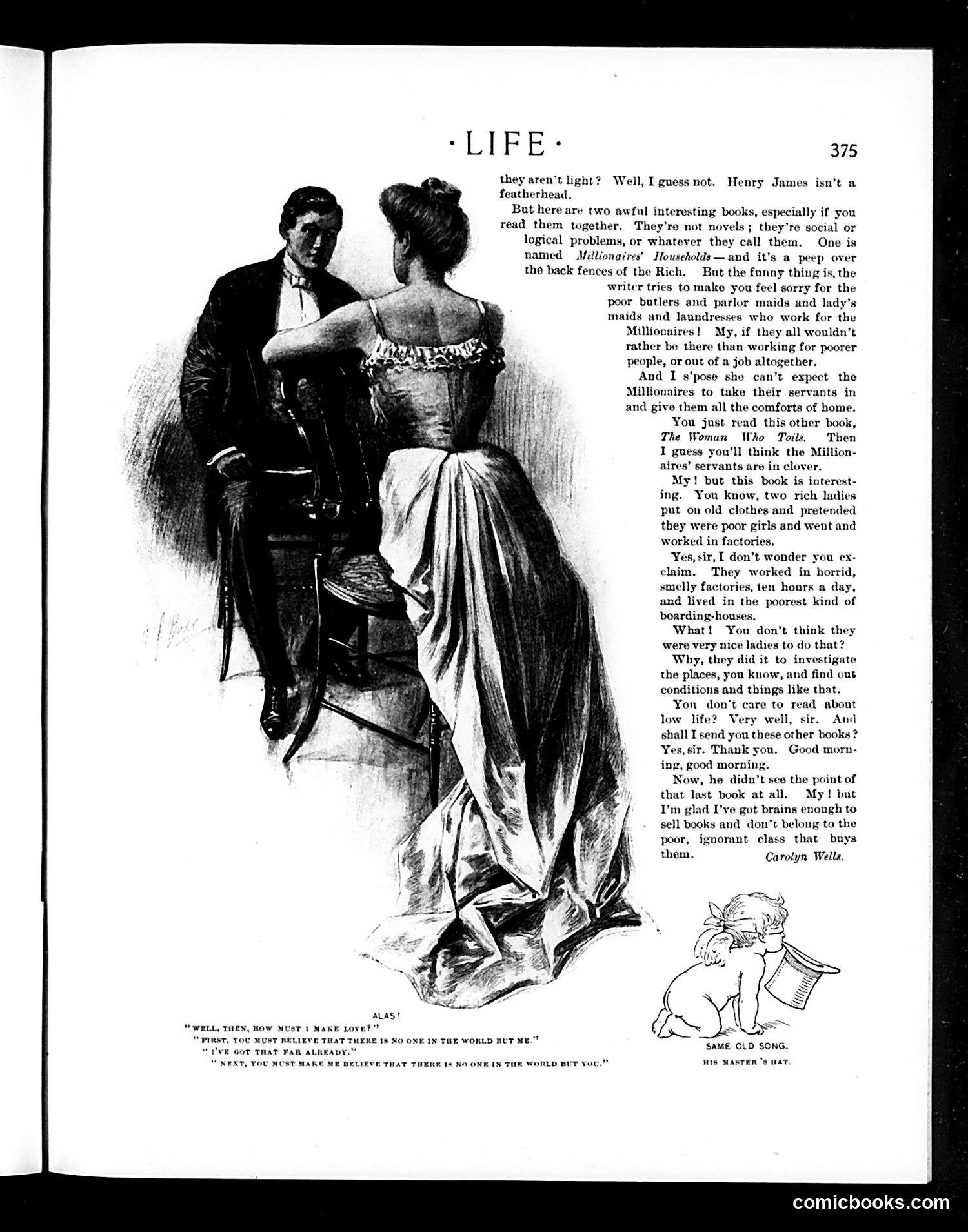
This page contains two distinct pieces of satire: **Main Illustration & Text (by Carolyn Wells):** A book salesman lectures a wealthy male customer about two social-issue books: *Millionaires' Households* and *The Woman Who Toils*. The salesman sarcastically praises the latter, which describes two rich women who disguised themselves as poor factory workers to investigate labor conditions. The joke targets the salesman's obliviousness—he's proud to sell books exposing exploitation while remaining blind to the absurdity: wealthy women playing at poverty for research rather than addressing actual suffering. The narrator smugly concludes he's too intelligent for such books, revealing his own class-blind hypocrisy. **Bottom Cartoon ("Same Old Song"):** A cupid addresses a man on making love, demanding the man believe "there is no one in the world but me," then reversing it. This satirizes the clichéd, reciprocal flattery of romantic courtship as mechanical performance rather than genuine feeling. Both pieces mock self-satisfied attitudes—toward class consciousness and romance respectively.
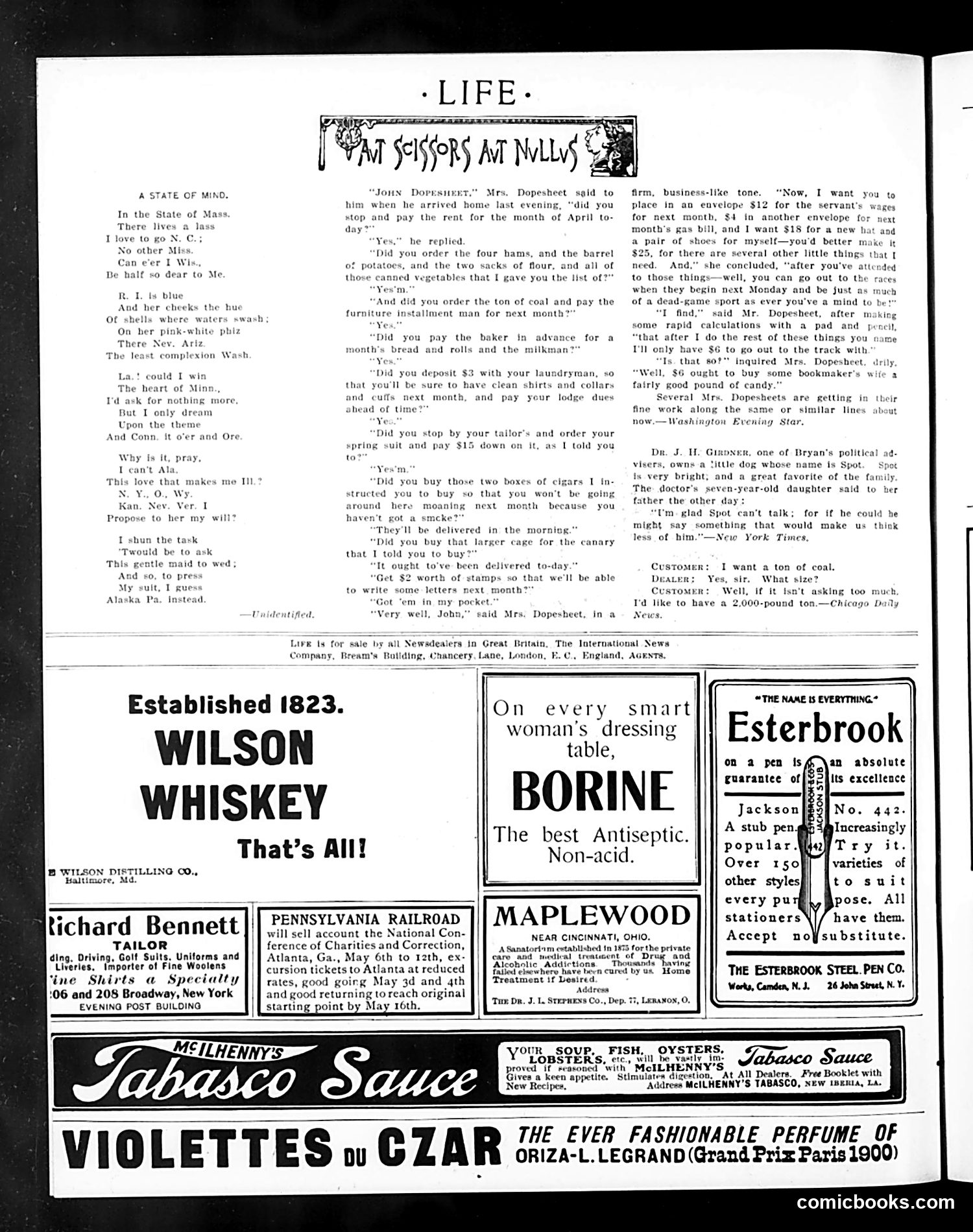
This page is primarily **advertising and filler content** rather than political satire. The main feature is "Mrs. Scissors Am Nullys"—a domestic humor column depicting marital financial negotiations between Mr. and Mrs. Dopesheet. **The satire:** The piece satirizes the tension between husbands wanting discretionary spending (particularly for gambling at the racetrack) and wives managing household budgets meticulously. Mrs. Dopesheet allocates money for servants, utilities, clothing, and other necessities, leaving her husband only $6 for betting—which she considers excessive. The humor relies on the contrast between her practical accounting and his desire for leisure spending. **Context for modern readers:** This reflects early 1900s gender dynamics where wives controlled household finances while husbands sought personal autonomy. The racetrack gambling reference was common entertainment. The second anecdote about Dr. Gidner's dog named "Spot" is unrelated humor. The remainder is period advertising for whiskey, railroads, pens, and sauce—typical of *Life* magazine's business model.
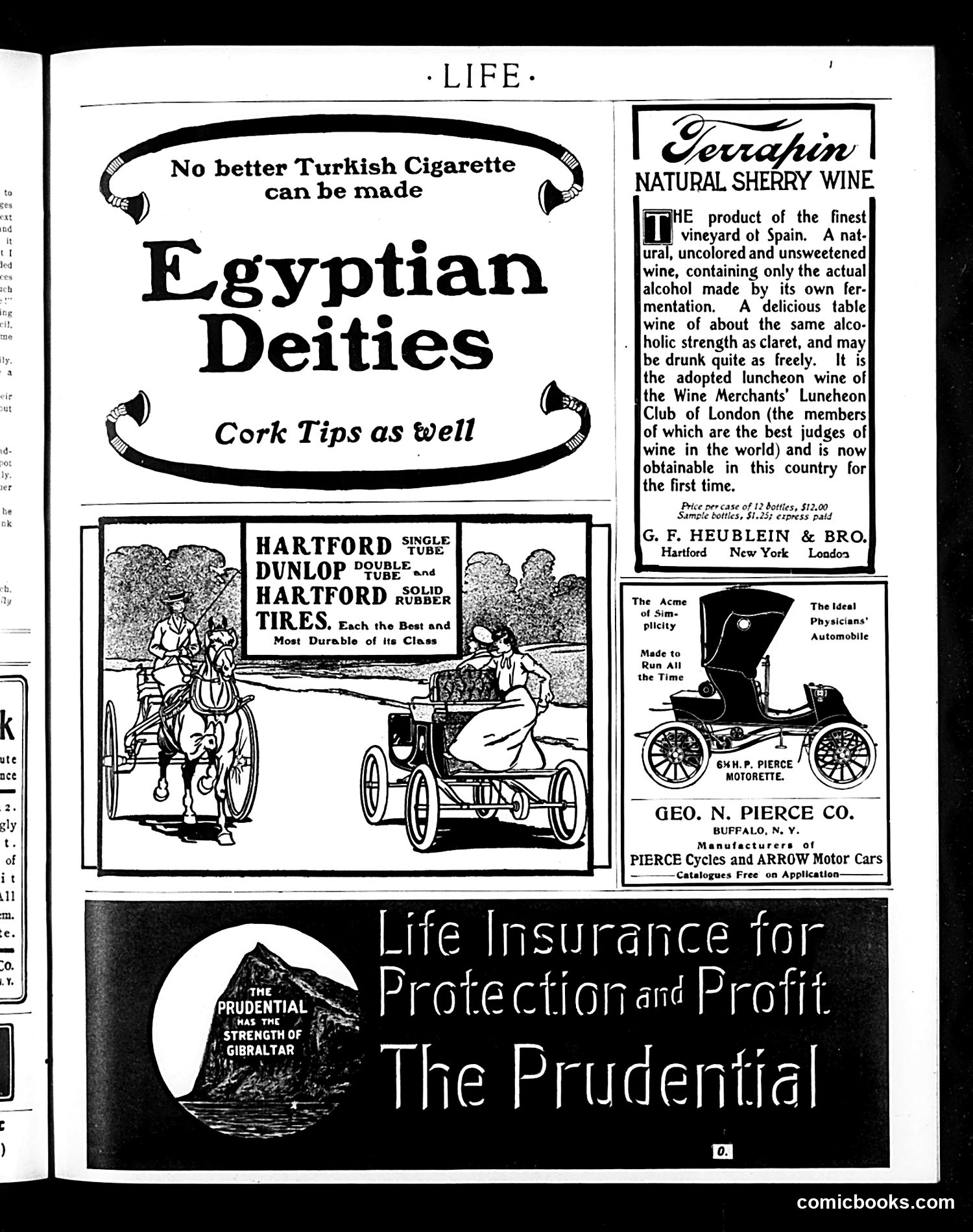
This page is primarily **advertising**, not satire or political commentary. It contains four commercial advertisements typical of early 20th-century American magazines: 1. **Egyptian Deities cigarettes** — promoting Turkish cigarettes with a small illustration showing people with horse-drawn carriages 2. **Terrapín Natural Sherry Wine** — Spanish wine marketed as a luxury luncheon beverage 3. **Hartford Dunlop Tires** — automobile tires advertised as durable 4. **Pierce Motorette and Pierce Arrow automobiles** — early motor cars Below is a **Prudential Life Insurance** advertisement featuring the company's iconic Rock of Gibraltar logo. The page reflects early 1900s consumer culture: cigarettes, wine, and automobiles were marketed as status symbols to affluent readers. There is **no apparent political cartoon or satire** here—it's a straightforward advertising section from *Life* magazine's commercial content.
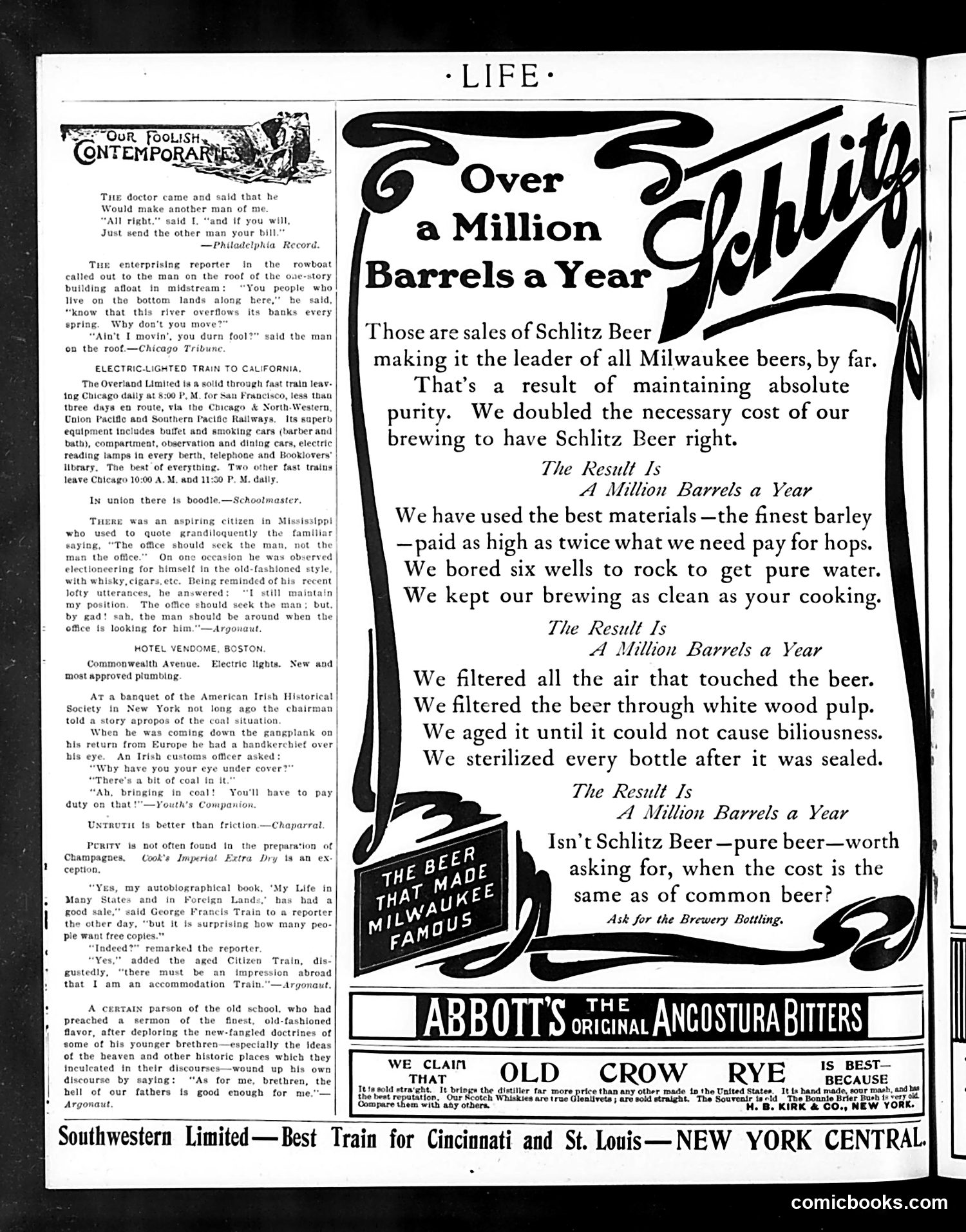
This page from *Life* magazine combines satirical editorial content with period advertisements. **The Cartoons/Satire:** The left column contains brief humorous anecdotes—short jokes about foolish contemporary behavior. These include a doctor's retort about payment, a reporter questioning a flood-prone homeowner, and commentary on train travel and bribery ("In union there is boodle"). The humor relies on wordplay and ironic observations of daily American life. **The Advertisements:** The dominant content is a large Schlitz Beer advertisement claiming "Over a Million Barrels a Year" in sales. It emphasizes the brewery's quality-control measures (filtered water, sterilized bottles, aged beer) to justify premium pricing. Below that are ads for Abbott's Bitters and Old Crow Rye whiskey, typical for the era. **Historical Context:** This appears to be pre-Prohibition content celebrating American beer and liquor production. The page reflects early 20th-century consumer marketing emphasizing manufacturing superiority and purity standards.
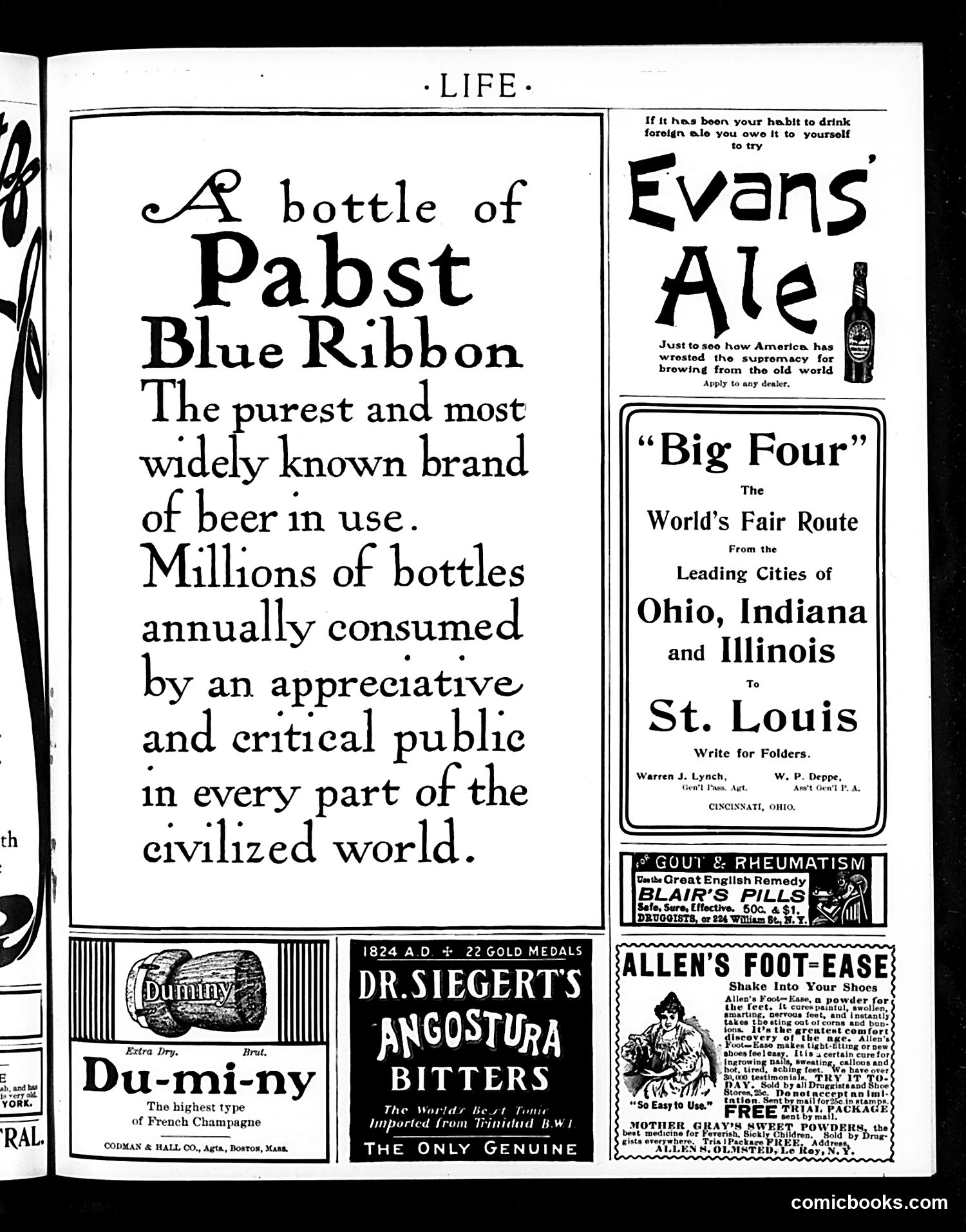
This is primarily an **advertising page**, not editorial content or satire. It contains five product advertisements typical of early 20th-century Life magazine. The main ad promotes **Pabst Blue Ribbon beer**, claiming it's "the purest and most widely known brand" consumed globally by "an appreciative and critical public." This reflects pre-Prohibition era advertising (before 1920). Supporting ads include: - **Evans' Ale** (positioning American brewing as superior to "the old world") - **Du-mi-ny** champagne - **Dr. Siegert's Angostura Bitters** (a medicinal tonic) - **Blair's Pills** and **Allen's Foot-Ease** (patent medicines) These ads showcase common commercial claims of the era: purity, international prestige, and curative properties. The "Big Four" travel route ad promotes St. Louis tourism, likely tied to a World's Fair. There is **no political cartoon or satire present**—this is straightforward period advertising.
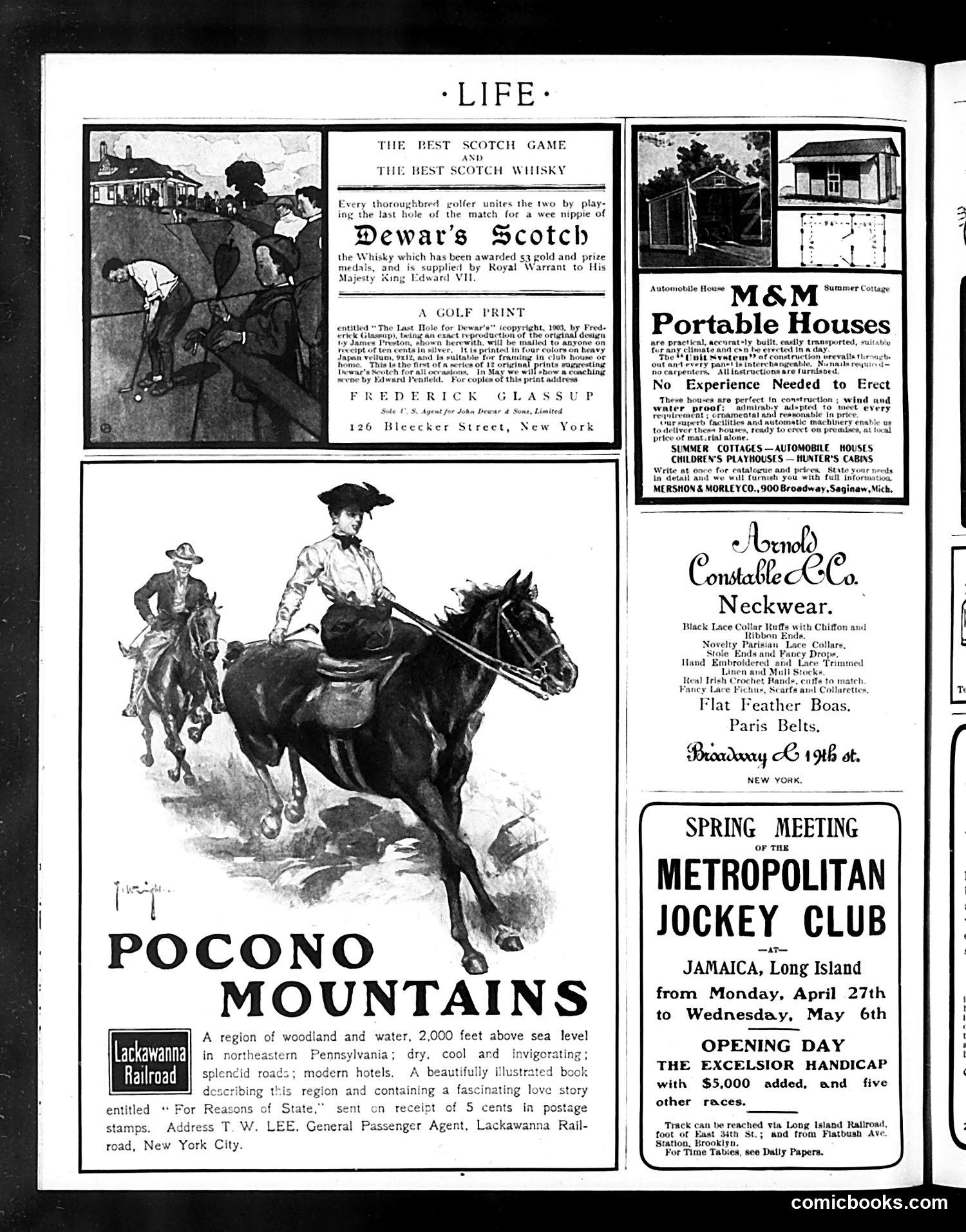
This is primarily an **advertising page** rather than editorial satire. The content reflects early 1900s American consumer culture and leisure. The main illustration depicts **horseback riders in Western/frontier dress**, likely advertising the Pocono Mountains as a destination for outdoor recreation and romance. The accompanying text emphasizes the region's natural attractions: elevation, woodland, water, and "modern hotels." Other advertisements target affluent readers: Dewar's Scotch whisky (marketed to golfers, with royal warrant endorsement), portable houses and cottages (practical leisure structures), Arnold Constable neckwear and accessories (fashionable goods), and the Metropolitan Jockey Club's spring horse-racing meet on Long Island. The page reflects **Edwardian-era leisure culture**—golf, horseback riding, horse racing, and resort travel were markers of upper-class recreation. There is no political satire visible; this represents *Life's* commercial advertising base supporting its editorial content.
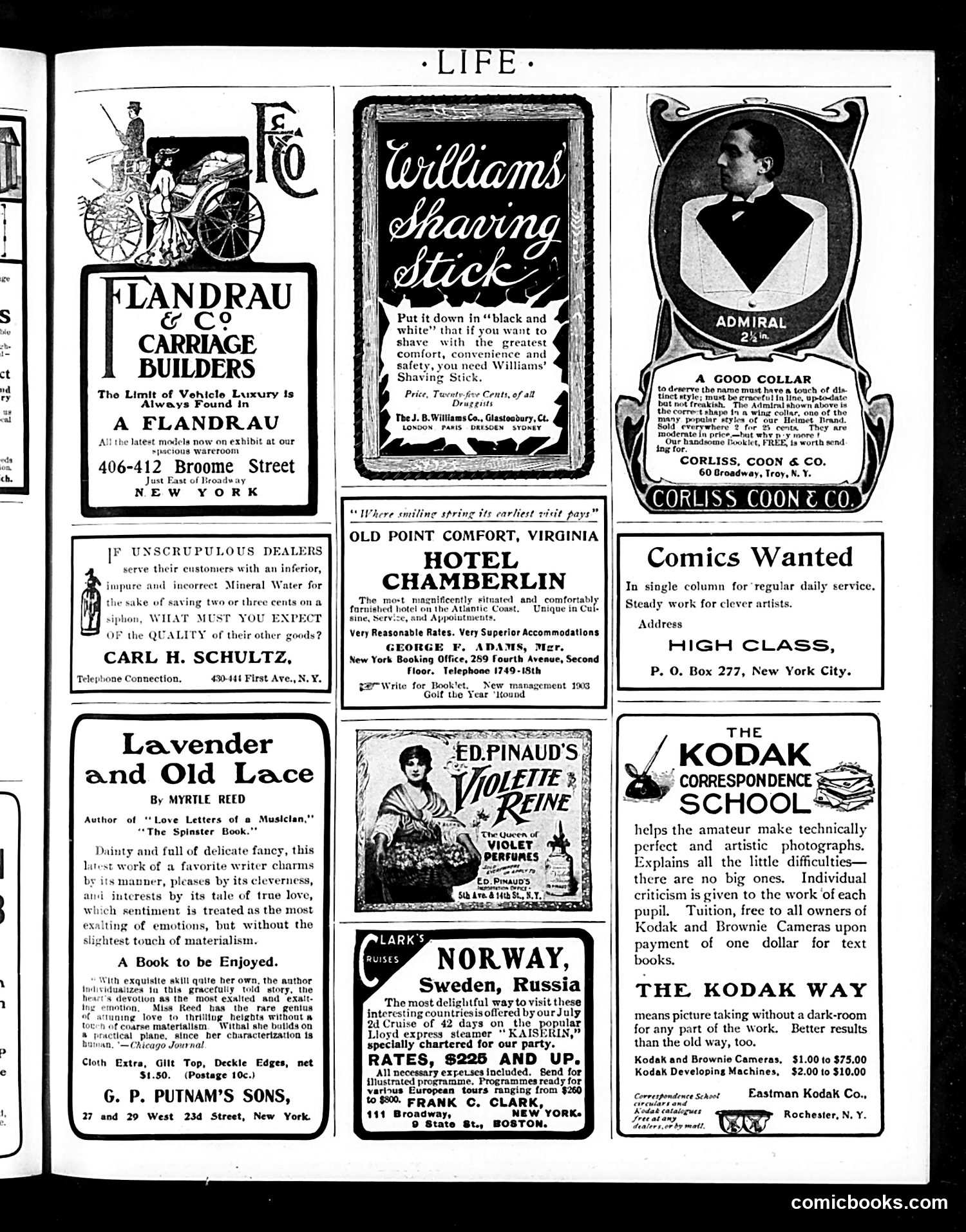
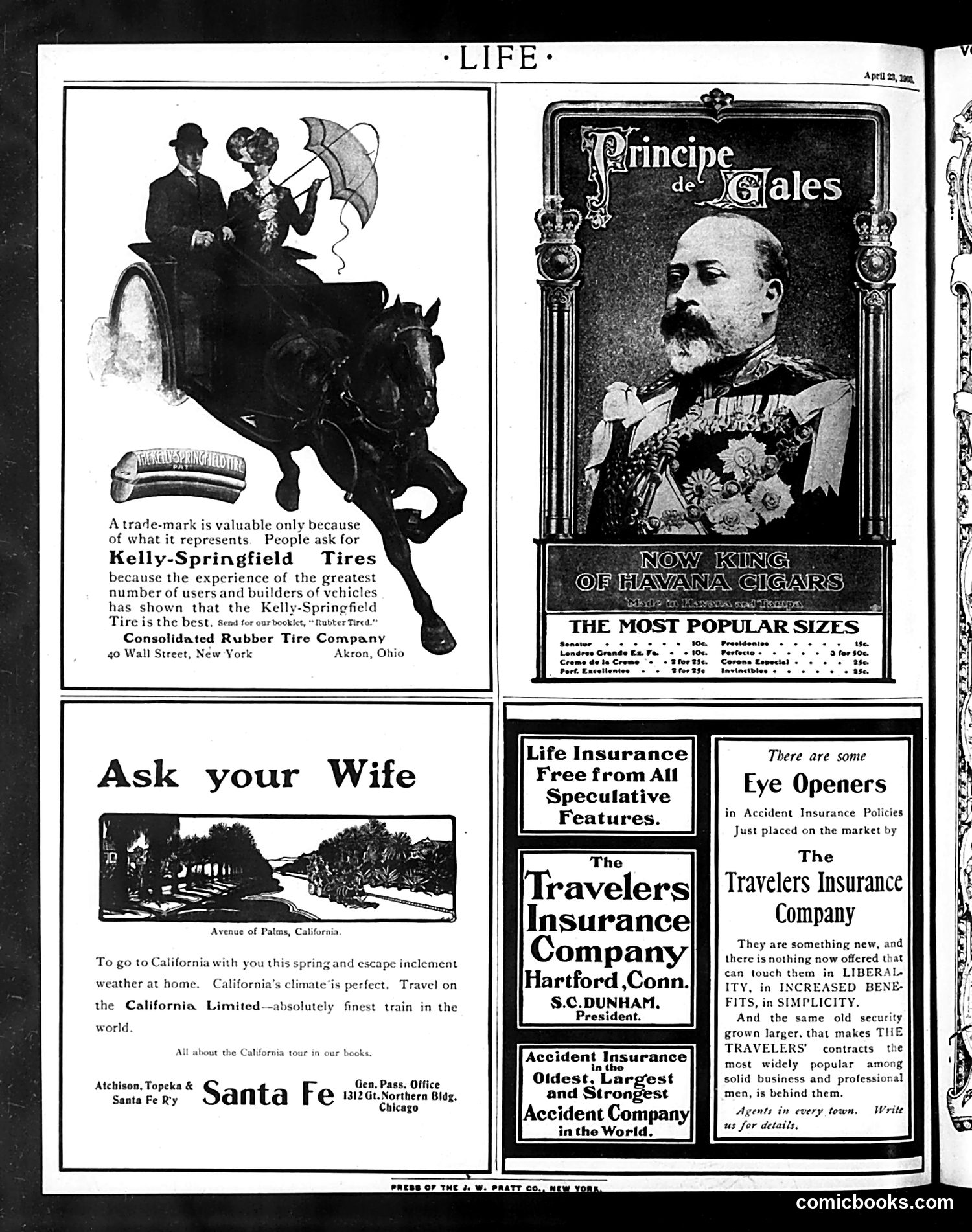
This page is primarily **advertising**, not political satire. It contains four distinct ads: 1. **Kelly-Springfield Tires**: Uses an illustration of a fashionable couple in a carriage to argue that brand reputation—built on user experience—drives purchasing decisions. 2. **Santa Fe Railway**: Targets husbands with the tagline "Ask your Wife," suggesting California travel as a spring escape from bad weather. Pitches the "California Limited" as the world's finest train. 3. **Travelers Insurance Company**: Two overlapping ads promoting accident insurance, emphasizing their status as "oldest, largest and strongest" and highlighting new liberal benefits. 4. **Prince of Gales Havana Cigars**: Features what appears to be royalty (unclear which prince) to associate the product with prestige. The page reflects early 1900s consumer culture: brand loyalty, leisure travel, insurance products, and aspirational advertising linking products to status and authority figures.