
Life, 1903-04-23 · page 14 of 22
Life — April 23, 1903 — page 14: what you’re looking at
What you’re looking at
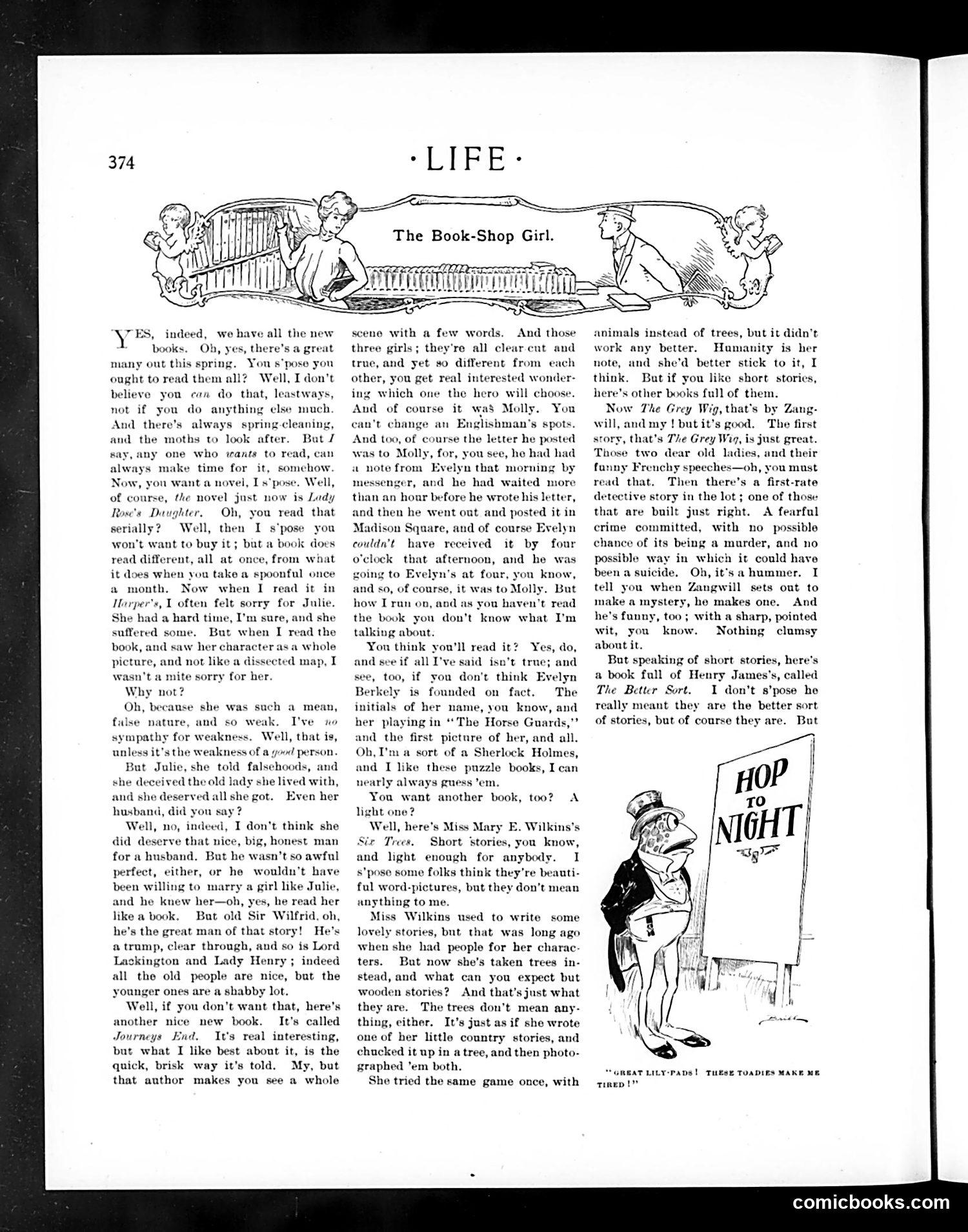
This page presents a monologue by a female bookstore clerk discussing new novels with a customer. The speaker recommends several contemporary books (*Lady Rose's Daughter*, *Journeys End*, Mary E. Wilkins's *Six Trees*) while dispensing shrewd literary criticism. The satire targets both the clerk's pretensions to literary judgment and contemporary fiction itself. She claims to psychoanalyze characters (Julie in *Rose's Daughter* deserves her suffering because she's deceitful), make biographical deductions worthy of "Sherlock Holmes," and dismiss respected authors as washed-up (Wilkins once wrote good stories about people, but now writes "wooden stories" about trees). The small "Hop to Night" advertisement at right features a tired figure—likely depicting the exhausted reader overwhelmed by spring's literary output. The satire suggests ordinary people confidently pontificate about literature while often missing nuance, and that modern fiction, despite acclaim, can be shallow or derivative.
📄 Transcribed text from this page (OCR, searchable)
Machine-transcribed from the original scan — historical spelling and the odd misread are preserved.
we have all the new s, there's a great indeed, Oh many out this spring. You s'pose you ought to read them all? Well, I don't believe you can do that, leastways, not if you do anything else much. And there’s always spring-cleaning, and the moths to look after. But J Ye: books. ny one who wants to read, can time for it, on want a novel, I s’pos e, the novel just now Rose's Daughter, serially? somehow Well, is Lady Oh, you read that Well, then I s‘pose you won't want to buy it; but a book does read different, all at once, from what it does when you take a spoonful once a month. Now when I read it in Harper's, 1 often felt sorry for Julie. She had a hard time, I’m sure, and she suffered some. But when I read the book, and saw her character as a whole picture, and not like a dissected map, I wasn't a mite sorry for her. Why not? Oh, because she was such a mean, false nature, and so we I've no sympathy for weakness. Well, that is, unless it’s the weakness of a yoo person. 3ut Julie, she told falsehoods, and she deceived the old lady she lived with, and she deserved all she got. Even her husband, did you say? Well, no, indeed, I don't think she did deserve that nice, big, honest man for a husband. But he wasn’t so awful perfect, either, or he wouldn't bh; been willing to marry a girl like Julie, and he knew her—oh, yes, he read her like a book. But old Sir Wilfrid, oh, he's the great man of that story! He’s atramp, clear through, and so is Lord Lackington and Lady Henry ; indeed all the old people are nice, but the younger ones are a shabby lot. Well, if you don’t want that, here's another nice new book. It’s called Journeys End. It's real interesting, but what I like best about it, is the quick, brisk way it’s told. My, but that author makes you see a whole scene with a few words. And those three girls; they're all clearcut and true, and yet so different from each other, you get real interested wonder- ing which one the hero will choose. And of course it was Molly. You can't change au Englishman's spots. And too, of course the letter he posted was to Molly, for, you see, he had had a note from Evelyn that morning by messenger, and he had waited more than an hour before he wrote his letter, and then he went out and posted it in Madison Square, and of course Evelyn couldn't have received it by four o'clock that afternoon, and he was going to Evelyn's at four, you know, and so, of course, it was to Molly. But how Tran on, and as you haven't read the book you don't know what I'm talking about. You think you'll read i Yes, do, and see if all I've said isn’t true; and see, too, if you don't think Evelyn Berkely is founded on fact. The initials of her name, you know, and her playing in ‘The Horse Guards,”’ and the first picture of her, and all. Ob, I'm a sort of a Sherlock Holmes, and I like these puzzle books, I can nearly always guess ’em. You want another book, too? A light one? Well, here’s Miss Mary E. Wilkins’s Trees. Short ‘Stories, you know, and light enough for anybody. I s’pose some folks think they’re beauti- ful word-pictures, but they don’t mean anything to me. Miss Wilkins used to write some lovely stories, but that was long ago when she had people for her charac- ters. But now she’s taken trees in- stead, and what can you expect but wooden stories? And that’s just what they are. The trees don’t mean any- thing, either. It’s just f she wrote one of her little country stories, and chucked it up in a tree, and then photo- graphed ’em both. She tried the same game once, with Sir animals instead of trees, but it didn't work any better. Humanity is her note, and she'd better stick to it, I think. Butif you like short stories, here’s other books full of them. Now The Grey Wig, that’s by Zang- will, and my ! butit’s good. The first story, that’s The Grey Wig, is just great. Those two dear old ladies, and their fanny Frenchy speeches—oh, you must read that. Then there’s a first-rate detective story in the lot ; one of those that are built just right. A fearful crime committed, with no possible chance of its being a murder, and no possible way in which it could have been a suicide, Oh, it’sa hummer, I tell you when Zangwill sets out to make a mystery, he makes one. And he’s funny, too; with a sharp, pointed wit, you know. Nothing clumsy about it. But speaking of short stories, here's a book full of Henry James's, called The Better Sort. 1 don't s'pose he really meant they are the better sort of stories, but of course they are. But “GREAT LILY-PaDs! THESE TOADIES MAKE ME tinep 1” comicbooks.com