
Life, 1903-04-23 · page 12 of 22
Life — April 23, 1903 — page 12: what you’re looking at
What you’re looking at
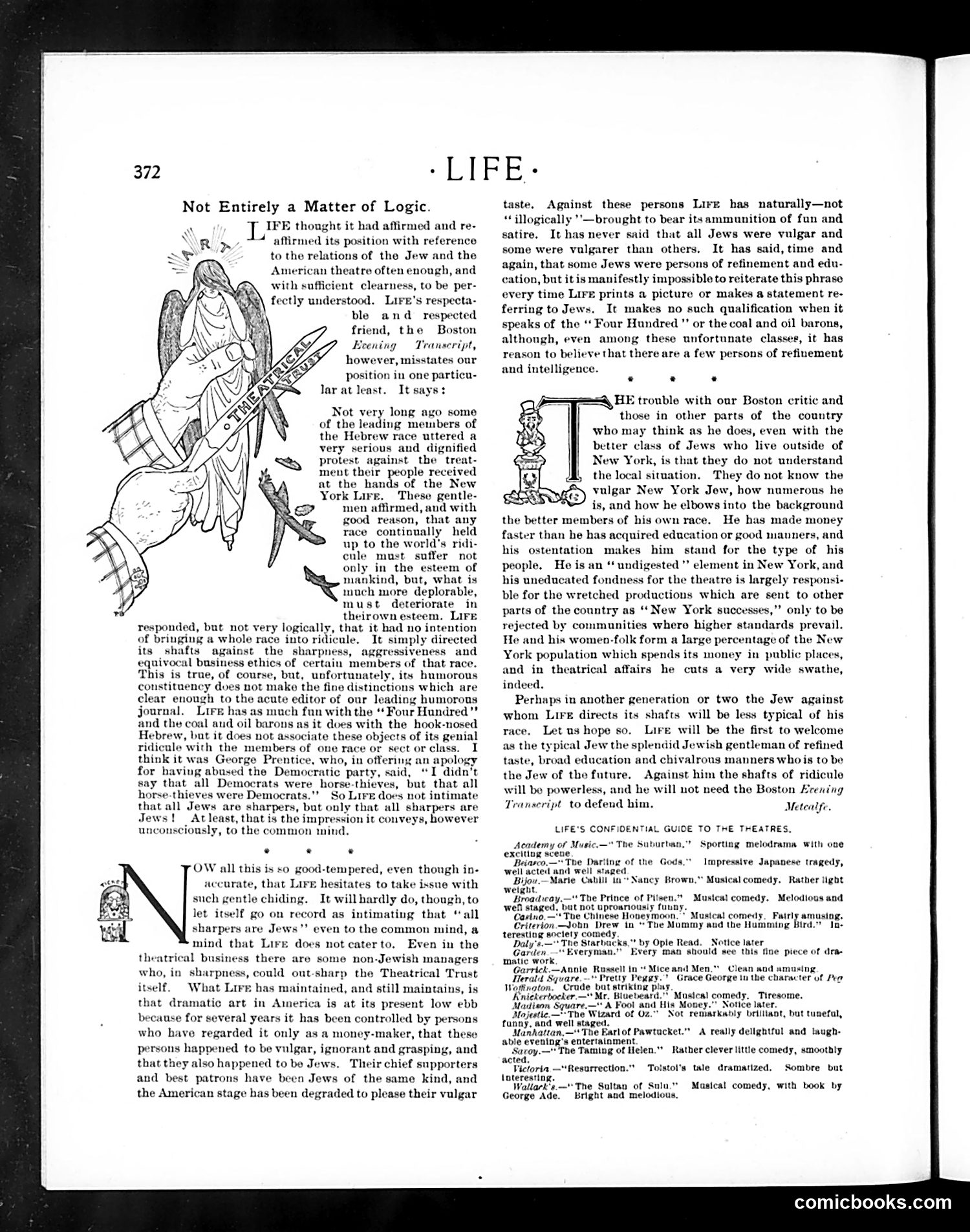
This page contains an essay titled "Not Entirely a Matter of Logic" addressing antisemitic stereotypes about Jewish Americans, particularly regarding their involvement in theater management and production in New York. The cartoon shows a caricatured figure with exaggerated Jewish features. The text defends Jews against claims that they control theater and monopolize entertainment, arguing that such accusations are illogical and unfair. It dismisses comparisons to George Prentice's Democratic apology, asserting that blanket statements about any ethnic group are unreasonable. The piece argues that Jewish theater managers and producers have legitimately succeeded in American business and should not face discriminatory attacks based on their religion or ethnicity. It's a defense against widespread early-20th-century antisemitic conspiracy theories about Jewish cultural influence.
📄 Transcribed text from this page (OCR, searchable)
Machine-transcribed from the original scan — historical spelling and the odd misread are preserved.
» LIFE. Not Entirely a Matter of Logic. IFE thought it had affirmed and re- affirmed its position with reference to the relations of the Jew and the American theatre often enough, and with sufficient clearness, to be per- fectly understood. Lire's respecta- ble and _ respected friend, the Evening Transcript, however, misstates our position in one particu- lar at least. It says: 4 Not very long ago some of the leading members of the Hebrew race uttered a very serious and dignified protest against the treat- ment their pe ple received at the hands of the New York Lire, These gentle- men affirmed, and with good reason, that any race continually held up to the world’s ridi- cule must suffer not only in the esteem of mankind, but, what is much more deplorable, must deteriorate in theirown esteem. LIFE responded, but not very logically, that it had no intention of briuging a whole race into ridicule. It simply directed its shafts against the sharpness, aggressiveness and equivocal business ethics of certain members of that race. This is true, of course, but, unfortunately, its humorous constituency does not make the fine distinctions which are clear enough to the acute editor of our leading humorous journal. Lire has as much fun with the “Four Hundred” and the coal aud oil barons as it does with the hook-nosed Hebrew, but it does not associate these objects of its genial ridicule with the members of one race or s. I think it was George Prentice, who, in offering an apology for having abused the Democratic party, said, “I didn’t say that all Democrats were horse-thieves, but that all horse-thieves were Democrats."” So Lire does not intimate that all Jews are sharpers, but only that all sharpers are Jews! Atleast, that is the impression it conveys, however unconsciously, to the common mind. * * e OW all this is so good-tempered, even though in- accurate, that Lire hesitates to take issue with such gentle chiding. It will hardly do, though, to let itself go on record as intimating that “all sharpers are Jews’? even to the common mind, a mind that Lire does not caterto, Even in the theatrical business there are some non-Jewish managers who, in sharpness, could out-sharp the Theatrical Trust itself. What Lire has maintained, and still maintains, i that dramatic art in Aierica is at its present low ebb because for several years it has been controlled by persons who have regarded it only as a money-maker, that the persons happened to be vulgar, ignorant and grasping, and that they also happened to be Jews. Their chief supporters and best patrons have been Jews of the same kind, and the American stage has been degraded to please their vulgar taste. Against these persons Lire has naturally—not “¢ jlogically ’—brought to bear its ammunition of fun and satire. It has never said that all Jews were vulgar and some were vulgarer than others. It has said, time and again, that some Jews were persons of refinement and edu- cation, but itis manifestly impossible to reiterate this phrase every time Lire prints a picture or makes a statement re- ferring to Jews. It makes no such qualification when it speaks of the ‘‘ Four Hundred ” or the coal and oil barons, although, even among these unfortunate classes, it has reason to believe that there are a few persons of refinement and intelligence. * * * HE trouble with our Boston critic and those in other parts of the country who may think as he does, even with the better class of Jews who live outside of New York, is that they do not understand cf, the local situation, They do not know the @) vulgar New York Jew, how numerous he and how he elbows into the background the better members of his own race. He has made money faster than he has acquired education or good manners, and his ostentation makes him stand for the type of his people. He is an “ undigested " element in New York, and his uneducated fondness for the theatre is largely responsi- ble for the wretched productions which are sent to other parts of the country as “New York successes,” only to be rejected by communities where higher standards prevail. He and his women-folk form a large percentage of the New York population which spends its money in public plac and in theatrical affairs he cuts a very wide swathe, indeed. Perhaps in another generation or two the Jew against whom Lire directs its shafts will be less typical of his race, Let us hope so. Lire will be the first to welcome as the typical Jew the splendid Jewish gentleman of refined taste, broad education and chivalrous manners who is to be the Jew of the future, Against him the shafts of ridicule will be powerless, and he will not need the Boston Erening Transcript to defend him, Metcalfe. LIFE'S CONFIDENTIAL GUIDE TO THE THEATRES, Academy of Music.—* The Sit rian,’ Sporting melodrama with one exciting scene Beiasco. e Darting of the Gods,” well acted and well staged Bijow.—Marie Cabill in“ Nancy Brown,” Musical comedy. Rather light weight Broadiay.—"* The Prince of Pilsen.” ‘well staged. but uproanousiy funny. Gartno.—* The Chinese Honeymoon. * Musical comedty. Fairly amusing. Criterion —Jobn Drew in “Tbe Mommy aud the Humming Bird.” In- teresting society comedy. Daly's. The Starbacks." by Ople Read. Notice later Garden — Everyman.” Every man should see this fine piece of dra matic work. Garrick.-Annie Russell in“ Mice and Men. Clean and amusing Herald Square." Pretty Peggy.’ Grace George in the character of Peg Wopinaton. Crade bat striking p Anickerbocker.—" Mr, Bluebeard. Impressive Japanese tragedy, Mustcal comedy. Melodious and Musical comedy. Tiresome. 4 Money.” Notice later. Not remiarkbly brilitant, but tunefal, funny, and well staged. Manhattan,—* The Earlot Pawtucket.” A really delightful and laugh- able evening's entertainment ‘Saroy.—" The Taming of Helen." Rather clever little comedy, smoothly acted. Victoria —“Resurrection.”* —T Interesting. Wallark's.—""The Saltan of Sulu.” George Ade. Bright and melodious. ots tale dramatized, Sombre but Masical comedy, with book by comicbooks.com