
Life, 1903-04-23 · page 4 of 22
Life — April 23, 1903 — page 4: what you’re looking at
What you’re looking at
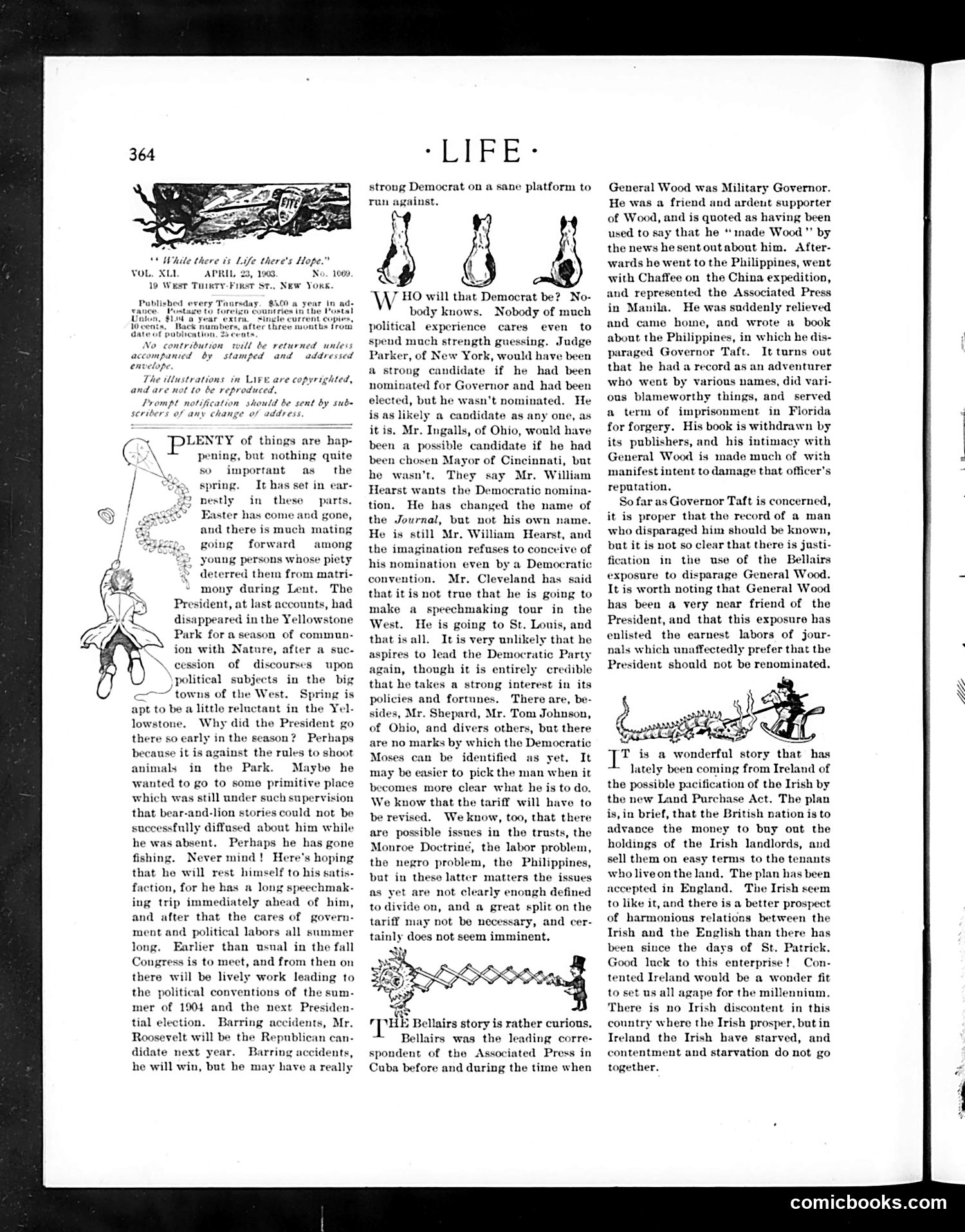
This page contains political commentary about Democratic Party leadership and candidates around 1900. The text discusses potential Democratic nominees, mentioning figures like William Hearst (who changed his newspaper's name from the *Journal*) and Judge Parker of New York as possible gubernatorial candidates. The cartoon on the left depicts a figure emerging from or associated with "the Yellowstone Park" — likely referencing President McKinley's recent disappearance there during a communion visit. The satire suggests Democratic leaders reluctant to take risks, perhaps hoping McKinley would vanish so they could claim power without real opposition. The cartoon's humor relies on readers knowing current political figures and recent news events of that election season.
📄 Transcribed text from this page (OCR, searchable)
Machine-transcribed from the original scan — historical spelling and the odd misread are preserved.
. XL APRIL 23, 1968. 19 West Tutkty-Finst St., New Yor: in ad. tal No contribution twill be returned unte accompanied by stamped and addressed envelope The illustrations in Live are copyrighted, and are not to be reproduced, Prompt notification should be sent by sub= seribers of any change of address PLENTY of things are bap- a \ pening, but nothing quite \ so important as the | Sq, spring. It has set in ear- nestly in these parts. Easter has come gone, and there is much mating going forward among young persons whose piety deterred them from matri- mony during Lent. The President, at last accounts, had disappeared in the Yellowstone Park for a season of commun- ion with Nature, after a suc- cession of discourses upon political subjects in the big —— towns of the West. Spring is apt to be a little reluctant in the Yel- lowstone. Why did the President go there so early in the season? Perhaps because it is against the rules to shoot animals in the Park. Maybe he wanted to go to some primitive place which was still under such supervision that bear-and-lion stories could not be successfully diffused about him while he was absent. Perhaps he has gone fishing. Never mind! Here's hoping that he will rest himself to his satis- faction, for he has a long speechmak- ing trip immediately ahead of him, and after that the cares of govern- ment and political labors all summer long. Earlier than usual in the fall Congress is to meet, and from then on there will be lively work leading to the political conventions of the sum- mer of 1904 and the next Presiden- tial election. Barring accidents, Mr. Roosevelt will be the Republican can- didate next year. Barring accidents, he will win, but he may have a really ‘LIFE * strong Democrat on a sane platform to run against. Q W HO will that Democrat be? No- body knows. Nobody of much political experience cares even to spend much strength guessing. Judge Parker, of New York, would have been a strong candidate if he had been nominated for Governor and had been elected, but he wasn’t nominated. He is as likely a candidate as any one, as itis, Mr. Ingalls, of Ohio, would have been a possible candidate if he had been chosen Mayor of Cincinnati, but he wasn't. They say Mr. William Hearst wants the Democratic nomina- tion. He has changed the name of the Journal, but not his own name. He is still Mr. William Hearst, and the imagination refuses to conceive of his nomination even by a Democratic convention. Mr. Cleveland has said that itis not true that he is going to make a speechmaking tour in the West. He is going to St. Louis, and that isall. Itis very unlikely that he aspires to lead the Democratic ty again, though it is entirely credible that he takes a strong interest in its policies and fortunes. There are, be- sides, Mr. Shepard, Mr. Tom Johnson, of Ohio, and divers others, but there are no marks by which the Democratic Moses can be identified as yet. It may be easier to pick the man when it becomes more clear what he is to do, We know that the tariff will have to be revised. We know, too, that there are possible issues in the trusts, the Monroe Doctrine, the labor problem, the negro problem, the Philippines, but in these latter matters the issues fas yet are not clearly enough defined to divide on, and a great split on the tariff may not be necessary, and cer- tainly does not seem imminent. mp Bellairs story is rather curious, - Bellairs was the leading corre- spondent of the Associated Press in Cuba before and during the time when General Wood was Military Governor. He was a friend and ardent supporter of Wood, and is quoted as having been used to say that he “inade Wood" by the news hesentoutabout him. After- wards he went to the Philippines, went with Chaffee on the China expedition, and represented the Associated Press in Manila. He was suddenly relieved and came home, and wrote a book about the Philippines, in which he dit paraged Governor Taft. It turns out that he had a record as an adventurer who went by various names, did vari- ous blameworthy things, and served a term of imprisonment in Florida for forgery. His book is withdrawn by its publishers, and his intim: with General Wood is made much of w manifest intent to damage that officer's reputation, So far as Governor Taft is concerned, it is proper that the record of a man who disparaged him should be known, but it is not so clear that there is justi- fication in the use of the Bellairs exposure to disparage General Wood. It is worth noting that General Wood has been a very near friend of the President, and that this exposure has enlisted the earnest labors of jour- nals which unaffectedly prefer that the President should not be renominated. is a wonderful story that has lately been coming from Ireland of the possible pacification of the Irish by the new Land Purchase Act. The plan is, in brief, that the British nation is to advance the money to buy ont the holdings of the Irish landlords, and sell them on easy terms to the tenants who live on the land, The plan has been accepted in England. The Irish seem to like it, and there is a better prospect of harmonious relations between the Irish and the English than there has been since the days of St. Patrick. Good luck to this enterprise! Con- tented Ireland would be a wonder fit to set us all agape for the millennium. There is no Irish discontent in this country where the Irish prosper, but in Ireland the Irish have starved, and contentment and starvation do not go together. comicbooks.com \ \