
A complete issue · 24 pages · 1902
Life — December 4, 1902
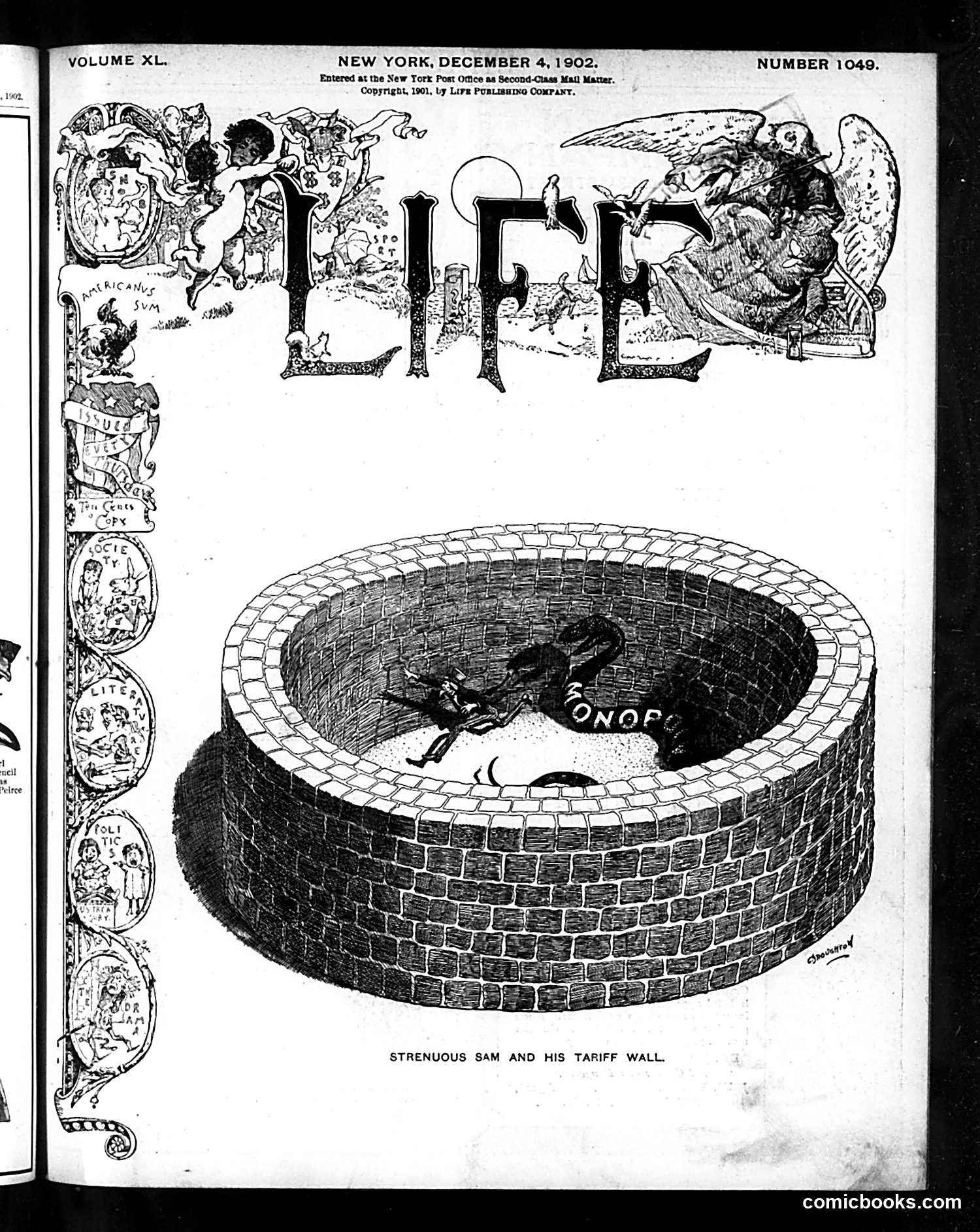
This 1902 *Life* magazine cartoon satirizes President Theodore Roosevelt's protective tariff policies. "Strenuous Sam" refers to Roosevelt's famous "strenuous life" philosophy. The image depicts him trapped inside a massive brick wall labeled "MONOPOLY"—suggesting that high tariffs, intended to protect American industry, instead created monopolies that confined even the president. The cartoon critiques the unintended consequences of Roosevelt's economic policies: while tariffs were meant to strengthen America, they allegedly trapped the president within the very protectionist structure he championed. The decorative border on the left contains classical references, typical of *Life's* sophisticated visual language for educated readers familiar with mythology and political allegory.
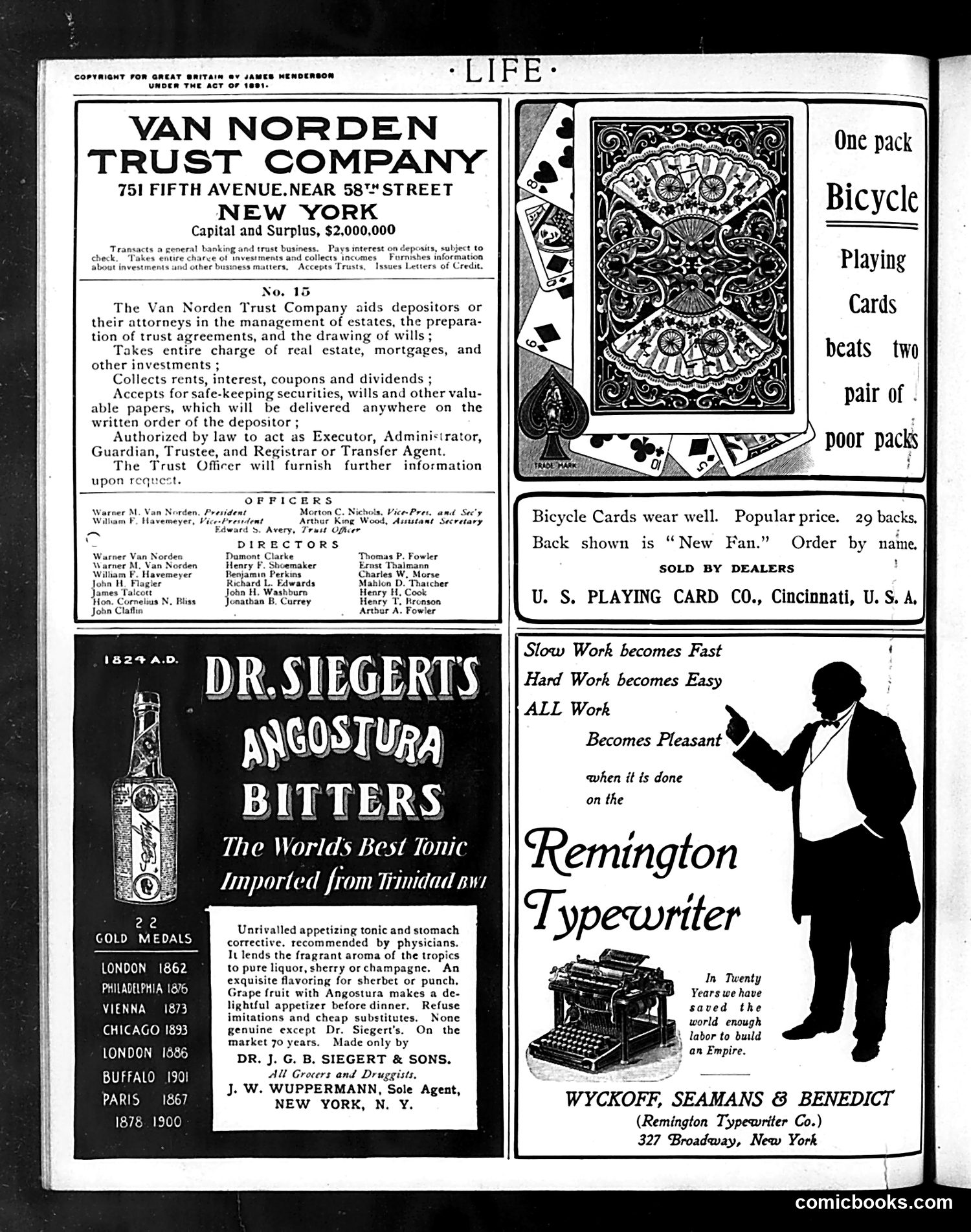
This page is primarily **advertisements** with no political cartoons or satirical content. The ads include: - **Van Norden Trust Company** (financial services) - **Bicycle Playing Cards** by U.S. Playing Card Co. - **Dr. Siegert's Angostura Bitters** (medicinal tonic, imported from Trinidad) - **Remington Typewriter** (featuring a well-dressed man and the slogan "Slow Work becomes Fast") The Remington ad uses motivational language typical of early 20th-century advertising, suggesting the typewriter increases worker productivity and enables empire-building. There is no satire or political commentary visible on this page—it functions as a straightforward advertising section of the magazine.
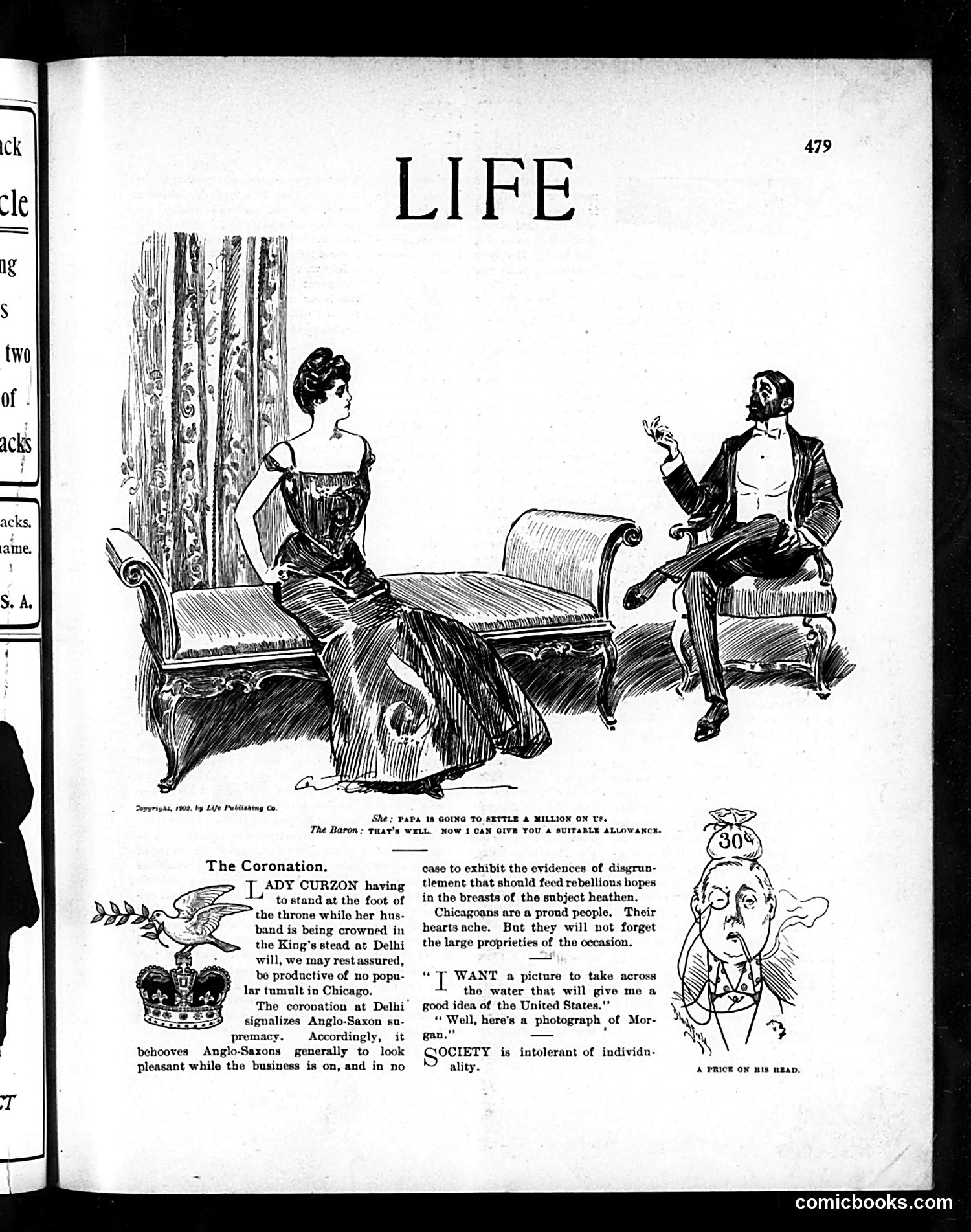
**Main Cartoon (top):** Shows a woman and man in formal attire having a conversation. The caption reads "Papa is going to settle a million on us! That's well. Now I can give you a suitable allowance." This satirizes wealthy marriages where financial arrangements dominate relationships—the woman condescendingly offers her husband an "allowance" from her dowry, reversing traditional gender roles regarding money and revealing how mercenary such unions were. **"The Coronation" Section:** References an actual coronation (likely British, given the crown imagery), using it to comment on Chicago society's pretensions. The text mocks Chicagoans' desire to appear refined and proper during "Anglo-Saxon supremacy," while noting their hearts "ache" over propriety concerns. **Bottom Right Cartoon:** A caricatured head labeled "A Price on His Head" (meaning appears to depict someone disreputable or undesirable). The page combines social satire about wealth, class, and American pretension.
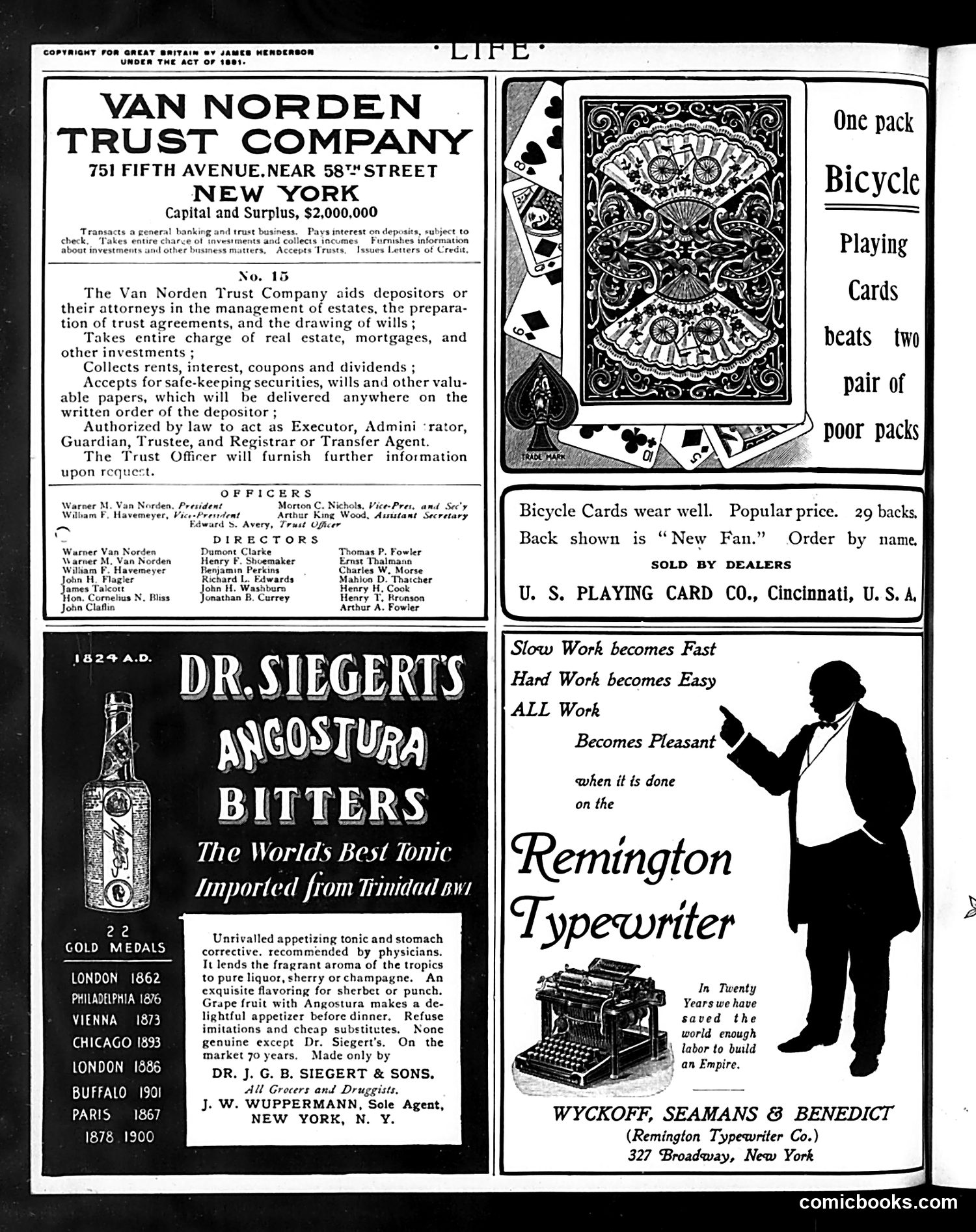
This page consists primarily of **advertisements** rather than political cartoons or satirical content. The ads include: - **Van Norden Trust Company** (banking/estate services) - **Bicycle Playing Cards** (U.S. Playing Card Co., Cincinnati) - **Dr. Siegert's Angostura Bitters** (imported tonic from Trinidad) - **Remington Typewriter** (Wyckoff, Seamans & Benedict) The Remington ad uses the mild visual humor of showing a man in formal dress enthusiastically gesturing toward the typewriter, with text claiming it makes work "Pleasant"—a common early 20th-century advertising approach emphasizing labor-saving technology. There are no identifiable political cartoons, caricatures of public figures, or satirical commentary visible on this page. It represents typical *Life* magazine advertising content from this era.
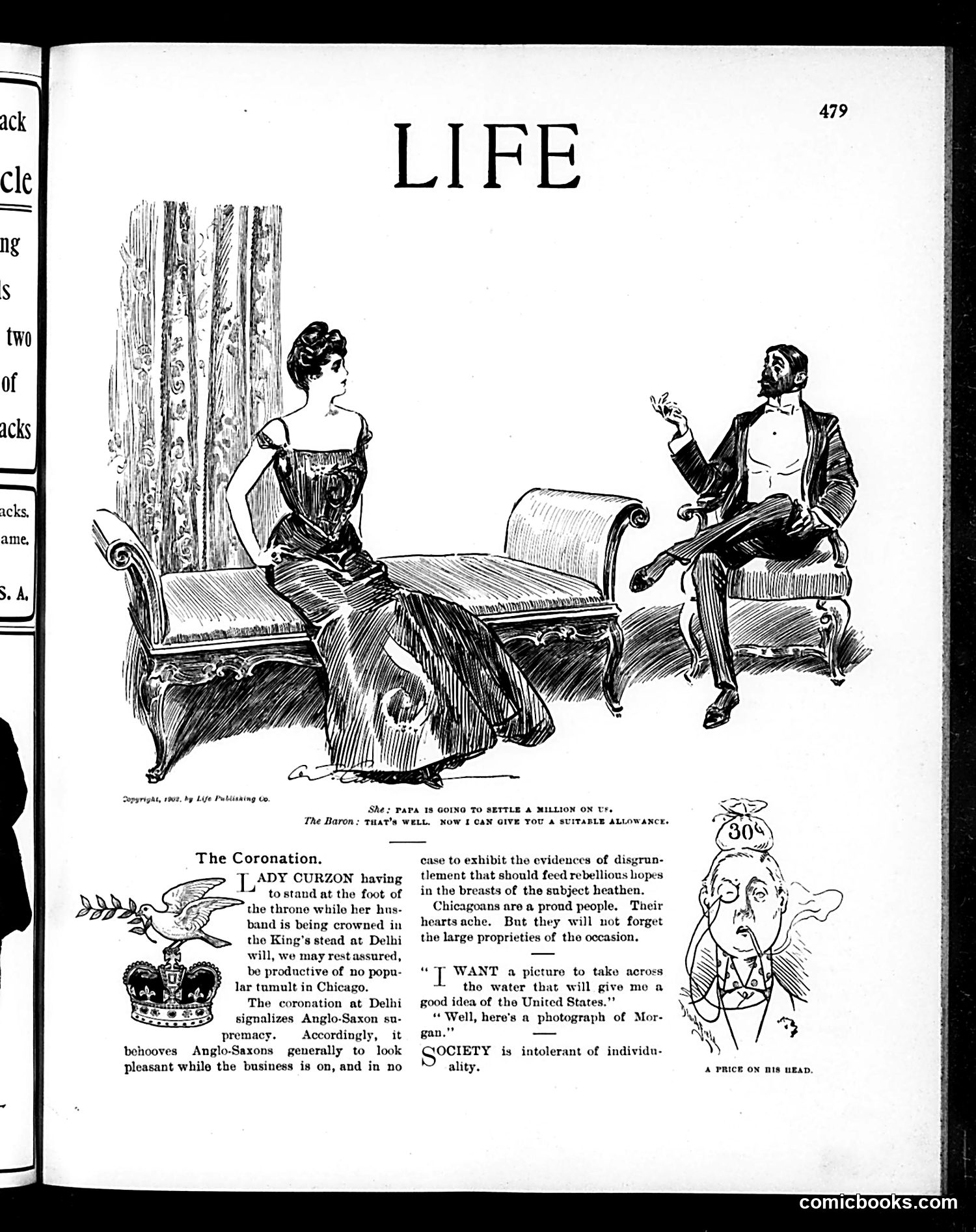
The main cartoon satirizes a wealthy couple discussing a coronation (likely British, given the crown imagery and "Delhi" reference to a British imperial ceremony). The Baron tells his wife he'll "settle a million on her" as an allowance—the joke being that even massive wealth seems inadequate for high society spending. The secondary article "The Coronation" mocks Anglo-Saxon pretension during imperial ceremonies while noting Chicagoans' pride. The final joke panel ("A Price on His Head") appears to comment on society's superficiality and materialism. Overall, the page satirizes Gilded Age wealth disparity, aristocratic excess, and American social climbing through ironic commentary on lavish spending and imperial pageantry.
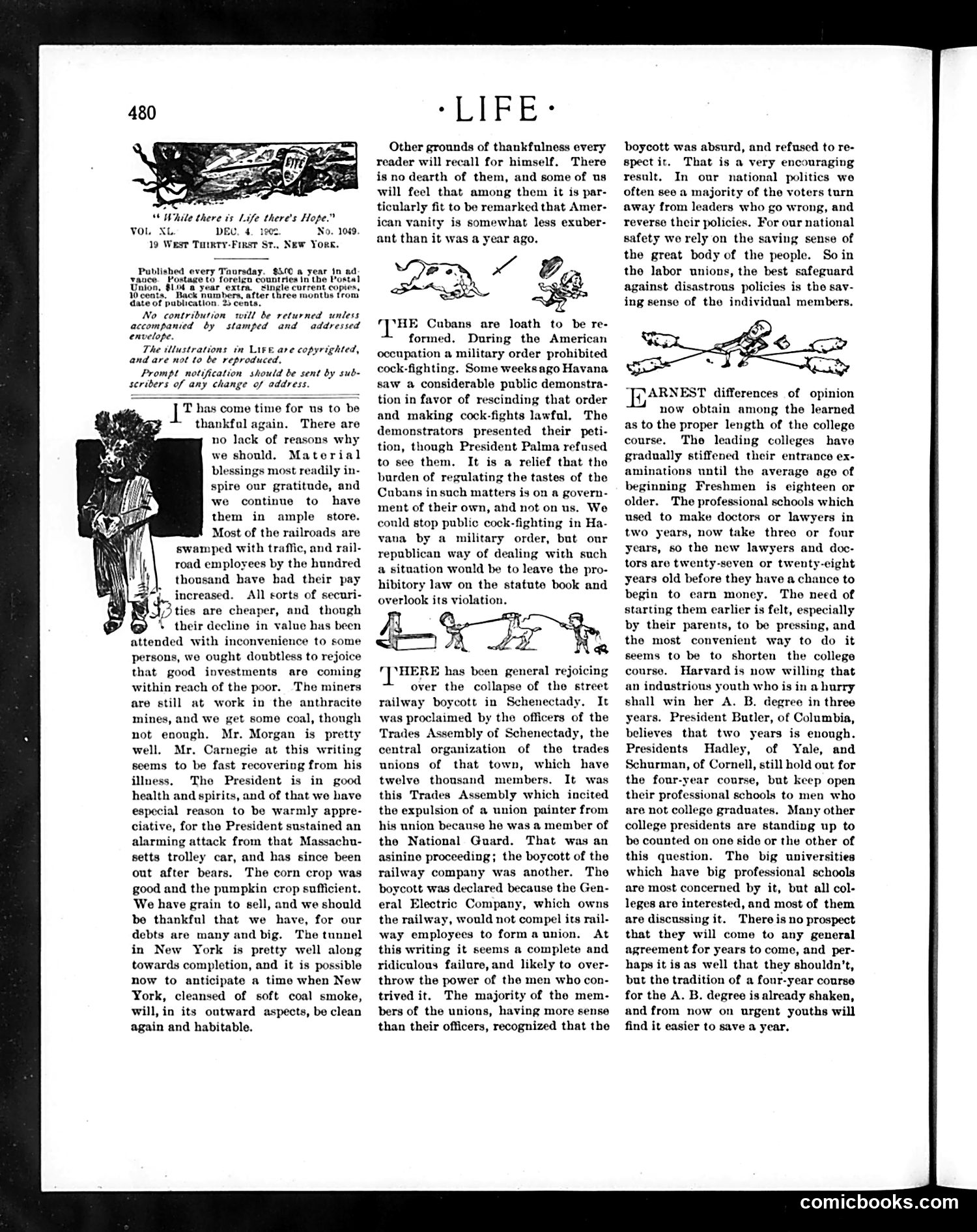
This page contains editorial commentary rather than a political cartoon. The text discusses several contemporary issues: **Cuba and Cock-fighting:** The article references President Palma's refusal to rescind a military order prohibiting cock-fighting in Cuba, noting that public demonstrations failed to change this policy. The satirical point appears to be that even elected officials sometimes resist popular pressure on matters they deem important. **Labor unions:** The piece discusses the Schenectady railway boycott and General Electric's labor disputes, praising unionists for ultimately recognizing that refusing to compel workers to unionize was more effective than coercion. **Higher education:** A lengthy section debates whether colleges should shorten their courses from four to three years, particularly for professional schools—a debate apparently active among institutions like Harvard and Cornell at this time.
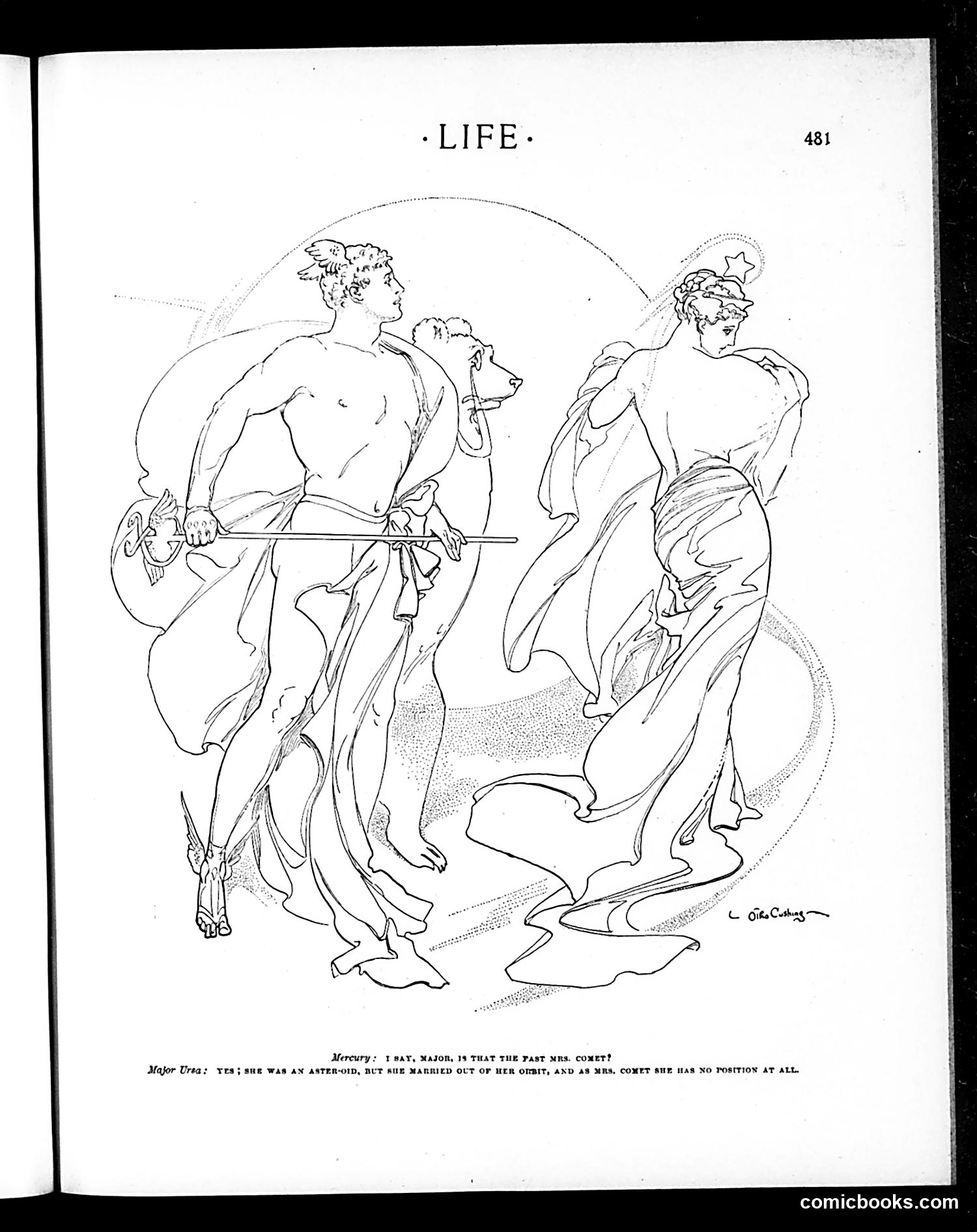
This is a classical mythology cartoon from *Life* magazine (page 481). The image depicts Mercury and Major Ursa, two constellations personified as classical figures with wings and drapery. The dialogue satirizes a romantic scandal: Mercury suggests that Major (Ursa) might be the missing "Mrs. Comet." Major Ursa responds that while she was once an asteroid, she "married out of her orbit" and as Mrs. Comet has "no position at all." The joke plays on astronomical terminology to mock women who lose social status through marriage—specifically, wives who abandon their own identity and position to become merely an appendage to their husband's name and station. This reflects turn-of-the-century feminist concerns about marriage law and women's legal standing.
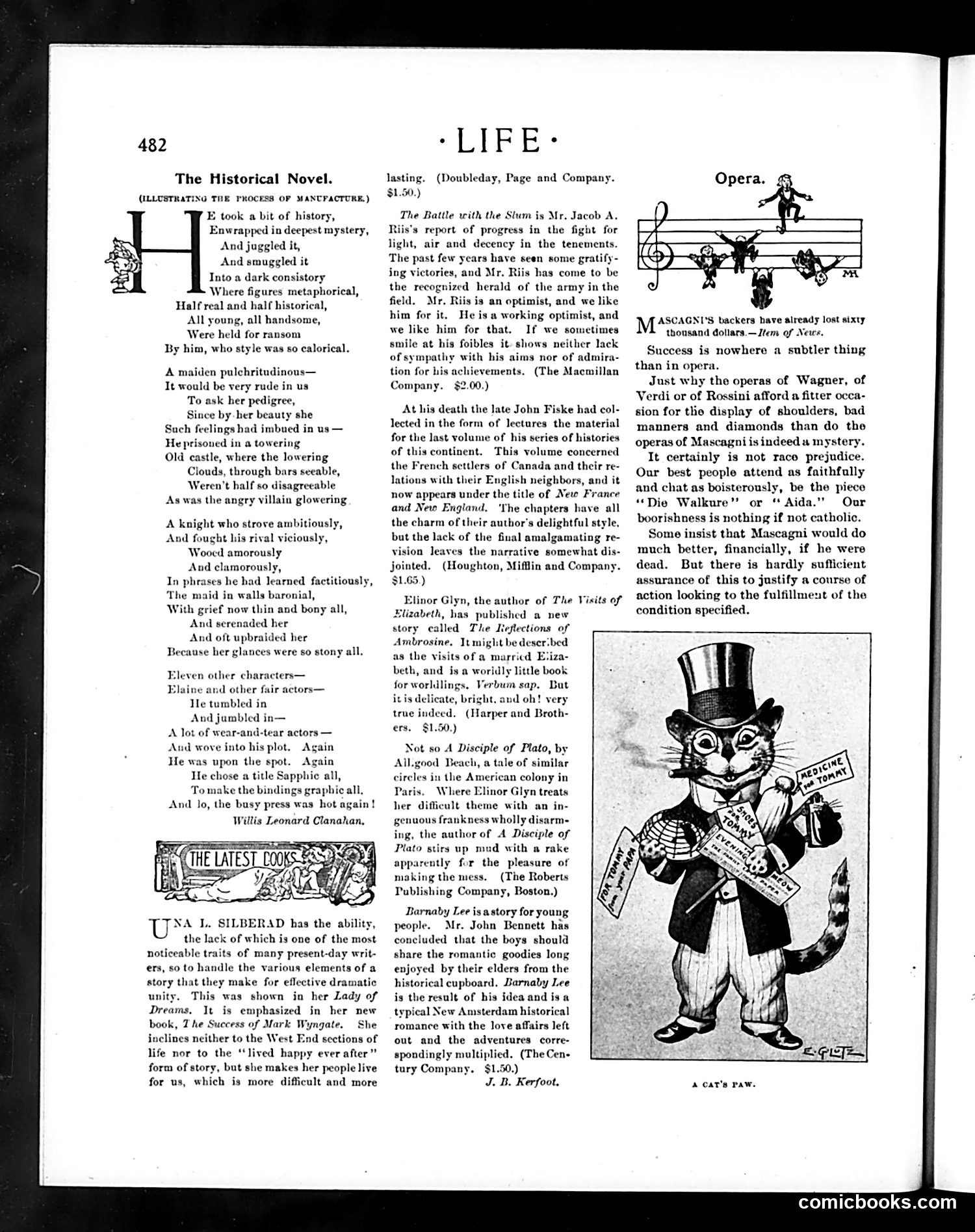
This page primarily contains book reviews from Life magazine's literary section. The cartoon titled "A Cat's Paw" (bottom right) depicts an anthropomorphic cat dressed as a fashionable gentleman in top hat and monocle, holding what appears to be newspapers or documents labeled with various publication names. The phrase "cat's paw" is an idiom meaning a person used by another to accomplish their purposes. The cartoon likely satirizes how newspapers or media outlets manipulate public opinion, or how certain publications serve the interests of powerful figures behind the scenes. The cat's elegant dress suggests pretense or false respectability masking this manipulative function. The surrounding text reviews historical novels and contemporary literature from that era.
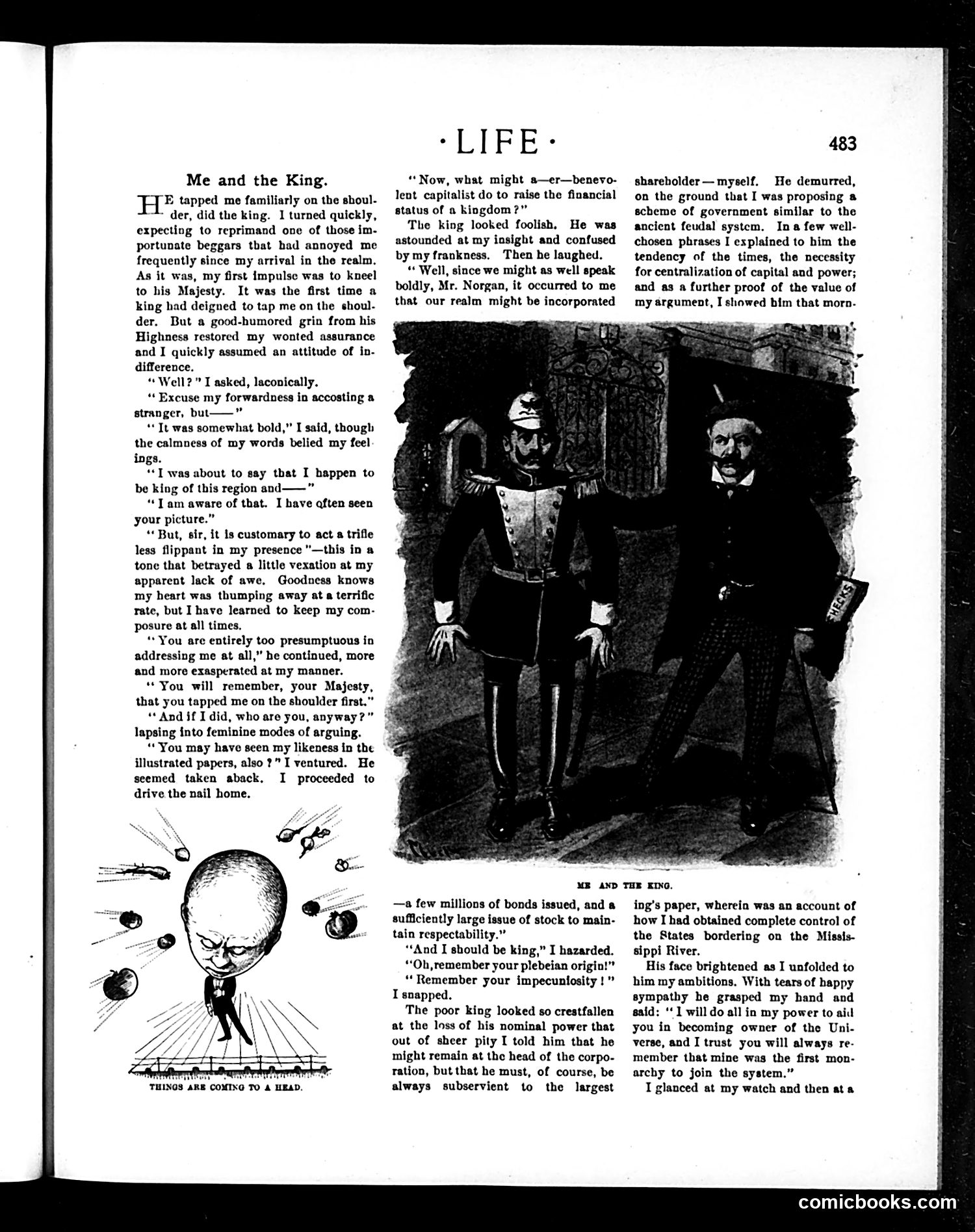
This page satirizes a businessman's presumptuous encounter with a monarch. The narrator, identified as "Mr. Morgan" (likely J.P. Morgan, the prominent banker), describes tapping a king on the shoulder and proposing to incorporate the kingdom as a financial scheme—essentially suggesting he could run the nation's finances better than the monarch. The satire mocks both the king's gullibility and Morgan's arrogance. Morgan argues that issuing bonds and stock would raise the kingdom's financial status, positioning himself as indispensable. The accompanying illustration shows the king appearing bewildered by this businessman's presumption. The joke critiques Gilded Age capitalists who believed financial manipulation and incorporation could solve any problem, including governing nations—reflecting contemporary anxiety about unchecked corporate power.
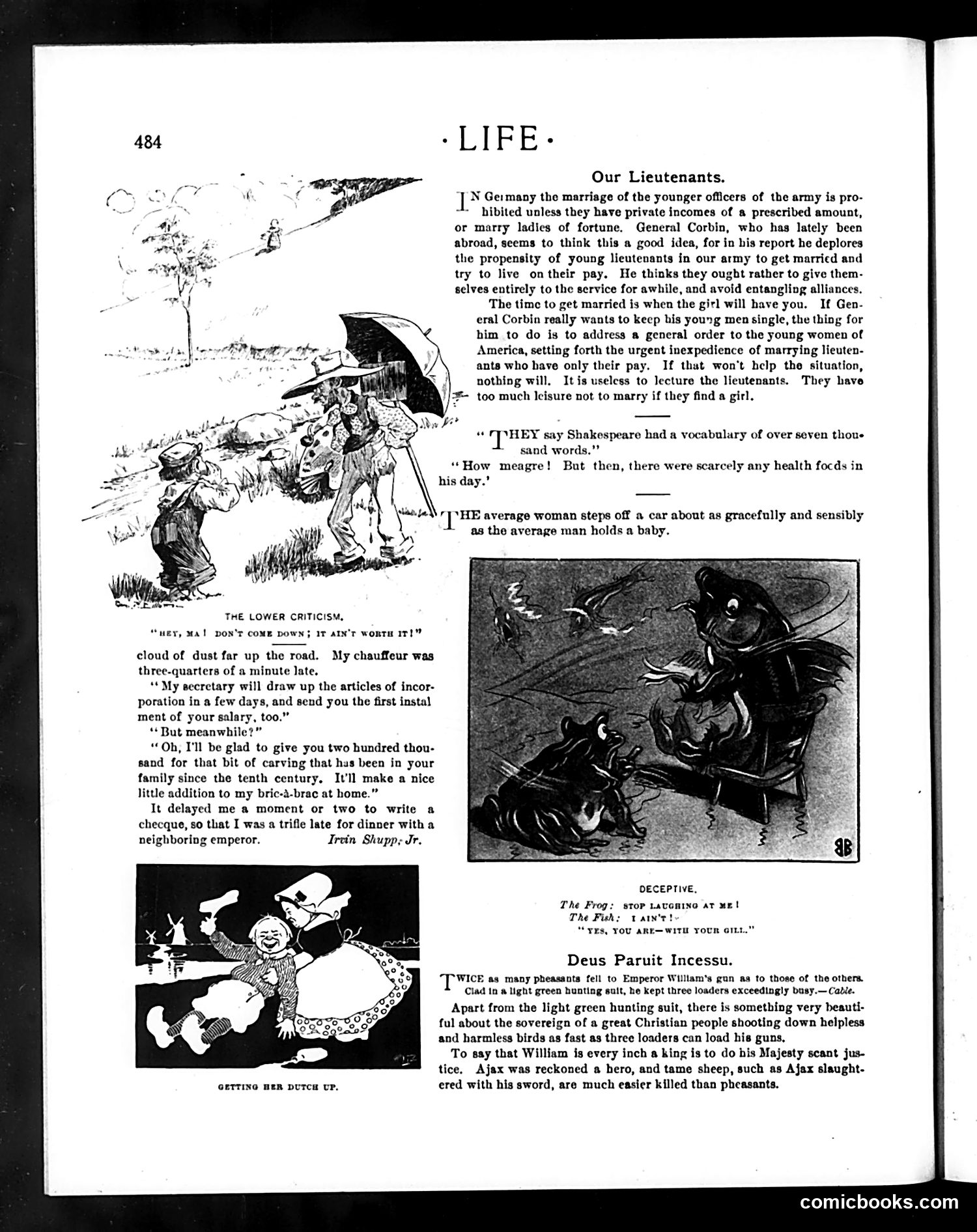
This page contains three satirical pieces: 1. **"Our Lieutenants"** - Commentary on German military policy regarding young officers' marriages, attributed to General Corbin. The text critiques the idea that young lieutenants should remain single to focus on military service. 2. **"The Lower Criticism"** - A sketch about a man complaining his chauffeur was late, mentioning salary negotiations. The humor involves class commentary on employer-employee relations. 3. **"Deus Paruit Incessu"** - A piece about Emperor William (Wilhelm II) and hunting, suggesting the Kaiser shoots harmless birds rather than engaging in truly dangerous pursuits—a political jab at German militarism as performative rather than substantive. The cartoons use visual humor and wordplay typical of early 1900s American satirical magazines, targeting military bureaucracy and contemporary figures.
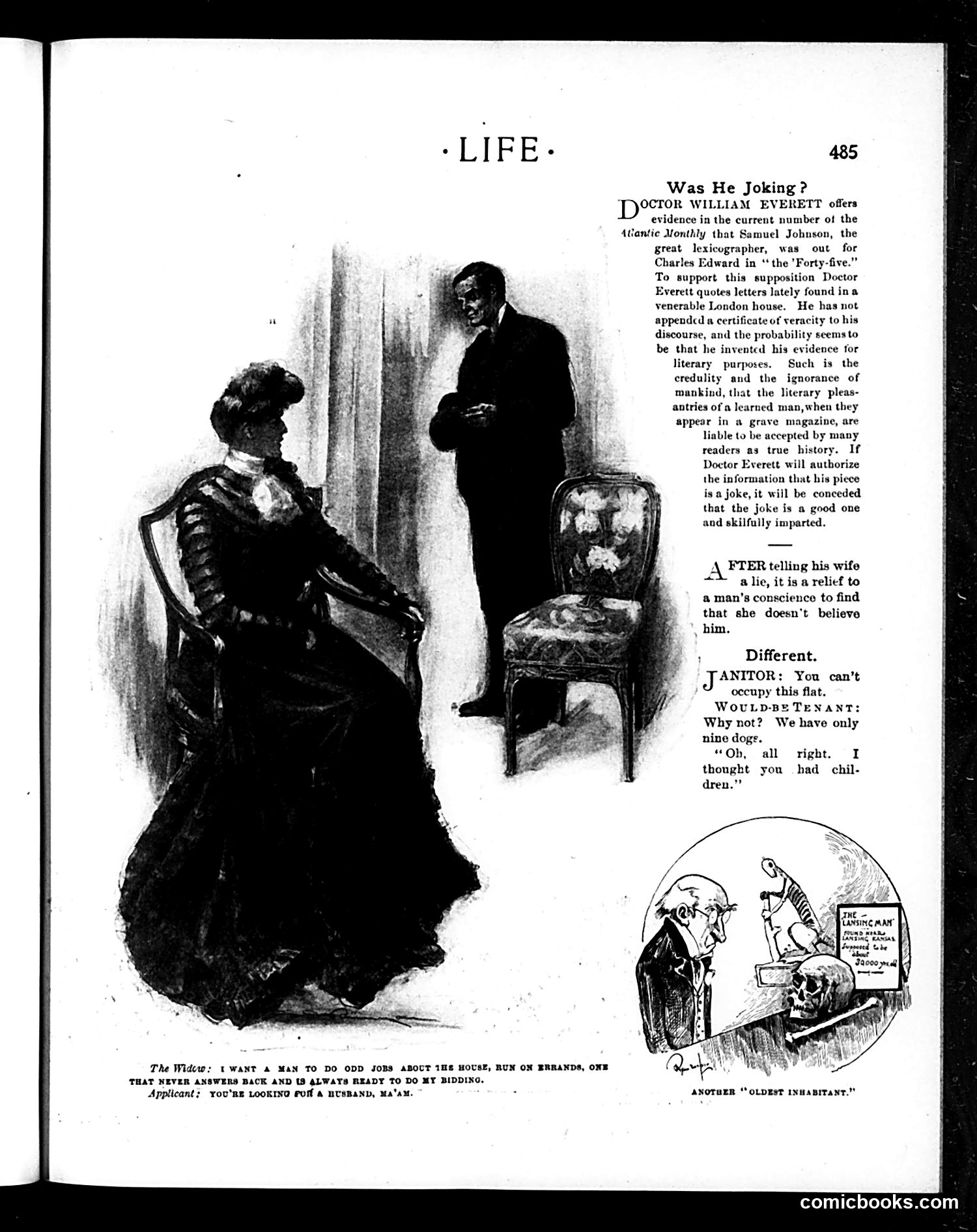
This page contains three separate humorous pieces typical of early 20th-century satirical magazines: 1. **"Was He Joking?"** - An article discussing Doctor William Everett's claim that Samuel Johnson (the famous 18th-century lexicographer) appeared in Charles Edward's "Forty-five." The piece satirizes how readers may naively accept literary anecdotes as fact when published in serious magazines. 2. **"Different"** - A brief joke about a janitor and world-weary tenant discussing occupancy; the humor lies in the tenant's assumption about children. 3. **"Another 'Oldest Inhabitant'"** - A small cartoon depicting what appears to be a gravedigger or undertaker, playing on the common "oldest inhabitant" character type in period humor—people claiming ancient knowledge of their locality. The page's humor relies on era-specific conventions and character types now largely unfamiliar to modern readers.
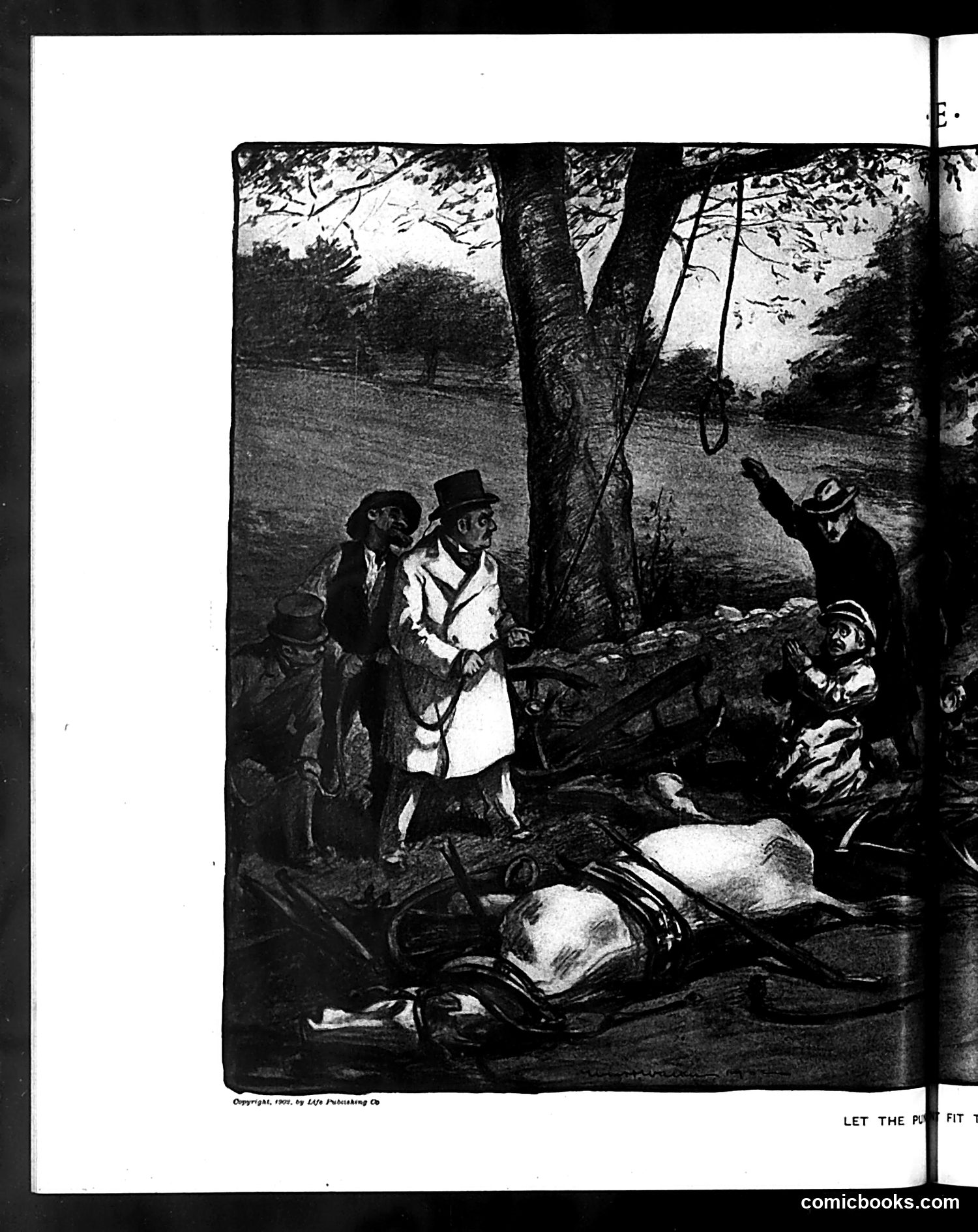
This appears to be a satirical illustration from Life magazine (copyright 1909, per the visible text). The scene depicts what looks like a social or political gathering in a park setting, with well-dressed figures in top hats observing something on the ground. Without clearer text identifying the specific cartoon title or caption, I cannot definitively explain the satirical point. The image shows gentlemen in formal dress reacting to figures on the ground, suggesting social commentary about class dynamics or public behavior. The rural/park setting and formal attire suggest commentary on upper-class social conventions or hypocrisy. The partial visible text "LET THE P[?] FIT T[?]" at the bottom may be the caption, but it's too obscured to interpret with confidence. I cannot specify the exact political or social reference without risking inaccuracy.
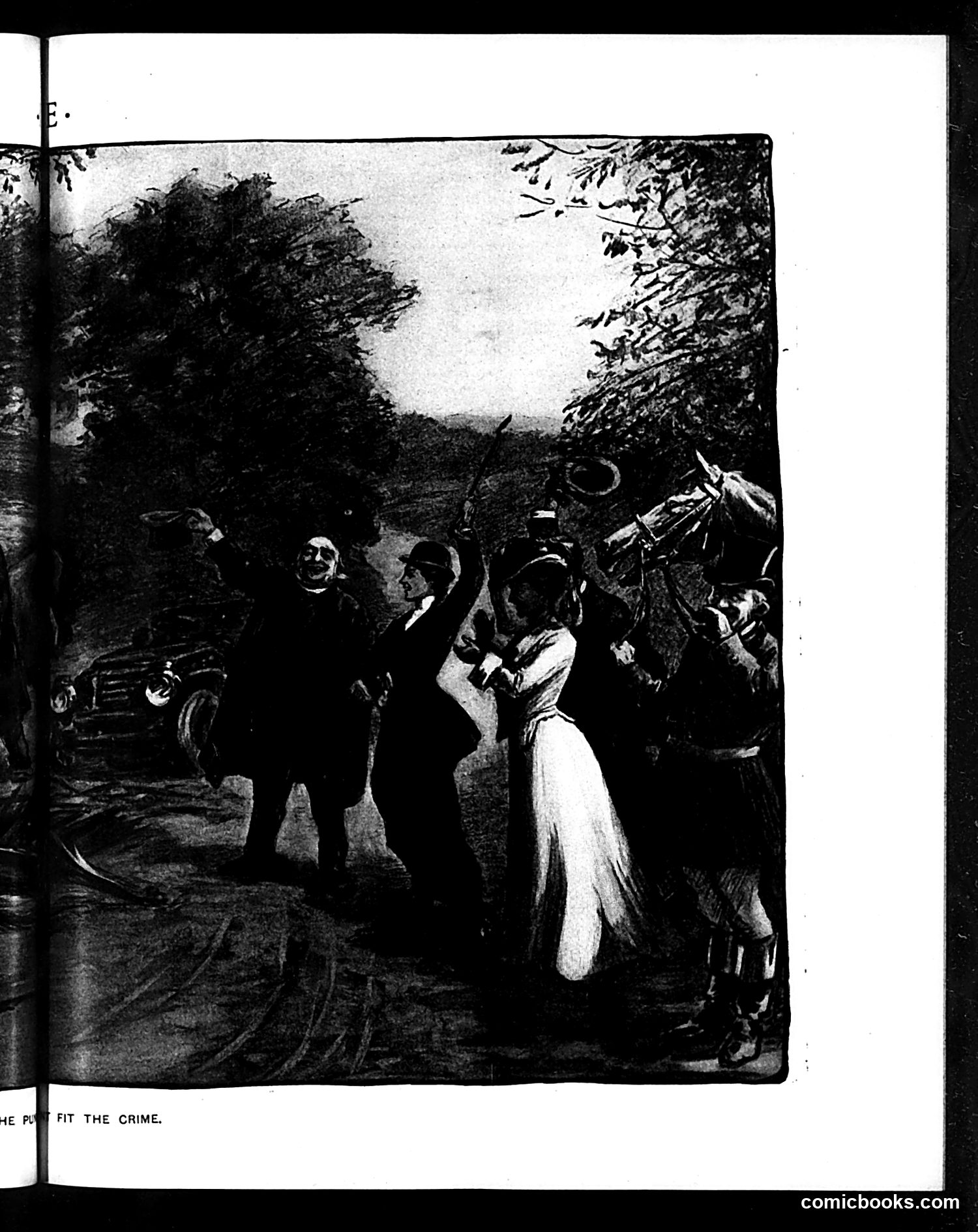
This appears to be a satirical illustration titled "Fit the Crime," showing a nighttime scene with multiple figures gathered around horses. The image depicts what seems to be a law enforcement or judicial proceeding, likely from the 19th or early 20th century based on the clothing and artistic style. The caption "Fit the Crime" suggests commentary on proportional punishment or justice. The scene appears to show officials or authorities with horses, possibly depicting a arrest, trial, or execution scenario. However, without additional context about Life magazine's specific issue date or accompanying article text, I cannot definitively identify the particular political event, scandal, or social issue being satirized. The cartoon likely critiqued contemporary views on criminal justice or law enforcement practices of its era.
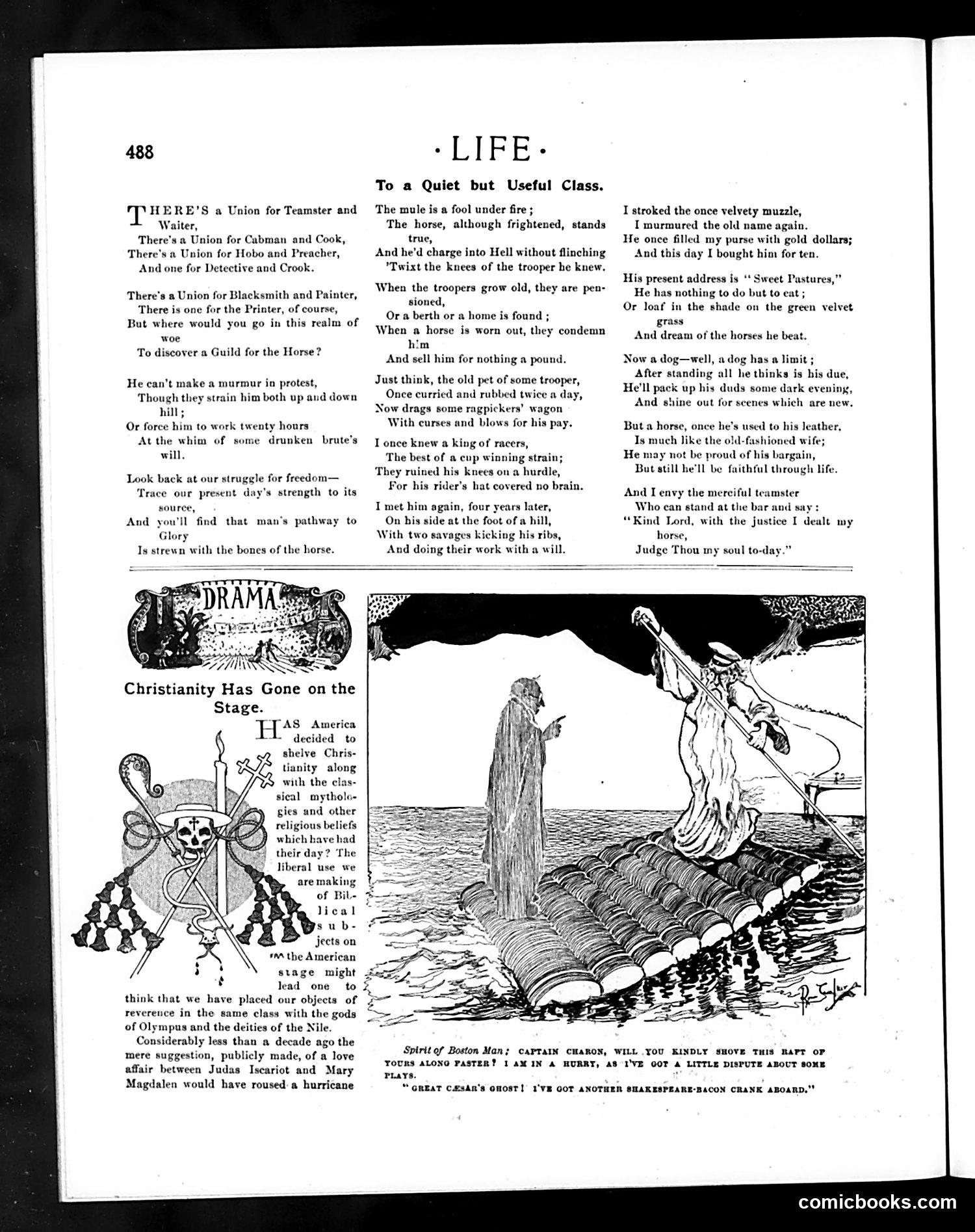
**Top Poem: "To a Quiet but Useful Class"** This satirical poem advocates for horses as an exploited working class deserving union protections like other laborers. It contrasts horses' loyal service—they charge into battle, work grueling hours, and remain faithful to their masters—with their shabby retirement: sold for pennies, worked to death by ragpickers, or abandoned when worn out. The poem uses emotional anecdotes (a former racehorse reduced to cart-pulling) to shame society's callous treatment. The satire points to labor rights activism of the era while highlighting how horses—essential to transportation, military, and industry—receive no legal protections or dignified retirement. **Lower Cartoon: "Christianity Has Gone on the Stage"** This section critiques the American theater's recent trend of staging biblical narratives and religious subjects as entertainment. The text suggests America is treating Christianity like defunct classical mythology—shelving it as outdated. The concern (mentioned: a proposed love affair between Judas and Mary Magdalen) reflects anxiety that sacred subjects are becoming trivialized theatrical fodder rather than serious religious material.
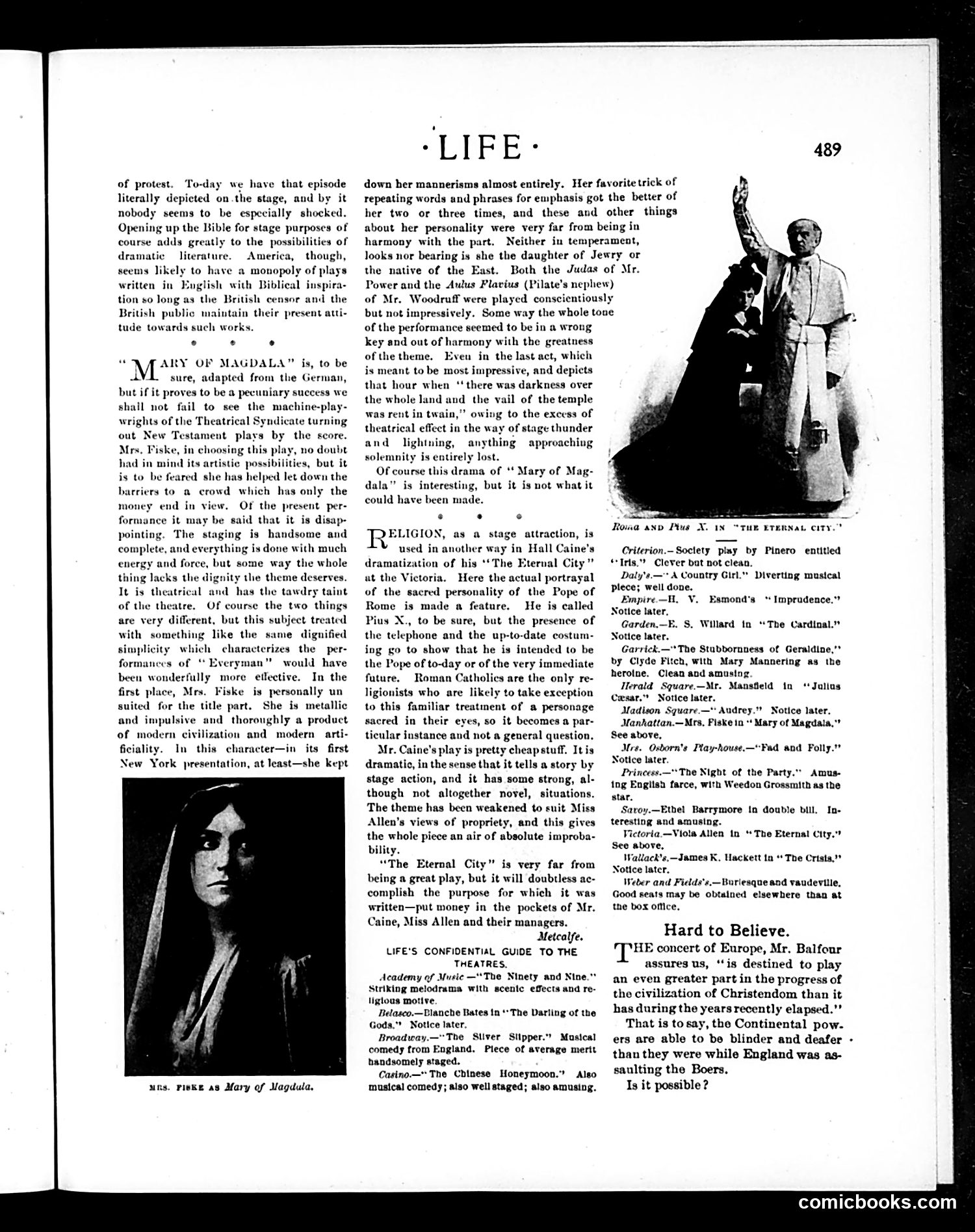
This page reviews two theatrical productions: **"Mary of Magdala"** (starring Mrs. Fiske) and **"The Eternal City"** (based on Hall Caine's novel). The critic dismisses both plays as disappointing despite their ambitious subject matter. Mrs. Fiske's performance in the Biblical drama is faulted as artificial and mannered—her metallic, modern personality clashes with the role's spiritual gravity. The production itself, though handsomely staged, prioritizes theatrical spectacle (thunder and lightning effects) over dignified simplicity, undermining the sacred themes. "The Eternal City" draws criticism for its cheap dramatics, particularly its portrayal of a contemporary Pope (Pius X), which the reviewer considers sensationalism rather than serious drama. The page also notes that British censors would never permit such Biblical adaptations, suggesting America's more permissive theatrical environment.
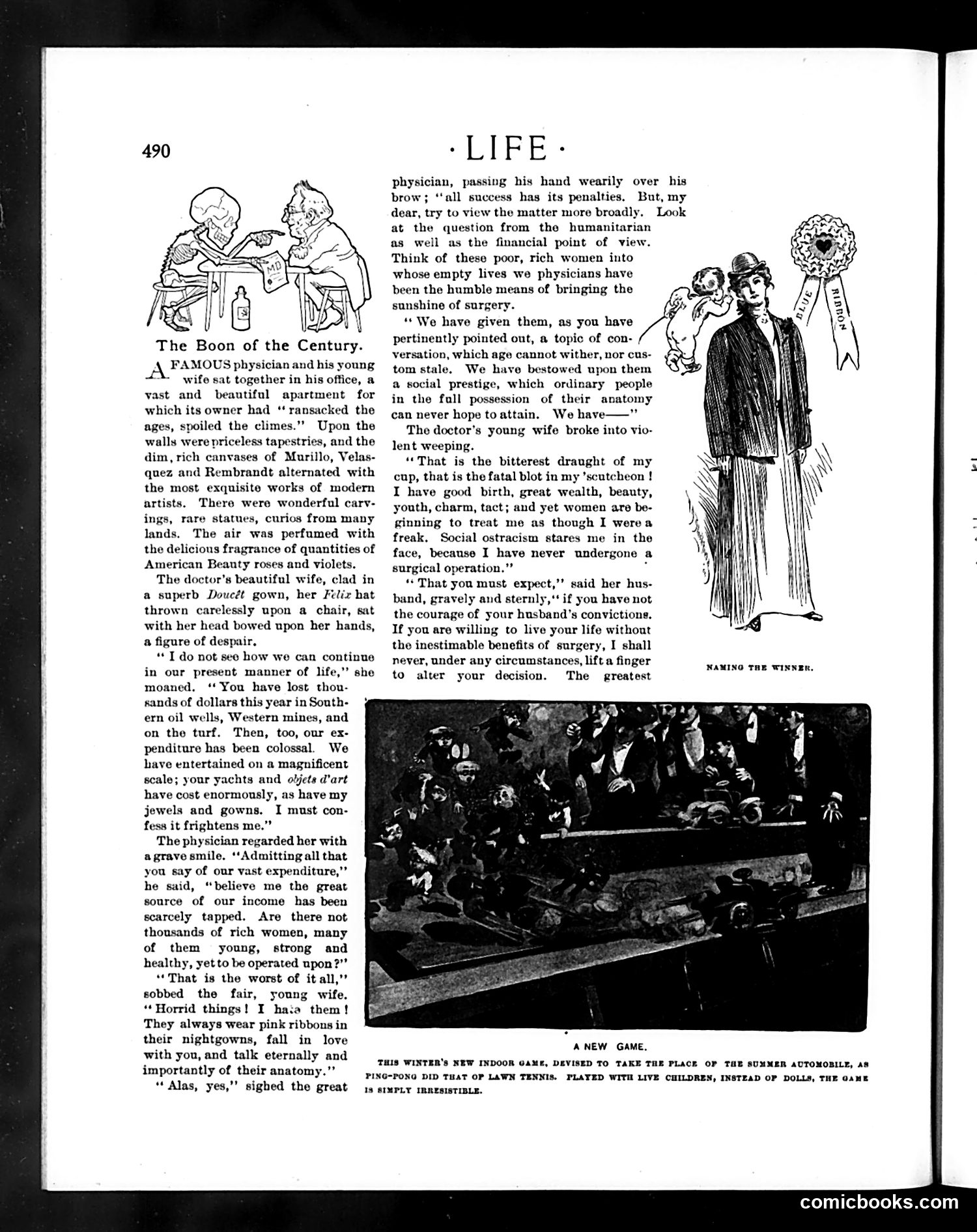
This satirical story mocks the early 20th-century trend of unnecessary surgery among wealthy women, presented as a status symbol. A wealthy physician and his wife discuss finances: she worries their spending exceeds income despite thousands lost on investments and lavish entertaining. He cynically suggests the solution: performing surgery on wealthy women—"thousands of rich women, many of them young, strong and healthy"—who aren't actually ill. The satire targets two targets: physicians who profit from unnecessary procedures, and wealthy women who undergo surgery as a form of social prestige and conversation topic. The wife's despair that she herself hasn't undergone surgery (and thus faces "social ostracism") exposes how absurd this has become—surgery as fashion requirement rather than medical necessity. The bottom illustration, "A New Game," appears unrelated satirical content about children's games.
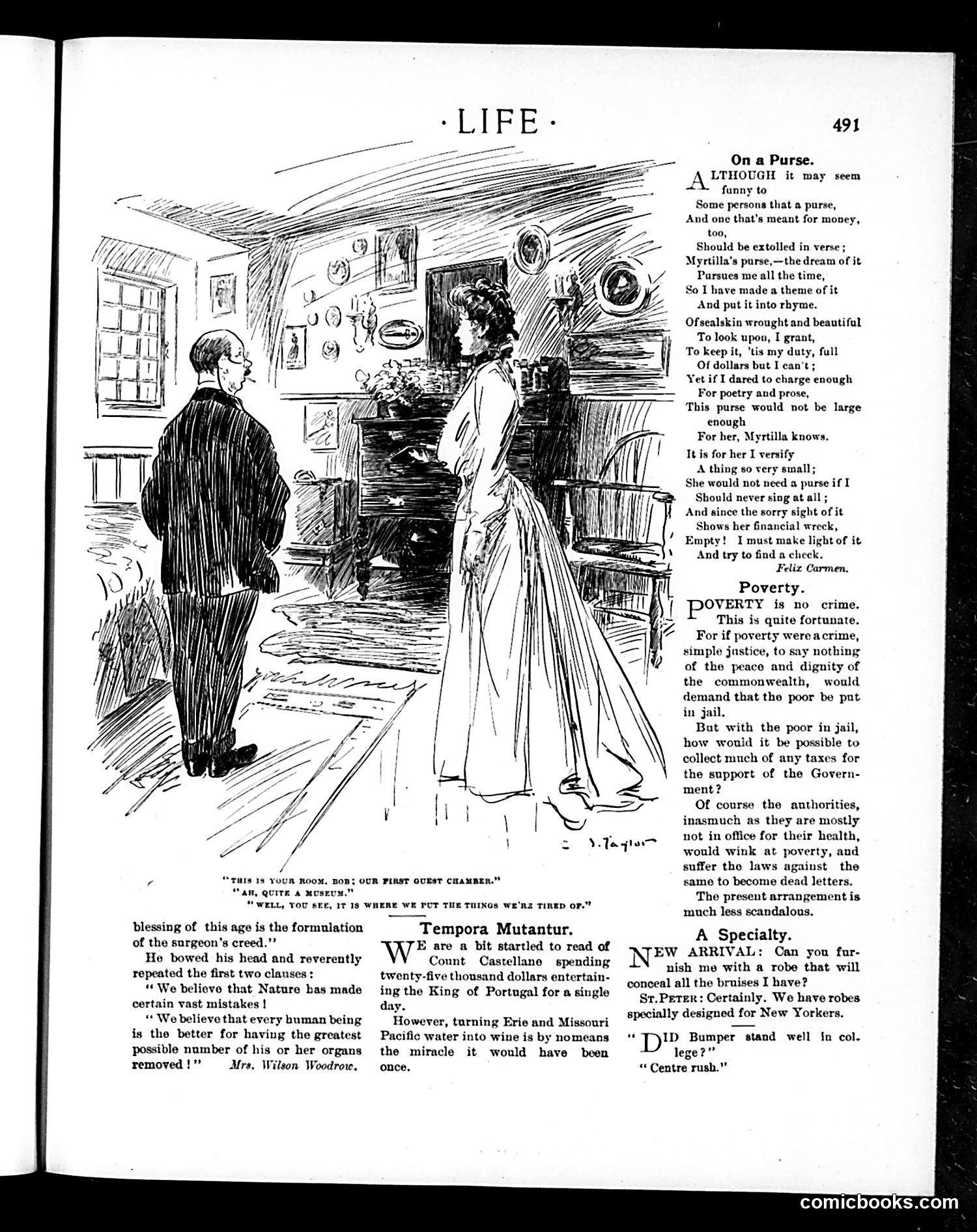
This page contains several satirical pieces typical of early 20th-century American humor: **Main Cartoon**: Shows a woman and man in a modest room; the caption reveals it's a guest bedroom that doubles as storage for unwanted items. The satire mocks both bourgeois pretense (maintaining a "guest chamber") and domestic clutter. **"On a Purse"**: A humorous poem about a woman named Myrtilla whose purse is perpetually empty despite the speaker's poetic efforts to fill it with money—satirizing both struggling writers and women's financial dependence. **"Poverty"**: Dark social satire arguing poverty *cannot* be criminalized because the poor generate tax revenue. If jailed, the government loses funding—exposing the hypocrisy of laws that punish the poor while authorities ignore poverty itself. **"A Specialty"**: A brief joke where a New York tailor offers special robes designed to conceal bruises—darkly implying New York violence is so common it requires specialized clothing. The page reflects turn-of-the-century class anxieties, gender economics, and urban crime concerns.
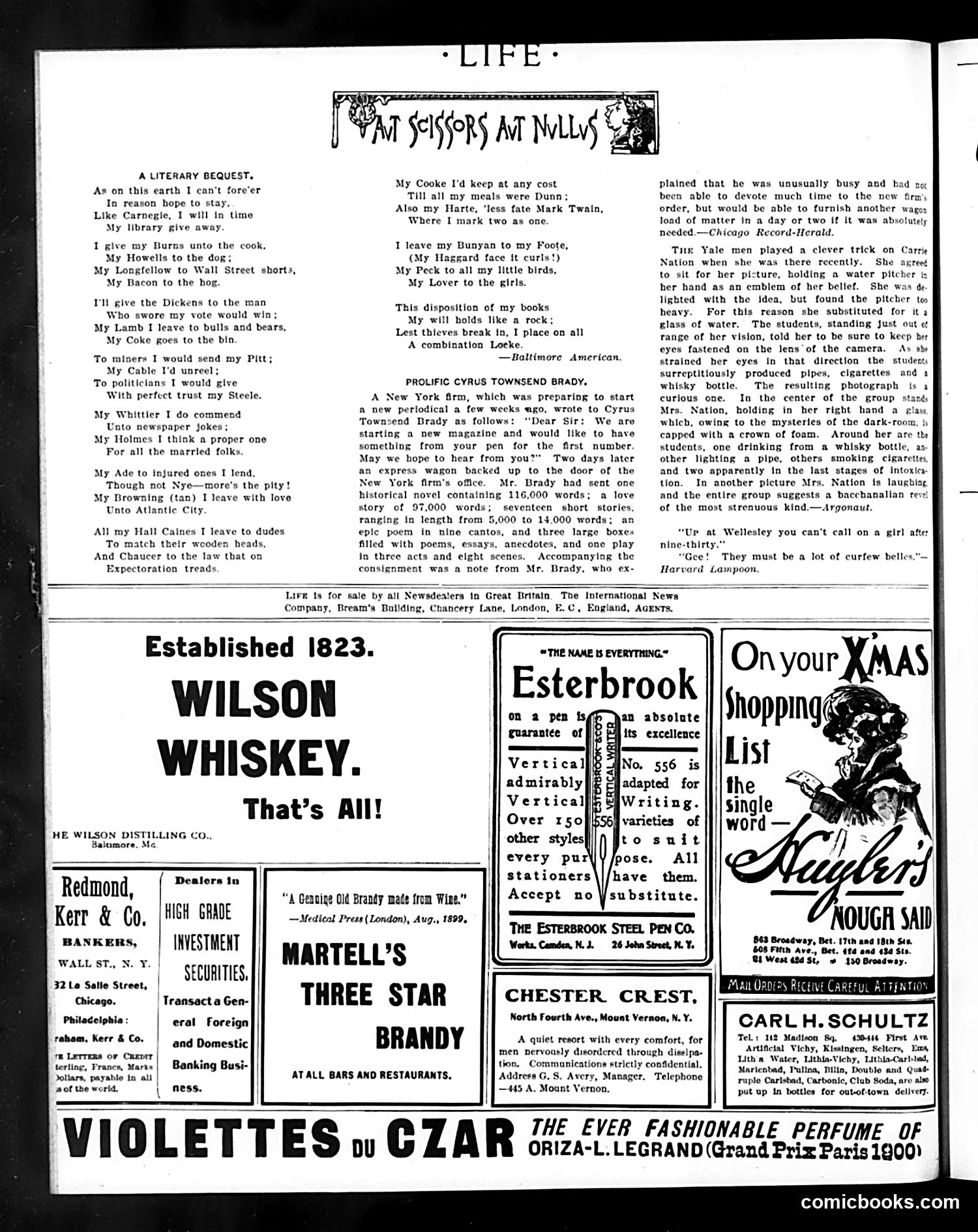
This poem is a clever **pun-based satire** that "bequests" famous authors' works by matching their surnames to their supposed recipients. The joke relies on punning with American authors' names: - Burns → cook (burns food) - Pitt → miners (pit mining) - Cable → politicians (to "unreel"/reveal) - Steele → politicians (steel/trust) - Harte → fate (heart) - Loeke → thieves (lock) The piece mocks both the pretentiousness of **Andrew Carnegie's recent library donations** (referenced in the opening) and satirizes how people value literature—or don't. It's also gentle social commentary, assigning books to groups like "married folks," "dudes," and "the law" in ways that suggest these readers are intellectually unfit. The accompanying article on **Cyrus Townsend Brady** humorously contrasts this: Brady, a prolific writer, overwhelmed a magazine with 116,000 words in response to a simple request, claiming he was "unusually busy."
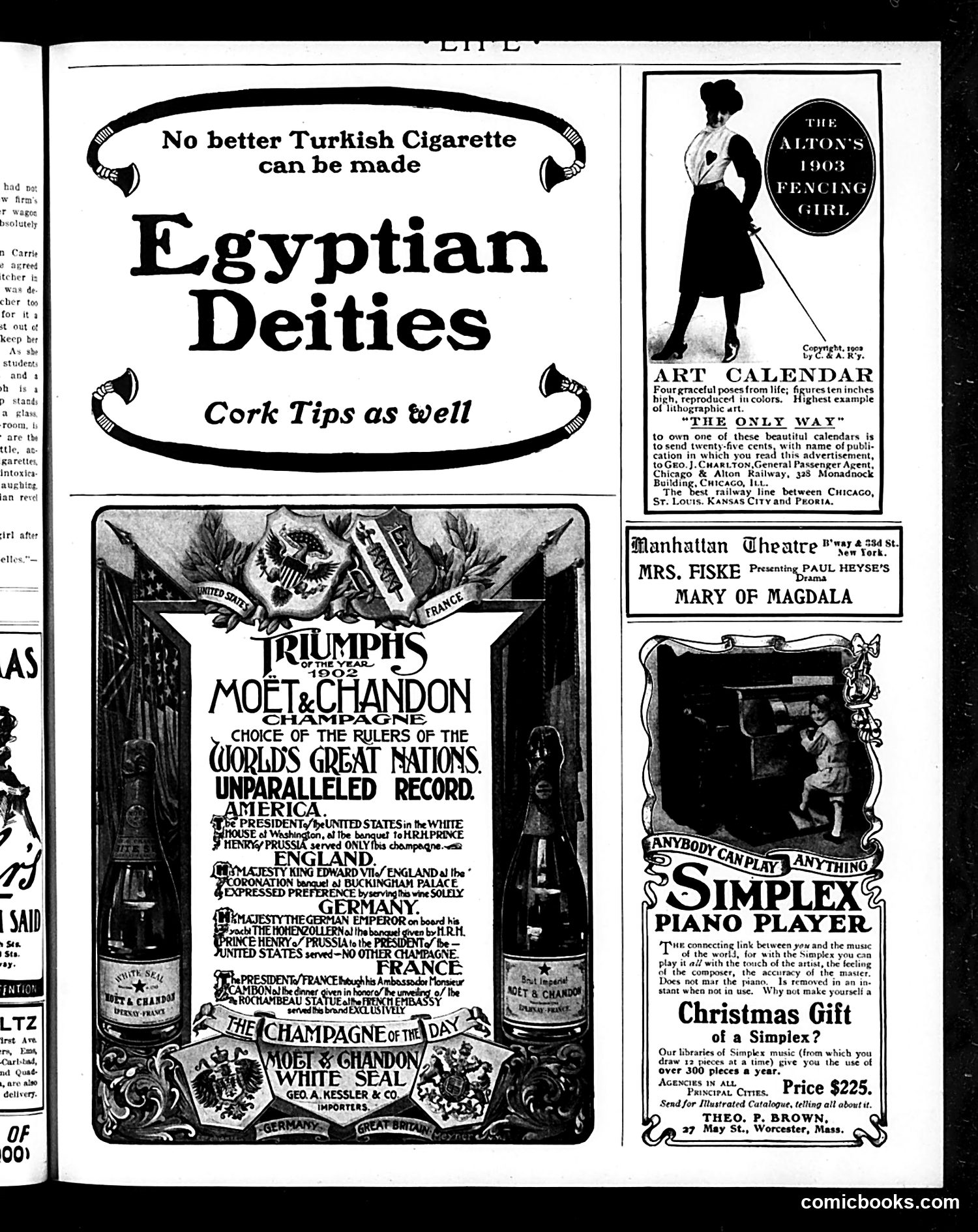
This page is primarily **advertising**, not political satire. It showcases luxury consumer goods and entertainment from the early 1900s. The largest ad promotes **Egyptian Deities cigarettes** with cork tips, claiming superiority as Turkish tobacco. Below it, a prominent **Moët & Chandon champagne advertisement** lists which world leaders ("rulers of the world's great nations") supposedly chose this brand—naming the U.S. President, King Edward VII of England, and the German Emperor. This is brand prestige through association with power and royalty. The right column contains period entertainment and product ads: an **art calendar** from a railroad company, a **Manhattan Theatre production** of "Mary of Magdala," and a **Simplex player piano** (a mechanical music device) marketed as a Christmas gift. The satire, if any, is implicit: these ads peddle status and luxury to aspirational readers by leveraging famous names and claims of elite approval—a common advertising strategy of the era.
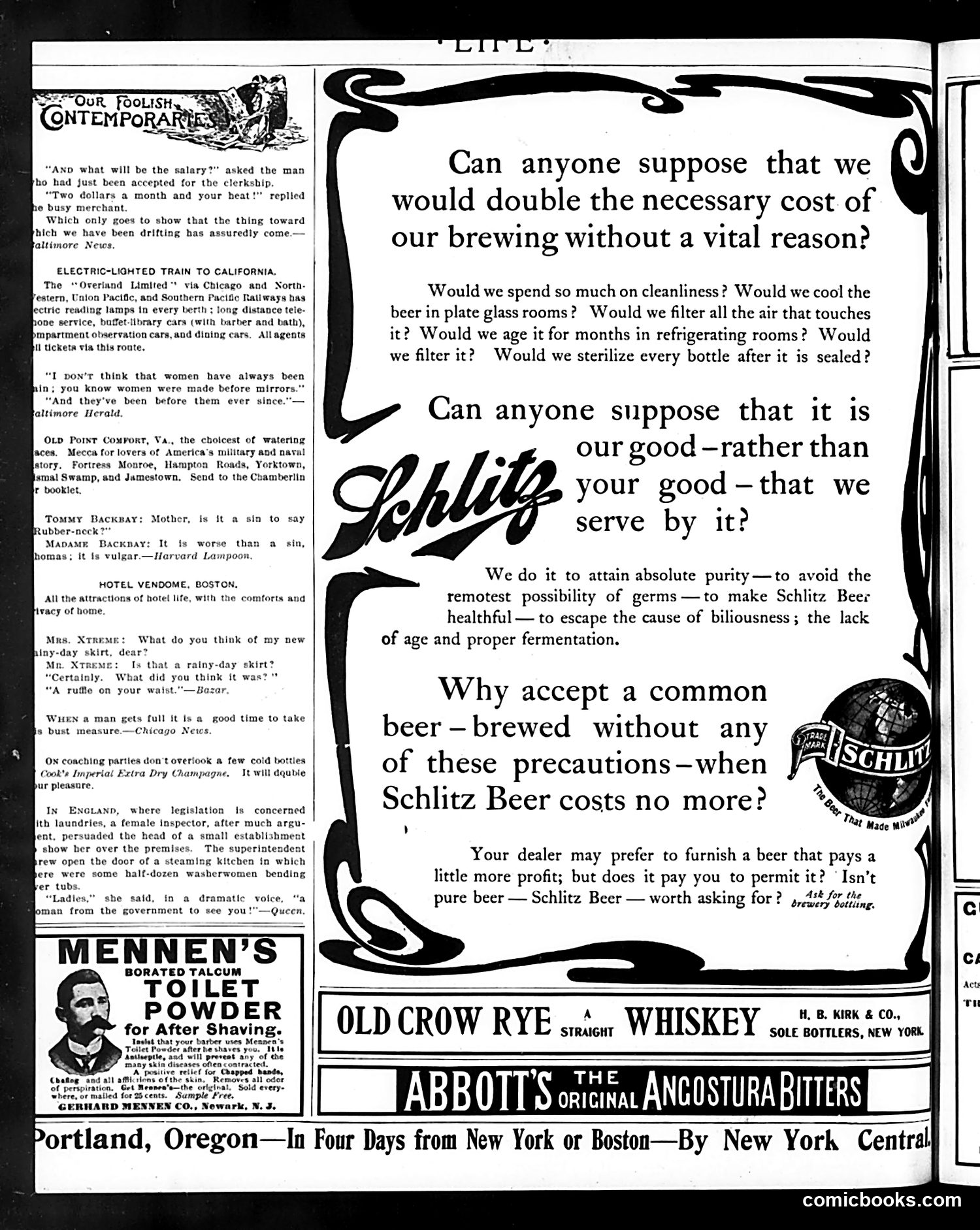
This page contains primarily **advertisements and brief satirical jokes**, not political cartoons. The main advertisement is for **Schlitz Beer**, which uses an early 20th-century marketing strategy emphasizing purity and hygiene—arguing that their expensive brewing process (cleanliness, refrigeration, filtration, sterilization) justifies the cost and should be preferred over cheaper competitors. This reflects contemporary concerns about food safety and germ theory. The surrounding content comprises short humorous items mocking contemporary social absurdities: a clerk hired for "$2 a month and your heat," the observation that women have always admired mirrors, and jokes about clothing and etiquette. These are lightweight social satire typical of Life's format—gentle mockery of modern manners and foolish trends, rather than hard political commentary. The page also advertises other products (Mennen's talcum powder, Old Crow whiskey, Abbott's bitters) typical of the era's patent medicines and grooming products.
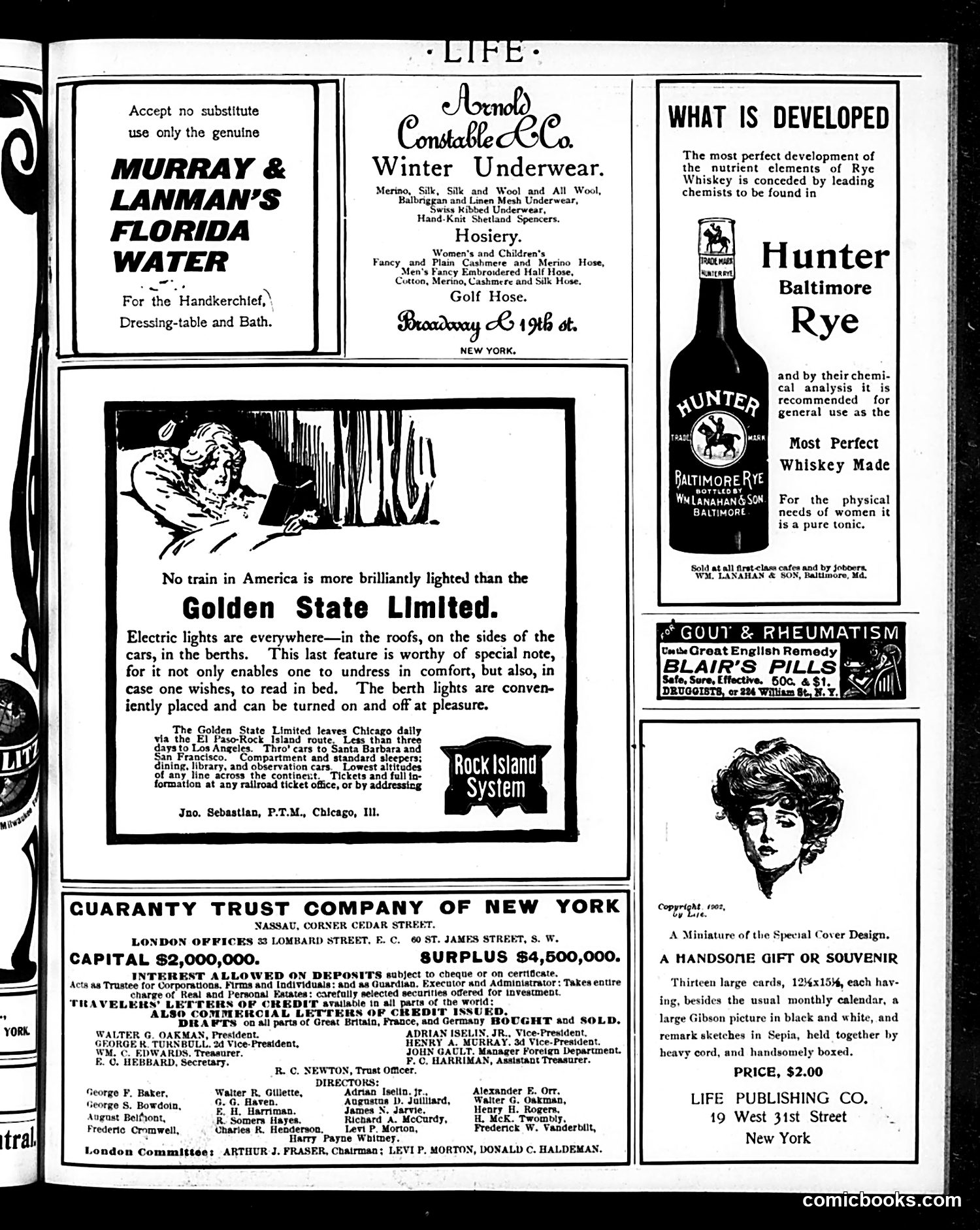
This page is primarily **advertising**, not satire or political content. The main visual element is a **cartoon illustration** (appears to be by a Gibson-style artist, popular in early 1900s Life magazine) depicting a woman in bed, used to advertise the **Golden State Limited train**. The ad emphasizes the train's electric berth lights, which allow passengers to undress comfortably and read in bed—highlighting a then-modern luxury amenity. The page includes numerous product advertisements: patent medicines (Blair's Pills for gout and rheumatism), toiletries (Murray & Lanman's Florida Water), alcohol (Hunter Baltimore Rye whiskey—marketed to women as a "tonic"), clothing, and financial services (Guaranty Trust Company). There is no political satire here. The content reflects early 20th-century advertising aimed at affluent readers, with particular emphasis on modern conveniences and dubious health claims typical of the era.
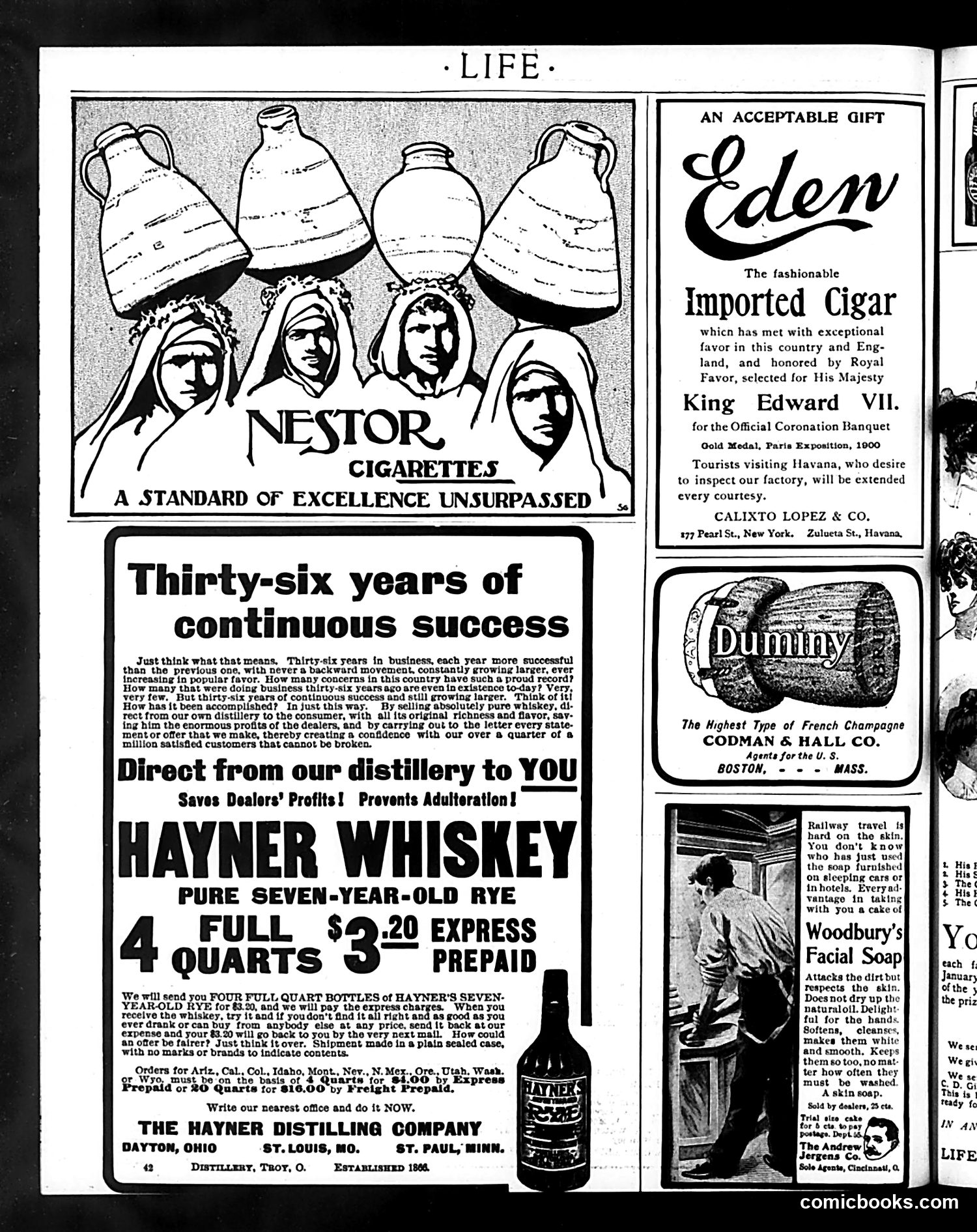
This page is primarily **advertising**, not satire or political commentary. It contains four product advertisements from the early 1900s: **Main content:** Hayner Whiskey dominates with claims of "thirty-six years of continuous success," emphasizing direct distillery-to-consumer sales that bypass dealers and prevent adulteration. The pitch appeals to consumer trust and value. **Supporting ads:** - **Nestor Cigarettes** (top left): Features four classical female heads and vague claims of "excellence unsurpassed" - **Eden Imported Cigars** (right): Name-drops King Edward VII's coronation to suggest prestige - **Woodbury's Facial Soap** (bottom): Addresses concerns about hygiene on public transportation **Context for modern readers:** These ads reflect Progressive Era consumer concerns—distrust of middlemen, purity of products, and germ anxiety. The use of royal endorsement and classical imagery was standard marketing. There is **no political cartoon or satire** present on this page.
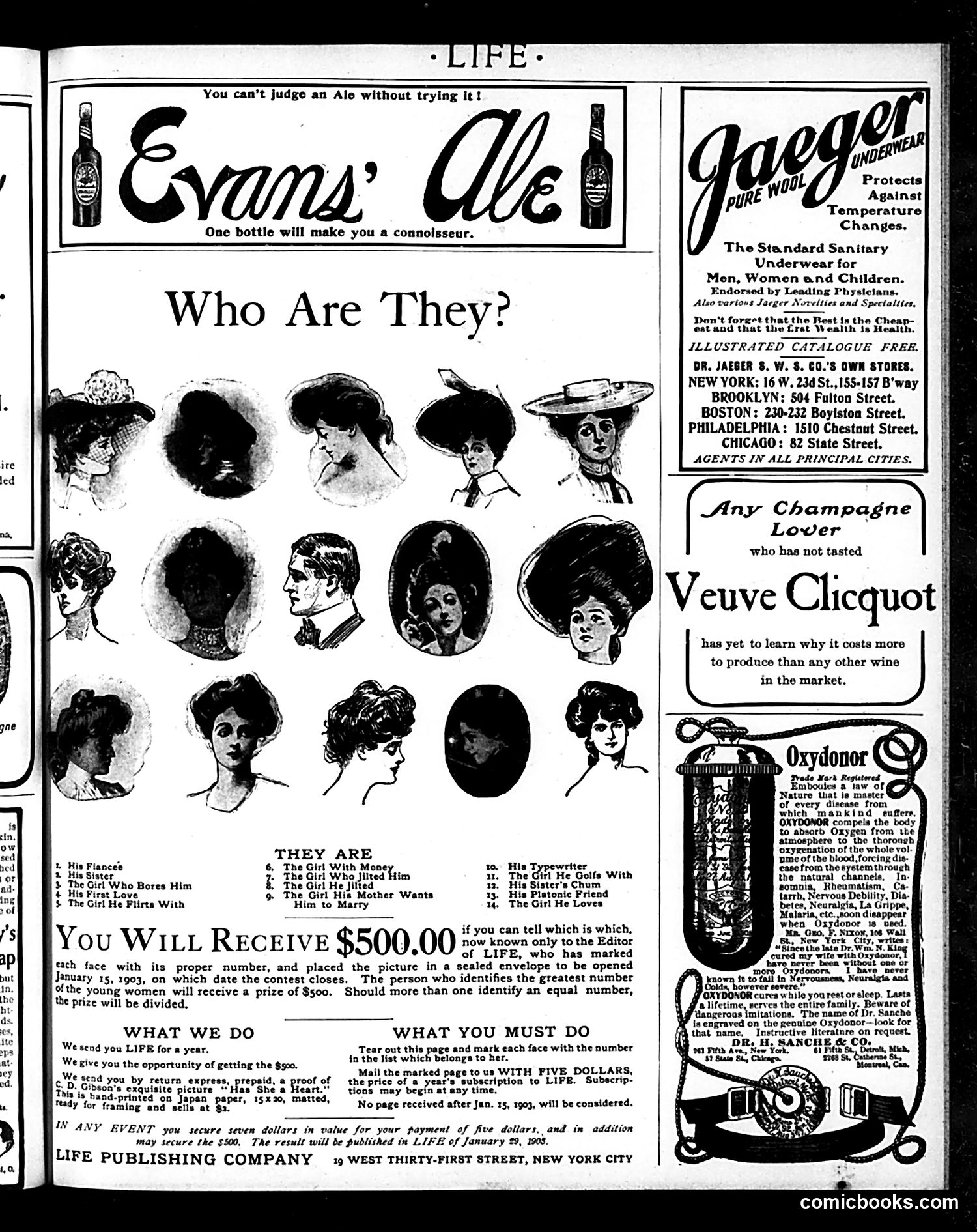
This page features a **guessing game contest** rather than political satire. The central image shows 15 sketched female faces labeled "Who Are They?" with corresponding identities: "His Sister," "The Girl Who Bores Him," "His First Love," "The Girl He Jilted," etc. **The Premise**: Readers must match each numbered face to its correct identity from the list. The winner(s) receive $500—substantial money in 1903. For just $5 (a year's subscription to Life), participants get seven dollars in value plus a chance at the prize. **Social Context**: The game reflects early-1900s romantic comedy tropes and satirizes the complicated web of women in a man's life. The categories—jilts, crushes, mother's preference—suggest genteel romantic entanglement common to period literature. **Surrounding Ads** include Evans' Ale, Jaeger wool underwear, Veuve Clicquot champagne, and Oxydonor (a dubious medical device), typical of Life's advertising base. This is fundamentally a **circulation-building promotion**, not editorial commentary.
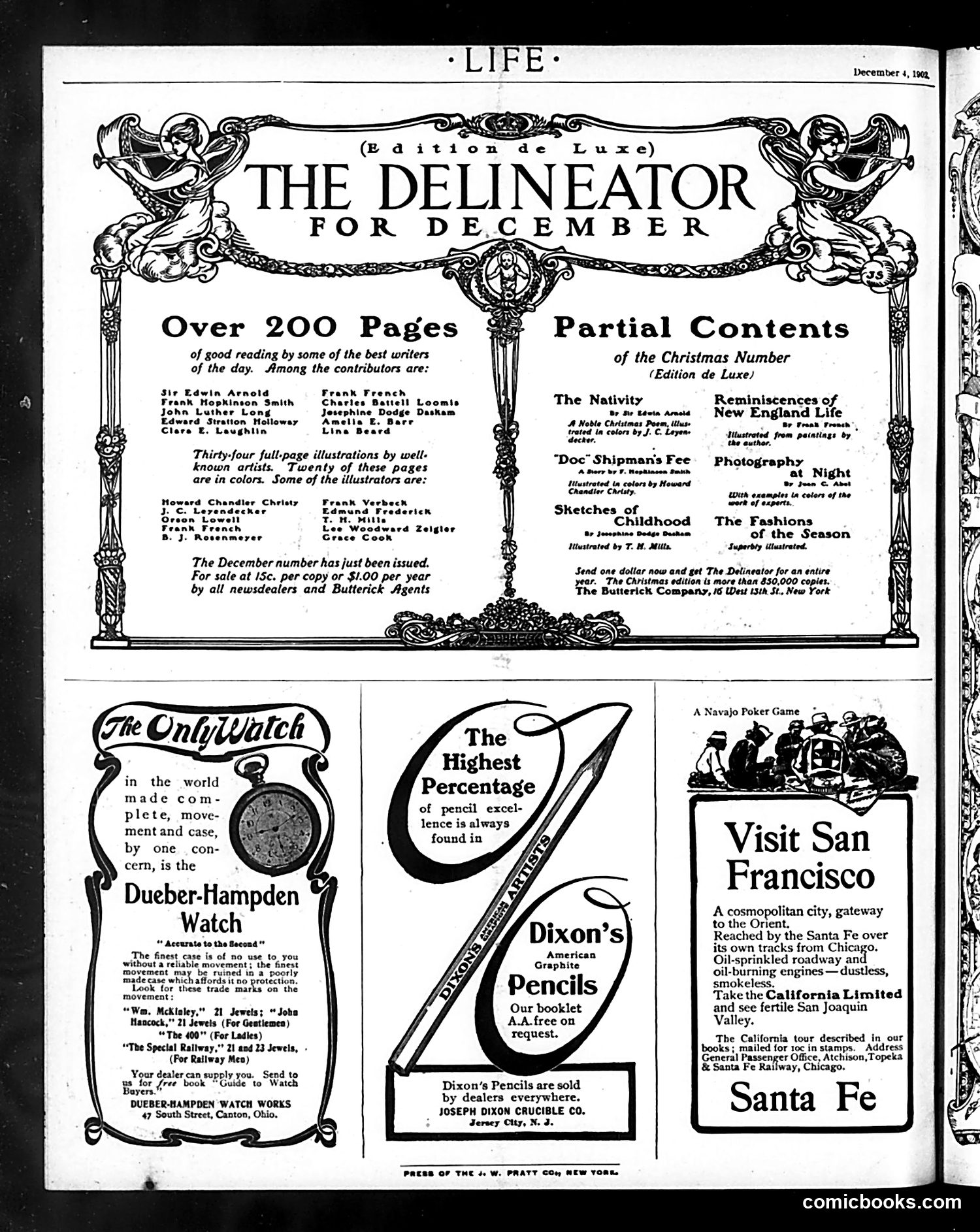
This is primarily a title/contents page for Life's Christmas edition, not a political cartoon. The page advertises *The Delineator* magazine's luxury holiday issue, listing over 200 pages featuring stories by prominent writers and 34 full-page illustrations, many in color. Below the main announcement are three product advertisements typical of the era: a Dueber-Hampden pocket watch (emphasizing reliable American manufacturing), Dixon's pencils (highlighting graphite quality), and a Santa Fe Railway ad promoting San Francisco tourism and the "California Limited" train service. The page reflects early 1900s commercial culture and leisure travel—the railroad ad particularly showcases how wealthy Americans increasingly took vacation trips to newly accessible destinations. There is no political satire or cartooning present; this is a straightforward advertising and editorial announcement page.