
Life, 1902-12-04 · page 15 of 24
Life — December 4, 1902 — page 15: what you’re looking at
What you’re looking at
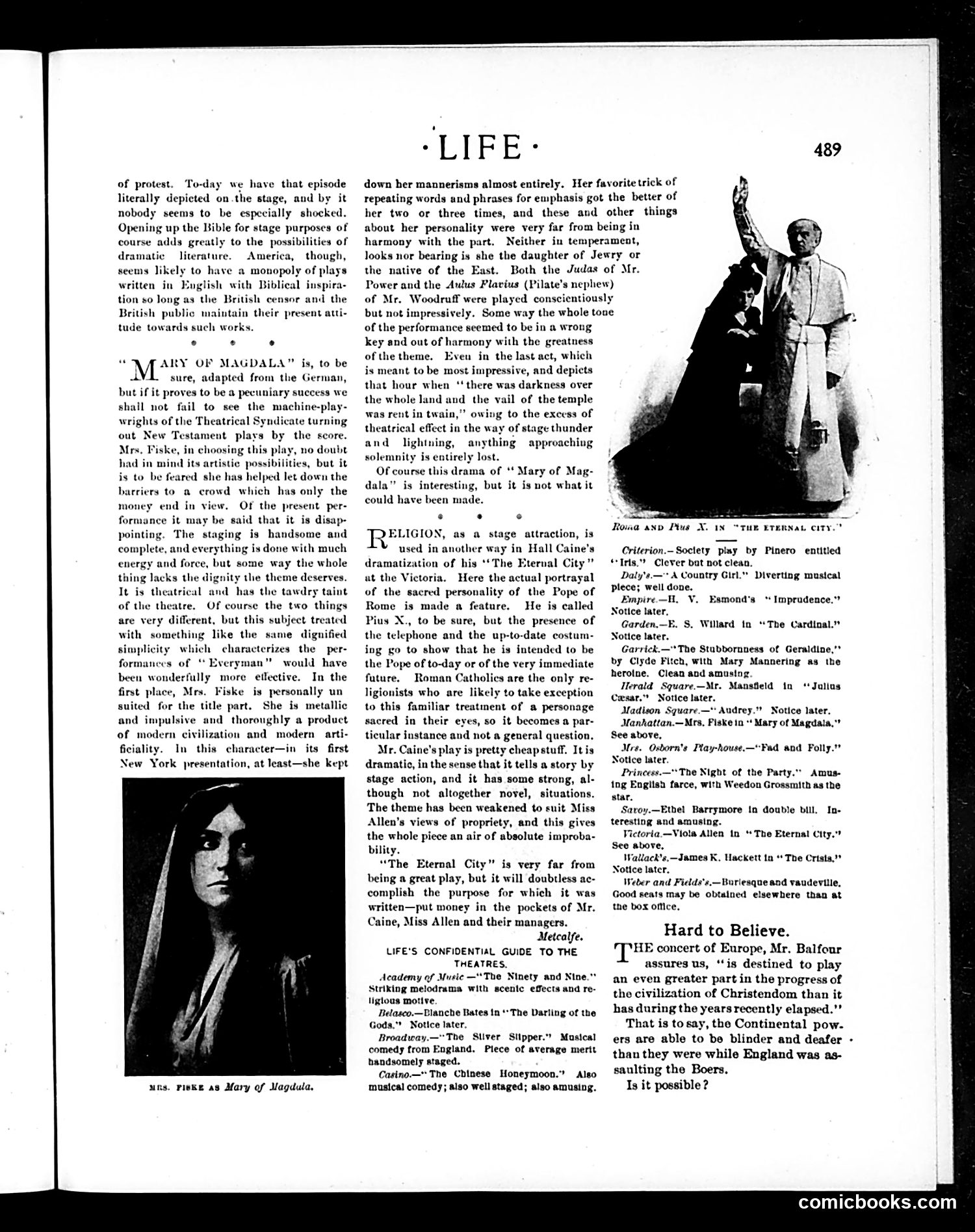
This page reviews two theatrical productions: **"Mary of Magdala"** (starring Mrs. Fiske) and **"The Eternal City"** (based on Hall Caine's novel). The critic dismisses both plays as disappointing despite their ambitious subject matter. Mrs. Fiske's performance in the Biblical drama is faulted as artificial and mannered—her metallic, modern personality clashes with the role's spiritual gravity. The production itself, though handsomely staged, prioritizes theatrical spectacle (thunder and lightning effects) over dignified simplicity, undermining the sacred themes. "The Eternal City" draws criticism for its cheap dramatics, particularly its portrayal of a contemporary Pope (Pius X), which the reviewer considers sensationalism rather than serious drama. The page also notes that British censors would never permit such Biblical adaptations, suggesting America's more permissive theatrical environment.
📄 Transcribed text from this page (OCR, searchable)
Machine-transcribed from the original scan — historical spelling and the odd misread are preserved.
of protest. To-day we have that episode literally depicted on.the stage, and by it nobody seems to be especially shocked. Opening up the Bible for stage purposes of course adds greatly to the possibilities of dramatic literature. America, though, seems likely to have a monopoly of plays written in English with Biblical inspir: tion so long as the British censor and the British public maintain their present atti- tude towards such works. ° ° ° “ Mt OF MAGDALA” is, to be a sure, adapted from the German, but if it proves to be a pecuniary success we shail not fail to see the machine-play- wrights of the Theatrical Syndicate turning out New Testament plays by the score. Mrs. Fiske, in choosing this play, no doubt had in mind its artistic possibilities, but it is to be feared she has helped let down the barriers to a crowd which has only the end in view. Of the present pe formance it may be said that it is disap- pointing. The staging is handsome and complete, and everything is done with much energy and force, but some way the whole thing lacks the dignity the theme deserve It is theatrical and has the tawdry taint of the theatre. Of course the two things are very different, but this subject treated with something like the same dignified simplicity which characterizes the per- formances of ‘“ Everyman" would have been wonderfully more eilective. In the first place, Mrs. Fisk personally un suited for the title part. She is metallic and impulsive and thoroughly a product of modern civilization and modern arti- ficiality. In this character—in its first New York presentation, at least—she kept mone: uns. riske as Mary of Magdula, “LIFE: down her mannerisms almost entirely. Her favorite trick of repeating words und phrases for emphasis got the better of her two or three times, and these and other things about her personality were very far from being in harmony with the part. Neither in temperament, looks nor bearing is she the daughter of Jewry or the native of the East. Both the Judas of Mr. Power and the Aulus Flavius (Pilate's nephew) of Mr. Woodruff were played conscientiously but not impressively. Some way the whole toue of the performance seemed to be in a wrong key and out of harmony with the greatness ofthe theme. Even in the last act, which is meant to be most impressive, and depicts that hour when ‘there was darkness over the whole land and the vail of the temple was rent in twain,” owing to the excess of theatrical effect in the way of stage thunder and lightning, anything approaching solemnity is entirely lost. Of course this drama of ** Mary of Mag- dala” is interesting, but it is not what it could have been made. . ° ay in Hall Caine’s ution of his *‘The Eternal City” at the Victoria. Here the actual portrayal of the sacred personality of the Pope of Rome is made a feature. He is called Pius X., to be sure, but the presence of the telephone and the up-to-date costum- ing go to show that he is intended to be the Pope of to-day or of the very immediate future. Roman Catholics are the only re- ligionists who are likely to take exception to this familiar treatment of a personage sacred in their eyes, so it becomes a par- ticular instance and not a general question. Mr. Caine’s play is pretty cheap stuff. It is dramatie, in the sense that it tells a story by stage action, and it has some strong, al- though not altogether novel, situations. The theme has been weakened to suit Miss Allen’s views of propriety, and this gives the whole piece an air of absolute improba- bility. “The Eternal City” is very far from being a great play, but it will doubtless ac- complish the purpose for which it was written—put money in the pockets of Mr. Caine, Miss Allen and their managers. Metcalfe. LIFES CONFIDENTIAL GUIDE TO THE THEATRES. Academy of Music —“The Ninety and Nine.” Striking melodrama with scente effects and re- ligtous motive. Retasco.—Dianche Bates in “The Darling of the Gods." Notice later. Broadway.—"The Silver Sitpper.” comedy from England, handsomely staged. Casino—" The Chinese Honeymoon.” Also musical comedy; also well staged; also amusing. Masical Plece of average merit Rowa asp Pius X. iN “Tue ETERNAL city.” Criterion.—Soctety play by Pinero entitled “Tris, Clover bat not clean. Daty’e.—* A Country Girl.” Diverting musical Plece; well done. Empire —H, V. Notice tater. Garden, Notice later. Garrick.—"The Stubbornness of Geraldine," by Clyde Fitch, with Mary Mannering as the heroine. Clean and amusing. Herald Square.—Mr. Mansfeld tn Cwsar.* Notice later. Madison Square-— Audrey."" Notice later. Manhattan.—Mrs, Piske tn“ Mary of Magdais,"” See above, Mrs. Osborn's Playrhouse-—"Fad and Folly." Notice later. Princess.—"The Night of the Party." Amus- ing Engitsh farce, with Weedon Grossmith as the star, Saroy.—Ethel Barrymore in doubte bill, In- teresting and amusing. Victoria.—Viola Allen in “ The Eternal City."’ See above, Watack’s,—James K. Hackett tn “The Crists* Notice later. Weber and Fields's,—Buriesque and vaudeville, Good seats may be obtained elsewhere than at the box office, Esmond‘s “ Imprudence." E. S, Willard in “The Cardinal.” “Jolins Hard to Believe. HE concert of Europe, Mr. Balfour assures us, ‘‘is destined to play an even greater part in the progress of the civilization of Christendom than it has during the years recently elapsed." That is tosay, the Continental pow- ers are able to be blinder and deafer than they were while England was as- saulting the Boers. Is it possible? comicbooks.com