
Life, 1902-12-04 · page 8 of 24
Life — December 4, 1902 — page 8: what you’re looking at
What you’re looking at
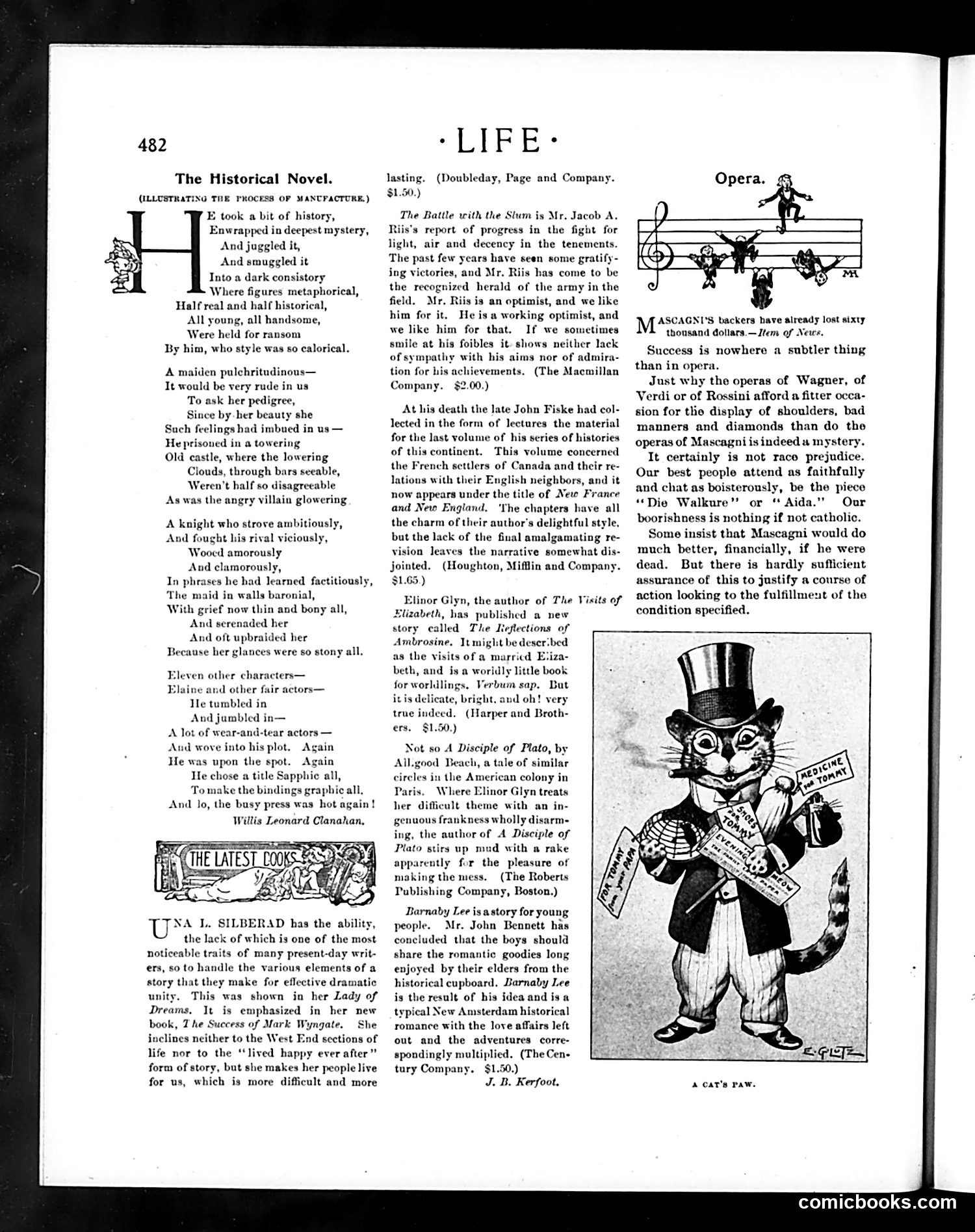
This page primarily contains book reviews from Life magazine's literary section. The cartoon titled "A Cat's Paw" (bottom right) depicts an anthropomorphic cat dressed as a fashionable gentleman in top hat and monocle, holding what appears to be newspapers or documents labeled with various publication names. The phrase "cat's paw" is an idiom meaning a person used by another to accomplish their purposes. The cartoon likely satirizes how newspapers or media outlets manipulate public opinion, or how certain publications serve the interests of powerful figures behind the scenes. The cat's elegant dress suggests pretense or false respectability masking this manipulative function. The surrounding text reviews historical novels and contemporary literature from that era.
📄 Transcribed text from this page (OCR, searchable)
Machine-transcribed from the original scan — historical spelling and the odd misread are preserved.
482 The Historical Novel. (ILLUSTRATING THE PROCESS OF MANUFACTURE) E took a bit of history, Enwrapped in deepest mystery, And juggled it, And smuggled it Into a dark consistory Where figures metaphorical, Half real and half historical, All young, all handsome, Were held for ransom By him, who style was so calorical. A maiden pulchritudinous— It would be very rude in us To ask her pedigree, ince by-her beauty she Such feelings had imbued in us — He prisoned in a towering Old castle, where the lowering Ciouds, through bars seeable, Weren't half so disagreeable As was the angry villain glowering A knight who strove ambitiously, And fought his rival viciously, Woocd amorously And clamorously, In phrases he had learned fa The maid in walls baronial, With grief now thin and bony all, And serenaded her ‘And oft upbraided her Because her glances were so stony all. itiously, her characters— xe and other fair actors— He tumbled in And jambled in— A lot of wear-and-tear actors — And wove into his plot. Again He was upon the spot. Again He chose a title Sapphic all, To make the bindings graphic all, And lo, the busy press was hot again! Willis Leonard Clanahan, NA 1. SILBERAD has the ability, the lack of which is one of the most noticeable traits of many present-day writ- ers, so to handle the various elements of a story that they make for eflective dramatic unity. This was shown in her Lady of Dreams. It is emphasized in her new book, The Success of Mark Wyngate. She inclines neither to the West End sections of life nor to the ‘lived happy ever after” form of story, but she makes her people live for us, which is more difficult and more » LIFE > lasting. (Doubleday, Page and Company. $1.50.) The Battle with the Slum is Mr. Jacob A. Riis’s report of progress in the fight for light, air and decency in the tenements. The past few years have seen some gratify- ing victories, and Mr. Riis has come to be the recognized herald of the army in the field. Mr. Riis is an optimist, and we like him for it. He isa working optimist, and we like him for that. If we sometimes smile at his foibles it shows neither lack of sympathy with his aims nor of admira- tion for his achievements. (The Macmillan Company. $2.00.) At his death the late John Fiske had col- lected in the form of lectures the material for the last volume of his series of histories of this continent. This volume concerned the French settlers of Canada and their re- lations with their English neighbors, and it now appears under the title of New France and New England, ‘The chapters have all the charm of their author's delightful style, but the lack of the final amalgamating re- vision leaves the narrative somewhat dis- jointed. (Houghton, Mifflin and Company. $1.65.) Elinor Glyn, the author of The Visits of Elizabeth, has published a new story called The Ieflections of ASCAGNU’S backers have already lost sixty thousand dollars.—Item of News. Success is nowhere a subtler thing than in opera. Just why the operas of Wagner, of Verdi or of Rossini afford a fitter occa- sion for tlie display of shoulders, bad manners and diamonds than do the operas of Mascagni is indeed a mystery. It certainly is not race prejudice. Our best people attend as faithfully and chat as boisterously, be the piece “Die Walkure’” or ‘ Aida." Our boorishness is nothing if not catholic. Some insist that Mascagni would do much better, financially, if he were dead. But there is hardly sufficient assurance of this to justify a course of action looking to the fulfillment of the condition specified. Ambrosine. It might be deser:bed as the visits of a married Etiza- beth, and is a woridly litle book for worldlings, Verbum sap. But c, bright, and oh! very . (Harper and Broth- Not so A Disciple of Plato, by All.good Beach, a tale of similar jes in the American colony in Paris. Where Elinor Glyn treats her difficult theme with an in- genuous frankness wholly disarm- ing, the author of A Disciple of Plato stirs up mud with a rake apparently for the pleasure of making the mess. (The Roberts Publishing Company, Boston.) Barnaby Lee isastory for young people. Mr. John Bennett has concluded that the boys should share the romantic goodies long enjoyed by their elders from the historical cupboard. Barnaby Lee is the result of his idea and is a typical New Amsterdam historical romance with the love affairs left out and the adventures corre- spondingly multiplied. (The Cen- tury Company. $1.50.) J. B. Kerfoot. A cat's raw. comicbooks.com