
Life, 1902-12-04 · page 6 of 24
Life — December 4, 1902 — page 6: what you’re looking at
What you’re looking at
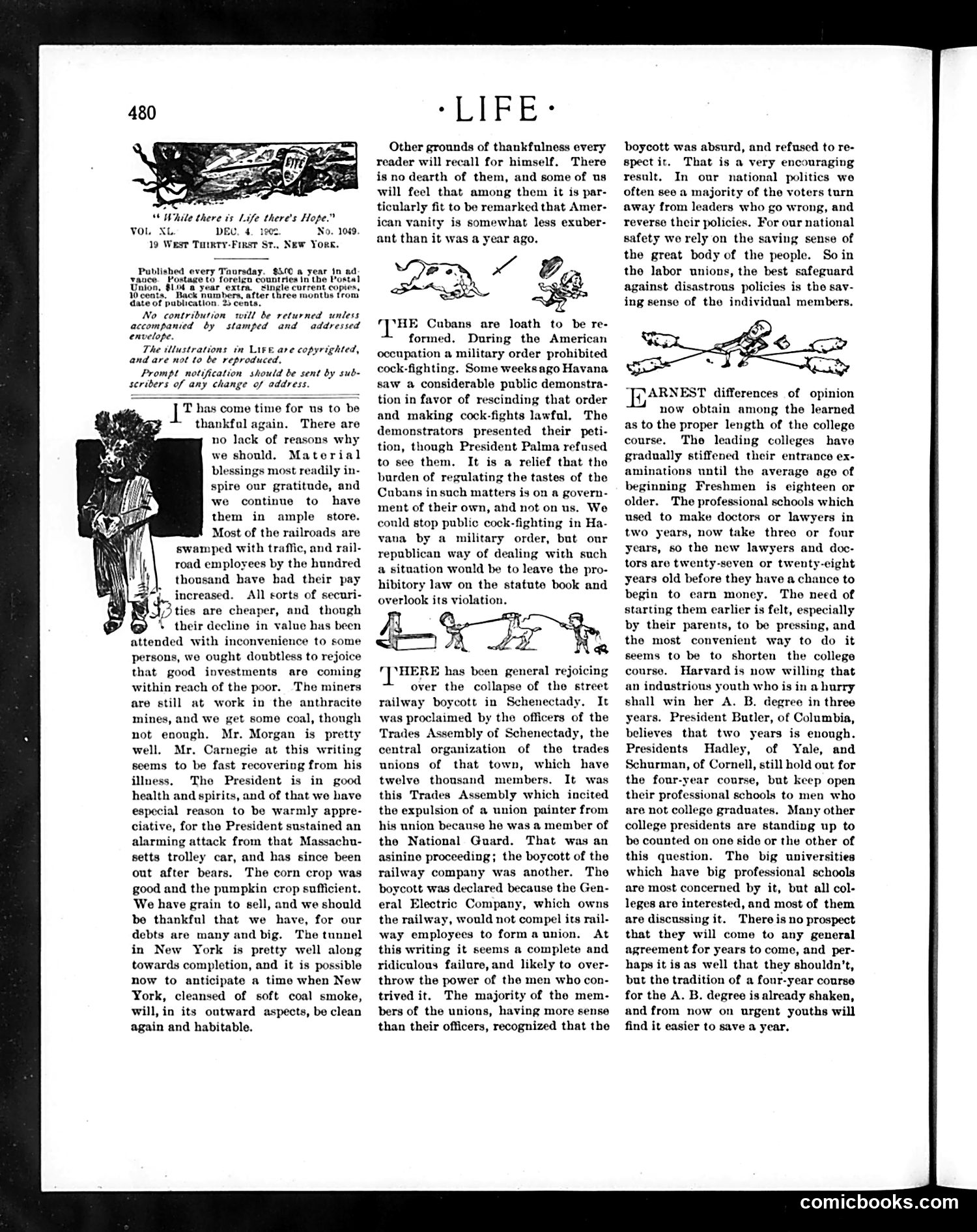
This page contains editorial commentary rather than a political cartoon. The text discusses several contemporary issues: **Cuba and Cock-fighting:** The article references President Palma's refusal to rescind a military order prohibiting cock-fighting in Cuba, noting that public demonstrations failed to change this policy. The satirical point appears to be that even elected officials sometimes resist popular pressure on matters they deem important. **Labor unions:** The piece discusses the Schenectady railway boycott and General Electric's labor disputes, praising unionists for ultimately recognizing that refusing to compel workers to unionize was more effective than coercion. **Higher education:** A lengthy section debates whether colleges should shorten their courses from four to three years, particularly for professional schools—a debate apparently active among institutions like Harvard and Cornell at this time.
📄 Transcribed text from this page (OCR, searchable)
Machine-transcribed from the original scan — historical spelling and the odd misread are preserved.
VOL Xt. DEv. 4 19 West Tatrty-First No. 1049 New York. Published every Taursday. $3! fC a year in ad. Faunce. Postage to foreign countries in the Postal Union, $14 a year extras current copies, Weents. Back numbers, after e months trom date of publication. 2 cents, No contribution will be returned untess accompanied by stamped and addressed envelope. The illustrations in Lire ave copyrighted, and are not to be reproduced, Prompt notification should be sent by sub- scribers of any change of address. T has come time for us to be thankfal again. There are no lack of reasons why we should. Material blessings most readily in- spire our gratitude, and we continue to have them in ample store. Most of the railroads are swamped with traffic, and rail- road employees by the hundred thousand have had their pay +7) increased. All sorts of securi- $3 ties are cheaper, and though @ * their decline in value has been attended with inconvenience to some persons, we ought doubtless to rejoice that good investments are coming within reach of the poor. The miners are still at work in the anthracite mines, and we get some coal, though not enough. Mr. Morgan is pretty well. Mr. Carnegie at this writing seems to be fast recovering from his illness, The President is in good health and spirits, and of that we have especial reason to be warmly appre- ciative, for the President sustained an alarming attack from that Massachu- setts trolley car, and has since been out after bears. The corn crop was good and the pumpkin crop sufficient. We have grain to sell, and we should be thankful that we have, for our debts are many and big. The tunnel in New York is pretty well along towards completion, and it is possible now to anticipate a time when New York, cleansed of soft coal smoke, will, in its outward aspects, be clean again and habitable. *LIFE* Other grounds of thankfulness every reader will recall for himself. There is no dearth of them, and some of us will feel that among them it is par- ticularly fit to be remarked that Amer- ican vanity is somewhat less exuber- ant than it was a year ago. ZED” Fa ([HE Cubans are loath to be re- formed. During the American occupation a military order prohibited cock-fighting. Some weeks ago Havana saw a considerable public demonstra- tion in favor of rescinding that order and making cock-fights lawful, The demonstrators presented their peti- tion, though President Palma refused to see them. It is a relief that tho burden of regulating the tastes of the Cubans insuch matters is on a govern- ment of their own, and not on us. We conld stop public cock-fighting in Ha- vana by a military order, but our republican way of dealing with such a situation would be to leave the pro- hibitory law on the statute book and overlook its violation. "THERE has been general rejoicing over the collapse of the street railway boycott in Schenectady, It was proclaimed by the officers of the Trades Assembly of Schenectady, the central organization of the trades unions of that town, which have twelve thousand members. It was this Trades Assembly which incited the expulsion of a union painter from his union because he was a member of the National Guard. That was an asinine proceeding; the boycott of the railway company was another. The boycott was declared because the Gen- eral Electric Company, which owns the railway, would not compel its rail- way employees to formaunion. At this writing it seems a complete and ridiculous failure, and likely to over- throw the power of the men who con- trived it. The majority of the mem- bers of the unions, having more sense than their officers, recognized that the boycott was absurd, and refused to re- spect it. That is a very encouraging result. In our national politics we often see a majority of the voters turn away from leaders who go wrong, and reverse their policies. For our national safety we rely on the saving sense of the great body of the people. Soin the labor unions, the best safeguard against disastrous policies is the sav- ing sense of the individual members. JeARsest differences of opinion now obtain among the learned as to the proper length of the college course, The leading colleges have gradually stiffened their entrance ex- aminations until the average age of beginning Freshmen is eighteen or older. The professional schools which used to make doctors or lawyers in two years, now take three or four years, so the new lawyers and doc- tors are twenty-seven or twenty-eight years old before they have a chance to begin to earn money. The need of starting them earlier is felt, especially by their parents, to be pressing, and the most convenient way to do it seems to be to shorten the college course. Harvard is now willing that an industrious youth who is in a hurry shall win her A. B. degree in three years. President Butler, of Columbia, believes that two years is enough. Presidents Hadley, of Yale, and Schurman, of Cornell, still hold out for the four-year course, but keep open their professional schools to men who are not college graduates. Many other college presidents are standing up to be counted on one side or the other of this question. The big universities which have big professional schools are most concerned by it, but all col- leges are interested, and most of them are discussing it. There is no prospect that they will come to any general agreement for years to come, and per- haps it is as well that they shouldn’t, but the tradition of a four-year course for the A. B. degree is already shaken, and from now on urgent youths will find it easier to save a year, comicbooks.com