
A complete issue · 22 pages · 1902
Life — November 20, 1902
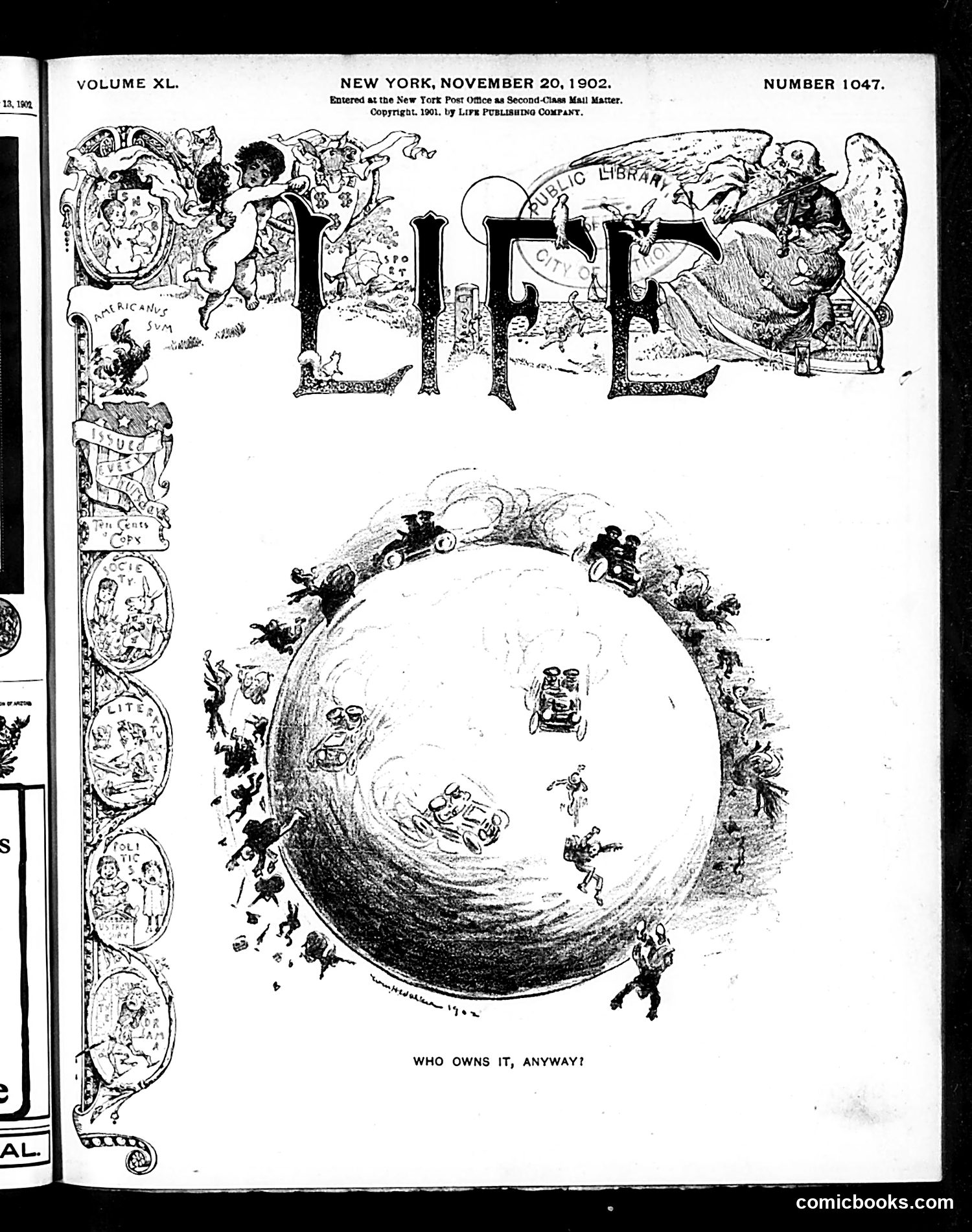
This satirical cover depicts a massive globe surrounded by tiny figures engaged in violent conflict—cars, carriages, and people fighting chaotically across its surface. The caption reads "WHO OWNS IT, ANYWAY?" The cartoon appears to critique imperial competition and colonial rivalries of the early 1900s, when major powers were aggressively competing for global dominance and territorial control. The warring figures represent different nations or factions scrambling for ownership and control of world resources and territories. The ornate left border contains decorative vignettes, typical of Life's design style. This cover likely responds to contemporary international tensions, possibly referencing conflicts over China, African colonization, or other imperial disputes of that era.
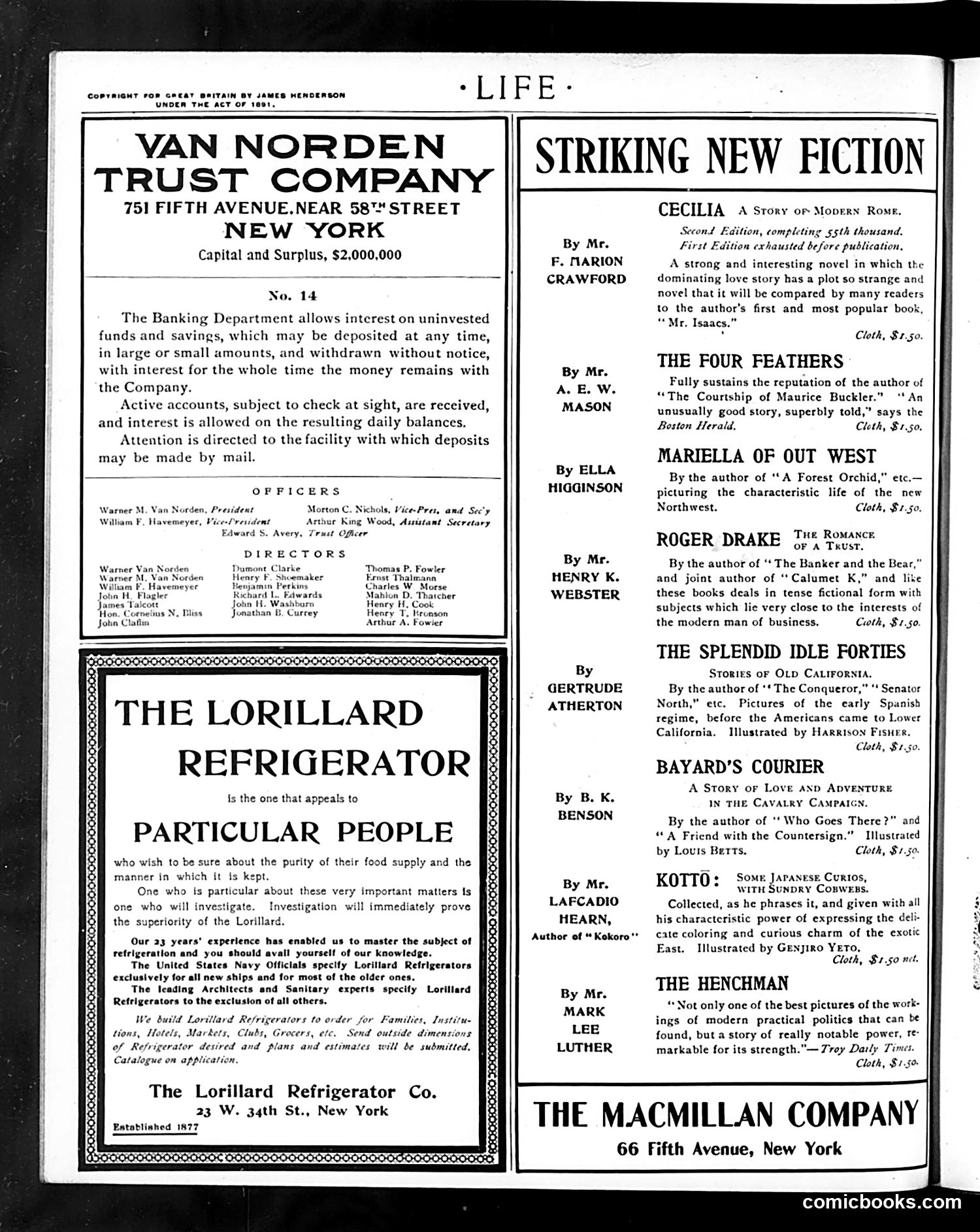
This page is primarily **advertising and book announcements** rather than political satire or cartoons. The left side features ads for the Van Norden Trust Company bank and the Lorilland Refrigerator Company. The right side is titled "Striking New Fiction" and lists books published by The Macmillan Company, including titles by F. Marion Crawford, A.E.W. Mason, Ella Higginson, and others. There are **no political cartoons visible** on this page. The content is straightforward commercial—banking services, household appliances, and literary advertisements typical of *Life* magazine's revenue model in this era. The page demonstrates how early 20th-century magazines mixed editorial content with paid advertising.
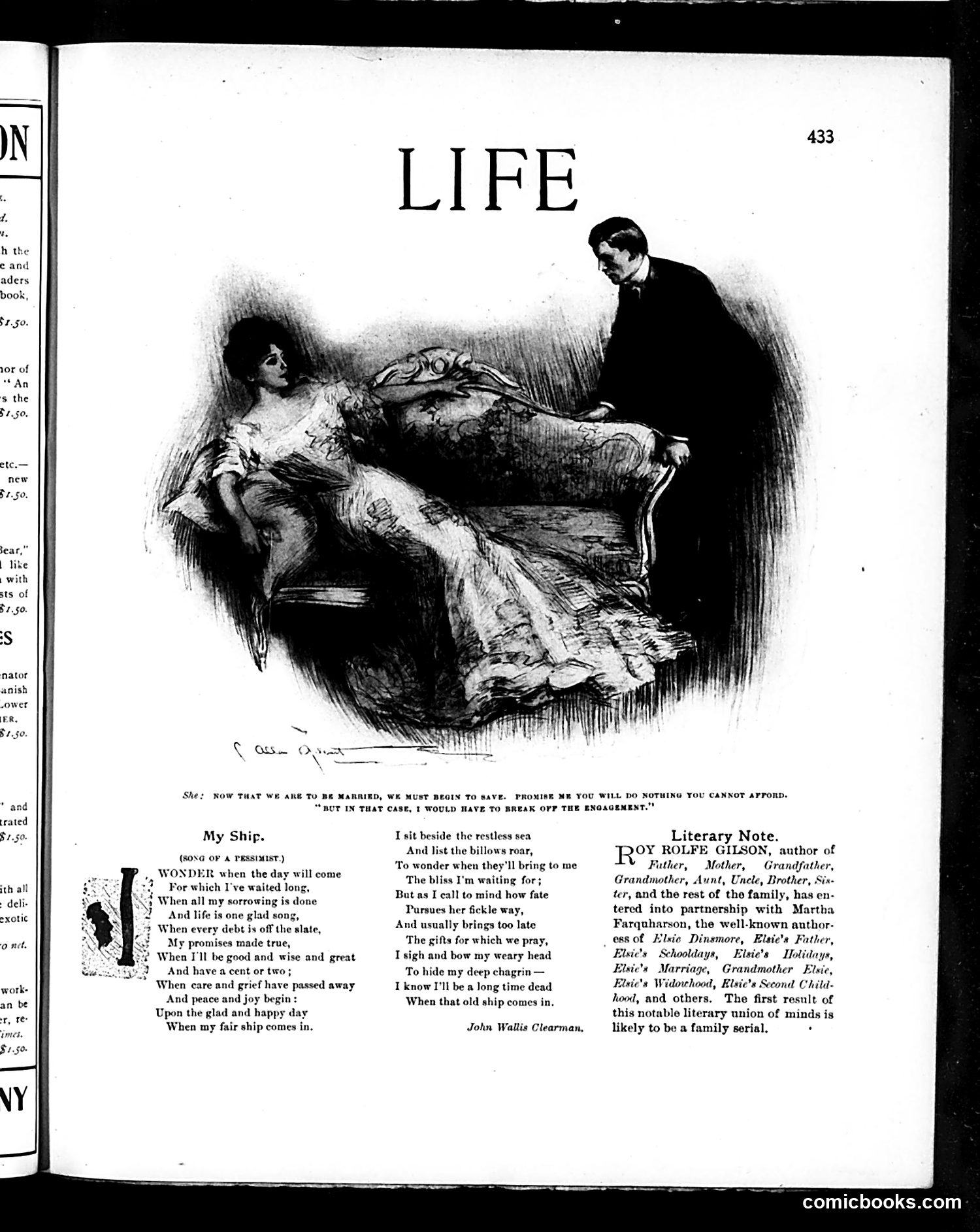
**The Main Illustration:** The cartoon depicts a couple on a couch with a man standing nearby. The caption reads: "Now that we are to be married, we must begin to save. Promise me you will do nothing you cannot afford. But in that case, I would have to break off the engagement." **Meaning:** This is social satire about marriage and financial expectations. The joke plays on the contradiction between the bride's demands for thrift and the groom's recognition that maintaining a marriage to someone with such expensive tastes is financially impossible. The humor targets both the materialistic expectations women were stereotyped as having and the economic pressures on men to support wives' spending habits—a common theme in early 20th-century satirical magazines like *Life*. The accompanying poems ("My Shir" and literary note about Roy Rolfe Gilson) appear separate from the cartoon's satire.
This page contains political commentary rather than cartoons. The text discusses early 1900s Republican and Democratic politics, mentioning President Roosevelt's popularity and Republican congressional gains. The small illustrated vignettes are decorative rather than satirical—showing figures like a cherub and various people in period dress, typical of Life's design style. The main article critiques a fireworks accident in Madison Square Garden caused by Mr. Hearst's celebration of his Congressional election victory. The author argues Hearst bears responsibility for negligent fireworks safety, blaming the Board of Aldermen for allowing such dangerous displays in public spaces. The piece also discusses coal prices, mining labor conditions, and debates about workers' unions—suggesting working-class concerns of the era. The satire is subtle: criticizing elite figures (Hearst, politicians) for prioritizing celebration over public safety.
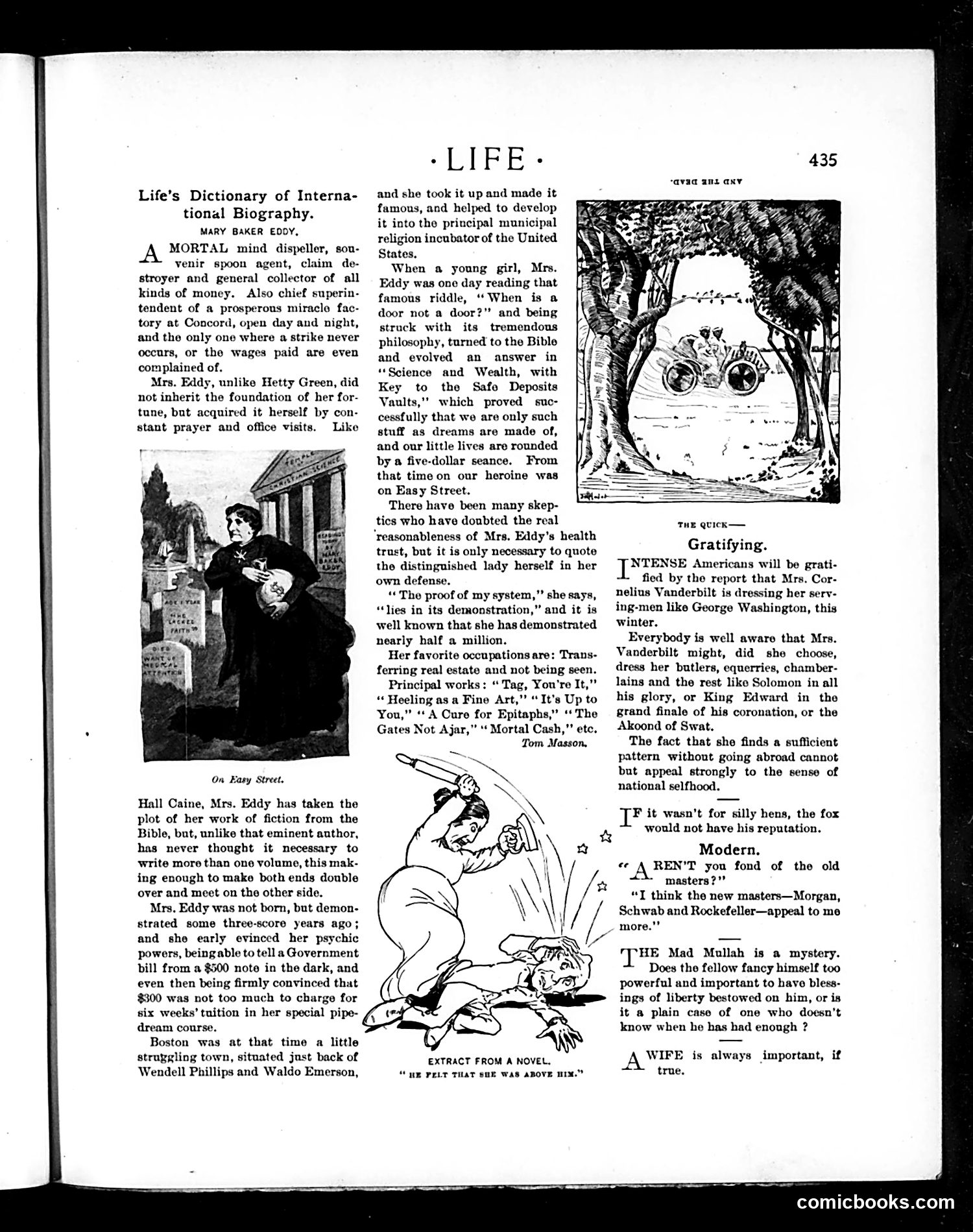
This page contains a biographical entry on **Mary Baker Eddy**, founder of Christian Science. The left illustration shows her on Easy Street, referencing her wealth and influence. The text describes her as a "mortal mind dissolver" and "general collector" who built a prosperous religious enterprise without experiencing strikes—a pointed reference to her anti-labor stance. The cartoon labeled **"He Felt That She Was Above Him"** appears to satirize gender dynamics or power imbalances, though its specific target is unclear from the image alone. The right section shifts to unrelated society gossip about **Mrs. Cornelius Vanderbilt** and brief philosophical observations ("Modern," "A Wife is always important"). The page mixes biography, satire, and humor typical of early 20th-century Life magazine's format.
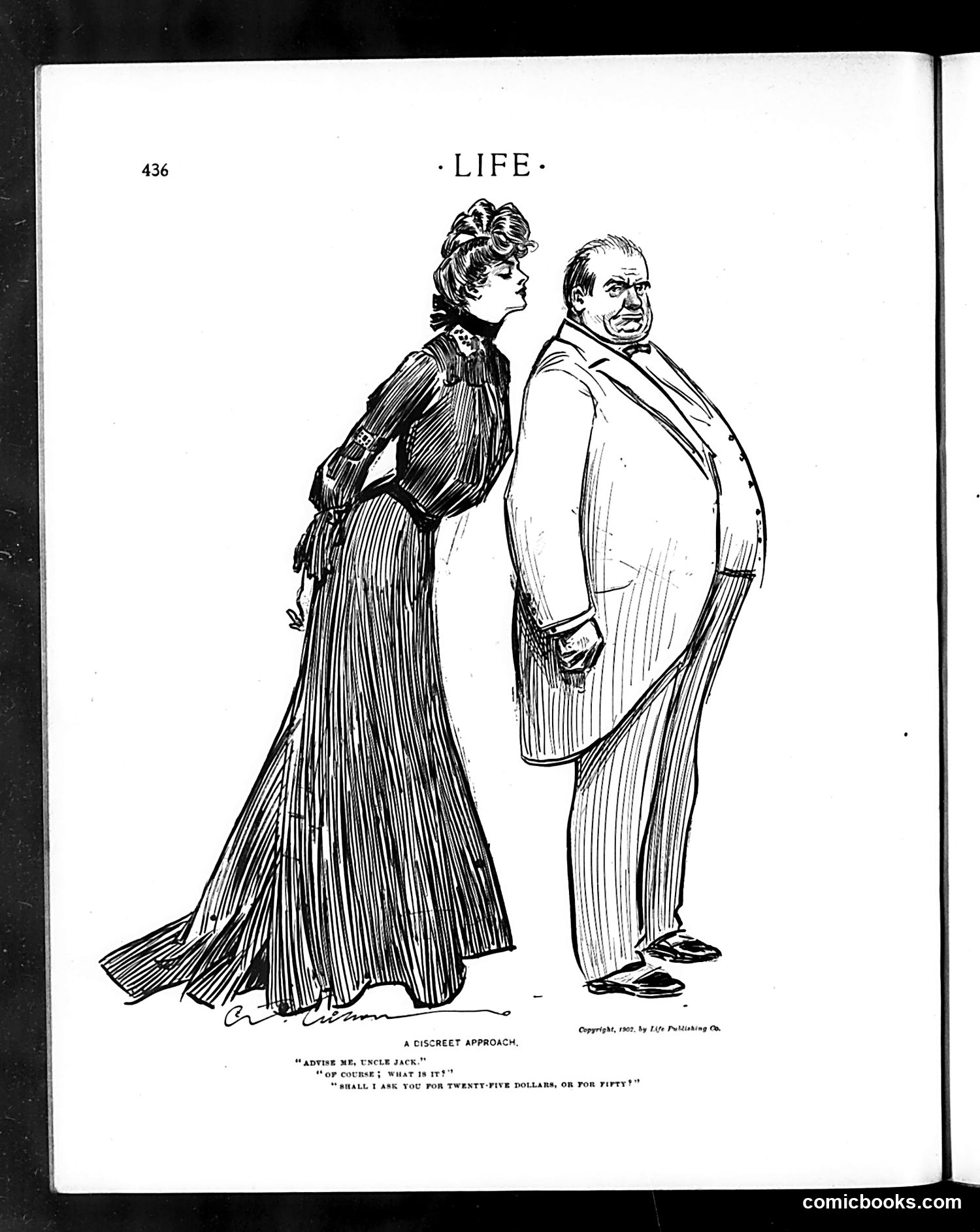
This cartoon satirizes awkward financial negotiations between a couple. A well-dressed man and an elegantly-gowned woman stand back-to-back, avoiding eye contact—a visual metaphor for discomfort. The caption reads: "Adieu, my love! Of course, what is it?" "Shall I ask you for twenty-five dollars, or for fifty?" The humor targets the delicate social dynamics of turn-of-the-century courtship and marriage, where direct money discussions were considered improper or unromantic. The woman's indirect, awkward phrasing ("shall I ask") satirizes the period's social conventions that required couples to dance around financial matters rather than address them candidly. The cartoon mocks both genteel pretense and the genuine financial complications underlying romantic relationships.
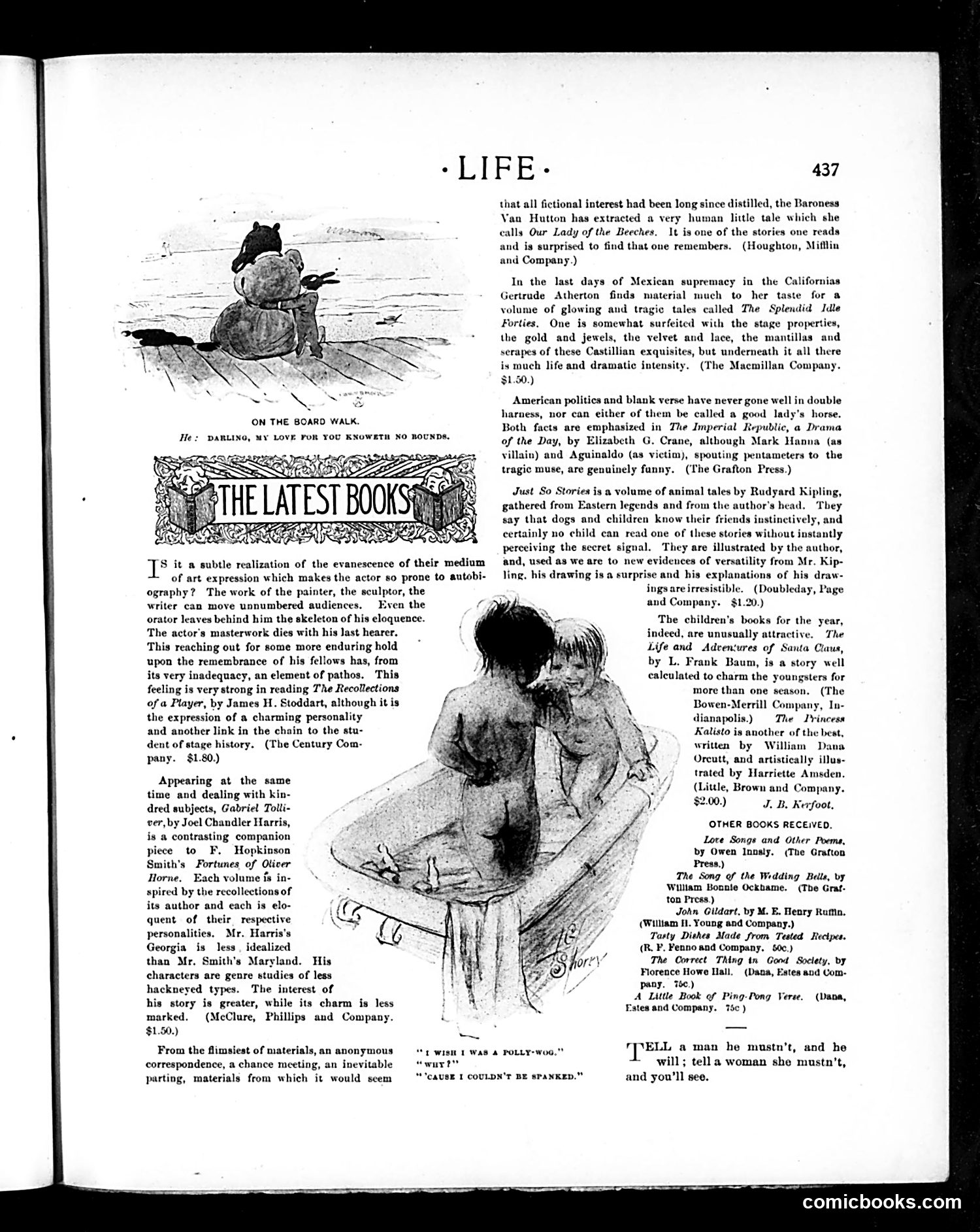
This page is primarily a book review section titled "The Latest Books," not a political cartoon. The illustrations are literary sketches rather than satirical cartoons. The top image captioned "On the Board Walk" shows a figure on a beach—likely illustrating one of the reviewed books. The lower sketch depicts what appears to be a domestic scene with two figures, captioned with dialogue: "I wish I was a Polly-wog," "Why?" and "Cause I couldn't be spanked." The page reviews several children's and adult books from the early 1900s, including *Just So Stories* by Rudyard Kipling and *The Imperial Republic* by Elizabeth Oakes. The content focuses on literary merit rather than political satire, representing Life magazine's role as a cultural arbiter, not primarily as a political publication.
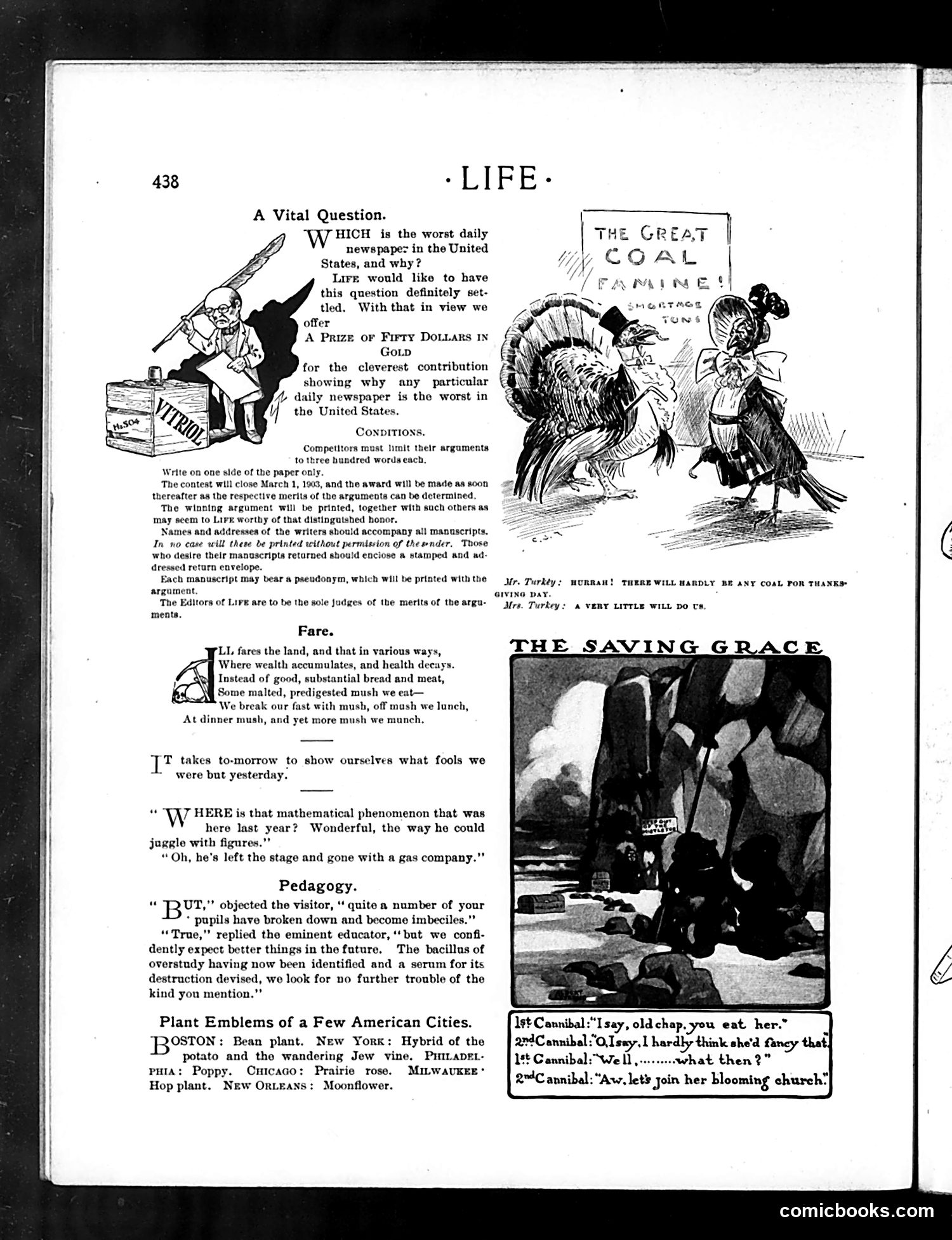
This cartoon satirizes the 1902-1903 coal shortage crisis affecting America. The dialogue between Mr. and Mrs. Turkey suggests coal will be scarce for heating during winter ("hardly be any coal for thanksgiving day"). The cartoon anthropomorphizes the turkey as facing the same fuel crisis as American households. The joke plays on the turkey's impending doom at Thanksgiving combined with the literal threat of freezing without coal—a double crisis. This references the anthracite coal strike and subsequent shortage that left many Americans unable to heat their homes during winter months, making fuel scarcity a genuine public concern of the era. The satire mocks both the energy crisis and the looming holiday threat.
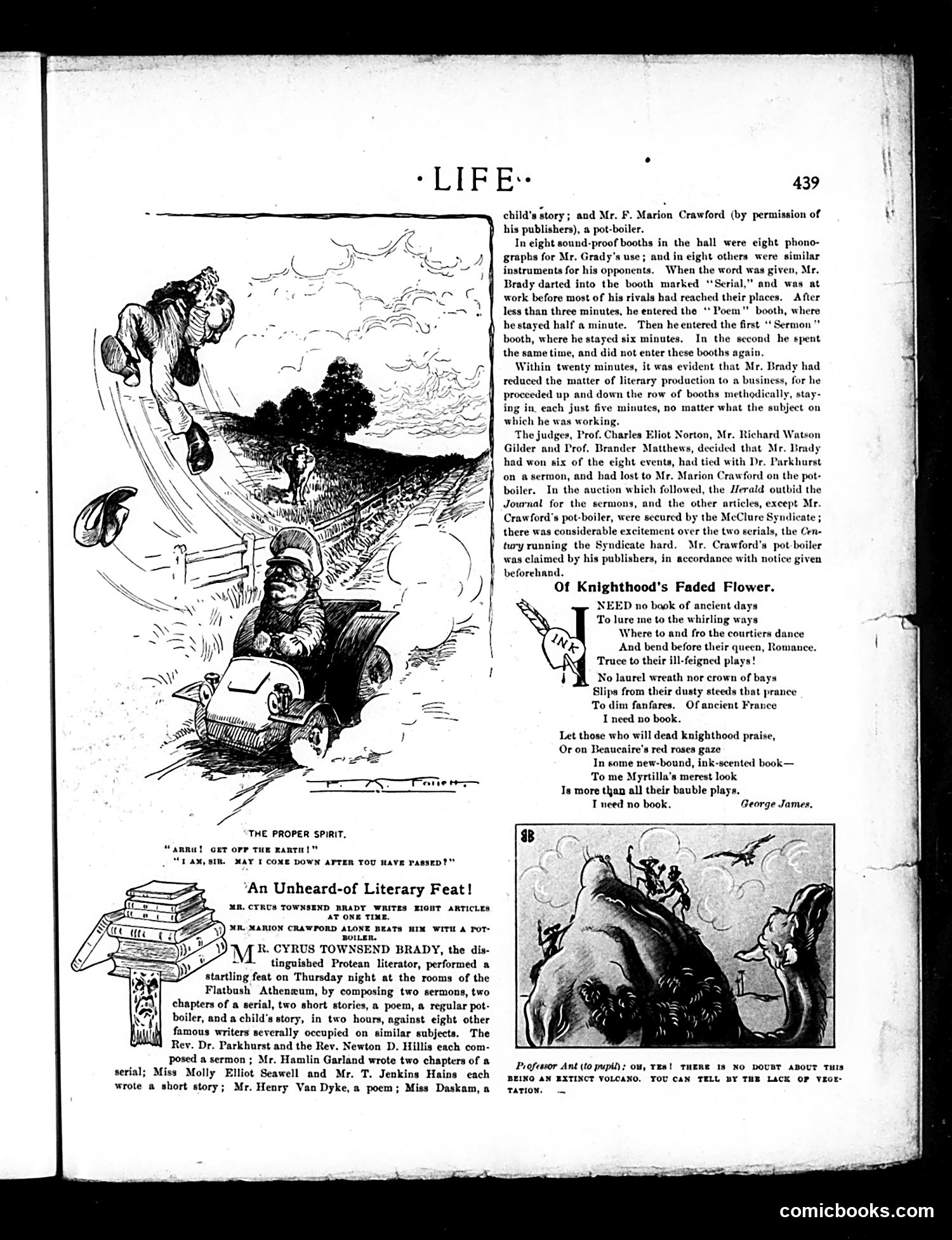
This political cartoon satirizes literary pretension and productivity. The image depicts a figure being thrown forcefully downward with books flying around him—illustrating the phrase "ARM! GET OFF THE EARTH!" The accompanying text describes an "Unheard-of Literary Feat" where Mr. Cyrus Townsend Brady wrote eight articles simultaneously, while Mr. Marion Crawford completed a pot-boiler in under three minutes. The satire targets prolific but low-quality writers who churned out commercial fiction rapidly. The violent imagery mocks their aggressive approach to publishing, suggesting such productive "hacks" should literally be ejected. This reflects early 20th-century literary snobbery distinguishing serious authors from commercial manufacturers of popular fiction.
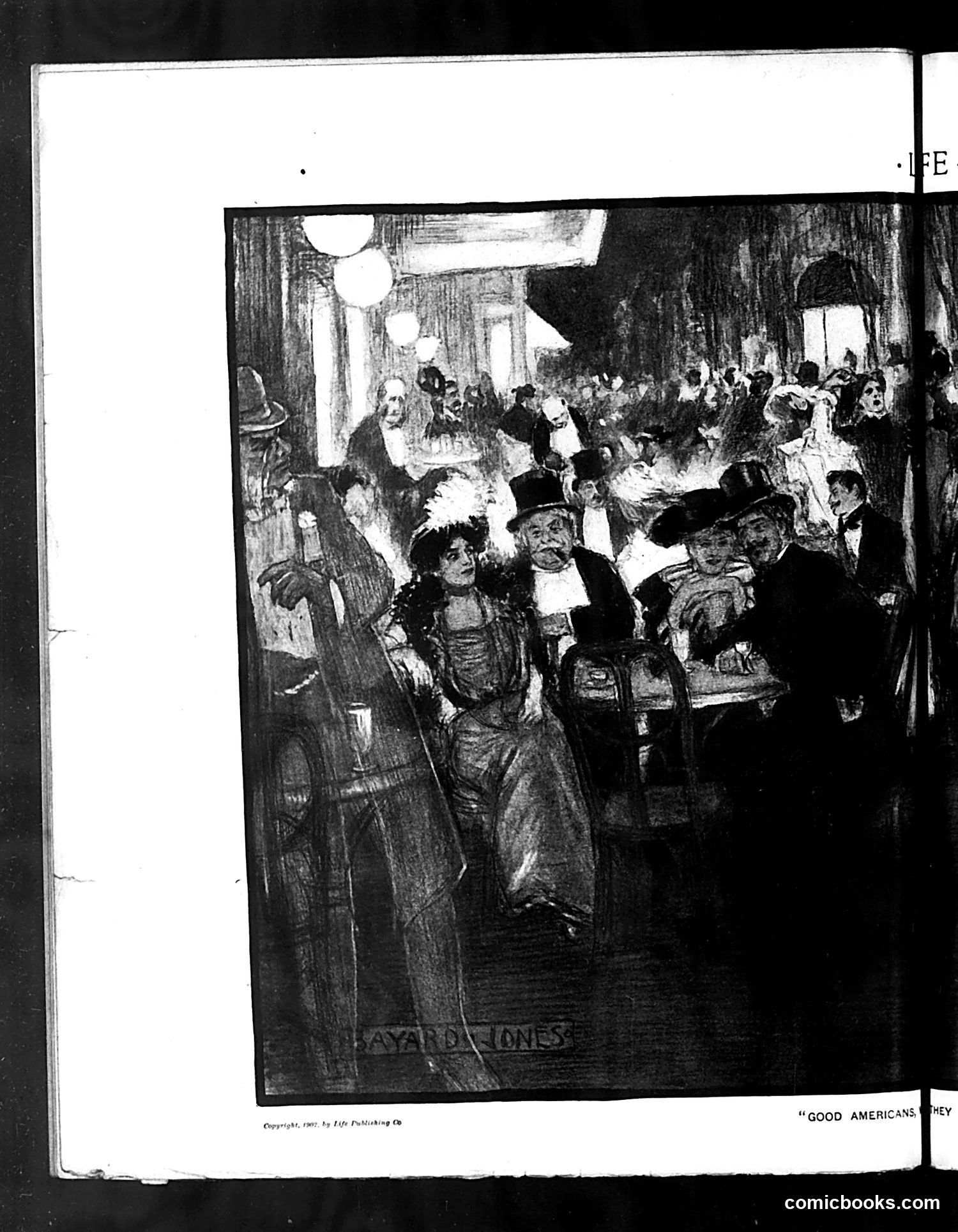
This appears to be a satirical illustration by cartoonist Cesare Maccari depicting a formal social gathering or reception in an ornate interior space. The caption reads "Good Americans" (partially visible at bottom right). The scene shows well-dressed figures in formal attire and elaborate hats gathered in what appears to be an exclusive venue. The style and composition suggest social satire—likely commentary on American high society or the wealthy elite of the period. The phrase "Good Americans" paired with this crowded, somewhat chaotic formal gathering likely carries ironic weight, suggesting critique of pretentiousness or exclusivity among the upper classes. However, without additional context about the specific date and political moment, I cannot identify particular individuals or pinpoint the exact social commentary intended.
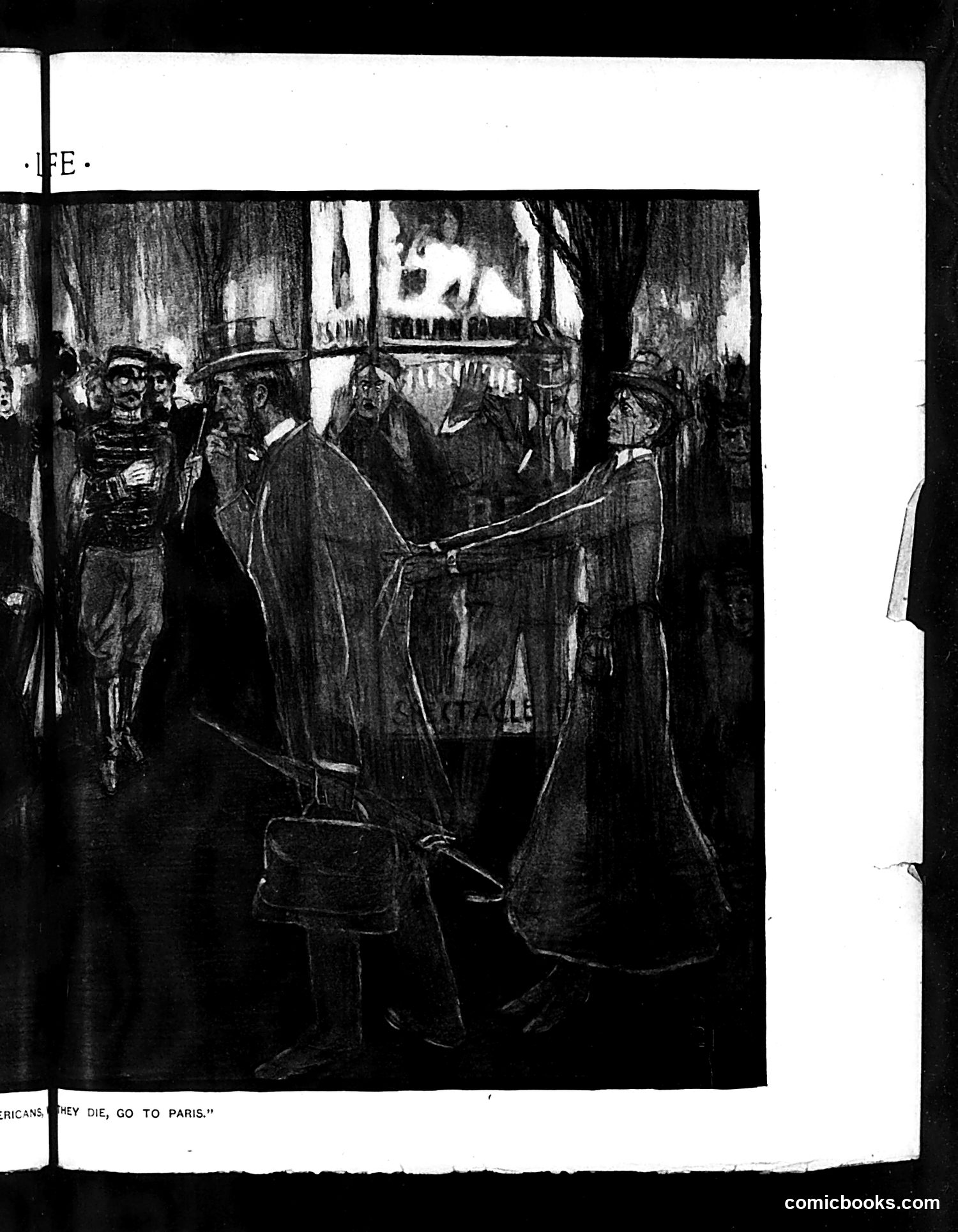
This appears to be a World War I-era satirical illustration from *Life* magazine. The caption reads "WHEN AMERICANS DIE, GO TO PARIS," suggesting commentary on American soldiers' deaths and their relationship to France. The image depicts military and civilian figures in what appears to be an interior setting with draped fabric. The sketch style and composition suggest this is criticizing either: 1. The sacrifice of American lives for French interests, or 2. American soldiers dying while fighting alongside France The specific identities of the caricatured figures are unclear from the image alone, but the satire appears to mock the human cost of American involvement in European conflicts and possibly questions the fairness of the alliance or war effort.
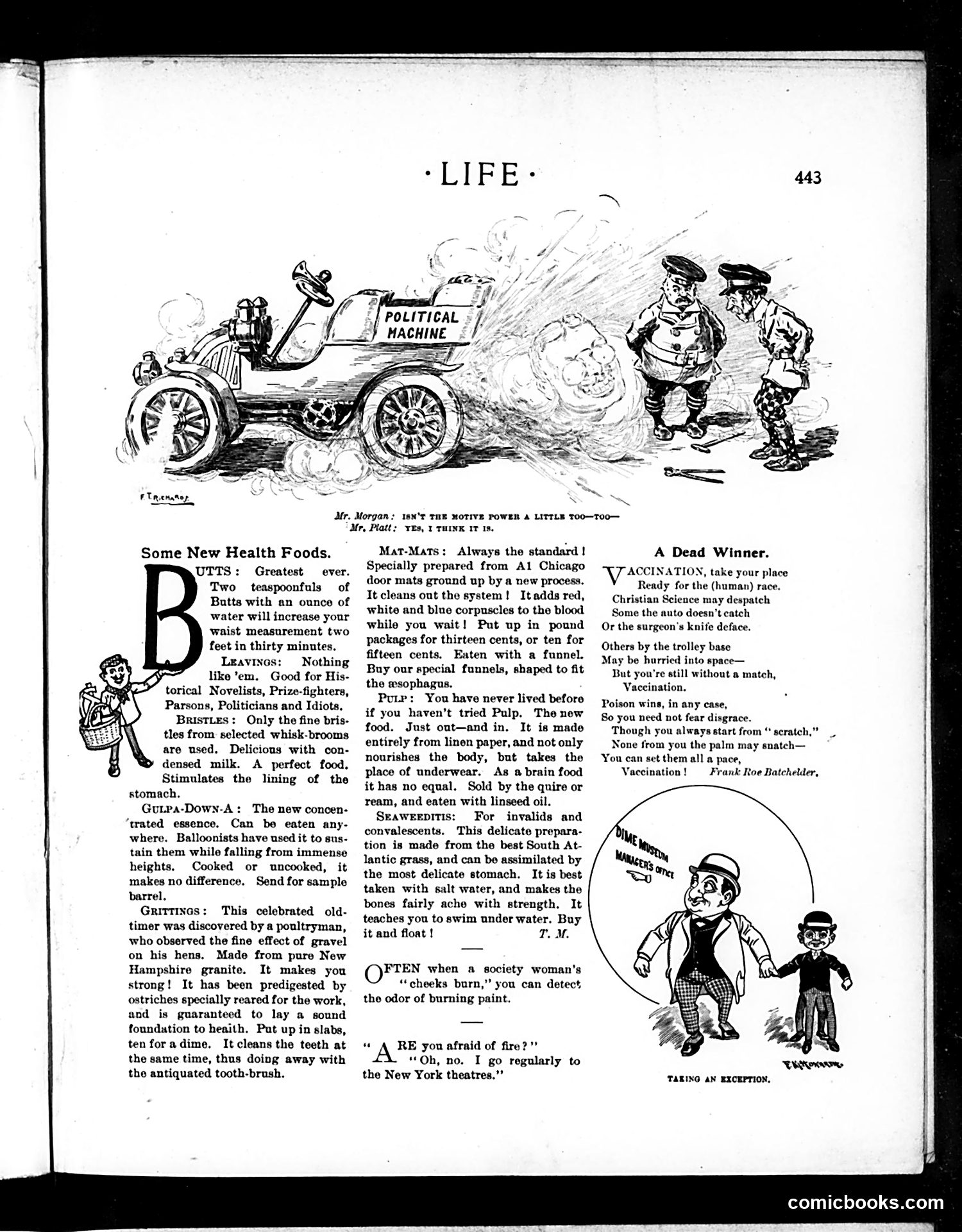
The top cartoon mocks the "Political Machine"—a metaphor for corrupt political systems. Two figures (likely representing politicians J.P. Morgan and Thomas C. Platt, based on the dialogue) discuss whether the machine's "motive power" is "too" much, suggesting concerns about excessive corporate or political influence driving American governance. Below are satirical fake "health food" advertisements parodying dubious patent medicines and quack remedies popular in the early 1900s. Products like "Butts," "Bristles," and "Mat-Mats" mock real snake-oil salesmen who made absurd health claims. The humor lies in the obviously ridiculous ingredients (ground-up door mats, whisk-broom bristles, granite) and impossible benefits. The "Dead Winner" poem sarcastically suggests vaccination as the only guaranteed protection, since other dangers (automobiles, trolleys, poison, surgeons) constantly threaten modern life. This reflects early skepticism about new technologies and medical safety.
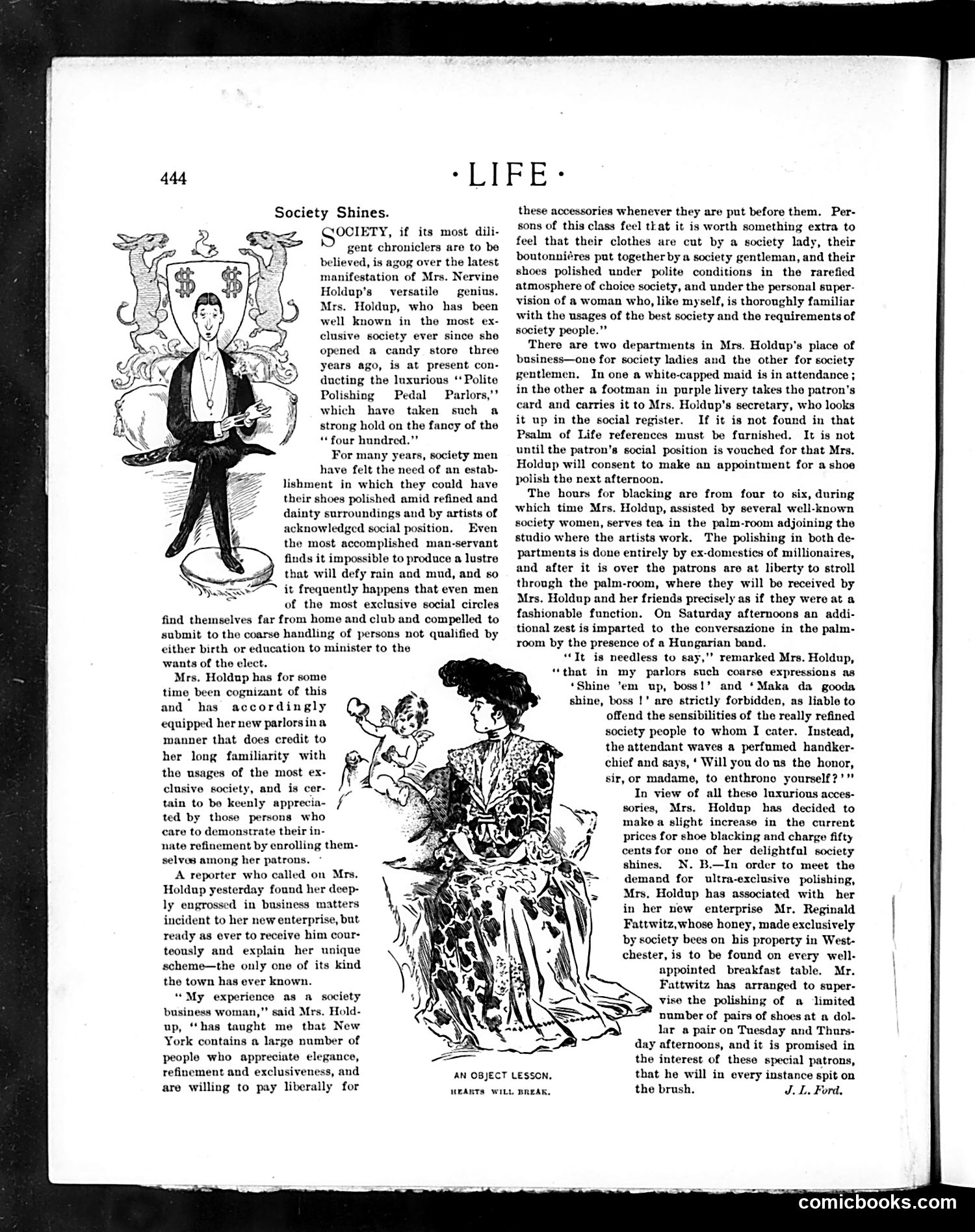
This satirical article mocks the absurd pretensions of wealthy New York society. "Mrs. Holdup" (a deliberately ironic name suggesting she's extracting money) runs a shoe-polishing parlor that caters exclusively to the elite "four hundred"—society's most exclusive circle. The joke is that she's monetized snobbery itself: she charges wealthy patrons premium prices for shoe shining performed by "ex-domestics of millionaires" in a refined atmosphere, complete with tea service and social-register verification. The satire targets how the wealthy willingly overpay for services simply because they're delivered within an "exclusive" social setting by people of alleged social standing. The cartoon's subtitle—"Hearts Will Break"—likely suggests the fragility or absurdity of these social pretensions. Life magazine is ridiculing both Mrs. Holdup's entrepreneurial exploitation of class consciousness and her clients' willingness to pay for the *illusion* of exclusivity rather than any actual service improvement.
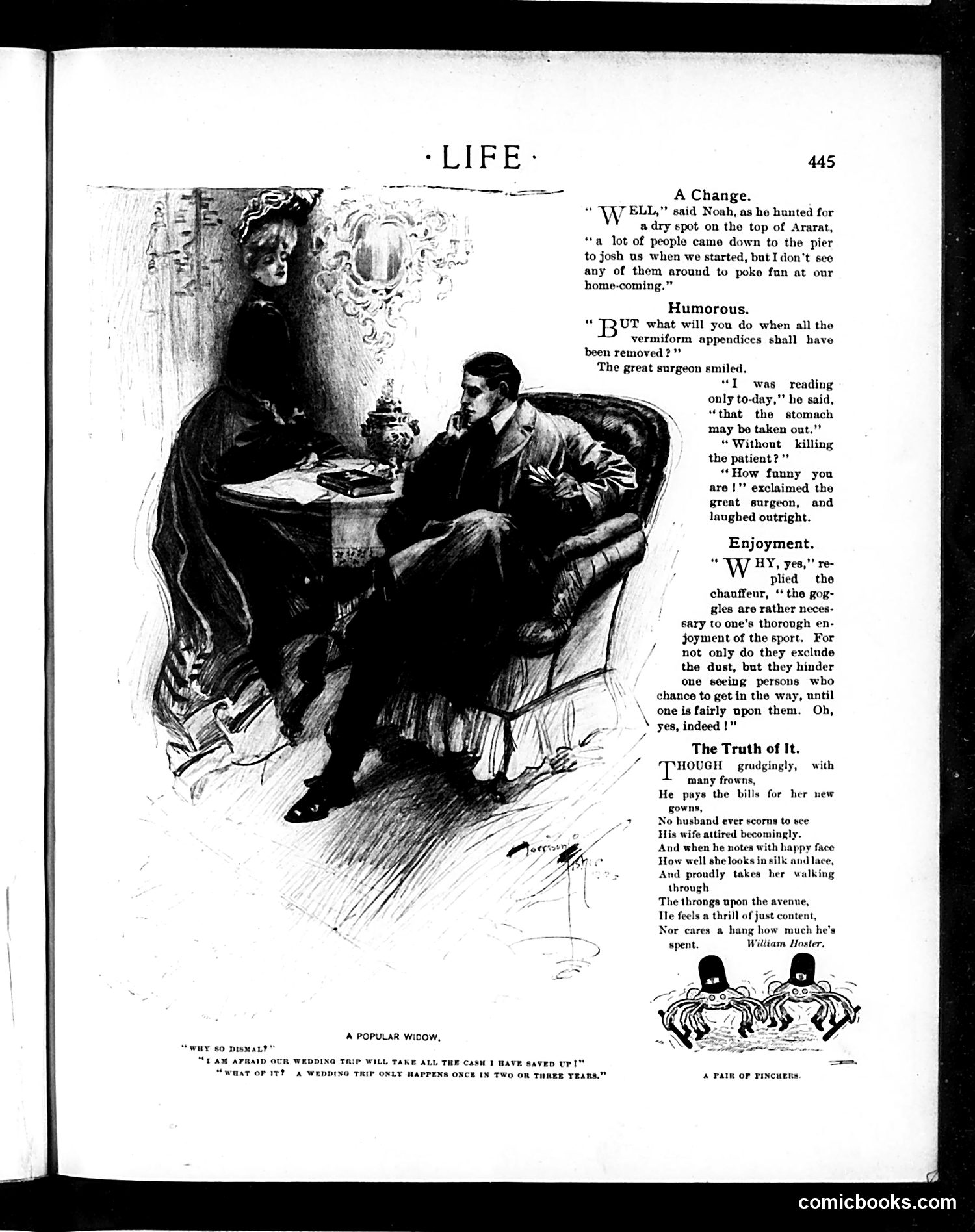
This page contains four brief humorous pieces typical of early Life magazine: 1. **"A Change"** mocks Noah's ark, with Noah noting that critics who mocked his voyage at departure are absent at homecoming—a joke about fair-weather skeptics. 2. **"Humorous"** satirizes medical progress: a surgeon discusses removing organs (appendices, stomachs) with dark comedy about modern surgery's expanding scope. 3. **"Enjoyment"** contains sharp social satire about automobile goggles: a chauffeur admits they're useful partly because they *prevent seeing pedestrians* in the driver's way—mocking both early motorists' recklessness and their indifference to public safety. 4. **"The Truth of It"** and the widow cartoon offer domestic satire: husbands reluctantly fund wives' expenses and wardrobes, yet secretly enjoy displaying well-dressed wives publicly—cynical commentary on marriage economics. The page reflects early 20th-century anxieties about new technology (automobiles), medical advancement, and changing gender/economic dynamics in marriage.
This page contains primarily **text-based humor and commentary** rather than visual cartoons. **"The Universal Habit"** is a humorous poem about women constantly checking their belts (corset fastenings) at their backs—while shopping, in church, even during romantic moments. The joke satirizes the impracticality and obsession of Victorian women's fashion, specifically the constant need to adjust restrictive corsetry. Even when her suitor confesses love, the woman's primary concern is her belt, not romance. The page also includes brief satirical commentary on: - A wealthy man's will requiring his widow to maintain his first wife's grave (critiquing cruel testamentary conditions) - Wit throughout history, using Cicero as example - A travel guide to Turkey being censored by confiscating pages about Constantinople The advertisements below are for whiskey, dress fabrics, and pens—typical period commerce. The satire targets **women's fashion constraints and social absurdities** of the early 1900s.
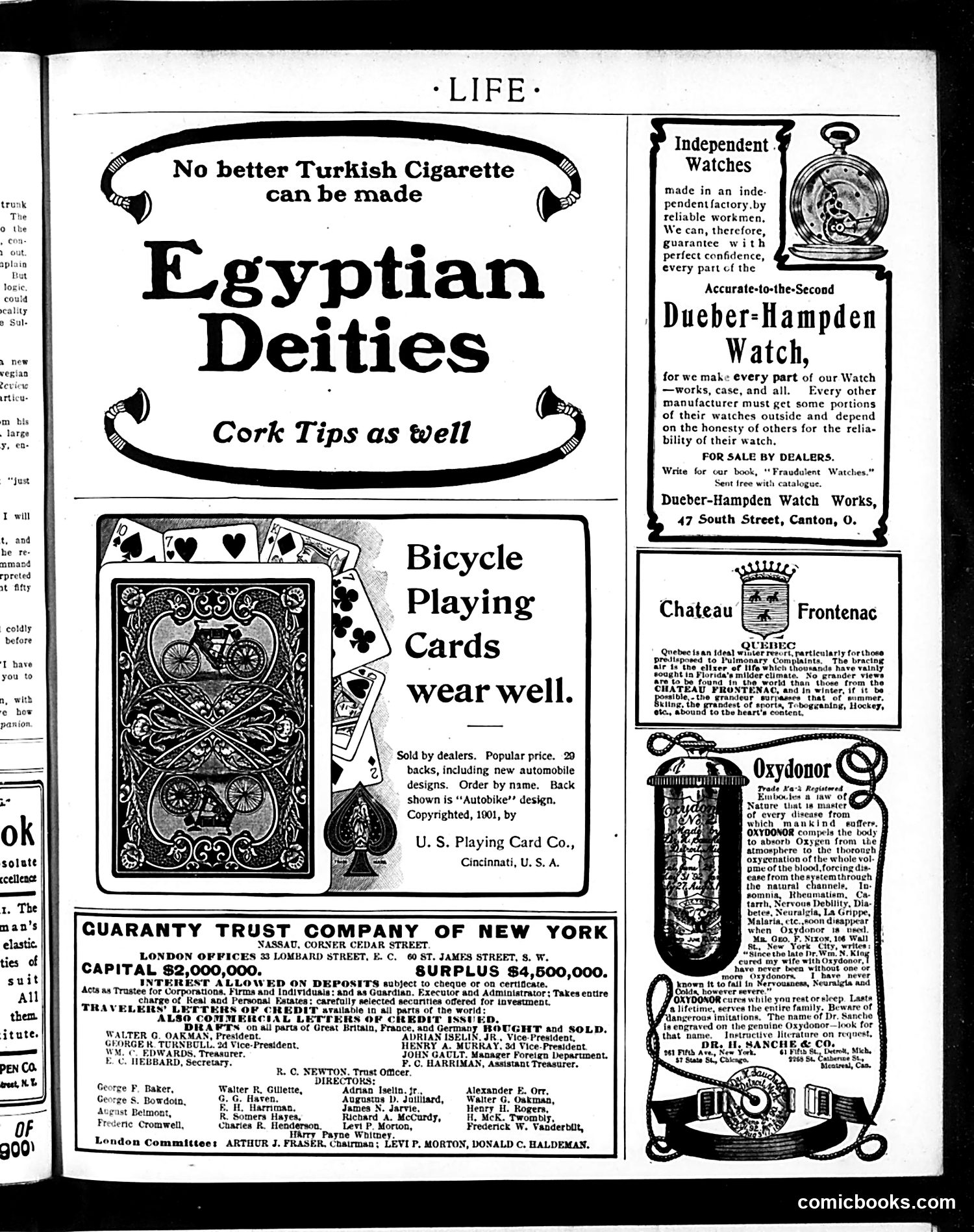
This is primarily an **advertising page** from Life magazine (circa 1901, based on copyright dates visible). Rather than political satire, it features product advertisements typical of the era: **Main advertisements:** - **Egyptian Deities cigarettes** with cork tips - **Bicycle Playing Cards** ("Autobike" design) by U.S. Playing Card Co. - **Guaranty Trust Company of New York** (banking/financial services) - **Dueber-Hampden Watches** (independent manufacture claimed as quality advantage) - **Chateau Frontenac** (Canadian resort hotel) - **Oxydonor** (patent medicine device claiming to cure various ailments through oxygen absorption) **Notable context for modern readers:** The Oxydonor exemplifies early 1900s patent medicine claims—pseudoscientific devices making sweeping health promises. The Dueber-Hampden ad emphasizes vertical integration (making all components in-house) as a reliability guarantee. These ads reflect consumer concerns of the era: trust in manufacturing, health remedies, and leisure travel. The page contains no political cartoons or satirical commentary—it's a straightforward commercial publication section.
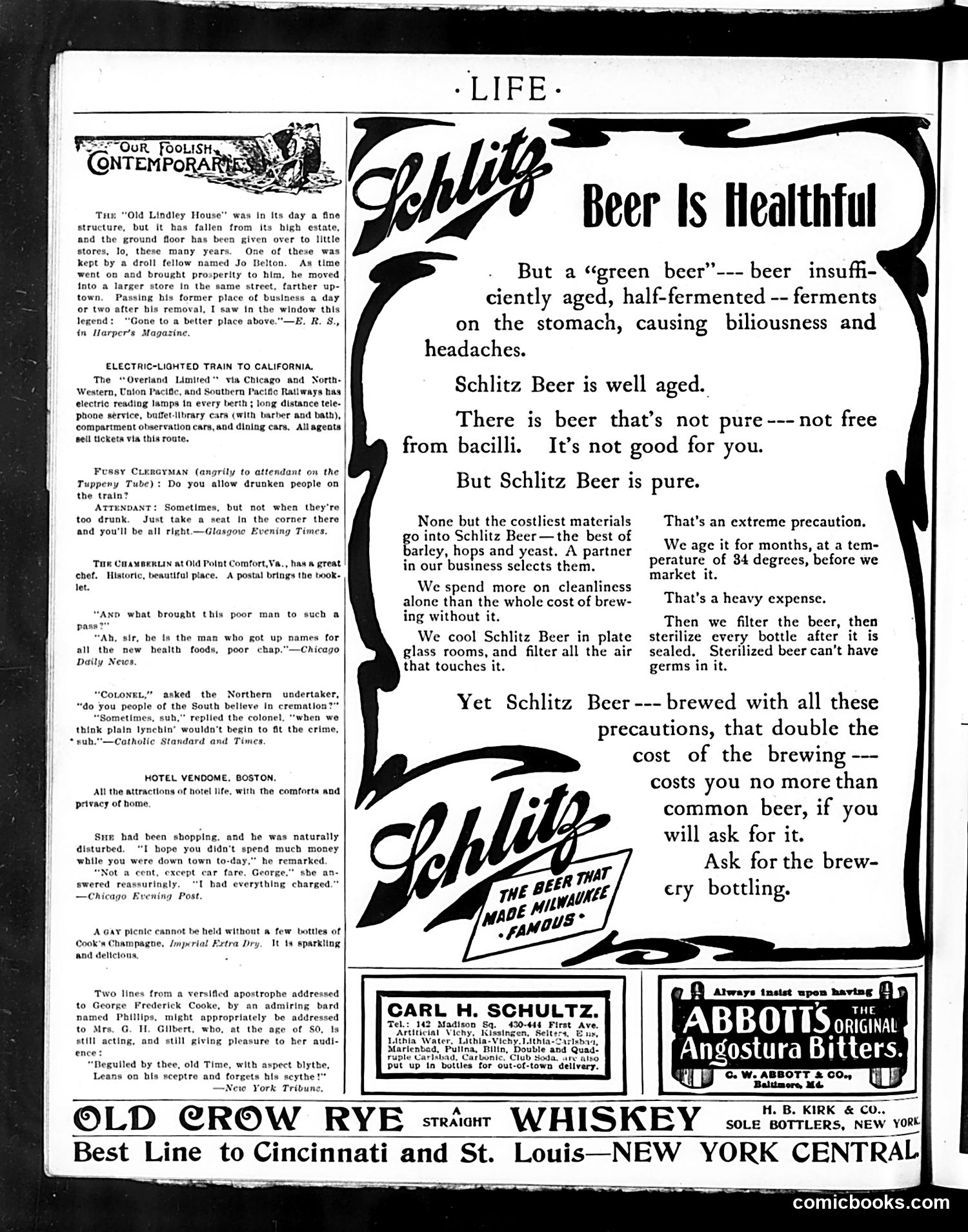
This page is primarily **advertising**, dominated by a large Schlitz Beer advertisement occupying roughly the right half. **The Schlitz Ad's Message:** The advertisement addresses a contemporary concern: "green beer" (insufficiently aged, half-fermented beer) causing stomach problems. Schlitz counters this by emphasizing their extensive quality-control process—months of aging at precise temperatures, costly materials, rigorous filtering and sterilization—yet claims these precautions don't increase the price above "common beer." The ad reflects early 1900s anxieties about food and beverage safety, before modern food regulation, when "purity" was a major selling point. **Left Column Content:** Short humorous anecdotes and advertisements for hotels, trains, and other services typical of *Life* magazine's format—satirical sketches rather than formal cartoons. **Historical Context:** This appears from the Prohibition era or immediately before, when beer's healthfulness was actively marketed to counter temperance arguments. The emphasis on "purity" and scientific cleanliness reflects Progressive Era consumer concerns about industrial food production safety.
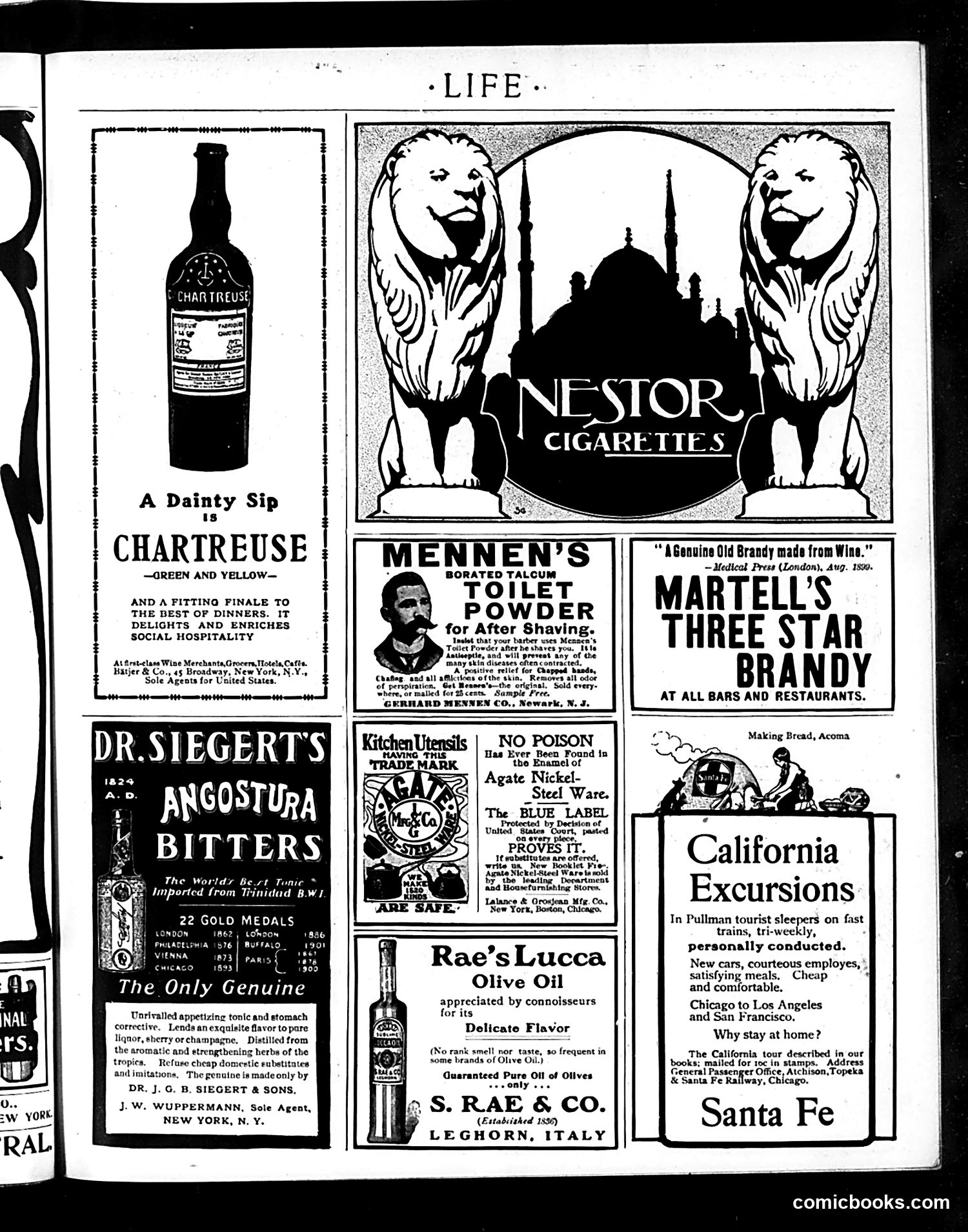
This is primarily a **commercial advertisement page** rather than editorial content. It features luxury consumer products marketed to affluent readers of the early 1900s. The ads target wealthy clientele through appeals to refinement and cosmopolitanism: Chartreuse liqueur, Nestor cigarettes (framed by classical lion statues suggesting prestige), Martell's brandy, Dr. Siegert's Angostura Bitters (claiming 22 gold medals), Mennen's toilet powder, kitchen ware, Rae's Italian olive oil, and Santa Fe Railway excursions to California. These advertisements reflect **Gilded Age consumer culture**—emphasizing imported European goods, exotic ingredients, and leisure travel as markers of social status. The medical/scientific language ("antiseptic," "guaranteed pure") reflects period advertising tactics attempting to lend credibility to consumer products. There is **no political satire evident** on this page; it's purely commercial promotion typical of Life's revenue model during this era.
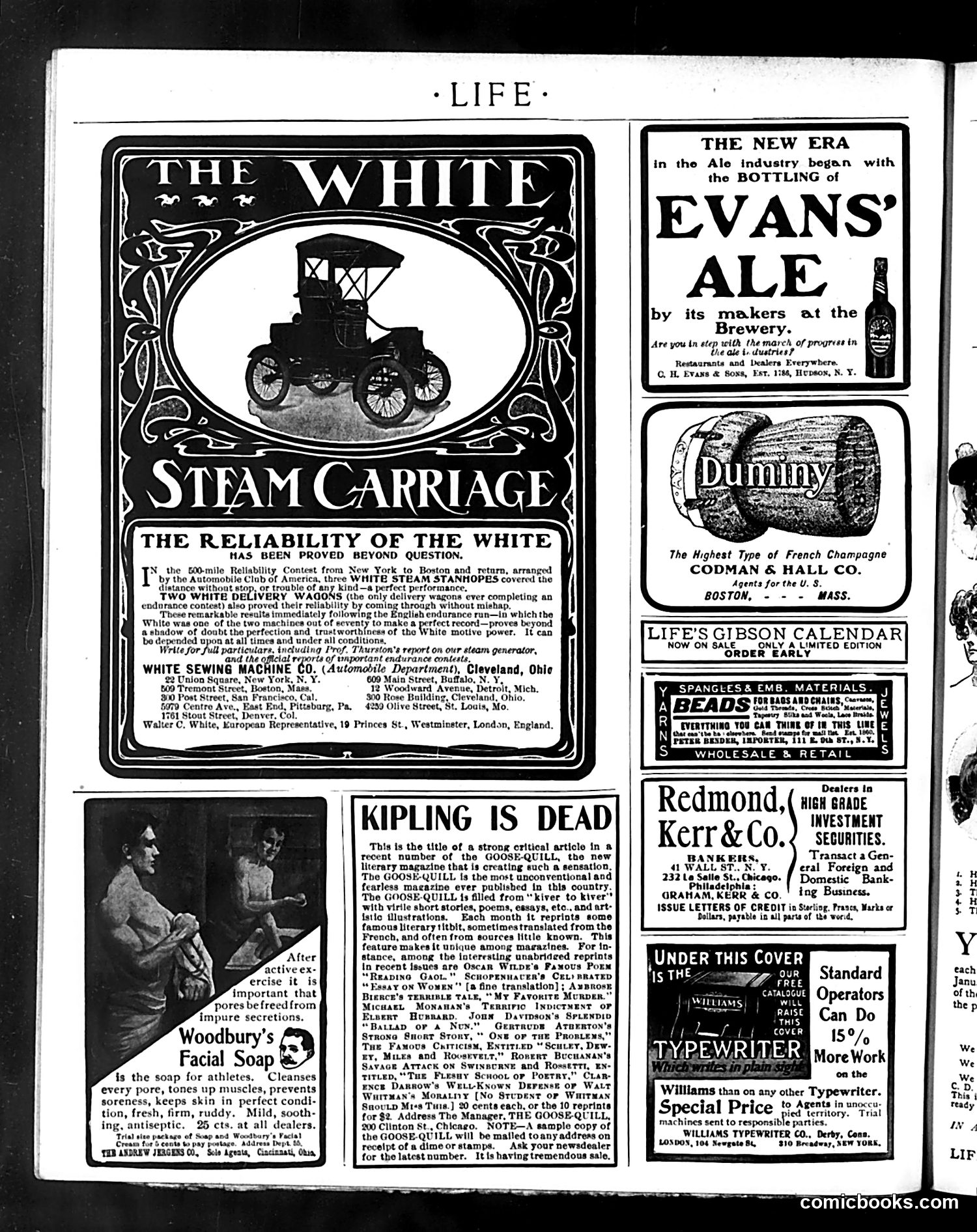
This is primarily an **advertising page** from Life magazine, not a political cartoon. The main content promotes various products: White Steam Carriages (automobiles), Evans' Ale, Woodbury's Facial Soap, and others. The one editorial piece is an advertisement for the **Goose-Quill literary magazine**, which uses the provocative headline **"KIPLING IS DEAD"**—not referring to Rudyard Kipling's actual death, but rather a critical article claiming his literary influence is obsolete. This was marketing bravado: the Goose-Quill positioned itself as daring and modern by publishing "unconventional" reprints of famous literary works, positioning itself against established literary tastes. The page reflects early 1900s consumer culture and the era's obsession with technological progress (steam automobiles) and modern consumer products marketed as scientific and health-promoting.
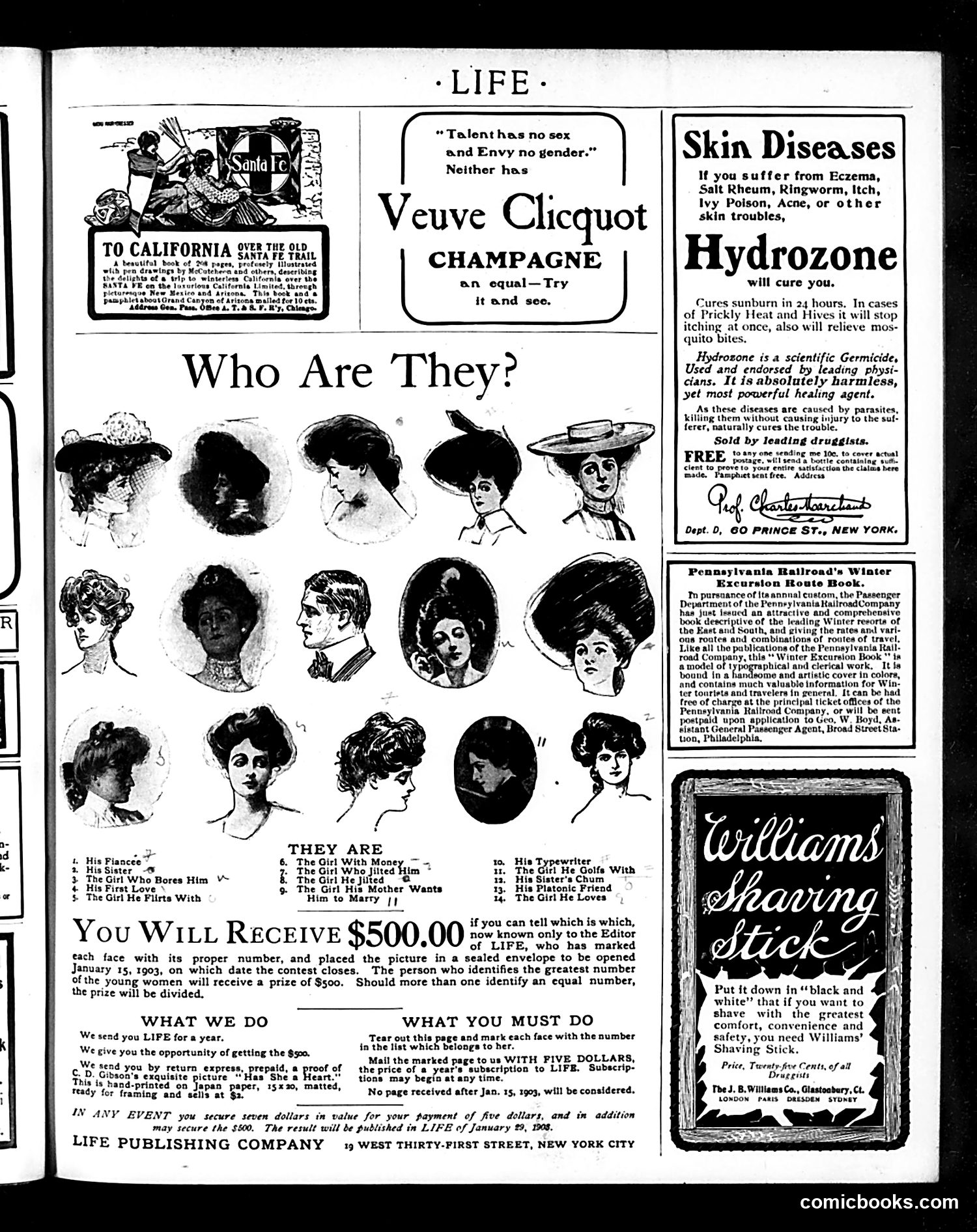
This page is primarily a **contest advertisement** rather than political satire. The main feature shows 15 illustrated female faces with a puzzle: readers must identify which woman corresponds to numbered categories (e.g., "His Fiancée," "The Girl Who Bores Him," "The Girl He Loves"). The contest offers **$500 to whoever correctly identifies the most faces**, with the winner determined January 15, 1903. Contestants pay $5 for a year's subscription to *Life* magazine; the page explicitly states this provides "$7 in value"—a marketing pitch. The surrounding advertisements (Veuve Clicquot champagne, Hydrozone skin treatment, Pennsylvania Railroad) are typical period magazine fare. The opening quote about talent having "no sex" and envy having "no gender" appears designed to frame the female-focused puzzle as progressive humor. This reflects early-1900s magazine culture: *Life* used contests to boost subscriptions while satirizing romantic relationships and courtship expectations.
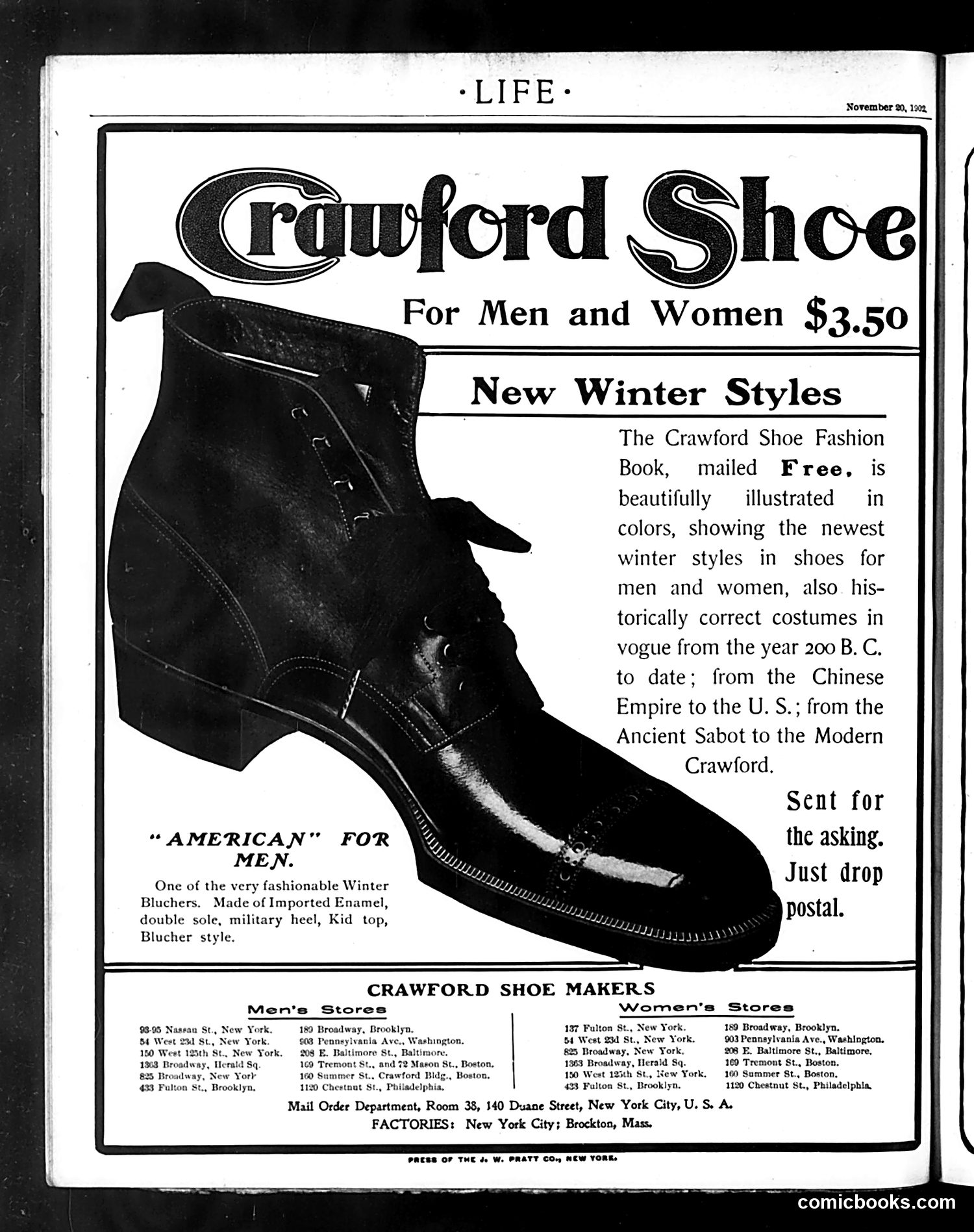
This is **not a cartoon or satire** — it's a straightforward product advertisement for Crawford Shoe Makers, published November 30, 1903. The page advertises the "American" winter blucher boot for men at $3.50, featuring a military heel and kid leather top. The ad promotes a free illustrated fashion book covering shoe history from 200 B.C. to present day, spanning Chinese, ancient European, and American styles. The advertisement lists multiple retail locations across New York, Brooklyn, Boston, Washington D.C., and Baltimore, plus a mail-order department in New York City. This represents typical early 20th-century magazine advertising — using historical and fashion appeals to market contemporary footwear to both men and women.