
Life, 1902-11-20 · page 4 of 22
Life — November 20, 1902 — page 4: what you’re looking at
What you’re looking at
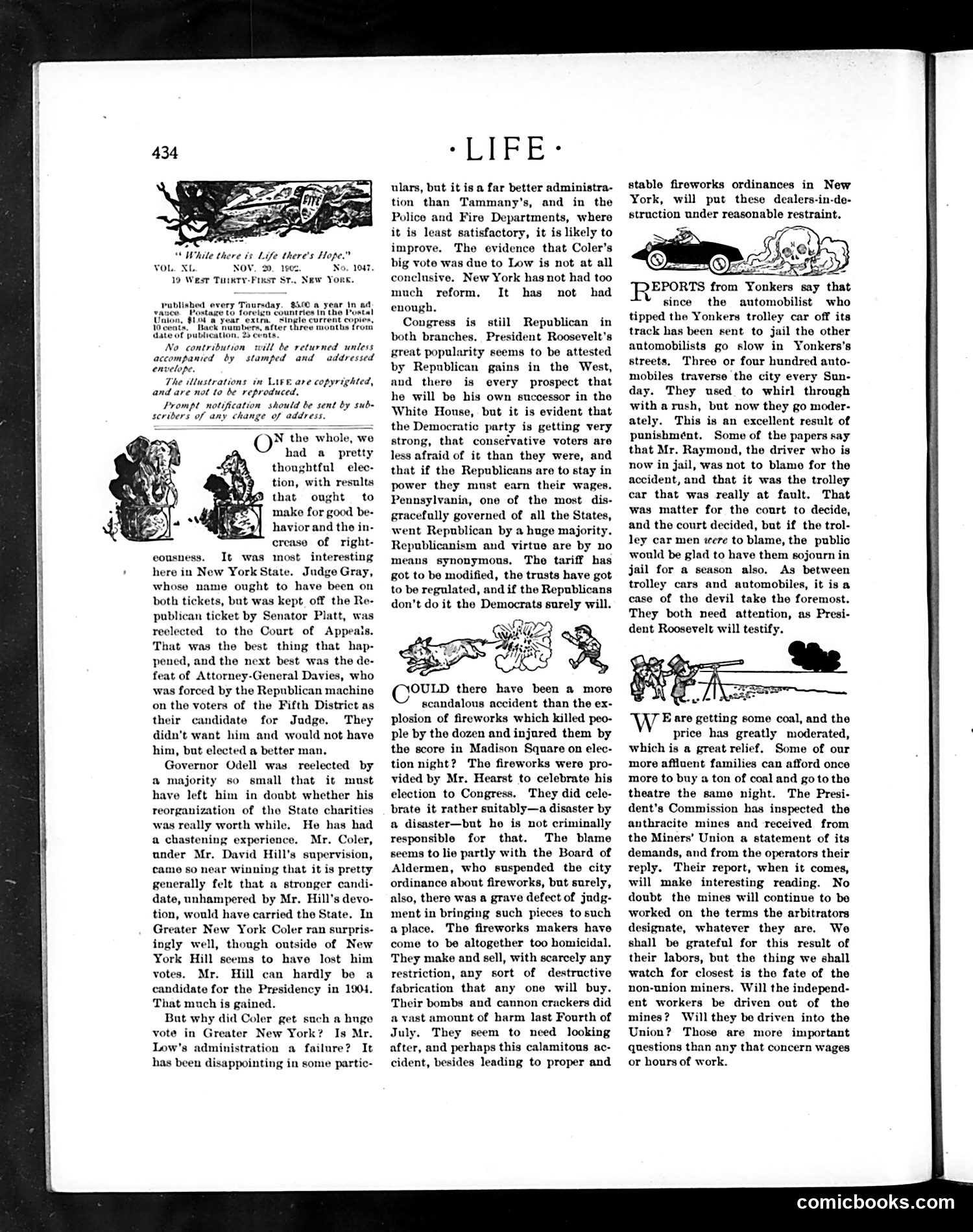
This page contains political commentary rather than cartoons. The text discusses early 1900s Republican and Democratic politics, mentioning President Roosevelt's popularity and Republican congressional gains. The small illustrated vignettes are decorative rather than satirical—showing figures like a cherub and various people in period dress, typical of Life's design style. The main article critiques a fireworks accident in Madison Square Garden caused by Mr. Hearst's celebration of his Congressional election victory. The author argues Hearst bears responsibility for negligent fireworks safety, blaming the Board of Aldermen for allowing such dangerous displays in public spaces. The piece also discusses coal prices, mining labor conditions, and debates about workers' unions—suggesting working-class concerns of the era. The satire is subtle: criticizing elite figures (Hearst, politicians) for prioritizing celebration over public safety.
📄 Transcribed text from this page (OCR, searchable)
Machine-transcribed from the original scan — historical spelling and the odd misread are preserved.
“While there is Life there's Hope.” VOL. Xt. NOV. 20, 1902. >. 1047. 19 West Tuixty-Finst St.. New Yous. Published every Thursday. $0 a year tn ad. vauce. Postage to foreign countries in the Postal Union, $10l-a year extra Single current copie TWeeats. Back nui ‘after three months fro date of publication ats No contribution will be returned untess accompanied by stamped and addressed envelope. The itlustrations in Live are copyrighted, and are not to be reproduced, Prompt notification should be sent by sub- scribers of any change of address. N the whole, we had a_ pretty thoughtful elec- tion, with results that ought to make for good be- havior and the in- crease of right- eousness. It was most interesting here in New York State. Judge Gray, whose name ought to have been on both tickets, but was kept off the Re- publican ticket by Senator Platt, was reelected to the Court of Appeais. That was the best thing that hap- pened, and the next best was the de- feat of Attorney-General Davies, who was forced by the Republican machine on the voters of the Fifth District as their candidate for Judge. They didn’t want him and would not have him, but elected a better man, Governor Odell was reelected by a majority so small that it must have left him in doubt whether his reorganization of the State charities was really worth while. He has had a chastening experience. Mr. Coler, under Mr. David Hill's supervision, came so near winning that it is pretty generally felt that a stronger candi- date, unhampered by Mr. Hill's devo- tion, would have carried the State. In Greater New York Coler ran surpris- ingly well, though outside of New York Hill seems to have lost him votes. Mr. Hill can hardly be a candidate for the Presidency in 1904. That much is gained. But why did Coler get such a huge vote in Greater New York? Is Mr. Low's administration a failure? It has been disappointing in some partic- : LIVE - ulars, but it is a far better administra- tion than Tammany's, and in the Police and Fire Departments, where it is least satisfactory, it is likely to improve. The evidence that Coler’s big vote was due to Low is not at all conclusive. New York has not had too much reform, It has not had enough, Congress is still Republican in both branches, President Roosevelt's great popularity seems to be attested by Republican gains in the West, and there is every prospect that he will be his own successor in tho White House, but it is evident that the Democratic party is getting very strong, that conservative voters are less afraid of it than they were, and that if the Republicans are to stay in power they must earn their wages. Pennsylvania, one of the most dis- gracefully governed of all the States, went Republican by a huge majority. Republicanism and virtue are by no means synonymous. The tariff has got to be modified, the trusts have got to be regulated, and if the Republicans don’t do it the Democrats surely will. OULD there have been a more scandalous accident than the ex- plosion of fireworks which killed peo- ple by the dozen and injured them by the score in Madison Square on elec- tion night? The fireworks were pro- vided by Mr. Hearst to celebrate his election to Congress. They did cele- brate it rather suitably—a disaster by a disaster—but ho is not criminally responsible for that. The blame seems to lie partly with the Board of Aldermen, who suspended the city ordinance about fireworks, but surely, also, there was a grave defect of judg- ment in bringing such pieces to such aplace. The fireworks makers have come to be altogether too homicidal. They make and sell, with scarcely any restriction, any sort of destructive fabrication that any one will buy. Their bombs and cannon crackers did avast amount of harm last Fourth of July. They seem to need looking after, and perhaps this calamitous ac- cident, besides leading to proper and stable fireworks ordinances in New York, will put these dealers-in-de- struction under reasonable restraint. EPORTS from Yonkers say that since the automobilist who tipped the Yonkers trolley car off its track has been sent to jail the other antomobilists go slow in Yonkers’s streets. Three or four hundred auto- mobiles traverse the city every Sun- day. They used to whirl through with a rush, but now they go moder- ately. This is an excellent result of punishmént. Some of the papers say that Mr. Raymond, the driver who is now in jail, was not to blame for the accident, and that it was the trolley car that was really at fault. That was matter for the court to decide, and the court decided, but if the trol- ley car men were to blame, the public would be glad to have them sojourn in jail for a season also. As between trolley cars and automobiles, it isa case of the devil take the foremost. They both need attention, as Presi- dent Roosevelt will testify. Ww are getting some coal, and the price has greatly moderated, which is a great relief. Some of our more affluent families can afford once more to buy a ton of coal and go to the theatre the same night. The Presi- dent's Commission has inspected the anthracite mines and received from the Miners’ Union a statement of its demands, and from the operators their reply. Their report, when it comes, will make interesting reading. No doubt the mines will continue to be worked on the terms the arbitrators designate, whatever they are. We shall be grateful for this result of their labors, but the thing we shall watch for closest is the fate of the non-union miners. Will the independ- ent workers be driven out of the mines? Will they be driven into the Union? Those are more important questions than any that concern wages or hours of work. comicbooks.com