
Life, 1902-11-20 · page 7 of 22
Life — November 20, 1902 — page 7: what you’re looking at
What you’re looking at
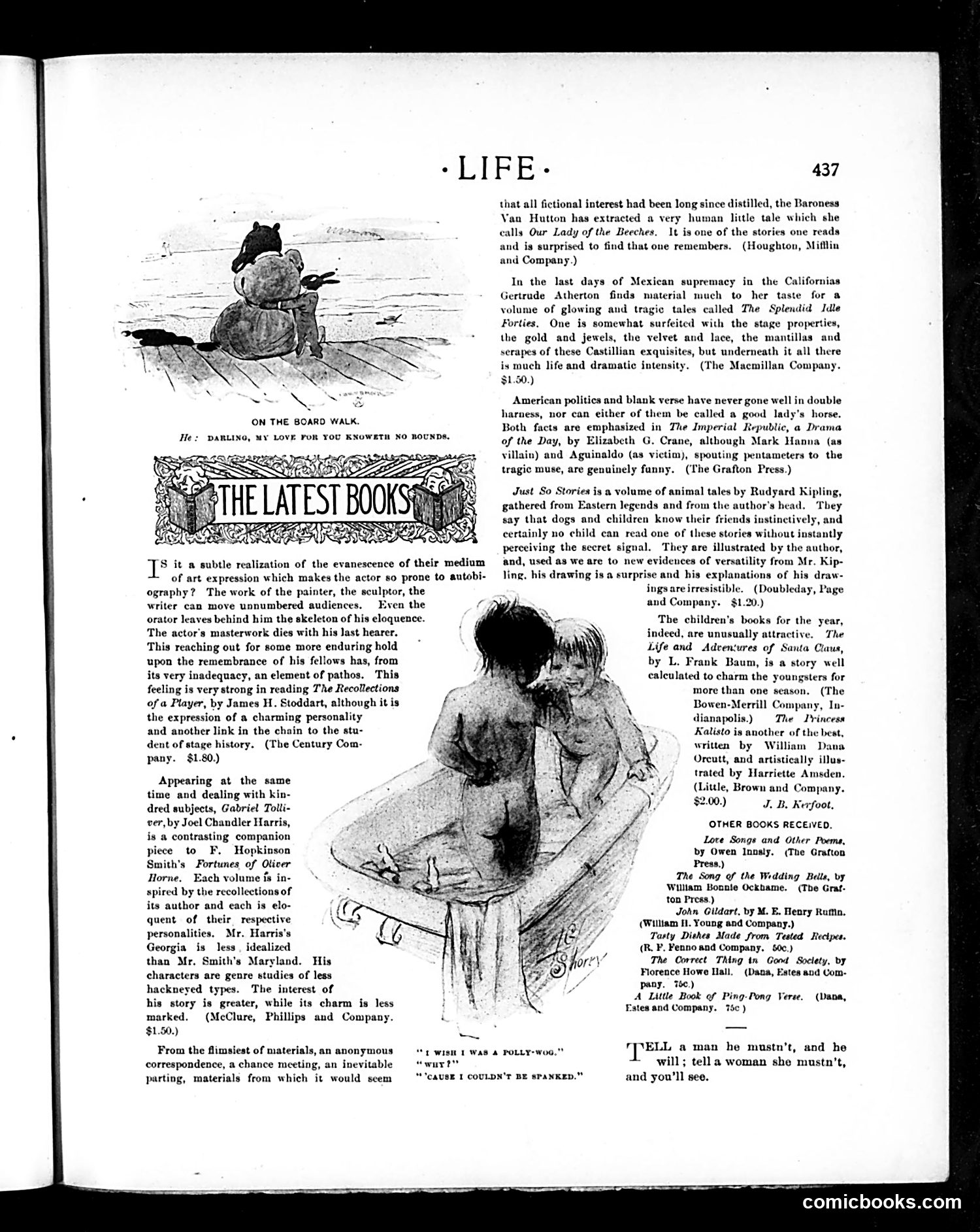
This page is primarily a book review section titled "The Latest Books," not a political cartoon. The illustrations are literary sketches rather than satirical cartoons. The top image captioned "On the Board Walk" shows a figure on a beach—likely illustrating one of the reviewed books. The lower sketch depicts what appears to be a domestic scene with two figures, captioned with dialogue: "I wish I was a Polly-wog," "Why?" and "Cause I couldn't be spanked." The page reviews several children's and adult books from the early 1900s, including *Just So Stories* by Rudyard Kipling and *The Imperial Republic* by Elizabeth Oakes. The content focuses on literary merit rather than political satire, representing Life magazine's role as a cultural arbiter, not primarily as a political publication.
📄 Transcribed text from this page (OCR, searchable)
Machine-transcribed from the original scan — historical spelling and the odd misread are preserved.
“DURE ON THE BOARD WALK. ¢ DARLING, MY LOVE YOR YOU KNowRTA No ROUNDS, T? it a subtle realization of the evanescence of their medium of art expression which makes the actor so prone to autobi- ography? The work of the painter, the sculptor, the writer can move unnumbered audience: Even the ‘6 orator leaves behind him the skeleton of his eloquence. The actor's masterwork dies with his last hearer. This reaching out for some more enduring hold upon the remembrance of his fellows has, from its very inadequacy, an element of pathos. This feeling is very strong in reading The Recollections of a Player, by James H. Stoddart, although it is the expression of a charming personality and another link in the chain to the stu- dent of stage history. (The Century Com- pany. $1.80.) Appearing at the same time and dealing with kin- dred subjects, Gabriel Tolli- ver, by Joel Chandler Harris, is a contrasting companion piece to F, Hopkinson Smith's Fortunes of Oticer Horne, Each volume fs in- spired by the recollections of its author and each is elo- quent of their respective personalities, Mr. Harris's Georgia is less, idealized than Mr. Smith's Maryland. His characters are genre studies of less hackneyed types. The interest of his story is greater, while its charm is less marked. (McClure, Phillips and Company. $1.50.) From the flimsiest of materials, an anonymous correspondence, a chance meeting, an inevitable parting, materials from which it would scem “wurt™ “1 wis 1 Was 4 POLLY-woo.”” ‘CAUSE I COULDN'T BE SPANKED.” 437 that all fictional interest had been long since distilled, the Baroness Van Hutton has extracted a very human little tale which she calls Our Lady of the Beeches. It is one of the stories one reads and is surprised to find that one remembers. (Houghton, Mifllin and Company.) In the last days of Mexican supremacy in the Californias Gertrude Atherton finds material much to her taste for a volume of glowing and tragic tales called The Splendid Idle Forties. One is somewhat surfeited with the stage properties, the gold and jewels, the velvet and lace, the mantillas and serapes of these Castillian exquisites, but underneath it all there is much life and dramatic intensity. (The Macmillan Company. $1.50.) American politics and blank verse have never gone well in double harness, nor can either of them be called a good lady's horse. Both facts are emphasized in The Imperial Republic, a Drama of the Day, by Elizabeth G. Crane, although Mark Hanna (as villain) and Aguinaldo (as victim), spouting pentameters to the tragic muse, are genuinely fanny. (‘The Grafton Press.) Just So Stories is a volume of animal tales by Rudyard Kipling, gathered from Eastern legends and from the author's head, They say that dogs and children know their friends instinctively, and certainly no child can read one of these stories without instantly perceiving the secret signal. They are illustrated by the author, ‘and, used as we are to new evidences of versatility from Mr. Kip- ling. his drawing isa surprise and his explanations of his draw- ingsareirresistible. (Doubleday, Page and Company. $1.20.) The children’s books for the year, indeed, are unusually attractive. The Life and Adventures of Santa Claus, by L. Frank Baum, is a story well calculated to charm the youngsters for more than one season. (The Bowen-Merrill Company, In- dianapolis.) The Tvincess Kalisto is another of the best, written by William Dana Orcutt, and artistically illus- trated by Harriette Amsden. (Liule, Brown and Company. $2.00.) J.B. Kerfoot, OTHER BOOKS RECEIVED, Lore Songs and Other Poems, by Owen Innsly, (The Grafton Press.) The Song of the Widding Bells, vy William Bonnie Ockbame. (The Graf- ton Press.) John Gildart, by M. E. Henry Rumn. (Witltam #1. Young and Company.) Tasty Dishes Made from Tested Recipes. (R.P, Fenno and Company, 0c.) The Correct Thing in Good Soclety, by Florence Howe Hall. (Dana, Estes and Com- pany. 6c.) A Little Book of Ping-Pong Verse. Estes and Company. 1c ) (Dana, Eu a man he mustn’t, and he will; tella woman she mustn't, and you'll see. comicbooks.com