
A complete issue · 22 pages · 1902
Life — October 2, 1902
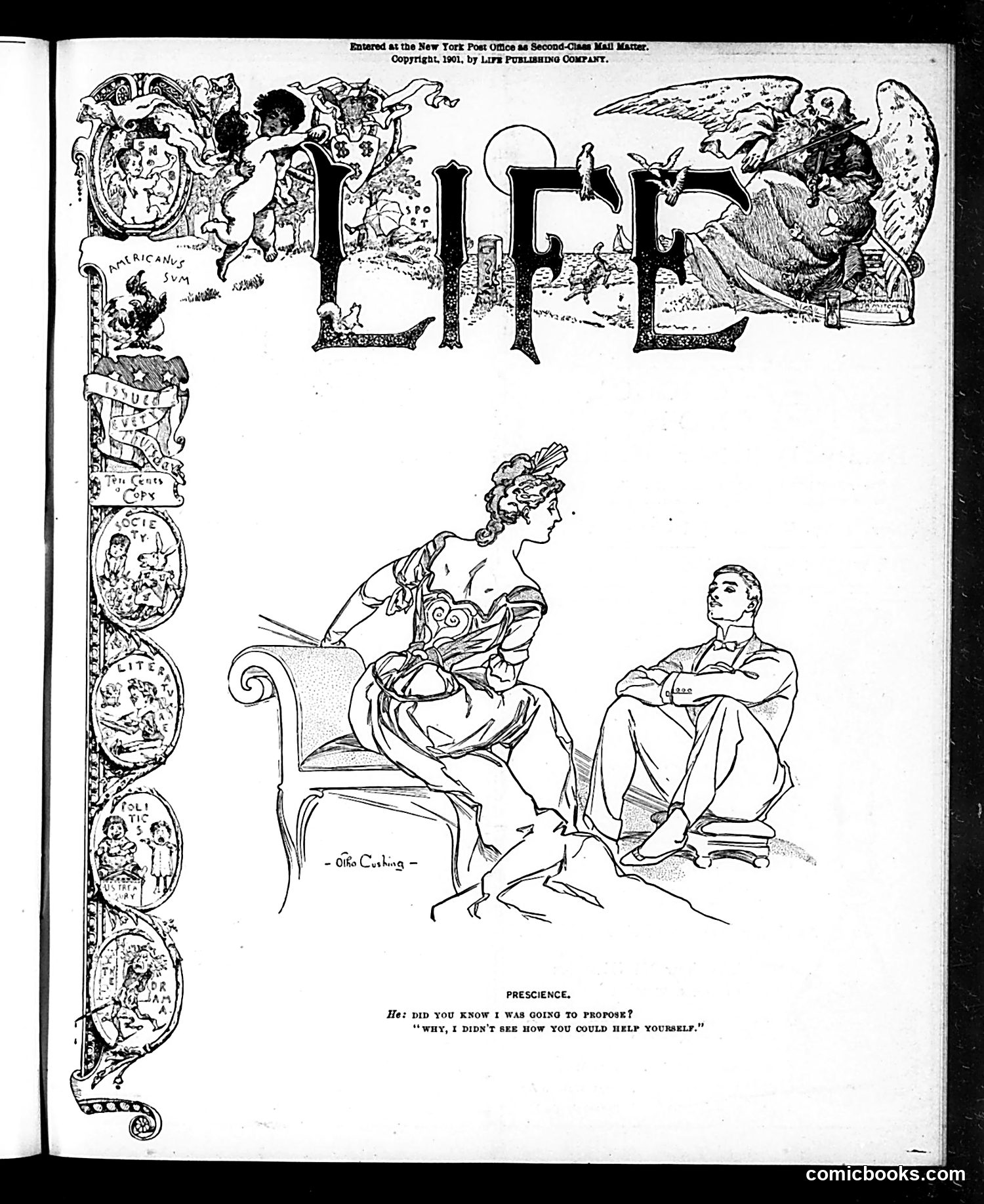
This page from Life (copyrighted 1901) features an illustration titled "Prescience" depicting a romantic scene. A woman sits in a chair while a man kneels beside her. The caption reads: "He: DID YOU KNOW I WAS GOING TO PROPOSE? 'WHY, I DIDN'T SEE HOW YOU COULD HELP YOURSELF.'" The satire mocks courtship conventions and gender dynamics of the Edwardian era. The woman's confident response suggests she views the man's proposal as inevitable—implying female superiority in romantic matters despite the era's male-dominated society. The decorative border includes classical references and small medallion illustrations, typical of Life's ornate design style. The humor lies in her assured expectation that he had no choice but to propose.
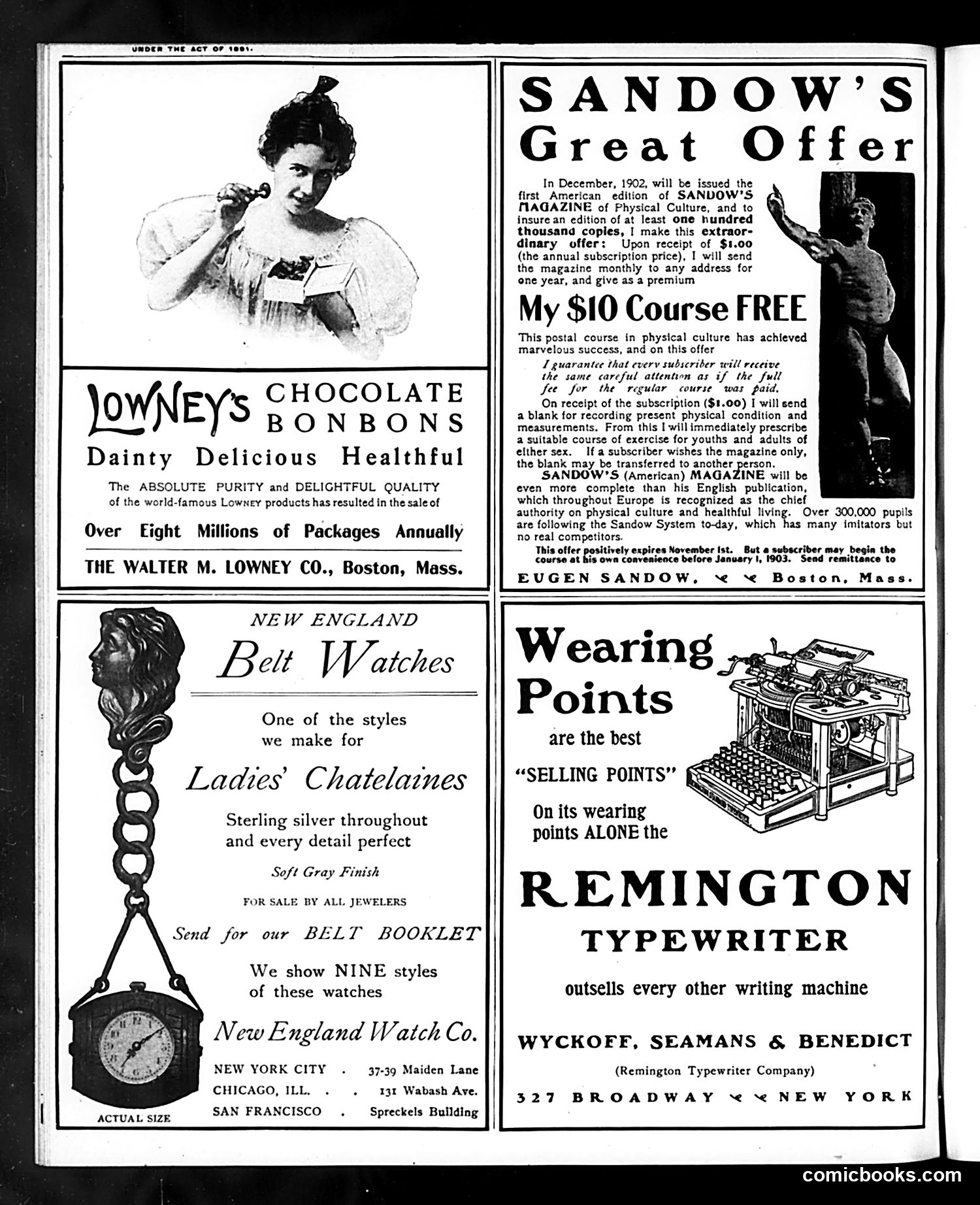
This page is **primarily advertisements** from early 1900s American publications, not political cartoons or satire. The four ads showcase consumer products of the era: 1. **Lowney's Chocolate Bonbons** - emphasizes "absolute purity" and healthfulness, claiming eight million packages sold annually. 2. **Sandow's Great Offer** - promotes Eugen Sandow's physical culture magazine and a $10 correspondence course in bodybuilding, targeting subscribers with promises of personal fitness measurements and customized exercise regimens. 3. **New England Belt Watches** - advertises ladies' chatelaine watches in sterling silver, available through jewelers. 4. **Remington Typewriter** - claims superiority over competitors based on "wearing points." These ads reveal early 1900s consumer culture: health-consciousness, physical fitness trends, luxury goods for women, and workplace technology.
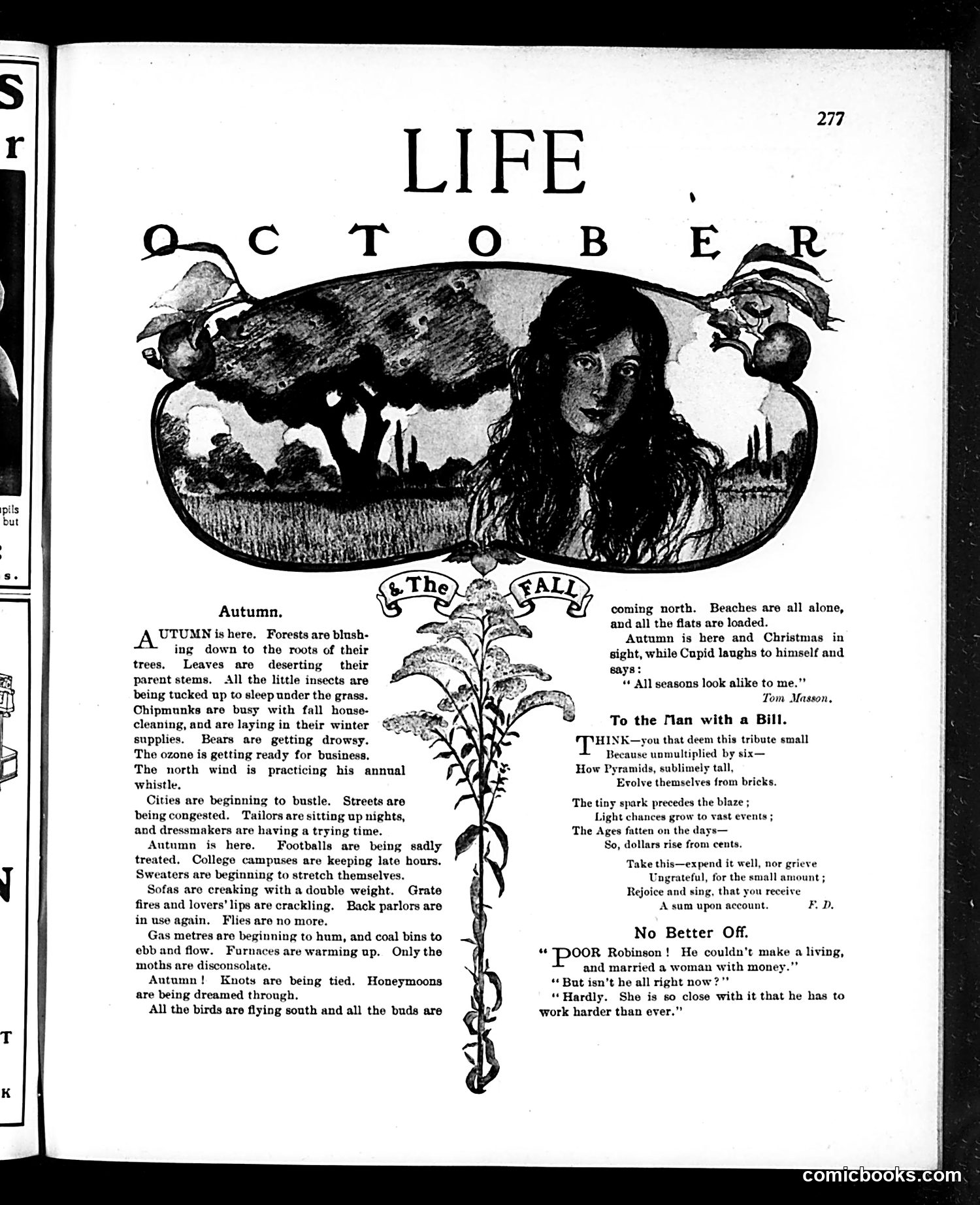
This page presents October seasonal content with two distinct elements: **Main Illustration**: A decorative art nouveau-style header featuring a woman's face surrounded by autumn imagery—bare trees and landscape scenes. The design emphasizes the fall season's arrival. **"Autumn" Essay**: A prose piece celebrating the season's characteristics—falling leaves, animals preparing for winter, increased urban activity (tailors working, furnaces warming). It's sentimental, descriptive writing typical of early 20th-century magazine content. **"To the Clan with a Bill"**: A short poem with social commentary, appearing to critique wealth inequality ("How Pyramids, sublimely tall, / Evolve themselves from bricks") and monetary systems. **"No Better Off"**: A brief humorous dialogue about a poor man (Robinson) unable to provide for his wife despite her working harder than ever—social satire on economic hardship and labor. The page blends seasonal nostalgia with subtle class-consciousness commentary.
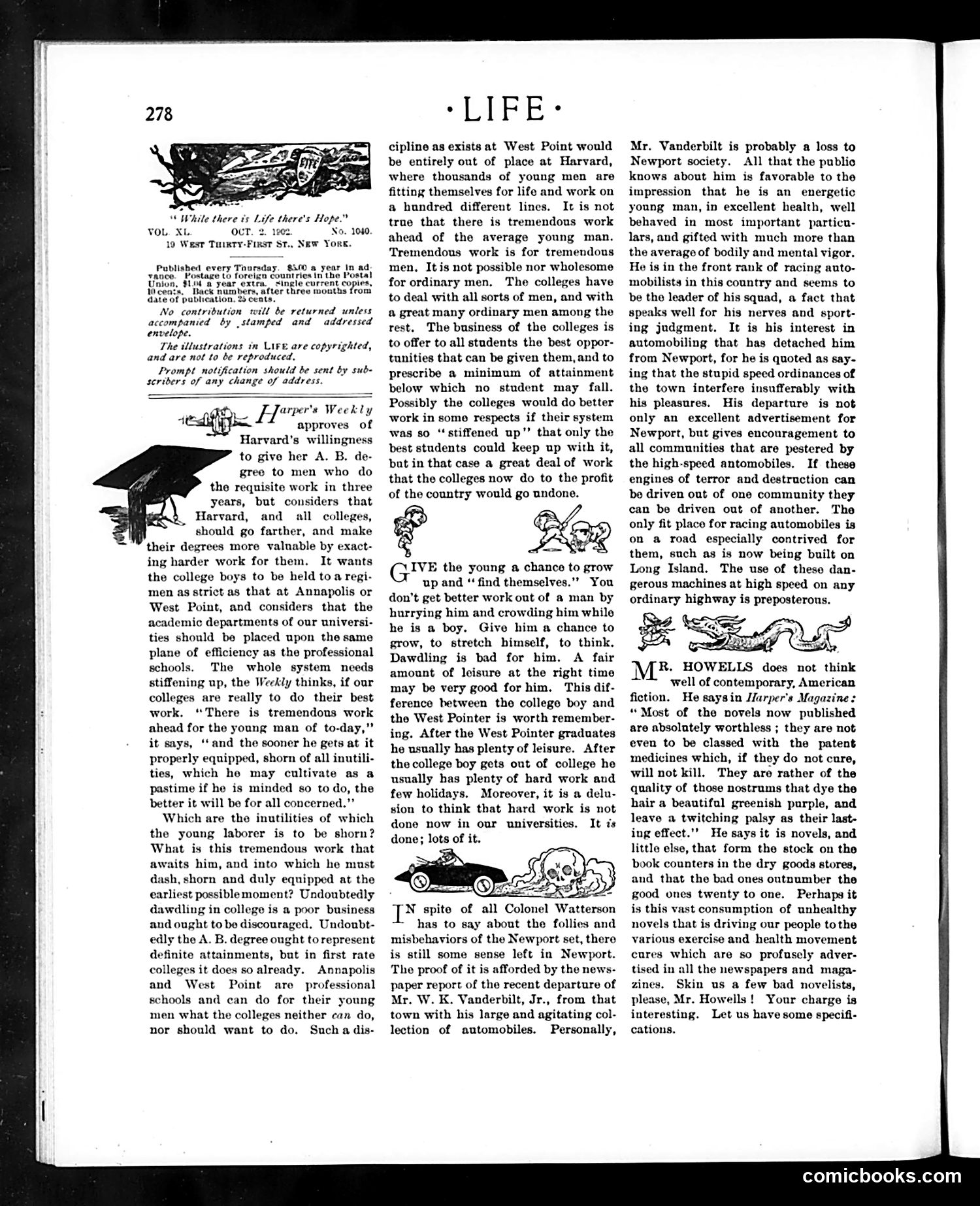
This page contains editorial commentary rather than political cartoons. The main text discusses college education, particularly comparing Harvard and West Point as institutions that should produce rigorous, disciplined young men. There's criticism of Mr. W.K. Vanderbilt Jr.'s recent departure from Newport with "his large and agitating collection of automobiles"—satirizing wealthy elites' obsession with racing cars and leisure pursuits rather than serious work. The page also critiques contemporary American fiction as "unhealthy," arguing that bad novels outnumber good ones twenty to one, and that this consumption of lowbrow literature drives social decline. Small decorative illustrations (cars, dogs) accompany the text but aren't satirical cartoons themselves. The satire targets wealthy idleness and popular culture's perceived moral degradation.
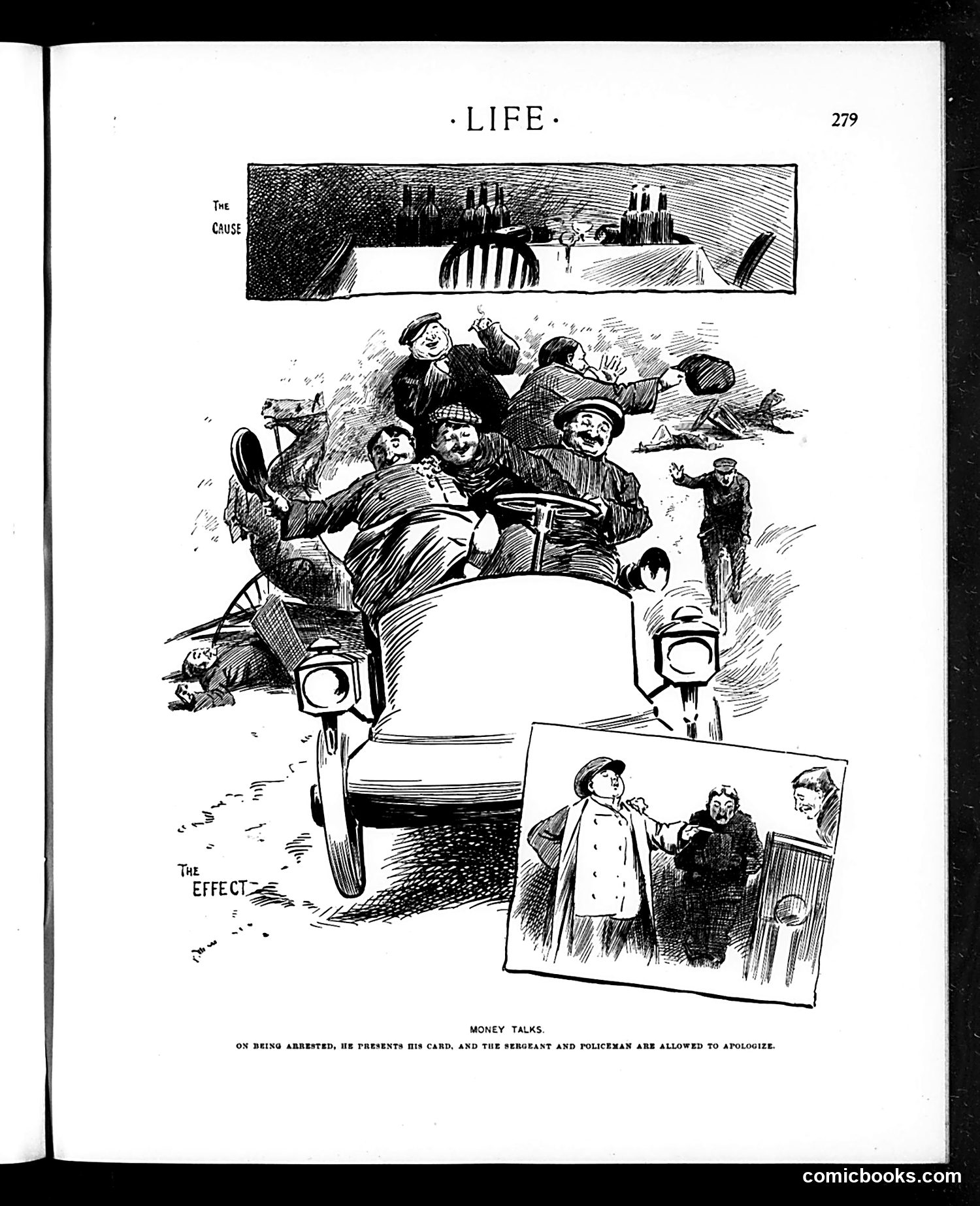
This two-panel cartoon illustrates the corrupting influence of wealth on law enforcement. **"The Cause"** (top panel): Shows a chaotic street scene with multiple people fighting or in distress—suggesting criminal activity or social disorder. **"The Effect"** (bottom panel): Depicts a wealthy man presenting his card to police, with the caption explaining that "on being arrested, he presents his card, and the sergeant and policeman are allowed to apologize." The satire mocks how money and social status could literally buy immunity from justice. The "card" likely refers to a calling card or credential signaling wealth/status. By presenting it, the arrested man essentially reverses roles—the police apologize rather than proceed with arrest. This critiques the early 20th-century reality that wealthy defendants received vastly different treatment than ordinary citizens.
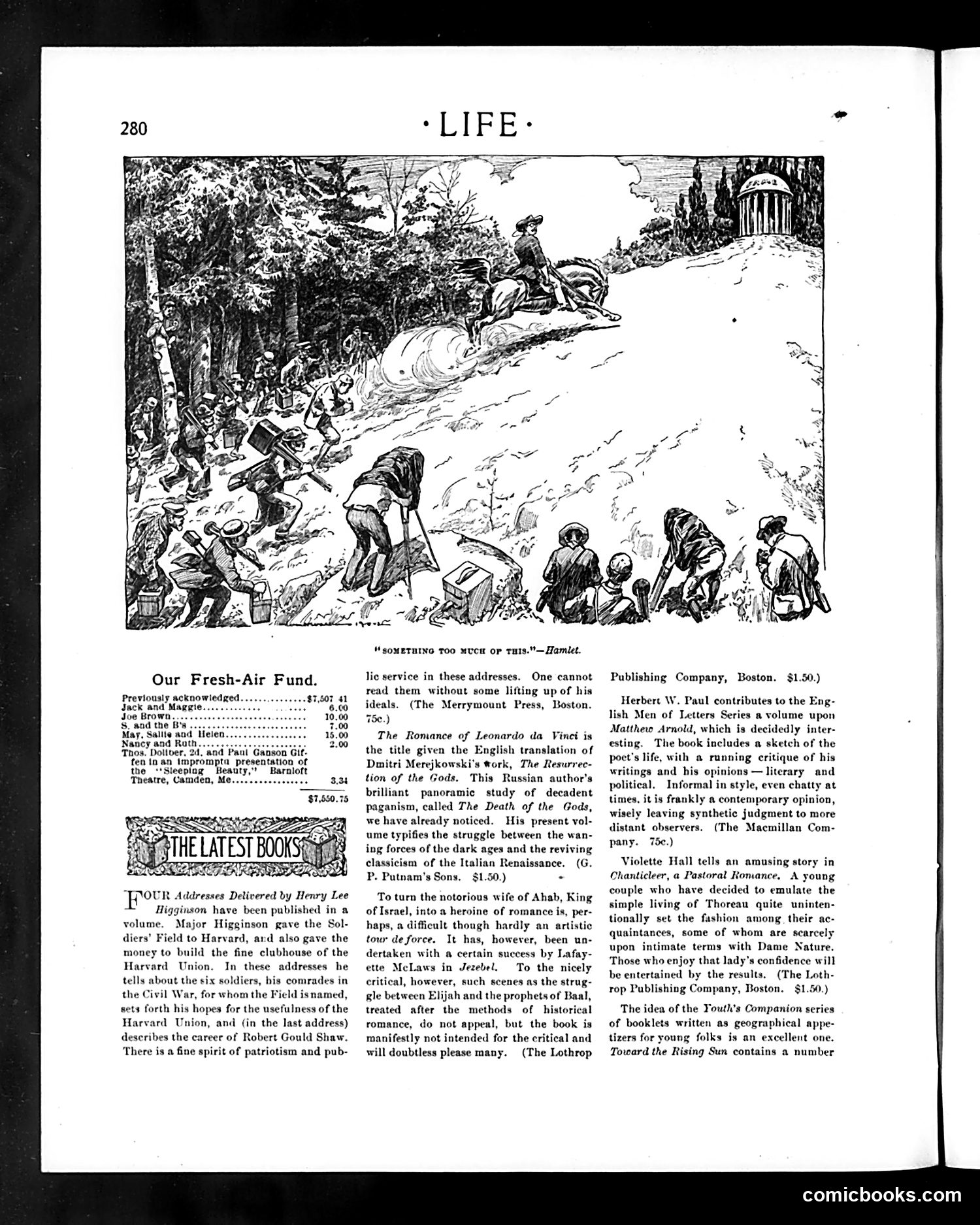
The main illustration depicts a scene of manual labor and construction work, with men digging and hauling materials (likely logs or barrels) up a hillside. The caption quotes Hamlet: "Something too much of this." This appears to be commentary on "Our Fresh-Air Fund," a charitable initiative listed below the cartoon that collected donations ($7,650.15 total) to send urban poor—particularly children—to countryside locations for health benefits. The satire likely critiques the disconnect between the fund's charitable intentions and the harsh physical labor conditions the beneficiaries actually experienced. The Hamlet quote suggests ironic excess or discomfort, implying the "fresh air" remedy may involve grueling work rather than genuine respite for recipients.
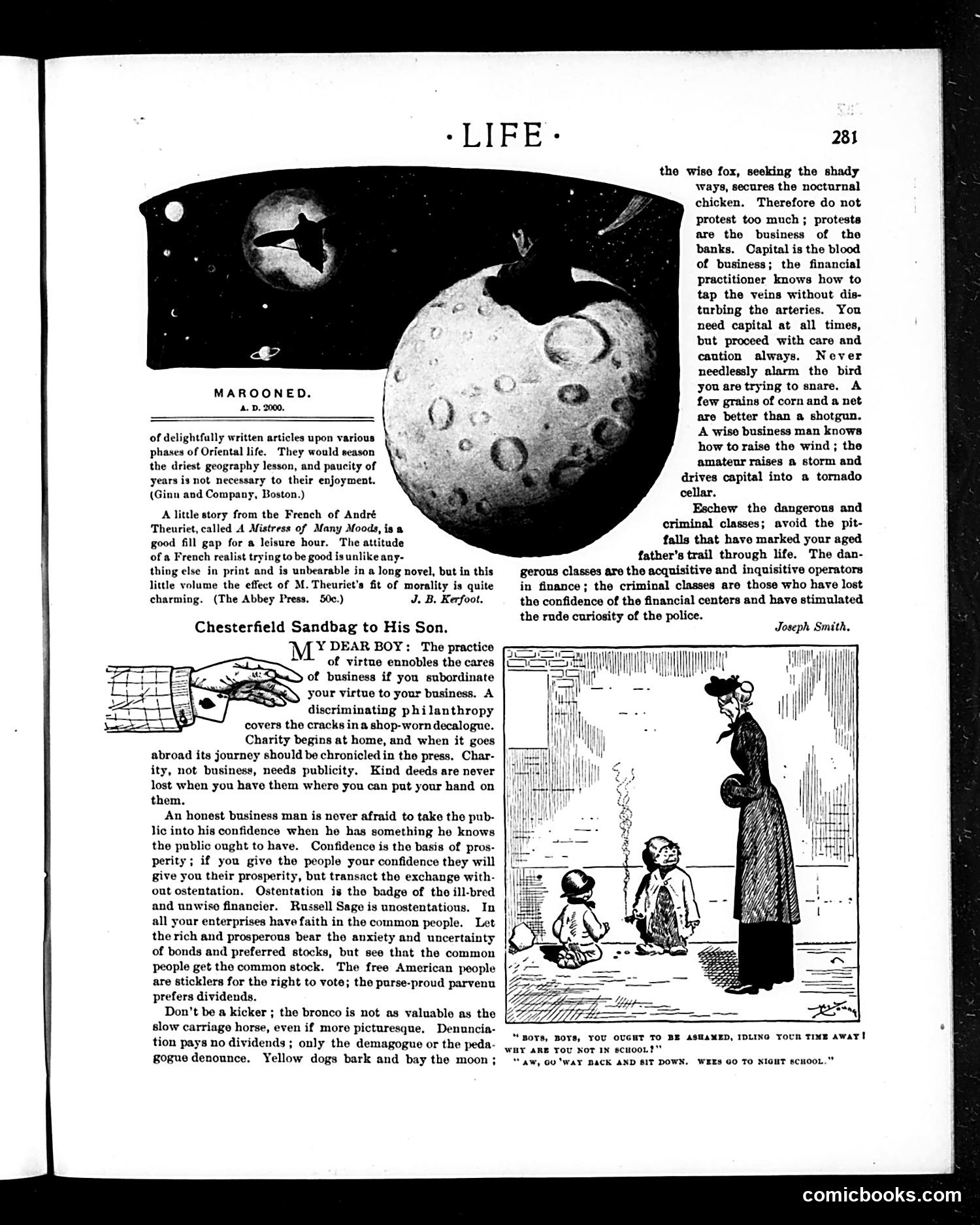
This page contains business advice rather than political satire. The main cartoon depicts an adult scolding children for being out of school, with the caption: "Boys, boys, you ought to be ashamed, idling your time away! Why are you not in school?" The children's response ("Aw, go way back and sit down. We go to night school") is a joke about child labor—a serious social issue of the era. The accompanying text, "Chesterfield Sandbag to His Son," offers cynical business wisdom about confidence, public relations, and financial manipulation. It suggests that business success depends on deception and maintaining public confidence regardless of actual ethics. The overall page satirizes both industrial-era child labor practices and morally questionable business tactics normalized in American capitalism.
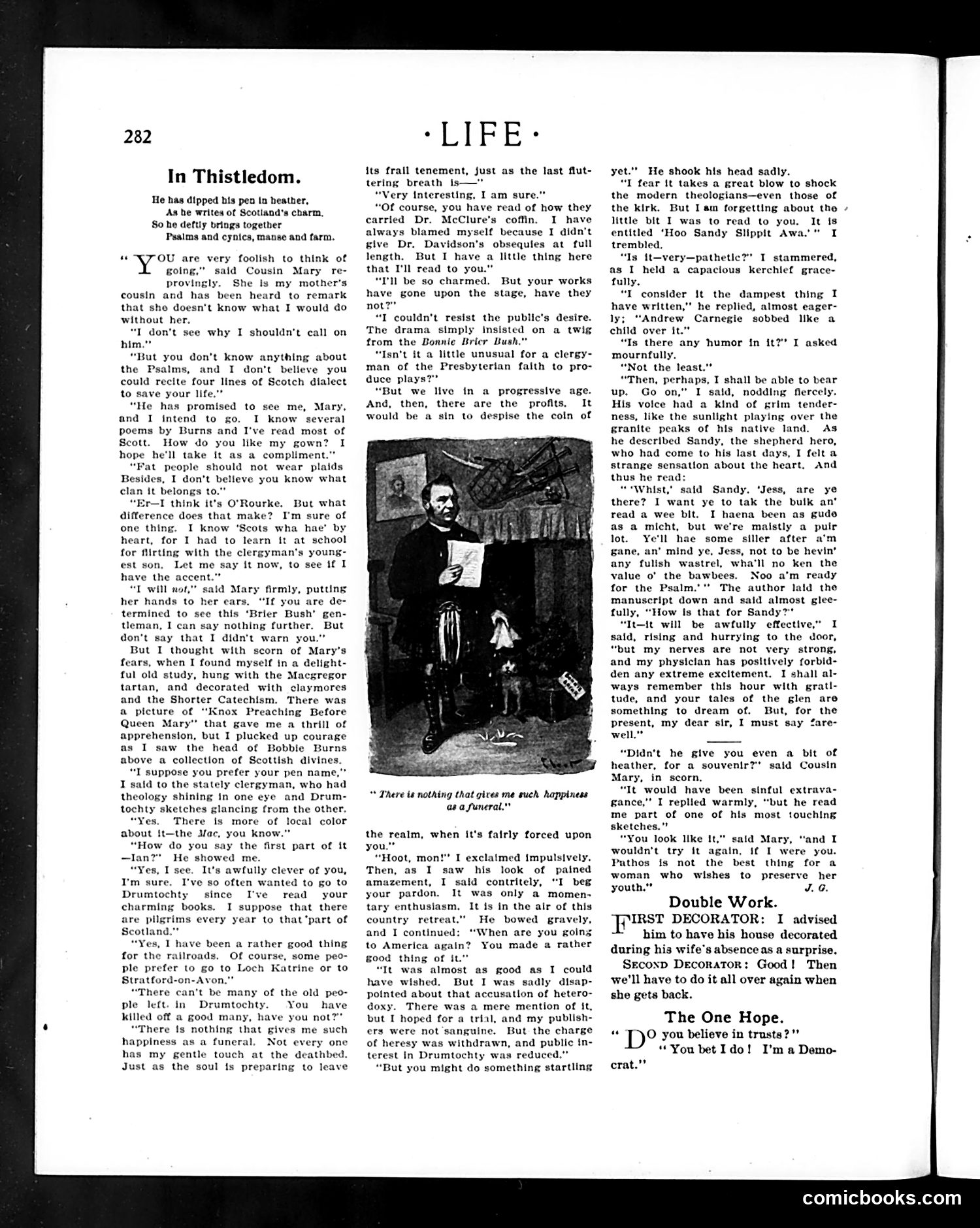
This page contains a literary dialogue piece titled "In Thistledom," not a political cartoon. The text discusses Scottish literature and poetry, with characters debating the merits of Scottish writers like Burns and Scott versus English literature. The single illustration shows what appears to be a religious or clerical figure in robes holding a document or manuscript, standing in a landscape setting. The caption reads: "There is nothing that gives me such happiness as a funeral." This caption serves as dark satire—the figure (likely representing a clergyman) ironically expresses that funerals bring him joy, presumably commenting on either clerical hypocrisy, morbid attitudes, or the satirical observation that religious figures benefit professionally from death. The humor relies on the grotesque contrast between the serious, solemn nature of funerals and the character's cheerful admission.
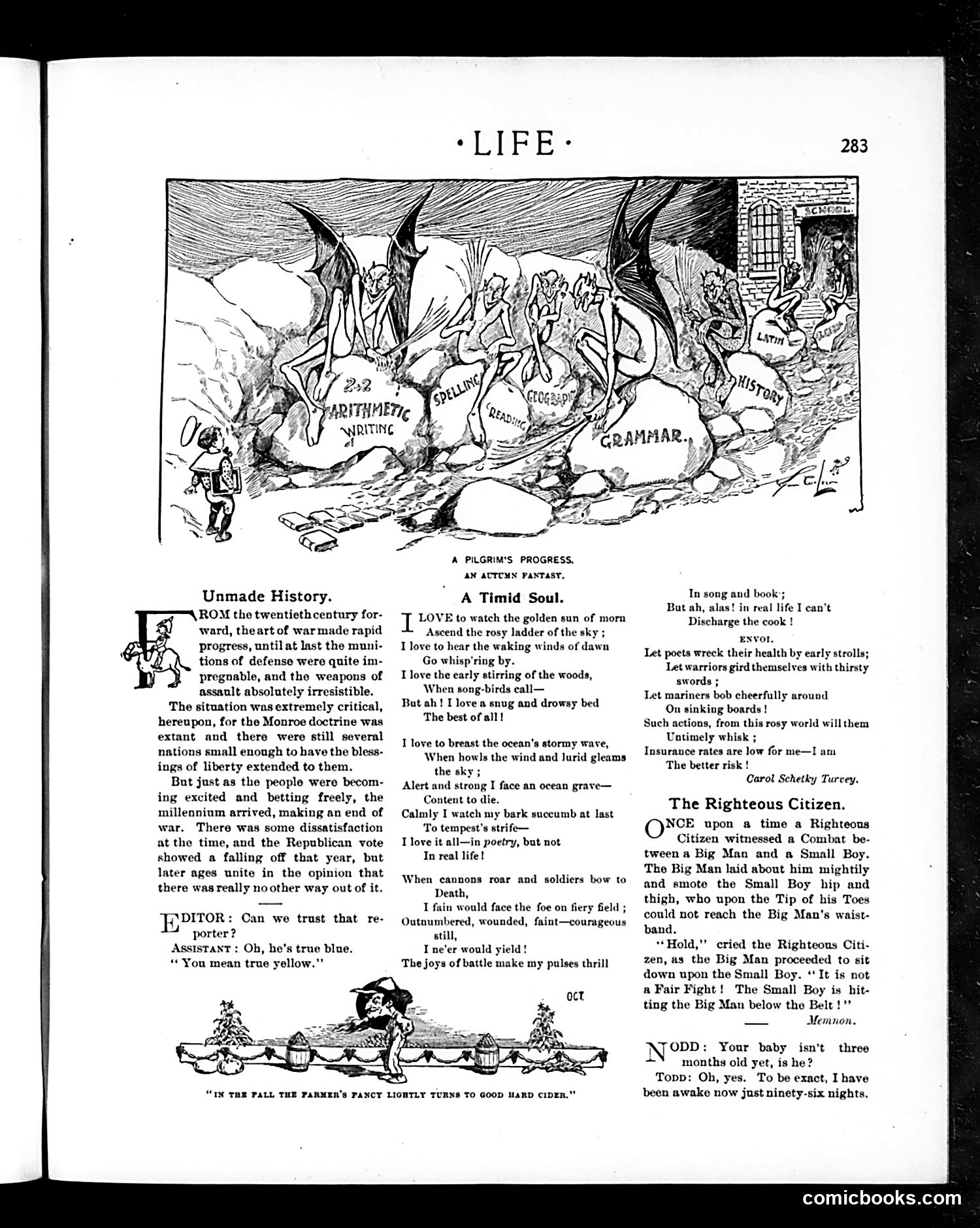
**Top Cartoon - "A Pilgrim's Progress: An Autumn Fantasy"** This allegorical illustration depicts education as a dangerous journey. A small figure (student/pilgrim) faces demons guarding large boulders labeled with school subjects: "Arithmetic," "Writing," "Spelling," "Reading," "Grammar," and "History." The winged demons represent obstacles in education. This satirizes the perceived harshness of 19th-century schooling methods, suggesting that basic subjects were presented to children as formidable, frightening challenges rather than accessible knowledge. **Text Content** The remaining prose and verse pieces—"Unmade History," "A Timid Soul," and "The Righteous Citizen"—are unrelated satirical sketches critiquing historical progress, timid personalities, and moral hypocrisy. The humor relies on irony and social commentary rather than visual gags.
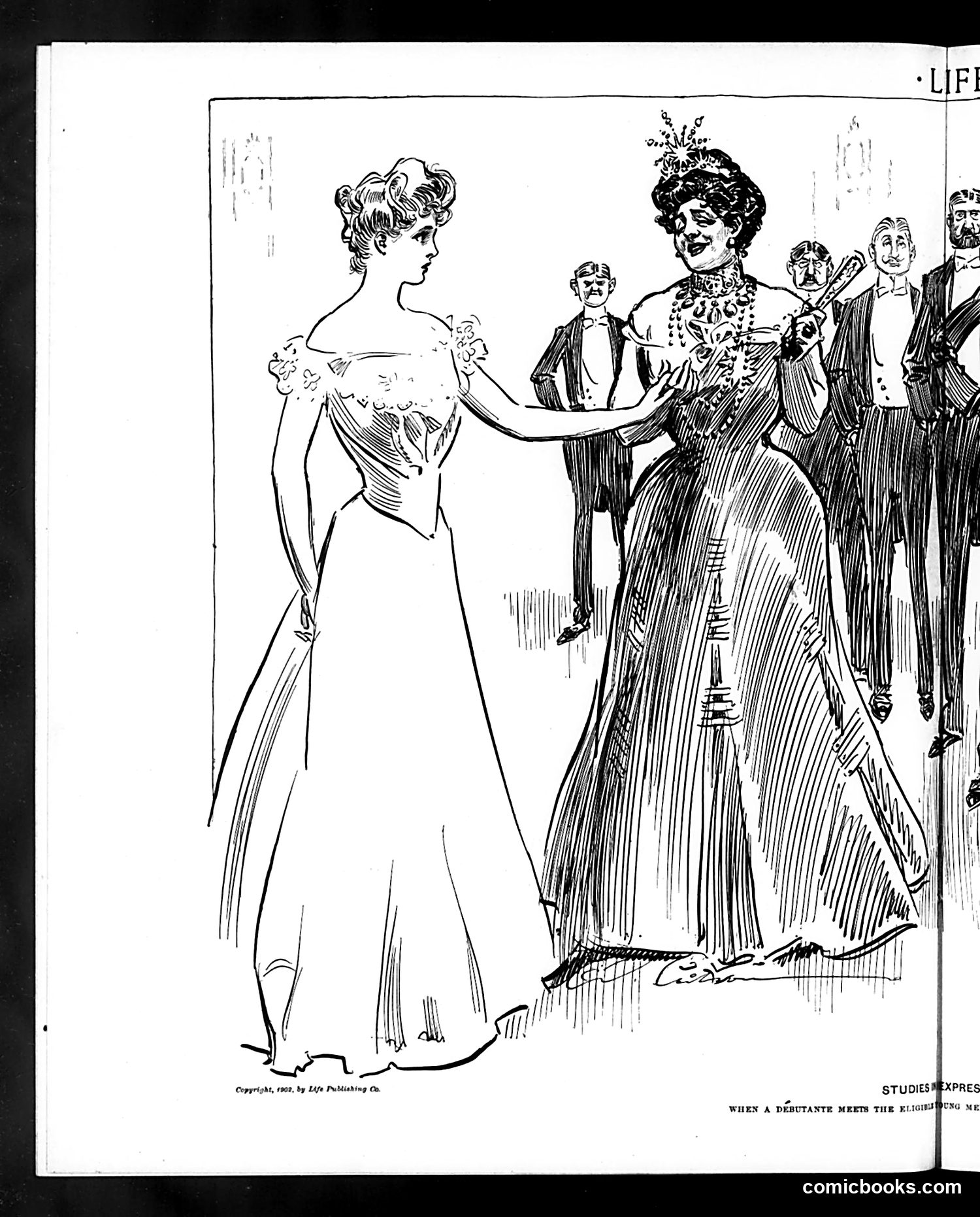
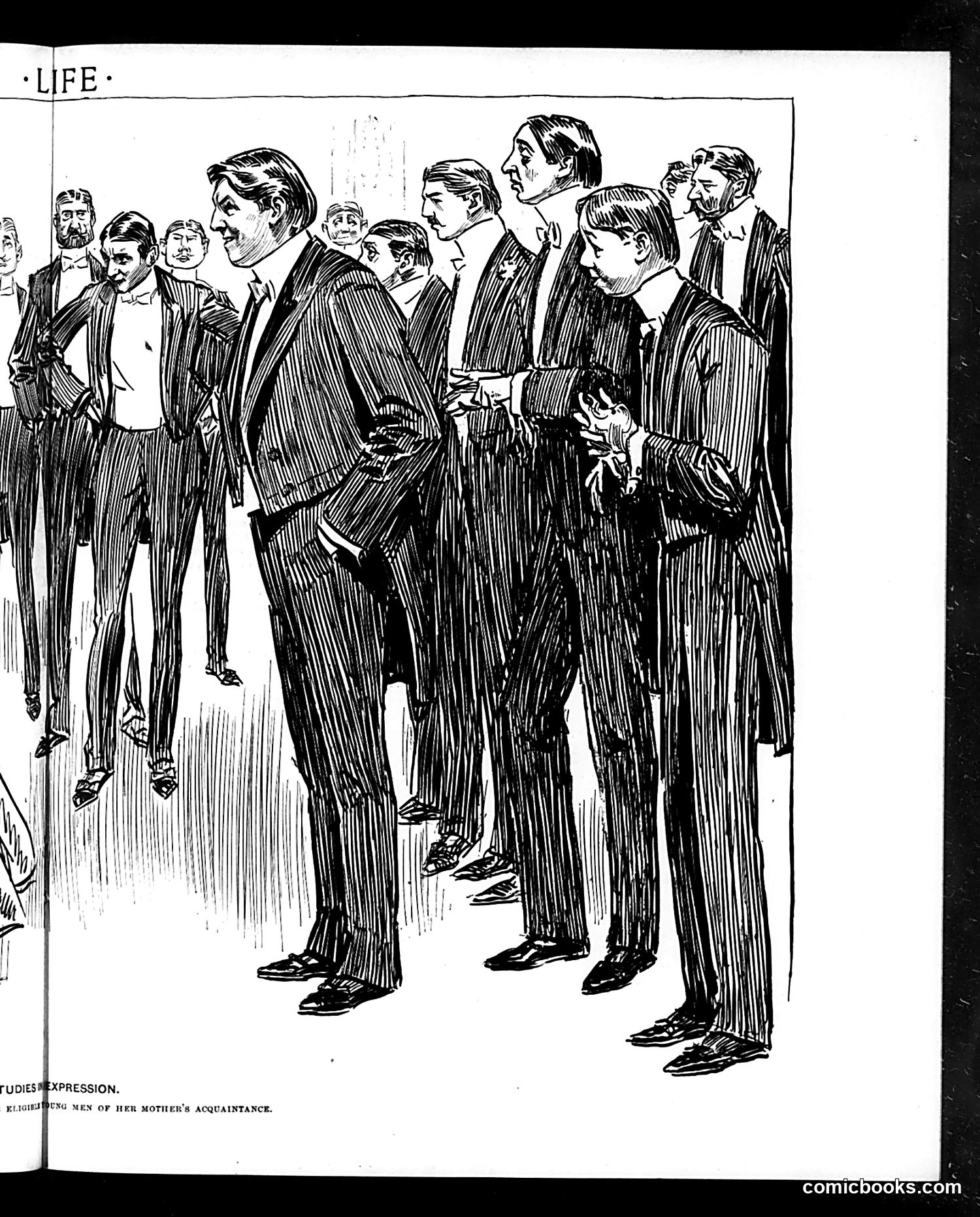
This is a satirical illustration about social class and marriage prospects in early 20th-century American high society. The image depicts a young woman in an elegant white gown (the debutante) being presented to a wealthy, older woman adorned with jewels and an elaborate tiara. Behind them stand formally-dressed gentlemen, apparently witnesses to this social encounter. The satire mocks the ritualistic nature of debutante balls—formal presentations of unmarried young women to society—where marriage prospects were evaluated based on family wealth and social standing. The title's phrase "meets the richer" suggests the humor lies in the debutante's calculated attempt to secure an advantageous match with someone of greater financial means, reducing romantic courtship to crude economic transaction.
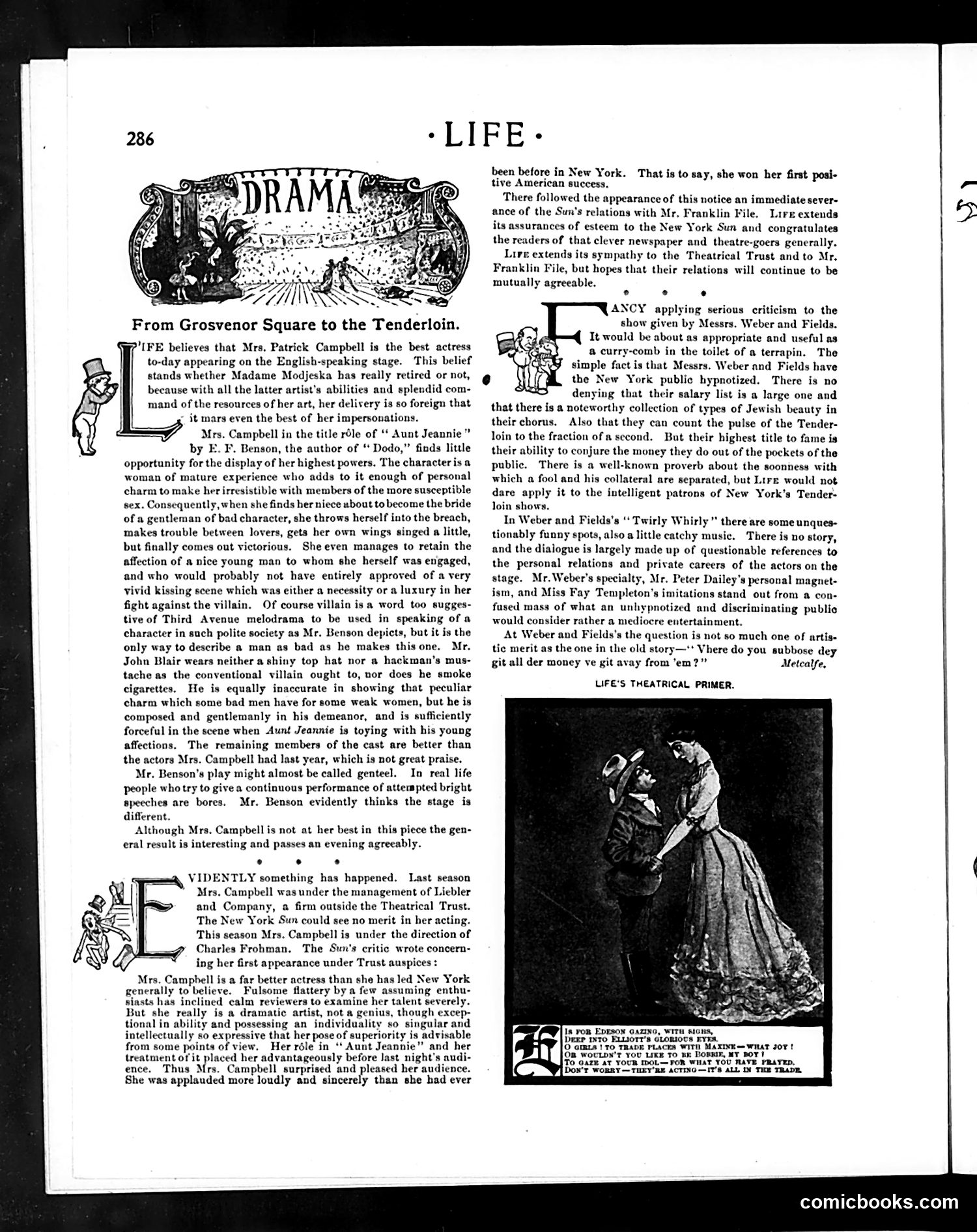
This page contains drama criticism reviewing Mrs. Patrick Campbell's performance in "Aunt Jeannie" by E.P. Benson. The critic praises Campbell as "the best actress to-day appearing in English-speaking plays," noting her maturity and experience enhance the role. The review critiques the play itself as somewhat conventional, with Campbell elevating mediocre material. It references competing theatrical productions and discusses salary disputes between Weber and Fields (apparently famous performers) and the Theatrical Trust—suggesting labor tensions in early 1900s theater. The illustration labeled "Is for Edmond Gardin, with Rider" appears to be a theatrical scene, though its specific meaning is unclear from the visible content. The overall page focuses on professional theater criticism and industry business rather than political satire.
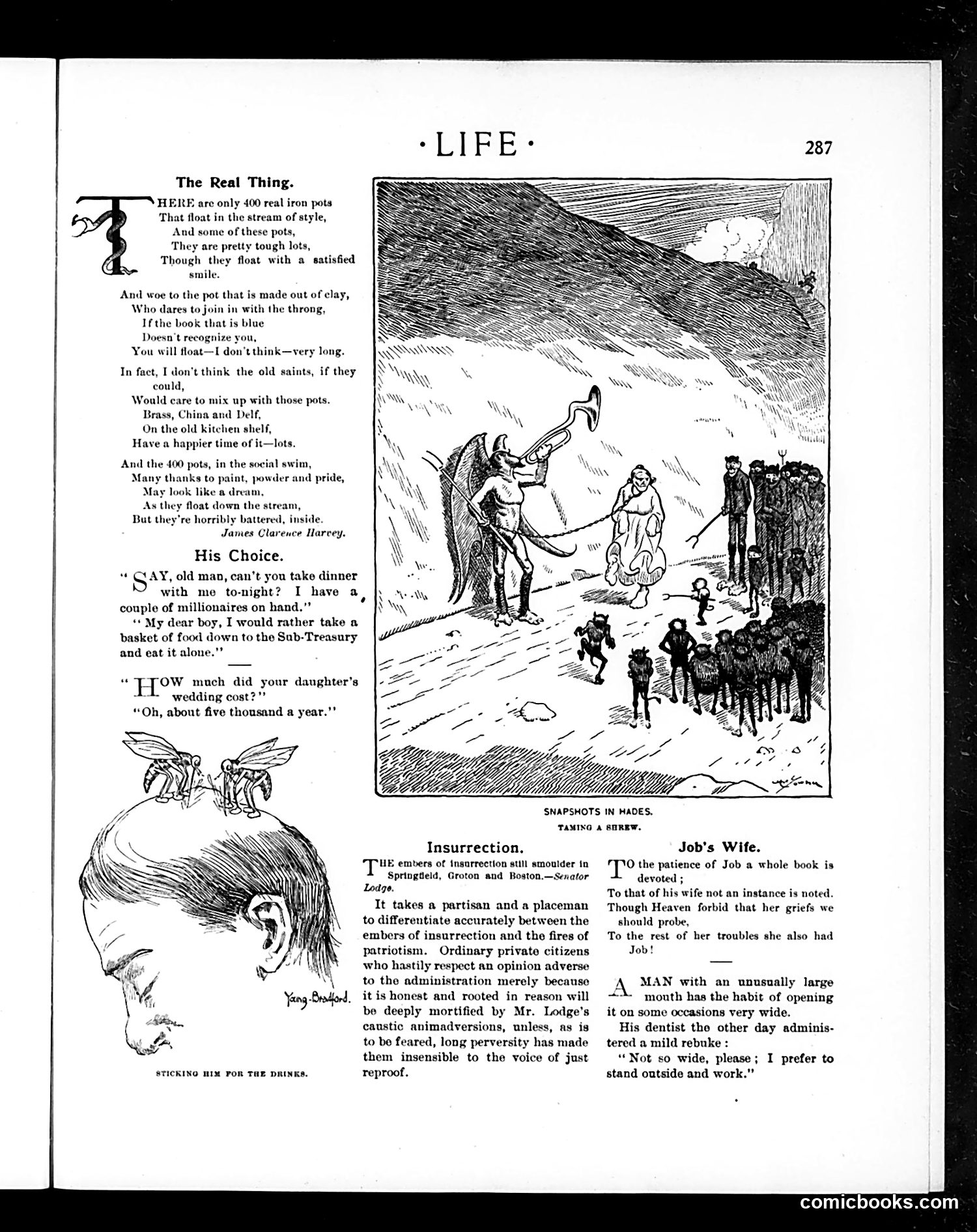
This satirical page contains multiple brief pieces mocking American social pretension and politics circa early 1900s. **"The Real Thing"** is a poem by James Clarence Harvey ridiculing social climbers. The "400 real iron pots" references the famous "Four Hundred"—New York's elite social circle. The poem warns that those of modest origins ("clay pots") who attempt to join high society will fail unless recognized by "the book that is blue" (likely the Social Register), and that the wealthy are "horribly battered, inside" despite their polished appearance. **"His Choice"** presents a joke about preferring solitude to wealthy company—mocking the assumed desirability of millionaire acquaintance. **"Insurrection"** critiques Senator Lodge for dismissing political dissent as dangerous sedition, arguing that honest disagreement needn't be labeled rebellion. The page illustration "Snapshots in Hades: Taming a Shrew" depicts devils managing a difficult woman—a crude, misogynistic visual gag. **"Job's Wife"** briefly notes the biblical Job's wife receives no recognition for her suffering, a minor commentary on female invisibility.
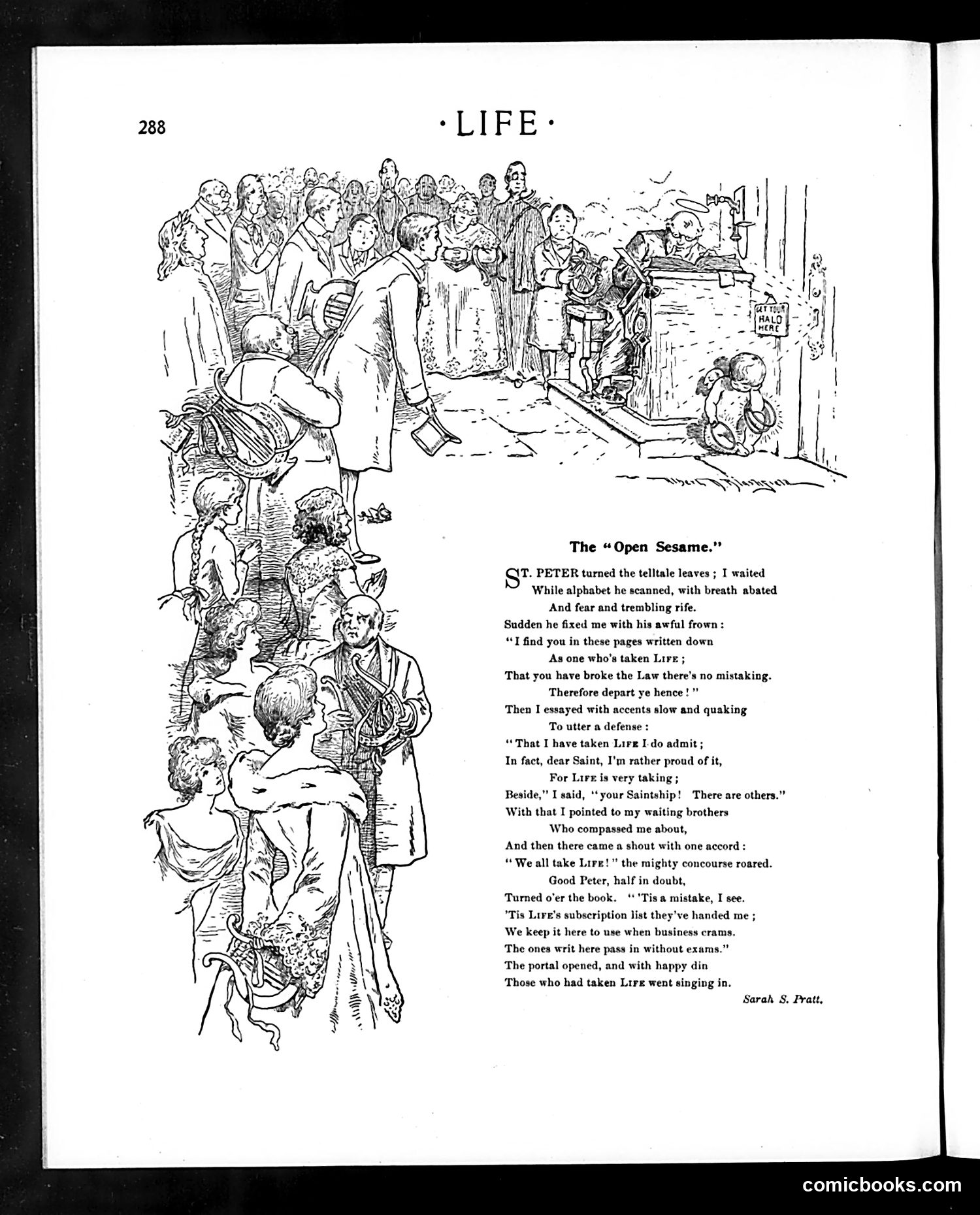
This poem satirizes **Life magazine's subscription practices** through a religious allegory. St. Peter appears to condemn the narrator for "taking Lire" (Life), interpreting it as breaking divine law. However, the twist reveals "Lire" is actually the subscription list for *Life* magazine itself. The satire suggests that *Life's* subscribers form a large, organized group whose collective presence legitimizes what might otherwise seem questionable. The "business crams" reference indicates the magazine uses subscriber lists strategically during busy periods, perhaps implying questionable circulation practices or accounting methods common to publications of that era. The humor lies in the double meaning: those who've "taken Life" (consumed the magazine) are actually respectable subscribers who "pass in without exams"—suggesting *Life* magazine's broad, uncritical readership. The poem gently mocks both magazine promotion tactics and readers' blind acceptance of popular publications.
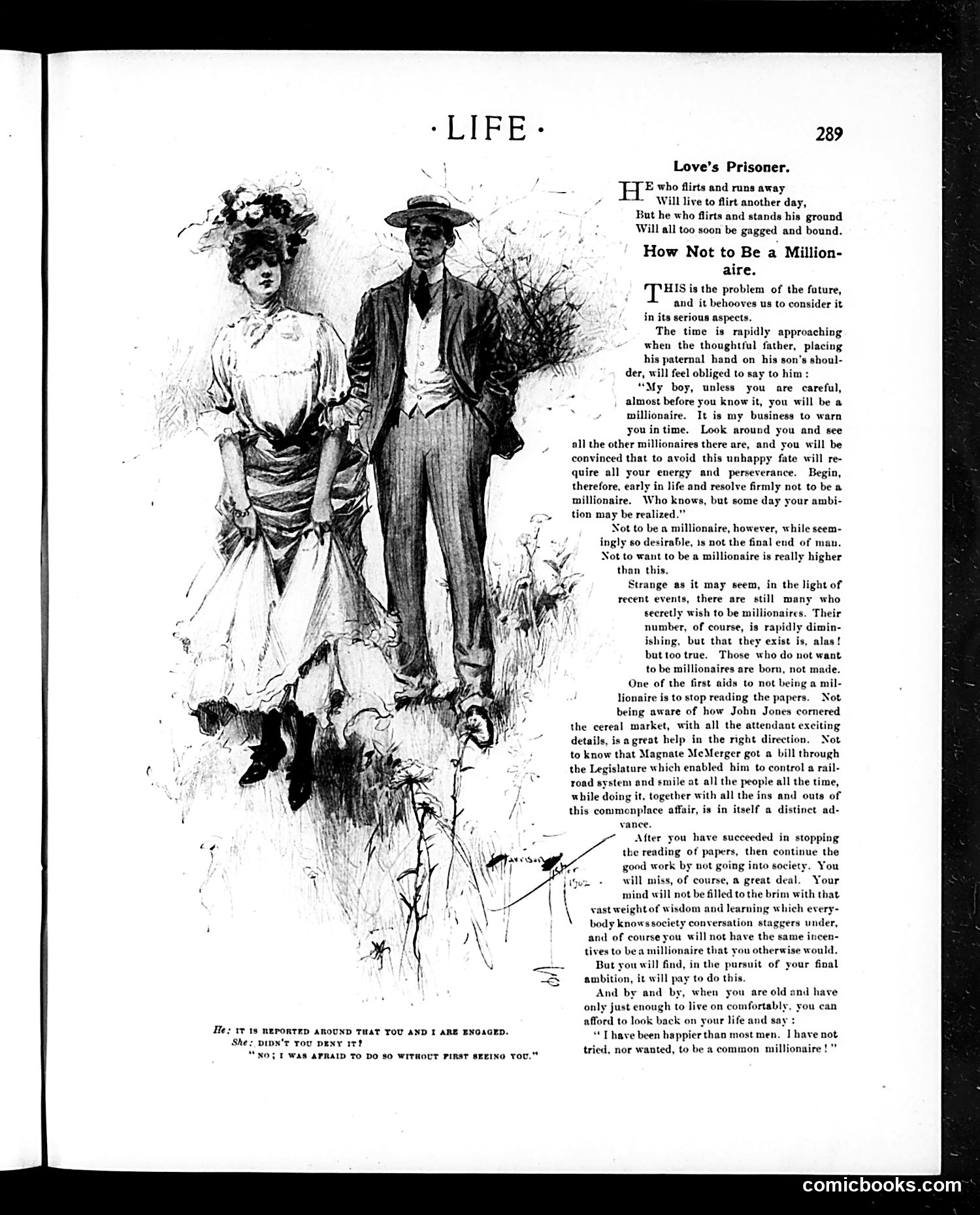
This page contains two distinct pieces of satire from Life magazine (a publication known for social commentary): **"Love's Prisoner"** (top): A short verse with accompanying sketch showing an engaged couple. The dialogue below—"He: it is reported around that you and I are engaged. She: didn't you deny it? He: No; I was afraid to do so without first seeing you"—satirizes the social expectations and gossip surrounding engagements, mocking how couples felt obligated to conform to public knowledge of their romantic status. **"How Not to Be a Millionaire"** (main text): A longer satirical essay advising fathers to warn sons *against* becoming millionaires—inverting typical ambitions. It mocks the wealthy by suggesting that avoiding newspapers (which report on business deals) and avoiding high society (where one encounters wealthy people) are the best strategies to prevent wealth accumulation. The satire targets both the obsession with millionaire status and, implicitly, the conspicuous behavior and market manipulation of the wealthy during the Gilded Age.
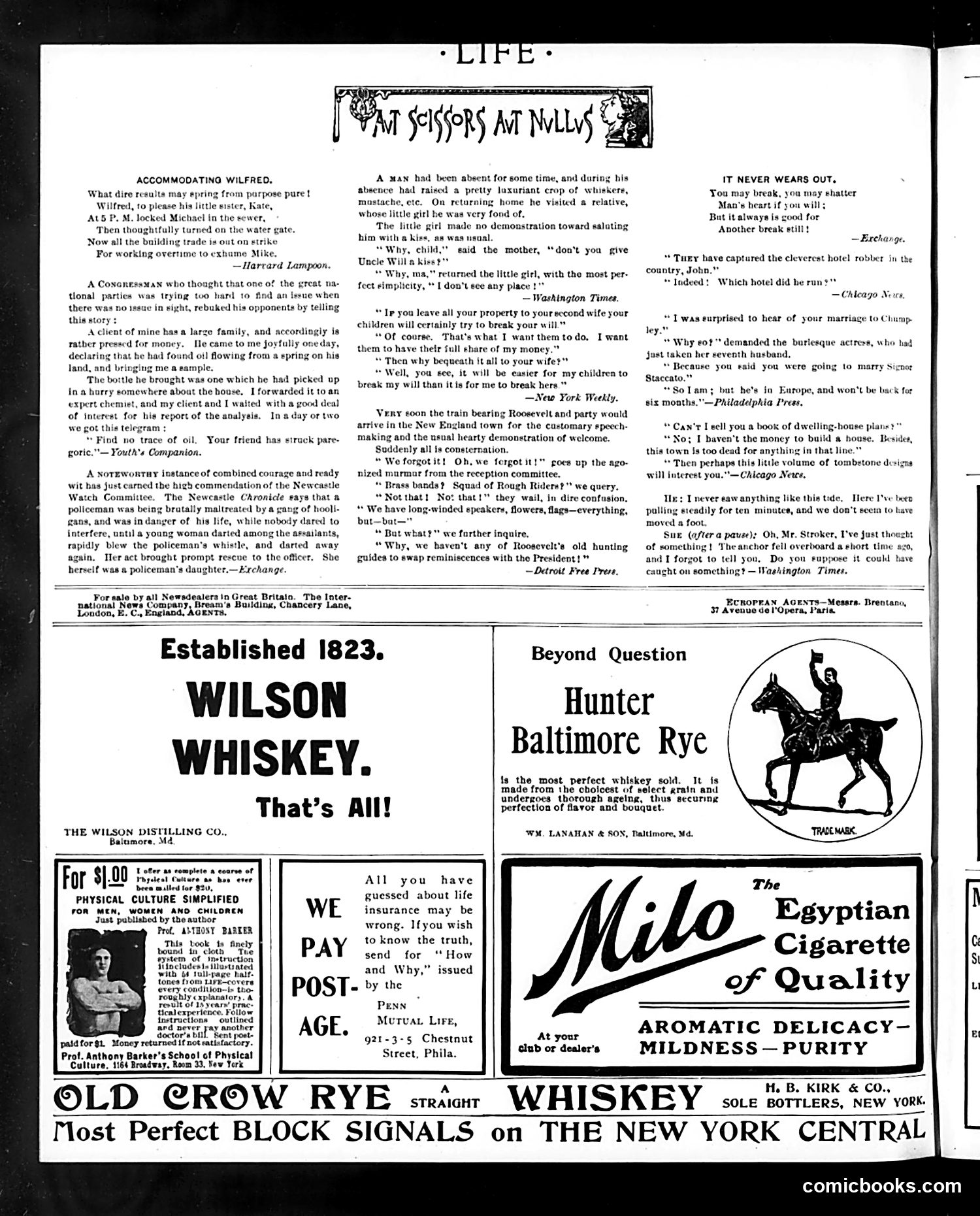
This page from *Life* magazine (a satirical humor publication) contains multiple short humorous anecdotes rather than a single cartoon. The pieces mock everyday social situations and human behavior: **Key content includes:** - A Harvard Lampoon anecdote about a boy locking his sister's suitor in a sewer as a "favor" - A congressman's story ridiculing political opportunism—comparing frivolous campaign issues to mistaking paraffin for oil - A Newcastle policeman rescue story praising a young woman's courage - Jokes about mustaches, wills, and marriage **The satire targets:** family absurdity, political empty rhetoric, class dynamics, and marital discord (common *Life* themes of the era). The page is primarily **advertising** below the humor—whiskey, cigarettes, and physical culture courses—reflecting early 1900s publication economics. No specific political figures appear identifiable, though Roosevelt receives oblique mention regarding campaign theatrics. The humor is genteel, middle-class social commentary typical of *Life*'s editorial voice.
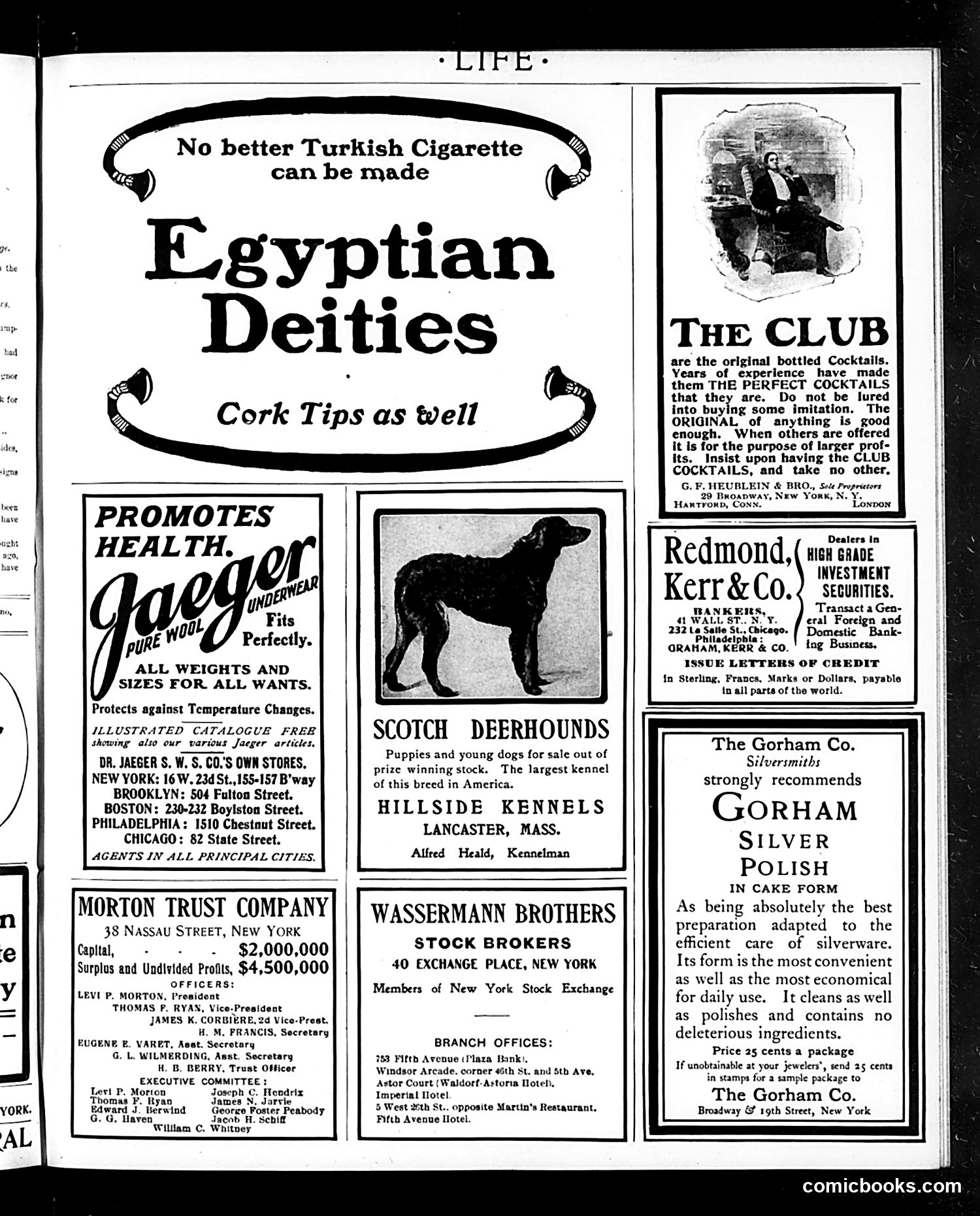
This page is **primarily advertising** with no discernible political cartoon or satire. It consists of roughly a dozen advertisements from early 20th-century companies. The top features "Egyptian Deities" cigarettes—the name appears to reference orientalism popular in that era, though no actual cartoon or joke accompanies it. Other ads promote Jaeger underwear (claiming health benefits), Scotch deerhounds, Club brand cocktails, financial services (stock brokers, trust companies, and banks), Gorham silver polish, and dog breeding. The only illustration is a photograph of a Scotch deerhound used to advertise Hillside Kennels. **Context for modern readers:** This reflects early 1900s consumer culture, including now-outdated health claims for clothing, exotic product naming, and the prominence of financial institutions in magazines. The multiple banking/brokerage ads suggest Life's affluent readership.
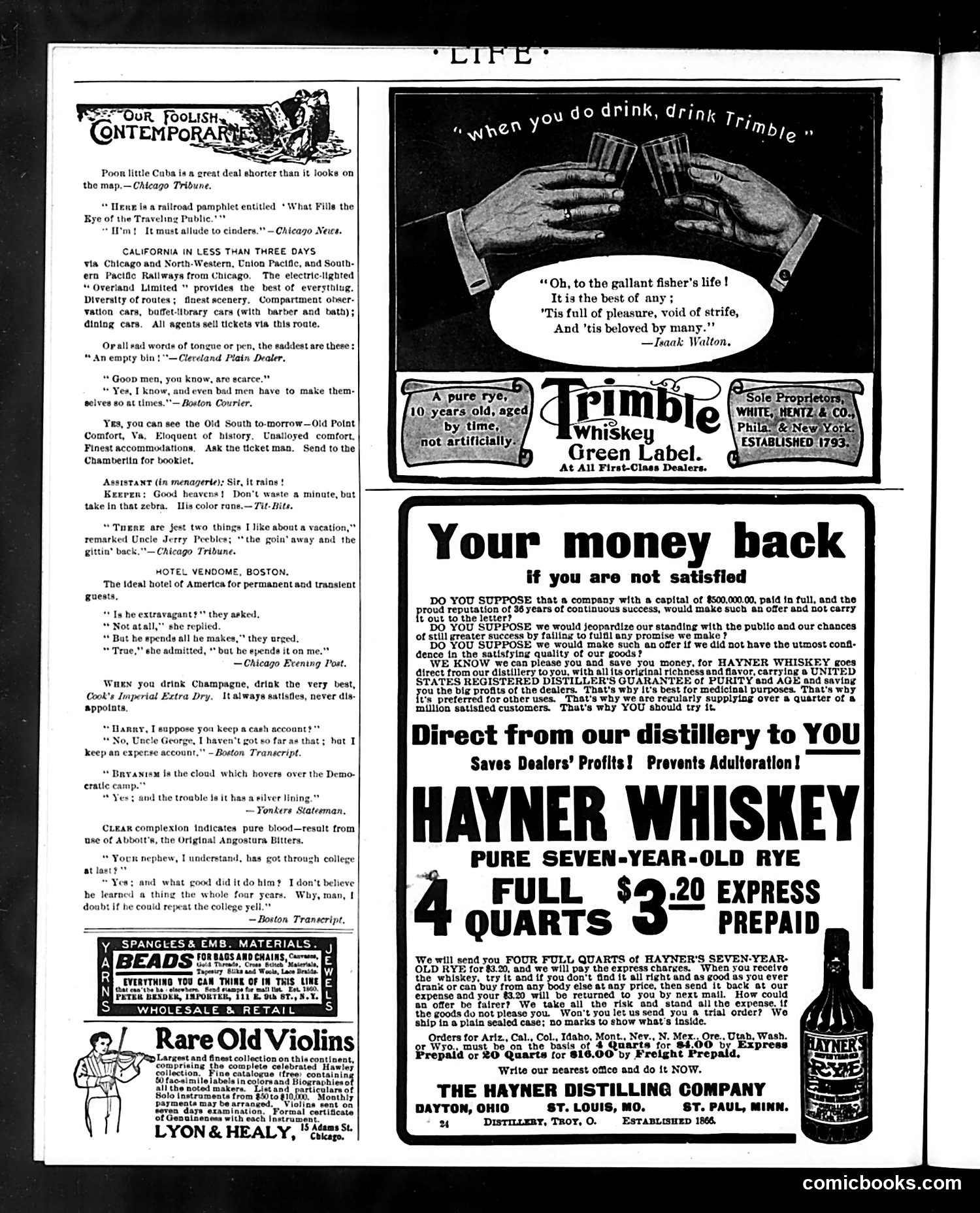
This page consists primarily of **advertisements and short humorous quips** rather than political cartoons. The content includes: **Humorous anecdotes** playing on wordplay and irony—such as a joke about "poor little Cuba" being shorter than shown on maps, and quips about extravagant husbands and college education's worthlessness. **Railroad and hotel advertisements** promoting American travel (California via various railways, Hotel Vendome in Boston). **Two major whiskey advertisements**: Trimble Whiskey's "Green Label" and Hayner Whiskey, emphasizing purity and direct-from-distillery sales. Hayner's ad stresses quality assurance and a money-back guarantee. **Minor product ads** for Angostura Bitters, violin instruction, and beads. The page reflects **early 1900s consumer culture**, where Life magazine blended satirical humor with commercial advertising. There are no identifiable political figures or sharp social critique—just gentle, domestic humor typical of the era's light satire magazine format.
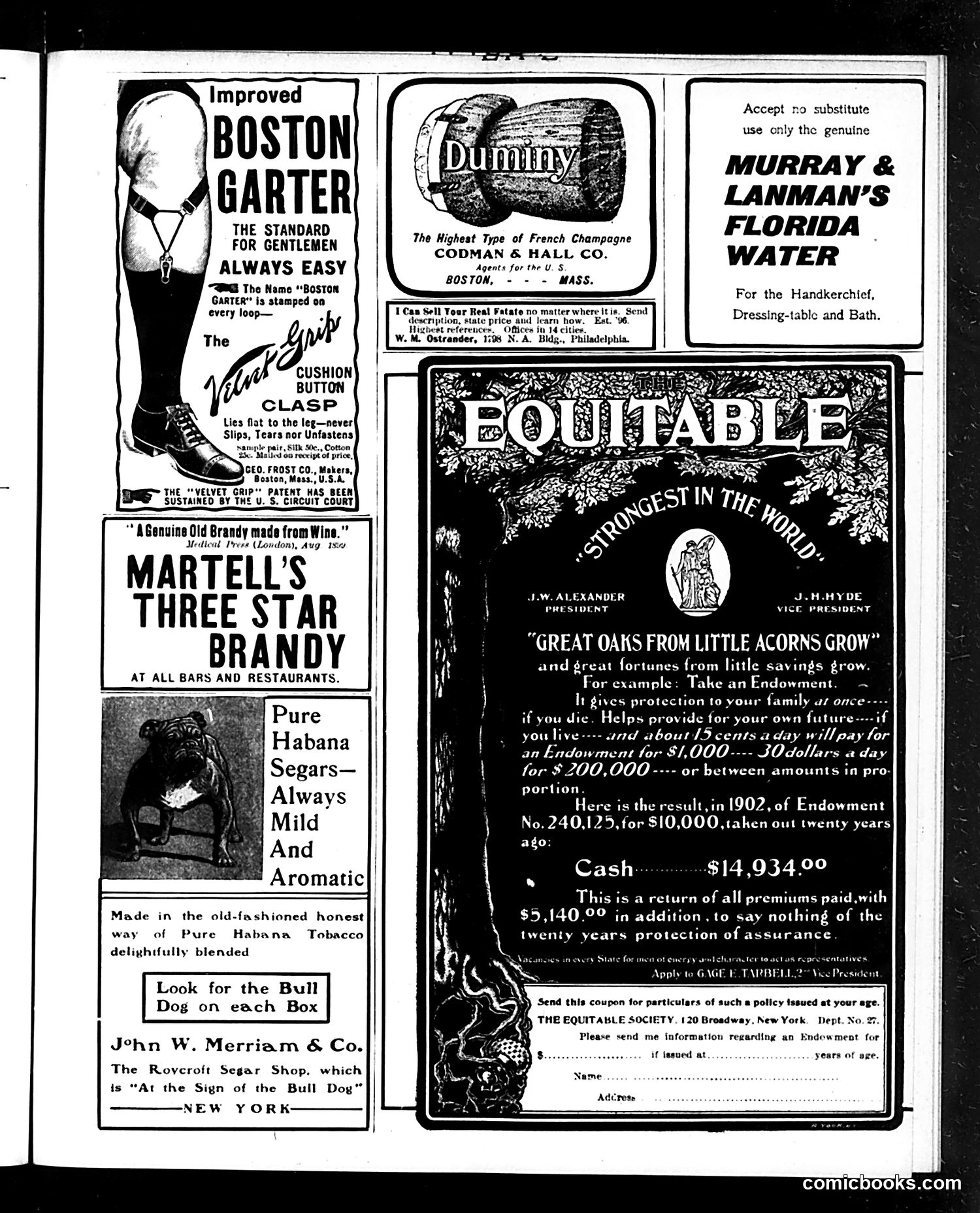
This page consists entirely of **advertisements**, not political cartoons or satirical content requiring historical interpretation. The ads promote consumer goods typical of early 1900s America: garters, champagne, brandy, cigars, and Florida water (a toilet cologne). Most notably, the large right-side advertisement for **The Equitable Society** promotes life insurance endowments—a financial product promising long-term savings and family protection. The endowment ad's example (a $10,000 policy from 1902 yielding $14,934 after twenty years) reflects early-20th-century consumer finance marketing, targeting middle-class Americans concerned with savings and family security. No political figures, caricatures, or satirical commentary appear on this page. It represents standard commercial advertising from the era, notable mainly for what products were considered essential or desirable to advertise in a major publication.
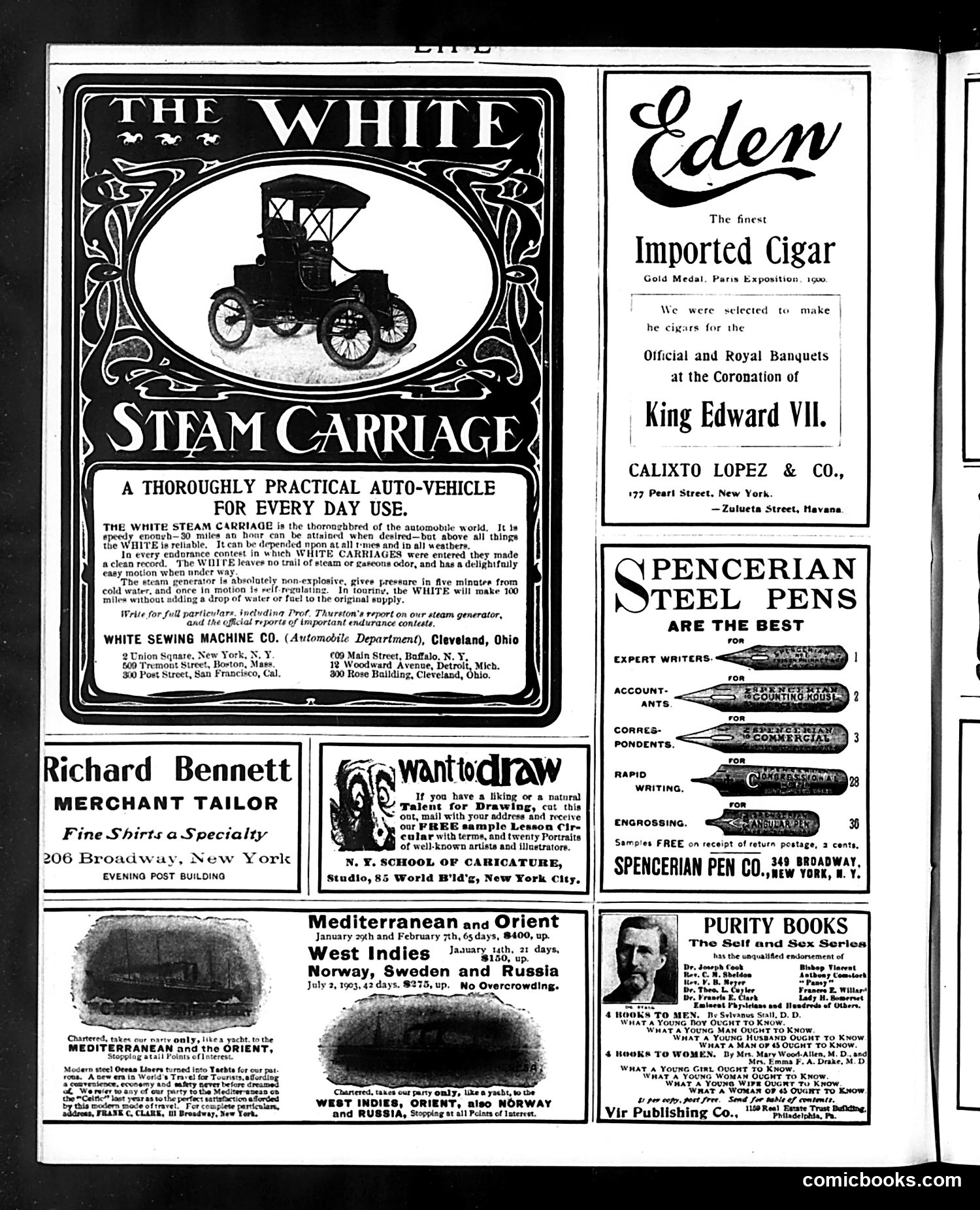
This page is primarily **advertising**, not satire or political commentary. It showcases early 1900s consumer products and services: **Main Advertisement**: The White Steam Carriage dominates the left side—an automobile powered by steam rather than gasoline. The ad emphasizes reliability, cleanliness (no smoke/odor), and performance in endurance contests. This reflects the era when steam and electric vehicles competed with gasoline engines before the latter won out. **Supporting Ads** include: - Eden imported cigars (claiming royal endorsement from King Edward VII's coronation) - Spencerian steel pens for different professions - A merchant tailor offering fine shirts - The N.Y. School of Caricature (offering drawing lessons) - Cruise ship travel packages - "Purity Books"—the "Self and Sex Series," medical guides on reproductive health/sex education, endorsed by doctors The page reflects Edwardian-era consumer culture: automobile innovation, growing middle-class commerce, and emerging discussions about sex education presented through medical/moral frameworks.
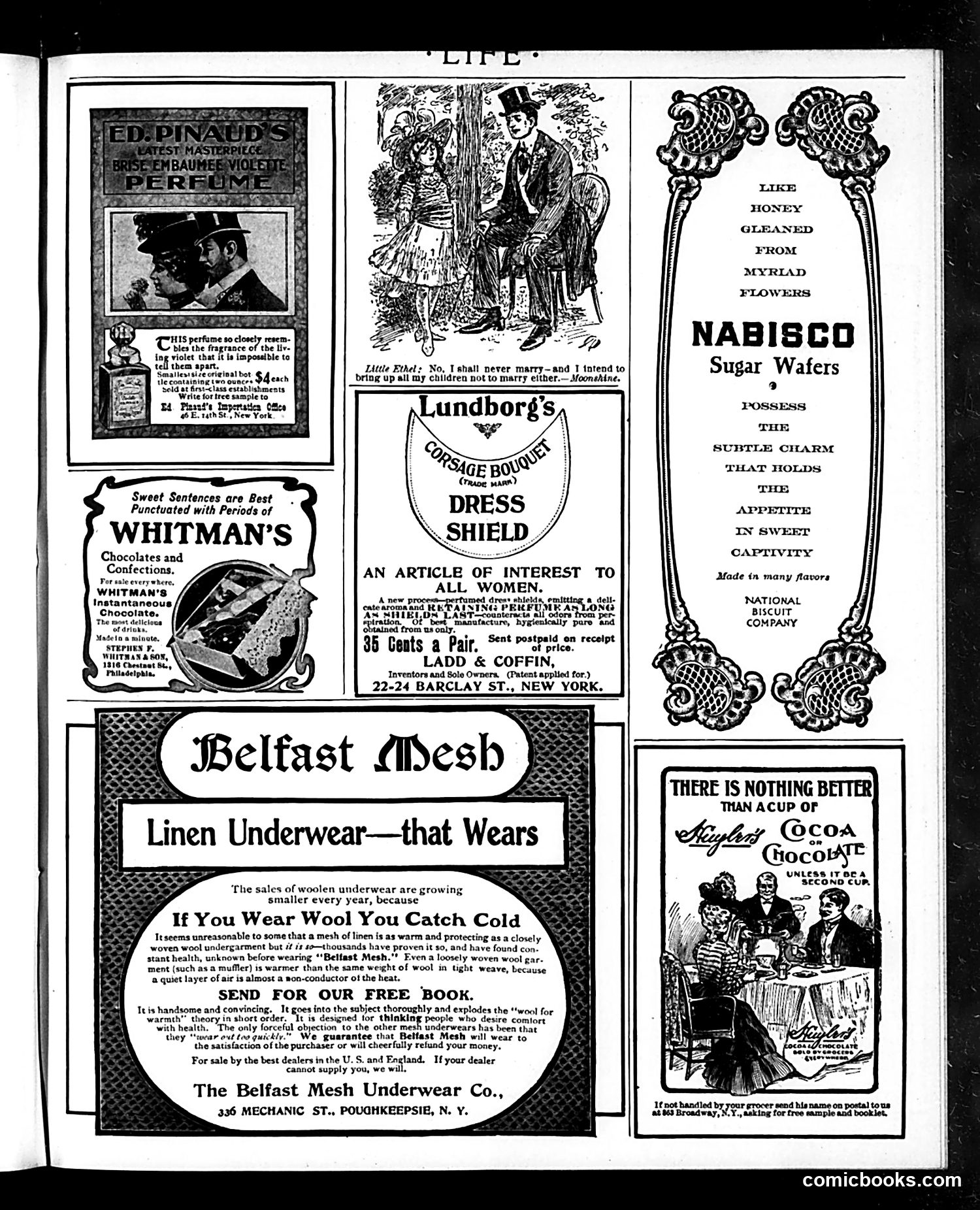
This is primarily an **advertising page** from Life magazine, with one small satirical cartoon. The cartoon—captioned "Little Ethel"—shows a young woman rejecting a man's marriage proposal under a tree. The joke plays on turn-of-century anxieties about women's independence: Ethel declares she will never marry and will raise her children the same way, inverting traditional expectations that women should seek marriage. The humor targets contemporary debates about women's changing roles and attitudes toward matrimony. The page is dominated by product advertisements typical of the era: perfume, chocolate confections, cocoa, sugar wafers, and notably **Belfast Mesh underwear**—which makes health claims about linen mesh being warmer than wool despite seeming counterintuitive. The ads reflect early 1900s consumer culture and the marketing strategies used to reach middle-class readers. No political content is evident; this is a straightforward commercial page with one light domestic joke about courtship.
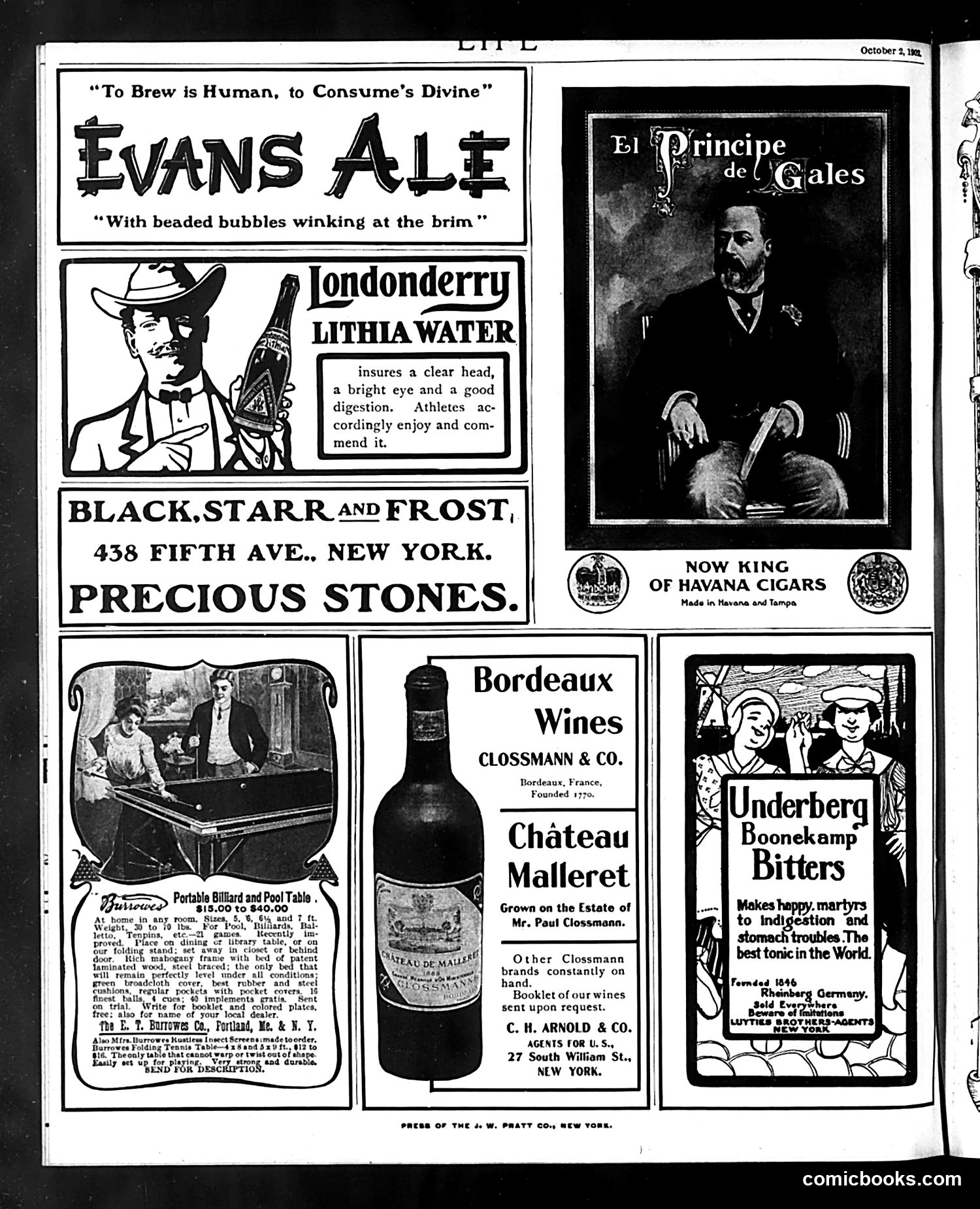
This page is primarily **advertising**, not political satire. It showcases luxury consumer goods marketed to affluent Americans of the Edwardian era. The ads feature: - **Evans Ale** — positioned with a literary quote ("beaded bubbles winking at the brim," from Keats) to appeal to educated consumers; marketed to athletes - **Londonderry Lithia Water** — a patent medicine claiming health benefits (clear head, digestion) - **El Príncipe de Gales cigars** — Havana imports, presented with a distinguished gentleman's portrait - **Precious stones** from Fifth Avenue jeweler Black, Starr & Frost - **Bordeaux wine and bitters** — European luxury imports The satire is **implicit rather than explicit**: Life's editors are gently mocking upper-class aspirations by juxtaposing high-minded literary references with commercial sales pitches. The page reflects turn-of-century American wealth and imported-goods consumption, when European products signified sophistication and status.