
Life, 1902-10-02 · page 8 of 22
Life — October 2, 1902 — page 8: what you’re looking at
What you’re looking at
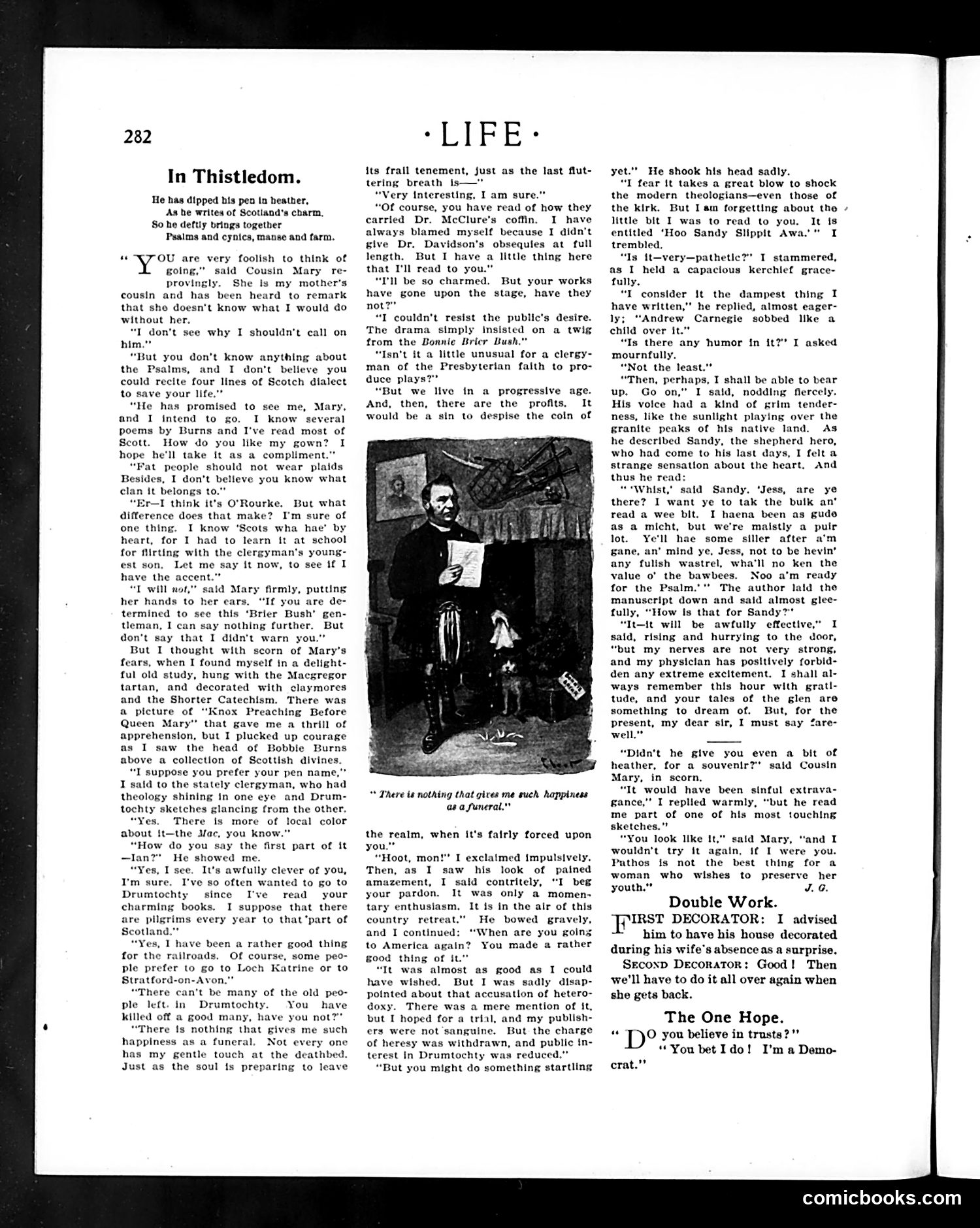
This page contains a literary dialogue piece titled "In Thistledom," not a political cartoon. The text discusses Scottish literature and poetry, with characters debating the merits of Scottish writers like Burns and Scott versus English literature. The single illustration shows what appears to be a religious or clerical figure in robes holding a document or manuscript, standing in a landscape setting. The caption reads: "There is nothing that gives me such happiness as a funeral." This caption serves as dark satire—the figure (likely representing a clergyman) ironically expresses that funerals bring him joy, presumably commenting on either clerical hypocrisy, morbid attitudes, or the satirical observation that religious figures benefit professionally from death. The humor relies on the grotesque contrast between the serious, solemn nature of funerals and the character's cheerful admission.
📄 Transcribed text from this page (OCR, searchable)
Machine-transcribed from the original scan — historical spelling and the odd misread are preserved.
In Thistledom. He has dipped his pen in heather, As he writes of Scotland's charm, So he deftly brings together Psalms and cynics, manse and farm. OU are very foolish to think of going,” said Cousin Mary re- provingly. She is my mother's cousin and has been heard to remark that she doesn't know what I would do without her, “I don't see why I shouldn't call on him." “But you don’t know anything about the Psalms, and I don’t believe you could recite four lines of Scotch dialect to save your life.”* “He has promised to see me, Mary, and I intend to go, I know several poems by Burns and I've read most of Scott. How do you like my gown? I hope he'll take it as a compliment.” Fat people should not wear plaids Besides, I don’t believe you know what clan it belongs to.” I think it's O'Rourke, But what difference does that make? I'm sure of one thing. I know ‘Scots wha hae’ by heart, for I had to learn it at school for flirting with the clergyman's young- est son, Let me say it now, to see if I have the accent.” “I will not,” said Mary firmly, putting her hands to her ears. “If you are de- termined to see this ‘Brier Bush’ gen- tleman, I can say nothing further. But don’t say that I didn’t warn you.” But I thought with scorn of Mary's fears, when I found myself in a delight- ful old study, hung with the Macgregor tartan, and decorated with claymores and the Shorter Catechism. There was a picture of “Knox Preaching Before Queen Mary” that gave me a thrill of apprehension, but I plucked up courage as I saw the head of Bobbie Burns above a collection of Scottish divines. I suppose you prefer your pen name,” I said to the stately clergyman, who had theology shining in one eye and Drum- tochty sketches glancing from the other. “Yes. There is more of local color about {tthe Mac, you know.” “How do you say the first part of it —Ian?" He showed me. es, I see. It's awfully clever of you, I'm sure. I've so often wanted to go to Drumtochty since I've read your charming books. I suppose that there are pilgrims every year to that ‘part of Scotland." es, I have been a rather good thing for the railroads. Of course, some peo- ple prefer to go to Loch Katrine or to Stratford-on-Avon.”” “There can’t be many of the old pe ple left. in| Drumtochty. You he Killed off a good many, have you not?" “There 1s nothing that gives me such happiness as a funeral, Not every one has my gentle touch at the deathbed. Just as the soul {s preparing to leave “LIFE : its frail tenement, just as the last flut- tering breath 1s— Very interesting, I am sure.” “Of course, you have read of how they carried Dr. McClure’s coffin. I have always blamed myself because I didn't give Dr. Davidson's obsequies at full length. But I have a little thing here that I'll read to you." “I'll be so charmed. But your works have gone upon the stage, have they not?” “I couldn't resist the public's desire. The drama simply insisted on a twig from the Bonnie Bricr Bush." “Isn't it a little unusual for a clersy- man of the Presbyterian faith to pro- duce plays?" “But we live in a progressive age. And, then, there are the profits, It would be a sin to despise the coin of the realm, when it's fairly forced upon you.”” “Hoot, mon!” I exclaimed tmpulsively. Then, as I saw his look of pained amazement, I sald contritely, “I bes your pardon. It was only a momen- tary enthusiasm, It fs in the air of this country retreat.” He bowed gravely, and I continued: “When are you going to America again? You made a rather good thing of it “It was almost as good as I could have wished. But I was sadly disap- pointed about that accusation of hetero- doxy. There was a mere mention of it, but I hoped for a trial, and my publish- ers were not’sanguine. But the charge of heresy was withdrawn, and public in- terest In Drumtochty reduced.” “But you might do something startling yet." He shook his head sadly. “I fear It takes a great blow to shock the modern theologians—even those of the kirk. But I am forgetting about the little bit I was to read to you. It 18 entitled ‘Hoo Sandy Slippit Awa." I trembled. “Is it-very—pathetle?” I stammered, as I held a capacious kerchlef grace- fully. “I consider it the dampest thing I have written,” he replied, almost eager- ly; “Andrew Carnegie sobbed lke a child over it.” “Is there any humor In it?" I asked mournfully, “Not the least. “Then, perhaps, I shall be able to bear up. Go on,” I sald, nodding fercely. His voice had a kind of grim tender- ness, like the sunlight playing over the granite peaks of his native land. As he described Sandy, the shepherd hero, who had come to his last days, I felt a strange sensation about the heart, And thus he read: “Whist,’ sald Sandy, ‘Jess, are ye there? I want ye to tak the bulk an’ read a wee bit. I haena been as gude as a micht, but we're maistly a puir lot. Ye'll hae some siller after a'm gane, an’ mind ye, Jess, not to be hevin’ any fulish wastrel, wha'll no ken the value o' the bawbees. Noo a’m ready for the Psalm." The author lald the manuscript down and said almost glee- fully, “How Is that for Sandy?" “It-it will be awfully effective,” I sald, rising and hurrying to the door, “but my nerves are not very strong, and my physician has positively forbid- den any extreme excitement, I shall al- ways remember this hour with gratl- tude, and your tales of the glen are something to dream of. But, for the present, my dear sir, I must say ‘are- well.” “Didn't he give you even a bit of heather, for a souvenir?" said Cousin Mary, in scorn. “It would have been sinful extrava- gance," I replied warmly, “but he read me part of one of his most touching sketches.” “You look Ike It," said Mary, “and I wouldn't try it again, if I were you. Puthos {s not the best thing for a woman who wishes to preserve her youth.” JG. Double Work. IRST DECORATOR: I advised him to have his house decorated during his wife's absence as a surprise, Secoxp Decorator: Good! Then we'll have to do it all over again when she gets back. The One Hope. * [0 you believe in truste?” “You bet Ido! I'm a Demo- comicbooks.com