
Life, 1902-10-02 · page 6 of 22
Life — October 2, 1902 — page 6: what you’re looking at
What you’re looking at
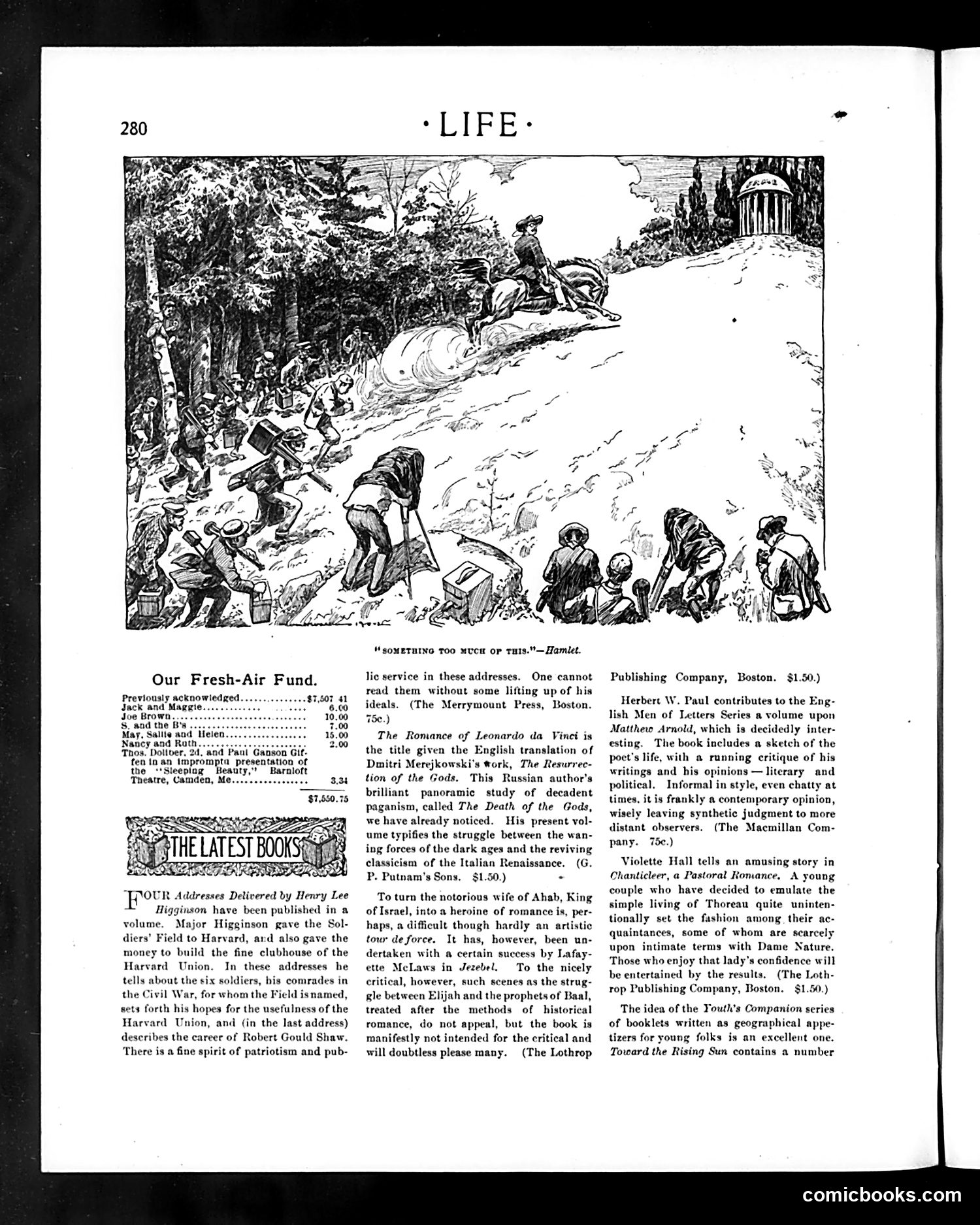
The main illustration depicts a scene of manual labor and construction work, with men digging and hauling materials (likely logs or barrels) up a hillside. The caption quotes Hamlet: "Something too much of this." This appears to be commentary on "Our Fresh-Air Fund," a charitable initiative listed below the cartoon that collected donations ($7,650.15 total) to send urban poor—particularly children—to countryside locations for health benefits. The satire likely critiques the disconnect between the fund's charitable intentions and the harsh physical labor conditions the beneficiaries actually experienced. The Hamlet quote suggests ironic excess or discomfort, implying the "fresh air" remedy may involve grueling work rather than genuine respite for recipients.
📄 Transcribed text from this page (OCR, searchable)
Machine-transcribed from the original scan — historical spelling and the odd misread are preserved.
Our Fresh-Air Fund. Previously acknowledged. Jack and Maggs Joe Brown... S. and the B's May, Sallie and iieren, Nancy and Rath ‘Thos. Doltoer, 24, it. fen in an tmprompta presentation of the ‘*Sleeplag Beauty,” Barnloft Theatre, Camden, Me......eeceseeeee “PROUR Addresses Delivered by Henry Lee Higginson have been published in a volume. Major Higginson gave the Sol- diers’ Field to Harvard, and also gave the money to build the fine clubhouse of the Harvard Union. In these addresses he tells about the six soldiers, his comrades in the Civil War, for whom the Field isnamed, sets forth his hopes for the usefulness of the Harvard Union, and (in the last address) describes the career of Robert Gould Shaw. There is a fine spirit of patriotism and pub- “sometuino Too uucH or tu1s."—Hamlet. lic service in these addresses. One cannot read them without some lifting up of his ideals. (The Merrymount Press, Boston. 75e.) The Romance of Leonardo da Vinci is the title given the English translation of Dmitri Merejkowski's Work, The Resurrec- tion of the Gods. This Russian author's brilliant panoramic study of decadent paganism, called The Death of the Gods, we have already noticed. His present vol- ume typifies the struggle between the wan- ing forces of the dark ages and the reviving classicism of the Italian Renaissance. (G. P. Putnam's Sons. $1.50.) - To turn the notorious wife of Ahab, King of Israel, into a heroine of romance is, per- haps, a difficult though hardly an artistic tour de force. It has, however, been un- dertaken with a certain success by Lafay- ette McLaws in Jezebel. To the nicely critical, however, such scenes as the strug- gle between Elijah and the prophets of Baal, treated after the methods of historical romance, do not appeal, but the book is manifestly not intended for the critical and will doubtless please many. (The Lothrop Publishing Company, Boston. $1.50.) Herbert W. Paul contributes to the Eng- lish Men of Letters Series a volume upon Matthew Arnold, which is decidedly inter- esting. The book includes a sketch of the poet's life, with a running critique of his writings and his opinions — literary and political. Informal in style, even chatty at times, it is frankly a contemporary opinion, wisely leaving synthetic judgment to more distant observers. (The Macmillan Com- pany. 75c.) Violette Hall tells an amusing story in Chanticleer, a Pastoral Romance, A young couple who have decided to emulate the simple living of Thoreau quite uninten- tionally set the fashion among their ac- quaintances, some of whom are scarcely upon intimate terms with Dame Nature. Those who enjoy that lady's confidence will be entertained by the results, (The Loth- rop Publishing Company, Boston. $1.50.) The idea of the Youth’s Companion series of booklets written as geographical appe- tizers for young folks is an excellent one. Toward the Rising Sun contains a number comicbooks.com