
Life, 1902-10-02 · page 4 of 22
Life — October 2, 1902 — page 4: what you’re looking at
What you’re looking at
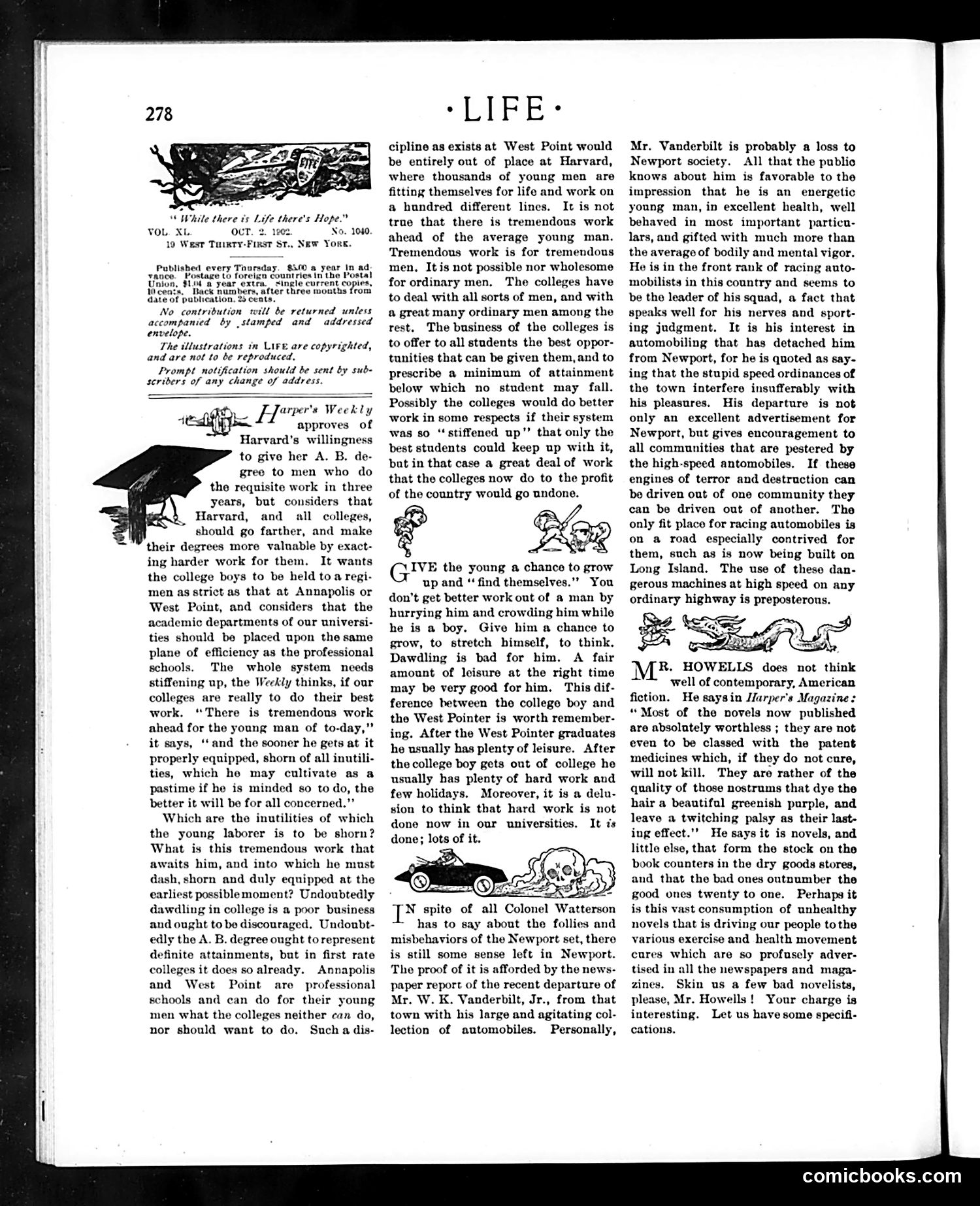
This page contains editorial commentary rather than political cartoons. The main text discusses college education, particularly comparing Harvard and West Point as institutions that should produce rigorous, disciplined young men. There's criticism of Mr. W.K. Vanderbilt Jr.'s recent departure from Newport with "his large and agitating collection of automobiles"—satirizing wealthy elites' obsession with racing cars and leisure pursuits rather than serious work. The page also critiques contemporary American fiction as "unhealthy," arguing that bad novels outnumber good ones twenty to one, and that this consumption of lowbrow literature drives social decline. Small decorative illustrations (cars, dogs) accompany the text but aren't satirical cartoons themselves. The satire targets wealthy idleness and popular culture's perceived moral degradation.
📄 Transcribed text from this page (OCR, searchable)
Machine-transcribed from the original scan — historical spelling and the odd misread are preserved.
“While there és Life there's Hope.” OcT. 1202. No. 1040. Published every Taursday. $300 a year in ad Postage to foreign countries in the Postal #10 a year extra. single current copies, cents. Back numbers, after three months from date of publication, 25 cats, No contribution will be returned unless accompanied by stamped and addressed envelope. The illustrations in LiFe are copyrighted, and are not to be reproduced, Prompt notification should be sent by sub- scribers of any change of address. rarper's Weekly oF @ approves of Harvard's willingness to give her A. B. de- gree to men who do the requisite work in three years, but considers that Harvard, and all colleges, ” should go farther, and make their degrees more valuable by exact- ing harder work for them. It wants the college boys to be held to a regi- men as strict as that at Annapolis or West Point, and considers that the academic departments of our universi- ties should be placed upon the same plane of efficiency as the professional schools. The whole system needs stiffening up, the Weekly thinks, if our colleges are really to do their best work, “There is tremendous work ahead for the young man of to-day,’’ it says, ‘‘and the sooner he gets at it properly equipped, shorn of all inutili- ties, which he may cultivate as a pastime if he is minded so to do, the better it will be for all concerned.” Which are the inutilities of which the young laborer is to be shorn? What is this tremendous work that awaits him, and into which he must dash, shorn and duly equipped at the earliest possiblemoment? Undoubtedly dawdling in college is a poor business and ought to be discouraged. Undoubt- edly the A. B. degree ought to represent definite attainments, but in first rate colleges it does so already. Annapolis and West Point are professional schools and can do for their young men what the colleges neither can do, nor should want to do. Such a dis- ‘LIFE + cipline as exists at West Point would be entirely out of place at Harvard, where thousands of young men are fitting themselves for life and work on a hundred different lines. It is not trae that there is tremendous work ahead of the average young man. Tremendous work is for tremendous men. Itis not possible nor wholesome for ordinary men. The colleges have to deal with all sorts of men, and with a great many ordinary men among the rest. The business of the colleges is to offer to all students the best oppor- tunities that can be given them, and to prescribe a minimum of attainment below which no student may fall. Possibly the colleges would do better work in some respects if their system was so ‘stiffened up’? that only the best students could keep up with it, but in that case a great deal of work that the colleges now do to the profit of the country would go undone. IVE the young a chance to grow up and “find themselves.” You don’t get better work out of a man by hurrying him and crowding him while he is a boy. Give him a chance to grow, to stretch himself, to think. Dawdling is bad for him. A fair amount of leisure at the right time may be very good for him. This dif- ference between the college boy and the West Pointer is worth remember- ing. After the West Pointer graduates he usually has plenty of leisure. After the college boy gets ont of college he usually has plenty of hard work and few holidays. Moreover, it is a delu- sion to think that hard work is not done now in our universities. It is done; lots of it. N I has to say about the follies and misbehaviors of the Newport set, there is still some sense left in Newport. The proof of it is afforded by the news- paper report of the recent departure of Mr. W. K. Vanderbilt, Jr., from that town with his large and agitating col- lection of automobiles. Personally, Mr. Vanderbilt is probably a loss to Newport society. All that the public knows about him is favorable to the impression that he is an energetic young man, in excellent health, well behaved in most important particu- lars, and gifted with much more than the average of bodily and mental vigor. He is in the front rank of racing auto- mobilists in this country and seems to be the leader of his squad, a fact that speaks well for his nerves and sport- ing judgment. It is his interest in automobiling that has detached him from Newport, for he is quoted as say- ing that the stupid speed ordinances of the town interfere insufferably with his pleasures. His departure is not only an excellent advertisement for Newport, but gives encouragement to all communities that are pestered by the high-speed antomobiles. If these engines of terror and destruction can be driven out of one community they can be driven out of another. Tho only fit place for racing automobiles is on a road especially contrived for them, such as is now being built on Long Island. The use of these dan- gerous machines at high speed on any ordinary highway is preposterous. Me. HOWELLS does not think well of contemporary, American fiction. He saysin Jarper's Magazine: “Most of the novels now published are absolutely worthless ; they are not even to be classed with the patent medicines which, if they do not cure, will not kill, They aro rather of the quality of those nostrums that dye the hair a beautifal greenish purple, and leave a twitching palsy as their last- ing effect.” He says it is novels, and little else, that form the stock on the book counters in the dry goods stores, and that the bad ones outnumber the good ones twenty to one. Perhaps it is this vast consumption of unhealthy novels that is driving our people tothe various exercise and health movement cures which are so profusely adver- tised in all the newspapers and maga- zines. Skin us a few bad novelists, please, Mr. Howells! Your charge is interesting. Let us have some specifi- cations. comicbooks.com