
Life, 1902-10-02 · page 12 of 22
Life — October 2, 1902 — page 12: what you’re looking at
What you’re looking at
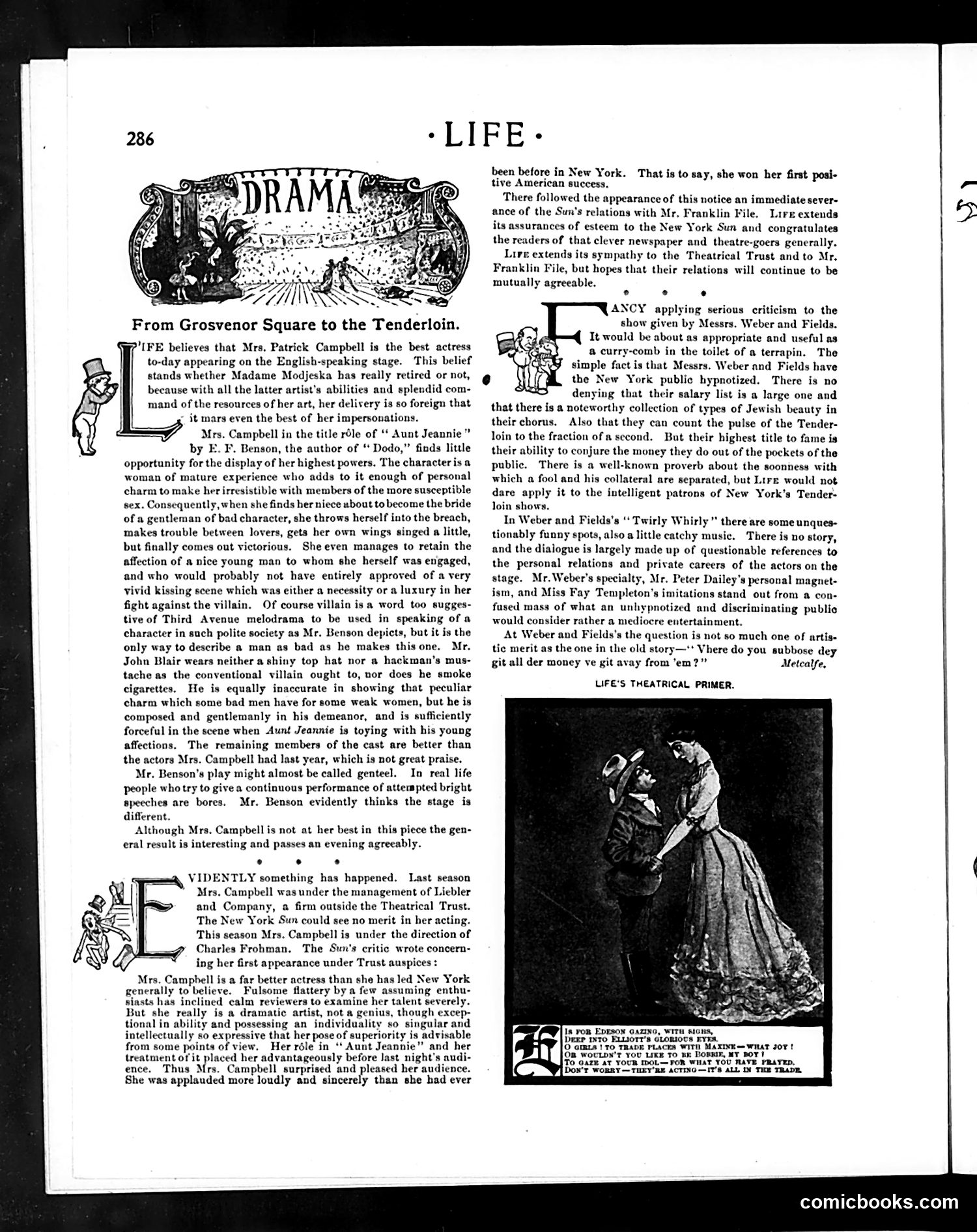
This page contains drama criticism reviewing Mrs. Patrick Campbell's performance in "Aunt Jeannie" by E.P. Benson. The critic praises Campbell as "the best actress to-day appearing in English-speaking plays," noting her maturity and experience enhance the role. The review critiques the play itself as somewhat conventional, with Campbell elevating mediocre material. It references competing theatrical productions and discusses salary disputes between Weber and Fields (apparently famous performers) and the Theatrical Trust—suggesting labor tensions in early 1900s theater. The illustration labeled "Is for Edmond Gardin, with Rider" appears to be a theatrical scene, though its specific meaning is unclear from the visible content. The overall page focuses on professional theater criticism and industry business rather than political satire.
📄 Transcribed text from this page (OCR, searchable)
Machine-transcribed from the original scan — historical spelling and the odd misread are preserved.
-LIFE- From Grosvenor Square to the Tenderloin. *IFE believes that Mrs. Patrick Campbell is the best actress to-day appearing on the English-speaking stage. This belief stands whether Madame Modjeska has really retired or not, because with all the latter artist's abilities and splendid com- mand of the resources of her art, her delivery is so foreign that it mars even the best of her impersonations. Mrs. Campbell in the title role of ‘‘ Aunt Jeannie ” by E. F. Benson, the author of ‘ Dodo,” finds little opportunity for the display of her highest powers. The characteris a woman of mature experience who adds to it enough of personal charm to make her irresistible with members of the more susceptible sex. Consequently, when she finds her niece about to become the bride of a gentleman of bad character, she throws herself into the breach, makes trouble between lovers, gets her own wings singed a little, but finally comes out victorious. She even manages to retain the affection of a nice young man to whom she herself was engaged, and who would probably not have entirely approved of a very vivid kissing scene which was either a necessity or a luxury in her fight against the villain. Of course villain isa word too sugges- tive of Third Avenue melodrama to be used in speaking of a character in such polite society as Mr. Benson depicts, but it is the only way to describe a man as bad as he makes this one. Mr. John Blair wears neither a shiny top hat nor a hackman’s mus- tache as the conventional villain ought to, nor does he smoke cigarettes. He is equally inaccurate in showing that peculiar charm which some bad men have for some weak women, but he is composed and gentlemanly in his demeanor, and is sufficiently forceful in the scene when Aunt Jeannie is toying with his young affections. The remaining members of the cast are better than the actors Mrs. Campbell had last year, which is not great praise. Mr. Benson's play might almost be called genteel. In real life people who try to givea continuous performance of attempted bright speeches are bores. Mr. Benson evidently thinks the stage is different, Although Mrs. Campbell is not at her best in this piece the gen- eral result is interesting and passes an evening agreeably. . . . VIDENTLY something has happened. Last season Mrs. Campbell was under the management of Liebler and Company, a firm outside the Theatrical Trust. The New York Sun could see no merit in her acting. This season Mrs. Campbell is under the direction of Charles Frohman, The Stm's critic wrote concern- ing her first appearance under Trust auspices: Mrs. Camphell is a far better actress than she has led New York generally to believe. Fulsome flattery by a few assuming enthu- siasts has inclined calm reviewers to examine her talent severely. But she really is a dramatic artist, not a genius, though excep- tional in ability and possessing an individuality so singular and intellectually so expressive that her pose of superiority is advisable from some points of view. Her réle in ‘‘ Aunt Jeannie” and her treatment of it placed her advantageously before Jast night's audi- ence. Thus Mrs. Campbell surprised and pleased her audience. She was applauded more loudly and sincerely than she had ever been before in New York. That is to say, she won her first posi tive American success, There followed the appearance of this notice an immediate sever- ance of the Sun's relations with Mr. Franklin File. Lire extends its assurances of esteem to the New York Sun and congratulates the readers of that clever newspaper and theatre-goers generally. Lire extends its sympathy to the Theatrical Trust and to Mr. Franklin File, but hopes that their relations will continue to be mutually agreeable. . . ANCY applying serious criticism to the show given by Messrs. Weber and Fields. It would be about as appropriate and useful as @ curry-comb in the toilet of a terrapin. The simple fact is that Messrs. Weber and Fields have the New York public hypnotized. There is no denying that their salary list is a large one and that there is a noteworthy collection of types of Jewish beauty in their chorus. Also that they can count the pulse of the Tender- loin to the fraction ofa second. But their highest title to fame is their ability to conjure the money they do out of the pockets of the public. There is a well-known proverb about the soonness with which a fool and his collateral are separated, but Lire would not. dare apply it to the intelligent patrons of New York's Tender- loin shows. In Weber and Fields's ‘‘ Twirly Whirly ” there are some unques- tionably funny spots, also alittle catchy music. There is no story, and the dialogue is largely made up of questionable references to the personal relations and private careers of the actors on the stage. Mr. Weber's specialty, Mr. Peter Dailey's personal magnet- ism, and Miss Fay Templeton’s imitations stand out from a con- fased mass of what an unhypnotized and discriminating public would consider rather a mediocre entertainment. At Weber and Fields’s the question is not so much one of artis- tic merit as the one in the old story—"* Vhere do you subbose dey git all der money ve git avay from ‘em?” Metcalfe, LIFES THEATRICAL PRIMER. Is vom Eoasox oasivo, wirs sious, Bere'no Ruste cuomiove rree Bia ro neeee ranges WITH HaxDNt= wnat 207 ! Ou woLDN'y You Like To we LORIE RY pov TO Gaze AT YOUR IDOL—FOR WHAT YOU RAVE FRAYED, CO oe ca tune ae cron ire ALL OY Ti Ta comicbooks.com