
A complete issue · 22 pages · 1902
Life — September 25, 1902
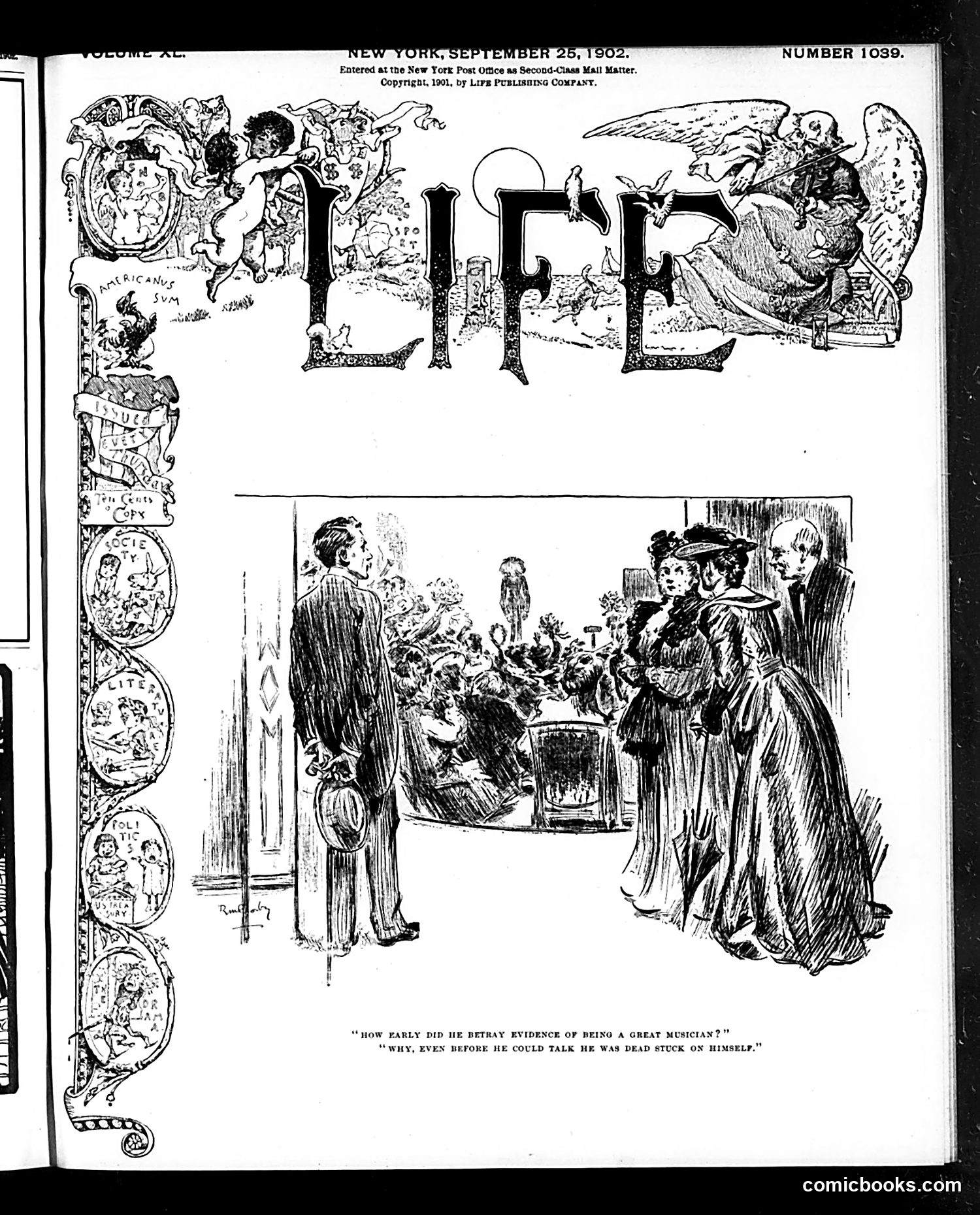
The main cartoon depicts a social situation where a man stands conversing with fashionably dressed women in what appears to be an elegant interior. The caption reads: "How early did he betray evidence of being a great musician?" / "Why, even before he could talk he was dead stuck on himself." This is a satirical commentary on vanity and musical pretension. The joke hinges on a double meaning: the phrase "dead stuck on himself" (meaning self-absorbed) is presented as evidence of musical talent, when logically it reveals only egotism. The cartoon mocks both wealthy patrons who conflate artistic affectation with genuine ability, and aspiring musicians whose primary talent appears to be self-promotion rather than actual skill. The ornate decorative border suggests the pretentious world being satirized.
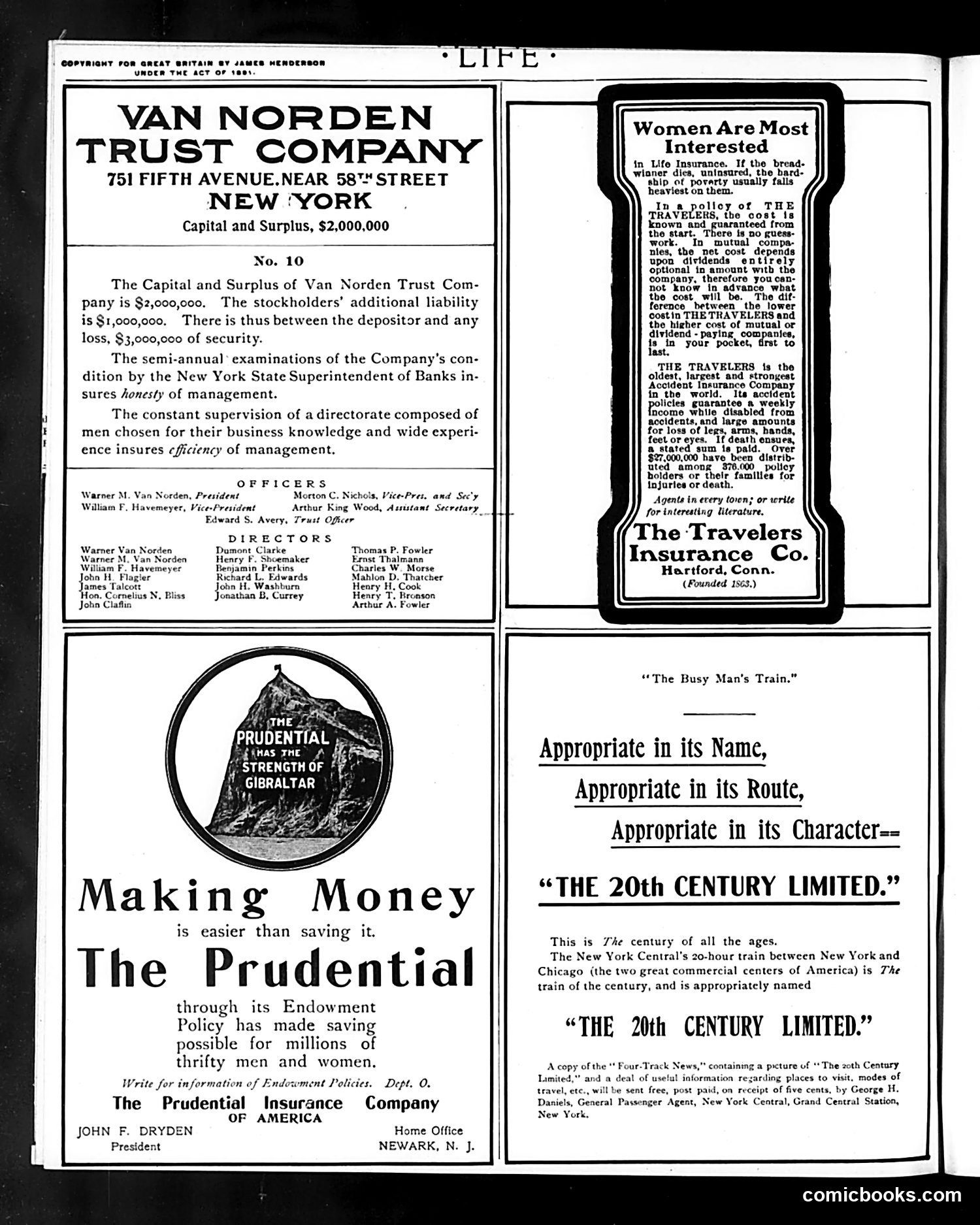
This page is **primarily advertising**, not satirical content. It contains four separate advertisements: 1. **Van Norden Trust Company** — financial services ad listing officers and directors 2. **The Travelers Insurance Company** — life insurance ad targeting women, emphasizing financial security for families if the breadwinner dies 3. **The Prudential Insurance Company** — endowment policy ad using the Rock of Gibraltar as a symbol of strength and reliability 4. **New York Central's "20th Century Limited"** — railroad advertisement for a prestigious 20-hour passenger train between New York and Chicago There are no political cartoons or satirical commentary on this page. The content reflects early 20th-century commercial messaging emphasizing financial security, insurance protection, and modern transportation.
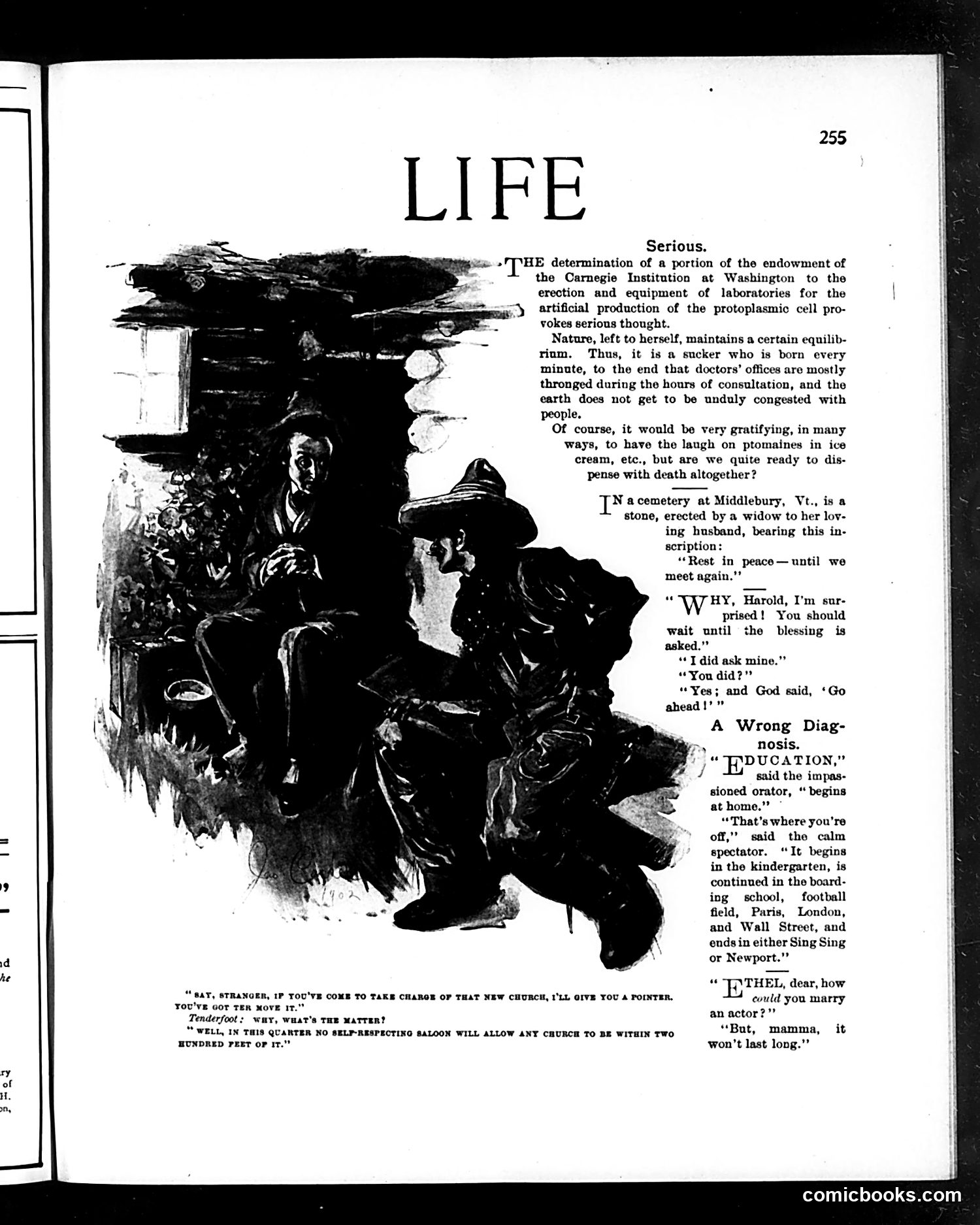
This page contains several brief satirical pieces rather than a single cartoon: **"Serious"** section discusses the Carnegie Institution's endowment for laboratory work on protoplasmic cells—treated humorously as an example of nature's built-in efficiency that makes doctors' offices less crowded. **"A Cemetery at Middlebury, VI"** anecdote mocks optimistic epitaphs ("Rest in peace—until we meet again"), contrasting religious platitudes with mortality. **"A Wrong Diagnosis"** jokes about education's definition, satirizing how it supposedly "begins at home" but extends through childhood institutions to Wall Street—suggesting education trains people for capitalist success rather than genuine learning. **"Ethel" dialogue** appears a domestic humor bit about marriage and acting careers. The page reflects *Life*'s signature style: short, punchy social commentary targeting pretension and conventional wisdom.
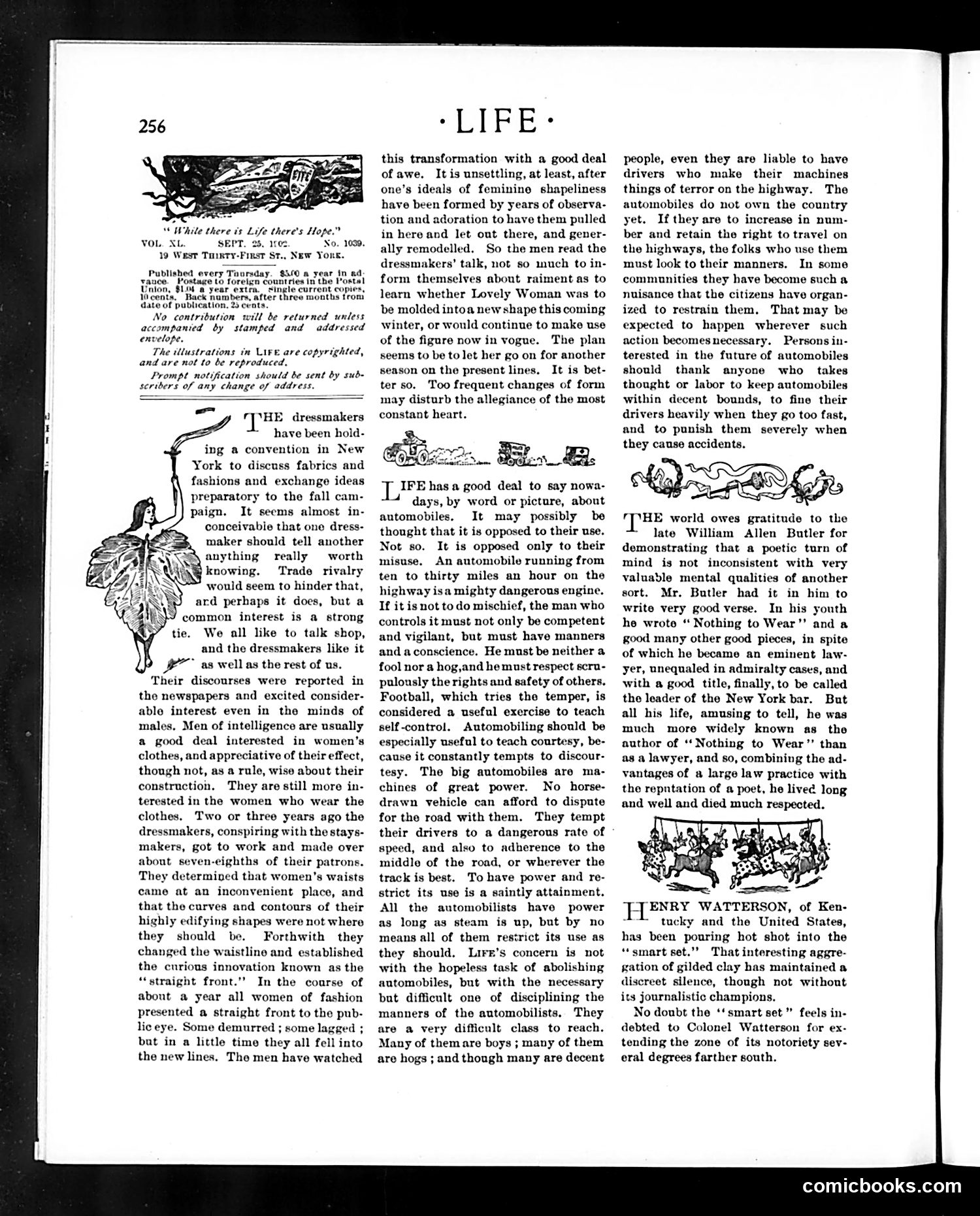
This page discusses automobiles and their social impact, with particular focus on driving etiquette and safety concerns. The main cartoon features a classical female figure (likely representing Fashion or Society) gesturing toward early automobiles and carriages. The text criticizes automobile drivers for dangerous behavior—speeding, reckless driving, and disregarding pedestrian safety. It advocates for driver education and self-discipline. There's also praise for William Allen Butler's literary work on automobile conduct. The final section briefly mentions Henry Watterson of Kentucky and the United States, crediting him with establishing a "smart set" that extended the zone of Southern society's notoriety. The satire targets the new automobile culture's safety hazards and drivers' lack of courtesy during this early motorcar era.
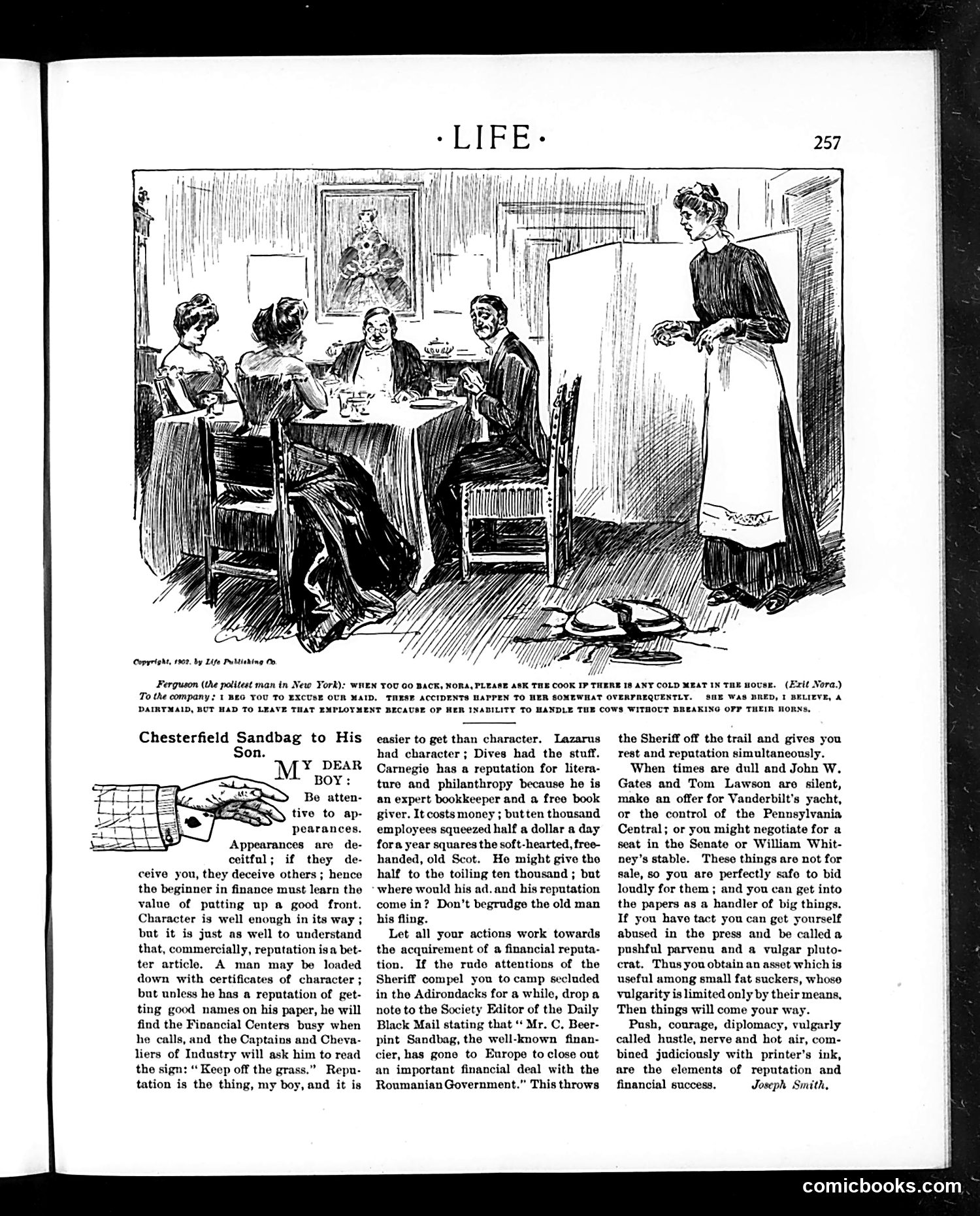
The top cartoon depicts a domestic servant presenting a complaint to her employers at tea. The caption references Ferguson, described as "the politest man in New York," who advises that when domestic help reports problems (like finding cold meat in the house), employers should dismiss complaints rather than investigate. The satire mocks wealthy New Yorkers' dismissive attitudes toward their servants' legitimate concerns and grievances. It suggests the upper class uses politeness as a facade while actually disregarding workers' welfare and rights. Below is an article titled "Chesterfield Sandbag to His Son" about financial reputation and character—discussing how appearances matter commercially, even when undeserved. Both pieces critique the gap between superficial respectability and actual conduct in Gilded Age society.
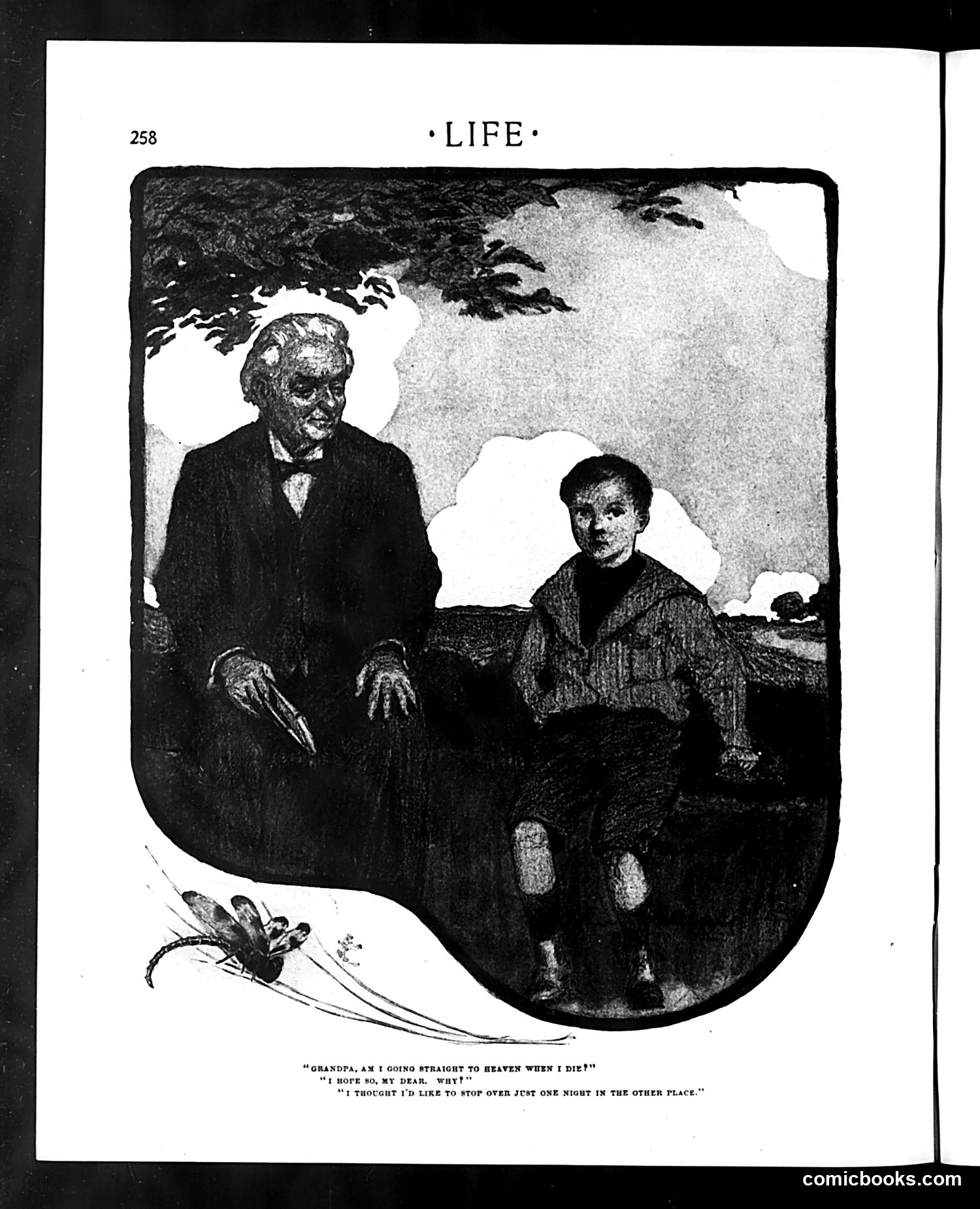
This illustration depicts an elderly gentleman and a younger boy in what appears to be a nighttime scene. The dialogue reveals the subject matter: the grandfather is discussing death and the afterlife with the child, expressing hope of going "straight to heaven" while joking about wanting to "stop over just one night in the other place." The cartoon satirizes religious attitudes toward morality and the afterlife through dark humor. The grandfather's casual, almost flippant tone about sin and damnation suggests hypocrisy—implying respectable people acknowledged their moral failings while expecting divine mercy. The small insect illustration at bottom left may represent temptation or vice. Without additional context or a visible date, the specific historical period remains unclear, though the artistic style suggests early-to-mid 20th century publication.
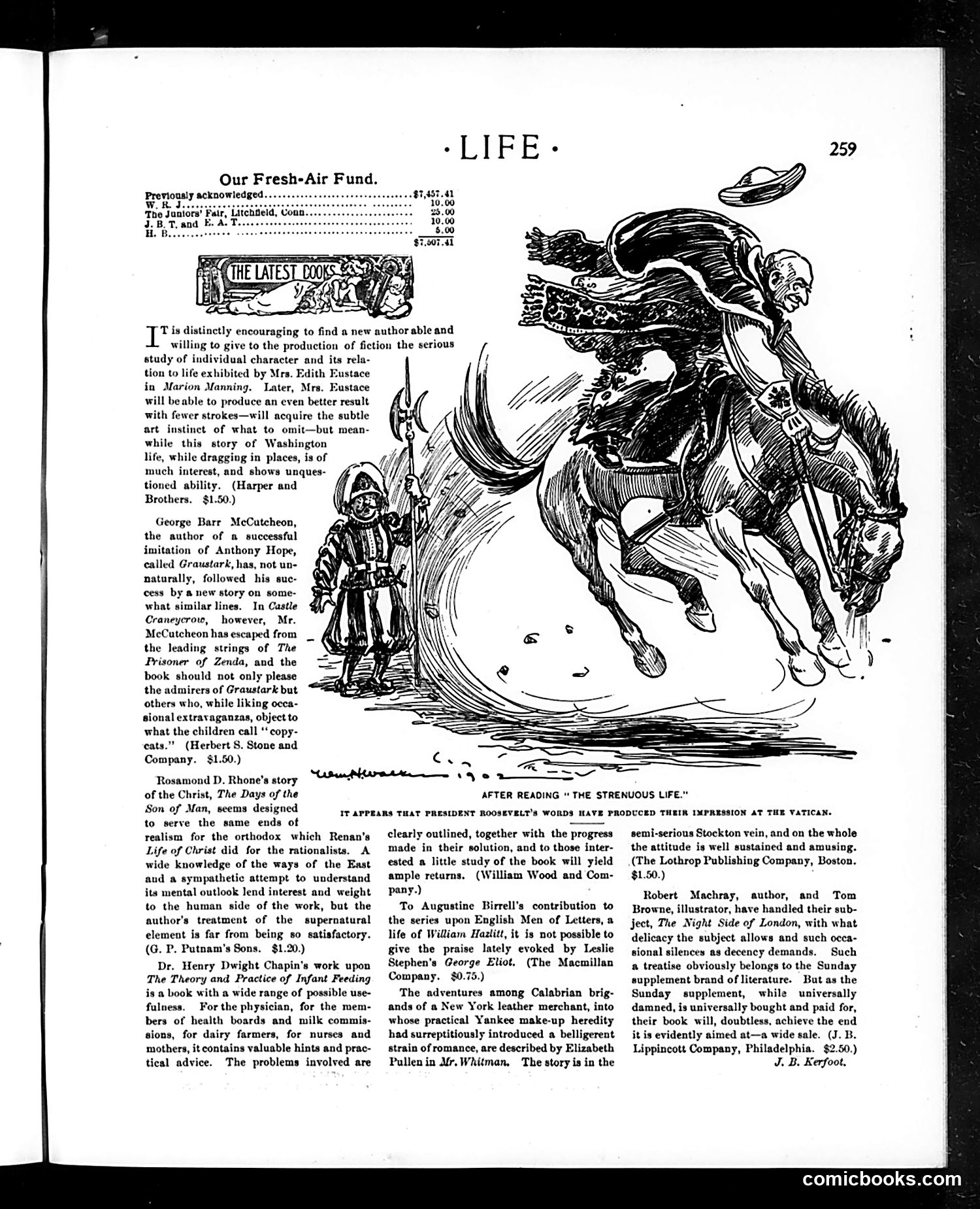
The main illustration depicts a man on horseback being thrown violently through the air, his body contorted mid-fall. The caption states: "It appears that President Roosevelt's words have produced their impression at the Vatican." This is political satire targeting **President Theodore Roosevelt** and his famous philosophy of "the strenuous life"—his promotion of vigorous physical activity and robust living. The cartoon mocks how Roosevelt's rhetoric apparently inspired even Vatican officials to attempt such strenuous pursuits, resulting in this comical mishap. The humor lies in the absurdist suggestion that Roosevelt's ideology has spread so far that even the Pope's representatives are injuring themselves attempting the "strenuous" lifestyle—satirizing both Roosevelt's evangelical promotion of his philosophy and the Vatican's presumed sedentary nature.
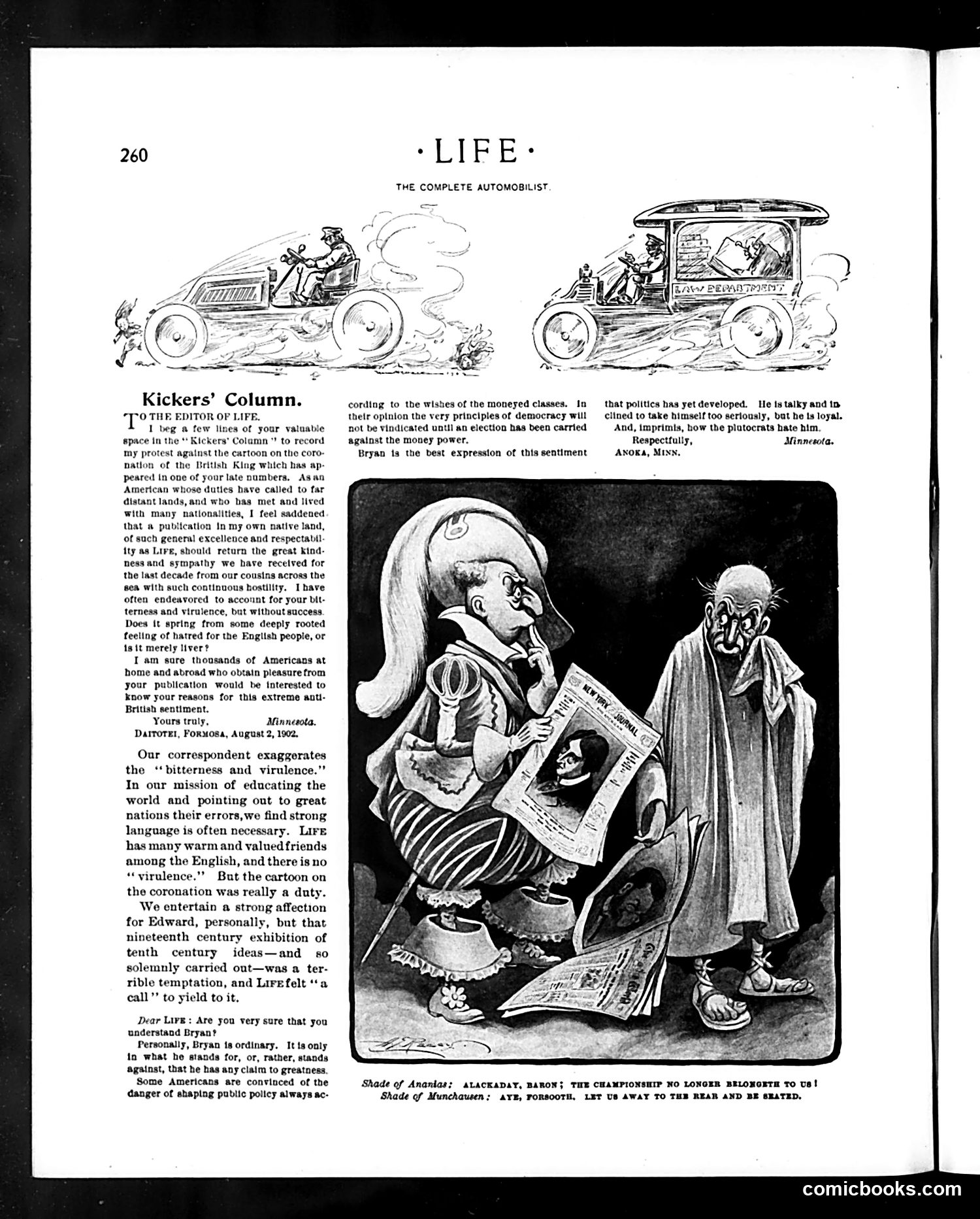
This page from *Life* magazine (dated August 2, 1902, based on the Daipotel, Porsoda letter) contains a political cartoon titled "Shade of Anandais" and "Shade of Munchausen" that appears to satirize British imperial policy in India. The cartoon depicts two ghostly figures—likely representing historical figures associated with deception and exaggeration in colonial narratives—commenting on contemporary British rule. The accompanying text critiques *Life*'s use of harsh language toward England while defending the magazine's educational mission to critique powerful nations' errors. The cartoon suggests that British colonial claims about benevolent rule in India are as fantastical as the legendary tales of Baron Munchausen, invoking historical references to critique imperial mythology and propaganda.
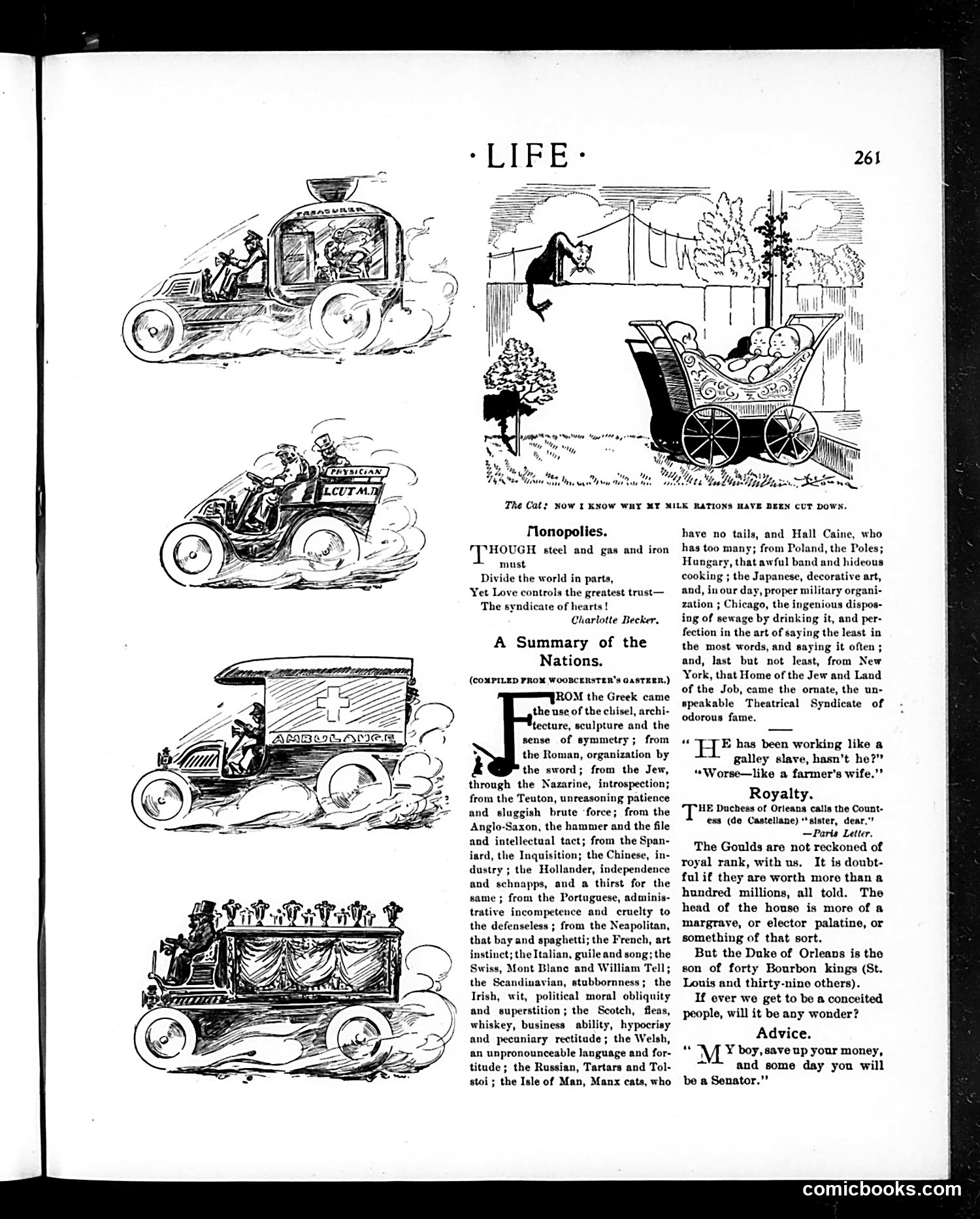
The left side features four cartoon illustrations of early automobiles—depicted as fantastical, heavily-laden contraptions bursting with passengers and cargo. These appear to satirize the novelty and chaos of early motorcar culture, showing overcrowded, unwieldy vehicles. The right side includes a cartoon captioned "The Cost: now I know why my silk rations have been cut down," showing a woman pushing a baby carriage while a monkey hangs laundry—likely commentary on wartime rationing and economic priorities. Below are brief satirical pieces titled "Monopolies," "A Summary of the Nations," and "The Royalty," offering sharp social and political critiques. The "Advice" section at bottom contains tongue-in-cheek suggestions about saving money and political ambition.
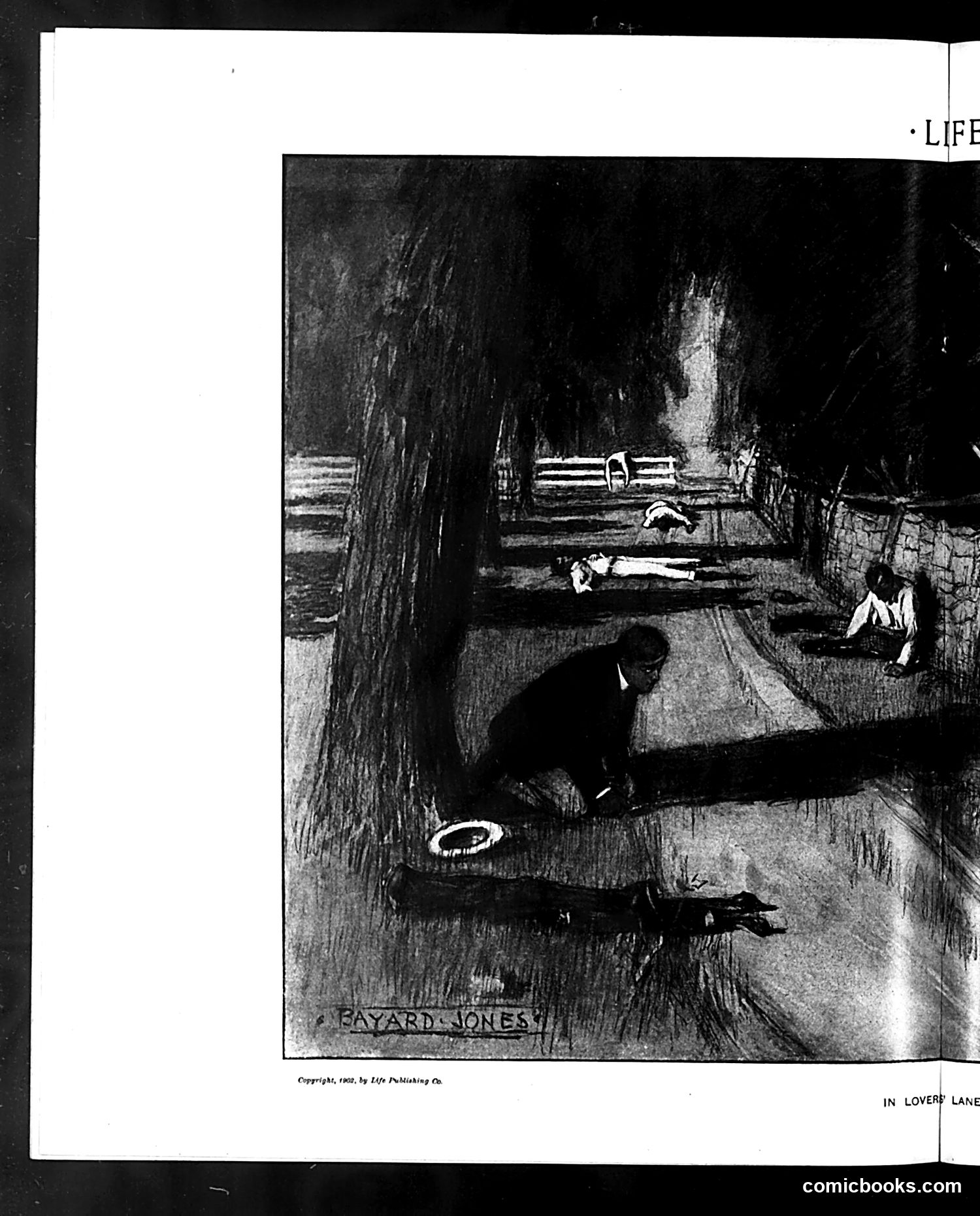
This appears to be a satirical illustration depicting a narrow urban alleyway or passageway. The scene shows several figures in what seems to be a working-class or impoverished neighborhood setting, with brick walls creating a confined space. The title "In Lovers' Lane" is ironic—the cramped, dreary alley contrasts sharply with the romantic connotations of "lovers' lane." The cartoon likely satirizes urban poverty and squalid living conditions in American cities, particularly tenement districts. The figures appear to be residents going about daily life in these confined spaces, which the artist presents as both inadequate and darkly humorous. The satire critiques the gap between idealized American life and harsh urban realities.
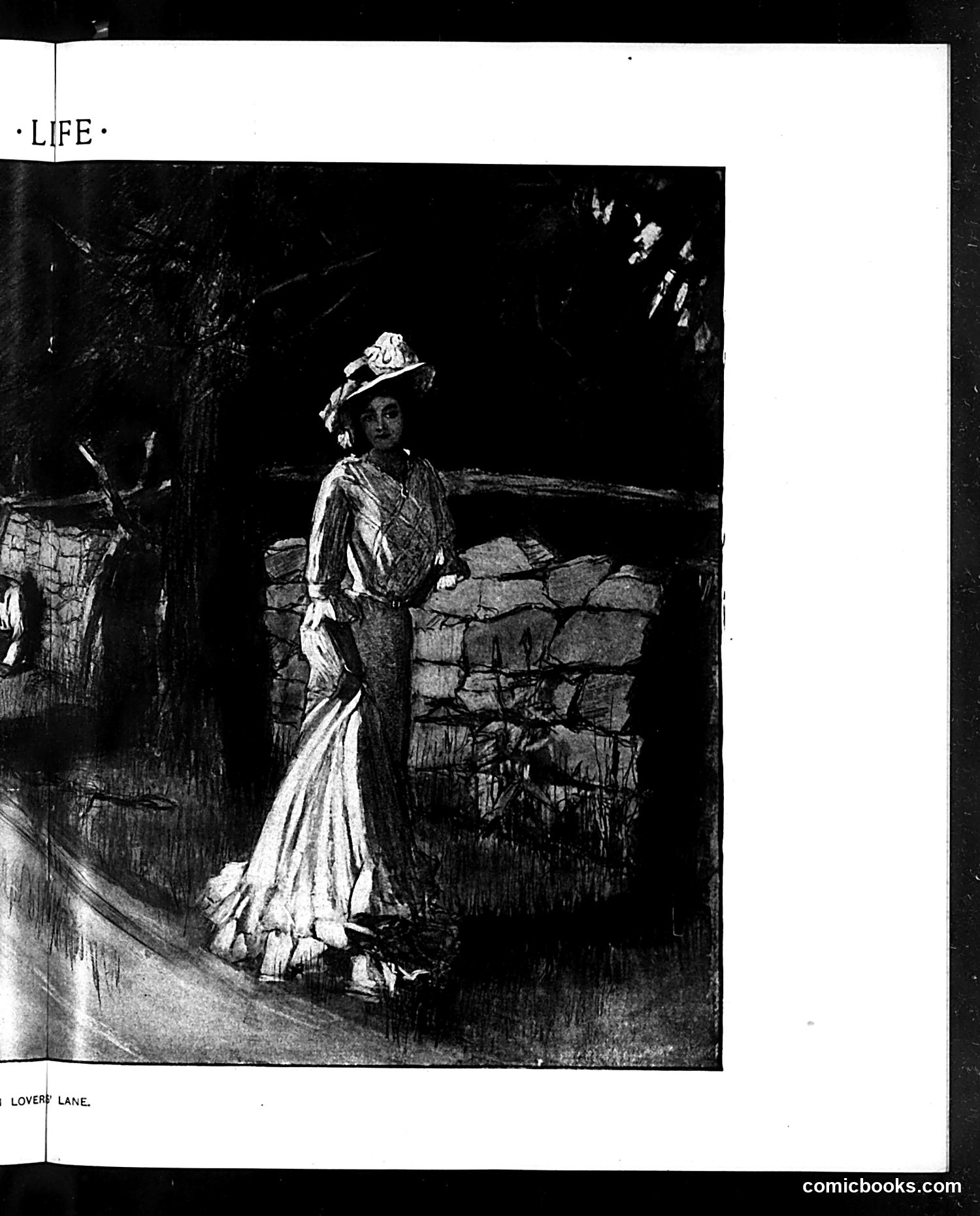
This page from *Life* magazine shows an illustration titled "Lovers Lane" (visible at bottom left). The image depicts a elegantly dressed woman in early 20th-century attire—featuring a long flowing skirt, ornate jacket, and decorative hat—standing alone in what appears to be a secluded, dimly-lit setting with a stone wall behind her. The satire likely comments on contemporary courtship customs and the romanticized notion of "Lovers Lane" as a meeting place. The woman's solitary, somewhat melancholic pose—waiting or waiting in vain—may mock the gap between sentimental expectations of romance and mundane reality. The dramatic chiaroscuro (light/dark contrast) adds ironic theatricality to what might be an anticlimactic or disappointing romantic scenario. Without additional text, the precise satirical target remains unclear.
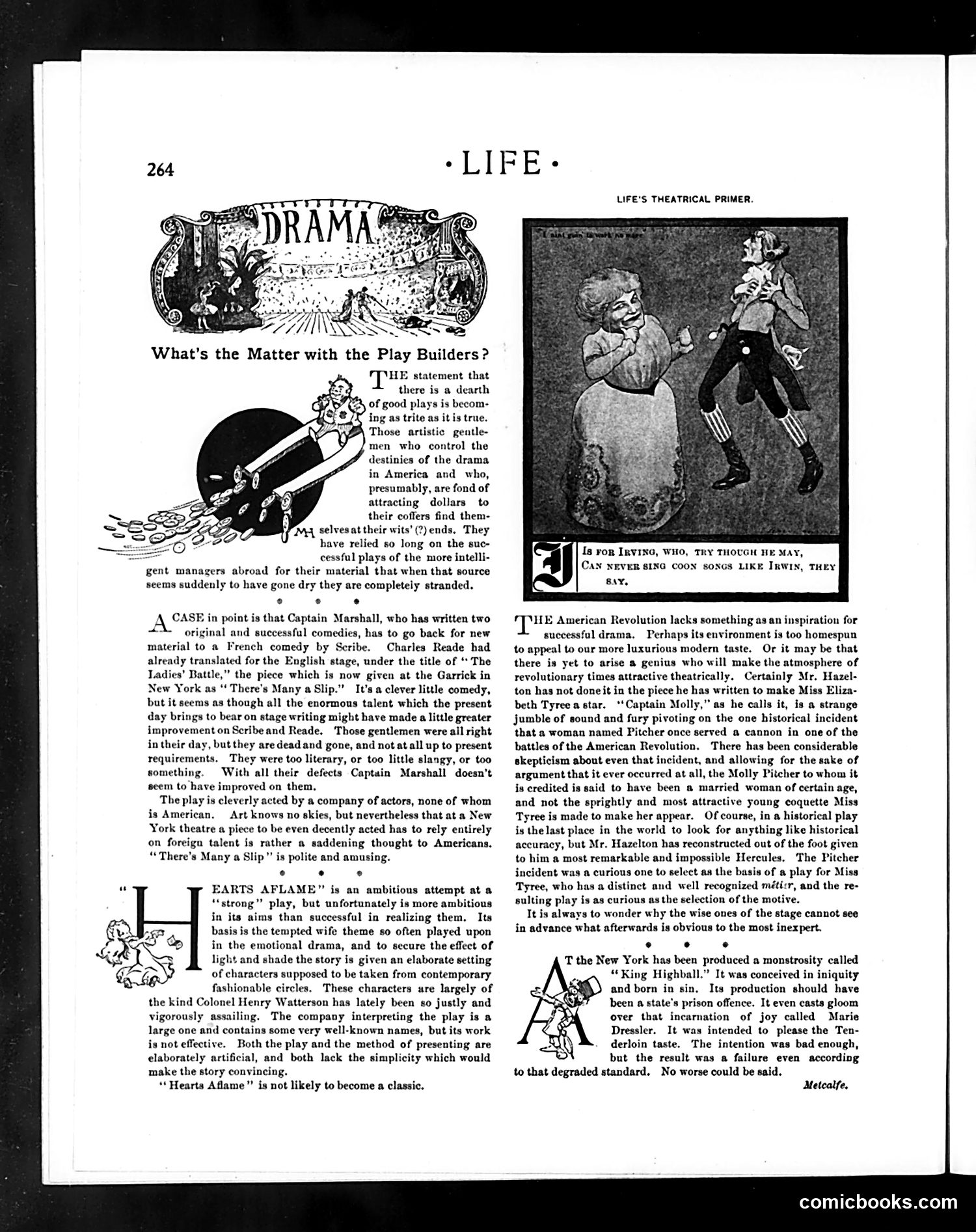
This page critiques American theatrical producers and playwrights for their lack of originality and artistic merit. The main article "What's the Matter with the Play Builders?" argues that successful dramatists are abandoning original material to chase foreign comedies and financially-driven adaptations. Specific targets include: - **Captain Marshall's adaptation** of a French comedy ("The Ladies' Battle"), criticized as derivative - **"Hearts Aflame"** — called an ambitious but unsuccessful "strong" play with overly elaborate staging that obscures weak storytelling - **Marie Dressler's vehicle "King Highball"** — dismissed as artistically degraded entertainment The satirical cartoon (captioned "Is for Irving") mocks theatrical stars, suggesting even famous performers cannot elevate mediocre material. The overall message: American drama lacks originality, relying instead on foreign sources and star power to attract audiences.
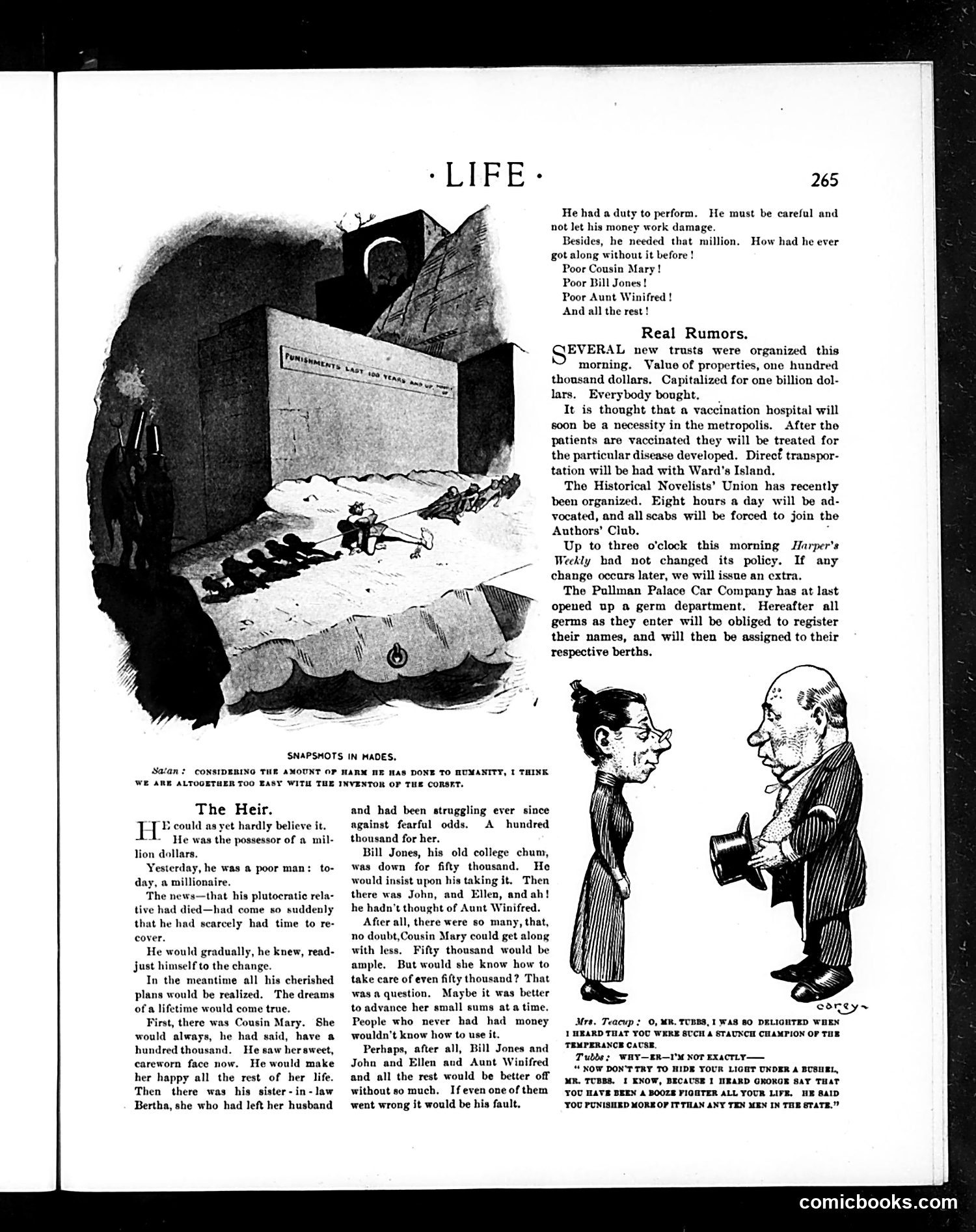
**The Main Cartoon ("Snapshots in Hades"):** A wealthy man confronts the inventor of the corset in the afterlife, sarcastically suggesting he's been "too easy" given the device's harm to humanity. This mocks both the corset's painful restrictions on women and the era's tendency to lionize inventors regardless of social cost. **"The Heir" Story:** A newly-rich man inherits a million dollars and immediately fantasizes about generous gifts to poor relatives (Cousin Mary, Bill Jones, Aunt Winifred). But as he calculates the amounts, he talks himself out of it—worrying recipients won't manage money wisely, that he needs the funds himself. The satire targets plutocratic hypocrisy: the wealthy's self-serving rationalization for withholding charity. **"Real Rumors" Section:** Mock news items satirizing contemporary excess—trusts capitalized at inflated values, Pullman trains registering "germs"—skewering corporate malfeasance and monopolistic practices of the Gilded Age. **Bottom Cartoon:** A woman praises "Mr. Tubbs" as a temperance advocate; he protests until she reveals he's actually been a lifelong heavy drinker—mocking public figures' false moral posturing.
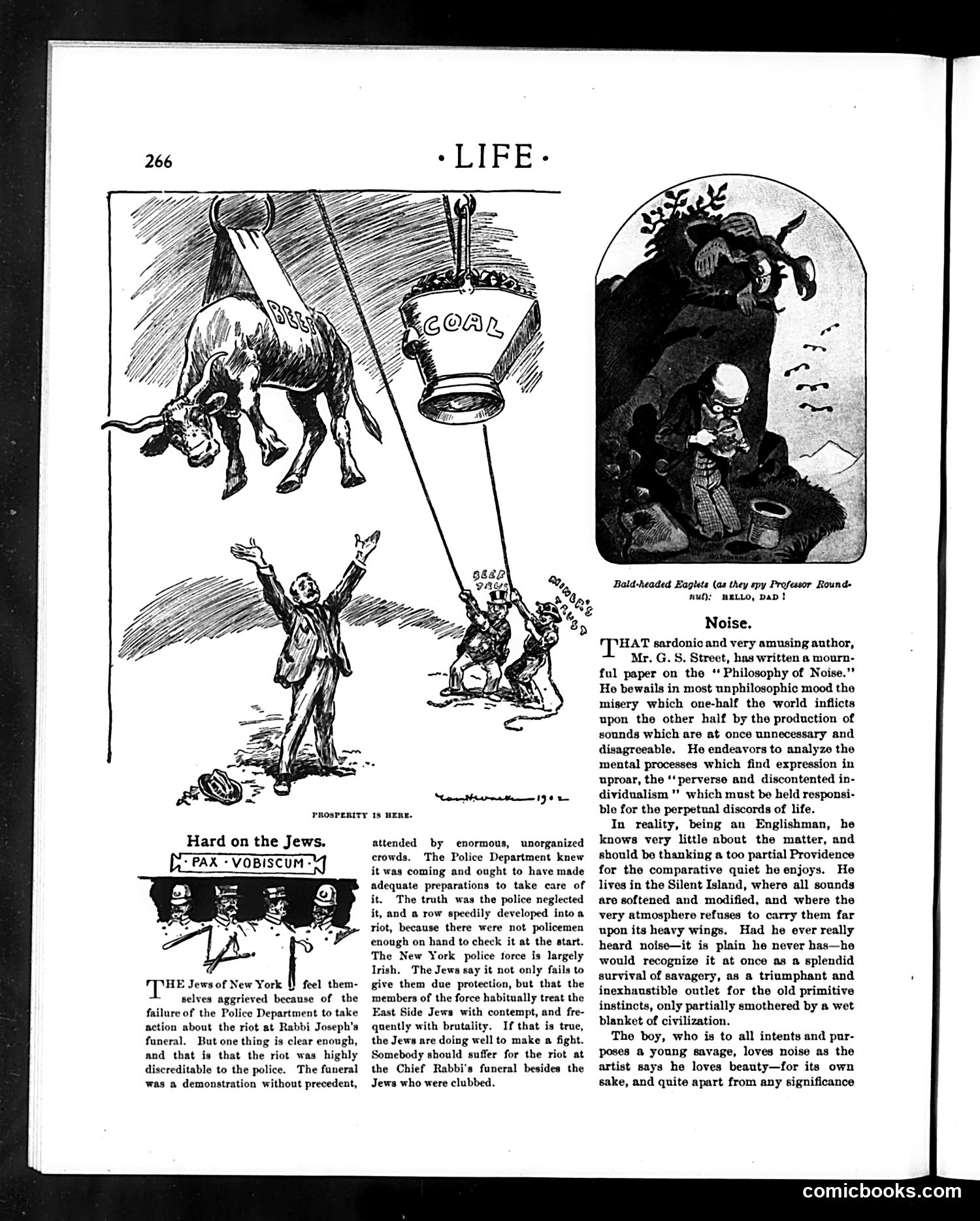
This page from *Life* magazine addresses two distinct social issues of the era: **"Hard on the Jews"** criticizes the New York Police Department's failure to adequately police a riot at Rabbi Joseph's funeral. The cartoon argues the NYPD—largely staffed by Irish officers—was negligent and that Jewish immigrants on the East Side faced habitual police contempt and brutality. The satire advocates for Jewish self-defense and accountability. **"Noise"** is a lighter piece mocking British author G. S. Street's philosophical complaints about noise pollution. The cartoon dismisses his grievances as the complaints of an Englishman sheltered by a "Silent Island," while American boys—portrayed as "young savages"—naturally and validly love noise as a primal, artistic expression. Both pieces reflect early 20th-century American attitudes toward immigrant communities, social discord, and working-class life, with the Jewish piece addressing real discrimination while the "Noise" piece uses ethnic stereotyping for humor.
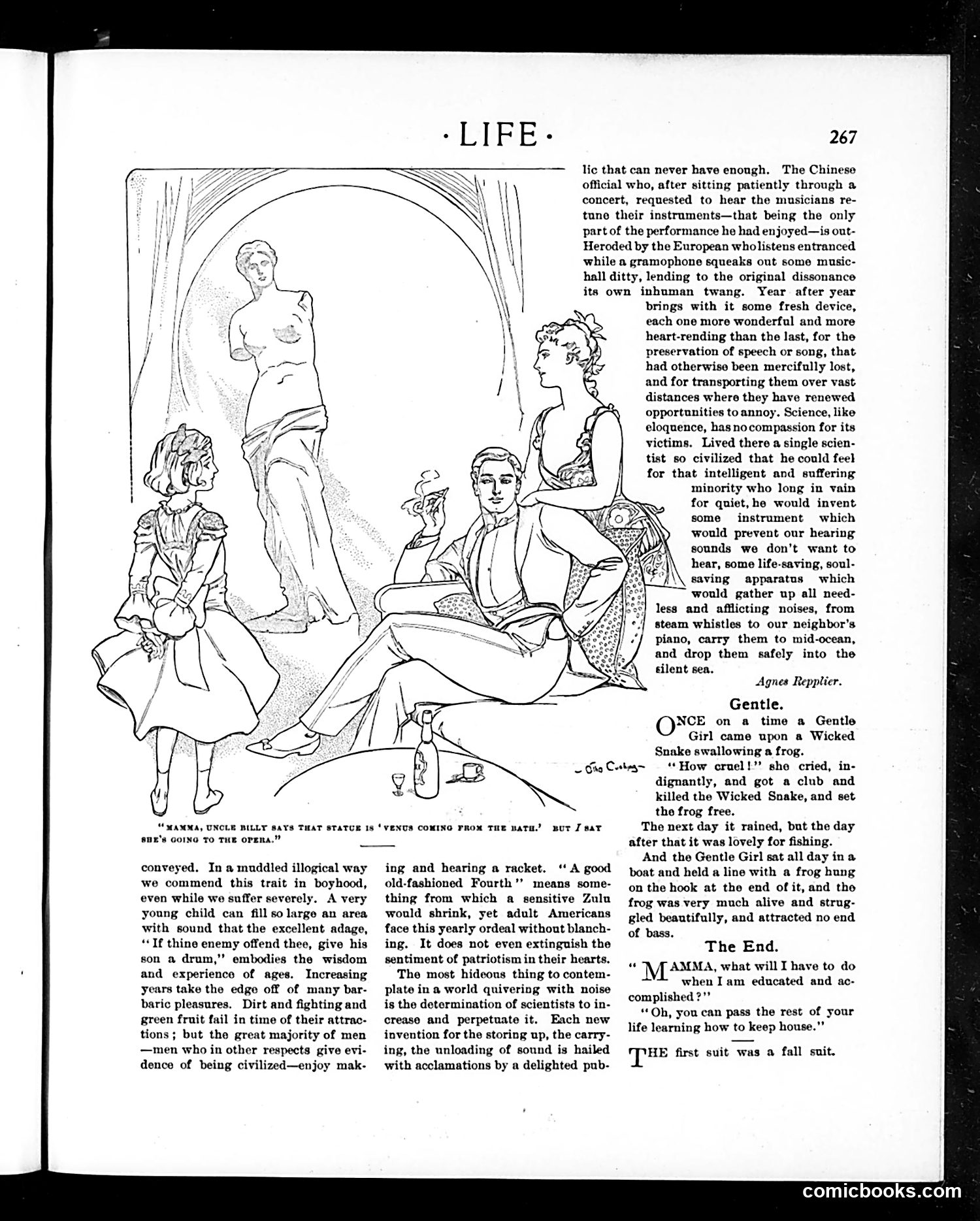
The cartoon shows a child pointing at a classical statue of Venus while telling her mother Uncle Billy claims it's "coming from the bath." The joke mocks innocent childhood misinterpretations of art and adult prudishness—the child's literal reading of the statue's title embarrasses the mother, who must explain the classical reference. The accompanying text by Agnes Repplier critiques modern noise pollution, particularly lamenting new sound-recording technology (gramophones) that preserves and broadcasts unwanted noise. She contrasts this with a hypothetical device that would collect annoying sounds (steam whistles, neighbor's pianos) and dump them in the ocean. A separate brief story, "Gentle," uses irony: a girl kills a snake to save a frog from cruelty, then uses that same frog as fishing bait, illustrating human hypocrisy about animal suffering. The final joke suggests an educated woman's future consists merely of housekeeping—satirizing limited expectations for women's roles.
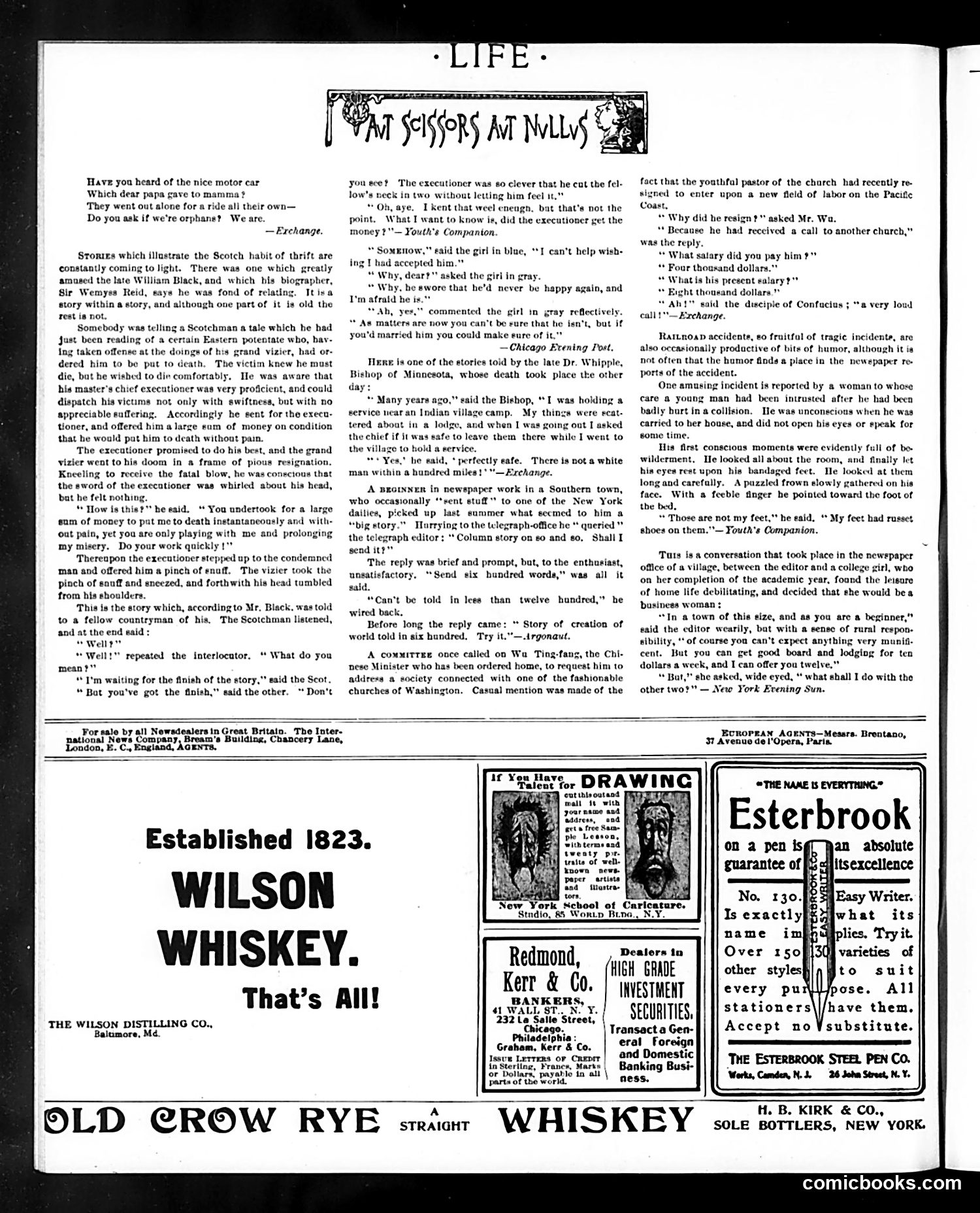
This page contains mostly **humorous anecdotes** rather than political cartoons, reflecting Life magazine's satirical approach to American social life circa the 1920s. The jokes target: 1. **Parental neglect/materialism**: The opening verse mocks wealthy parents who give their children expensive gifts (motor cars) but ignore them, leaving kids "orphans" while alive. 2. **Scottish stinginess**: A recurring ethnic stereotype—multiple stories celebrate Scottish obsession with saving money over all else, even at death's door. 3. **Gender relations/marriage**: A brief joke about a woman regretting rejecting a suitor, with another woman sardonically noting marriage would confirm his unhappiness. 4. **Journalistic incompetence**: A newspaper editor dismisses a reporter's "big story" as unsummarizable, mocking both sensationalism and editorial judgment. The page is largely **advertisements** (Wilson Whiskey, Esterbrook pens, banking services) surrounding these anecdotes. The humor reflects period attitudes about class, ethnicity, and gender typical of 1920s American satire.
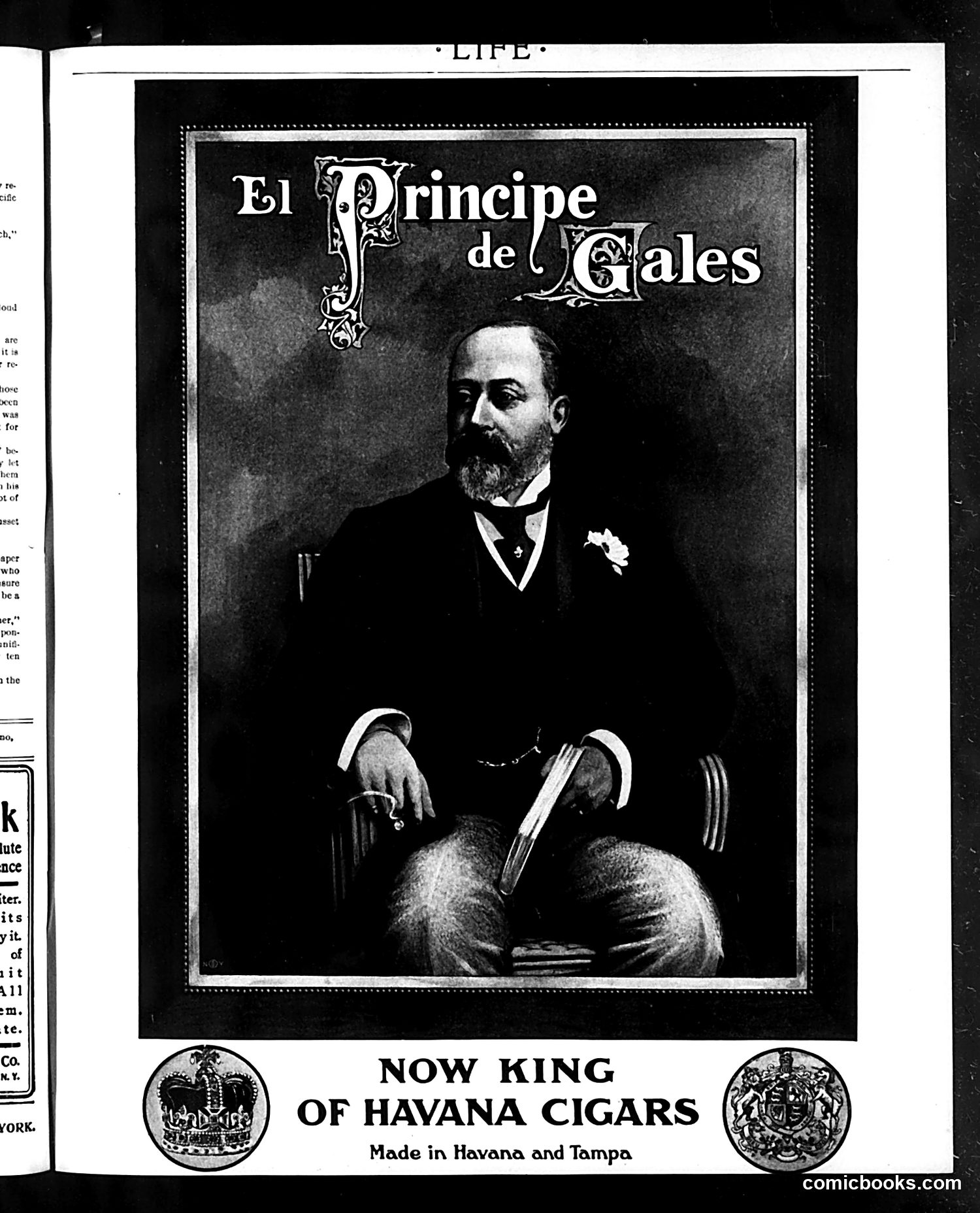
This is a **cigar advertisement**, not political satire. It features a formal portrait of a distinguished bearded gentleman in evening dress, positioned as "El Príncipe de Gales" (The Prince of Wales). The ad's humor relies on a **pun or branding strategy**: by naming the product after royalty, it elevates the cigar's prestige. The phrase "NOW KING OF HAVANA CIGARS" suggests this brand has achieved top status in the market. The ornate decorative lettering and formal presentation style were typical of early-20th-century luxury product advertising. The dual royal seals at the bottom reinforce the claim to elite quality. Rather than political commentary, this represents period **marketing strategy**—using association with nobility and refinement to sell premium cigars manufactured in Havana and Tampa (both major cigar-production centers).
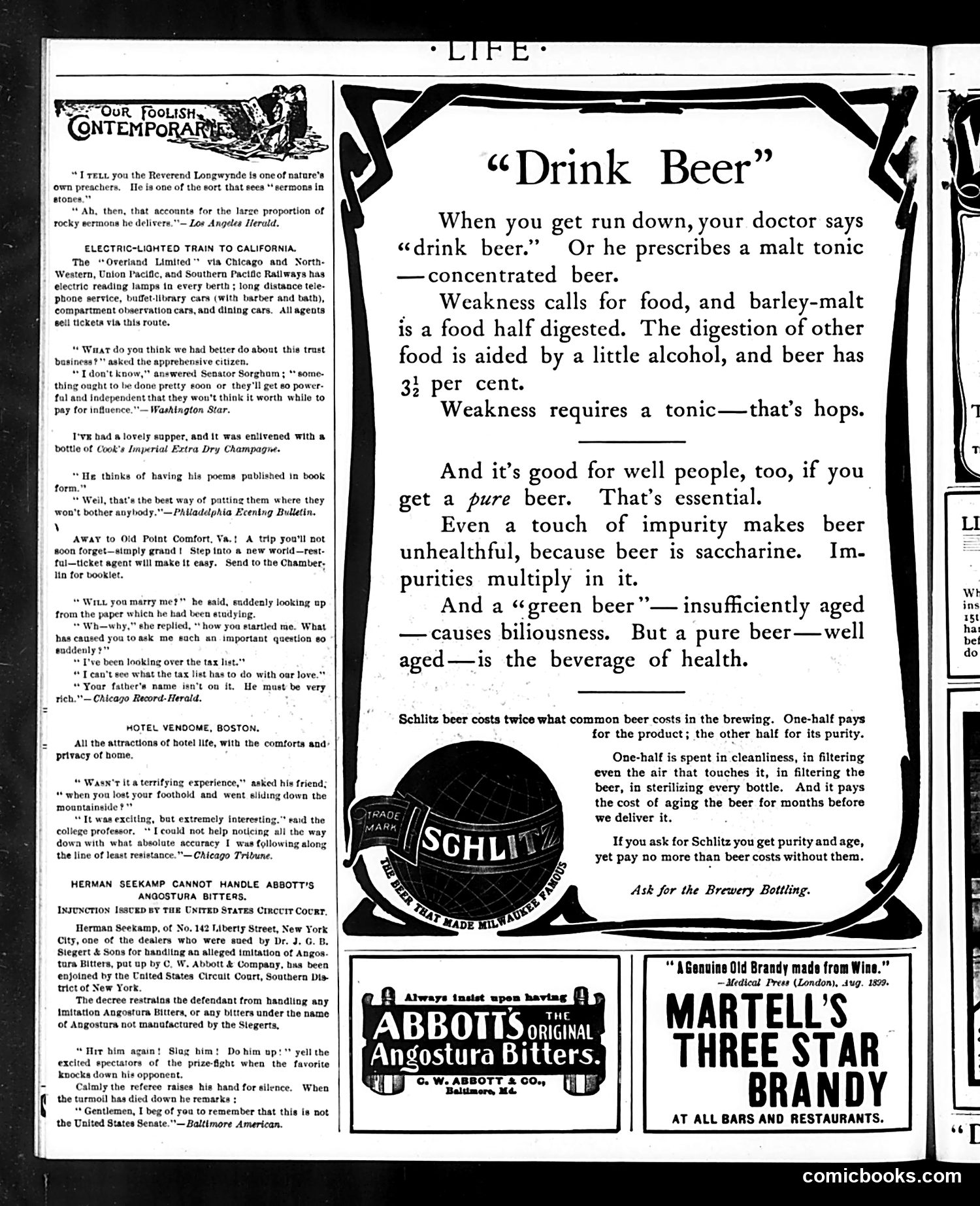
This is primarily a **advertising page** for beer and liquor brands, disguised within Life magazine's satirical content. The main feature is a large Schlitz beer advertisement claiming beer has medicinal value—doctors allegedly prescribed it for weakness and poor digestion. The ad emphasizes "purity" and claims impurities (and "green beer") cause illness, while pure, aged beer promotes health. Below are smaller ads for Abbott's Angostura Bitters and Martel's Three Star Brandy, similarly marketed as medicinal tonics. The scattered jokes in the left margin are unrelated satirical pieces mocking various targets: a preacher's poor sermons, politicians' corruption, a suitor checking a father's tax records before proposing. **Context:** This reflects the pre-Prohibition era (page predates 1920) when alcohol was openly marketed with **false health claims**—a practice modern readers would recognize as fraudulent advertising now banned by law. Doctors genuinely did recommend such products, making this appear legitimate to contemporary audiences.
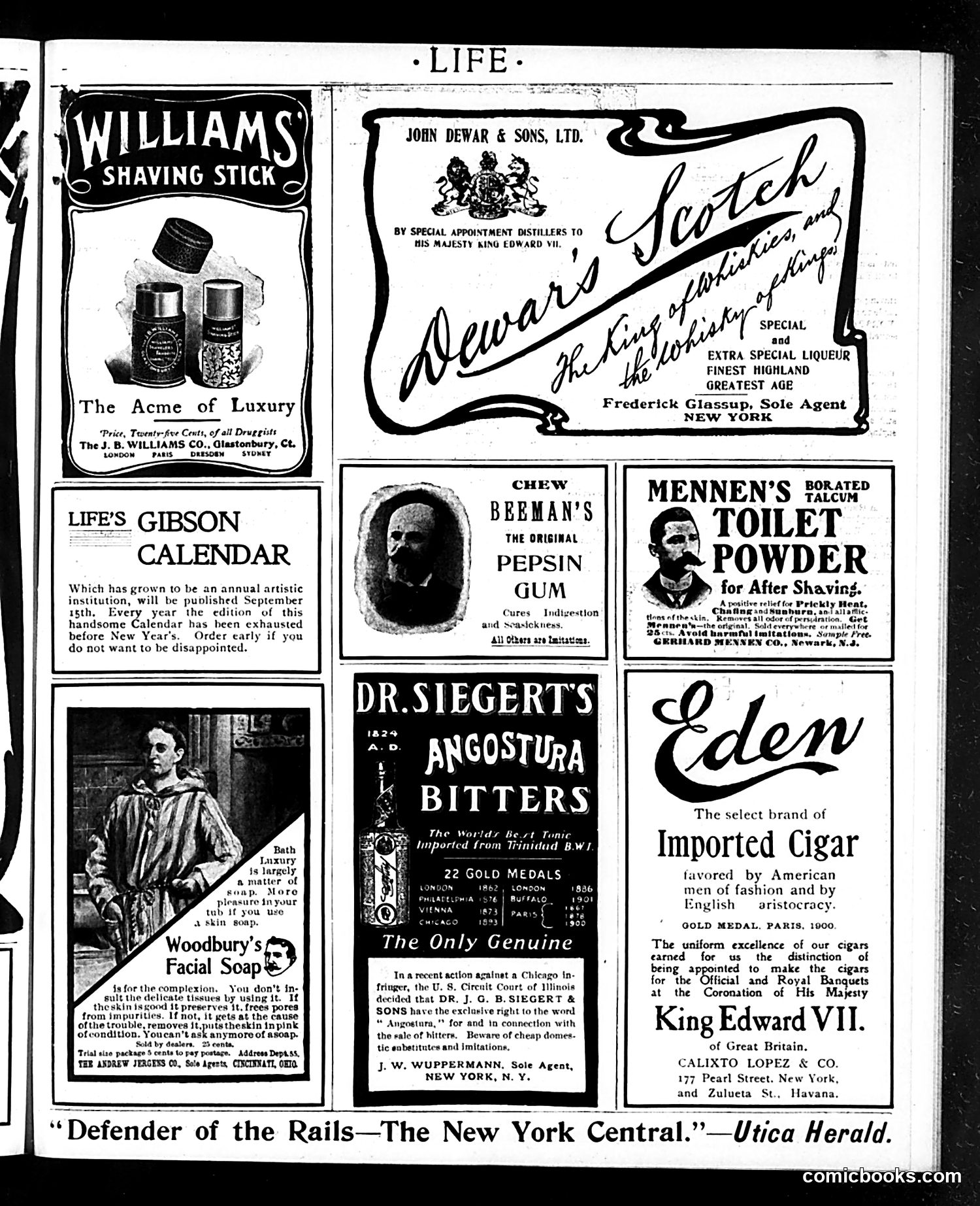
This page is primarily **advertising**, not editorial content or cartoons. The ads showcase luxury goods marketed to affluent men of the Edwardian era (early 1900s), with frequent references to **King Edward VII's royal patronage** as a status symbol—note the repeated emphasis on official appointments ("by special appointment distillers to His Majesty King Edward VII," cigars made for his coronation banquets). Products advertised include shaving supplies, whisky, bitters, gum, toilet powder, and cigars—typical grooming and leisure items for gentlemen. The copy emphasizes exclusivity and imported quality (Trinidad bitters, Scottish whisky, Havana cigars). The only editorial content visible is a small announcement about **Life's annual Gibson Calendar**, a prestigious artistic publication that apparently sold out each year. The page's final line quotes the *Utica Herald* calling *Life* the "Defender of the Rails—The New York Central," likely referencing contemporary railroad controversies, though context is unclear from this image alone.
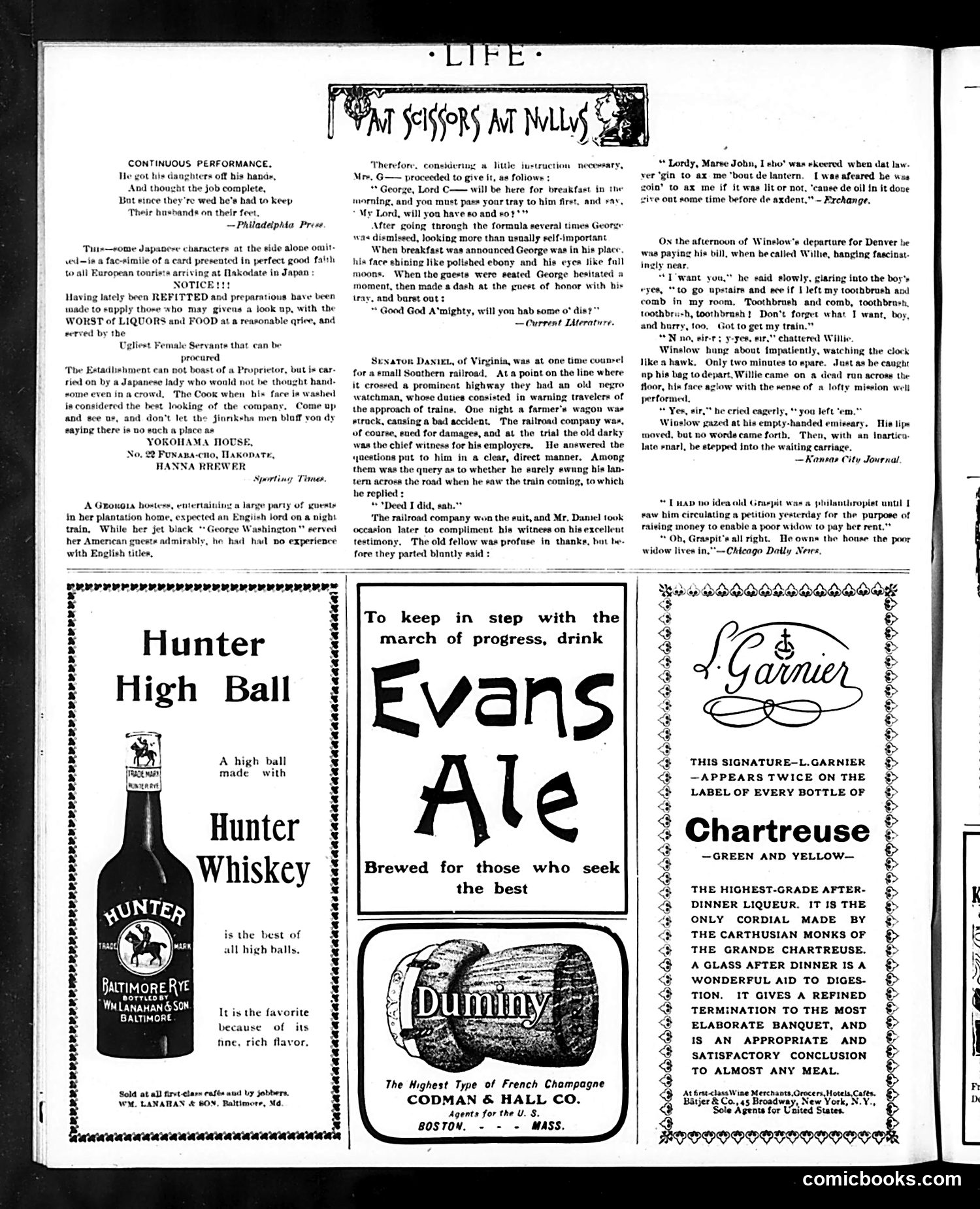
This page contains **primarily short humorous anecdotes** rather than political cartoons. The jokes satirize social awkwardness and cultural misunderstandings: 1. **"Continuous Performance"**: A domestic joke about wives managing husbands' behavior after marriage. 2. **Japanese Establishment Ad**: A tongue-in-cheek advertisement for a deliberately shabby Yokohama inn, ironically marketing its poor conditions ("Ugliest Female Servants"). 3. **"George" Anecdote**: Humor at the expense of a Black servant ("jet black George Washington") who, unfamiliar with English titles, addresses an arriving lord with crude informality ("Good God A'mighty, will yon hab some o' dis?") — reflecting period racial stereotypes in comic form. 4. **Senator Daniel Story**: A railroad anecdote where a Black witness admits his safety lantern had burned out before the accident—undermining his testimony's credibility. The page also contains liquor and liqueur advertisements. The humor relies on class distinctions, racial caricature, and period vernacular that modern readers would recognize as offensive stereotyping.
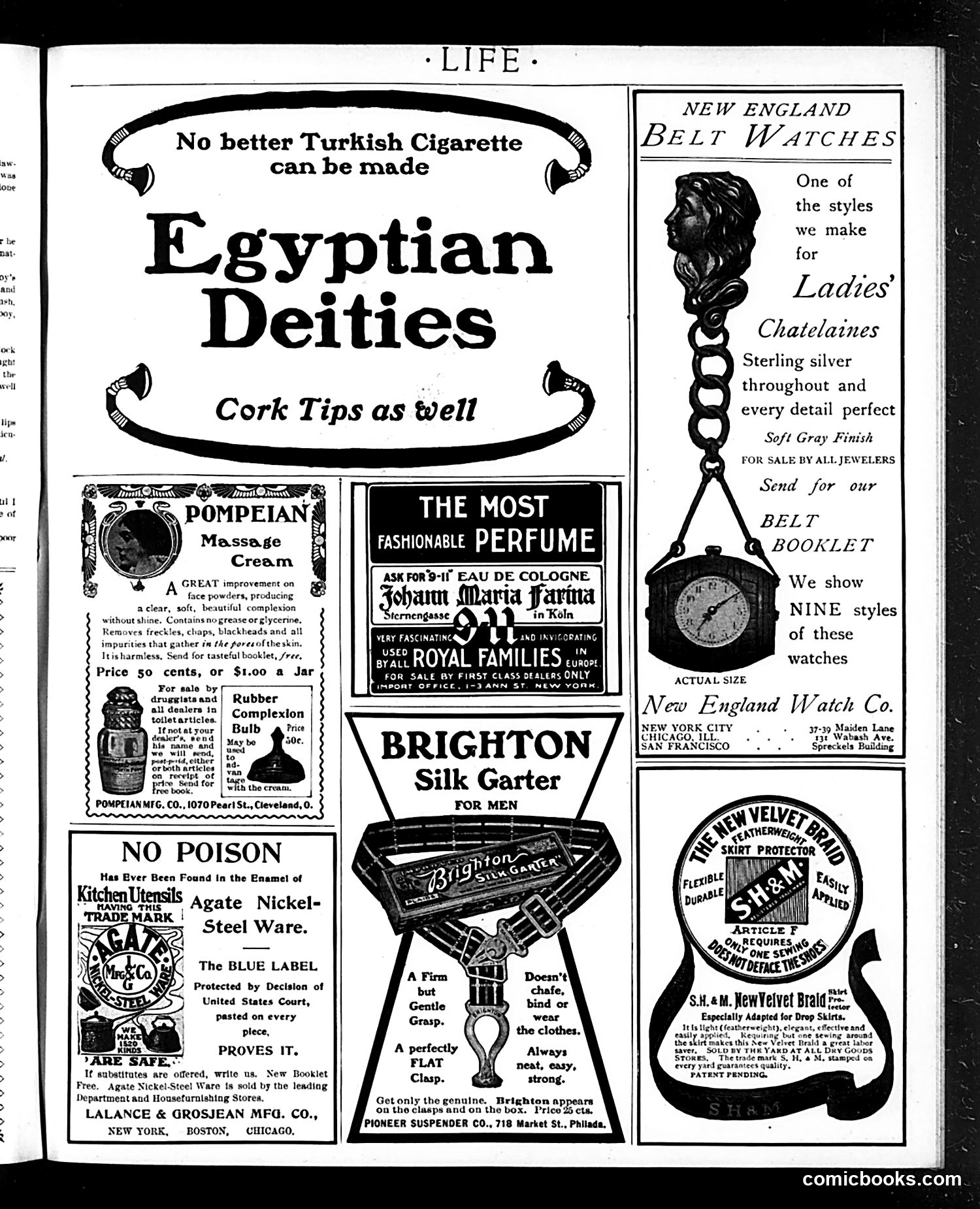
This is primarily a **advertisements page** from Life magazine, not a political cartoon. It contains product ads typical of the early 20th century. The notable element is **"Egyptian Deities" cigarettes**—the brand name plays on early 1900s fascination with Egyptology (following Tutankhamun's tomb discovery in 1922). The "No better Turkish Cigarette can be made" slogan reflects the era's association of Turkish tobacco with luxury and quality. Other ads reflect period concerns: Pompeian massage cream promises to remove "freckles" and "blackheads" (beauty standards of the time); "No Poison" messaging for kitchenware addresses contemporary anxieties about enamel safety; women's belt watches, garters, and skirt protectors reflect restrictive Victorian/Edwardian fashion. **No satire or political commentary is present**—this is straightforward commercial advertising. The historical value lies in what these products reveal about early 20th-century consumer culture, gender roles, and aesthetic preferences.
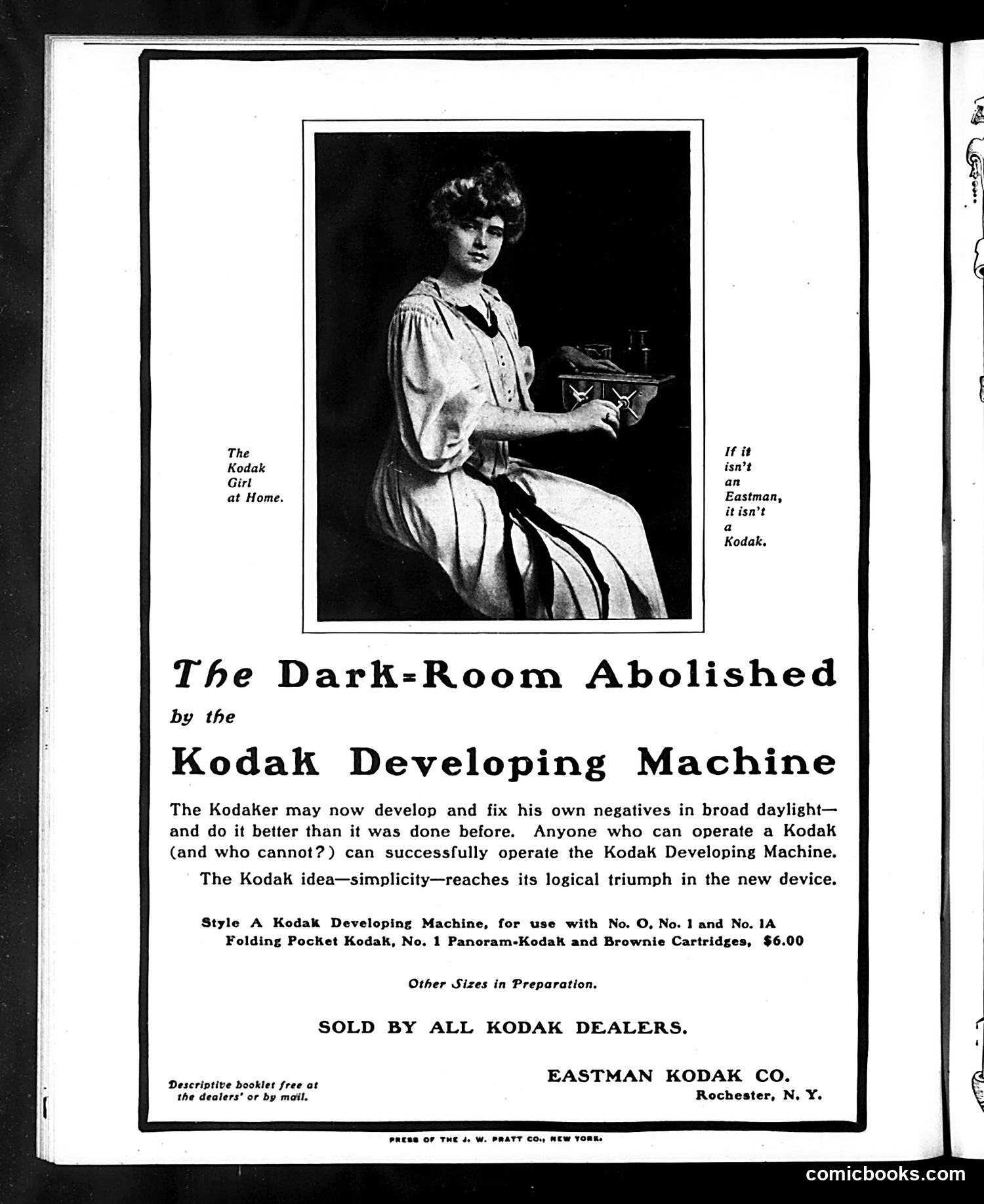
This is a **product advertisement**, not satire or political commentary. The page promotes Eastman Kodak's new "Developing Machine" (priced at $6.00). **The "joke" or appeal**: The headline "The Dark-Room Abolished" celebrates that amateur photographers no longer need a darkroom to develop photographs. Previously, film development required a light-sealed room—a technical barrier for home users. This machine allows daylight development, democratizing photography. **The imagery**: A young woman ("The Kodak Girl at Home") holds the developing machine, representing the target market: middle-class home users, likely women, who could now develop their own photos without specialized equipment or knowledge. **The marketing claim**: The tagline "If it isn't an Eastman, it isn't a Kodak" emphasizes brand dominance. The text stresses simplicity—anyone who can operate a camera can use this device—lowering barriers to entry. This reflects early-20th-century **consumer culture**: technological innovation marketed to amateur enthusiasts as liberation from technical complexity.