
Life, 1902-09-25 · page 7 of 22
Life — September 25, 1902 — page 7: what you’re looking at
What you’re looking at
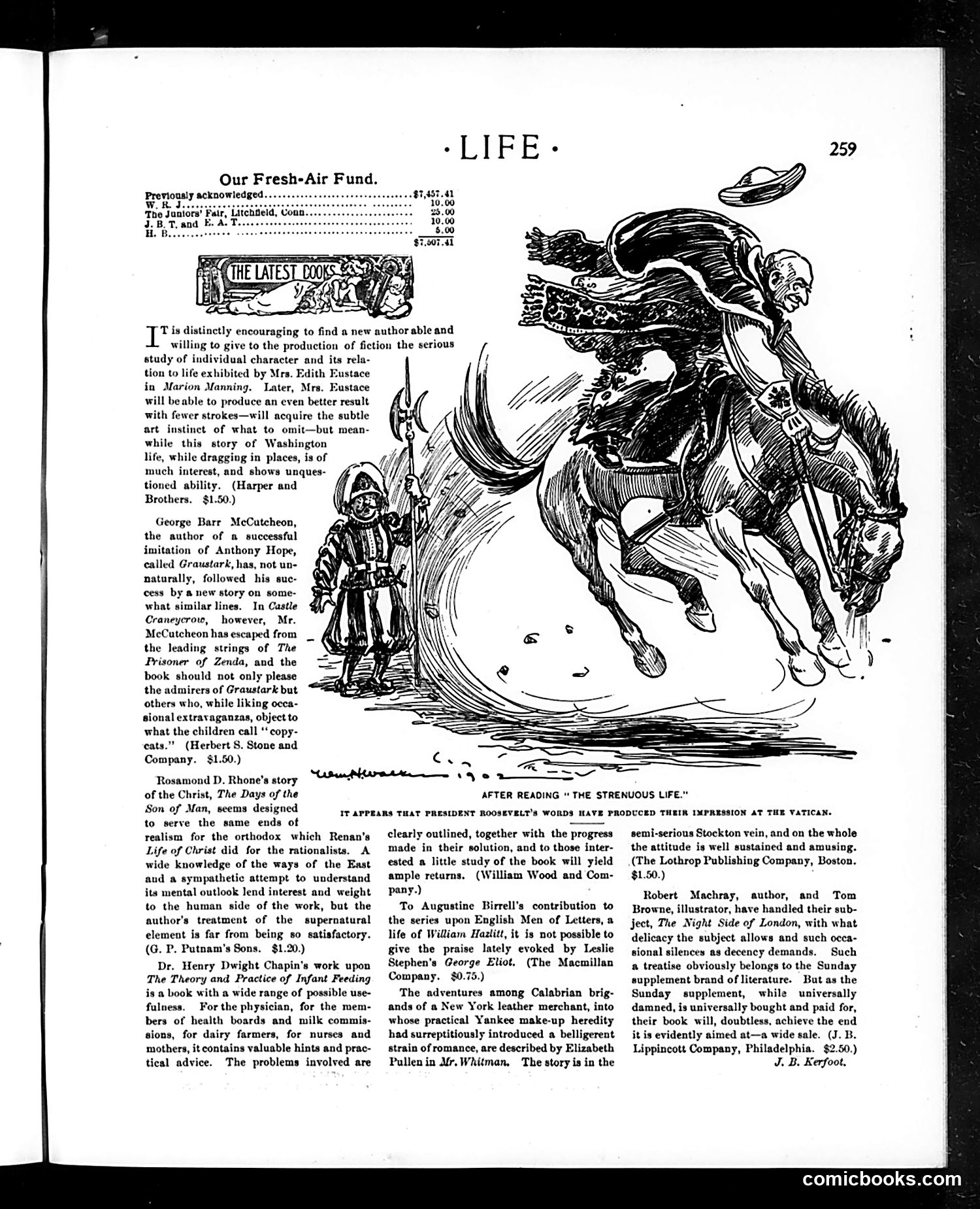
The main illustration depicts a man on horseback being thrown violently through the air, his body contorted mid-fall. The caption states: "It appears that President Roosevelt's words have produced their impression at the Vatican." This is political satire targeting **President Theodore Roosevelt** and his famous philosophy of "the strenuous life"—his promotion of vigorous physical activity and robust living. The cartoon mocks how Roosevelt's rhetoric apparently inspired even Vatican officials to attempt such strenuous pursuits, resulting in this comical mishap. The humor lies in the absurdist suggestion that Roosevelt's ideology has spread so far that even the Pope's representatives are injuring themselves attempting the "strenuous" lifestyle—satirizing both Roosevelt's evangelical promotion of his philosophy and the Vatican's presumed sedentary nature.
📄 Transcribed text from this page (OCR, searchable)
Machine-transcribed from the original scan — historical spelling and the odd misread are preserved.
Our Fresh-Air Fund. Previously acknowledged W. RJ. 4 held, T is distinctly encouraging to find a new author able and willing to give to the production of fiction the serious study of individual character and its rela- tion to life exhibited by Mrs. Edith Eustace in Marion Manning. Later, Mrs. Eustace will beable to produce an even better result with fewer strokes—will acquire the subtle art instinct of what to omit—but mean- while this story of Washington life, while dragging in places, is of much interest, and shows unques- tioned ability. (Harper and Brothers, $1.50.) George Barr McCutcheon, the author of a successful imitation of Anthony Hope, called Graustark, has, not un- naturally, followed his suc- cess by a new story on some- what similar lines. In Castle Craneycrow, however, Mr. McCutcheon has escaped from the leading strings of The Prisoner of Zenda, and the book should not only please the admirers of Graustark but others who, while liking occa- sional extravaganzas, object to what the children call “ copy- eats.” (Herbert S. Stone and Company. $1.50.) Rosamond D. Rhone’s story of the Christ, The Days of the Son of Man, seems designed to serve the same ends of realism for the orthodox which Renan’s Life of Christ did for the rationalists. A wide knowledge of the ways of the East and a sympathetic attempt to understand its mental outlook lend interest and weight to the human side of the work, but the author's treatment of the supernatural element is far from being so satisfactory. (G. P. Putnam's Sons. $1.20.) Dr. Henry Dwight Chapin'’s work upon The Theory and Practice of Infant Feeding is a book with a wide range of possible use- falness. For the physician, for the mem- bers of health boards and milk commis- sions, for dairy farmers, for nurses and mothers, it contains valuable hints and prac- tical advice. The problems involved are AFTER READING “THE STRENUOUS LIFE." clearly outlined, together with the progress made in their solution, and to those inter- ested a little study of the book will yield ample returns. (William Wood and Com- pany.) To Augustine Birrell's contribution to the series upon English Men of Letters, a life of William Hazlitt, it is not possible to give the praise lately evoked by Leslie Stephen's George Eliot, (The Macmillan Company. $0.75.) The adventures among Calabrian brig- ands of a New York leather merchant, into whose practical Yankee make-up heredity had surreptitiously introduced a belligerent strain of romance, are described by Elizabeth Pullen in Mr. Whitman, The story is in the IT APPEARS THAT PRESIDENT ROOSEVELT'S WORDS HAVE PRODUCED THEIR IMPRESSION AT THE VATICAN. semi-serious Stockton vein, and on the whole the attitude is well sustained and amusing. (The Lothrop Publishing Company, Boston. $1.50.) Robert Machray, author, and Tom Browne, illustrator, have handled their sub- ject, The Night Side of London, what delicacy the subject allows and such occa- sional silences as decency demands. Such a treatise obviously belongs to the Sunday supplement brand of literature. But as the Sunday supplement, while universally damned, is universally bought and paid for, their book will, doubtless, achieve the end it is evidently aimed at—a wide sale. (J. B. Lippincott Company, Philadelphia. $2.50.) J. B. Kerfoot, comicbooks.com