
Life, 1902-09-25 · page 5 of 22
Life — September 25, 1902 — page 5: what you’re looking at
What you’re looking at
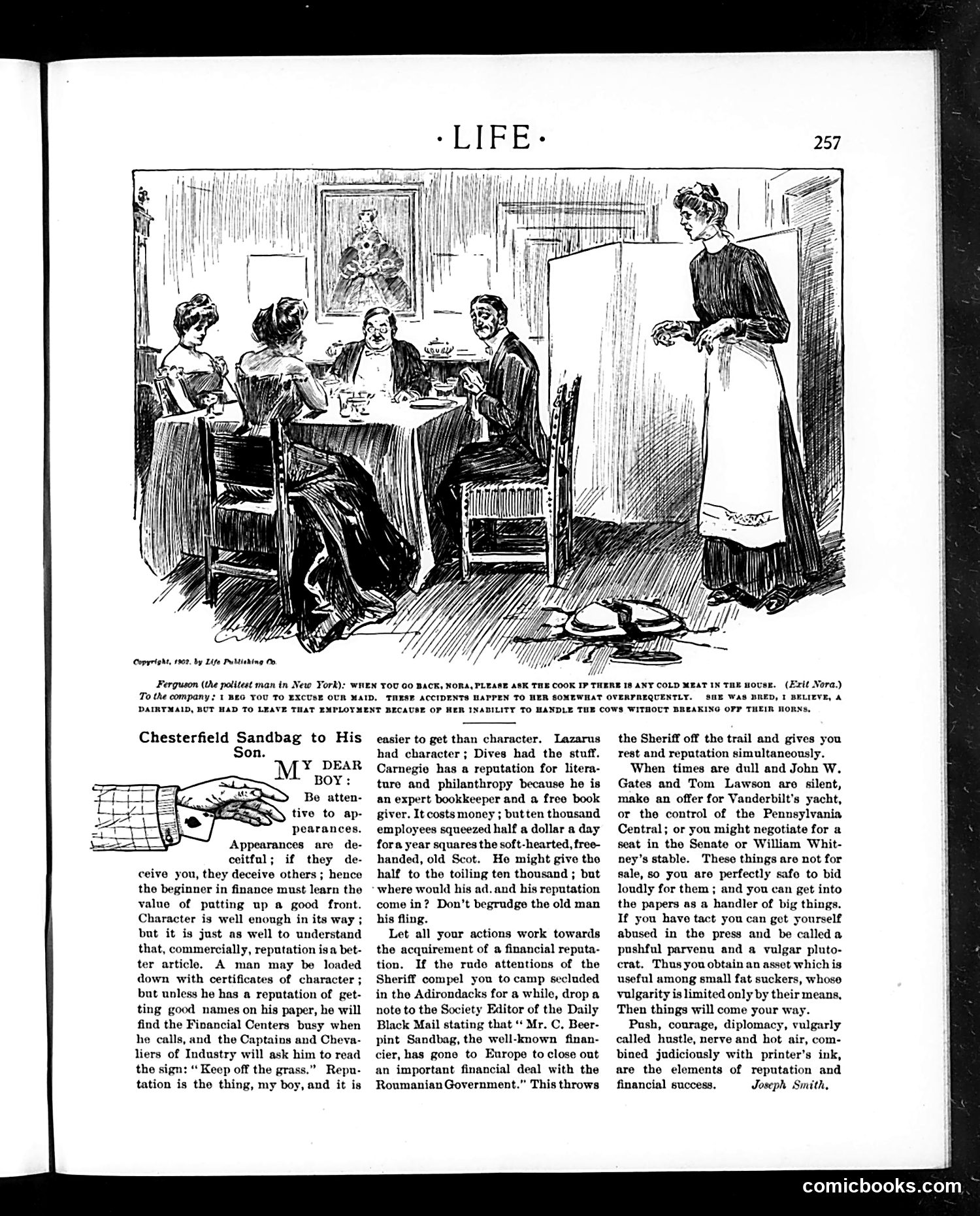
The top cartoon depicts a domestic servant presenting a complaint to her employers at tea. The caption references Ferguson, described as "the politest man in New York," who advises that when domestic help reports problems (like finding cold meat in the house), employers should dismiss complaints rather than investigate. The satire mocks wealthy New Yorkers' dismissive attitudes toward their servants' legitimate concerns and grievances. It suggests the upper class uses politeness as a facade while actually disregarding workers' welfare and rights. Below is an article titled "Chesterfield Sandbag to His Son" about financial reputation and character—discussing how appearances matter commercially, even when undeserved. Both pieces critique the gap between superficial respectability and actual conduct in Gilded Age society.
📄 Transcribed text from this page (OCR, searchable)
Machine-transcribed from the original scan — historical spelling and the odd misread are preserved.
Y Copyright, 1902. by Life Publishing Co. Ferguson (the potitest man in New York): wien TOU 00 BACK, NORA, PLEASE ASK THE COOK IP THERE 18 ANY COLD MEAT IN THE HOU! To the company; 1 BEG YOU To EXCUSE OUR MAID, THESE ACCIDENTS HAPPEN TO HER SOMEWHAT OVERFREQUENTLY. Ye Yyy ee v (Exit Nora.) SNE WAS BRED, I BELIEVE, A DAIRYMAID, BUT HAD TO LEAVE THAT EMPLOYMENT BECAUSE OP HER INABILITY TO HANDLE THE COWS WITHOUT BREAKING OFF THEIR Chesterfield Sandbag to His Son. } Y DEAR BOY: 1 eS Be atten- PS tive to ap- pearances. Appearances are de- ceitful; if they de- ceive you, they deceive others ; hence the beginner in finance must learn the value of putting up a good front. Character is well enough in its way ; but it is just as well to understand that, commercially, reputation isa bet- ter article. A man may be loaded down with certificates of character ; but unless he has a reputation of get- ting good names on his paper, he will find the Financial Centers busy when he calls, and the Captains and Cheva- liers of Industry will ask him to read the sign: “ Keep off the grass.” Repu- tation is the thing, my boy, and it is easier to get than character. Lazarus had character; Dives had the stuff. Carnegie has a reputation for litera- ture and philanthropy because he is an expert bookkeeper and a free book giver. It costs money ; but ten thousand employees squeezed half a dollar a day fora year squares the soft-hearted, free- handed, old Scot. He might give tho half to the toiling ten thousand ; but where would his ad. and his reputation come in? Don’t begrudge the old man his fling. Let all your actions work towards the acquirement of a financial reputa- tion. If the rude attentions of the Sheriff compel you to camp secluded in the Adirondacks for a while, drop a note to the Society Editor of the Daily Black Mail stating that ‘‘ Mr. C, Beer- pint Sandbag, the well-known finan- cier, has gone to Europe to close out an important financial deal with the Roumanian Government.” This throws the Sheriff off the trail and gives you rest and reputation simultaneously. When times are dull and John W. Gates and Tom Lawson aro silent, make an offer for Vanderbilt's yacht, or the control of the Pennsylvania Central; or you might negotiate for a seat in the Senate or William Whit- ney’s stable. These things are not for sale, so you are perfectly safe to bid loudly for them ; and you can get into the papers as a handler of big things. If you have tact you can get yourself abused in the press and be calleda pushful parvenu and a vulgar pluto- crat. Thus you obtain an asset which is useful among small fat suckers, whose vulgarity is limited only by their means, Then things will come your way. Push, courage, diplomacy, vulgarly called hustle, nerve and hot air, com- bined judiciously with printer’s ink, are the elements of reputation and financial success. Joseph Smith, comicbooks.com _