
Life, 1902-09-25 · page 12 of 22
Life — September 25, 1902 — page 12: what you’re looking at
What you’re looking at
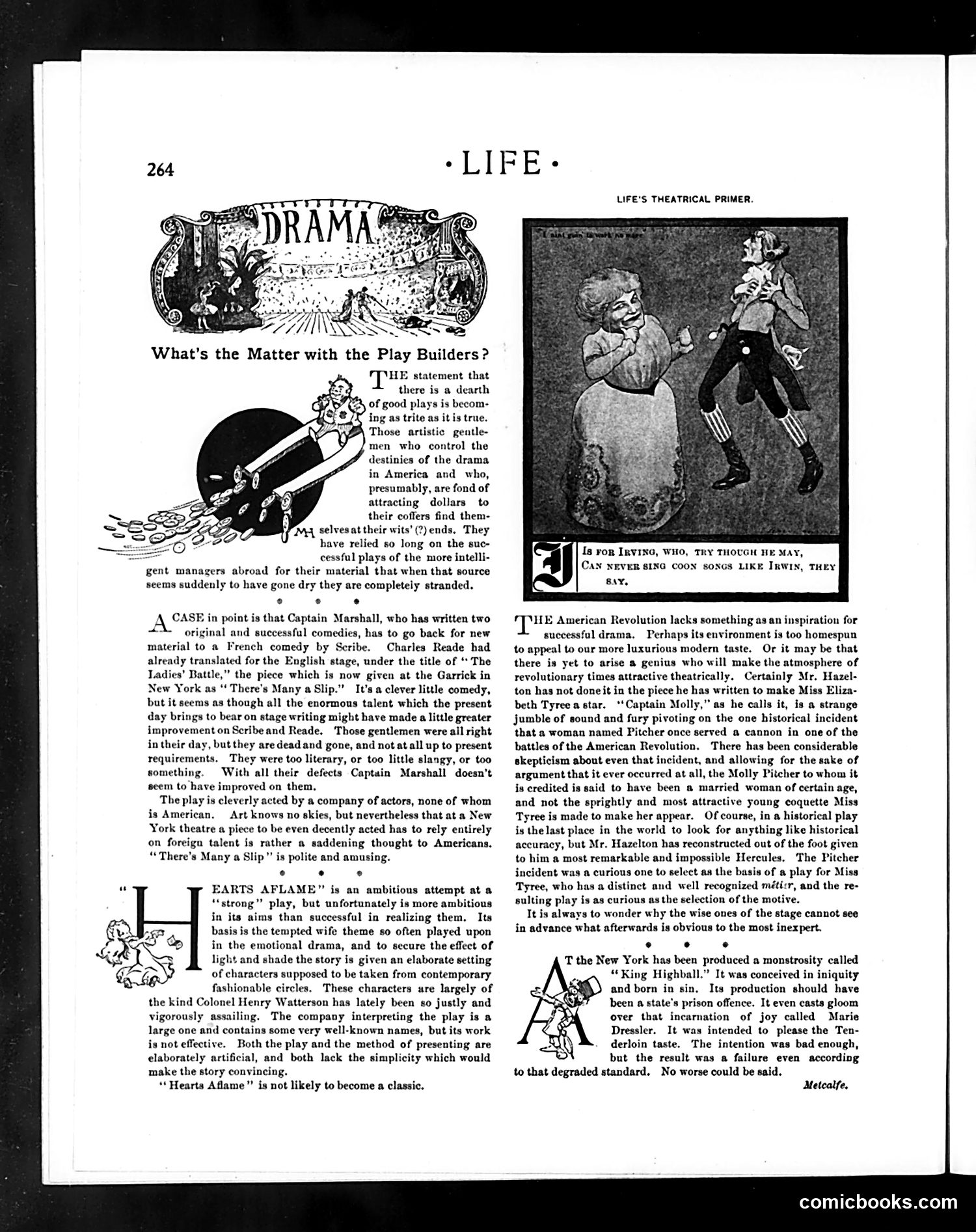
This page critiques American theatrical producers and playwrights for their lack of originality and artistic merit. The main article "What's the Matter with the Play Builders?" argues that successful dramatists are abandoning original material to chase foreign comedies and financially-driven adaptations. Specific targets include: - **Captain Marshall's adaptation** of a French comedy ("The Ladies' Battle"), criticized as derivative - **"Hearts Aflame"** — called an ambitious but unsuccessful "strong" play with overly elaborate staging that obscures weak storytelling - **Marie Dressler's vehicle "King Highball"** — dismissed as artistically degraded entertainment The satirical cartoon (captioned "Is for Irving") mocks theatrical stars, suggesting even famous performers cannot elevate mediocre material. The overall message: American drama lacks originality, relying instead on foreign sources and star power to attract audiences.
📄 Transcribed text from this page (OCR, searchable)
Machine-transcribed from the original scan — historical spelling and the odd misread are preserved.
HE statement that there is a dearth of good plays is becom- ing as trite as it is true. Those artistic gentle- men who control the destinies of the drama in America and who, presumably, are fond of attracting dollars to their coffers find them- ‘Mi selvesat their wits’ (?)ends, They have relied so long on the suc cessful plays of the more intelli- gent managers abroad for their material that when that source seems suddenly to have gone dry they are completely stranded. ° ° . CASE in point is that Captain Marshall, who has written two original and successful comedies, has to go back for new material to a French comedy by Scribe. Charles Reade had already translated for the English stage, under the title of ** The Tadies’ Battle,” the piece which is now given at the Garrick in New York as “ There's Many a Slip.” It’s a clever little comedy, but it seems as though all the enormous talent which the present day brings to bear on stage writing might have made a little greater improvementon Scribeand Reade. Those gentlemen were all right in their day, but they are dead and gone, and not at all up to present requirements. They were too literary, or too little slangy, or too something. With all their defects Captain Marshall doesn't seem to have improved on them. The play is cleverly acted by a company of actors, none of whom is American, Art knows no skies, but nevertheless that at a New York theatre a piece to be even decently acted has to rely entirely on foreign talent is rather a saddening thought to Americans. “There's Many a Slip” is polite and amusing. e . ° EARTS AFLAME” is an ambitious attempt at a “strong” play, but unfortunately is more ambitious in its aims than successful in realizing them. Its basis is the tempted wife theme so often played upon in the emotional drama, and to secure the effect of light and shade the story is given an elaborate setting of characters supposed to be taken from contemporary fashionable circles, These characters ure largely of the kind Colonel Henry Watterson has lately been so justly and vigorously assailing. The company interpreting the play is a large one and contains some very well-known names, but its work is noteffective. Both the play and the method of presenting are elaborately artificial, and both lack the simplicity which would make the story convincing. ‘Hearts Aflame”’ is not likely to become a classic. LIFE'S THEATRICAL PRIMER. Is yor Invino, WHO, TRY THOUGH HE MAY, CAN NEVER SING COON SONGS LIKE IRWIN, THEY ax. Tre American Revolution lacks something as an inspiration for successful drama. Perhaps its environment is too homespun to appeal to our more luxurious modern taste. Or it may be that there is yet to arise a genius who will make the atmosphere of revolutionary times attractive theatrically. Certainly Mr. Hazel- ton has not doneit in the piece he has written to make Miss Eliza- beth Tyree a star. ‘Captain Molly,” as he calls it, is a strange jumble of sound and fury pivoting on the one historical incident that a woman named Pitcher once served a cannon in one of the battles of the American Revolution. There has been considerable akepticism about even that incident, and allowing for the sake of argument that it ever occurred at all, the Molly Pitcher to whom it is credited is said to have been a married woman of certain age, and not the sprightly and most attractive young coquette Miss Tyree is made to make her appear. Of course, in a historical play is the last place in the world to look for anything like historical accuracy, but Mr. Hazelton has reconstructed out of the foot given to him a most remarkable and impossible Hercules, The Pitcher incident was a curious one to select as the basis of a play for Miss Tyree, who has a distinct and well recognized méticr, and the re- sulting play is as curious as the selection of the motive. It is always to wonder why the wise ones of the stage cannot see in advance what afterwards is obvious to the most inexpert. . . . T the New York has been produced a monstrosity called “King Highball.” It was conceived in iniquity and born in sin, Its production should have been a state's prison offence. It even casts gloom over that incarnation of joy called Marie Dressler. It was intended to please the Ten- derloin taste. The intention was bad enough, but the result was a failure even according to that degraded standard. No worse could be said. Metcalfe, comicbooks.com