
Life, 1902-09-25 · page 4 of 22
Life — September 25, 1902 — page 4: what you’re looking at
What you’re looking at
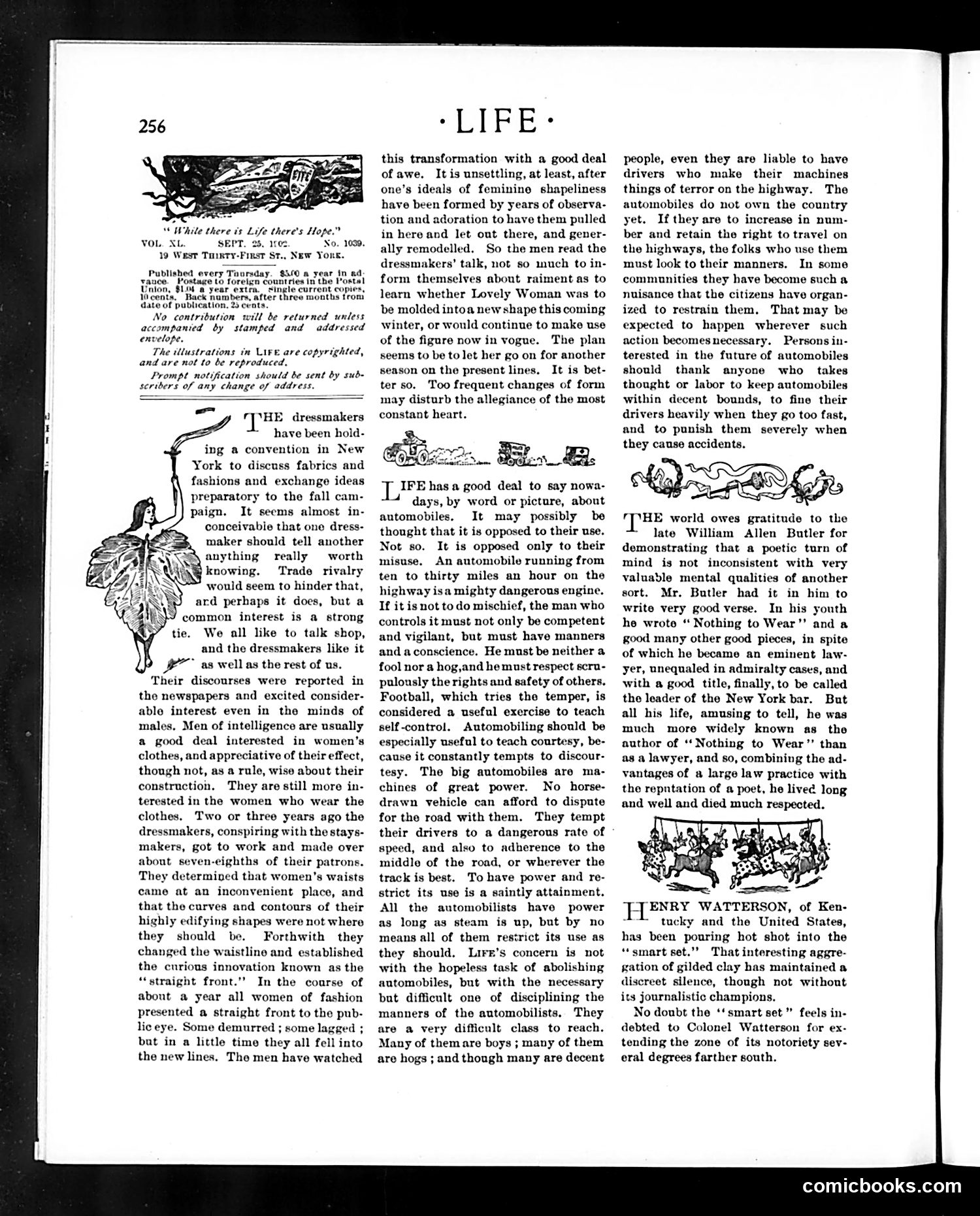
This page discusses automobiles and their social impact, with particular focus on driving etiquette and safety concerns. The main cartoon features a classical female figure (likely representing Fashion or Society) gesturing toward early automobiles and carriages. The text criticizes automobile drivers for dangerous behavior—speeding, reckless driving, and disregarding pedestrian safety. It advocates for driver education and self-discipline. There's also praise for William Allen Butler's literary work on automobile conduct. The final section briefly mentions Henry Watterson of Kentucky and the United States, crediting him with establishing a "smart set" that extended the zone of Southern society's notoriety. The satire targets the new automobile culture's safety hazards and drivers' lack of courtesy during this early motorcar era.
📄 Transcribed text from this page (OCR, searchable)
Machine-transcribed from the original scan — historical spelling and the odd misread are preserved.
“While there is Life there's Hope.” VOL. XL. SEPT. 25, 1°02. No. 1099. 19 West Tuinty-Fr New Yous. Published every T y. $30 a year In ad. vance. Postage to foreign countries ini the Hostal Union, $1.04 @ year extra, cents. Back numbers, date of publication, 2 ceats. No contribution will be returned unless accompanied by stamped and addressed envelope. The illustrations in Live are copyrighted, and are not to be reproduced. Prompt notification should be sent by sub- scribers of any change of address. single current copies, f three months trom HE dressmakers have been hold- pg a convention in New York to discuss fabrics and fashions and exchange ideas preparatory to the fall cam- paign. It seems almost in- conceivabie that one dress- maker should tell another \ anything really worth Trade rivalry would seem to hinder that, ard perhaps it does, but a common interest is a strong tie. We all like to talk shop, and the dressmakers like it > p as well as the rest of us. ‘Their discourses were reported in the newspapers and excited consider- able interest even in the minds of males. Men of intelligence are usually a good deal interested in women’s clothes, and appreciative of their effect, thongh not, as a rule, wise about their construction. They are still more in- terested in the women who wear the clothes. Two or three years ago the dressmakers, conspiring with the stays- makers, got to work and made over about seven-eighths of their patrons. They determined that women’s waists came at an inconvenient place, and that the curves and contours of their highly edifying shapes were not where they should be. Forthwith they changed the waistline and established the curious innovation known as the “straight front.” In the course of about a year all women of fashion presented a straight front to the pub- lic eye. Some demurred ; some lagged ; but in a little time they all fell into the new lines. The men haye watched “LUPE « this transformation with a good deal of awe. It is unsettling, at least, after one’s ideals of feminine shapeliness have been formed by years of observa- tion and adoration to have them pulled in here and let out there, and gener- ally remodelled. So the men read the dressmakers’ talk, not so much to in- form themselves about raiment as to learn whether Lovely Woman was to be molded intoa newshape this coming winter, or would continue to make use of the figure now in vogue. The plan seems to be to let her go on for another season on the present lines, It is bet- ter so. Too frequent changes of form may disturb the allegiance of the most constant heart. L IFE has a good deal to say nowa- + days, by word or picture, about automobiles. It may possibly be thought that it is opposed to their use. Not so. It is opposed only to their misuse, An automobile running from ten to thirty miles an hour on the ighway isa mighty dangerons engine. If it is not todo mischief, the man who controls it must not only be competent and vigilant, but must have manners and aconscience. He must be neither a fool nor a hog,and he must respect scru- pulously the rights and safety of others, Football, which tries the temper, is considered a useful exercise to teach self-control. Automobiling should be especially useful to teach courtesy, be- cause it constantly tempts to discour- tesy. The big automobiles aro ma- chines of great power. No horse- drawn vehicle can afford to dispute for the road with them. They tempt their drivers to a dangerous rate of speed, and also to adherence to the middle of the road, or wherever the track is best. To have power and re- strict its use is a saintly attainment. All the automobilists have power as long as steam is up, but by no means all of them restrict its use as they should, Lire’s concern is not with the hopeless task of abolishing automobiles, but with the necessary but difficult one of disciplining the manners of the automobilists. They are a very difficult class to reach. Many of them are boys ; many of them are hogs ; and though many are decent people, even they are liable to have drivers who make their machines things of terror on the highway. The automobiles do not own the country yet. If they are to increase in num- ber and retain the right to travel on the highways, the folks who use them must look to their manners. In some communities they have become such a nuisance that the citizens have organ- ized to restrain them. That may be expected to happen wherever such action becomes necessary. Persons in- terested in the future of automobiles should thank anyone who takes thought or labor to keep automobiles within decent bounds, to fine their drivers heavily when they go too fast, and to punish them severely when they cause accidents. [HE world owes gratitude to the late William Allen Butler for demonstrating that a poetic turn of mind is not inconsistent with very valuable mental qualities of another sort. Mr. Butler had it in him to write very good verse. In his youth he wrote “ Nothing to Wear’’ and a good many other good pieces, in spite of which he became an eminent law- yer, unequaled in admiralty cases, and with a good title, finally, to be called the leader of the New York bar. But all his life, amusing to tell, he was much more widely known as the author of ‘Nothing to Wear’’ than as a lawyer, and so, combining the ad- vantages of a large law practice with the reputation of a poet, he lived long and well and died much respected. -E “ENRY WATTERSON, of Ken- = tucky and the United States, has been pouring hot shot into the “smart set.” That interesting aggre- gation of gilded clay has maintained a discreet silence, though not without its journalistic champions. No doubt the ‘‘smart set” feels in- debted to Colonel Watterson for ex- tending the zone of its notoriety sev- eral degrees farther south. comicbooks.com