
A complete issue · 22 pages · 1902
Life — March 6, 1902
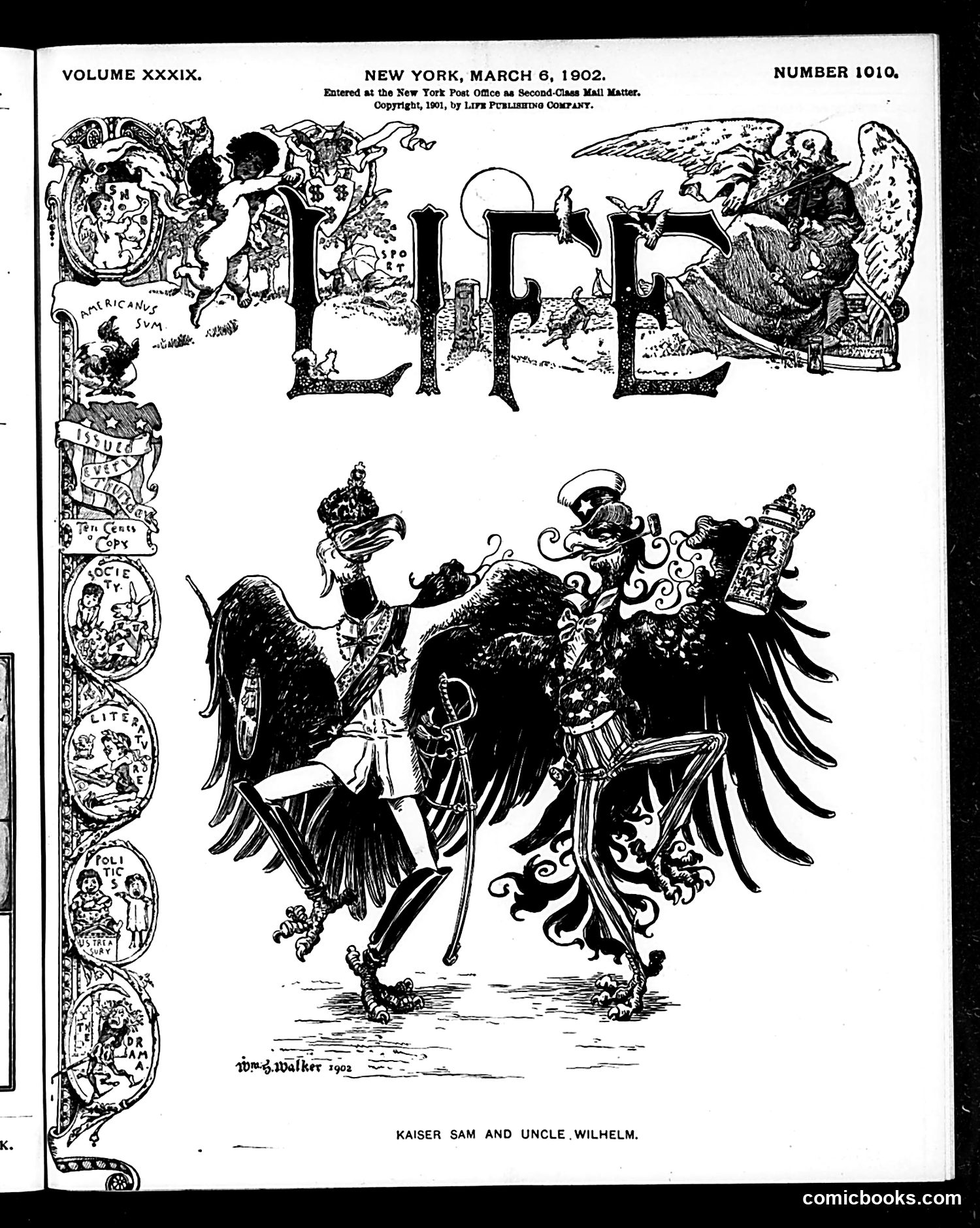
This political cartoon depicts "Kaiser Sam and Uncle Wilhelm"—a satirical representation of American-German relations. The central image shows two winged imperial eagles (representing the American and German empires) dancing together in formal dress, complete with crowns and military regalia. The cartoon likely comments on American and German imperial expansion and competition during the early 1900s—a period of rising tensions between the powers. "Kaiser Sam" refers to Uncle Sam (America) characterized as increasingly imperial, while "Uncle Wilhelm" represents Kaiser Wilhelm II of Germany. The dancing pose suggests either diplomatic maneuvering or mockery of their parallel imperial ambitions. The ornate border contains various emblems and national symbols, reinforcing the international theme.
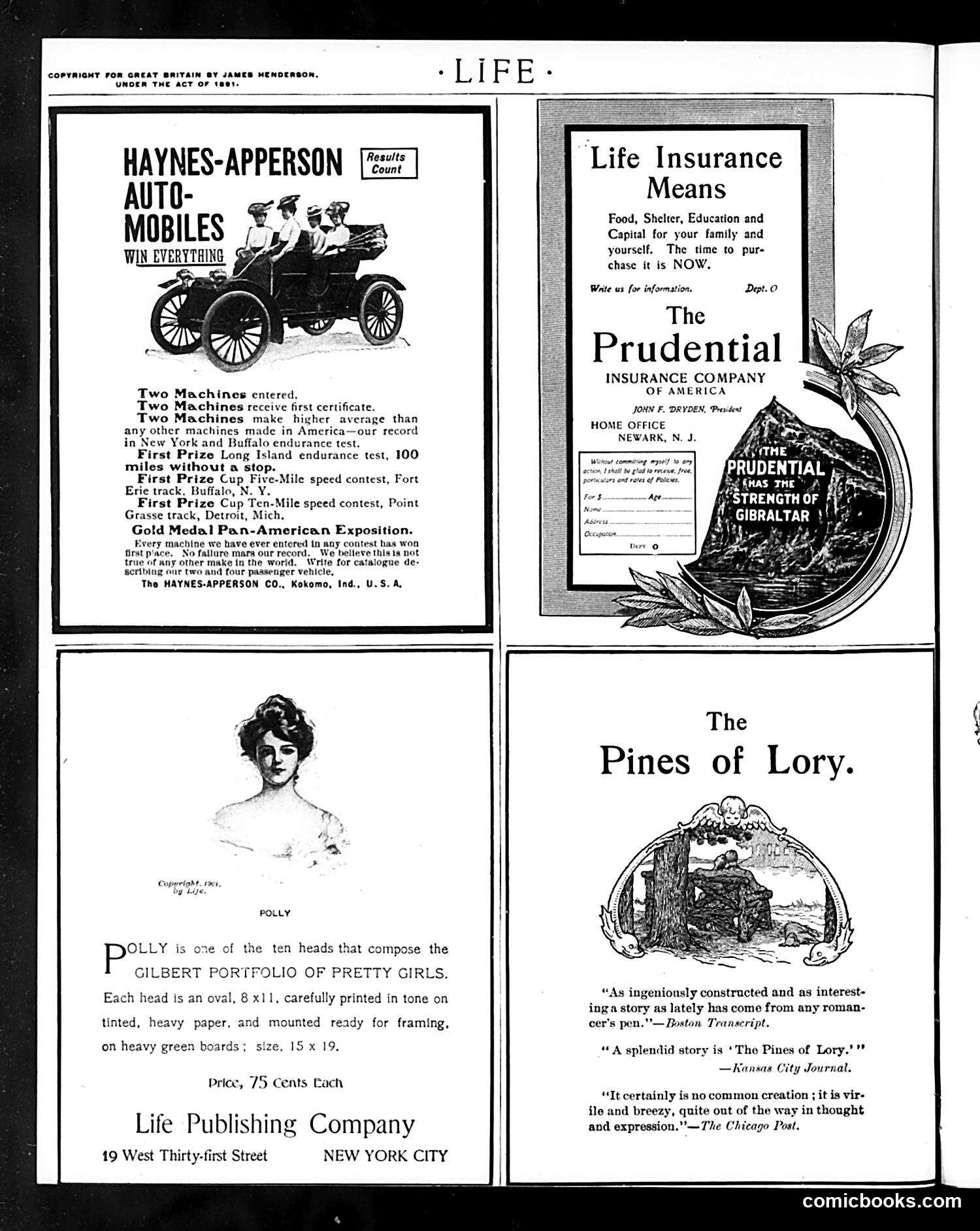
This page contains **four separate advertisements and content pieces**, not political cartoons: 1. **Haynes-Apperson Automobiles**: Ad emphasizing racing victories and reliability, with an illustration of an early motorcar. 2. **Prudential Insurance**: Life insurance advertisement promising "Food, Shelter, Education and Capital for your family." 3. **"Polly" Portfolio**: Art print advertisement from Life Publishing Company, featuring a portrait sketch of a woman's head. Part of a "Gilbert Portfolio of Pretty Girls" series, priced at 75 cents. 4. **"The Pines of Lory"**: Book advertisement with favorable reviews from contemporary newspapers praising it as an original romance story. This is primarily a **commercial advertising page** with no political satire or commentary—typical of early 20th-century magazine content.
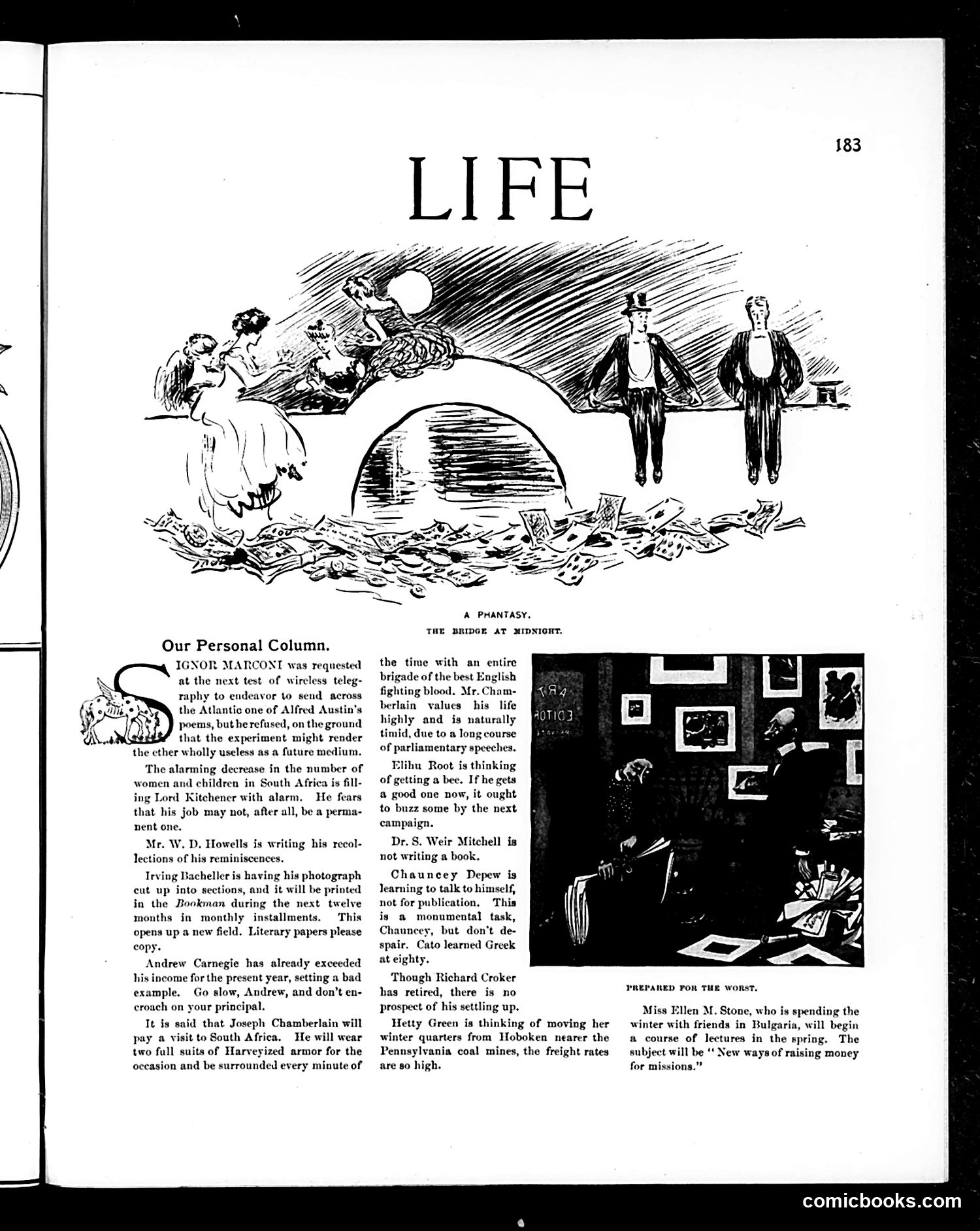
The main illustration, titled "A Phantasy: The Bridge at Midnight," depicts a surreal scene where wealthy figures in top hats stand beside an enormous money bag or purse balanced precariously over scattered currency and coins. On the opposite side, figures appear to be in distress or poverty. This appears to be **social satire criticizing wealth inequality**—the precarious "bridge" of money suggests the unstable relationship between the rich and poor, or perhaps warns that excessive wealth concentration is dangerous and unsustainable. The "Our Personal Column" section below contains gossip about various public figures' activities, typical of Life's satirical commentary on contemporary society and notable individuals. Without identifying specific historical figures mentioned, the overall page exemplifies Life's approach: mixing visual political commentary with gossipy social observation.
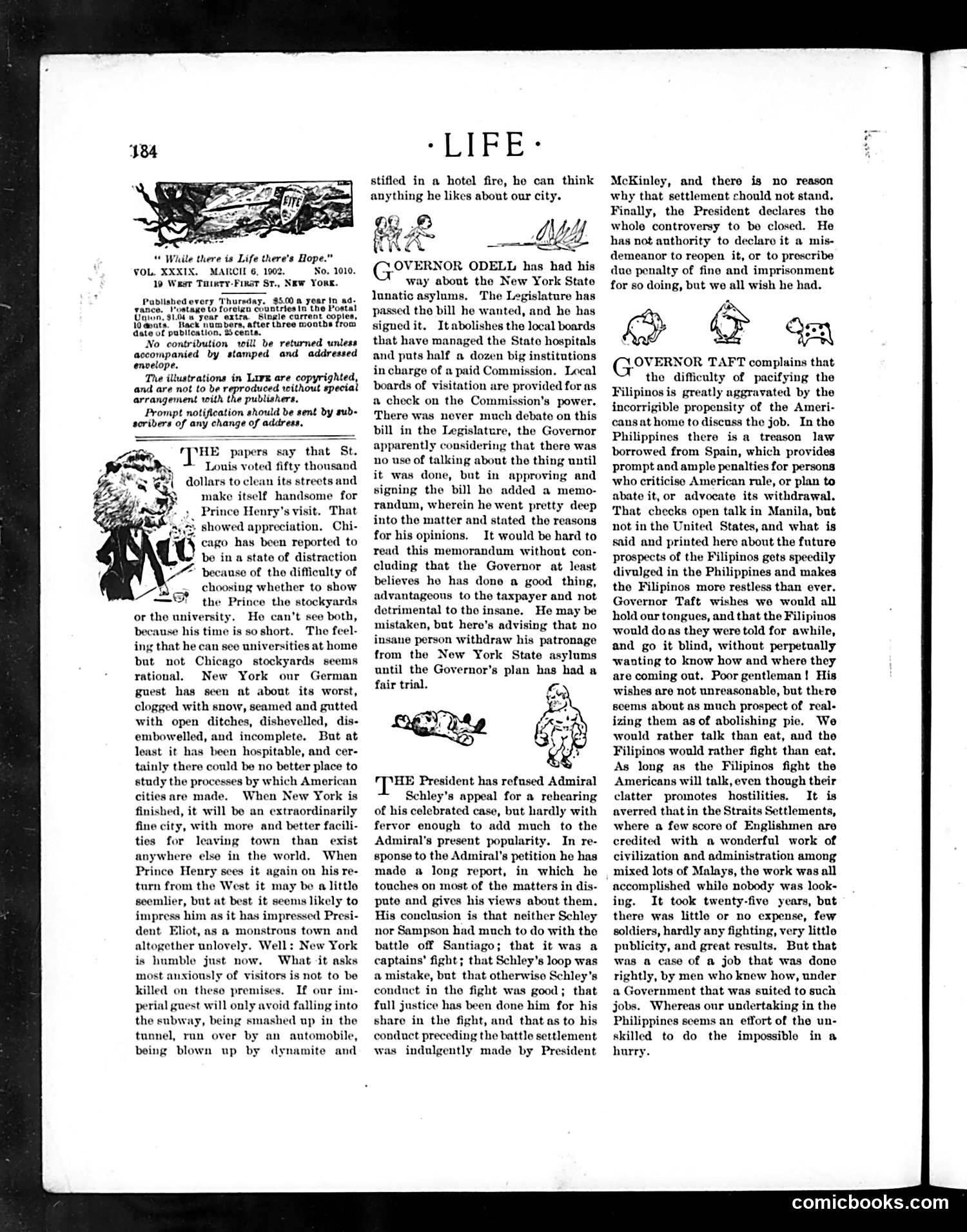
This page contains three political commentaries with small illustrations: 1. **St. Louis Streets**: A brief note mocking St. Louis's decision to spend thousands of dollars on street improvements while neglecting other civic needs—a critique of misplaced municipal priorities. 2. **Prince Henry's Visit**: Commentary on a German prince's visit to New York, satirizing the city's poor condition ("clogged with snow, seamed and gutted with open ditches"). The piece suggests New York is an embarrassing place to showcase American civilization, particularly compared to Chicago. 3. **Admiral Schley's Case**: Discussion of President Roosevelt's refusal to rehear Admiral Schley's appeal regarding the Battle of Santiago. The text defends Roosevelt's decision while critiquing Schley's conduct and popularity, suggesting the matter was justly settled.
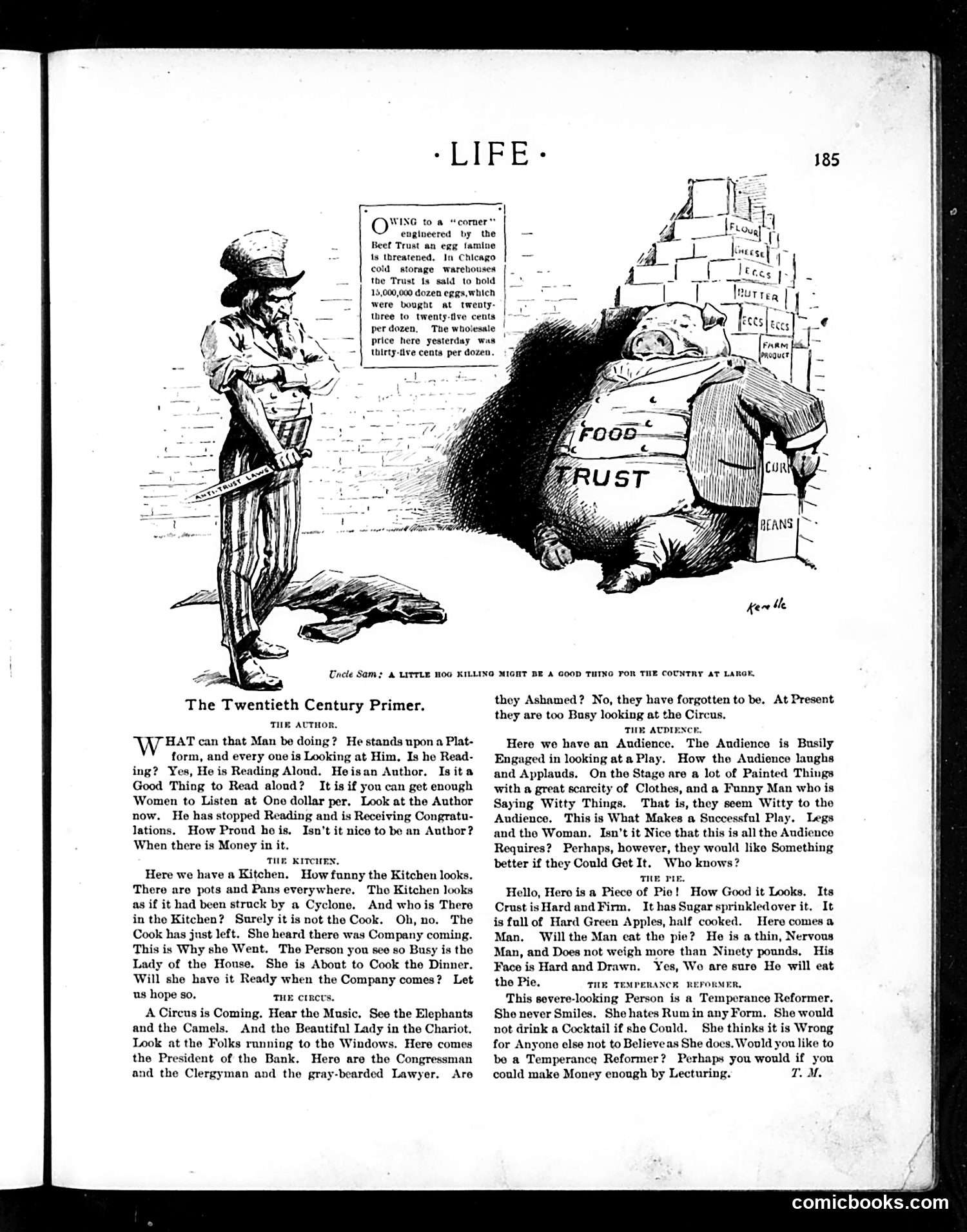
The main cartoon depicts **Uncle Sam** (identified by his characteristic hat and striped pants) confronting a large, menacing figure labeled "FOOD TRUST" laden with groceries. The accompanying text warns that "a little hog killing might be a good thing for the country at large." This satirizes **food monopolies** (trusts) that controlled egg and produce distribution, keeping prices artificially high. The cartoon references specific grievances: the Beef Trust allegedly hoarded eggs in Chicago cold storage; wholesale egg prices had risen to thirty-five cents per dozen. The satire suggests that breaking up these monopolistic "trusts"—humorously metaphorized as killing a hog—would benefit consumers through lower food prices. This reflects Progressive Era anxiety about corporate monopolies controlling essential goods.
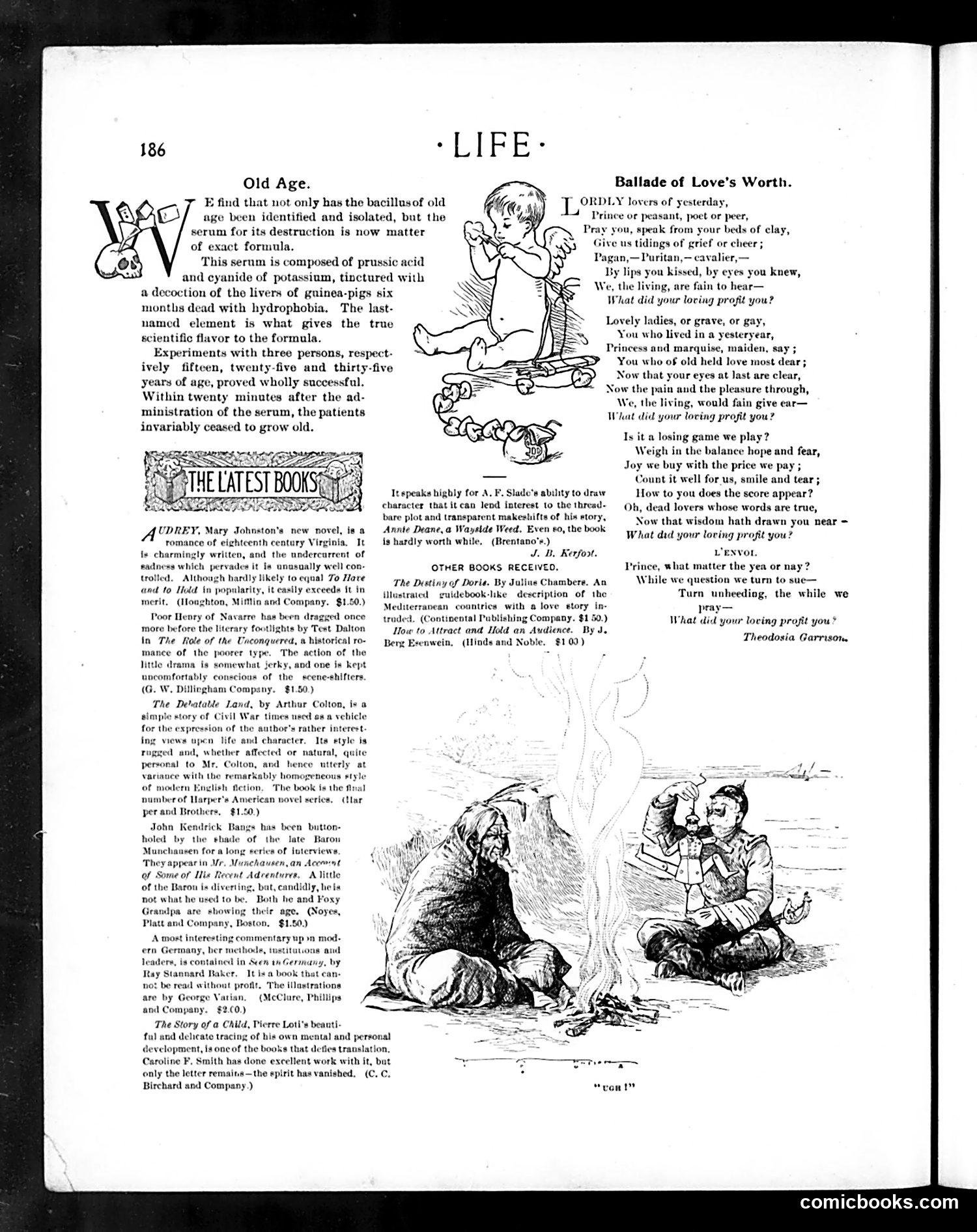
This page contains two distinct sections: **Upper left:** "Old Age" - A satirical medical piece describing a supposedly scientific serum (prussic acid and potassium cyanide) that destroys old age by killing the patient within twenty minutes. The dark humor mocks both dubious patent medicines and society's obsession with youth. **Upper right:** "Ballade of Love's Worth" - A poem by Theodsia Garrison using repeated refrain "What did your loving profit you?" to cynically examine romantic relationships and their disappointments. **Lower section:** Book reviews under "The Latest Books," discussing contemporary literature. **Bottom illustration:** An untitled sketch showing figures in what appears to be a comedic or cautionary scene, though the specific narrative is unclear from the image alone. The page exemplifies Life's characteristic blend of satirical commentary on contemporary anxieties—aging, love, and consumer culture—through humor and literary critique.
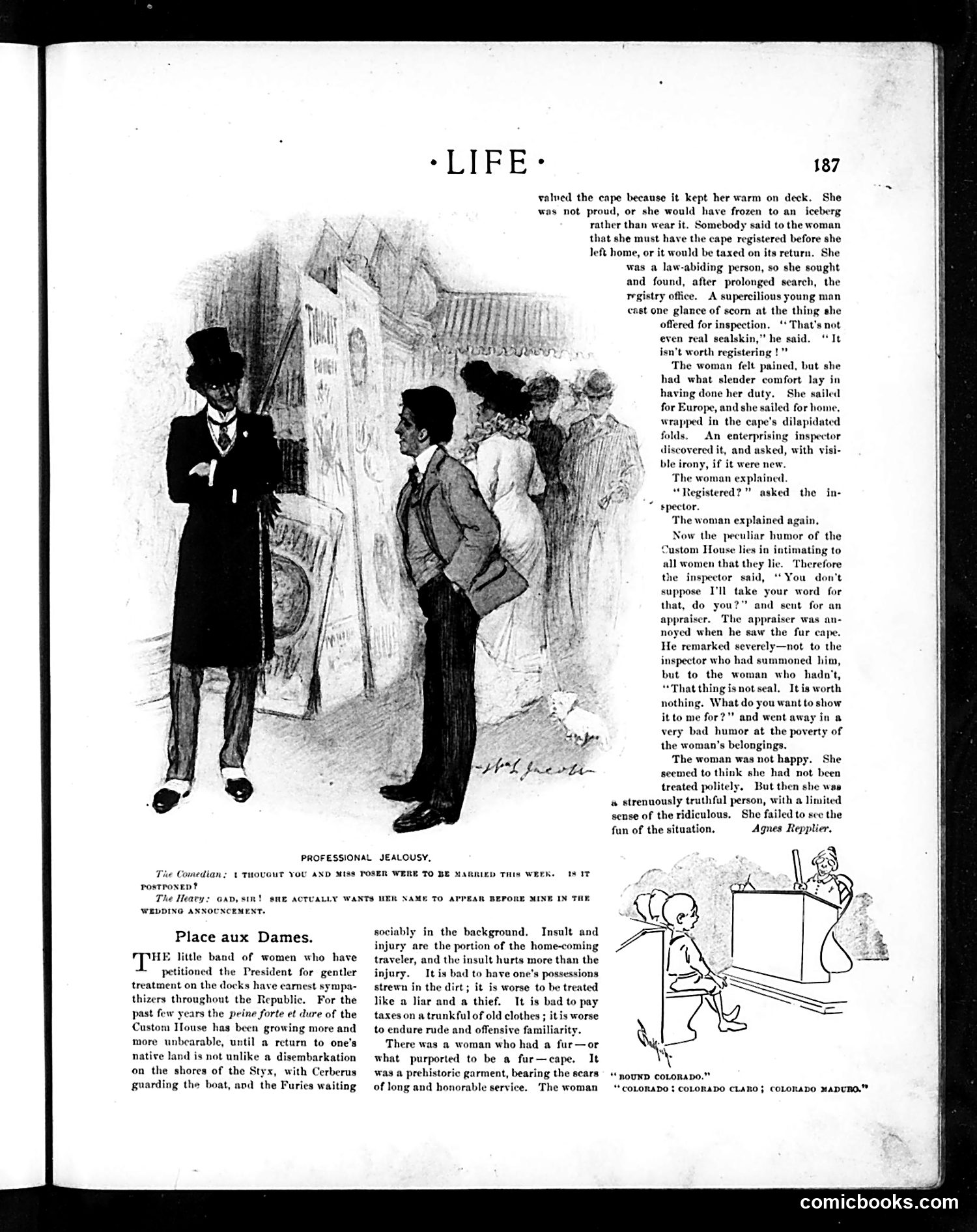
This cartoon satirizes **customs inspection procedures** at ports of entry, likely from the early 20th century. The scene shows a female customs inspector confronting a woman attempting to bring a worn fur cape through inspection. The humor lies in the inspector's jealousy: the woman hadn't registered the cape before leaving, so technically it requires duty upon return. However, the appraiser remarks the fur isn't real sealskin and is worthless—insulting the owner's possession rather than her deception. The accompanying text mocks how customs officials enforce trivial regulations, treating worn clothing as contraband. The "professional jealousy" refers to the inspector's petty enforcement of rules rather than genuine concern for tariffs.
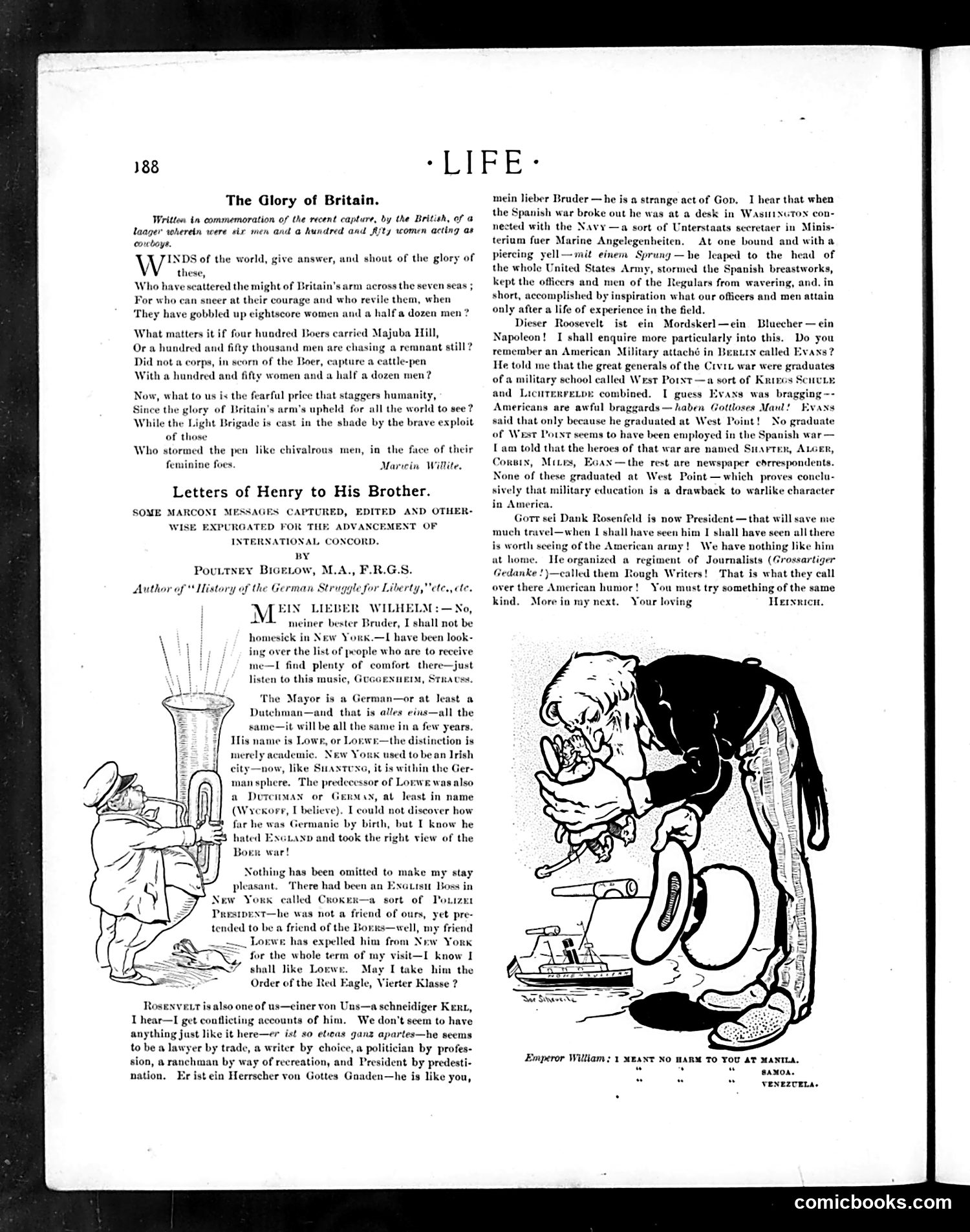
This page contains two distinct pieces: "The Glory of Britain" (a patriotic poem) and "Letters of Henry to His Brother" (satirical correspondence by Poultney Bigelow). **The Right Cartoon:** Depicts "Emperor William" (German Kaiser Wilhelm II) being kicked or propelled by what appears to be Uncle Sam (American figure on left). The caption states "I MEANT NO HARM TO YOU AT MANILA" with references to Manila, Samoa, and Venezuela—locations of late-1890s American-German diplomatic tensions. **The Satire:** Bigelow's letters mock German attitudes toward America, referencing West Point graduates, the Spanish-American War, and American military organization. The cartoon illustrates American frustration with German imperial ambitions in the Western Hemisphere, particularly in the Philippines and Caribbean during the competitive imperial period of the 1890s.
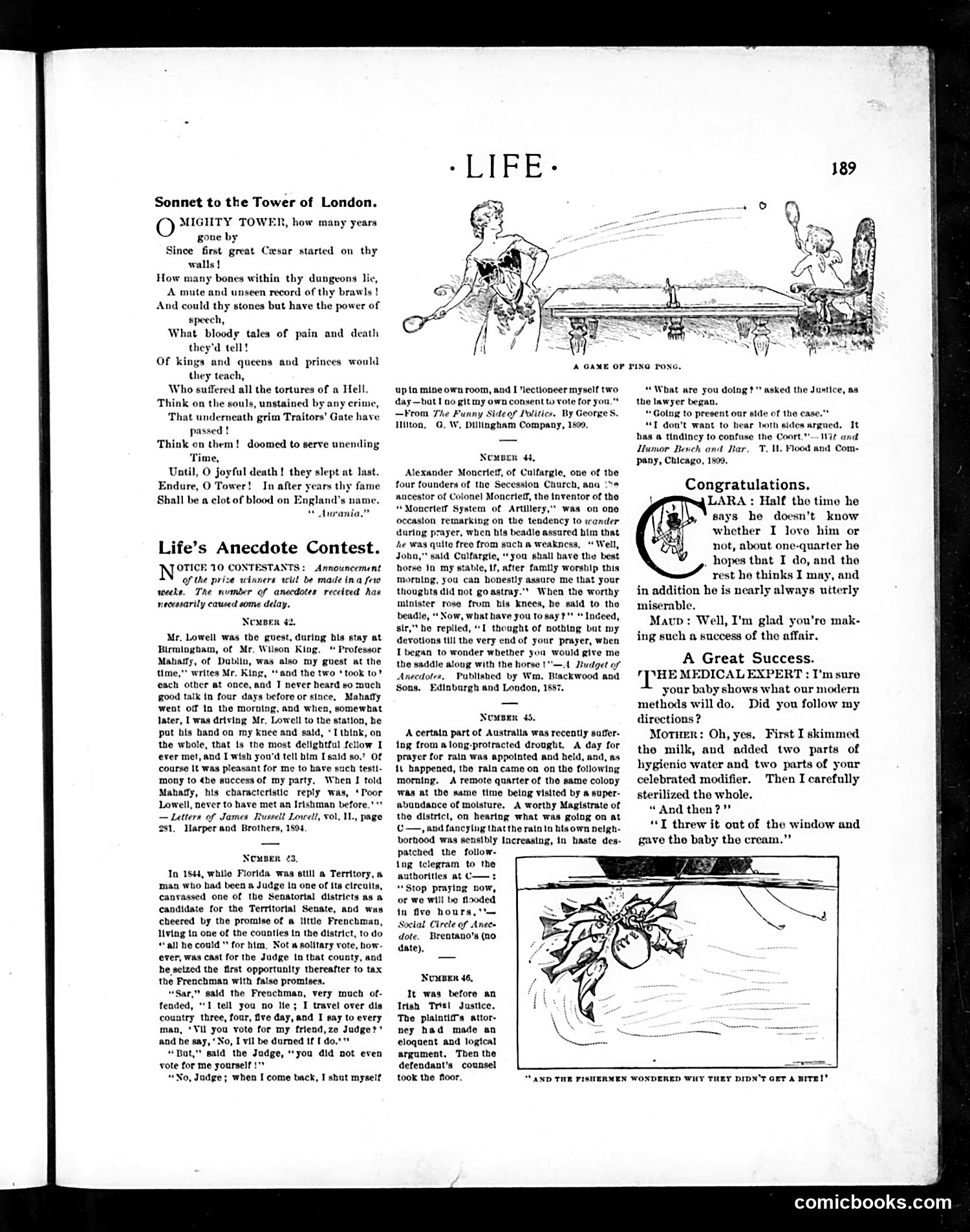
This page contains several humorous anecdotes and illustrations rather than a political cartoon. The main visual feature is "A Game of Ping Pong" (top right), showing a woman playing the sport—likely satirizing the growing popularity of this fashionable pastime among women in the late 19th/early 20th century. Below is a cartoon captioned "And the Fishermen Wondered Why They Didn't Get a Bite!" depicting what appears to be a woman in a boat, satirizing gender dynamics and leisure activities. The text pieces are comedic vignettes: "Life's Anecdote Contest" includes anecdotes about judicial incompetence (Number 42), colonial history (Number 44), and Australian drought relief (Number 45). "Congratulations" and "A Great Success" are brief humorous dialogues about domestic life and medical advice. The satire targets social pretension, bureaucratic foolishness, and Victorian domestic relations.
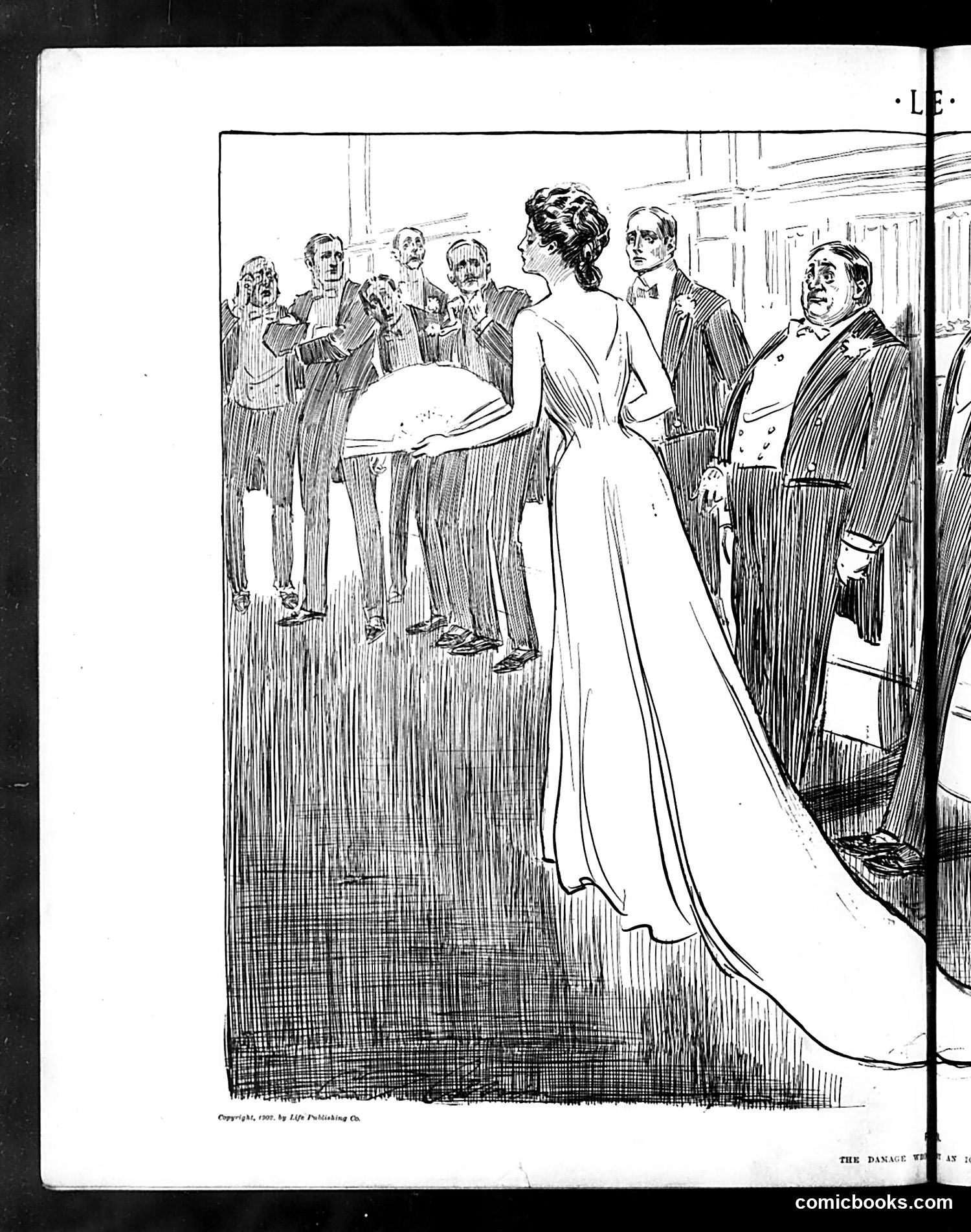
This appears to be an illustration from *Life* magazine depicting a formal social scene, likely from the early 20th century based on the art style and clothing. The central figure is a woman in an elegant white gown with a train, surrounded by formally dressed men in suits observing her. The partial caption at bottom reads "THE DAMAGE WE..." (text cut off), suggesting this is satirizing some aspect of social behavior or consequence. Without the complete caption and title, the specific satirical target is unclear—it could reference fashion excess, social climbing, romantic entanglement, or financial strain. The men's expressions suggest either admiration, concern, or judgment regarding the woman's appearance or actions. The exact social or political commentary cannot be determined from the visible portion alone.
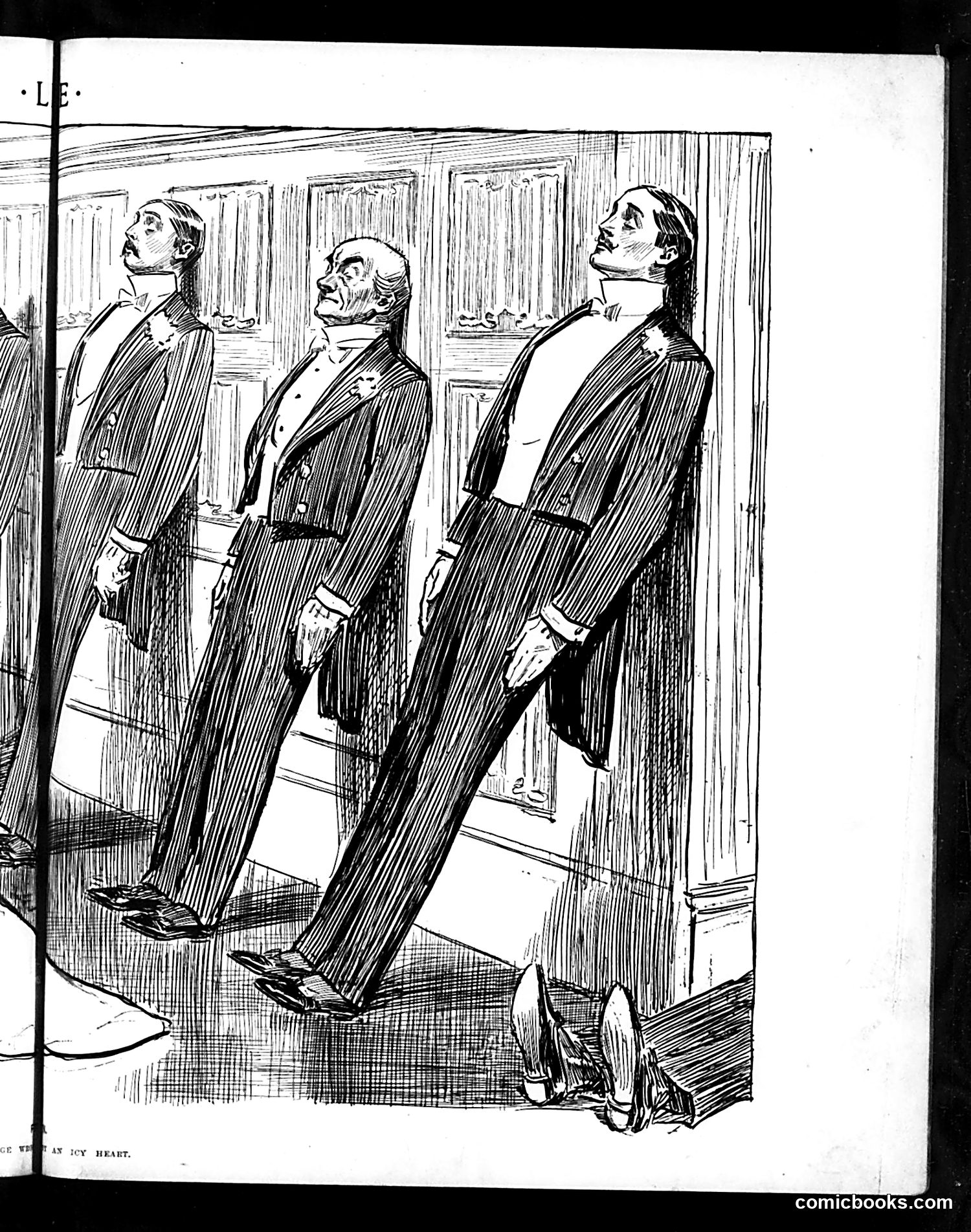
This appears to be a satirical cartoon from *Life* magazine depicting three men in formal pinstriped suits standing in what looks like an elegant interior with paneled walls. The men are drawn with exaggerated facial features typical of period caricature work. The partial caption visible at the bottom reads "OF WE IN ICY HEART" (likely incomplete or OCR-corrupted). Without the complete caption or additional context, I cannot definitively identify the specific figures or political references this cartoon intends to mock. The formal attire and interior setting suggest these may be politicians or wealthy businessmen, and the "icy heart" reference implies criticism of their coldness or lack of genuine feeling. However, I cannot specify which historical figures or events are being satirized without risking inaccuracy.
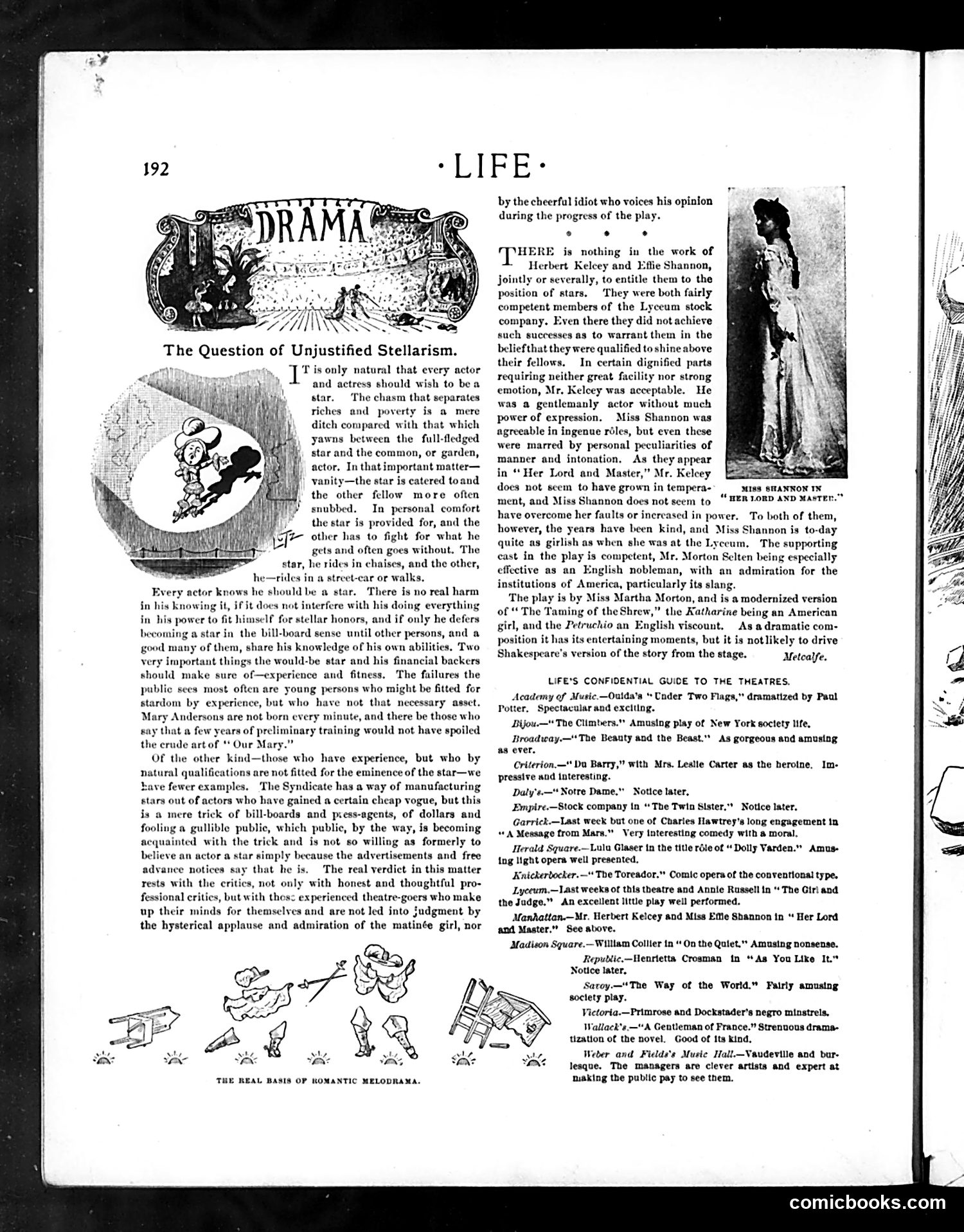
This page contains drama criticism and theater listings, not political cartoons. The main article, "The Question of Unjustified Stellarism," critiques actors—particularly Herbert Kelsey and Ellie Shannon—who receive star billing despite unremarkable talent. The author argues that becoming a star requires genuine ability, not just ambition or financial backing from theater owners. The accompanying illustrations appear to be generic theatrical vignettes rather than specific caricatures. The satirical point targets the theatrical industry's practice of artificially inflating actors' status through marketing and financial manipulation rather than merit—a critique of hype-driven celebrity that remains relevant today.
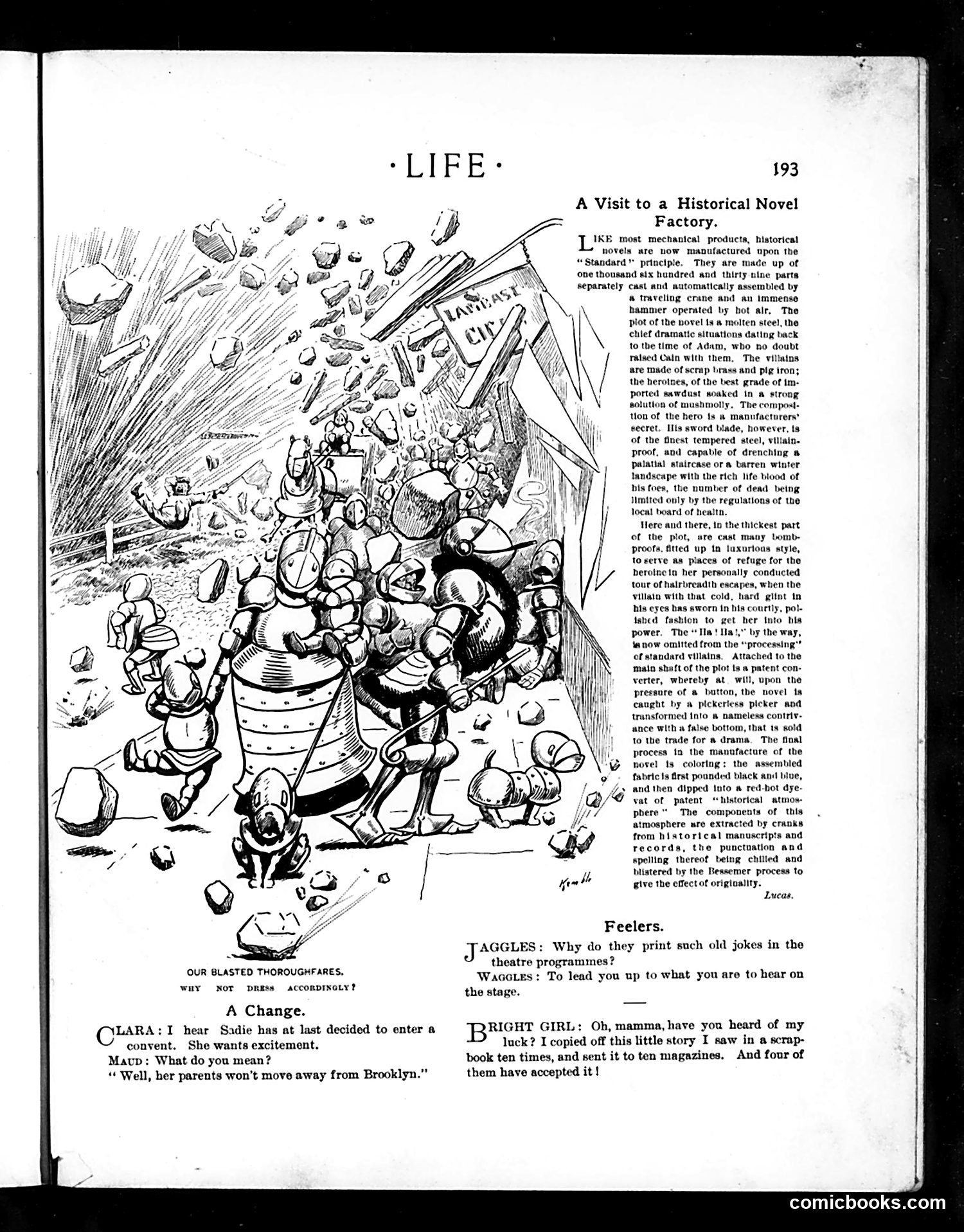
This Life magazine page contains three satirical pieces: **"Our Blasted Thoroughfares"**: A brief joke about Brooklyn residents dressing poorly for city streets, with the punchline that Sadie wants convent "excitement" because her parents won't leave Brooklyn—implying Brooklyn is so dull it drives people to religious life. **"A Visit to a Historical Novel Factory"**: A lengthy mock-industrial satire describing historical novels as mass-produced commodities. It ridicules the formulaic nature of popular historical fiction: standardized parts, melodramatic plots dating to Adam, stock villains made of cheap materials, and heroines perpetually in danger. The piece satirizes how these novels are manufactured products rather than genuine literature, with "originality" artificially added at the end through a fake "historical atmosphere" process. **"Feelers"**: Three brief jokes about theater programs printing tired jokes, and a girl submitting copied stories to magazines with surprising acceptance—mocking both theater conventions and magazine editorial standards. The overall tone mocks commercial entertainment's reliance on formula and recycled material.
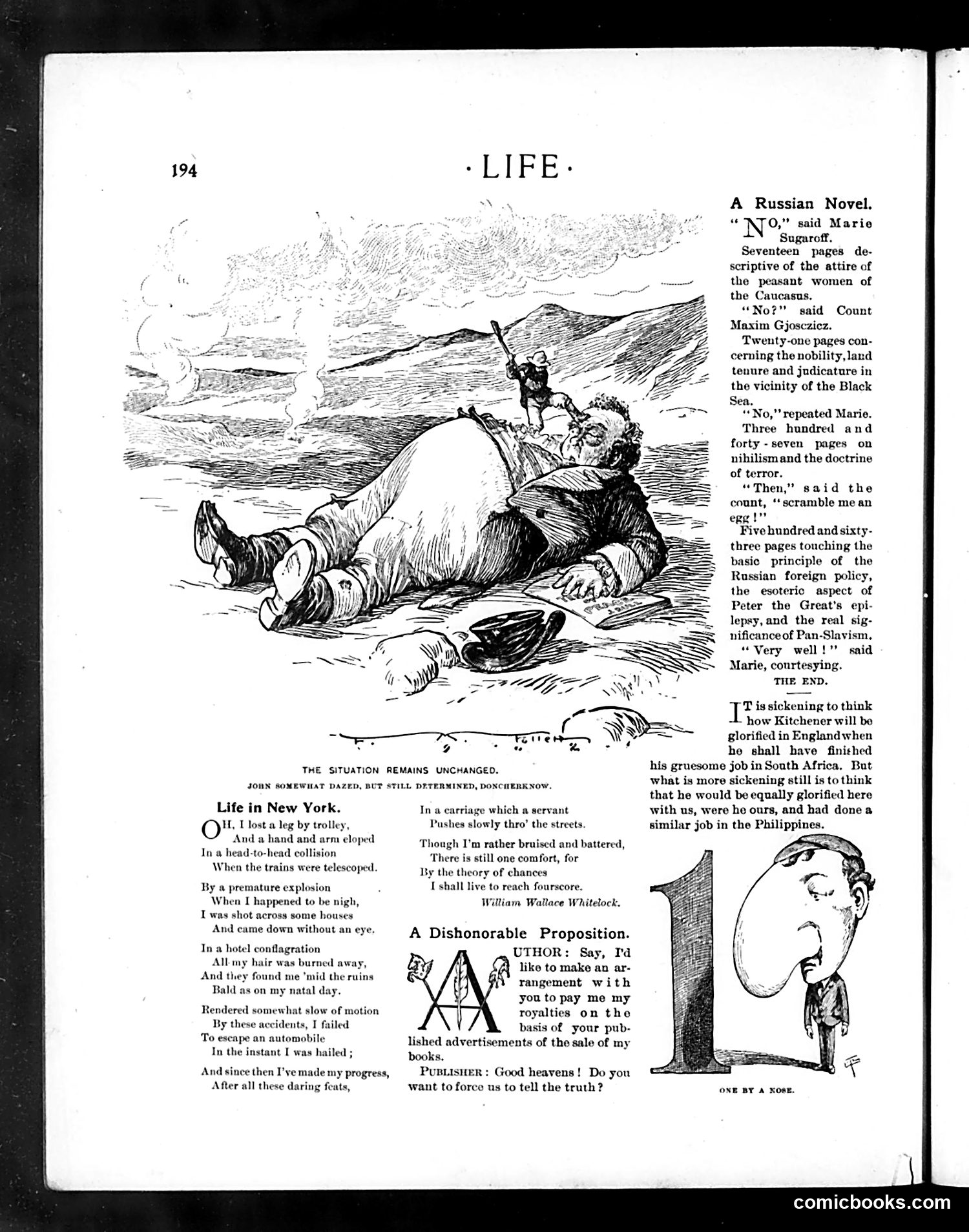
This page contains three distinct satirical pieces: **"Life in New York"** mocks urban dangers of the era—trolleys, train collisions, explosions, hotel fires, automobiles—through a man who has survived them all (losing limbs, hair, an eye) yet remains oddly optimistic about reaching old age through probability. **"A Dishonorable Proposition"** is a brief joke about publishing: an author proposes paying royalties based on the publisher's *advertised* book sales figures. The publisher's horrified response—"Do you want to force us to tell the truth?"—satirizes the gap between actual and claimed sales in the publishing industry. **"A Russian Novel"** parodies the verbose, digressive style of 19th-century Russian literature. A couple's romantic exchange is interrupted by absurdly long passages on peasant clothing, nobility, nihilism, and political theory—until the count simply asks for scrambled eggs, undercutting the pretentious gravity. The final section references **Kitchener's** role in the Boer War (South Africa) and suggests Americans would similarly glorify similar military actions in the Philippines, criticizing nationalist mythology.
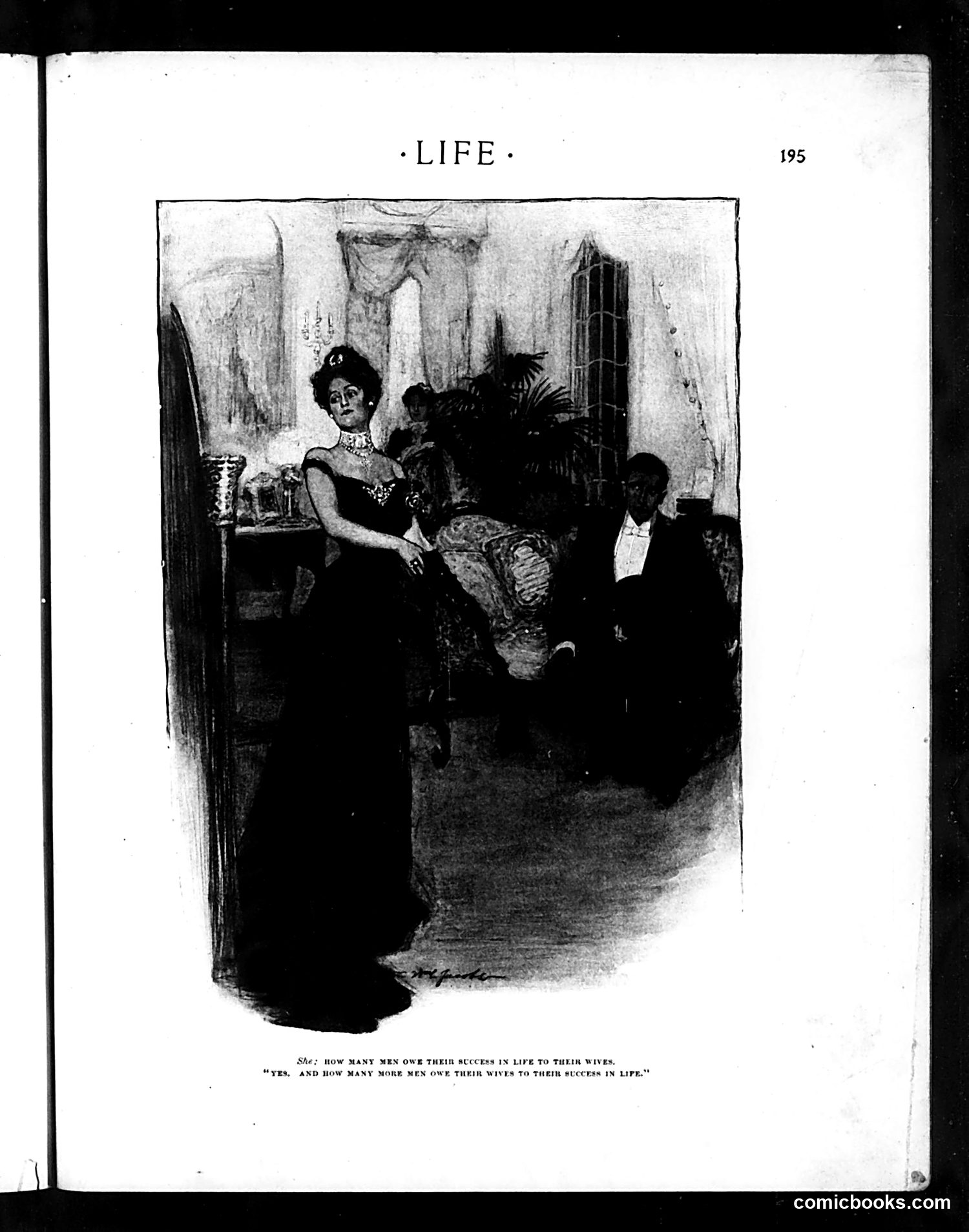
This is a satirical cartoon about marriage and social ambition. A well-dressed woman in an elegant black gown, adorned with jewelry and a choker, speaks to a man in formal attire at what appears to be an upscale social gathering. The humor hinges on a reversal: she acknowledges that many men credit their wives for their success, but he retorts that many more men owe their *wives themselves* to their financial success—implying men marry women based on wealth rather than love or compatibility. The cartoon satirizes early 20th-century marriage dynamics, suggesting that social success (and thus marriageability) was transactional. It critiques both the materialism of the era and the uncomfortable truth that women's marital prospects were largely determined by men's financial status rather than mutual affection.
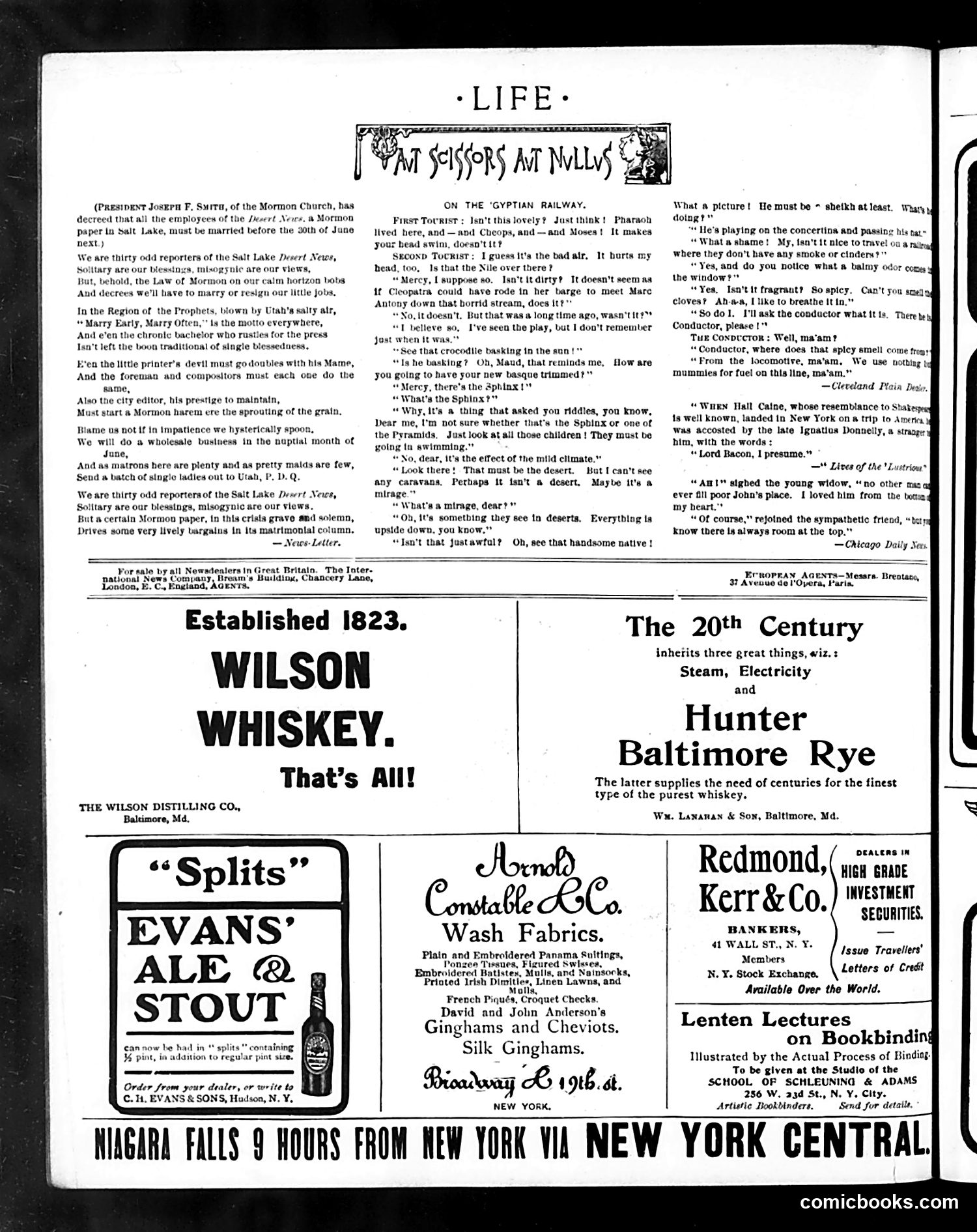
This page contains **three separate satirical pieces**, not a single cartoon: 1. **"Thirty Odd Reporters"** (top): Mocks the Mormon Church's President Joseph F. Smith, who decreed Salt Lake *Desert News* employees must marry by June 30th or lose their jobs. The poem humorously depicts desperate male reporters scrambling to find wives, requesting "a batch of single ladies" be sent to Utah urgently. The satire targets both the Church's marriage mandate and the resulting comic desperation. 2. **"On the Egyptian Railway"** (right): Two tourist dialogues poking fun at travelers' ignorance. Tourists mistake basic Egyptian geography, misunderstand mirages, and make crude assumptions about "natives." The humor is gentle mockery of tourists' stupidity and pretension. 3. **"Lives of the Illustrious"** (bottom right): A widow claims no man can replace her dead husband; her friend quips there's "always room at the top"—a dark joke implying remarriage/infidelity. The page is otherwise **advertisements** for whiskey, ale, fabrics, and financial services.
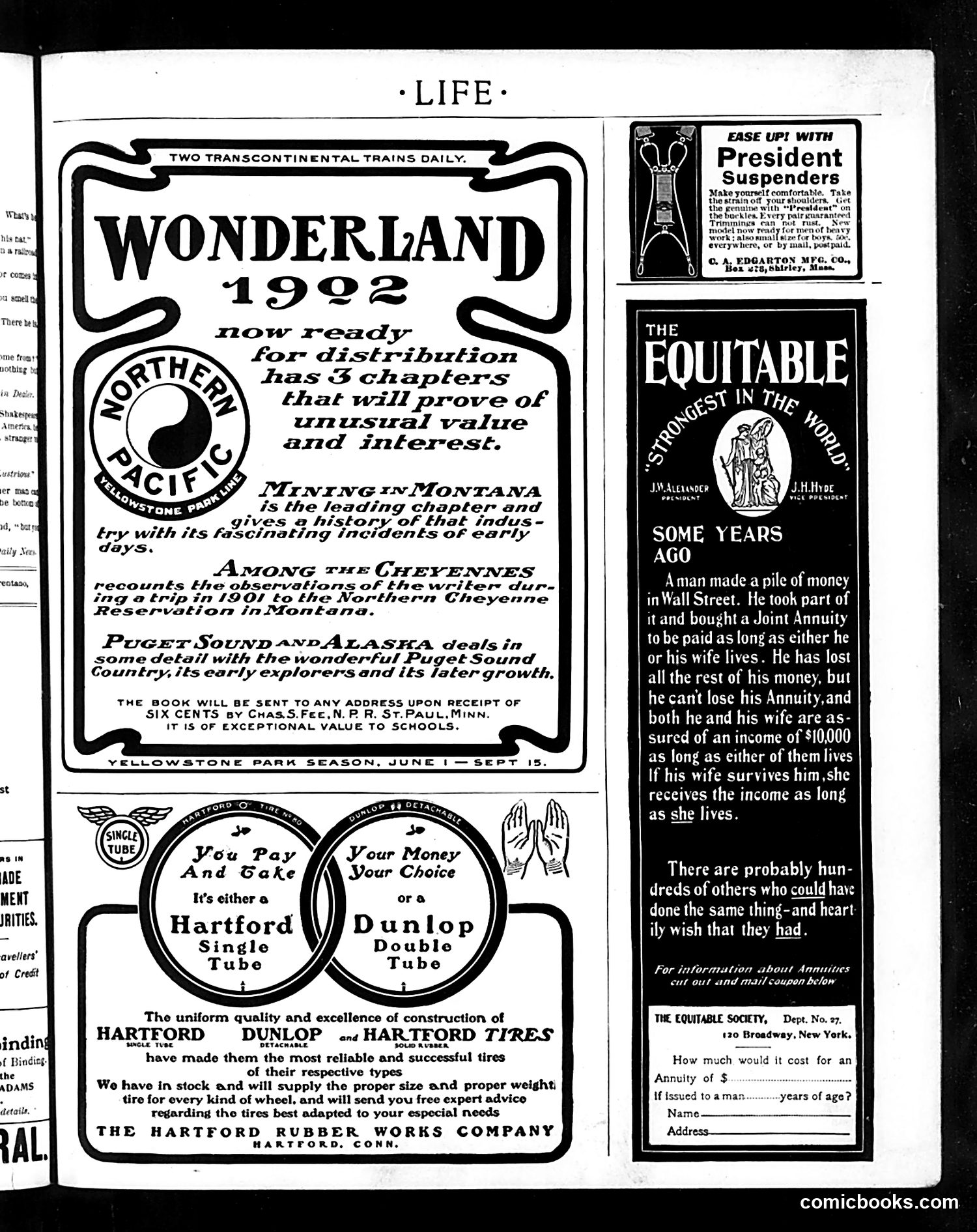
This page is primarily **advertising**, not editorial content or satire. The main advertisements are: 1. **"Wonderland 1922"** — promotes a Northern Pacific Railroad book about Montana mining, Cheyenne reservations, and Puget Sound, available for six cents. Marketed as educationally valuable. 2. **Hartford Rubber Works** — tire advertisement offering choice between Hartford Single Tube or Dunlop Double Tube, emphasizing quality and reliability. 3. **President Suspenders** — product advertisement claiming comfort by reducing shoulder strain. 4. **Equitable Society** — financial services advertisement for joint annuities, using a cautionary narrative: a Wall Street investor lost his fortune but retained his annuity income of $10,000 annually, securing his and his wife's financial security. The Equitable ad includes implicit social commentary about financial vulnerability and the value of insurance products, but this is advertising messaging rather than satire. No political cartoons or caricatures appear on this page.
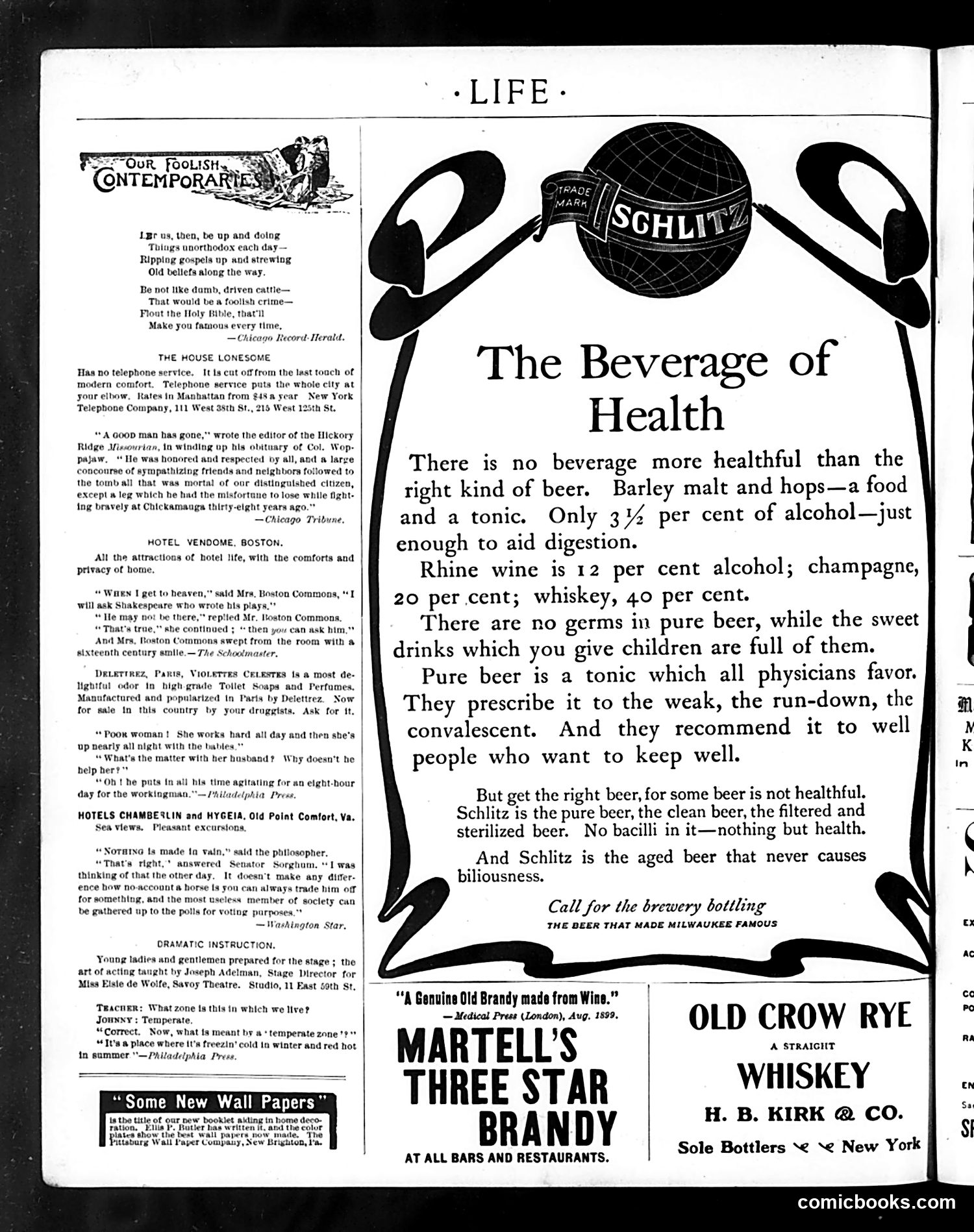
This page combines satirical commentary with period advertising. **The Satire ("Our Foolish Contemporaries"):** The opening verse mocks radical iconoclasts who reject tradition by "ripping gospels" and discarding "old beliefs" for shock value. The Chicago Record-Herald quote suggests contempt for those who gain fame through blasphemy or sensationalism rather than genuine accomplishment. The column of humorous anecdotes that follows uses irony to critique various contemporary absurdities: a newspaper's absurd obituary, marital disputes over Shakespeare attribution, a husband neglecting his wife while advocating for workers' rights, and a student's circular reasoning about "temperate zones." **The Advertising:** The large Schlitz beer advertisement is notable for its health claims—asserting beer contains only 3.5% alcohol and is "prescribed by physicians" for the weak and convalescent. This reflects pre-Prohibition-era marketing (the page predates 1920), when alcoholic beverages were marketed as medicinal tonics rather than recreational drinks. The page satirizes foolish trends while ironically profiting from questionable advertising claims about alcohol's health benefits.
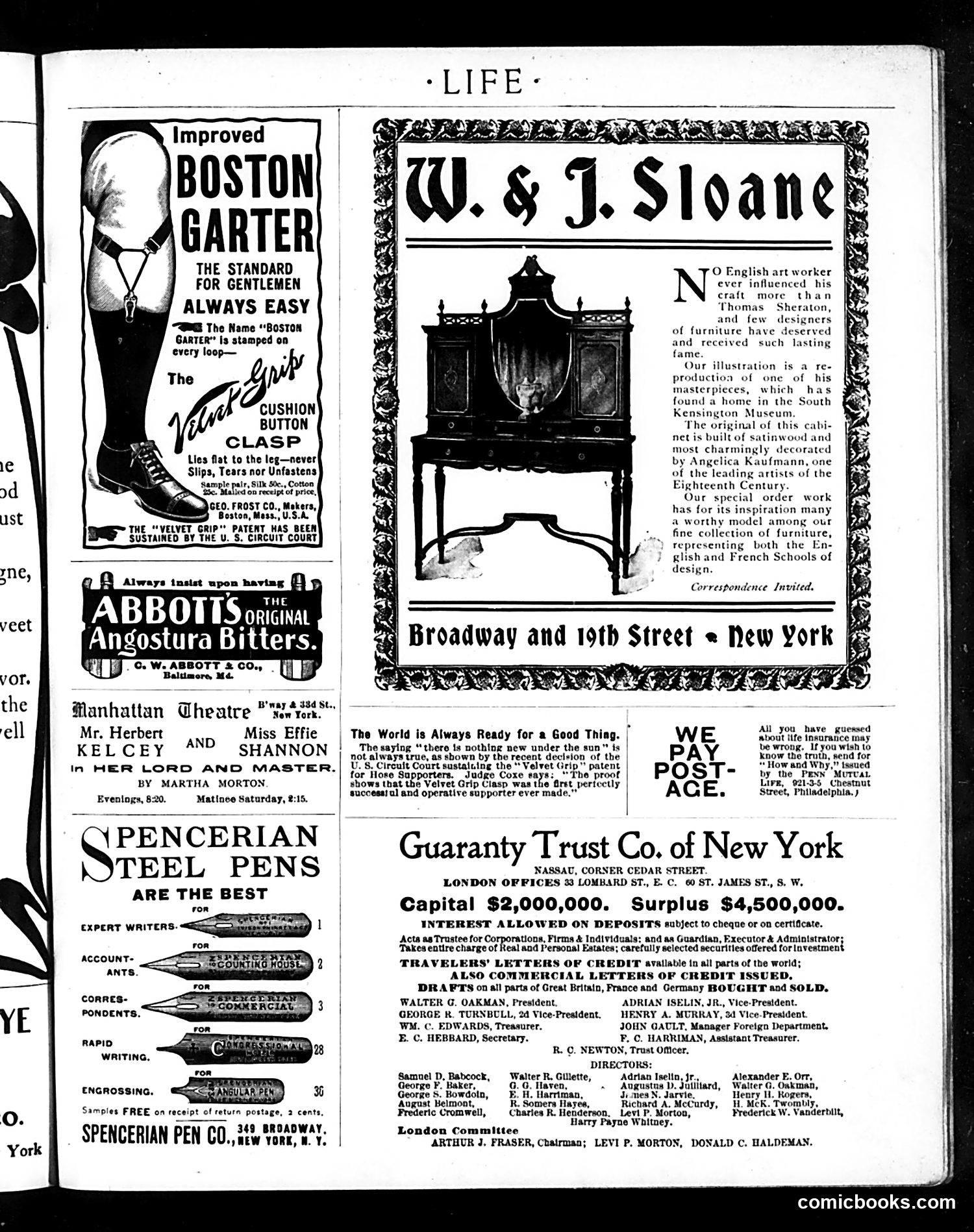
This page is primarily **advertising and corporate announcements**, not political satire or editorial cartoons. The upper portion features **product advertisements** for gentlemen's accessories (Boston Garter suspenders, Spencerian pens, Angostura bitters) and a furniture advertisement for **W. & J. Sloane**, a New York luxury retailer. The Sloane ad highlights an 18th-century English cabinet attributed to designer Thomas Sheraton. Below are **theater listings** for the Manhattan Theatre and a brief notice about a patent decision regarding the "Velvet Grip Clasp." The bulk of the page comprises **financial institution advertisements**: the Guaranty Trust Co. of New York displays its capital, board of directors (prominent wealthy names like George F. Baker and J.P. Morgan associate figures), and services offered. **There is no political cartoon or satirical content** on this page. It represents typical turn-of-the-century *Life* magazine advertising—targeting affluent readers through luxury goods, theater, and financial services.
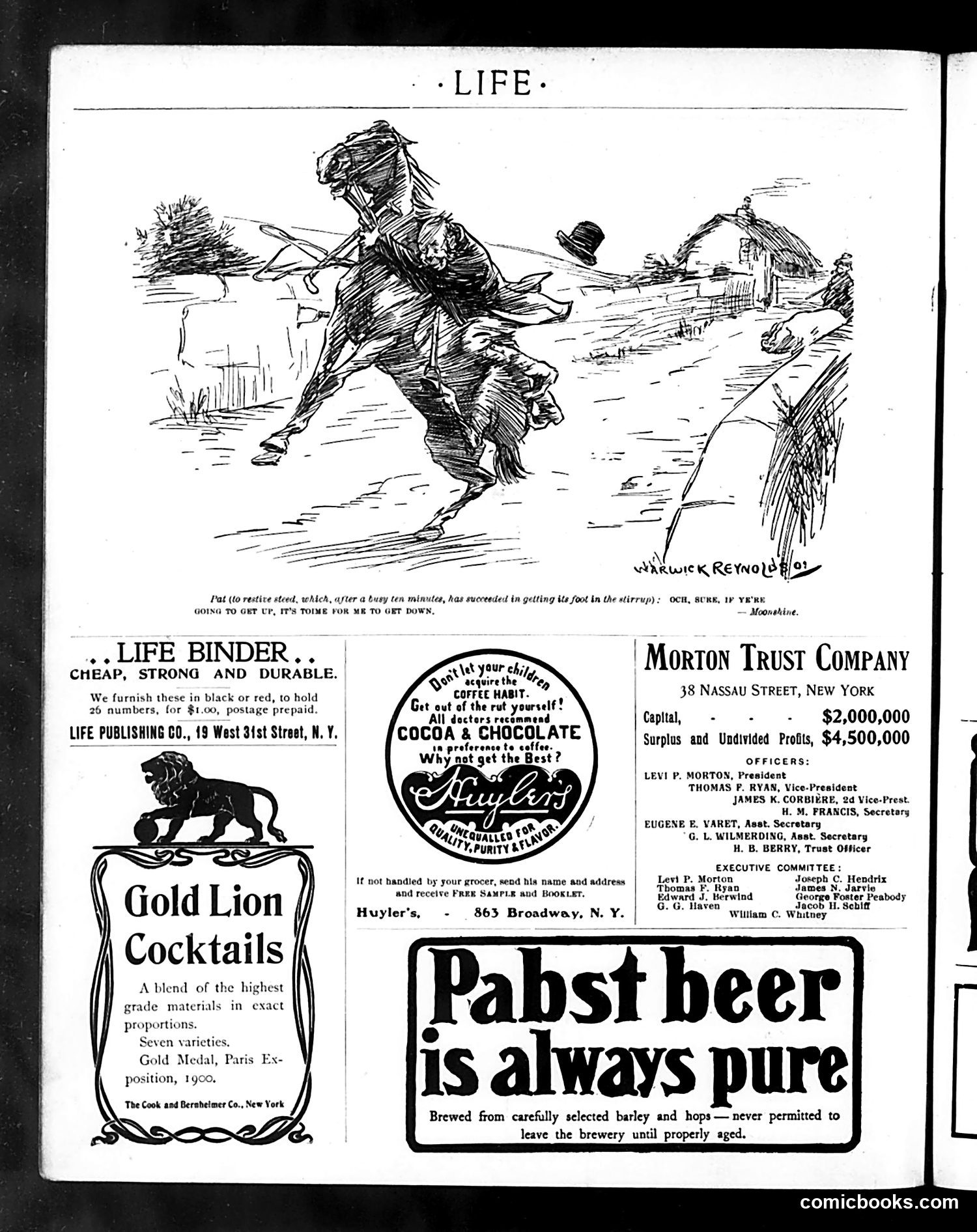
The main cartoon depicts an Irishman (identifiable by the "OCH" dialect and "Moonshine" attribution) on a bucking horse. The humor is a simple slapstick joke: after ten minutes of struggle, the rider finally gets his foot in the stirrup—only to announce it's time for him to dismount so the horse can get down. It's a play on exhaustion and comic timing, with the implication that both horse and rider are equally tired. The remainder of the page consists entirely of **advertisements**—Life binders, Gold Lion cocktails, Morton Trust Company, Huyler's cocoa, and Pabst beer. This was typical of early 1900s Life magazine, which blended satirical cartoons with commercial sponsors. The cartoons themselves carry no deeper political or social commentary; they were primarily vehicles for humor and entertainment.
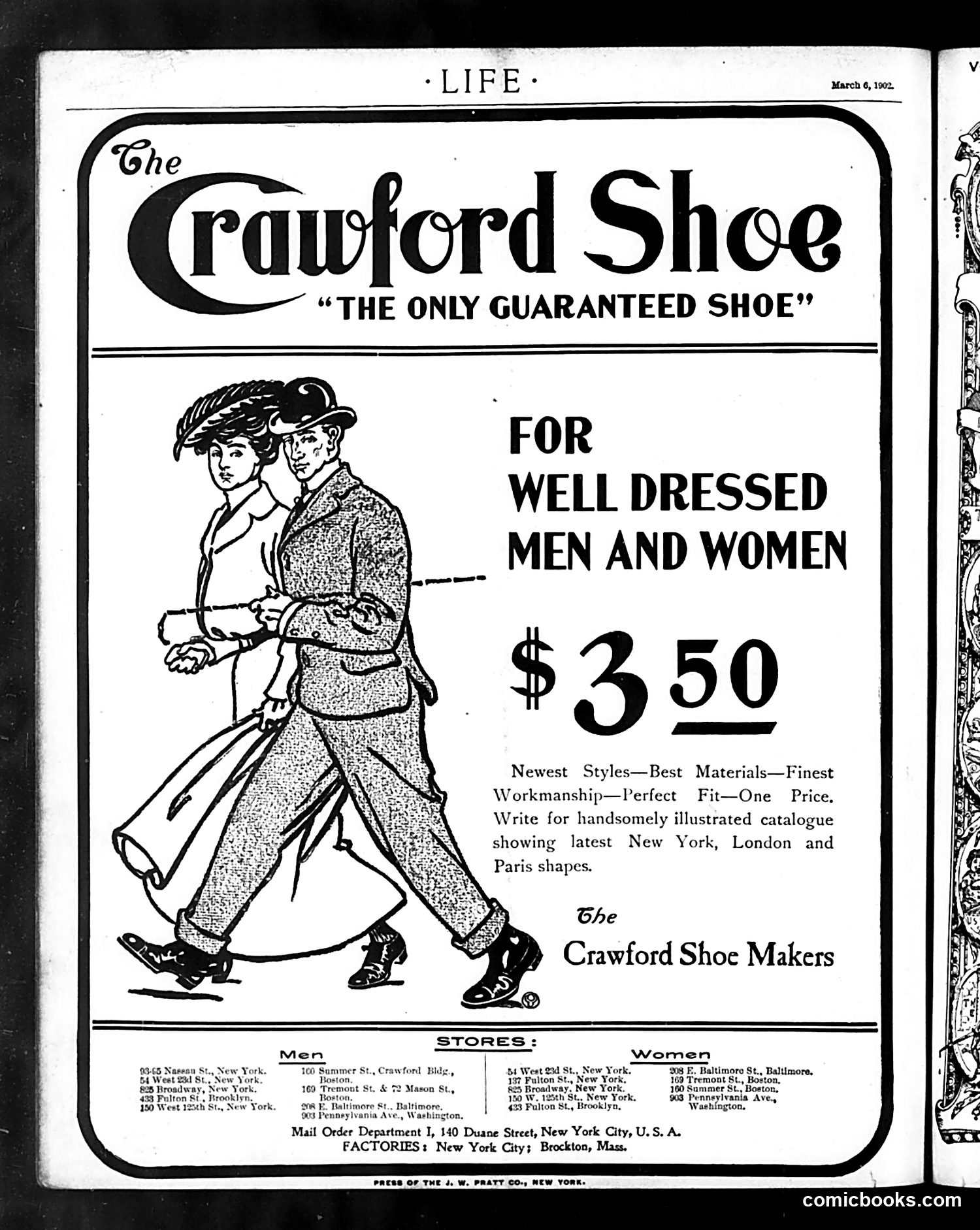
This is a **full-page advertisement**, not a cartoon or satire. It promotes the Crawford Shoe brand as "the only guaranteed shoe" priced at $3.50, marketed to "well dressed men and women." The illustration shows a fashionably dressed couple in early 1900s attire (the woman wears a large feathered hat; the man carries a cane), emphasizing that these shoes suit refined, stylish people. The ad emphasizes quality: "Newest Styles—Best Materials—Finest Workmanship—Perfect Fit—One Price." The stores listed were located in major cities (New York, Boston, Baltimore, Washington), with a mail-order option available from their Manhattan office. Factories operated in New York and Brockton, Massachusetts—Brockton being a historic shoe-manufacturing center. For modern readers: this represents early 1900s consumer culture, where branded shoes were aspirational goods marketed through lifestyle imagery rather than just product description.