
Life, 1902-03-06 · page 6 of 22
Life — March 6, 1902 — page 6: what you’re looking at
What you’re looking at
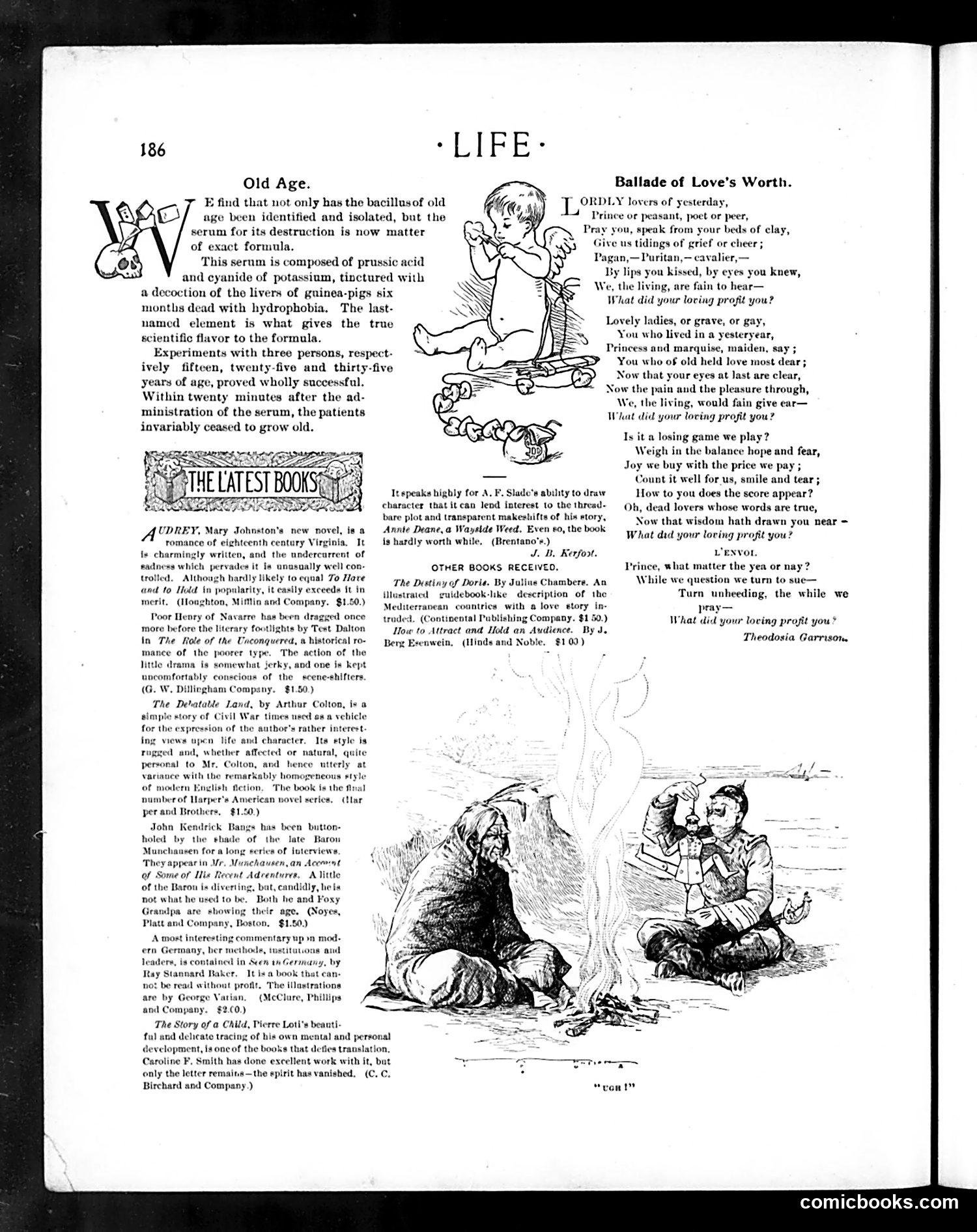
This page contains two distinct sections: **Upper left:** "Old Age" - A satirical medical piece describing a supposedly scientific serum (prussic acid and potassium cyanide) that destroys old age by killing the patient within twenty minutes. The dark humor mocks both dubious patent medicines and society's obsession with youth. **Upper right:** "Ballade of Love's Worth" - A poem by Theodsia Garrison using repeated refrain "What did your loving profit you?" to cynically examine romantic relationships and their disappointments. **Lower section:** Book reviews under "The Latest Books," discussing contemporary literature. **Bottom illustration:** An untitled sketch showing figures in what appears to be a comedic or cautionary scene, though the specific narrative is unclear from the image alone. The page exemplifies Life's characteristic blend of satirical commentary on contemporary anxieties—aging, love, and consumer culture—through humor and literary critique.
📄 Transcribed text from this page (OCR, searchable)
Machine-transcribed from the original scan — historical spelling and the odd misread are preserved.
Old Age. E find that not only has the bacillusof old age been identified and isolated, but the serum for its destruction is now matter of exact formula. This serum is composed of prussic acid and cyanide of potassium, tinctured with a decoction of the livers of guinea-pigs six months dead with hydrophobia, The last- named element is what gives the true scientific flavor to the formula. Experiments with three persons, respect- ively fifteen, twenty-five and thirty-five years of age, proved wholly successful. Within twenty minutes after the ad- ministration of the serum, the patients invariably ceased to grow old. Ballade of Love's Worth. \ ] ORDLY lovers of yesterday, 4 Prince of peasant, poet or peer, Pray you, speak from your beds of clay, Give us tidings of grief or cheer; p,—Puritan,— cavalier, — By lips you kissed, by eyes you knew, We, the living, are fain to hear— What did your loving profit you? . OF grave, OF gi ou Who lived in a yesteryear, Princess and marquise, maiden, say ; You who of old held love most dear; Now that your eyes at last are clear, in and the pleasure through, We, the living, would fain give ear— What did your toving progit you? Is it a losing game we play? Weigh in the balance hope and fear, Joy we buy with the price we pay ; Count it well for_us, smile and tear ; «THE LATEST BOOS ee, 2 AUDREY, Mary Johnston's new novel, is a romance of eighteenth century Virginia, It is charmingly written, and the undercarrent of sadness which pervades it I unusually well con- trolled. Although hardly likely to equal Jo Have and to Hold in popularity, it easily exceeds it in merit, (Hoaghton, Mifflin and Company. $1.00.) Poor I f Navarre has been dragged once Itspeaks highly for A. F, Slade's ability to draw. character that it can lend interest to the thread- bare plot and transparent makeshifts of his story, Annte Deane,a Wayside Weed. Even 80, the book is hardly worth while, (Brentano'+.) J.B. Kerfoot. OTHER BOOKS RECEIVED. The Destiny of Doris. By Julins Chambere. An Mlustratcd guidebook-like description of the Mediterranean coantrics with a love story in- traded. (Continental Publishing Company. $1 50.) How to you does the score appear? Ob, dead lovers whose words are true, Now that wisdom hath drawn you near = What did your loving profit you? L'ENVOL, Prince, what mutter the yea or nay? c We question we turn to sue— Turn unheeding, the while we pra your loving profit you? more before the literary footlights by Test Dalton How to Attract and Hold an Audience. By J. in The Role of the Unconquered, a historical ro- Berg Esenwein, (Hinds and Noble. $100) mance of the poorer type. The action of the little drama is somewhat jerky, and one is kept fortably conscious of the scene-shifters. Dilliegham Company. $1.50.) The Deratatle Land, by Arthur Colton, is a simple story of Civil War times used a8 a vehicle for the expression of the author's rather interest. ing views upen life and character, Ite etyle is rogged and, whether affected of natural, quite personal to Mr, Colton, and hence utterly at variance with the remarkably homogeneous style of modem clish th ”, he book is the fin number of Harper's American novel series. (Har per and Brothers, $1.20.) John Kendrick Bangs has been button holed by the thade of the late Barow Munchausen fora long eerics of interviews. ppearin Mr, Munchausen,an Accont Some of Mis Recent Adventures, Alittle of the Baron is diverting, bat, candidly, he is ‘not what he used to be. Both he and Foxy Grandpa are showing their age. (Noyes, Platt and C ny, Boston, $1.50.) A most in ing commentary up »n mod- ern Germany, ber methods, tnetituvons and leaders, is contained in Seen tn Germany, by Ray Stannard Baker, It is a book that can- not be reail without profit, The illastrations are by George Vatian, (McClure, Phillips and Company. $2.00.) The Story of a Child, Pierre Loti’s beanti- fu) and deheate tracing of bis own mental and personal development, is onc of the books that defies translation, Caroline F, Smith has done excellent work with it, but only the letter remaitis—the epirit has vanished, (C. Birchard and Company.) Theodosia Garrison, comicbooks.com