
Life, 1902-03-06 · page 4 of 22
Life — March 6, 1902 — page 4: what you’re looking at
What you’re looking at
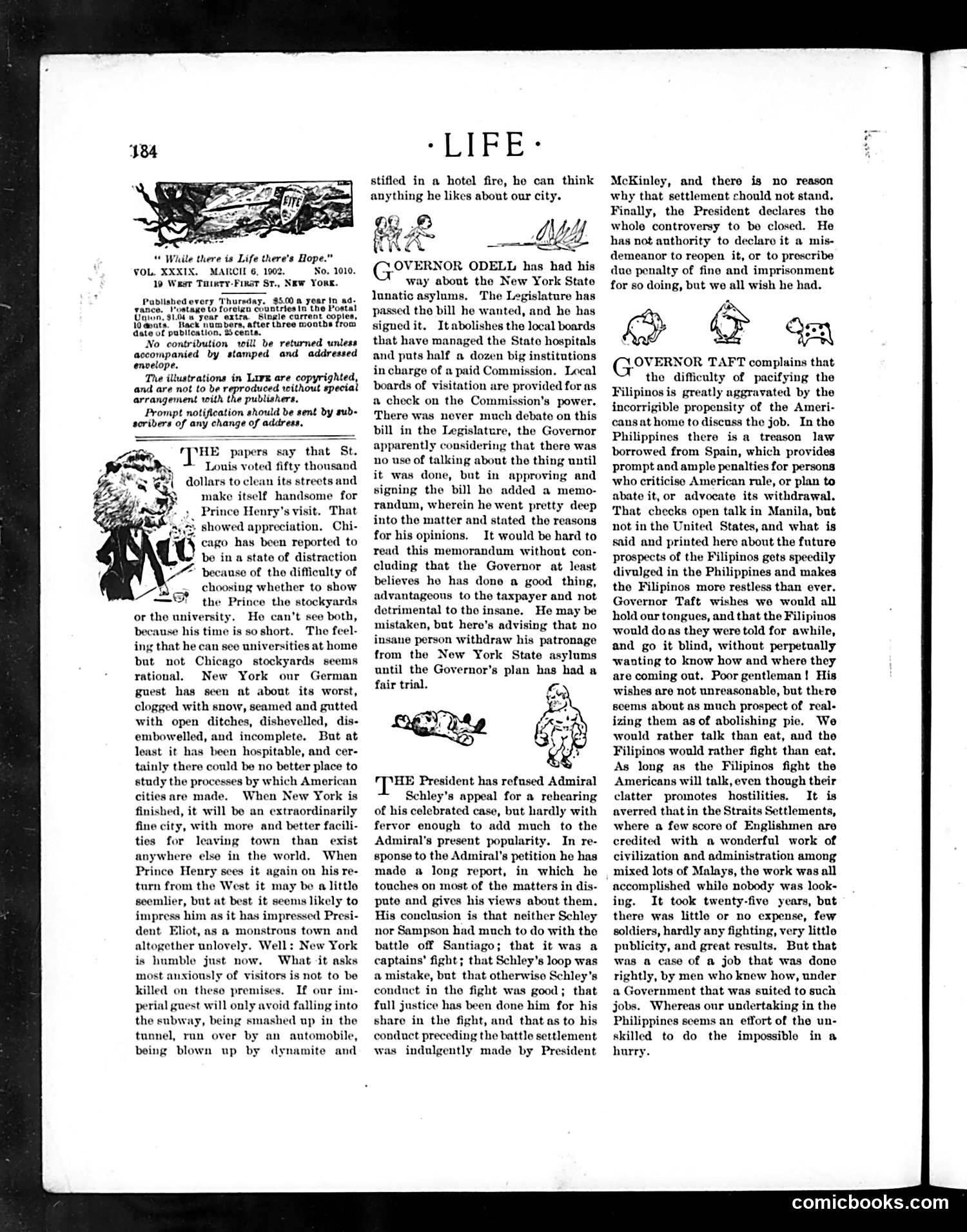
This page contains three political commentaries with small illustrations: 1. **St. Louis Streets**: A brief note mocking St. Louis's decision to spend thousands of dollars on street improvements while neglecting other civic needs—a critique of misplaced municipal priorities. 2. **Prince Henry's Visit**: Commentary on a German prince's visit to New York, satirizing the city's poor condition ("clogged with snow, seamed and gutted with open ditches"). The piece suggests New York is an embarrassing place to showcase American civilization, particularly compared to Chicago. 3. **Admiral Schley's Case**: Discussion of President Roosevelt's refusal to rehear Admiral Schley's appeal regarding the Battle of Santiago. The text defends Roosevelt's decision while critiquing Schley's conduct and popularity, suggesting the matter was justly settled.
📄 Transcribed text from this page (OCR, searchable)
Machine-transcribed from the original scan — historical spelling and the odd misread are preserved.
“ While there is Life there's Hope.” VOL. XXXIX. MARCII 6, 1902. No, 1010. 19 Wagr Taixty-Finat St., NEw YORK. Pablished every Thursday. $5.00 a year In ad. ‘ontage to forelan countries tn the Postal Si.Ot uw your extra. Single current copies. Rack numbers, after three months fro date of publication, 85 cents. No contribution will be returned unless accompanied by stamped and addressed envelope. The illustrations in Lure are copyrighted, and are not to be reproduced twithout special arrangement with the publishers, Prompt notification should be sent by sub- soribers of any change veoh address, rpHe papers say that St. Louis voted fifty thousand 2} dollars to clean its streets and : make itself handsome for Prince Henry’s visit. That . showed appreciation. Chi- cago has been reported to be ina state of distraction because of the difficulty of choosing whether to show the Prince the stockyards or the university. He can't see both, because his time is so short. The feel- ing that he can see universities at home but not Chicago stockyards seems rational. New York our German guest has seen at about its worst, clogged with snow, seamed and gutted with open ditches, dishevelled, dis- embowelled, and incomplete. But at least it has been hospitable, and cer- tainly there could be no better place to study the processes by which American cities are made. When New York is finished, it will be an extraordinarily fine city, with more and better facili- ties for leaving town than exist anywhere else in the world. When Prince Henry sees it again on his re- turn from the West it may be a little seemlier, but at best it seems likely to impress him as it has impressed Presi- dent Eliot, as a monstrous town and altogether unlovely. Well: New York is humble just now, What it asks most anxiously of visitors is not to be killed on these premises. If our im- perial guest will only avoid falling into the subway, being smashed up in the tunnel, run over by an automobile, being blown up by dynamite and LIFE stifled in a hotel fire, he can think anything he likes about our city. .OVERNOR ODELL has had his way about the New York State lunatic asylums. The Legislature has passed the bill he wanted, and he has signed it. It abolishes the local boards that have managed the Stato hospitals and puts half a dozen big institutions in charge of a paid Commission. Local boards of visitation are provided for as a check on the Commission’s power. There was never much debate on this bill in the Legislature, the Governor apparently considering that there was no use of talking about the thing until it was done, but in approving and signing the bill he added a memo- randum, wherein he went pretty deep into the matter and stated the reasons for his opinions. It would be hard to read this memorandum without con- cluding that the Governor at least believes he has done a good thing, advantageous to the taxpayer and not detrimental to the insane. He may be mistaken, but here’s advising that no insane person withdraw his patronage from the New York State asylums until the Governor’s plan has had a fair trial. HE President has refused Admiral Schley’s appeal for a rehearing of his celebrated case, but hardly with fervor enough to add much to the Admiral’s present popularity. In re- sponse to the Admiral’s petition he has made a long report, in which ho touches on most of the matters in dis- pute and gives his views about them. His conclusion is that neither Schley nor Sampson had much to do with the battle off Santiago; that it was a captains’ fight; that Schley’s loop was a mistake, but that otherwiso Schley’s conduct in the fight was good; that full justice has been done him for his share in the fight, and that as to his conduct preceding the battle settlement was indulgently made by President McKinley, and there is no reason why that settlement chould not stand, Finally, the President declares tho whole controversy to be closed. He has not authority to declare it a mis- demeanor to reopen it, or to prescribe due penalty of fine and imprisonment for so doing, but we all wish he had. GOVERNOR TAFT complains that the difficulty of pacifying the Filipinos is greatly aggravated by the incorrigible propensity of the Ameri- cansat home to discuss the job. In the Philippines there is a treason law borrowed from Spain, which provides prompt and ample penalties for persons who criticise American rule, or plan to abate it, or advocate its withdrawal. That checks open talk in Manila, but not in the United States, and what is said and printed here about the future prospects of the Filipinos gets speedily divulged in the Philippines and makes the Filipinos more restless than ever. Governor Taft wishes we would all hold our tongues, and that the Filipinos would doas they were told for awhile, and go it blind, without perpetually wanting to know how and where they are coming out. Poor gentleman! His wishes are not unreasonable, but there seems about as much prospect of real- izing them as of abolishing pie. We would rather talk than eat, and the Filipinos would rather fight than eat. As long as the Filipinos fight the Americans will talk, even though their clatter promotes hostilities. It is averred that in the Straits Settlements, where a few score of Englishmen are credited with a wonderful work of civilization and administration among mixed lots of Malays, the work was all accomplished while nobody was look- ing. It took twenty-five years, but there was little or no expense, few soldiers, hardly any fighting, very little publicity, and great results, But that was a case of a job that was done rightly, by men who knew how, under a Government that was suited to such jobs. Whereas our undertaking in the Philippines seems an effort of the un- skilled to do the impossible in a hurry. comicbooks.com