
A complete issue · 22 pages · 1901
Life — November 28, 1901
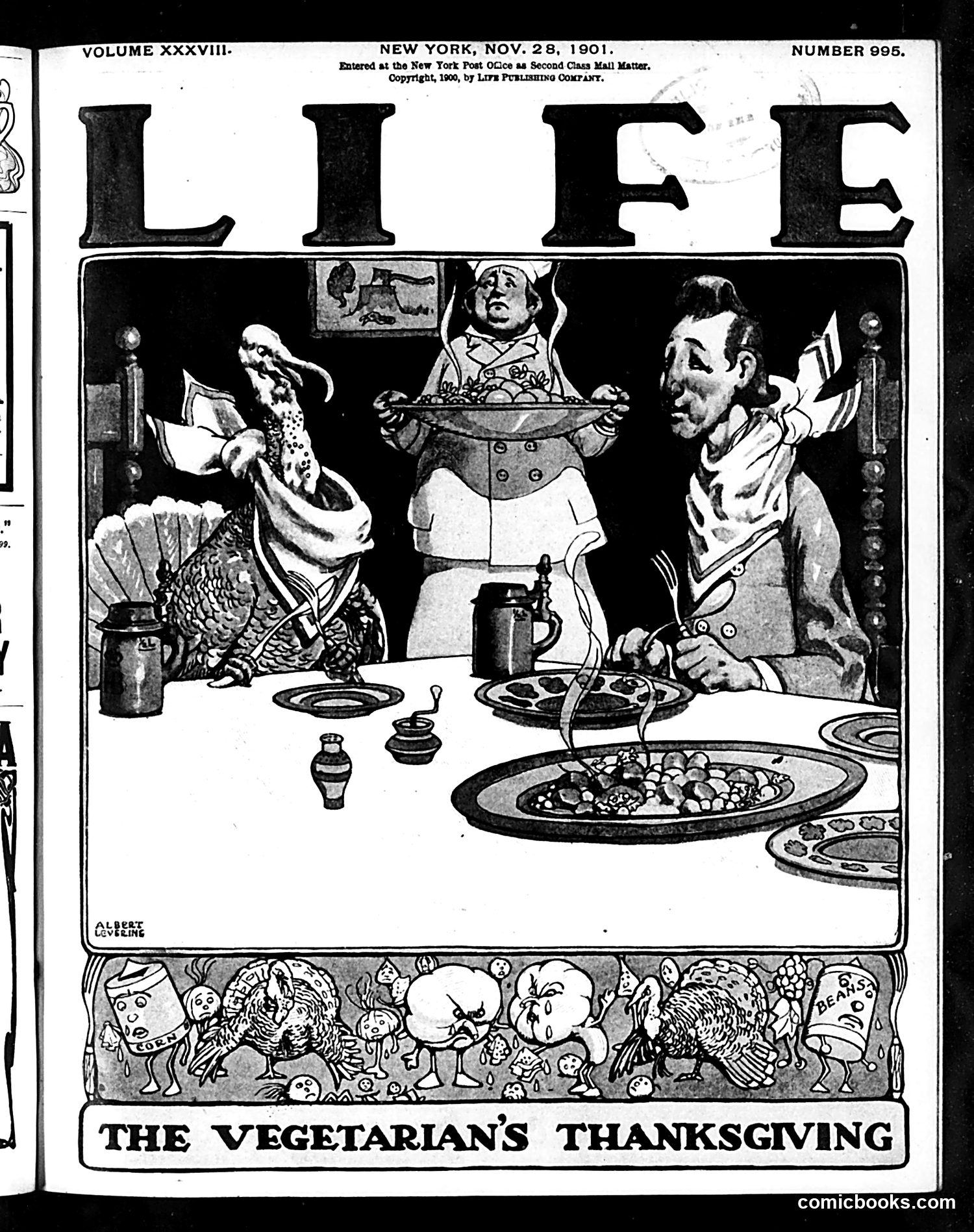
This satirical cartoon mocks vegetarianism, a growing dietary movement in early 1900s America. The illustration depicts a Thanksgiving dinner where two thin, gaunt men sit at a table with a live turkey and various vegetable dishes—an absurd contrast to traditional meat-based holiday meals. The exaggerated caricatures of the vegetarians appear malnourished and unwell, emphasizing the era's common mockery that plant-based diets were unhealthy or unmanly. The live bird present suggests the vegetarians' squeamishness about eating meat, while the sparse vegetable offerings underscore contemporary skepticism about vegetarianism's adequacy as nutrition. The decorative border features whimsical vegetables and figures, adding to the satirical tone. This reflects late-Victorian-era attitudes dismissing vegetarianism as eccentric or effeminate.
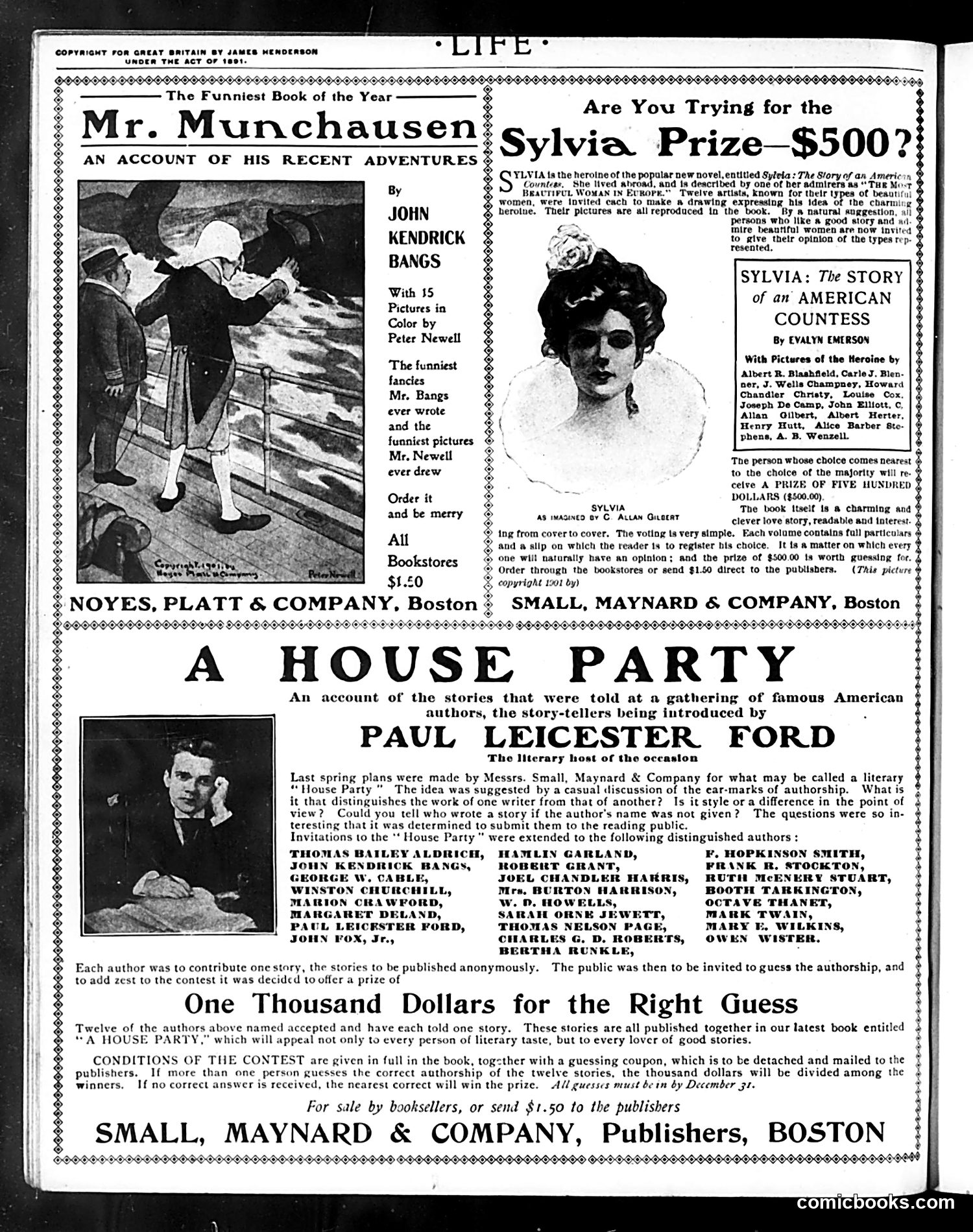
This page is primarily **advertising** for three literary products, with minimal satirical content. The top left advertises "Mr. Munchausen," a humorous book by John Kendrick Bangs illustrated by Peter Newell. The title references Baron Munchausen, the fictional character famous for absurdly exaggerated tall tales—appropriate for a book marketed as "The Funniest Book of the Year." The right side promotes "Sylvia: The Story of an American Countess" by Evalyn Emerson, offering a $500 prize for artwork depicting the heroine. The lower section advertises "A House Party," a collaborative fiction collection where twelve famous American authors each contributed anonymous stories, with readers invited to guess authorship for a $1,000 prize. All three are promotional pieces for Small, Maynard & Company publishers, with no significant political satire or social commentary evident.
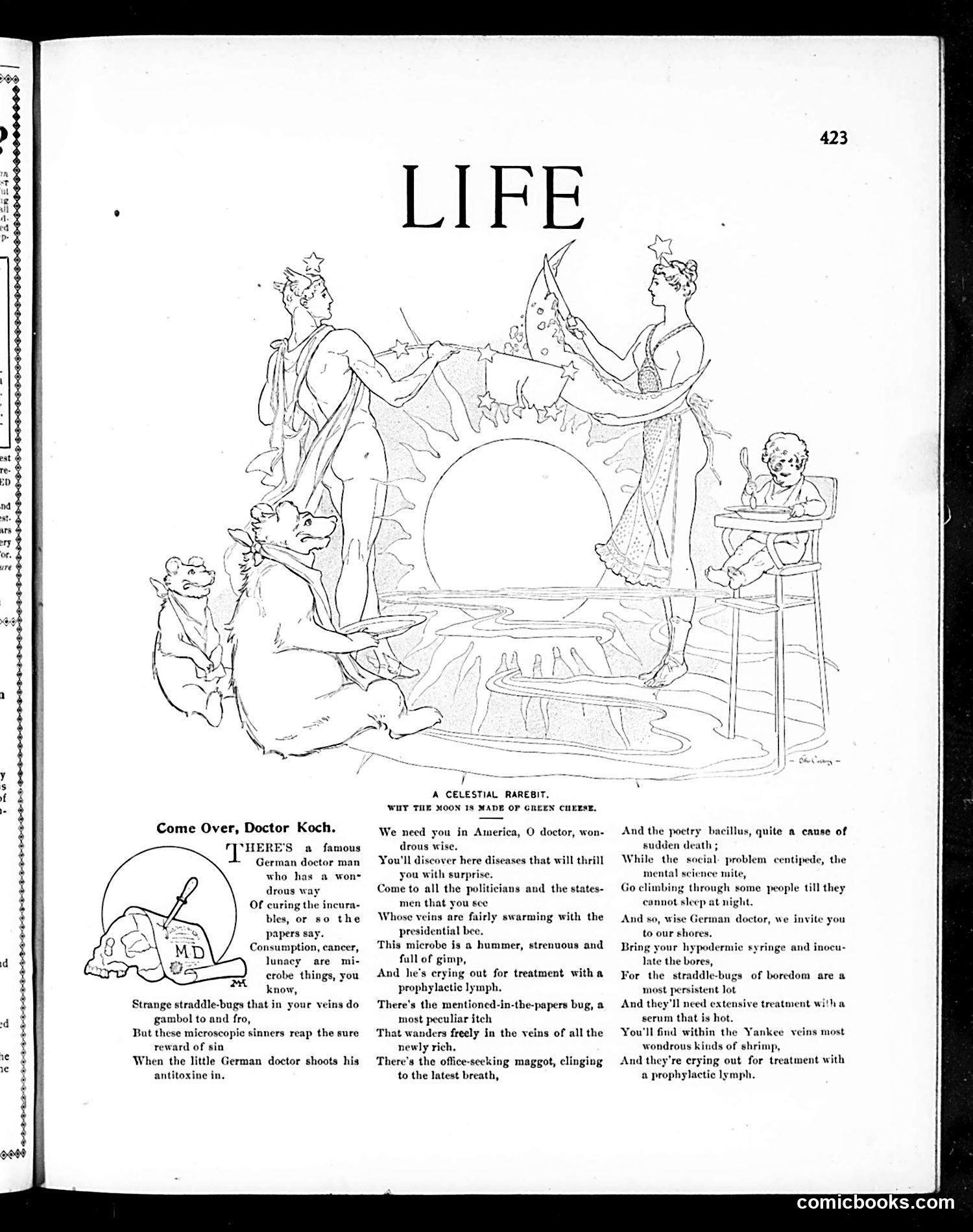
**Top Illustration**: "A Celestial Rarebit: Why the Moon is Made of Green Cheese" depicts classical figures and cherubs around a large circular object (the moon), satirizing fantastical scientific claims about celestial bodies. **"Come Over, Doctor Koch"**: This poem mocks a German doctor (likely referring to Robert Koch, the famous bacteriologist) and American diseases. The satire ridicules European medical expertise while listing American ailments with dark humor—"consumption, cancer, lunacy" and various parasites. It's a jingoistic jab suggesting American doctors don't need foreign help despite health problems. The small circular emblem marked "MD" reinforces the medical theme. The satire reflects early 20th-century American-European tensions and skepticism toward foreign medical authority.
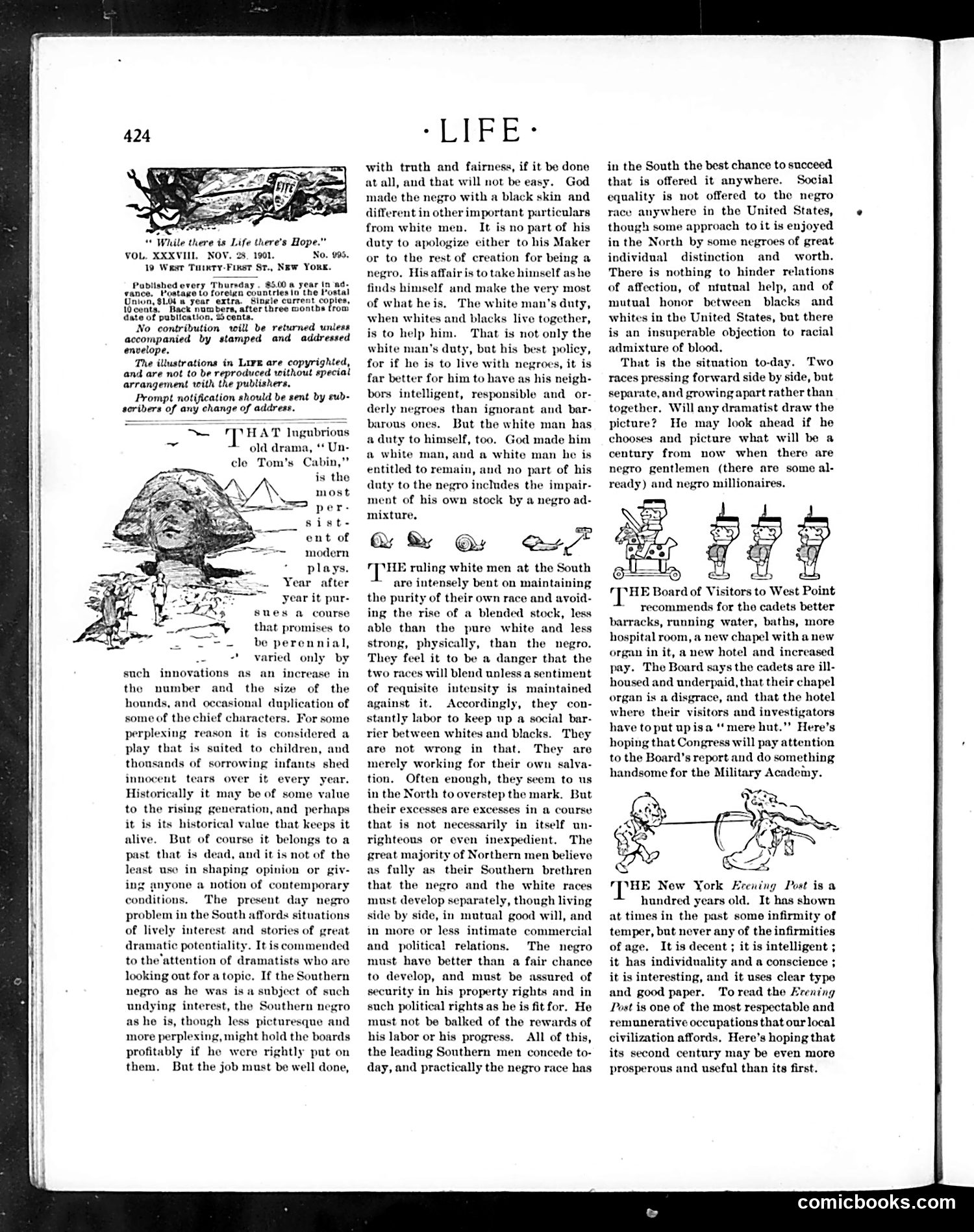
This page contains editorial commentary on race relations rather than traditional political cartoons. The illustrations appear to be decorative vignettes rather than satirical commentary. The text addresses contemporary debates about racial separation in the American South, specifically discussing whether whites and blacks should live separately or together. The author argues against racial mixing while acknowledging the Negro's humanity and right to fair treatment. The brief mention of the New York *Evening Post* (celebrating its centennial) and West Point military recommendations at the bottom are administrative notes rather than satirical content. The overall tone reflects early 1900s attitudes on segregation—attempting to balance paternalistic racial ideology with claims of fairness, a perspective that would be considered deeply racist by modern standards.
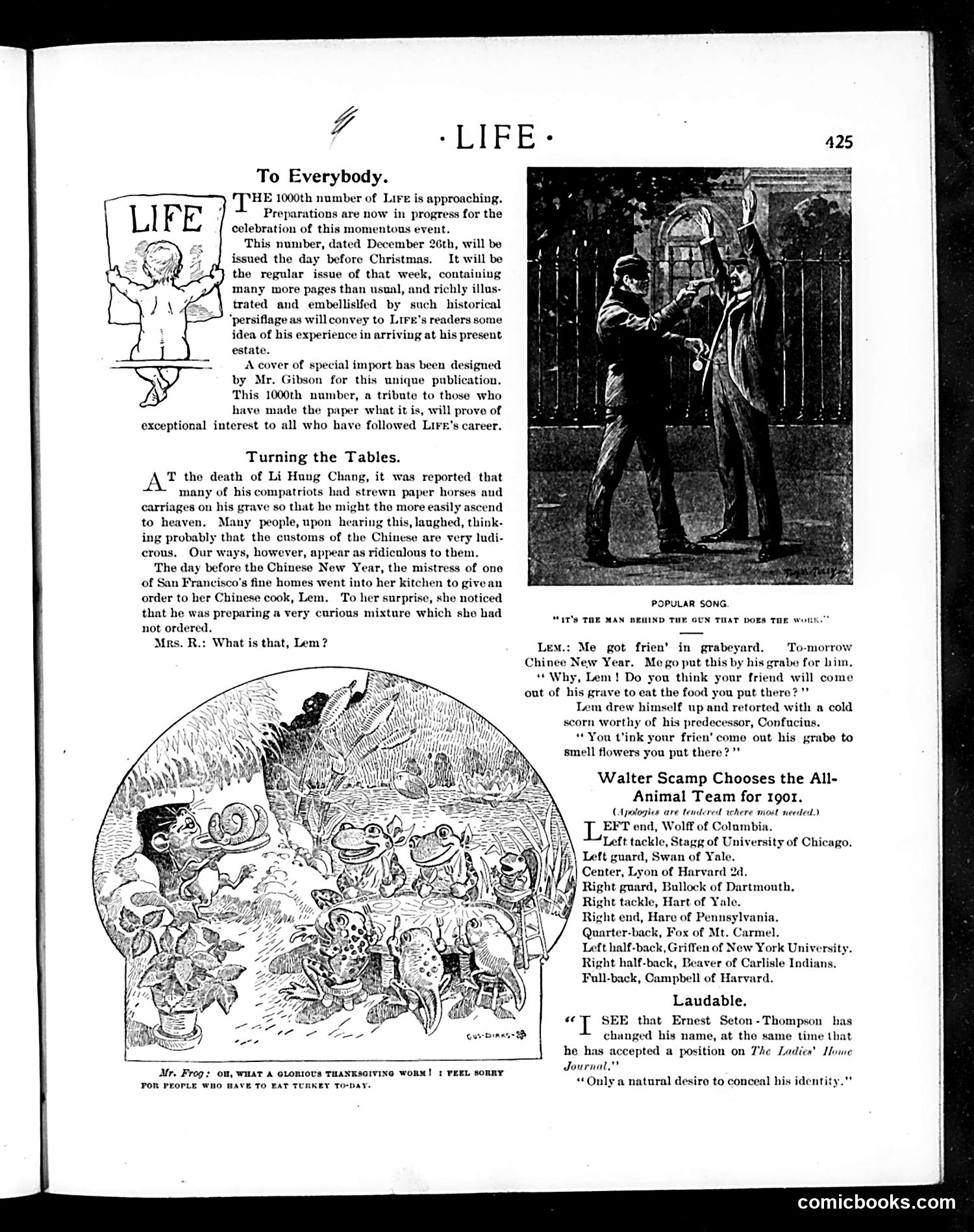
This page contains three distinct pieces of humor: 1. **"To Everybody"** announces Life's 1000th issue (dated December 28th), presenting this as a momentous celebration. 2. **"Turning the Tables"** is a brief comedic anecdote about cultural misunderstanding. A San Francisco housewife asks her Chinese cook Lem what he's preparing before Chinese New Year. Lem explains he's making food for his deceased friend's grave so the friend can eat in the afterlife. The joke mocks both Chinese funeral customs as "ludicrous" and the housewife's naive surprise—the satire cuts both ways, critiquing American dismissal of unfamiliar traditions. 3. **"Mr. Frog"** cartoon depicts anthropomorphic frogs in Thanksgiving dinner chaos, with the caption commenting on eating turkey—dark humor about prey animals.
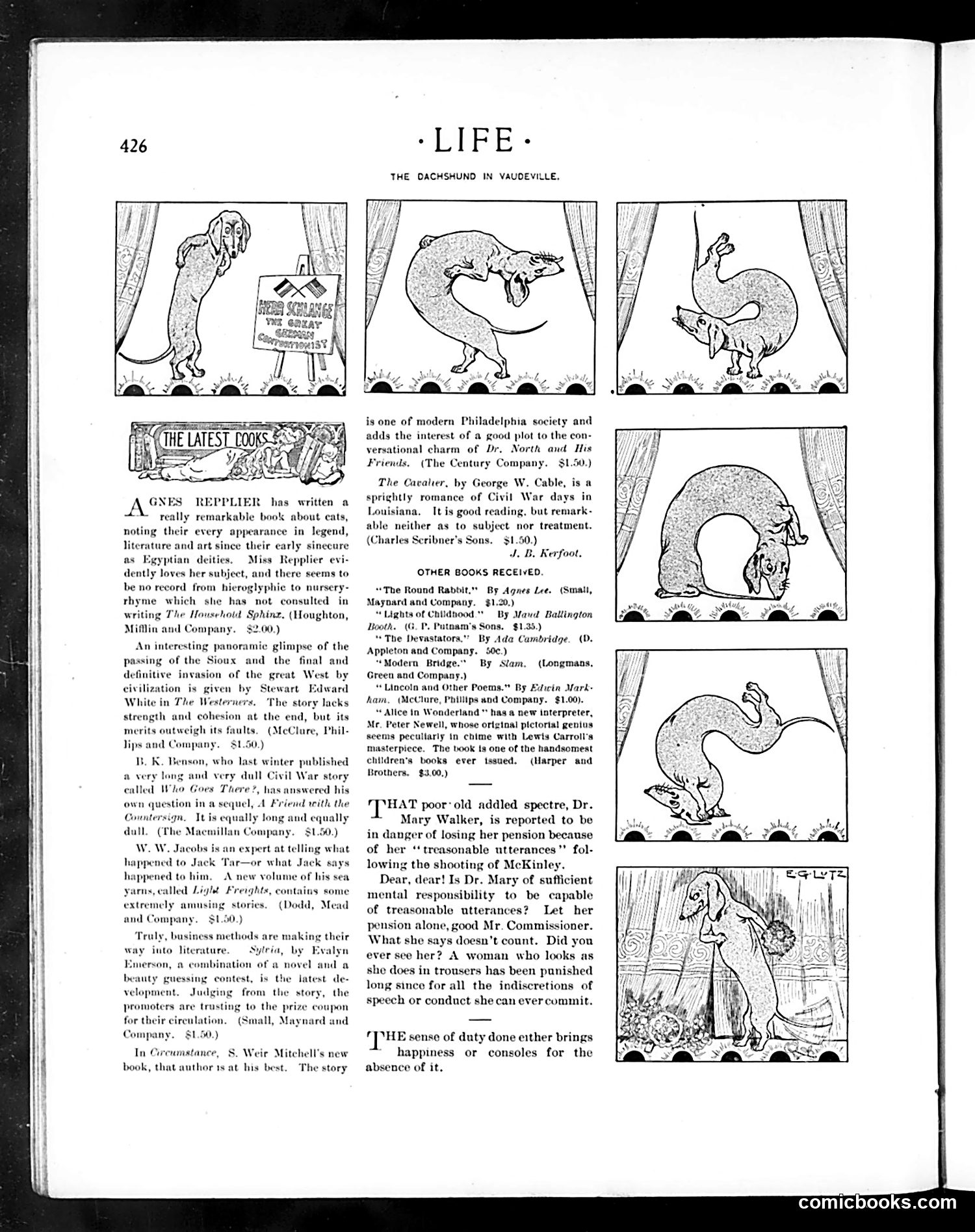
This comic strip sequence satirizes the dachshund dog breed's distinctive long, low body shape by depicting it performing in a vaudeville theater act. The strip shows the dog in various contorted poses—stretching, curling, and positioning itself in exaggerated ways—as if performing acrobatic tricks for an audience (indicated by the footlights shown as semi-circles). The joke plays on the dachshund's naturally elongated form, treating it as if the dog were a deliberately trained performer exploiting its unusual physiology for entertainment. This reflects early 20th-century vaudeville culture, when animals performing tricks were popular stage acts. The cartoonist humorously suggests the breed's shape makes it naturally suited to theatrical performance.
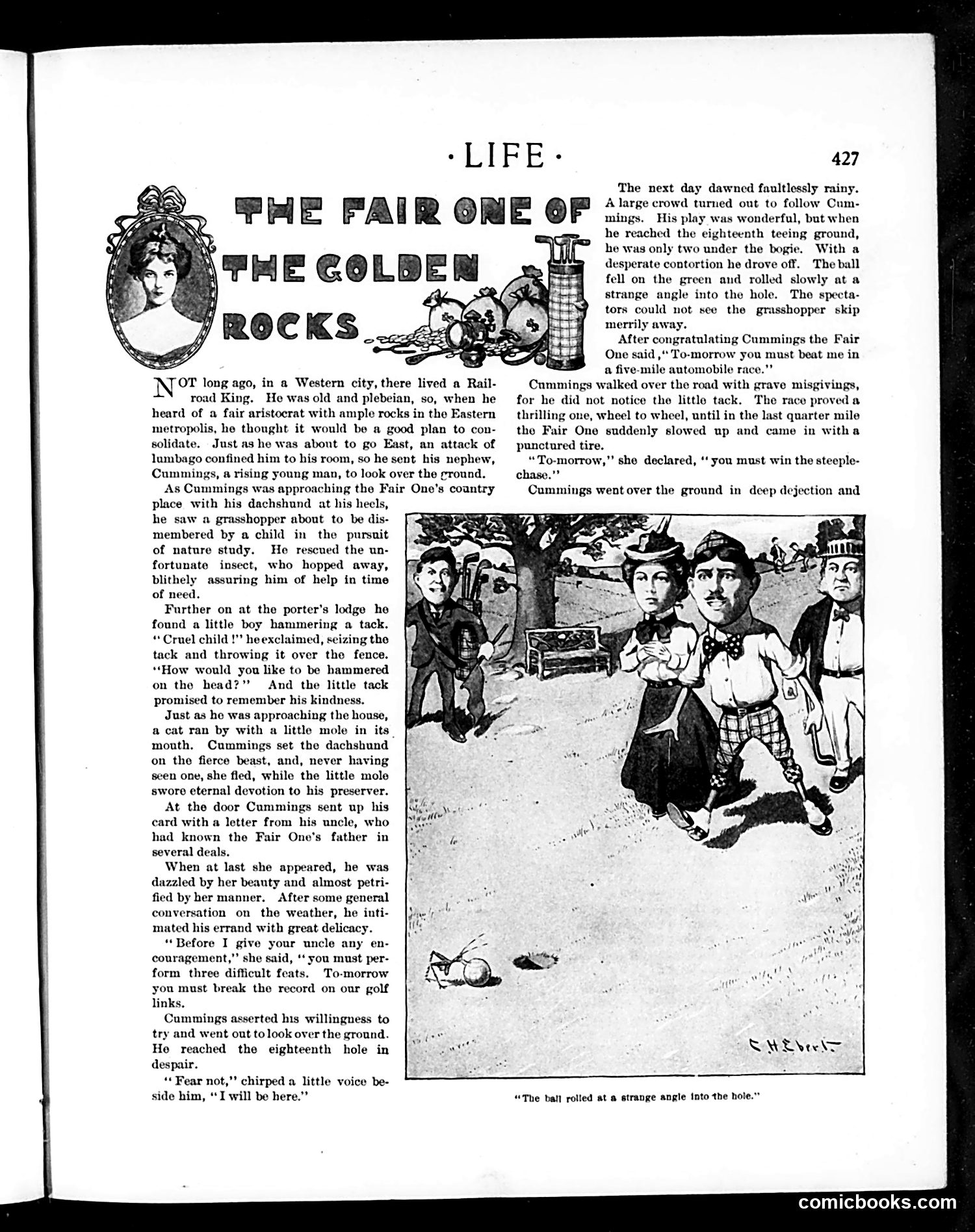
This is a fictional short story illustrated with a narrative cartoon, not political satire. The plot concerns a railroad magnate ("Railroad King") who sends his nephew Cummings to a Western fair to scout golden rocks for business consolidation. At the fair, Cummings encounters "the Fair One"—an attractive woman—and becomes smitten. She challenges him to perform three difficult feats to win her favor, including breaking a golf record. The illustration shows spectators watching as a golf ball rolls into a hole at an odd angle. The story is lighthearted romantic fiction typical of Life magazine's entertainment content, with no apparent political commentary or social satire.
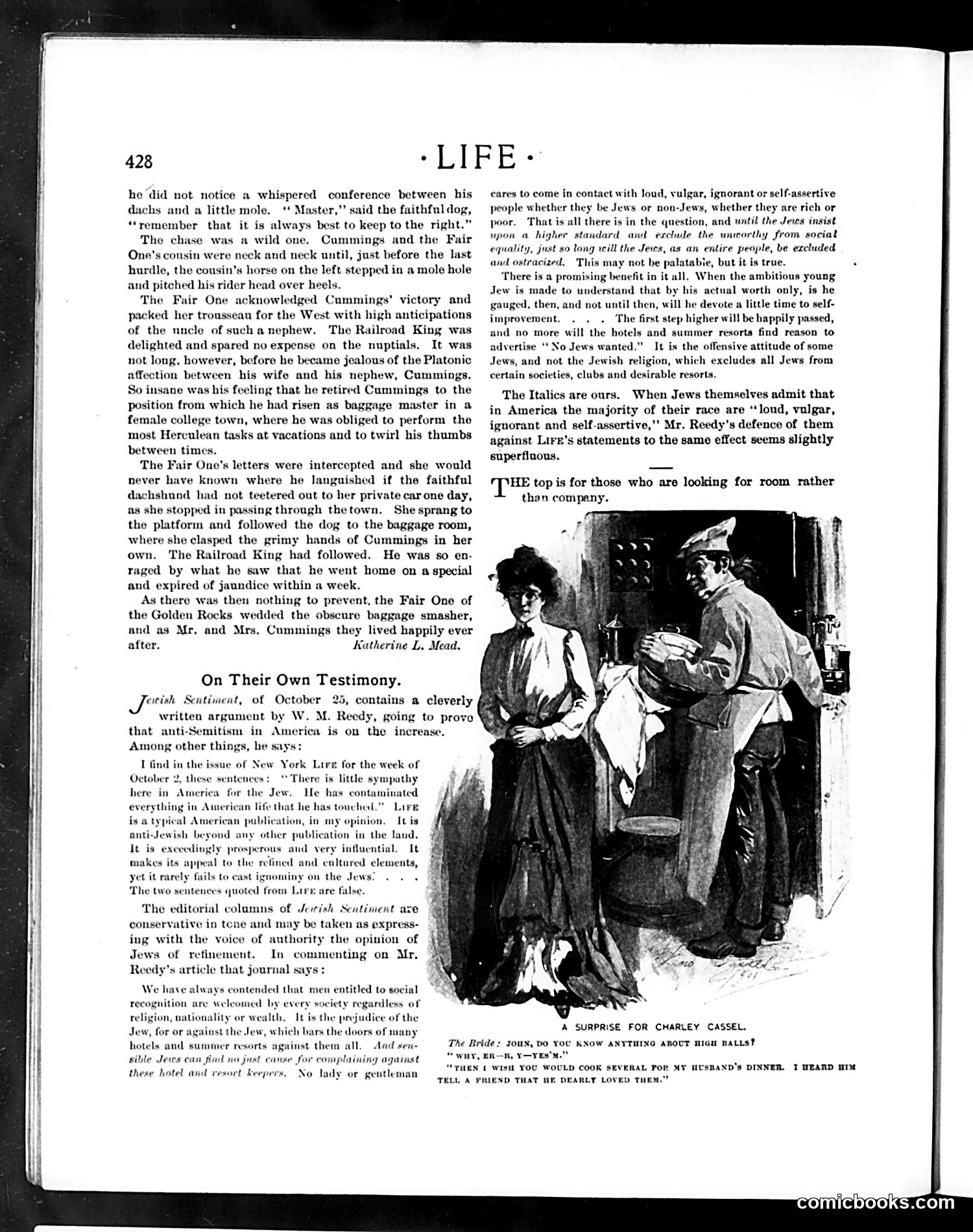
This page contains anti-Semitic content typical of early 20th-century American publications. The cartoon titled "A Surprise for Charley Cassel" depicts a woman at a doorway, with dialogue about her husband's infidelity and dinner plans. The accompanying article discusses anti-Semitism in America, citing *Jewish Sentiment* magazine's criticism of *Life* itself for promoting prejudice against Jews. The text acknowledges that *Life* is "anti-Jewish beyond any other publication" and notes the magazine's influential reach among educated audiences. The article defends excluding Jews from hotels and resorts, presenting discriminatory practices as socially acceptable. This page documents how mainstream American media actively promoted and normalized anti-Semitic attitudes during this period.
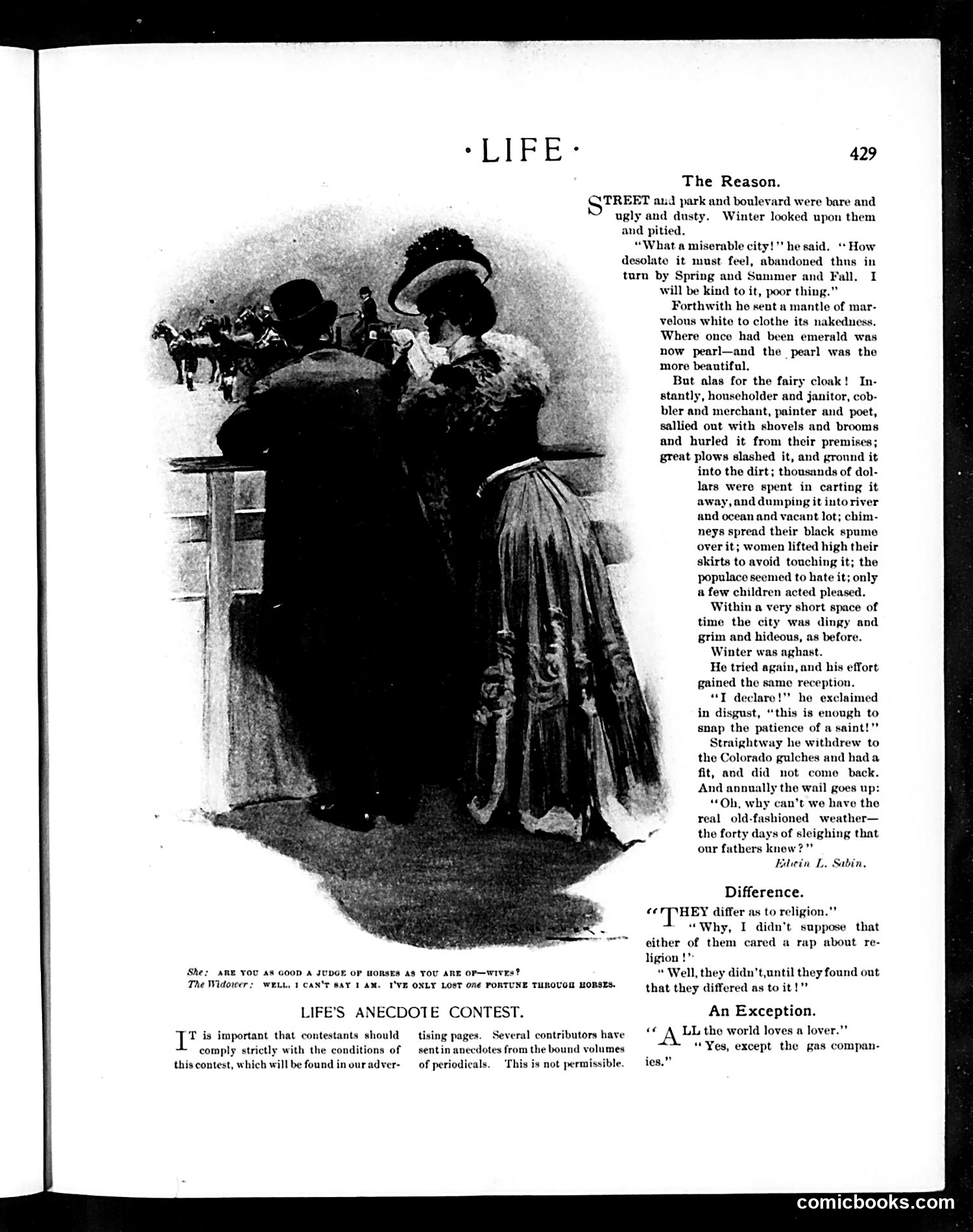
The main illustration depicts two figures in winter clothing (one in a large fur cloak, the other in a long skirt) observing a snow-covered street. The caption reads: "She: ARE YOU AS GOOD A JUDGE OF HORSES AS YOU ARE OF—WIFE? The Widower: WELL, I CAN'T SAY I AM. I'VE ONLY LOST ONE FORTUNE THROUGH HORSES." This is a widow/widower joke playing on marital misfortune. The widower's self-deprecating response suggests his late wife cost him financially—comparing spousal expense to horse-breeding losses, a common wealthy man's problem. The humor relies on period assumptions about marriage being economically risky for men and women as financial burdens. Below are three brief anecdotes ("The Reason," "Difference," "An Exception") offering short satirical observations about winter, religion, and romance—typical Life magazine filler humor.
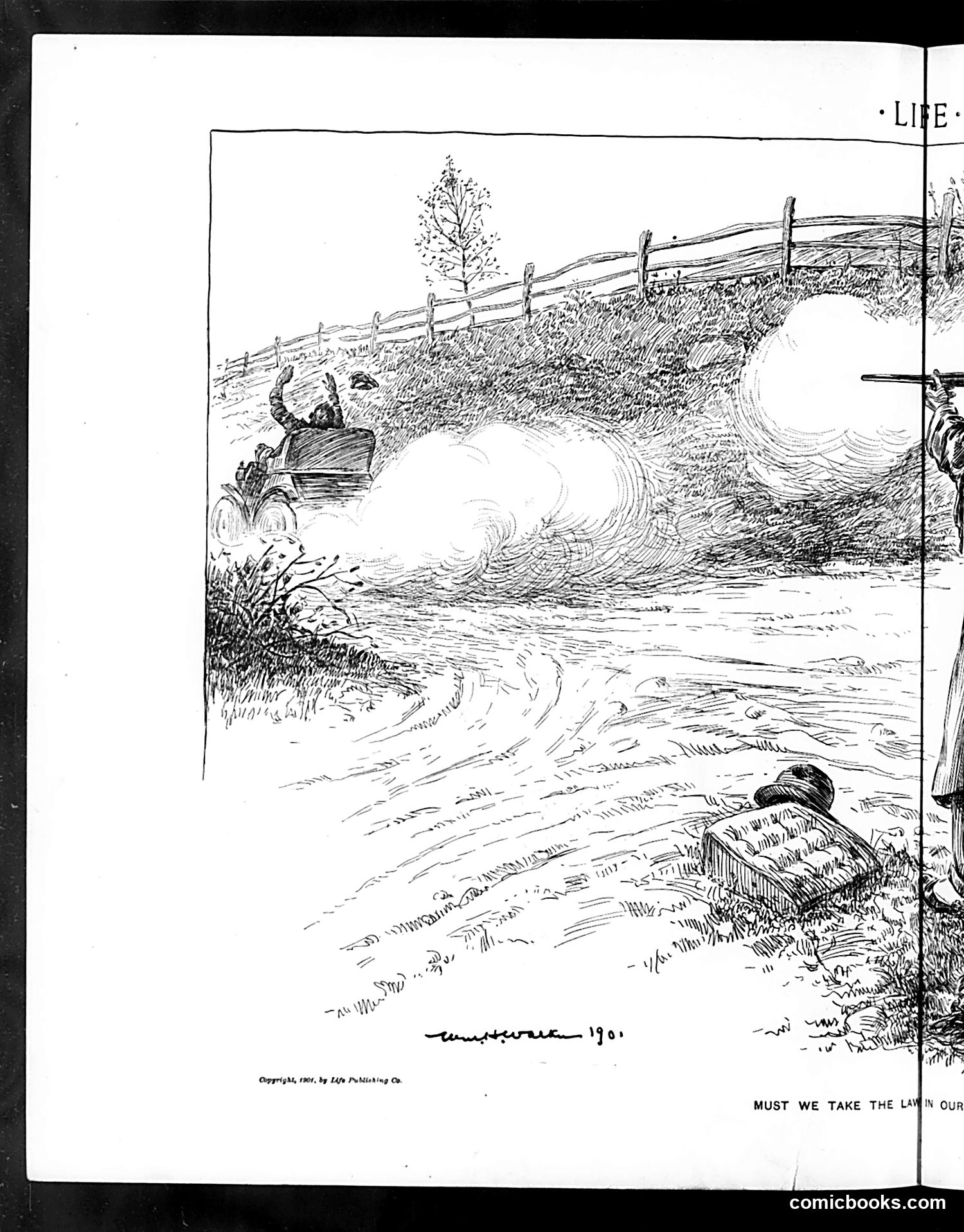
This 1901 Life magazine cartoon depicts a chaotic rural scene with large waves of water threatening a landscape. A figure in a cart on a hill appears distressed, arms raised in alarm. The bottom text reads "MUST WE TAKE THE LAW IN OUR" (incomplete). The cartoon likely comments on environmental or agricultural disaster—possibly flooding or water management issues affecting rural communities in early 1900s America. The figure's panic suggests farmers or rural residents facing uncontrollable natural forces or regulatory challenges beyond their control. The incomplete caption suggests the full message concerned whether citizens must accept ("take the law") regarding water rights, flooding prevention, or environmental regulation—topics of significant political debate during this era of industrial expansion and water resource conflicts. The artist's signature appears to be dated 1901.
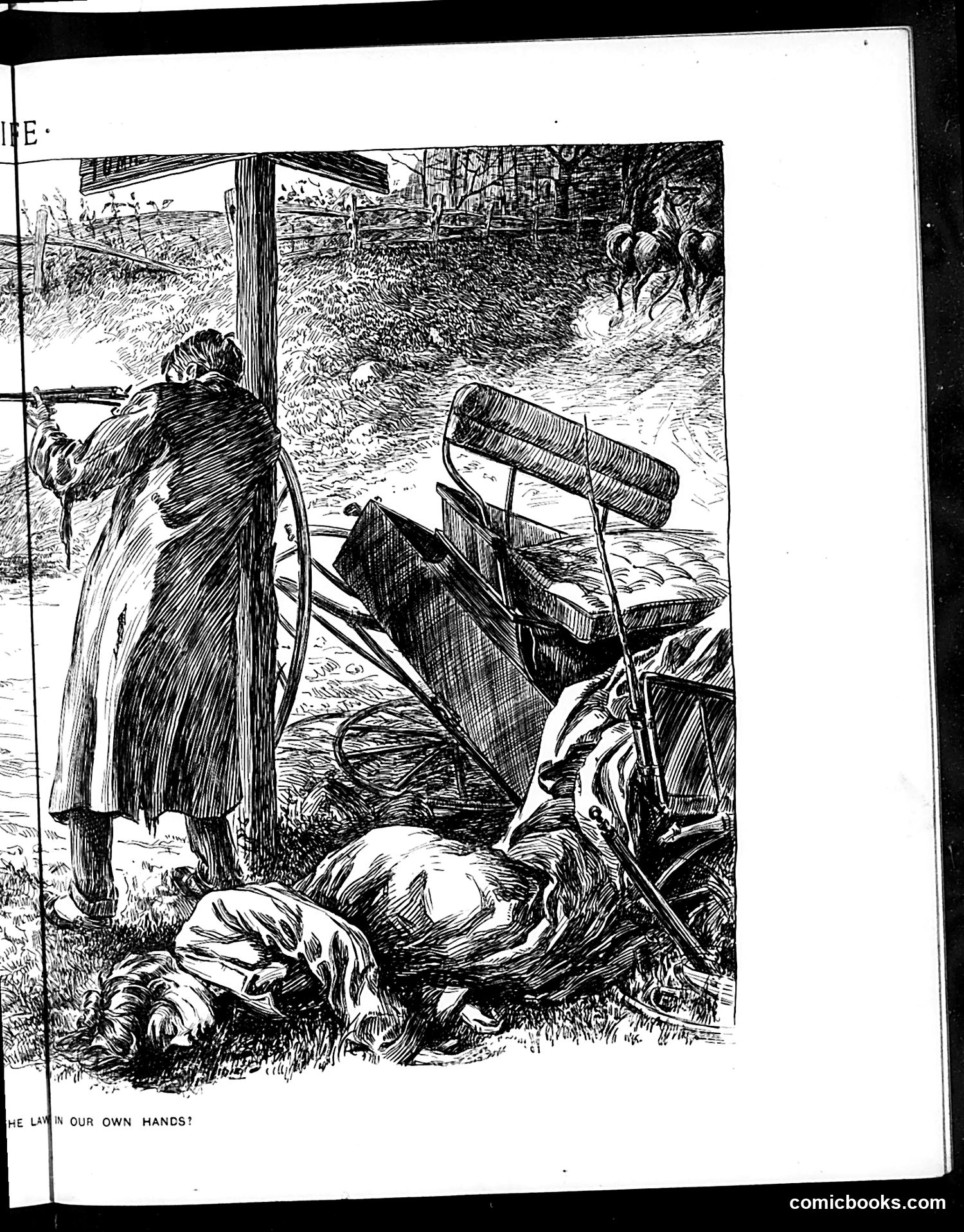
This is a satirical illustration from *Life* magazine showing a farm scene. The visible caption reads "HE LAY IN OUR OWN HANDS!" The image depicts a figure standing over what appears to be an injured or fallen man lying on the ground near farm equipment and animals. The scene suggests a rural accident or incident. The exclamatory caption implies that whoever "lay in our hands" was within the power or control of the people depicted—suggesting commentary on responsibility, negligence, or a missed opportunity to prevent harm. Without additional context, article text, or identifying details visible on the page, I cannot definitively identify the specific political or social commentary this cartoon targets. The rural setting and the emphasis on having someone "in our hands" suggests themes of accountability, but the precise historical reference remains unclear.
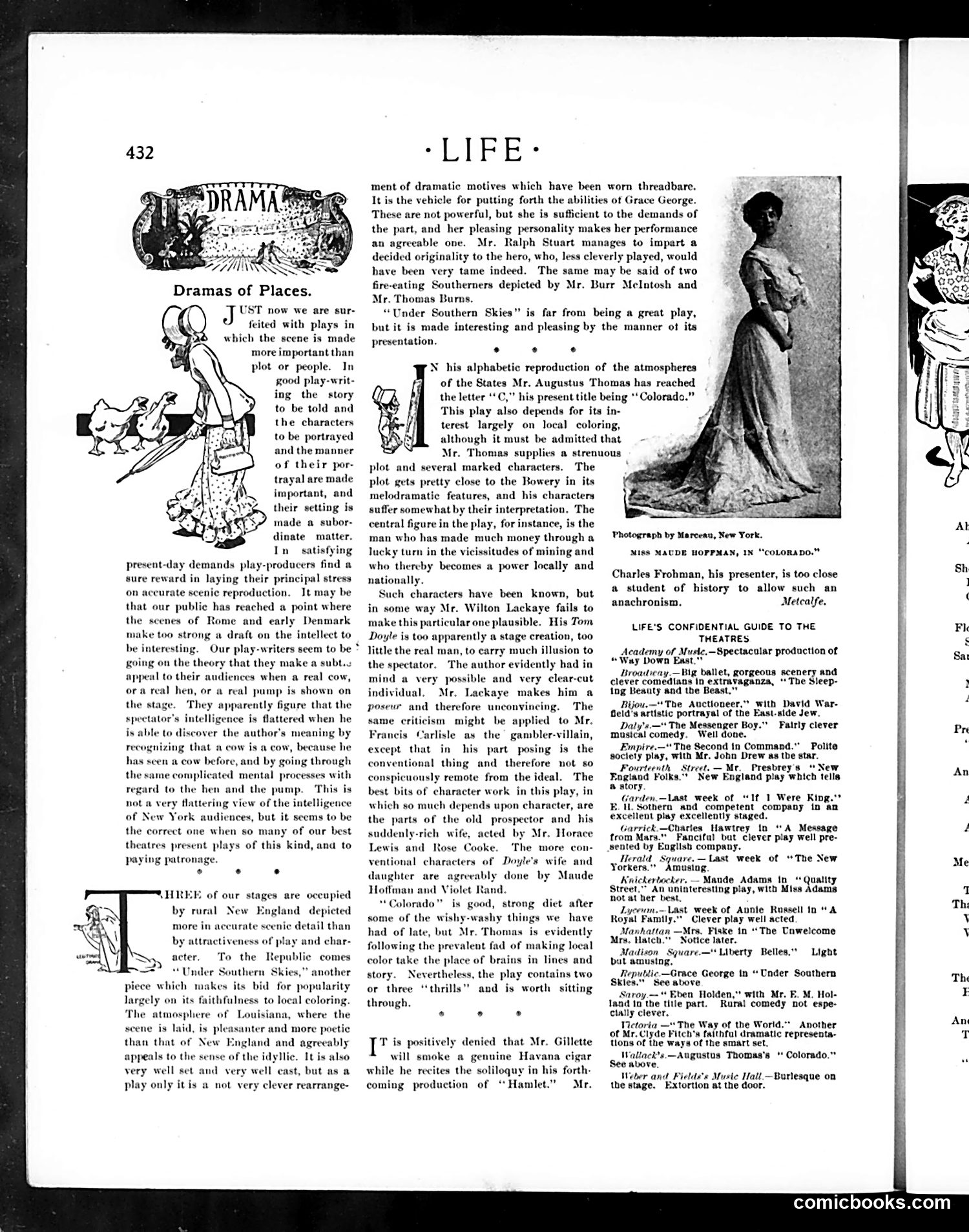
This is a theater review column discussing how **setting matters as much as plot and characters** in stage productions. The author argues that accurate scenic reproduction—depicting authentic locations like Rome, Denmark, Louisiana, or the American South—appeals to audiences and enhances performances. The illustrated vignettes show theatrical scenes and characters in costume, emphasizing the **importance of detailed set design** to theatrical success. The column reviews several contemporary plays including "Under Southern Skies," "Colorado," and references actors like Ralph Stuart and Augustus Thomas. It critiques some productions as unconvincing while praising others for atmospheric authenticity. This reflects early 20th-century theater criticism valuing **realistic scenography** as central to dramatic art.
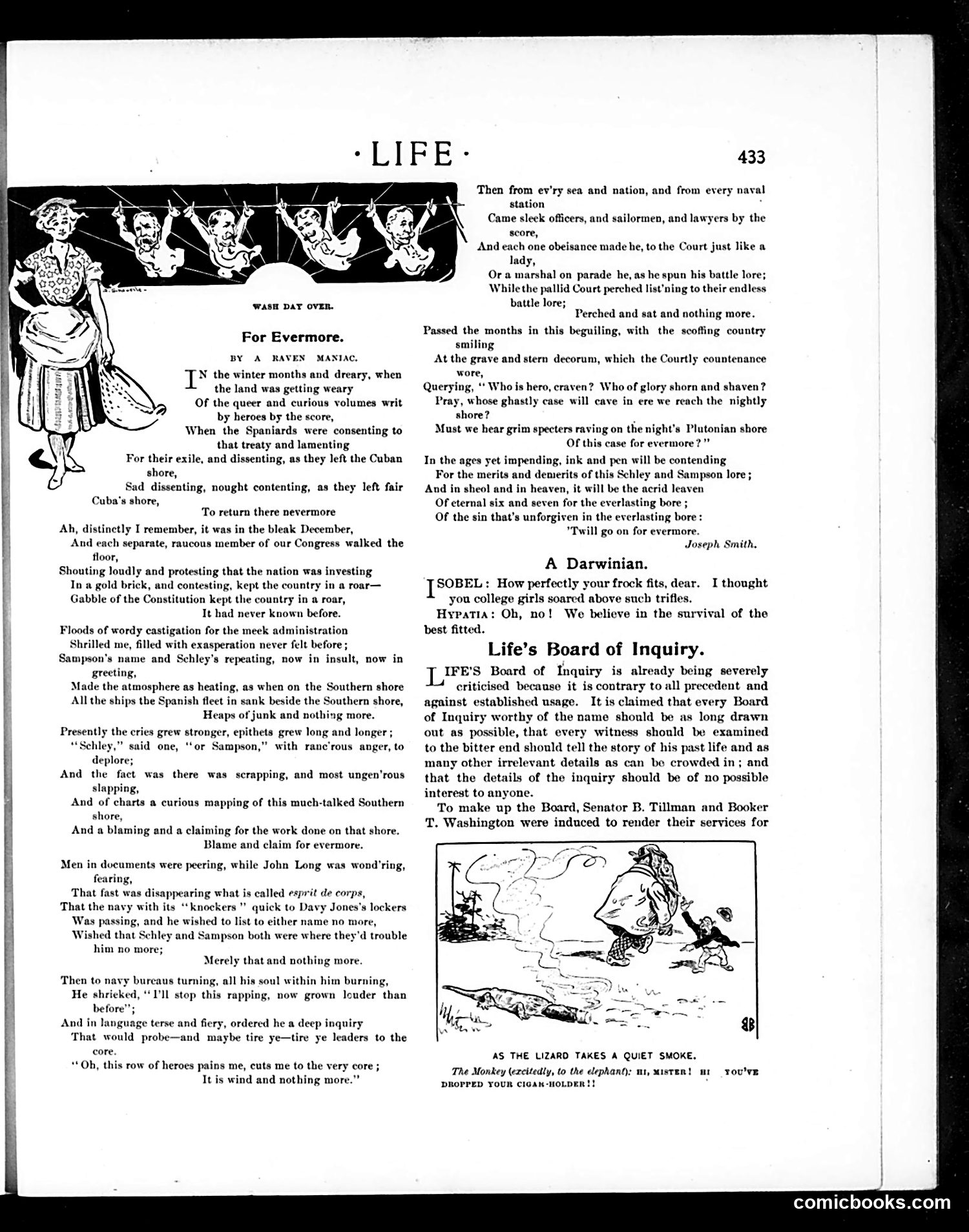
This page satirizes the heated public controversy over credit for the Spanish-American War's naval victory. The long poem "For Evermore" (parodying Poe's "The Raven") mocks the bitter dispute between Admiral William T. Sampson and Commodore Winfield Scott Schley over who deserved glory for defeating the Spanish fleet. The poem describes Congress angrily debating the matter, Navy Secretary John Long desperately ordering an official inquiry to end the infighting, and officers testifying before a court that sits examining evidence endlessly—"perched and sat and nothing more." The satire suggests the inquiry itself becomes an absurd spectacle, with the public mockingly watching the "scoffing country smiling" at the proceedings. The small cartoon below shows a lizard smoking, captioned with the monkey asking if it dropped its cigar holder—a completely unrelated joke about animal behavior.
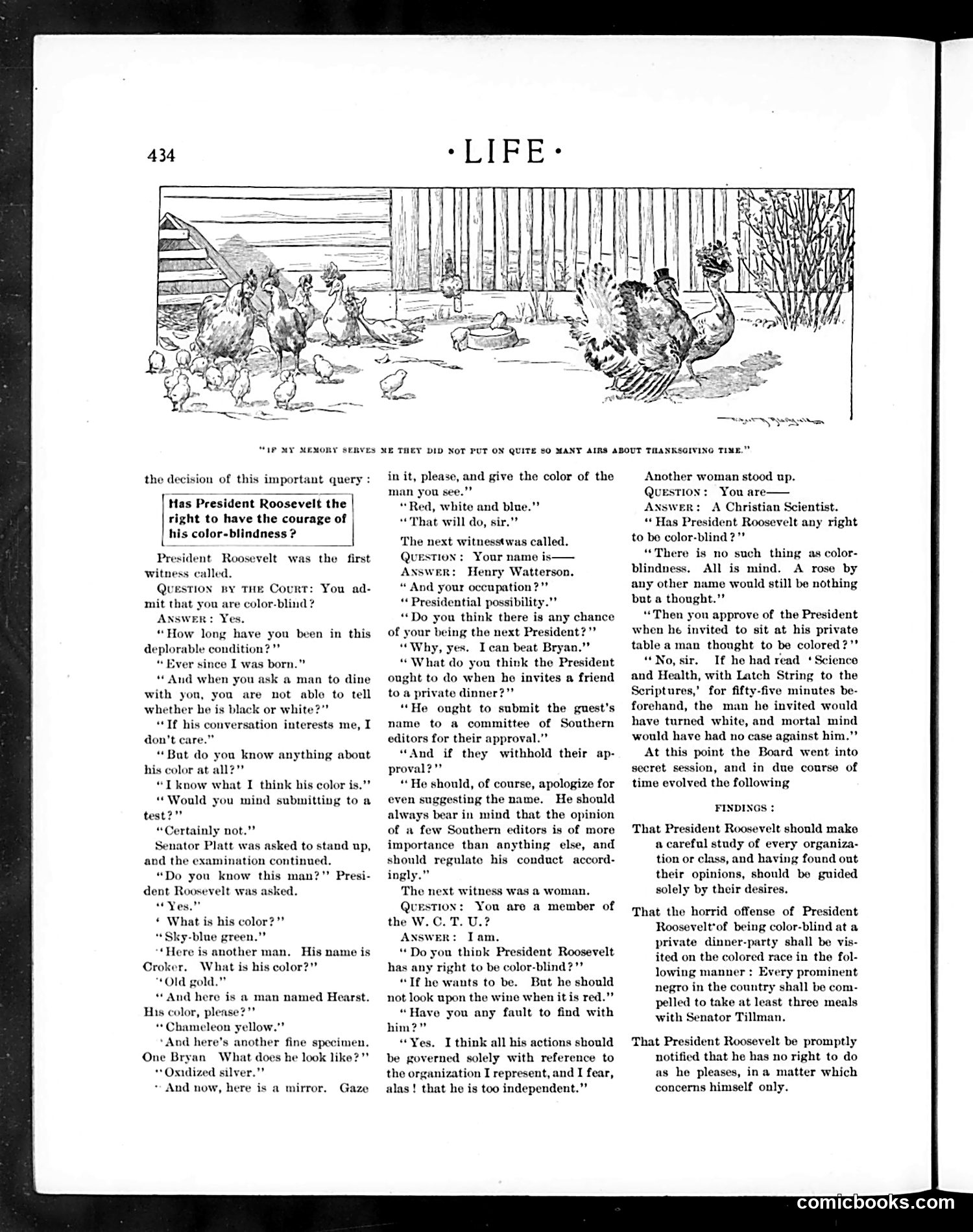
This satirical piece mocks the uproar over President Theodore Roosevelt's 1901 dinner with Booker T. Washington, an African American educator. The cartoon uses a mock trial format to ridicule both Roosevelt's critics and various pressure groups. Roosevelt is portrayed as genuinely "color-blind"—unable to see people's races. Witnesses include Henry Watterson (a Kentucky editor representing Southern political interests demanding deference), a W.C.T.U. woman (temperance activist), and a Christian Scientist, each shown as self-righteous and demanding the President prioritize *their* organization's concerns over principle. The satire's targets: Southern politicians (represented by Senator Tillman), religious/reform organizations, and anyone who believes the President should govern by consulting special interests rather than his conscience. The "findings" punish African Americans as retaliation—darkly satirizing how the controversy actually harmed Black Americans despite Roosevelt's gesture. The farmyard scene header suggests rural, unsophisticated moralizing about the dinner controversy.
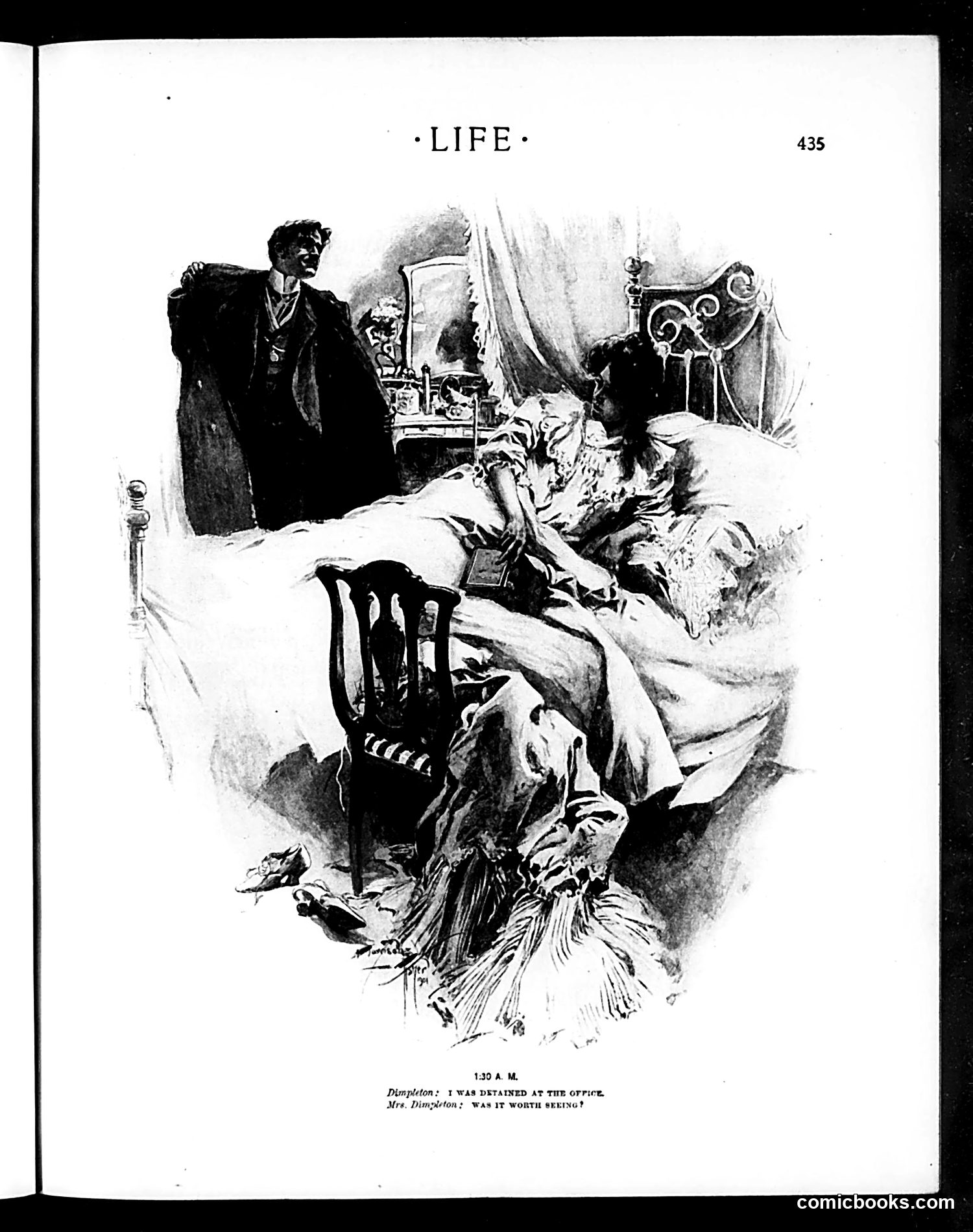
This is a single-panel cartoon depicting a domestic scene. A man (Dimpleton) arrives home late, explaining he was detained at the office. His wife responds with mild sarcasm: "Was it worth seeing?" The humor relies on a double meaning—the wife's question treats his office detention as if it were entertainment or a social outing worth attending, rather than work. This satirizes the common domestic excuse of working late, suggesting the wife is skeptical of her husband's explanation and implying he may have been elsewhere or exaggerating the importance of his office duties. The cartoon reflects early 20th-century gender dynamics and marital tension around work commitments and domestic life.
This page contains three satirical pieces typical of early 1900s American humor: **"The Amateur Chauffeur"** (poem, left column): Mocks the reckless driving behavior of early automobile enthusiasts—wealthy amateurs who drive dangerously fast, endangering pedestrians and animals. The satire questions why their families don't restrain them. This reflects contemporary anxiety about the new automobile technology and its dangers. **"The Old Mammy and Governor Taylor"** (anecdote, center): A dialect story about an enslaved woman pleading to free her husband from prison for stealing ham to feed his family. The humor relies on racist stereotypes and caricatured speech patterns common to the era. **"J. Pierpont Morgan's Interview"** (anecdote, right): Satirizes the famously private banker Morgan by describing how a *Times* journalist paid him £20 for a two-minute interview, getting Morgan to talk while the journalist stayed silent—mocking both Morgan's self-importance and his eventual satisfaction at being paid. The page is otherwise filled with period advertisements for whiskey, corsets, and other products.
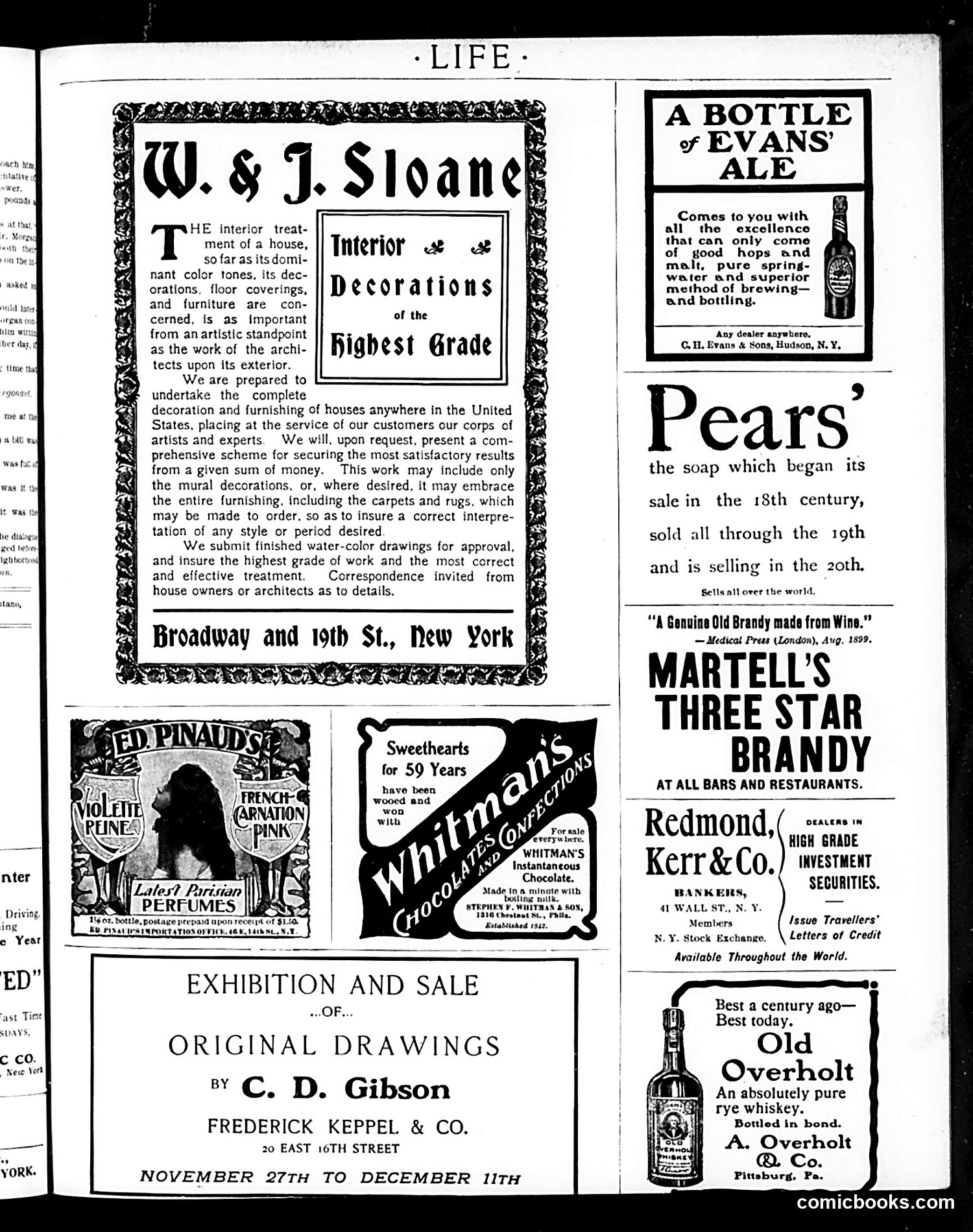
This is primarily an **advertising page** from Life magazine, not a political cartoon. The page showcases various luxury product advertisements typical of early 20th-century American consumer culture. **Notable advertisements include:** - **W. & J. Sloane**: Interior decoration services for high-end homes - **Pears' Soap**: Emphasizing its centuries-long market presence (18th-20th centuries) - **Martell's Brandy** and **Evans Ale**: Premium alcoholic beverages - **Whitman's Chocolates**: "Sweethearts for 59 Years" - **Old Overholt Whiskey**: Marketed as "absolutely pure" **At bottom:** An announcement for an exhibition of original drawings by **C. D. Gibson** (a famous Life illustrator) at Frederick Keppel & Co., November 27–December 11th. The page reflects turn-of-the-century marketing strategies emphasizing **tradition, purity, and refinement** to appeal to affluent readers. There is **no political satire or cartoon content** on this page—it functions as a commercial vehicle showcasing upscale products.
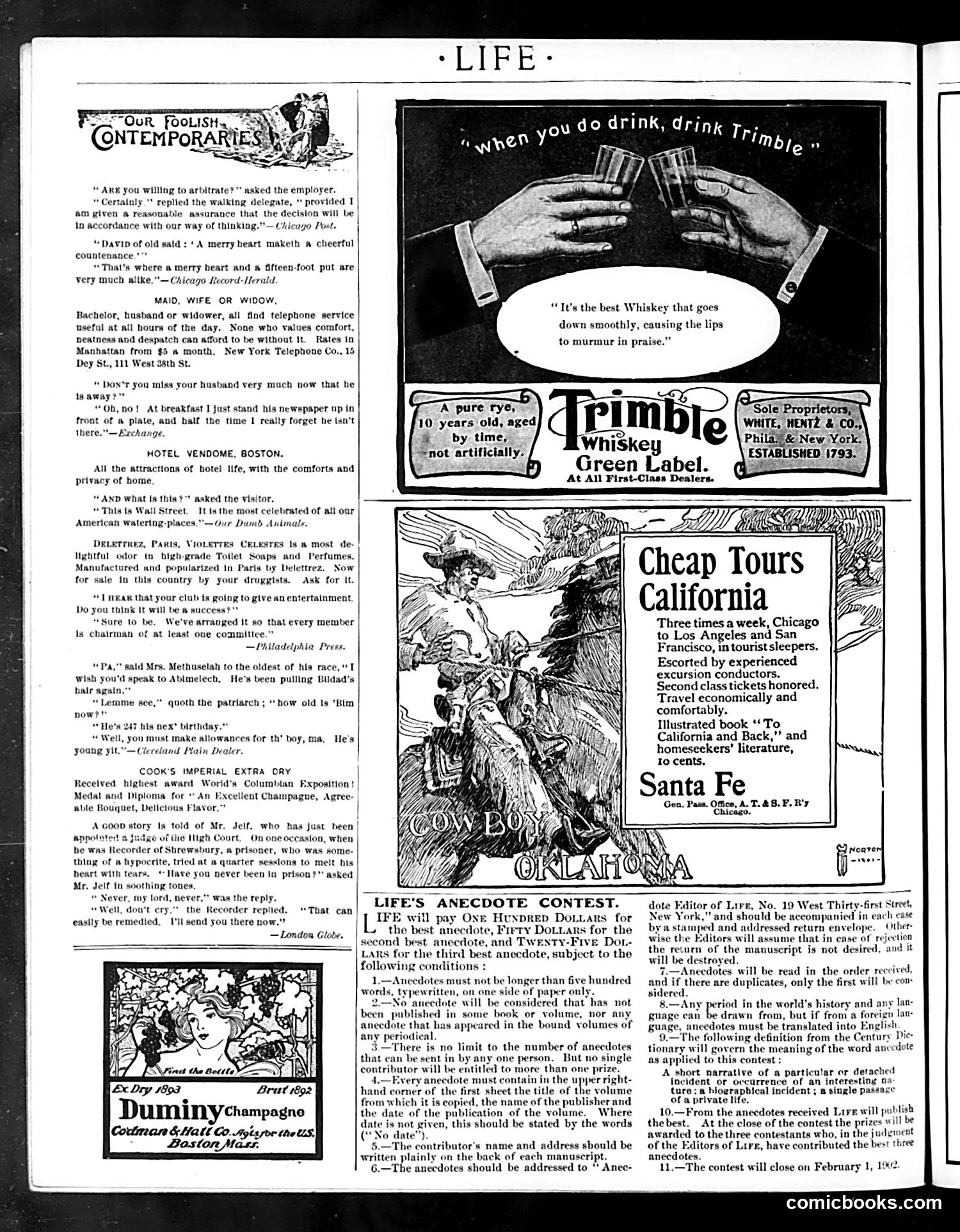
This page from *Life* magazine combines satirical commentary with period advertising. The "Our Foolish Contemporaries" section mocks labor disputes through a joke about union arbitration—a walking delegate agrees to arbitration only if the outcome matches what unions already want, satirizing the futility of compromise negotiations during the labor tensions of the era. Other humorous anecdotes target everyday absurdities: a wife forgetting her absent husband because a newspaper suffices as company; a judge threatening to send a prisoner to jail for the first time if he doesn't stop crying; and elderly biblical figures making parenting allowances for a 247-year-old child. The advertisements—Trimble Whiskey, California tours, and champagne—reflect Gilded Age consumer culture. The page concludes with *Life*'s anecdote contest, inviting reader submissions for publication, typical of magazines' engagement strategies of the period.
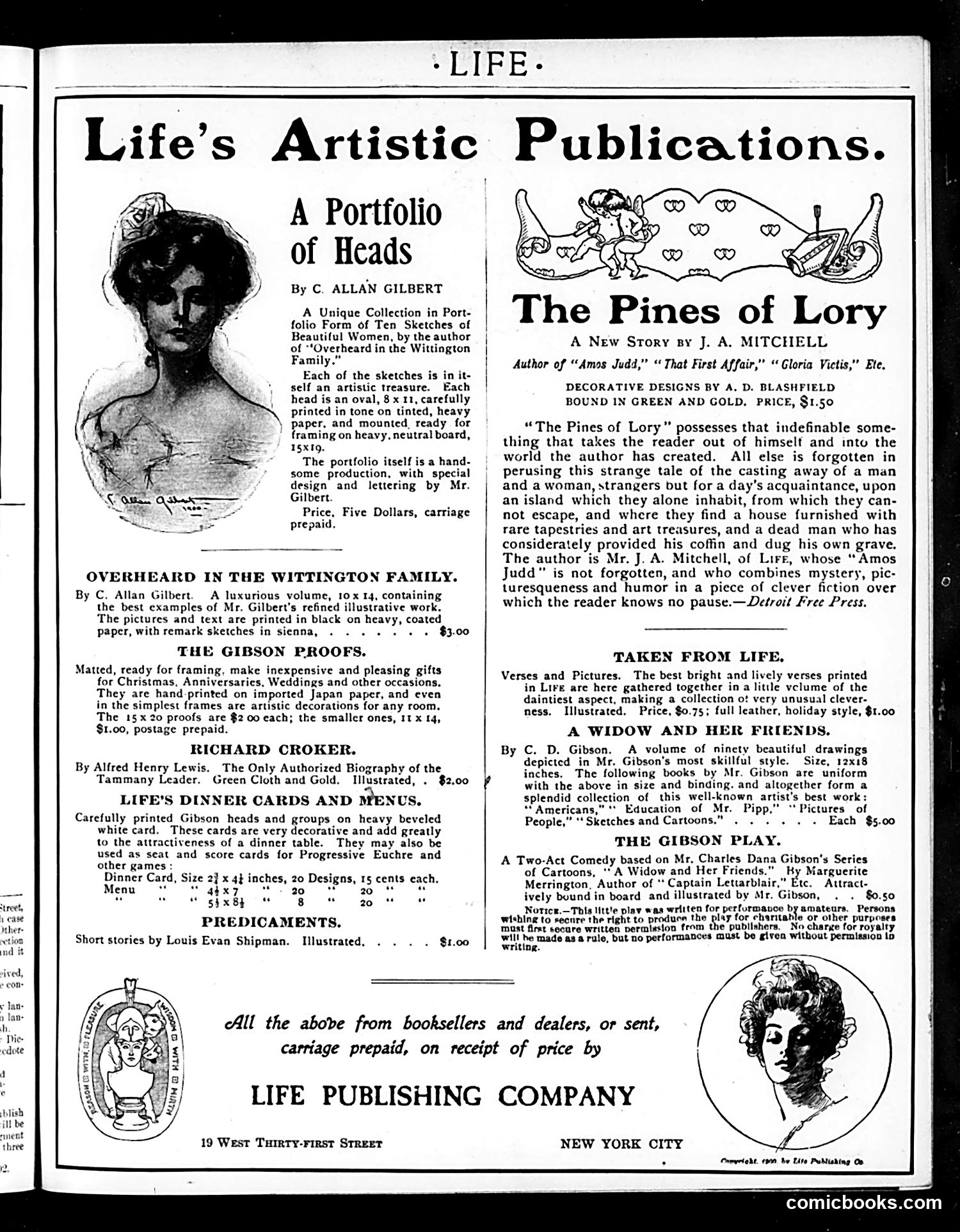
This is primarily an **advertising page** for Life Publishing Company's artistic publications, not a political cartoon. The page showcases books and prints by prominent illustrators of the era, particularly **C. Allan Gilbert** and **Charles Dana Gibson** (whose sketched female portraits appear in oval frames). Notable advertised items include: - **"Richard Croker" biography** by Alfred Henry Lewis—a reference to the infamous **Tammany Hall boss**, suggesting Life's satirical engagement with contemporary New York politics - **Gibson's illustrations and prints**, which were extremely popular decorative items for middle-class homes - **"The Pines of Lory"** by J.A. Mitchell, a serialized story The page reflects early 1900s publishing culture: original artwork sold as portfolios, matted prints as affordable gifts, and illustrated books as luxury items. The Tammany Hall reference hints at Life's editorial focus on urban political corruption, but the page itself is primarily commercial rather than satirical.
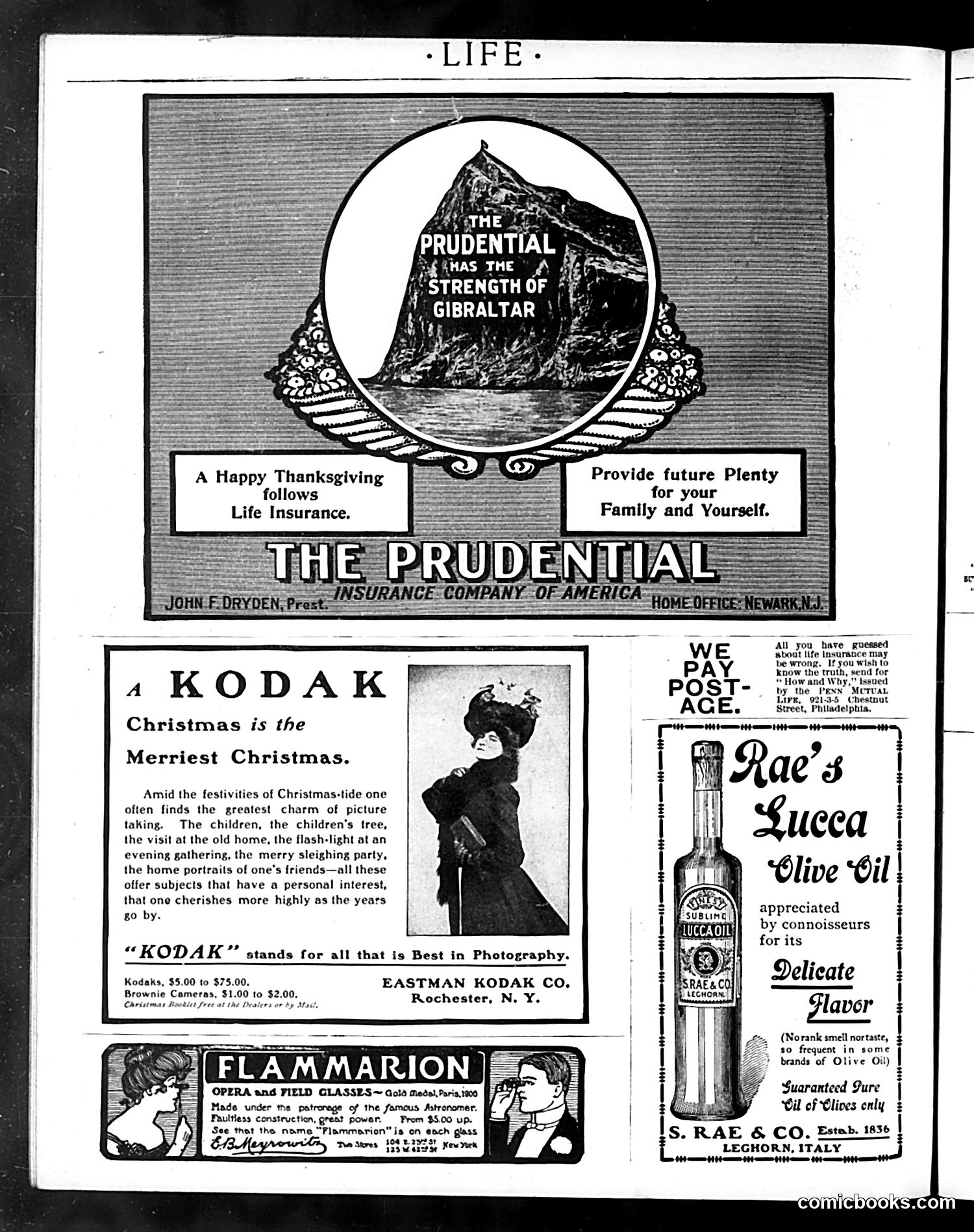
This page consists primarily of **advertisements**, not political satire or comics requiring historical context. The top ad for **Prudential Insurance** uses the Rock of Gibraltar as a metaphor for financial strength and security—a conventional corporate image of the era. The Thanksgiving message aims to encourage life insurance purchases as family protection. The remaining ads are standard commercial promotions: **Kodak cameras** (positioning photography as a sentimental family activity, especially during holidays), **Rae's Lucca Olive Oil** (marketed as a delicate Italian import for discriminating consumers), and **Flammarion opera glasses** (named after a famous astronomer, sold as precision instruments). These advertisements reflect early 20th-century consumer culture and marketing appeals to middle-class readers—emphasizing family values, technological progress, and imported luxury goods. There is no significant political or social satire present on this page.
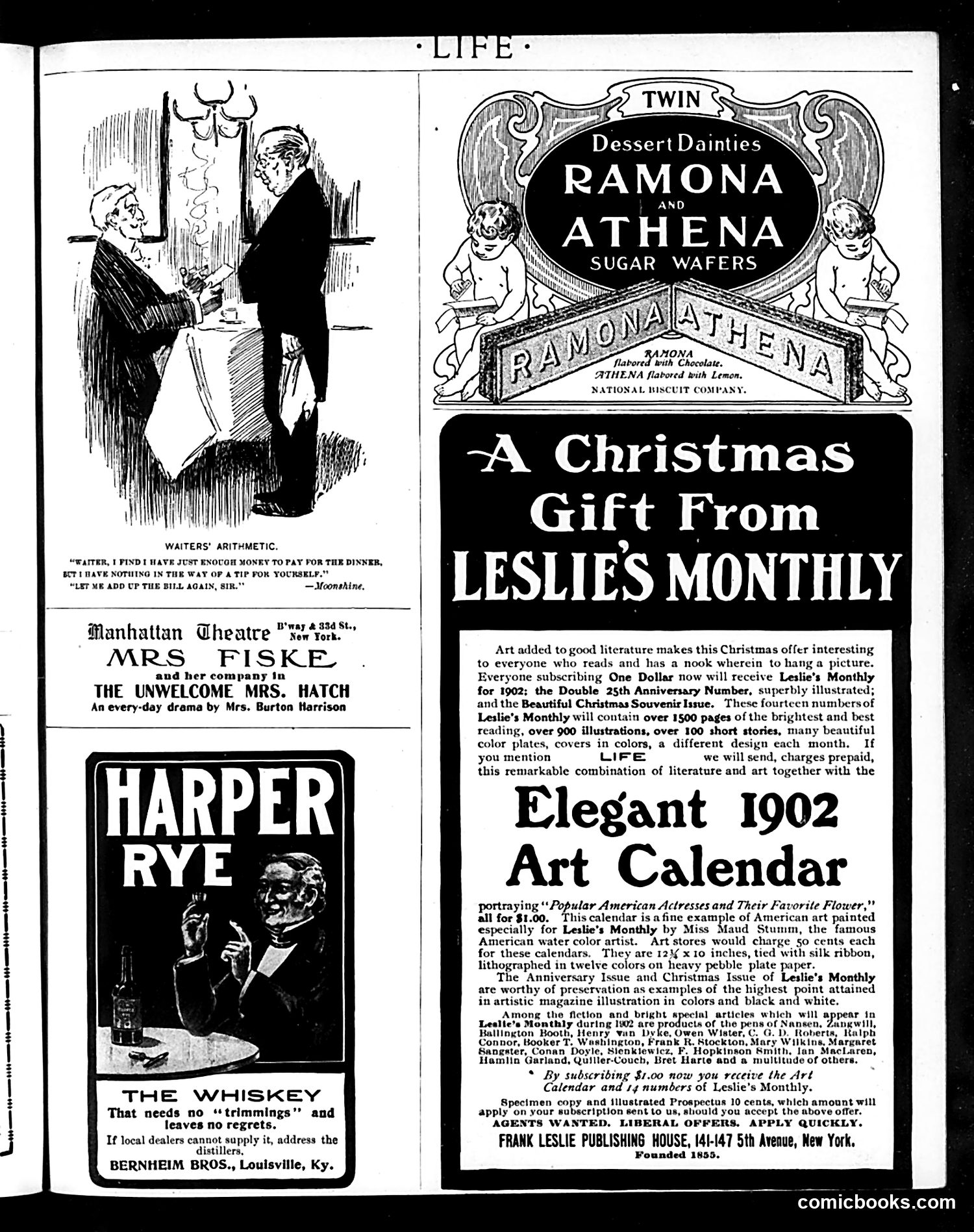
**The Main Cartoon ("Waiters' Arithmetic"):** A diner tells a waiter he has exactly enough money for dinner but nothing for a tip. The waiter responds by offering to "add up the bill again"—a satirical joke about restaurant math. The implication is that waiters would deliberately miscalculate bills upward to secure tips from customers who claimed poverty. This reflects the early 1900s practice of tip manipulation and the economic vulnerability of service workers dependent on gratuities. **Page Content:** The page is primarily advertising, featuring: - Product ads (Ramona and Athena sugar wafers, Harper Rye whiskey) - Theater promotion (Mrs. Fiske in "The Unwelcome Mrs. Hatch") - A major Leslie's Monthly magazine subscription offer promising art, literature, and a calendar of "Popular American Actresses" The satire captures a specific moment when tipping customs were still developing and workers used informal accounting tactics to supplement inadequate wages.
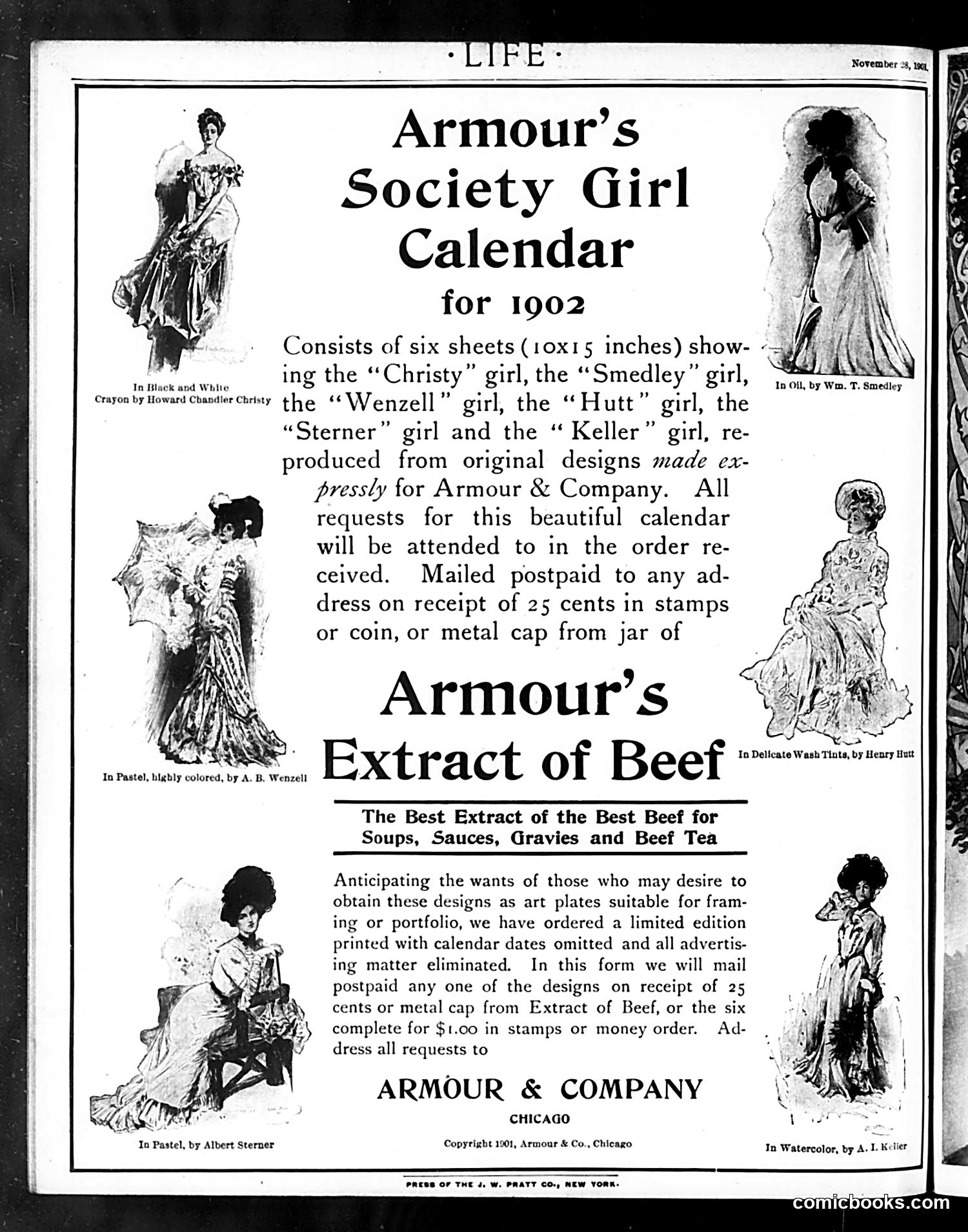
This is primarily an advertisement, not a satirical cartoon. The page promotes Armour & Company's 1902 calendar featuring six illustrated "Society Girl" designs by notable illustrators (Christy, Smedley, Wenzel, Hutt, Sterner, and Keller—all actual artists of the era). The images show fashionably dressed women in Edwardian attire. The company positioned these decorative calendar sheets as collectible art suitable for framing, available for 25 cents or a metal cap from their Extract of Beef jars. This was a common early-20th-century marketing strategy: attaching prestige and collectibility to product packaging to encourage purchases. The "Society Girl" theme capitalized on popular cultural interest in fashionable urban women. The lower section offers plain versions without calendar dates or advertising for collectors.