
Life, 1901-11-28 · page 9 of 22
Life — November 28, 1901 — page 9: what you’re looking at
What you’re looking at
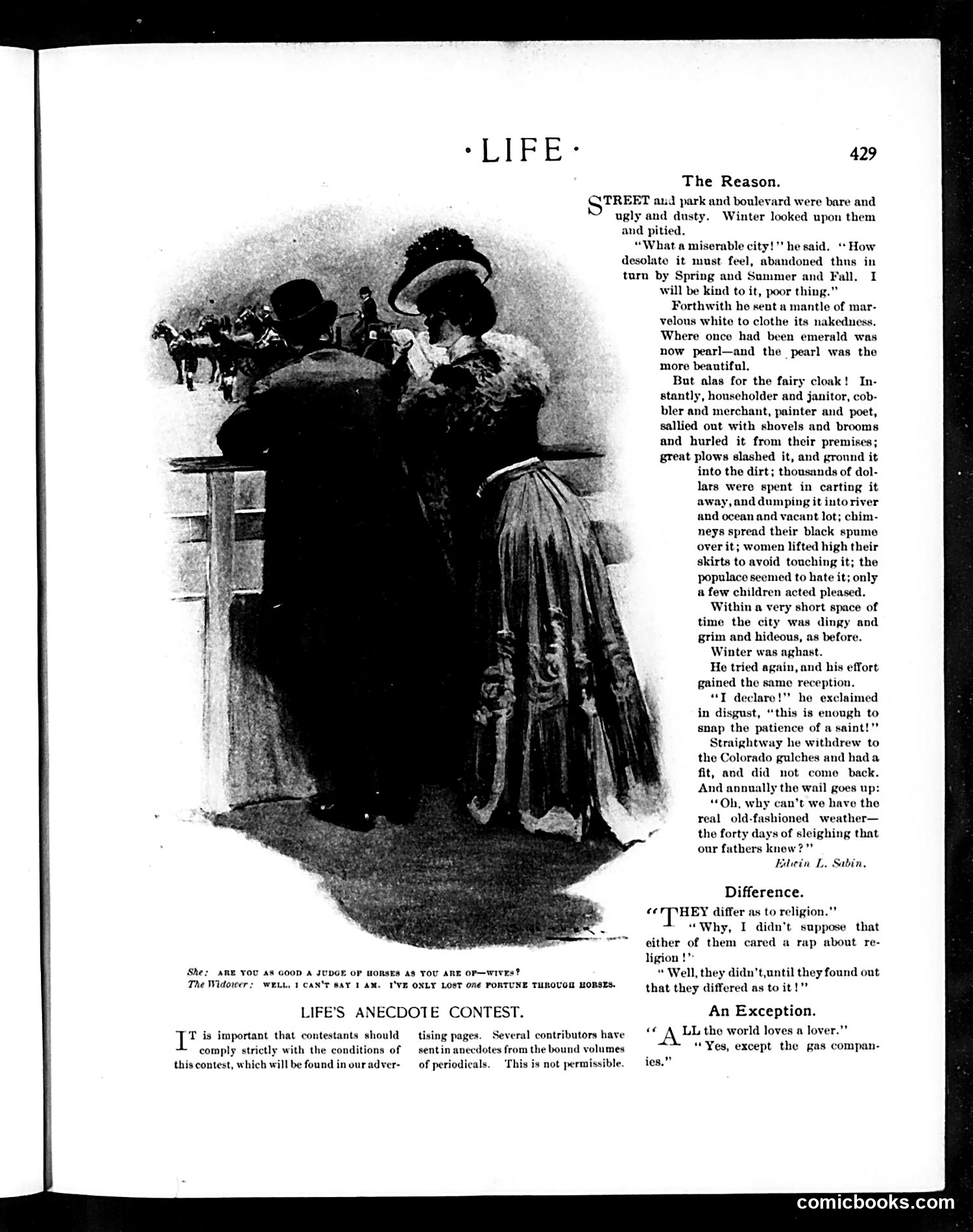
The main illustration depicts two figures in winter clothing (one in a large fur cloak, the other in a long skirt) observing a snow-covered street. The caption reads: "She: ARE YOU AS GOOD A JUDGE OF HORSES AS YOU ARE OF—WIFE? The Widower: WELL, I CAN'T SAY I AM. I'VE ONLY LOST ONE FORTUNE THROUGH HORSES." This is a widow/widower joke playing on marital misfortune. The widower's self-deprecating response suggests his late wife cost him financially—comparing spousal expense to horse-breeding losses, a common wealthy man's problem. The humor relies on period assumptions about marriage being economically risky for men and women as financial burdens. Below are three brief anecdotes ("The Reason," "Difference," "An Exception") offering short satirical observations about winter, religion, and romance—typical Life magazine filler humor.
📄 Transcribed text from this page (OCR, searchable)
Machine-transcribed from the original scan — historical spelling and the odd misread are preserved.
429 The Reason. STREET and park and boulevard were bare and ugly and dusty. Winter looked upon them and pitied. “What a miserable city!” he said. “ How desolate it must feel, abandoned thus in turn by Spring and Summer and Fall. I She: ARe YOU AS GOOD A JUDGE OP HORSES As YOU ARE OP—wivEs? The Widower: weit, 1 CAN'T SAY 1 AM. I'VE ONLY LOST oné PORTUNE TUROUGH MORSES. LIFE'S ANECDOTE CONTEST. is important that contestants should comply strictly with the conditions of tising pages. Several contributors have sentin anecdotes from the bound volumes of periodicals. ‘This is not permissible. J this contest, which will be found in our adver- will be kind to it, poor thing.” Forthwith he sent a mantle of mar- velous white to clothe its nakedness. Where once had been emerald was now pearl—and the pearl was the more beautiful. But alas for the fairy cloak! In- stantly, houscholder and janitor, cob- bler and merchant, painter and poet, sallied out with shovels and brooms and hurled it from their premises; great plows slashed it, and ground it into the dirt; thousands of dol- lars were spent in carting it away, and dumping it into river and ocean and vacant lot; chim- neys spread their black spume over it; women lifted high their skirts to avoid touching it; the populace seemed to hate it; only a few children acted pleased. Within a very short space of time the city was dingy and grim and hideous, as before. Winter was aghast. He tried again, and his effort gained the same reception. “T declare!” he exclaimed in disgust, “this is enough to snap the patience of a saint!” Straightway he withdrew to the Colorado gulches and hada fit, and did not come back. And annually the wail goes up: “Oh, w! an’t we have the real old-fashioned weather— the forty days of sleighing that our fathers knew?” Edwin L, Sabin, Difference. «eT HEY differ as to religion.”” “Why, I didn’t suppose that either of them cared a rap about re- ligion !”- “ Well, they didn’t,until they found out that they differed as to it!” An Exception. LL the world loves a lover." “Yes, except the gas compan- ies.” comicbooks.com