
Life, 1901-11-28 · page 12 of 22
Life — November 28, 1901 — page 12: what you’re looking at
What you’re looking at
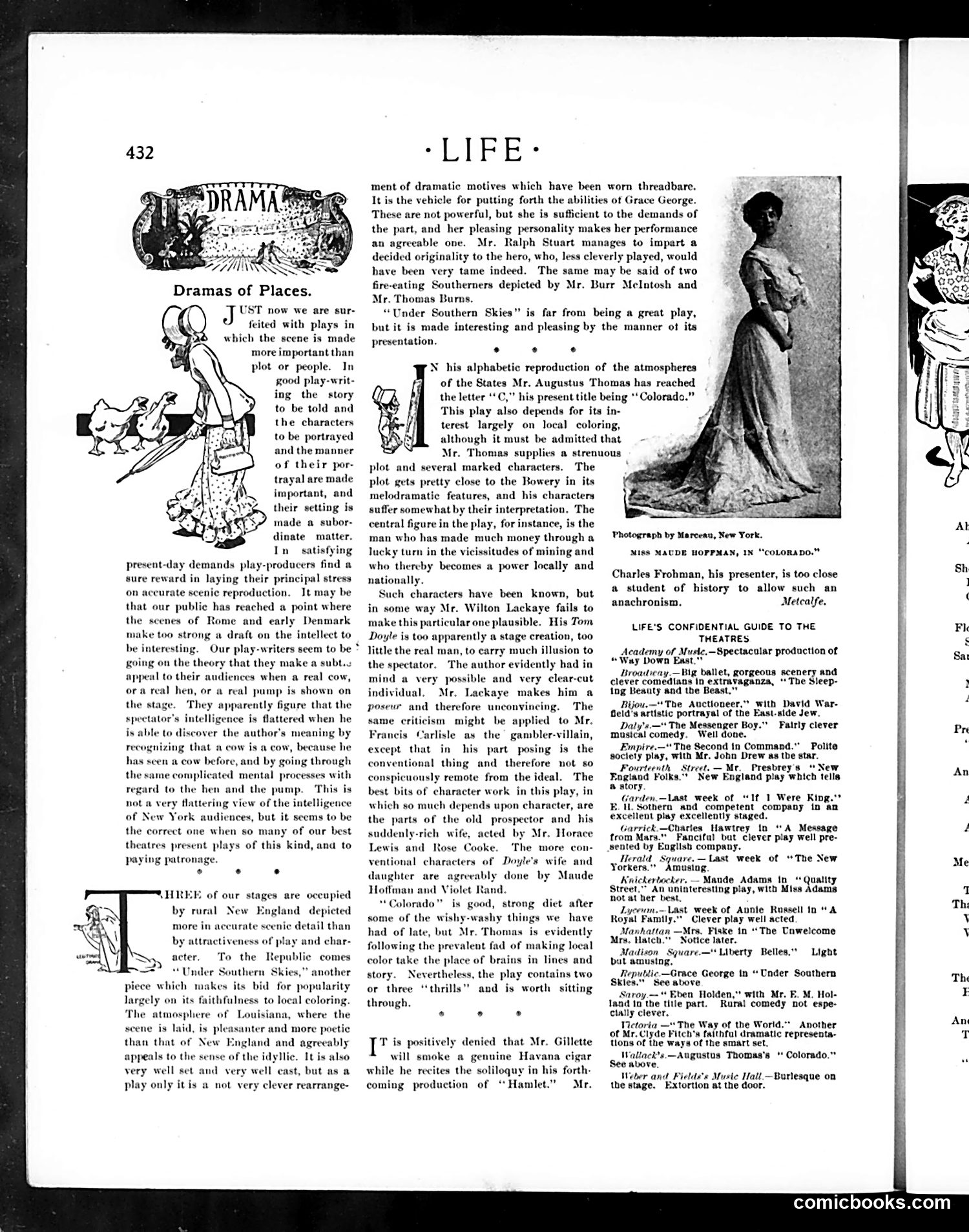
This is a theater review column discussing how **setting matters as much as plot and characters** in stage productions. The author argues that accurate scenic reproduction—depicting authentic locations like Rome, Denmark, Louisiana, or the American South—appeals to audiences and enhances performances. The illustrated vignettes show theatrical scenes and characters in costume, emphasizing the **importance of detailed set design** to theatrical success. The column reviews several contemporary plays including "Under Southern Skies," "Colorado," and references actors like Ralph Stuart and Augustus Thomas. It critiques some productions as unconvincing while praising others for atmospheric authenticity. This reflects early 20th-century theater criticism valuing **realistic scenography** as central to dramatic art.
📄 Transcribed text from this page (OCR, searchable)
Machine-transcribed from the original scan — historical spelling and the odd misread are preserved.
UST now we are sur- © feited with plays in which the scene is made more important than plot or people. In good play-writ- ing the story to be told and the characters to be portrayed and the manner of their po trayal are made important, and their setting is made a subor- dinate matte: In satisfying present-day demands play-producers find a sure reward in laying their principal stress on aceurate scenic reproduction. It may be that our public has reached a point where the scenes of Rome and early Denmark make too strong a draft on the intellect to be interesting. Our play-writers seem to be * ving on the theory that they make a subt.s appeal to their audiences when a real cow, ora real hen, of a real pump is shown on the stage. They apparently figure that the spectator’s intelligence is flattered when he is able to di the author's meaning by cove recognizing that a cow is a cow, because he has scen a cow before, and by going through the same complicated mental processes with regard to the hen and the pump. This is ot a very tering view of the intelligence of New York audiences, but it seems to be the correct one when so many of our best theatres pres s of this kind, ana to pay 1g patros . . KHUREE of our stages are occupied by rural New England depi more in accurate scenic detail th ted tractiveness of play and char- To the Republic comes er Southern Skies, other piece which makes its bid for popular largely on its faithfulness to local coloring. ‘The atmosphere of Louisiana, where the , is pleasanter and more p than that of New England and agreeably appeals to the sense of the idyllic. It is also very well set and very well east, but as a play only itis a not very clever rearrange- scene is “LUPE * ment of dramatic motives which have been worn threadbare. It is the vehicle for putting forth the « These are not powerful, but she is suff an agri Mr. Thomas Burns. “Under Southern Skies” is far from being a great play, but it is made interesting and pleasing by the manner ot its presentation. . ° e the letter ‘ plot and several marked characters. The plot gets pretty close to the Bowery in its melodramatic features, and his characters suffer somewhat by their interpretation. The central figure in the play, for instance, is the man who has made much money through a lucky turn in the vicissitudes of mining and who thereby becomes a power locally and nationally. ch characters have been known, but in some way Mr. Wilton Lackaye fails to e this particular one plausible. His Tom Doyle is too apparently a stage creation, too little the real man, to carry much illusion to the spectator. The author evidently had in mind a very possible and very clear-cut individual. Mr. Lackaye kes him a poseuwr and therefore unconvincing. The same criticism might be applied to Mr. Francis Carlisle as the gambler-villain, t that in his part posing is the conventional thing and therefore not so conspicuously remote from the ideal. ‘The best bits of character work in this play, in which so much depends upon character, are the parts of the old prospector and his suddenly-rich wife, acted by Mr. Horace Le and Rose C The more con- ventional characters of Doyle's wife and daughter are agreeably done by Maude Hotlman and Violet Rand. “Colorado” is good, strong some of the wishy-washy things w had of late, but Mr. Thomas is e following the prevalent fad of making local color take the place of brains in lines and story. Nevertheless, the play contains two or three “thrills” and is worth sitting through. . ° * T is positively denied that Mr. Gillette will smoke a genuine Havana cigar while he recites the soliloquy in his forth- coming production of “Hamlet.” Mr. nt to the demands of the part, and her pleasing personality makes ber performance able one. Mr. Ralph Stuart manages to impart a decided originality to the hero, who, less cleverly played, would have been very tame indeed. The same may be said of two fire-eating Southerners depicted by Mr. Burr Melntosh and N his alphabetic reproduction of the atmospheres of the States Mr. Augustus Thomas has reached his present title being “Colorado.” This play also depends for its in- terest largely on local coloring, although it must be admitted that Mr. Thomas supplies a strenuous ot Grace George. Photograph by Marceau, New York. MISS MAUDE HOFPMAN, IN “COLORADO.” Charles Frohman, his presenter, is too close a student of history to allow such an anachronism. Metcalfe. LIFE'S CONFIDENTIAL GUIDE TO THE THEATRES Academy of Muste.—Spectacalar production of Way Down East."* Broadticay.— Big ballet, gorgeous scenery and clever comedians tn extravaganza, “The Sleep- ing Beauty and the Beast.” Bijou.—"The Auctioneer,” with David War- fleld’s artistic portrayal of the East-side Jew. Daly's—" The Messenger Boy." Fairly clever musical comedy. Well done. Empire.—“ The Second tn Command.” Polite society play, with Mr. John Drew as the star. Fourteenth Street. — Mr. Presbrey's. “New Fogiand Folks." New England play which tells story. Garden.—Last week of “If 1 Were King." E. IL, Sothern and competent company in an excellent play excellently staged. Garrick —Charies Hawtrey in “A Message from Mars." Fancifal bat clever piay well pre- sented by English company. Herald, Square. —Last week ot “The New Yorkers.” Amusing. Knickertocker, — Mande Adama tn“ Qualtty Street,” An uninteresting play, with Miss Adams not at her best, Lycenm.— Last week of Annie Russell in “A Royal Family." Clever play well acted. Manhattan —Mrs. Fiske in “The Unwelcome Mrs, Hatch.” Notice later. Madison Square—" Liverty Belles.” Light bat amusing, Republic—Grace George in “Under Southern Skies." See above Saroy—“ Eben Holden," with Mr. E. M. Hol- land 10 the title part. Rural comedy not espe- ctally clever, Tictoria —"The Way of the World." Another of Mr. Clyde Fitch's faithful dramatic representa- tons of the ways of the smart set. Wattack's.—Augustus Thomas's ‘ Colorado.” ‘See above. Weber and Fields's Music Hall —Burlesque on the stage. Extortion at the door. | i comicbooks.com The An T