
Life, 1901-11-28 · page 14 of 22
Life — November 28, 1901 — page 14: what you’re looking at
What you’re looking at
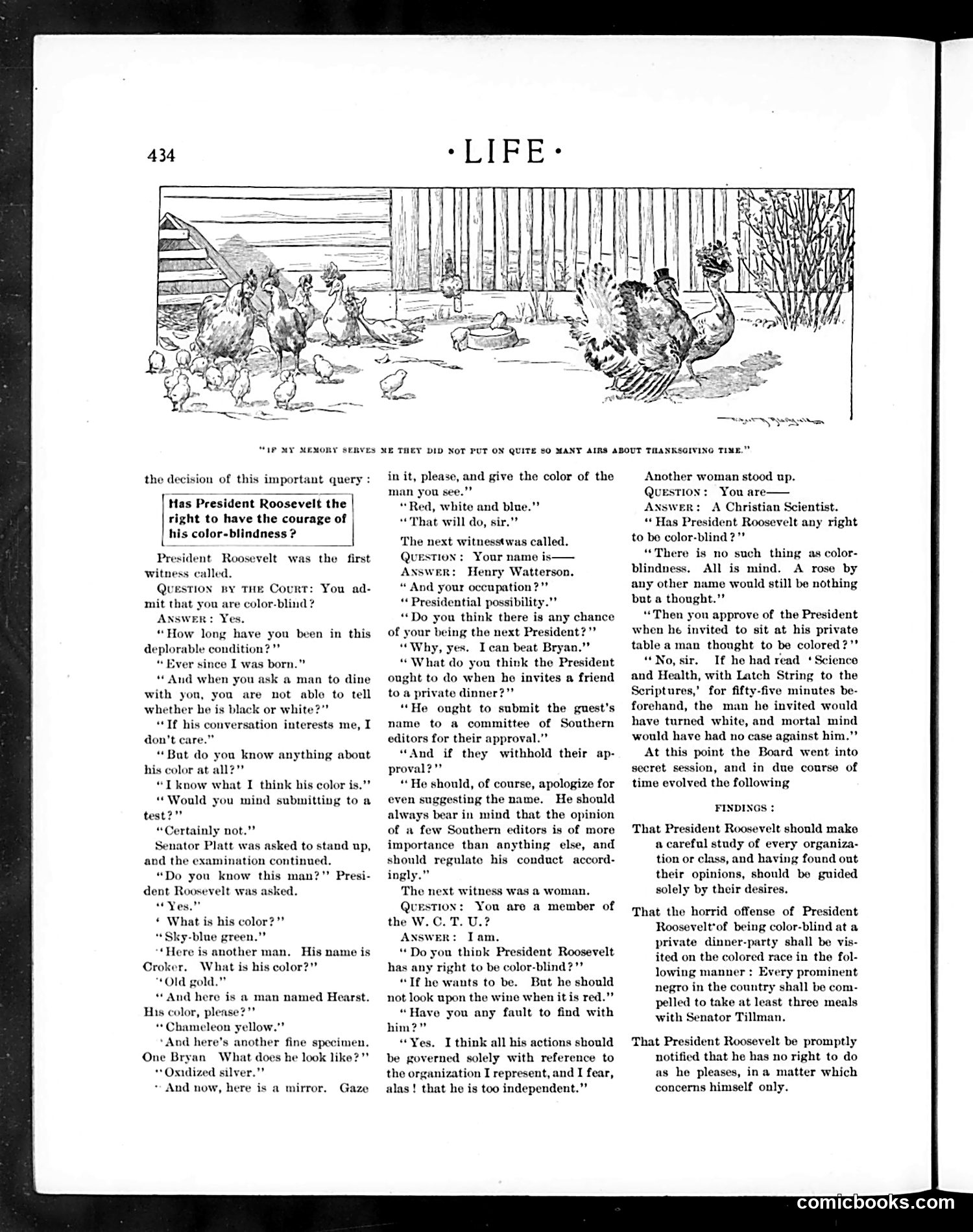
This satirical piece mocks the uproar over President Theodore Roosevelt's 1901 dinner with Booker T. Washington, an African American educator. The cartoon uses a mock trial format to ridicule both Roosevelt's critics and various pressure groups. Roosevelt is portrayed as genuinely "color-blind"—unable to see people's races. Witnesses include Henry Watterson (a Kentucky editor representing Southern political interests demanding deference), a W.C.T.U. woman (temperance activist), and a Christian Scientist, each shown as self-righteous and demanding the President prioritize *their* organization's concerns over principle. The satire's targets: Southern politicians (represented by Senator Tillman), religious/reform organizations, and anyone who believes the President should govern by consulting special interests rather than his conscience. The "findings" punish African Americans as retaliation—darkly satirizing how the controversy actually harmed Black Americans despite Roosevelt's gesture. The farmyard scene header suggests rural, unsophisticated moralizing about the dinner controversy.
📄 Transcribed text from this page (OCR, searchable)
Machine-transcribed from the original scan — historical spelling and the odd misread are preserved.
een “AP MY MEMORY SERVES NE THEY DID NOT PUT ON QUITE 80 MANY AIRS ABOUT TIANKSGIVING TIME.” the decision of this important query : Has President Roosevelt the | right to have the courage of his color-blindness ? | ! President Roosevelt was the first witness called. Question BY THE Court: You ad- mit that you are color-blind ? Answer: Yes. “How long have you been in this deplorable condition?" ver since I was born.” “And when you ask a man to dine with yon, you are not able to tell whether he is black or white?” “If his conversation interests me, I don't care.” “But do you know anything about his color at all?” “Tknow what I think his color is.” “Would you mind submitting to a test?" “Certainly not.”” Senator Platt was asked to stand up, and the examination continued. “Do you know this man?’ Presi- dent Roosevelt was asked. “Yes.” * What is his color?’’ “Sky-blue green.” ‘Here is another man. His name is Croker. What is his color?” “Old gold * And here His color, ple: «Chameleon yellow.” ‘And here’s another fine specimen. One Bryan What does he look like?’ “Oxidized silver.”” ~ And now, here is a mirror. 2 man named Hearst. Gaze in it, please, and give the color of the man you see.’” “Red, white and blue.”” “That will do, sir.” The next witnesstwas called. Qvestiey : Your name is: Answer: Henry Watterson. “ And your occupation?” «Presidential possibility.’’ “Do you think there is any chance of your being the next President?”’ “Why, yes. Ican beat Bryan.’”” “What do you think the President ought to do when he invites a friend to a private dinner?” “He ought to submit the guest’s name to a committee of Southern editors for their approval.” “And if they withhold their ap- proval?" “He should, of course, apologize for even suggesting the name. He should always bear in mind that the opinion of a few Southern editors is of more importance than anything else, and should regulate his conduct accord- ingly.” The next witness was a woman. Question: You are a member of the W. C. T. U.? Ayswer: Tam, “Do you think President Roosevelt has any right to be color-blind?”” “If he wants to be. But he should not look upon the wine when it is red.”” “Have you any fault to find with him?” “Yes. I think all his actions should be governed solely with reference to the organization I represent, and I fear, alas ! that he is too independent.”” Another woman stood up. QuEsTIO: You are— A Christian Scientist. ident Roosevelt any right to be color-blind?”* “There is no such thing as color- blindness. All is mind. A rose by any other name would still be nothing but a thought.”” “Then you approve of the President when he invited to sit at his private table a man thought to be colored?’ “No, sir. If he had read ‘Science and Health, with Latch String to the Scriptures,’ for fifty-five minutes be- forehand, the man he invited would have turned white, and mortal mind would have had no case against him.” At this point the Board went into secret session, and in due course of time evolved the following FINDINGS : That President Roosevelt should make acareful study of every organiza- tion or class, and having found out their opinions, should be guided solely by their desires. That the horrid offense of President Roosevelt*of being color-blind at a private dinner-party shall be vis- ited on the colored race in the fol- lowing manner : Every prominent negro in the country shall be com- pelled to take at least three meals with Senator Tillman, That President Roosevelt be promptly notified that he has no right to do as he pleases, ina matter which concerns himself only. comicbooks.com